


The whole CDP vs CRM conversation has moved past a simple "which one is better?" debate. Now, it's all about strategic synergy—figuring out how these two powerful systems can work together to drive real business results. At a high level, a Customer Relationship Management (CRM) system is for managing direct interactions with known customers, making it the go-to tool for sales and service teams.
On the other hand, a Customer Data Platform (CDP) is built to unify both anonymous and known data from every single touchpoint. This creates that elusive complete customer view that marketers have been chasing for years.
CDP vs CRM Understanding The Core Distinction
To really get the difference, think about comprehensive business suites that offer integrated CRM and ERP apps. These platforms show the CRM in its natural habitat: as an operational tool for direct customer engagement. It’s the system of record for sales pipelines, contact histories, and service tickets—the things your customer-facing teams live in every day.
A CDP, in contrast, is the engine that helps marketers understand the entire customer journey, long before a person becomes a known lead. A platform like Sitecore CDP is designed to pull in and stitch together data from everywhere, online or off. This can include:
- Anonymous clicks on your Sitecore or SharePoint-powered website
- Activity within your mobile app
- Interactions with email campaigns
- Point-of-sale transactions in a physical store
- Even signals from IoT devices
This process of data unification creates a persistent, single customer view. While a CRM knows a customer's transactional history, a CDP reveals the behavior and intent that led to those transactions. This is absolutely critical for any company using a Digital Experience Platform (DXP) like Sitecore. The CDP is what connects anonymous user behavior to a known customer profile, providing the fuel for the AI-driven personalization that powers a modern customer experience.

CDP vs CRM Key Differences at a Glance
While both platforms handle customer data, their core functions, primary users, and the types of data they focus on are fundamentally different. This table breaks down their distinct roles in a company’s tech stack.
For a deeper dive into how CDPs function, you might find our guide on 360 Analytics and Customer Data Platforms helpful.
| Attribute | Customer Data Platform (CDP) | Customer Relationship Management (CRM) |
|---|---|---|
| Primary Purpose | Unify customer data from all sources to create a single customer view for marketing activation. | Manage direct interactions and relationships with known customers and leads. |
| Primary Users | Marketing and analytics teams focused on personalization, segmentation, and journey orchestration. | Sales, customer service, and support teams managing pipelines and support tickets. |
| Data Focus | Both anonymous (e.g., website behavior) and known (e.g., purchase history) customer data. | Primarily known customer data (e.g., name, email, phone number, contact history). |
| Data Sources | First-party, second-party, and third-party data from web, mobile, CRM, POS, and offline systems. | Data is primarily entered manually by teams or through direct integrations like web forms. |
| Key Function | Identity resolution, audience segmentation, and data activation across marketing channels. | Pipeline management, contact management, and interaction tracking. |
Ultimately, the roles are complementary. Both platforms are essential for a holistic customer strategy, but they solve different problems for different teams.
A CRM manages the relationship; a CDP understands the person. This fundamental difference is key to building a synergistic system where both platforms work together to drive business growth.
Data Architecture: The Foundation of Purpose
To really understand the difference between a CDP and a CRM, you have to look beyond the feature lists and get down to their data architecture. A CRM is almost always built on a relational database. It’s structured to manage known customer information and their transaction history with precision.
This schema is rigid on purpose. It’s optimized for the daily workflows of sales and service teams—things like logging calls, updating deal stages, and tracking support tickets.
A Customer Data Platform, like Sitecore CDP, is built differently because its job is different. It’s architected for unifying and activating data at a massive scale. It typically uses a flexible, non-relational data model that can ingest and harmonize huge volumes of structured and unstructured data in real time. This means it can capture every click, search, and interaction from sources like a Sitecore website or even an internal SharePoint portal.
The Power of a Flexible Data Model
This architectural flexibility is the CDP's superpower. A CRM is fantastic at managing relationships with contacts it already knows. A CDP, however, is built to understand the complete journey of an individual, whether they are an anonymous visitor or a long-time loyal customer.
The secret sauce here is a core CDP function called identity resolution. A platform like Sitecore CDP uses sophisticated algorithms to stitch together all those disparate data points. It connects a cookie ID from a web visit, an email address from a newsletter signup, and a customer ID from a purchase into one persistent, constantly evolving customer profile. This is the unified view that makes advanced personalization possible.
A CRM's architecture is built to manage a relationship with a known entity. A CDP's architecture is built to understand the person behind every interaction, known or anonymous, and activate that understanding across all channels.
The Shift Toward Connected Systems
This architectural divide is more important than ever. Businesses are finally hitting the limits of what they can do with data trapped in silos. The convergence of CDP and CRM is reshaping enterprise strategy, with experts agreeing that a CRM’s value now hinges on connected data and usable AI.
Many CRM programs stall out because the customer data is just too fragmented. This stops companies from delivering the seamless experiences that modern consumers expect. As the North American CRM market continues to mature, it's clear that traditional CRM functionality isn't enough on its own. You can find more on these evolving customer data trends on CXtoday.com.
This signals a fundamental shift. We're moving from seeing CDP and CRM as separate tools to understanding them as complementary parts of a unified customer intelligence strategy. The end goal of any good data architecture is to generate actionable data-driven customer insights.
By integrating these systems, you create a powerful feedback loop. The CDP enriches the CRM with rich behavioral context, and the CRM feeds the CDP valuable outcome data from sales and service interactions. You can learn more by exploring these customer data integration solutions. This integrated approach turns a standard CRM from a simple system of record into a dynamic system of engagement, all powered by the comprehensive intelligence of a CDP.
The Power of Integration With Sitecore CDP And Your DXP
For any business running a Digital Experience Platform (DXP) like Sitecore, the conversation shouldn't be about choosing a CDP or a CRM. The real win comes from making them work together, with the DXP at the center. Modern composable architectures are built on unified data, and that’s where Sitecore CDP shines.
Sitecore CDP becomes the intelligent data hub, pulling in behavioral signals from your websites, mobile apps, and every other touchpoint. It stitches together a persistent profile for every single user, whether they’re anonymous visitors or known customers. Sitecore's personalization engine then uses that rich profile to serve up the right content and offers in real time.
The screenshot below from Sitecore's homepage shows exactly how the platform positions itself as the core of these connected digital experiences.
This visual really drives home the idea of a complete customer journey, from initial awareness all the way to advocacy. It’s a goal that a tightly integrated CDP and DXP can actually deliver on—a far broader scope than a CRM's primary focus on managing sales relationships.
Creating A Virtuous Data Cycle
Adding your CRM to this DXP and CDP setup completes the picture. The CRM feeds essential sales and service history back into Sitecore CDP, enriching customer profiles. In return, the CDP sends highly qualified, behaviorally-scored leads to the CRM. This creates a powerful, self-reinforcing loop of data intelligence.
This cycle flows through four distinct stages:
- Capture: Your DXP (e.g., Sitecore) and other systems capture rich behavioral data from every interaction.
- Unify: Sitecore CDP ingests this data, resolves identities, and builds that crucial single customer view.
- Activate: Sitecore’s AI-driven personalization uses the unified profile to deliver relevant, timely experiences on the DXP.
- Enrich: Engagement data and qualified leads are passed to the CRM, which then sends sales and service outcomes back to the CDP.
This integrated approach builds a connected customer intelligence engine. It finally gets marketing and sales teams working from the same playbook, maximizing the return on your entire tech stack. The CDP vs. CRM debate becomes irrelevant; the real question is how to best combine their strengths.
The goal is a single customer intelligence engine. Think of the DXP as the experience layer, the CDP as the brain, and the CRM as the system for human-led engagement—all working in perfect harmony.
The Role Of SharePoint and Other Enterprise Systems
This integration model isn't limited to your public-facing Sitecore websites. Many large organizations rely on Microsoft SharePoint as a critical hub for employees or as a partner extranet.
Imagine a partner logs into your SharePoint portal to download technical documents. When that signal is fed into Sitecore CDP, it can trigger a personalized follow-up through your marketing channels or arm a sales rep with crucial context for their next conversation. This connection bridges the gap between internal collaboration tools and external marketing, adding yet another layer of intelligence. For companies already invested in the Sitecore ecosystem, this level of integration is a game-changer. Our overview of Sitecore solutions offers deeper insights into how these platforms are implemented.
By combining the power of a DXP like Sitecore, the intelligence of a CDP, and the relational data in a CRM, enterprises can finally tear down the silos that have held back true customer-centricity. This unified strategy is how you turn raw data into meaningful, profitable relationships.
When To Choose A CDP, A CRM, Or Both
Making the right tech investment starts with a simple question: what’s your biggest business challenge right now? The "CDP vs. CRM" debate isn't about which platform is better, but which one solves your most pressing problem.
If your teams are drowning in manual sales pipeline tracking and can't get a clear view of one-on-one customer interactions, a CRM is your foundation. It’s the essential tool for customer-facing teams to manage known contacts and streamline service delivery.
But if your goal is to truly understand the entire customer journey—from anonymous visitor to loyal advocate—you need a CDP. It’s the only way to unify fragmented data from countless channels and deliver the kind of personalization that modern customers expect. For most large enterprises, it's not a matter of choosing one; it’s about figuring out how to make them work together.
A Decision Framework For Your Enterprise
The real question isn't if you need both, but in what order and how they’ll connect. As experts in platforms like Sitecore, we always start by asking clients to be brutally honest about their data. Is a messy, fragmented view of the customer holding you back?
This decision tree helps visualize the choice. Are you trying to solve a sales and service problem, a data and personalization problem, or both at once?
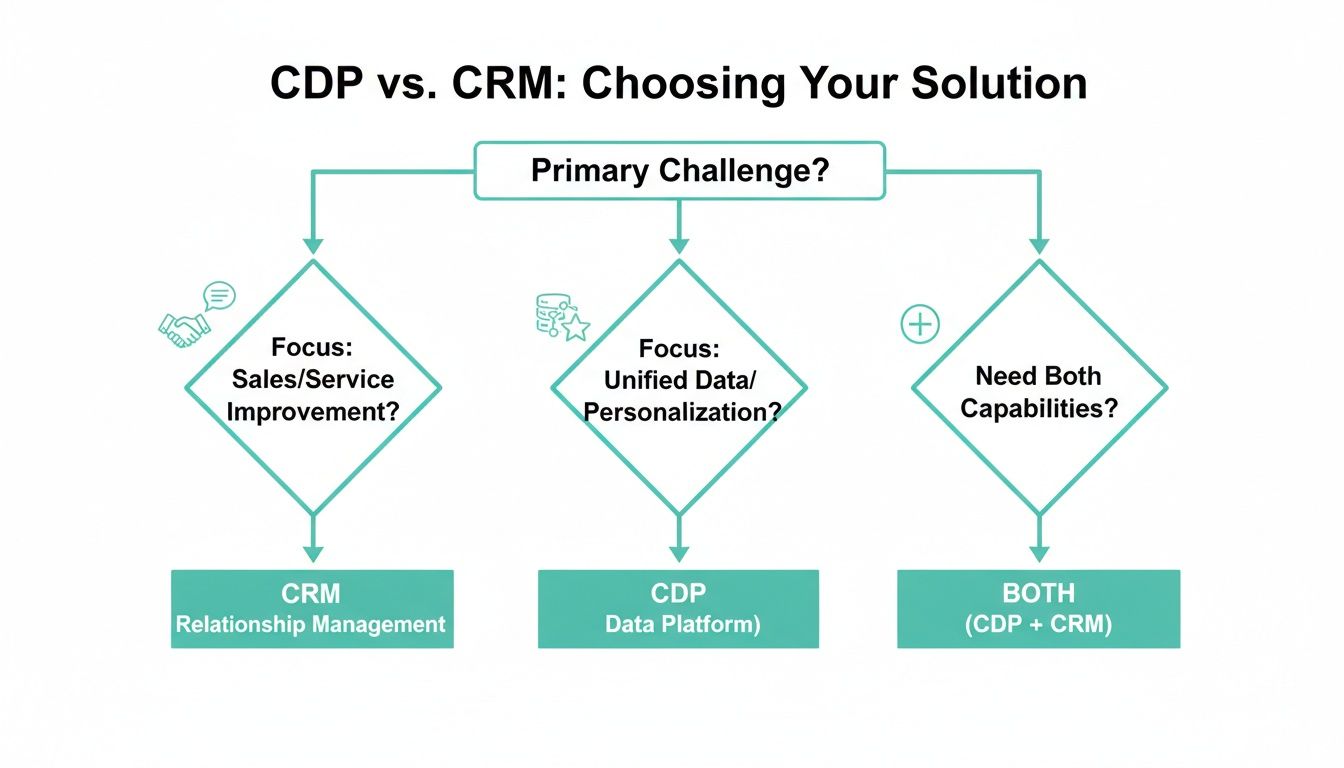
The flowchart makes it clear: the path you take depends entirely on your immediate business need.
If your sales team is struggling to keep up with leads, a CRM is the clear first step. But if your marketing team can't connect anonymous behavior on your Sitecore site with known customer profiles, a CDP like Sitecore CDP should be your top priority.
The ideal state is a tightly integrated ecosystem where the CDP serves as the system of intelligence and the CRM as the system of engagement. This ensures both marketing and sales operate from the same unified, AI-enriched customer truth.
This integration creates a powerful feedback loop. The CDP gives sales the behavioral context to make their outreach smarter, and the CRM feeds outcome data back to the CDP, making marketing segmentation sharper.
Market Growth Tells a Story
The explosive growth of the Customer Data Platform market tells you everything you need to know. While CRMs are a mature, essential tool, businesses have realized they can’t deliver the unified data needed for modern personalization on their own.
This isn't an accident. It shows that businesses have realized they can’t deliver the unified data needed for modern personalization with a CRM alone. The CDP market is growing rapidly as organizations recognize that customer data integration, powered by platforms from providers like Sitecore, is the key to a real competitive advantage. You can dig into the numbers yourself on Grandviewresearch.com.
For any large organization, the choice is rarely "if," but "when" and "how." Start with the platform that solves your most immediate pain, but always build with a clear plan for future integration. A platform like Sitecore CDP doesn't just unify your data; it prepares your organization to fully capitalize on technologies like Sitecore AI, turning customer insights into automated, personalized actions that drive real business value.
Implementation And Governance For A Unified Data Strategy
Rolling out a CDP or connecting it to your existing CRM is more than just a tech project—it's a strategic move. Getting it right depends on two things: a solid implementation plan and airtight data governance. These aren't just nice-to-haves; they're the difference between a unified data strategy and a very expensive mess.
From day one, you need to be defining your data sources, creating a universal data taxonomy, and making sure you’re compliant with regulations like GDPR. This is why a CDP project can never live solely within IT. It requires a true partnership between marketing, sales, IT, and even your legal team.

A Phased Approach For Sitecore CDP
For companies bringing in a platform like Sitecore CDP, we always recommend a phased rollout. This approach minimizes risk and shows value early, which helps build momentum for the bigger vision.
- Phase 1: Integrate High-Value Sources: Start with the data streams that matter most. This usually means your primary website (often built on Sitecore or SharePoint), your mobile app, and your CRM.
- Phase 2: Prove Value with Personalization: With that initial data flowing, pick a few high-impact use cases to prove the concept. For example, use Sitecore's AI to send personalized offers to cart abandoners or show dynamic content to visitors interested in a certain product line.
- Phase 3: Expand and Scale: Once you’ve demonstrated a clear ROI, it's time to expand. Start connecting other touchpoints like your point-of-sale systems, customer support desks, and loyalty programs.
This iterative process ensures your CDP project delivers measurable wins at every step, making it much easier to justify future investment and get everyone on board.
The Critical Role Of Data Governance
Without strong governance, even a powerful platform like Sitecore CDP can quickly turn into a data swamp. It’s the essential framework that ensures you’re building a trustworthy single customer view.
A strong data governance framework is the difference between a unified customer profile and a chaotic data swamp. It ensures data quality, access control, and consent management are actively managed, not just afterthoughts.
Your governance framework should spell out clear rules for:
- Data Quality: Establish firm standards for how data is cleaned, validated, and enriched before it ever enters the CDP.
- Access Controls: Define exactly who can view, edit, and export specific data sets, locking down sensitive customer information.
- Consent Management: Build a central system to track and honor user consent preferences across every connected platform.
As CDPs from market leaders like Sitecore become standard business infrastructure, strong governance is non-negotiable. You can explore more about the CDP market's growth on dinmo.com.
Of course, proper implementation and governance apply to all the systems your CDP touches. For teams also juggling enterprise resource planning systems, our article on best practices for CRM and ERP integration offers more detailed guidance. This unified approach is what turns the "CDP vs CRM" debate into a powerful, integrated strategy.
Common Questions About CDP And CRM
When talking about the CDP vs CRM debate, a few questions pop up again and again. Answering them helps clarify the unique job each platform does and how they work together, especially for businesses running on Sitecore.
Many teams wonder if their CRM can just do the work of a CDP. It’s a common question, but the answer is pretty straightforward.
Can A CRM Function As A CDP
While modern CRMs have certainly added more data features, they simply aren’t built to work like a true Customer Data Platform. A CRM uses a relational database, which is perfect for managing structured data and direct interactions with known customers—its core purpose is to support sales and service teams.
A CDP like Sitecore CDP, however, is designed for massive data ingestion and unification. It’s built to handle the huge volume and variety of real-time, unstructured data from both anonymous visitors and known customers. Trying to make a CRM do this job usually results in patchy customer profiles and a failure to deliver real-time personalization at scale.
Do We Still Need A CDP If We Have A CRM
For any company that wants to create modern, omnichannel experiences, the answer is a clear yes. Your CRM is essential for managing sales pipelines and customer service, but it wasn't designed to build the complete, unified customer view that today’s marketing demands. It sees the customer almost exclusively through a sales and support lens.
A CDP doesn’t replace your CRM; it makes it exponentially more powerful. It provides the deep behavioral context—the "why" behind the "what"—that your sales and service teams need to have more intelligent, relevant conversations.
A platform like Sitecore CDP works alongside your CRM by unifying data from every touchpoint, including your Sitecore website, SharePoint portals, and mobile apps. This creates a single source of truth that enriches your CRM records and fuels Sitecore’s AI-driven personalization, making every single interaction smarter.
What Is The Main Benefit Of Integrating Sitecore CDP
The biggest win from integrating Sitecore CDP with your DXP and CRM is creating a unified customer intelligence engine. Sitecore CDP becomes the central brain, blending anonymous behavioral data with the known customer information sitting in your CRM.
This unified profile lets your Sitecore DXP deliver hyper-personalized content and offers in real-time. At the same time, the CDP sends behaviorally qualified leads and rich customer insights back to your CRM. This gives your sales team a complete picture of a prospect's journey and interests before they even pick up the phone. This integration tears down data silos, gets marketing and sales on the same page, and maximizes the ROI on your entire tech stack.
At Kogifi, we specialize in implementing and integrating advanced DXP solutions that turn data into powerful customer experiences. Discover how we can help you build a unified data strategy with Sitecore and other leading platforms by visiting https://www.kogifi.com.