


A cloud content management system is a SaaS platform, hosted by a specialized provider like Sitecore or Microsoft, that lets you create, manage, and publish digital content using only an internet connection. This model removes the need for on-premise servers, giving your business unparalleled flexibility, on-demand scalability, and predictable operational costs.
Why Cloud Content Management Is a Strategic Shift
Moving content management to the cloud is not just an IT project; it's a fundamental shift in business strategy. A traditional, on-premise CMS is like building your own power generator in the basement. It's powerful but demands constant upkeep, consumes valuable resources, and requires a dedicated team of specialists just to maintain operations.
A cloud CMS, on the other hand, is like plugging into the city’s power grid. You gain access to a virtually limitless supply of managed, reliable power on demand. This frees your team from the complexities of infrastructure management, allowing them to focus on what they do best: creating exceptional customer experiences.

On-Premise vs Cloud CMS A Strategic Comparison
Deciding between an on-premise CMS and a cloud-native platform involves weighing significant trade-offs in control, cost, and agility. The table below breaks down the key differences to clarify the strategic path for your business.
| Attribute | On-Premise CMS | Cloud CMS |
|---|---|---|
| Infrastructure | You own, manage, and maintain all hardware and software. | The vendor manages all infrastructure for you. |
| Initial Cost | High upfront capital expenditure (CapEx) for hardware/licenses. | Low to no upfront cost; subscription-based (OpEx). |
| Scalability | Manual and slow. Requires purchasing and provisioning new servers. | Automatic and on-demand. Scales instantly with traffic. |
| Maintenance | Your IT team is responsible for all updates, patches, and security. | Vendor handles all maintenance, security, and updates. |
| Accessibility | Limited to your network; remote access can be complex to set up. | Accessible from anywhere with an internet connection. |
| Time-to-Market | Slower, with long procurement and setup cycles. | Much faster. Launch new sites and campaigns in days or weeks. |
| Innovation | Slower adoption of new features; dependent on manual upgrades. | Continuous innovation with automatic access to the latest features. |
Ultimately, the choice hinges on your strategic priorities. On-premise offers maximum control for organizations with strict data residency or deep customization needs, but at a high cost to agility. Cloud platforms are engineered for the speed and flexibility that modern business demands.
Redefining Business Agility
The primary driver for this strategic shift is agility. Cloud-native platforms like Sitecore's composable Digital Experience Platform (DXP) and SharePoint Online empower businesses to react to market changes almost instantly. There’s no more scrambling to provision new servers for a major marketing campaign or worrying about downtime during a product launch. The infrastructure scales seamlessly to meet any demand.
This newfound agility delivers a significant competitive edge:
- Faster Time-to-Market: Marketing teams can launch new digital campaigns and experiences in days, not months.
- Global Collaboration: Distributed teams can work in a centralized platform, ensuring brand consistency across all regions.
- Focus on Innovation: IT resources are freed from infrastructure maintenance and can be redirected to high-value, business-growth projects.
The Financial and Market Imperative
The financial argument for the cloud is clear—it shifts IT spending from a large upfront capital expense (CapEx) to a predictable, monthly operating expense (OpEx). Market trends tell an even more compelling story. The global CMS market is projected to grow from USD 35.16 billion in 2025 to USD 79.30 billion by 2033.
Tellingly, cloud solutions are projected to capture 58.4% of the market share in 2025, solidifying their dominance over on-premise systems. While large enterprises hold the biggest market share, small and medium-sized businesses are the fastest-growing segment, demonstrating the model's universal appeal. You can explore more data on CMS market dynamics for a complete overview.
This move to the cloud isn't just about reducing costs or simplifying IT. It's about future-proofing your digital strategy. It’s about building a foundation flexible enough to integrate with future technologies and robust enough to support your long-term vision.
Platforms from industry leaders like Sitecore and Microsoft are at the forefront of this transformation. Sitecore’s composable architecture enables businesses to assemble a best-in-class digital experience stack. Meanwhile, SharePoint Online, a core component of Microsoft 365, provides a secure, robust hub for internal content and collaboration. Both exemplify how a cloud CMS can power modern digital operations.
What a Cloud CMS Really Does for Your Business
A cloud-based CMS delivers tangible, measurable results that directly impact your bottom line and sharpen your competitive edge. It drives operational efficiency and unlocks strategic capabilities that were impossible with legacy on-premise systems.
Consider a new product launch. On a traditional system, IT teams scramble to provision sufficient server capacity, where any miscalculation could lead to a site crash, lost sales, and brand damage. Now, picture that same launch on a platform like Sitecore Experience Cloud. Built on an elastic cloud foundation, it handles traffic spikes effortlessly, automatically scaling to support millions of visitors. The result is a flawless customer experience with zero infrastructure drama.
Shift from Capital Burdens to Operational Agility
A cloud CMS fundamentally changes how you allocate IT spending. Legacy on-premise solutions require massive upfront investments in Capital Expenditure (CapEx)—expensive servers, storage, and software licenses that depreciate and demand costly upgrades every few years.
A cloud CMS transitions this model to a predictable Operating Expense (OpEx) subscription. This eliminates the risk of surprise hardware failures and the multi-million dollar "rip-and-replace" upgrade cycle.
This shift provides powerful advantages:
- Predictable Budgeting: Monthly or annual subscription fees simplify financial planning.
- No More Hidden Costs: Budgets are no longer consumed by server maintenance, power, cooling, physical security, or specialized staff.
- Smarter Resource Allocation: Capital once tied up in depreciating hardware can now be invested in innovation, marketing, or other growth-driving initiatives.
This financial agility enables you to seize market opportunities without being constrained by a rigid IT budget.
Launch Campaigns and Experiences at Global Speed
In today's market, speed is paramount. A cloud-native CMS drastically reduces time-to-market, empowering global teams to launch digital experiences in days. For example, teams using SharePoint Online can create secure, collaborative project sites in minutes, centralizing plans and assets for global access.
This capability extends beyond internal projects. With a cloud CMS like Sitecore XM Cloud, a marketing team in North America can build a campaign that their counterparts in Europe and Asia can instantly access, localize, and launch. This eliminates delays from provisioning regional servers or syncing disconnected systems, creating a unified and agile global marketing engine.
The market reflects this value. The global cloud-based content management services market was valued at $25 billion in 2024 and is expected to reach $40 billion by 2029. This growth is driven by businesses recognizing the immense value of scalability, cost-efficiency, and accessibility delivered by cloud platforms. You can learn more about the drivers behind this market expansion.
Ultimately, the real impact is a fundamental change in your company's metabolism. You stop reacting to technological limitations and start proactively shaping customer experiences, confident that your platform can support any ambition.
Mastering Digital Experiences with Sitecore's Composable DXP
When discussing an enterprise content management system cloud, Sitecore elevates the conversation from a single, rigid platform to a flexible, interconnected digital experience ecosystem.
The core principle is composability. Instead of a monolithic suite, Sitecore offers a portfolio of best-in-class, API-first products. This composable Digital Experience Platform (DXP) allows you to select and integrate the ideal tools for each specific function—content, commerce, personalization, and customer data—to build a marketing technology stack that perfectly aligns with your business strategy.
This is the power Sitecore brings to the cloud. You can integrate specialized tools like Sitecore Content Hub for digital asset management or Sitecore Personalize for AI-driven targeting, creating a unified system without traditional constraints. You can explore how composable DXPs enable scalable personalization to understand how customized your martech stack can become.
The screenshot below from Sitecore's website highlights their modern, modular approach, showcasing the core products of their cloud-native DXP.

This visual articulates Sitecore’s strategy: provide distinct, powerful components like XM Cloud, OrderCloud, and CDP that can be combined to construct the exact digital solution you require.
Introducing Sitecore XM Cloud
At the heart of Sitecore’s composable vision is Sitecore XM Cloud. This is not just another CMS; it is a true Software-as-a-Service (SaaS), headless platform that masterfully balances developer freedom with marketer agility.
The headless architecture is a significant advantage for developers. By decoupling the back-end content repository from the front-end presentation layer, they can use modern frameworks like React, Angular, or Vue.js to build high-performance, engaging experiences for websites, mobile apps, and IoT devices.
Simultaneously, marketers are empowered with a suite of visual tools. They can use an intuitive drag-and-drop editor to build pages, preview content across any channel, and launch personalization campaigns without writing code.
Sitecore XM Cloud bridges the traditional gap between IT and marketing. Developers get the modern, API-first environment they demand, while marketers receive the visual tools needed to create and optimize experiences at scale.
This synergy of headless flexibility and marketer-friendly tools translates directly to speed. Teams collaborate more effectively, development cycles are shortened, and new campaigns and features are brought to market faster than ever before.
Building Your Best-of-Breed Ecosystem
The value of a composable DXP is realized when you assemble different components to create your ideal digital ecosystem. Sitecore’s portfolio is designed for seamless integration with XM Cloud.
- Sitecore Content Hub: This is your centralized command center for all content and digital assets. It extends beyond a standard DAM, offering advanced tools for content planning, collaboration, and performance analytics.
- Sitecore Personalize: This is where one-to-one personalization is executed. By leveraging customer data, you can implement real-time targeting rules, run A/B tests, and automate entire omnichannel customer journeys.
- Sitecore CDP (Customer Data Platform): This platform aggregates customer data from disparate sources into a unified, 360-degree profile, fueling the personalization engine to make every interaction relevant.
- Sitecore OrderCloud: For e-commerce, this headless commerce platform enables the creation of any buying experience, from complex B2B ordering portals to streamlined B2C storefronts.
By combining these elements, you are no longer just managing content—you are orchestrating the entire digital experience. Each component is a best-in-class tool, but together they form a cohesive, adaptable platform that evolves with your business. This is a core advantage of a content management system cloud from an industry leader like Sitecore.
Powering Enterprise Collaboration with SharePoint Online

While Sitecore excels at managing the external-facing digital experience, the internal digital workplace is mastered by SharePoint Online. Modern SharePoint is a cloud-native powerhouse within the Microsoft 365 ecosystem, serving as the intelligent content service and collaborative engine for millions of businesses.
Its primary function is to provide a secure, centralized repository for documents, corporate knowledge, and team collaboration. Unlike a public-facing CMS, SharePoint Online is engineered for the complex demands of the enterprise, where robust security and seamless accessibility must coexist.
The Foundation of Secure Document Management
At its core, SharePoint Online provides governed, secure lifecycle management for documents. It is not merely a cloud drive but an environment where every file has a clear owner, a detailed version history, and a defined purpose. This is essential for organizations in regulated industries such as finance, healthcare, and legal services.
For example, a pharmaceutical company can use SharePoint to manage sensitive research data with a strict workflow: a document is drafted, routed for review, approved by compliance, published internally, and automatically archived according to retention policies. Every action creates an immutable audit trail.
SharePoint transforms document management from a chaotic free-for-all into a structured, compliant, and auditable process. Its precise version control ensures that everyone is working from the correct document, eliminating the costly risks of using outdated information.
This level of control makes it the definitive platform for building company intranets that serve as a single source of truth. Company news, HR policies, and departmental resources are all housed here, protected by granular permissions that ensure employees access only relevant information. Expert SharePoint solutions can tailor these features to solve specific business challenges.
Real-World Collaboration Scenarios
SharePoint's true power is unleashed through its deep integration with other Microsoft 365 tools, especially Microsoft Teams. When a new Team is created, a dedicated SharePoint site is automatically provisioned in the background. Every file shared in a Teams channel is stored, managed, and secured on that connected SharePoint site.
This creates a seamless collaborative workspace. A project team can co-author a proposal in real-time within Teams, confident that every change is automatically saved and versioned in SharePoint. This eliminates the inefficient and error-prone practice of emailing document versions back and forth.
This synergy reflects the explosive growth in the broader Cloud Enterprise Content Management (ECM) market. Valued at USD 34.17 billion in 2024, the market is projected to reach USD 87.01 billion by 2030. This surge is driven by enterprise demand for integrated cloud solutions that combine document management, workflow automation, and compliance. You can find more data on the expanding Cloud ECM market on mordorintelligence.com.
Driving the Modern Digital Workplace
Ultimately, SharePoint Online is the engine of the modern, secure digital workplace. Its strength lies in creating a structured environment where teams can collaborate freely while organizational security and compliance standards are enforced automatically.
Key applications include:
- Compliance Document Hub: Storing and managing files subject to regulations like GDPR or HIPAA, with automated retention policies and strict access controls.
- Project Management Backbone: Serving as the central repository for project files, plans, and reports, accessible through the user-friendly Teams interface.
- Corporate Intranet and Knowledge Base: Building a central portal for internal news, company policies, and employee resources to foster a connected and informed culture.
By mastering these roles, SharePoint Online proves it is far more than a file repository. It is an essential platform for modern business, ensuring information is both secure and accessible whenever and wherever it is needed.
Navigating Cloud Security and Compliance with Confidence
For any enterprise, security is non-negotiable. When moving your content management to the cloud, understanding the shared responsibility model is crucial. This is a core concept for any platform hosted on a public cloud like Microsoft Azure.
In this model, the cloud provider (e.g., Microsoft Azure) is responsible for the security of the cloud—the physical data centers, networking, and host infrastructure. You, the customer, are responsible for security in the cloud—your data, applications, access management, and network controls.
Microsoft secures the underlying global infrastructure. Platforms like Sitecore and SharePoint then build their robust security features on top of that foundation, providing the controls needed to protect your specific digital assets.
Enterprise-Grade Security in Sitecore and SharePoint
Both Sitecore and SharePoint are engineered with multi-layered security protocols to protect sensitive corporate and customer data. These features are integral to their architecture.
Their security measures cover three critical areas:
- Data Protection: Both platforms enforce encryption in transit and at rest, ensuring data is unreadable as it travels over networks and while stored on servers.
- Identity and Access Management (IAM): Sophisticated IAM controls are central to both systems. SharePoint leverages Azure Active Directory for precise user permissions management. Sitecore offers similar granular controls for content authors, marketers, and administrators, adhering to the principle of least privilege.
- Threat Detection: Advanced monitoring is used to identify and respond to suspicious activity. Microsoft 365, which powers SharePoint, includes threat detection protocols that flag unusual login attempts or data access patterns, helping to mitigate potential breaches. You can learn more about specific approaches in our guide on cloud security for the Sitecore DXP.
This layered approach provides defense-in-depth. By combining the infrastructure security of a hyperscale cloud provider with the application-level security of an enterprise CMS, you achieve a security posture far more resilient than most on-premise deployments.
Meeting Stringent Compliance Standards
Beyond security, enterprises must navigate a complex web of regulatory requirements. A major advantage of using a top-tier cloud CMS is its built-in support for compliance. For a deeper understanding of safeguarding data in the cloud, explore these Cloud Security Fundamentals.
Platforms like Sitecore on Azure and SharePoint Online are designed with compliance frameworks at their core. They undergo regular third-party audits and provide documentation to help your organization demonstrate adherence to standards such as:
- GDPR (General Data Protection Regulation): For protecting the data of EU citizens.
- HIPAA (Health Insurance Portability and Accountability Act): For securing protected health information in the US.
- SOC 2 (Service Organization Control 2): A report validating a service provider's security, availability, and processing integrity.
Building on these platforms allows you to inherit a significant portion of the compliance framework, freeing your teams to focus on your specific business rules rather than building a compliant infrastructure from the ground up.
Your Proven Framework for Cloud CMS Migration
Migrating your enterprise CMS to the cloud is a strategic overhaul of your digital foundation. A successful transition to a modern platform like Sitecore or SharePoint Online requires a disciplined, step-by-step approach to avoid data loss, downtime, and a poor return on investment.
The process begins with a detailed audit of your current content and architecture. This involves creating a comprehensive map of your digital assets to determine what to migrate, what to archive, and what to rebuild for cloud-native functionality.
Reviewing general cloud migration best practices will help you avoid common pitfalls and ensure a smoother transition.
Defining Your Migration Blueprint
Once you have inventoried your content, you must define measurable success criteria. Your Key Performance Indicators (KPIs) should focus on business outcomes, not just technical milestones.
- Reduce page load times by 30% by leveraging cloud infrastructure.
- Decrease content publishing time by 50% for marketing teams using new visual editors.
- Achieve 99.99% uptime, even during peak traffic.
With clear goals, you can develop a data migration strategy that minimizes business disruption. A "big bang" migration is often too risky. Instead, a phased approach—migrating one site or section at a time—allows for testing, learning, and refinement, leading to a more stable and predictable rollout. Our comprehensive website migration checklist provides a detailed breakdown of this process.
The following infographic illustrates the layers of a strong cloud security posture, from the infrastructure level up through the application and data layers.
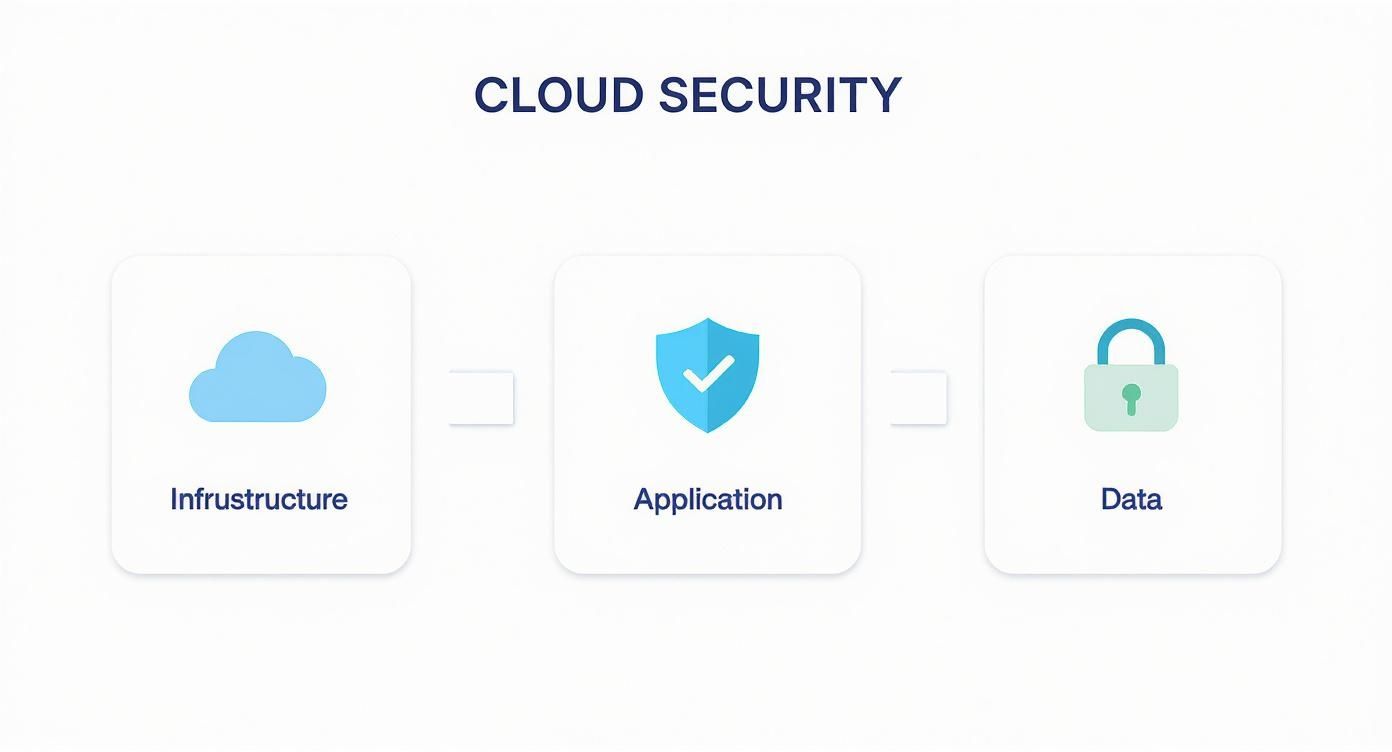
This image underscores that a secure migration demands a coordinated defense across every layer of your new cloud environment.
Planning for Integration and Adoption
A modern content management system cloud is the hub of your digital ecosystem. For Sitecore, migration planning must include API-first integrations with your existing martech stack. This requires mapping how your new CMS will connect with your CRM, analytics tools, and e-commerce platforms to create a seamless digital experience engine.
To guide your team, here’s a checklist outlining key tasks for each migration phase.
Cloud CMS Migration Phase Checklist
This table summarizes the critical actions for each stage of the migration process.
| Migration Phase | Key Actions and Considerations |
|---|---|
| 1. Discovery & Planning | Audit all existing content and applications. Define clear KPIs and success metrics. Choose the right cloud provider and migration strategy (e.g., phased vs. big bang). |
| 2. Design & Architecture | Design the new cloud architecture. Plan for security, compliance, and governance. Map out API integrations with your martech stack (CRM, analytics, etc.). |
| 3. Execution & Migration | Conduct a pilot migration with a small data set. Execute the phased migration plan. Validate data integrity and application functionality post-migration. |
| 4. Post-Migration & Adoption | Implement a comprehensive change management program. Provide hands-on training and workshops for content authors and marketers. Monitor performance, security, and costs continuously. |
Following a structured checklist ensures no critical steps are missed, from initial planning to user adoption.
Finally, user adoption is paramount. The technical migration is only half the battle. Your content creators, marketers, and IT teams must be prepared for the new platform. This requires a robust change management plan with clear communication, hands-on workshops, and ongoing support to help your team fully leverage the agility of your new cloud CMS.
Got Questions About Cloud CMS?
Moving to a cloud CMS is a major strategic decision. Here are answers to common questions we encounter from enterprise leaders, focusing on the Sitecore and SharePoint ecosystems.
Sitecore XM Cloud vs. Sitecore Managed Cloud: What's the Real Difference?
This question highlights the critical distinction between a true SaaS product and a hosted PaaS solution.
Sitecore XM Cloud is a fully managed, composable Software-as-a-Service (SaaS) platform. With this subscription-based service, Sitecore handles all updates, scaling, and infrastructure management automatically. This provides your marketers with a modern, headless architecture and intuitive visual editing tools, delivered with maximum uptime and minimal overhead.
Sitecore Managed Cloud, in contrast, is a Platform-as-a-Service (PaaS) offering. While Sitecore hosts your XP or XM instance on Microsoft Azure, your team or implementation partner remains responsible for managing the application layer, including performing upgrades and applying patches.
XM Cloud is designed for agility and minimal hands-on management. Managed Cloud offers greater control over the platform's configuration, which may be required for complex, legacy customizations.
Can We Actually Replace Our On-Premise File Servers with SharePoint Online?
For the vast majority of businesses, the answer is a definitive yes. SharePoint Online not only replaces traditional file servers but also introduces a superior level of functionality. It offers powerful document management features like precise version control, real-time co-authoring, and advanced search capabilities, all within the secure Microsoft 365 ecosystem.
A successful migration from file servers to SharePoint depends on a well-defined strategy. Without meticulous planning for data migration, governance, and user training, you risk poor adoption and will fail to realize its full collaborative potential.
How Does a Composable DXP Change Our Martech Strategy?
Adopting a composable DXP, like the model championed by Sitecore, fundamentally transforms your martech strategy. It shifts your organization from vendor lock-in with a monolithic suite to a flexible, "best-of-breed" approach.
Instead of relying on a single platform, you use APIs to integrate your cloud CMS with your preferred CRM, e-commerce engine, and analytics tools. This enables you to build a marketing stack perfectly tailored to your business needs—one that can evolve as new technologies emerge, without requiring a complete overhaul.
When business goals change, you can swap out individual components. This is a more intelligent and cost-effective way to innovate and maximize the return on your technology investments.
Ready to build a digital experience platform that drives real business results? At Kogifi, our experts specialize in implementing and optimizing Sitecore and SharePoint solutions that give you the agility to win. Explore our services to learn more.