


In the current digital-first landscape, viewing your Enterprise Content Management (ECM) system as a mere digital filing cabinet is a critical oversight. The true value of an ECM is unlocked when it's transformed from a passive repository into a dynamic engine for business growth, customer insight, and exceptional user experiences. Effective enterprise content management strategies are no longer just about organization; they are about activation and intelligence. This means moving beyond simple storage to create a system that actively works to enhance every digital interaction.
This article provides a deep dive into nine advanced strategies designed to leverage the full power of modern Digital Experience Platforms (DXP). We will focus primarily on the sophisticated capabilities within the Sitecore ecosystem, including its composable DXP and Sitecore Search, while also incorporating practical insights for maximizing Microsoft SharePoint's potential. These platforms offer powerful tools, but their value is only realized through deliberate, strategic implementation that aligns technology with specific business objectives.
For organizations looking to master their digital assets, whether through a new platform implementation or by optimizing an existing one, these strategies offer a clear roadmap. We will explore how to implement robust governance, enable AI-driven personalization, and deliver seamless omnichannel experiences that drive measurable business outcomes. This guide is built for marketing professionals, enterprise leaders, and technology teams aiming to build a content infrastructure that is not only organized but also intelligent, scalable, and prepared for future demands.
1. Strategy 1: Forge a Rock-Solid Foundation with Advanced Information Architecture
The most effective enterprise content management strategies begin not with technology, but with structure. An advanced Information Architecture (IA) is the systematic framework for organizing, structuring, and labeling content, transforming a chaotic repository into a findable, governable asset library. This foundational strategy focuses on creating well-defined taxonomies and metadata schemas that align directly with your business logic and, more importantly, your users' needs.
Without a robust IA, even the most powerful DXP like Sitecore will fail. Content becomes difficult to find, reuse is nearly impossible, and personalization efforts stall. A strong IA ensures that every piece of content has a logical place and purpose, directly enabling efficient search, streamlined governance, and the consistent delivery of relevant experiences across all digital channels.
Implementation in Practice: Sitecore and SharePoint
Different platforms require unique approaches to implementing a sound IA:
- In Sitecore: A strong IA translates into a logical content tree and meticulously designed data templates. This structure is paramount for leveraging Sitecore's personalization engine and component-based architecture. For instance, a global financial services firm built a component-based taxonomy within Sitecore, allowing them to define content once and reuse over 70% of their marketing assets across 50+ regional websites, ensuring brand consistency while accommodating local variations.
- In SharePoint: The strategy centers on leveraging Content Types and the Managed Metadata Service. A large healthcare provider used SharePoint's Term Store to create a single, authoritative vocabulary for patient-facing documents. This ensured consistent, accurate terminology was used across the entire organization, reducing compliance risks and improving clarity for patients.
Actionable Tips for Building Your IA
- Platform-Specific Best Practices: In Sitecore, use base templates to enforce inheritance, ensuring consistency and simplifying future updates. This is a core principle of effective Sitecore development. Within SharePoint, centralize your vocabulary in the Term Store to make it accessible across all site collections.
- User-Centric Design: Begin with user research and exercises like card sorting to understand how your audience mentally categorizes information. This ensures the final structure is intuitive for them, not just your internal teams.
- Phased Rollout: Start with a pilot project in a single department to test and refine your taxonomy before an enterprise-wide implementation.
- Involve Key Stakeholders: Collaborate with subject matter experts from various departments to ensure the taxonomy accurately reflects the business's diverse needs and terminology.
A well-planned IA is more than an organizational tool; it's the critical first step in unlocking the full potential of your ECM system. For a deeper dive into this essential discipline, you can learn more about crafting an effective framework with these best practices for enterprise IA design.
2. Strategy 2: Implement Proactive Content Lifecycle Management
Effective enterprise content management strategies extend far beyond creation and publication. Proactive Content Lifecycle Management (CLM) provides a governed framework for managing information from its initial draft through to its eventual archival or deletion. This strategy establishes clear policies, automated workflows, and defined ownership for every stage: creation, review, approval, publication, retention, and final disposition.
Without a formal CLM process, organizations face ballooning storage costs, increased compliance risks, and a repository cluttered with redundant, obsolete, and trivial (ROT) content. A robust CLM strategy ensures that information remains accurate, relevant, and secure throughout its lifespan. It systematically aligns content with business needs and regulatory mandates, transforming a potential liability into a well-managed, cost-optimized asset.
Implementation in Practice: Sitecore and SharePoint
Different platforms offer unique tools for enforcing the content lifecycle:
- In Sitecore: CLM is managed through a combination of custom workflows, the archiving feature, and integration with marketing automation. For example, a global manufacturing firm can use Sitecore's highly customizable workflows to automate the multi-stage review and approval process for engineering documents, enforcing a strict seven-year retention period followed by staged archival, ensuring both compliance and accessibility.
- In SharePoint: The strategy is centered on Information Management Policies and the Records Center. A financial institution can implement lifecycle policies for millions of customer documents in SharePoint, using automated retention schedules to comply with stringent regulatory requirements and manage the disposition of sensitive data.
Actionable Tips for Building Your CLM
- Map Content to Requirements: Before implementing any technology, map your content types to specific business and legal retention requirements. Not all content is created equal.
- Automate Where Possible: A key aspect of intelligent content lifecycle management involves leveraging Robotic Process Automation for Document Management Systems to streamline routine tasks like archival notifications and record declaration.
- Implement Tiered Storage: Optimize costs by creating graduated storage tiers (hot, warm, cold). Use premium storage for active content and move aging information to less expensive alternatives based on defined policies.
- Establish Clear Governance: Schedule annual reviews of all retention policies with legal and compliance teams to ensure they adapt to changing regulations. Communicate these policies clearly to all content owners.
By treating content as an asset with a defined lifespan, a CLM strategy introduces discipline and control, directly reducing risk and improving the overall efficiency of your content operations.
3. Strategy 3: Embrace Agility with a Cloud-First ECM Migration
The most forward-thinking enterprise content management strategies now prioritize agility and accessibility by moving away from on-premises infrastructure. A cloud-first ECM strategy involves migrating legacy content repositories to powerful, scalable platforms like Sitecore's composable DXP or Microsoft 365. This approach is not merely about shifting storage; it's about fundamentally re-architecting business processes to leverage cloud-native features like AI-powered search, real-time collaboration, and secure mobile access.
Without a modern, cloud-based foundation, businesses risk being anchored by high maintenance costs, rigid infrastructure, and an inability to innovate. Migrating to the cloud unlocks operational efficiencies, enhances global collaboration, and provides the elastic scalability needed to adapt to market demands. This strategic shift ensures that content is a dynamic, accessible asset that fuels productivity rather than a static archive locked in a server room.

Implementation in Practice: Sitecore and SharePoint
Leading platforms offer distinct pathways for a successful cloud migration:
- In Sitecore: The strategy often involves moving to a Platform-as-a-Service (PaaS) or composable DXP model. For example, a global manufacturing firm transitioned its extensive product documentation and marketing assets from an on-premises Sitecore instance to Sitecore Managed Cloud. This eliminated infrastructure overhead and enabled their teams to focus on delivering personalized content experiences, leveraging the cloud's scalability to handle fluctuating global traffic.
- In SharePoint: The primary path is migrating to SharePoint Online within Microsoft 365. A large professional services firm can consolidate multiple legacy systems into a unified SharePoint Online environment. This move enables seamless global collaboration, streamlines document management, and provides a secure, integrated platform for their massive workforce.
Actionable Tips for Your Cloud Migration
- Platform-Specific Best Practices: When migrating to SharePoint Online, leverage tools like the SharePoint Migration Tool (SPMT) and meticulously plan your site architecture and permissions. For Sitecore, prioritize a content audit to prepare for a potentially headless or composable architecture in the cloud, ensuring content is structured for omnichannel delivery.
- Conduct a Thorough Content Audit: Before moving a single file, identify and eliminate ROT (Redundant, Obsolete, Trivial) data. This reduces migration costs, complexity, and the risk of polluting your new, clean cloud environment.
- Develop a Phased Approach: Start with less critical content or a single department to pilot the migration process. This allows your team to refine its methods, address unforeseen challenges, and build momentum for larger, more complex data sets.
- Plan for Change Management: A cloud migration changes how users work. Create a comprehensive training and communication program to ensure smooth adoption, highlighting the benefits of new features like real-time co-authoring and mobile access.
A strategic move to the cloud is a critical step in future-proofing your content ecosystem. To explore this approach further, you can discover more about the benefits of a cloud-based content management system.
4. Intelligent Content Classification and Auto-Tagging
Manual content tagging and classification are significant bottlenecks in any large-scale enterprise. One of the most transformative enterprise content management strategies is to automate this process using artificial intelligence (AI), machine learning (ML), and natural language processing (NLP). This approach delegates the repetitive, time-consuming work of categorizing, tagging, and applying metadata to intelligent algorithms, dramatically increasing speed and consistency.
This strategy moves beyond simple rule-based systems. It uses models trained on your organization's own content to understand context, identify document types, extract key information, and route assets to the correct workflows or repositories. For global enterprises managing millions of assets, this isn't just an efficiency gain; it's a fundamental requirement for maintaining order, ensuring compliance, and unlocking the true value of their content library.
Implementation in Practice: Sitecore and SharePoint
Modern ECM platforms are increasingly embedding AI to streamline these core tasks:
- In Sitecore: While Sitecore doesn't offer a native, all-encompassing auto-tagging feature out-of-the-box, it serves as a powerful hub for integrating with best-in-class AI services. For instance, a financial services giant can connect Sitecore to Azure Cognitive Services. As they upload thousands of market analysis reports, the AI service automatically scans the documents, extracts keywords like company names and financial terms, and applies them as tags within the Sitecore media library, making assets instantly searchable.
- In SharePoint: This is where Microsoft's investment in AI truly shines with SharePoint Syntex. A legal firm can use Syntex to train models on their existing contracts. When a new contract is uploaded, Syntex not only identifies it as a "Master Service Agreement" but also extracts key clauses, client names, and expiration dates, populating them directly into SharePoint columns as metadata. This automates record-keeping and triggers retention policies without human intervention.
Actionable Tips for AI-Powered Classification
- Platform-Specific Best Practices: In Sitecore, leverage integration frameworks to connect with services like Microsoft Azure Cognitive Services or Google Cloud AI to handle the heavy lifting of classification. For SharePoint, start with Syntex's pre-built models before training custom ones for your unique document types.
- Establish Confidence Thresholds: Don't aim for 100% automation initially. Set a confidence score (e.g., 90%) below which content is flagged for human review. This builds trust in the system while handling edge cases effectively.
- Create a Feedback Loop: Your users are essential for refining the AI. Implement a simple mechanism for them to correct misclassifications. This feedback should be used to regularly retrain and improve the accuracy of your models.
- Combine AI with Business Rules: For complex compliance or workflow scenarios, use AI for the initial classification and then apply traditional business rules. For example, AI identifies an invoice, and a rule then routes it to the accounts payable team based on the dollar amount extracted by the AI.
By automating classification and tagging, organizations can ensure their content is consistently organized and easily discoverable, forming a reliable backbone for all other content-related activities.
5. Federated Search and Content Integration
Effective enterprise content management strategies must acknowledge a critical reality: content rarely lives in a single system. A federated search and content integration strategy addresses this by creating a unified search experience across multiple, disparate repositories. Instead of a costly and complex content migration, this approach deploys an intelligent indexing layer that connects systems like your ECM, cloud storage, and internal applications, presenting users with a single, powerful search bar.
This strategy is vital for modern enterprises where information is scattered across SharePoint sites, Sitecore instances, file shares, and various SaaS platforms. By leaving content in its native location while providing a centralized access point, you dramatically improve knowledge discovery, reduce employee frustration, and boost productivity without disrupting existing workflows or data governance protocols. It connects information silos, making the entire digital workplace searchable.
Implementation in Practice: Sitecore and SharePoint
Different platforms can serve as the hub for a federated search experience:
- In Sitecore: A product like Sitecore Search is designed specifically for this purpose, acting as the central index that connects to external repositories. For example, a global manufacturing firm used Sitecore Search to unify its product documentation from a SharePoint library, marketing assets from Sitecore XM, and technical specifications from a separate PIM system. This provided their sales and support teams a single interface to find all relevant product information instantly.
- In SharePoint: Microsoft Search excels at federating content across the Microsoft 365 ecosystem. A large consulting firm leveraged it to connect SharePoint Online, Teams, and OneDrive. They then used custom connectors to index a legacy internal knowledge base, allowing employees to find project data, expert profiles, and client history from one search box in SharePoint.
Actionable Tips for Building Your Federated Search
- Prioritize High-Value Sources: Begin by connecting the most frequently accessed and business-critical content repositories. This delivers immediate value and builds momentum for the project.
- Invest in Connector Quality: Ensure the connectors used to link systems are robust and reliable. High-quality connectors are crucial for accurate, real-time indexing and consistent search performance.
- Map Security and Permissions: Implement strict security mapping to ensure the search results respect the access permissions of the source systems. A user should only see content they are authorized to view in its native location.
- Analyze and Optimize: Use search analytics to monitor user queries, identify content gaps, and understand what users are struggling to find. Use this data to continuously refine search relevance and tune the user experience.
A well-executed federated search strategy transforms fragmented data into a unified, accessible knowledge asset. You can explore how to achieve this with modern DXP capabilities by learning more about the reasons to implement enterprise search with Sitecore Search.
6. Strategy 6: Adopt a Mobile-First Content Access Strategy
In an era of workforce mobility and remote operations, effective enterprise content management strategies must prioritize the devices employees use most: their smartphones and tablets. A mobile-first strategy reorients content access from a desktop-centric model to one where mobile interaction is the primary design consideration. This approach involves creating responsive interfaces, optimizing content formats for smaller screens, and enabling secure, on-the-go access to critical business information.
Without a mobile-first mindset, an ECM system becomes a bottleneck for field workers, remote teams, and traveling executives. Productivity plummets when employees cannot access, update, or capture content from their location. A robust mobile strategy ensures that your workforce has the information they need at the point of action, streamlining workflows, accelerating decision-making, and enhancing overall operational agility.
Implementation in Practice: Sitecore and SharePoint
Delivering secure and performant mobile content access requires a platform-specific approach:
- In Sitecore: The focus is on headless delivery and responsive design. For example, a global logistics company used Sitecore Experience Edge to deliver real-time shipping manifests and procedural documents to the mobile devices of its delivery drivers. This headless approach ensured lightning-fast, optimized content delivery to a custom native app, independent of the main corporate website's presentation layer.
- In SharePoint: The strategy leverages Power Apps and the native SharePoint mobile app. A large healthcare network enabled nurses to access and update patient care protocols at the bedside using a custom Power App connected to a SharePoint document library. This provided secure, role-based access to critical information, improving patient safety and ensuring compliance with the latest procedures.
Actionable Tips for Building Your Mobile Strategy
- Platform-Specific Best Practices: In Sitecore, utilize a headless architecture to decouple content from presentation, allowing you to deliver optimized data to any mobile application. For SharePoint, build lightweight Power Apps for task-specific mobile workflows instead of trying to replicate the entire desktop experience.
- Identify Key Use Cases: Begin by mapping the most critical tasks your mobile workforce performs. Focus on delivering high-value content and functionality for these specific scenarios, such as field sales accessing product sheets or maintenance crews reviewing technical diagrams.
- Optimize for Offline Access: Enable smart caching and offline synchronization for frequently accessed content. This ensures productivity is not interrupted in areas with poor or no connectivity, which is critical for field service and remote workers.
- Prioritize Security: Implement robust mobile security measures like containerization to separate business and personal data, and remote wipe capabilities to protect sensitive information on lost or stolen devices.
7. Content Governance and Stewardship Framework
One of the most critical enterprise content management strategies is establishing a formal system of accountability. A Content Governance and Stewardship Framework is the organizational blueprint that defines clear roles, policies, and processes for content across its entire lifecycle. This strategy moves beyond technology to create a human infrastructure of ownership, ensuring every piece of content is managed, compliant, and aligned with business goals.
Without a governance framework, content ecosystems descend into chaos, marked by inconsistency, outdated information, and significant compliance risks. This framework establishes who can create, approve, publish, and archive content, transforming content management from an ad-hoc activity into a disciplined, scalable business function. It ensures quality, reduces legal exposure, and creates clear lines of responsibility for maintaining valuable digital assets.
Implementation in Practice: Sitecore and SharePoint
Effective governance requires leveraging platform-specific features to enforce policies:
- In Sitecore: Governance is implemented through a combination of security roles, workflow states, and validation rules. For example, a global CPG company can deploy a governance model across multiple brands using Sitecore's user roles to create regional governance councils. This allows them to enforce brand standards globally while empowering local teams to manage their content within predefined workflows, ensuring both consistency and relevance.
- In SharePoint: The strategy centers on using permission levels, content approval workflows, and information management policies. A government agency can create a comprehensive framework for public records in SharePoint, using strict permissions and audit trails to establish a clear chain of custody, which is vital for security and regulatory compliance.
Actionable Tips for Building Your Governance Framework
- Secure Executive Sponsorship: A governance initiative requires top-down support to succeed. Position it as a business-critical function that mitigates risk and enhances brand value, not just an IT project.
- Start Small and Scale: Begin by applying governance to high-risk or high-value content areas, such as legal disclaimers or key product information, before rolling it out enterprise-wide.
- Automate Enforcement: In Sitecore, configure workflows to automatically route content to legal or brand teams for approval. In SharePoint, use information management policies to automate retention and disposition schedules for specific document types.
- Recognize Stewards: Build governance responsibilities into job descriptions and performance reviews. Acknowledge and reward employees who effectively steward their content areas to foster a culture of ownership.
A robust governance framework is the essential counterpart to technology, providing the structure and accountability needed to manage content effectively at scale. To learn more about setting up these critical controls, you can explore the principles of governing your Sitecore implementation.
8. Strategy 8: Adopt an API-First Integration and Content Services Approach
A transformative enterprise content management strategy involves shifting from monolithic systems to a flexible, API-first architecture. This approach treats content as a service, decoupling the back-end content repository from the front-end presentation layer. It transforms your ECM into a Content Services Platform (CSP), where content and its related functionalities are exposed through secure, standardized APIs for consumption by any application or channel.
This headless model offers unparalleled agility. Instead of being locked into a single "head" or user interface, content can be delivered to websites, mobile apps, in-store kiosks, or even IoT devices. It enables a best-of-breed technology stack, allowing you to integrate specialized marketing, e-commerce, and analytics tools without complex, custom-coded connections, ensuring your content ecosystem is future-proof and highly adaptable.
Implementation in Practice: Sitecore and SharePoint
Modern platforms are increasingly built to support this decoupled architecture:
- In Sitecore: The strategy is realized through Sitecore's Headless Services, which provide GraphQL and REST APIs. For instance, a major airline used this approach to deliver real-time flight status updates and promotional content from their central Sitecore instance to both their public website and their native mobile applications simultaneously, ensuring a consistent and up-to-the-minute customer experience across platforms.
- In SharePoint: This is achieved by leveraging the Microsoft Graph API. A large manufacturing company integrated SharePoint's content services with their custom-built factory floor management application. Using the Graph API, they seamlessly pulled updated technical manuals and safety protocols from SharePoint directly into the application's interface, ensuring workers always had access to the latest critical information.
Actionable Tips for Building Your API-First Ecosystem
- Standardize Your API Layer: In Sitecore, utilize the Headless SDKs to accelerate development and ensure consistent API consumption. For SharePoint, standardize on the Microsoft Graph API as the single entry point for accessing content and data across Microsoft 365.
- Provide Comprehensive Documentation: Use tools like Swagger/OpenAPI to generate interactive API documentation. This is crucial for developer adoption, reducing onboarding time and integration errors.
- Implement an API Gateway: Use a gateway like Azure API Management to centralize security, enforce policies, monitor usage, and manage traffic for all your content service APIs, creating a secure and observable ecosystem.
- Establish Strong Governance: From the beginning, implement a clear API versioning strategy (e.g., v1, v2) to manage changes without breaking existing integrations. Define and monitor Service Level Agreements (SLAs) for API performance and availability.
An API-first approach is the key to building a truly connected and scalable digital experience platform. For a deeper understanding of how to execute this effectively, you can explore these best practices for API integration in DXPs.
9. Strategy 9: Build a Brain with Knowledge Graphs and Semantic Content Management
The most advanced enterprise content management strategies evolve beyond simple storage and retrieval to build an organizational "brain." This is achieved through Knowledge Graphs and Semantic Content Management, an approach that focuses on the relationships between information, not just the information itself. It transforms your ECM from a digital filing cabinet into an intelligent platform that understands the context and meaning behind your content.
This strategy moves past traditional folders and metadata tags to create a network of interconnected entities, concepts, and data points. By using semantic technologies like ontologies, it enables more powerful search, automated content recommendations, and the discovery of insights that were previously hidden within siloed information. Content becomes a dynamic, interconnected asset that drives smarter business decisions.
Implementation in Practice: Sitecore and SharePoint
Different platforms can leverage semantic principles to build contextual intelligence:
- In Sitecore: While Sitecore doesn't have a native knowledge graph, this strategy is implemented by integrating it with dedicated graph databases or specialized semantic AI platforms. For a pharmaceutical company, this involved connecting Sitecore content about clinical trials with data from a knowledge graph that mapped compounds, researchers, and publications. This allowed researchers to discover related studies directly from the content they were viewing, accelerating R&D.
- In SharePoint: SharePoint's Managed Metadata Service provides a foundational layer for semantic enrichment. A large engineering firm used this to build a formal taxonomy (a precursor to an ontology) for project documentation. By integrating this with Microsoft Graph, they could surface connections between documents, subject matter experts (via Delve), and related project sites, significantly improving knowledge discovery across the enterprise.
The following concept map visualizes the core components that work together to power a semantic content management system, showing how abstract models are connected to concrete content through intelligent processing.
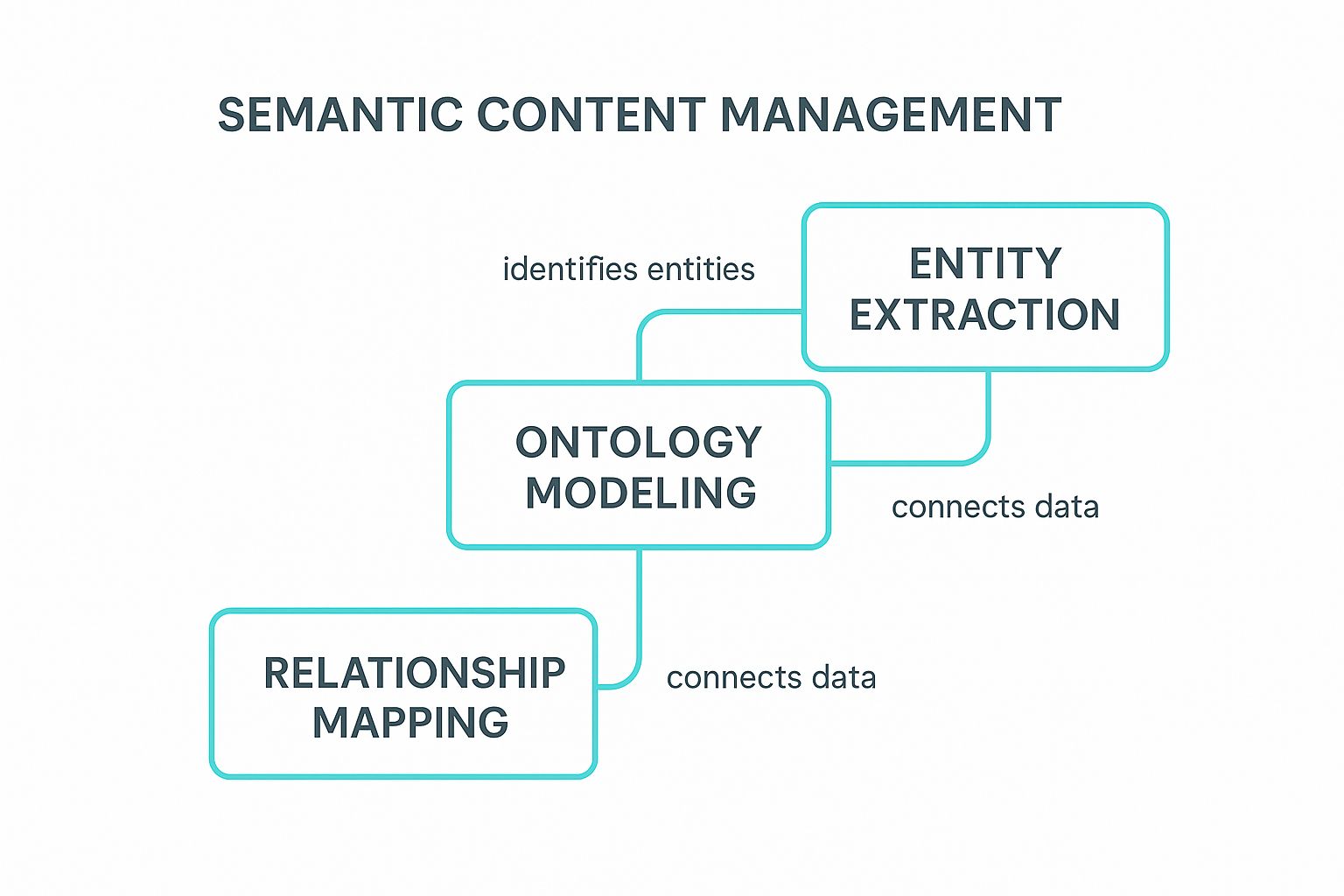
This visualization highlights how a formal 'Ontology' provides the rules, 'Entity Extraction' identifies the key players in your content, and 'Relationship Mapping' connects them into a meaningful network.
Actionable Tips for Building Your Knowledge Graph
- Start with a Focused Domain: Don't try to model the entire enterprise at once. Begin with a high-value use case, such as connecting product specifications to marketing materials, to prove the concept and demonstrate ROI.
- Engage Domain Experts: Your ontology, the formal model of your business knowledge, is only as good as the expertise that informs it. Collaborate closely with subject matter experts to accurately define concepts and their relationships.
- Iterative Implementation: Build your graph progressively. Start by identifying key entities and a few critical relationships. Gradually expand the model as you prove its value and secure more buy-in from stakeholders.
- Visualize the Connections: Use graph visualization tools to help users and stakeholders understand the relationships within the data. Seeing the connections makes the value of the knowledge graph tangible and intuitive.
Implementing a knowledge graph is a transformative step that turns your content repository into an active, intelligent knowledge base, paving the way for true AI-driven personalization and discovery. To explore how to link disparate data systems, you can learn more about implementing a composable DXP architecture.
Enterprise Content Management Strategies Comparison
| Strategy | Implementation Complexity 🔄 | Resource Requirements ⚡ | Expected Outcomes 📊 | Ideal Use Cases 💡 | Key Advantages ⭐ |
|---|---|---|---|---|---|
| Information Architecture and Taxonomy Development | High - Requires planning, stakeholder alignment | Medium - Expert involvement, ongoing governance | Improved content discoverability, consistent organization | Enterprise-wide content structuring, compliance | Enhances search effectiveness, scales with content |
| Content Lifecycle Management | Medium to High - Policy creation, workflow design | Medium - Legal expertise, automation tools | Reduced storage costs, regulatory compliance | Document retention, audit compliance | Systematic content disposal, compliance assurance |
| Cloud-First ECM Migration Strategy | High - Migration and process reengineering | High - Cloud infrastructure, change management | Scalability, remote access, cost savings over time | Modernization, hybrid work support | Scalability, reduced IT overhead, AI capabilities |
| Intelligent Content Classification and Auto-Tagging | High - AI/ML model training, ongoing tuning | High - Data science, computing infrastructure | Reduced manual effort, consistent metadata, faster processing | Large-scale, standardized document environments | Significant manual effort reduction, real-time tagging |
| Federated Search and Content Integration | Medium - Integration of multiple systems | Medium to High - Connector development, maintenance | Unified search experience, discovery across sources | Organizations with disparate content systems | No need for migration, preserves existing investments |
| Mobile-First Content Access Strategy | Medium - Mobile UX design and security | Medium - Mobile app development, MDM infrastructure | Enhanced productivity for mobile workers | Remote workforce, field operations | Increases adoption, supports offline access |
| Content Governance and Stewardship Framework | Medium - Policy design, role definition | Medium - Training, governance resources | Improved content quality, compliance, accountability | Compliance-sensitive industries, multi-department ECM | Ensures consistent content quality and accountability |
| API-First Integration and Content Services Platform | High - Development of APIs, microservices | High - Developer expertise, API management tools | Flexible integration, omnichannel delivery | Custom app integrations, headless CMS implementations | Enables composable architecture, accelerates development |
| Knowledge Graph and Semantic Content Management | Very High - Ontology development, data modeling | High - Specialized expertise, metadata quality | Enhanced contextual search, knowledge discovery | R&D, expert location, complex knowledge management | Discovers hidden relationships, supports AI insights |
Activating Your Content Strategy with the Right Expertise
Navigating the landscape of modern enterprise content management strategies is a journey from organized storage to intelligent activation. We have explored a comprehensive roadmap, moving from the foundational pillars of Information Architecture and Taxonomy to the advanced frontiers of Knowledge Graphs and Semantic Content Management. Each strategy presented, whether it's establishing a robust Content Governance Framework or executing a seamless Cloud-First Migration, represents a critical component in transforming your content from a static asset into a dynamic engine for business growth.
The overarching theme is clear: a successful ECM is no longer a siloed back-end system. It is the intelligent core of your digital experience ecosystem, a central nervous system that powers every customer interaction. Strategies like Federated Search, API-First Integration, and Mobile-First Access are not just technical upgrades; they are essential shifts toward creating a fluid, accessible, and unified content experience across every touchpoint. By embracing these approaches, you are building a future-proof foundation that can adapt to new channels, technologies, and customer expectations.
From Theory to Tangible ROI
The true value of these enterprise content management strategies is unlocked when they are implemented with precision and expertise. Consider the power of combining Intelligent Content Classification with a sophisticated platform like Sitecore. By integrating Sitecore with leading AI services, organizations can automate the tedious process of tagging and categorizing vast content libraries. This not only enhances searchability and discoverability but also lays the groundwork for hyper-personalized user experiences, where content is dynamically delivered to individuals based on their behavior, preferences, and context.
Similarly, implementing a comprehensive Content Lifecycle Management strategy within a platform like SharePoint or Sitecore ensures that content remains relevant, accurate, and compliant. This systematic approach, which governs content from creation to archival, mitigates risk, improves operational efficiency, and guarantees that your audience always engages with the most current and valuable information. The result is a more trustworthy and authoritative digital presence that fosters customer loyalty and drives conversions.
The Expertise That Bridges Strategy and Execution
Adopting these advanced concepts requires more than just an understanding of the principles; it demands deep technical and strategic expertise in the platforms that bring them to life. The intricacies of configuring Sitecore Content Hub for a headless content delivery model or architecting a SharePoint environment for optimal federated search are significant. The difference between a well-intentioned strategy and a high-performing digital ecosystem often comes down to the partner you choose to guide your implementation.
An expert partner understands that these strategies are not isolated initiatives but interconnected elements of a larger digital vision. They can help you:
- Align Technology with Business Goals: Ensure your Sitecore or SharePoint implementation directly supports key performance indicators, from lead generation to customer retention.
- Navigate Technical Complexity: Manage the intricacies of API integrations, cloud migrations, and AI model training to ensure a smooth and successful deployment.
- Champion User-Centric Design: Translate complex taxonomies and information architectures into intuitive, engaging, and accessible user experiences for both internal content creators and external customers.
- Future-Proof Your Investment: Build a scalable, flexible content platform that can evolve alongside your business and the ever-changing digital landscape.
Ultimately, mastering these enterprise content management strategies is about empowering your organization to operate with greater agility, intelligence, and impact. It’s about creating a single source of truth that fuels personalized experiences, streamlines operations, and delivers a measurable return on your content investment.
Ready to transform your content management from a cost center into a strategic business driver? Kogifi specializes in implementing advanced enterprise content management strategies on platforms like Sitecore and SharePoint, helping you unlock the full potential of your digital assets. Contact our experts today to start building a smarter, more effective content ecosystem.