


Your marketing lead wants a new checkout, a mobile app, and a marketplace storefront live in the same quarter. Your platform team knows the monolith can ship one of them well, or all three badly. That's the moment most enterprise teams start talking seriously about headless e commerce, and it's also where expensive misunderstandings begin. Decoupling buys you freedom, but it doesn't buy you speed, savings, or simplicity by default. What it buys is choice, and choice has an operating cost you need to price before you sign anything.
Table of Contents
What Headless E Commerce Really Means
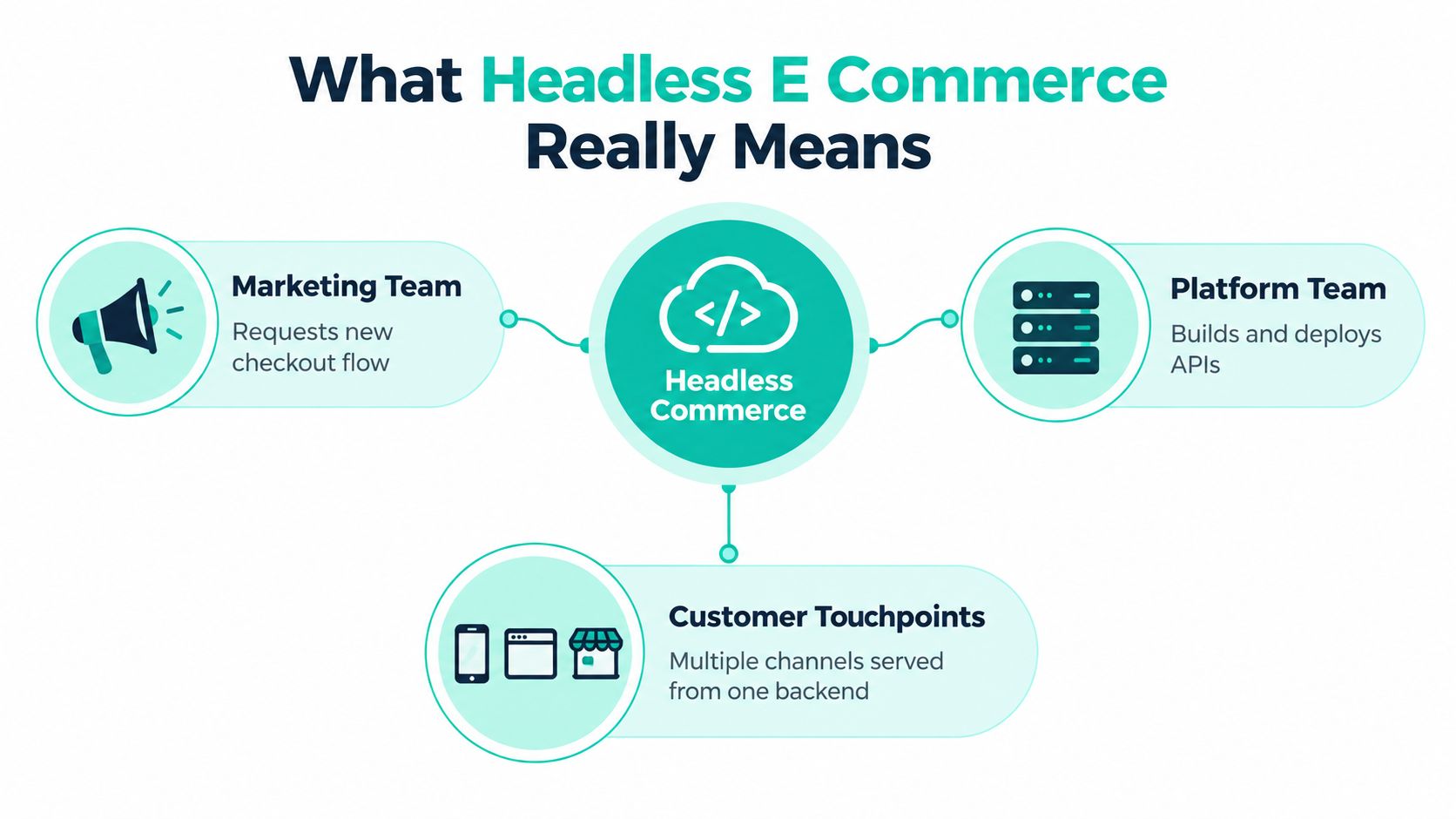
A regional merchandising team asks for a localized promotion. A mobile team needs the same catalog in an app. A marketplace team needs inventory and pricing without the storefront attached. On a monolith, each request queues behind the same codebase, the same release train, and the same templating engine.
Headless e commerce breaks that queue by separating the customer-facing presentation layer from commerce, content, and data back ends. APIs connect products, carts, payments, inventory, and experiences across websites, mobile apps, marketplaces, and other channels. You're not buying a product category. You're adopting an architectural pattern, which is why vendor comparisons get slippery so fast.
A Working Mental Model
Picture three layers. Storefronts sit on top and own rendering, interaction, and local market differences. Commerce and content services sit below and own catalog, pricing, cart, order, and editorial data. Contracts sit in the middle, and those contracts decide whether teams can move independently or just break each other faster.
Market estimates show this is no longer experimental, though definitions vary. One forecast projecting growth from $2.04 billion in 2025 to $6.17 billion by 2031 at a 20.69% compound annual growth rate is detailed in the headless commerce market forecast and adoption breakdown. That same forecast puts cloud deployment at 68.19% and large enterprises at 61.34% in 2025, a pattern that fits what ships in practice. Large organizations adopt headless first because they have the channel sprawl that justifies it.
If you can't name who owns each API contract, you don't have a headless architecture yet. You have distributed hope.
The Core Architectural Patterns
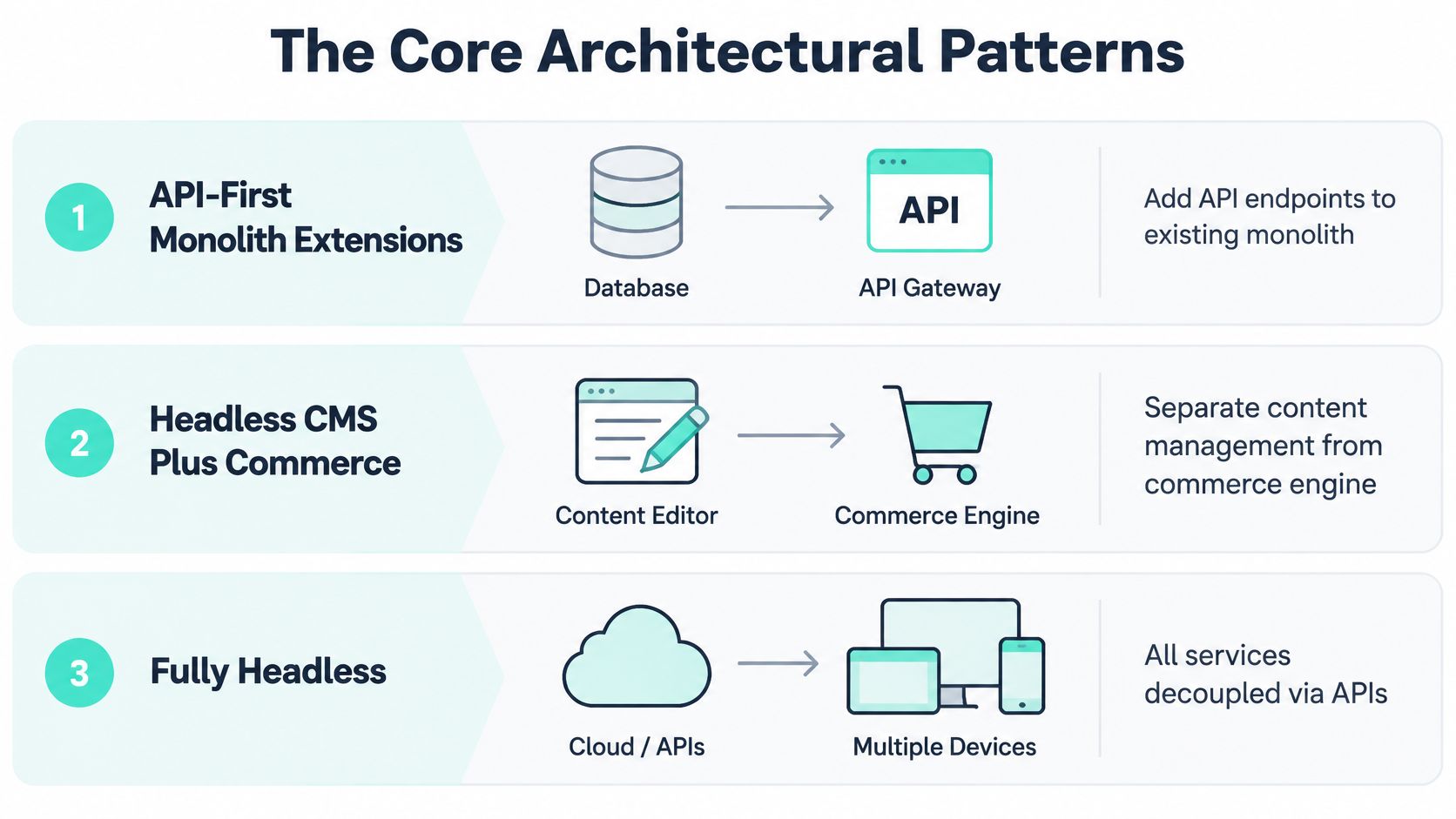
Three patterns cover most enterprise decisions. A restaurant analogy helps. The dining room is the front end, the kitchen is commerce logic, the pantry is content and product data, and APIs are the waiter carrying tickets between them. The question is how many separate kitchens you want to run.
Three Patterns Teams Actually Choose
- API-first monolith extensions: You keep the existing platform and expose endpoints for a new front end. This is the lowest-risk first step, though the monolith still sets your scaling ceiling.
- Headless CMS plus commerce: Content and commerce separate. A CMS owns pages and campaigns while a commerce engine owns cart and checkout, and the storefront composes both.
- Fully composable MACH stacks: Every capability is a chosen service. You get maximum replaceability and maximum integration ownership, as explored in this guide to ecommerce microservices architecture patterns.
One Request, End to End
A shopper opens a product page. Next.js serves the route, pulling page composition and editorial content from Sitecore XM Cloud through Experience Edge. The commerce engine returns price and availability, and Sitecore Personalize can adjust the experience for the segment. Nothing in that flow requires the CMS to know how checkout works, or the commerce engine to know how the hero banner renders.
That boundary discipline is the whole point. Sketch your stack, draw each boundary, and write a team name next to it. Any boundary without an owner will become an incident later.
Real Advantages and Hidden Trade-Offs
The genuine wins are real. Front end teams release independently, so a storefront fix doesn't wait for a commerce deployment. Channels reuse the same catalog, pricing, and content services instead of reimplementing them. Regional teams can localize presentation while commerce stays centrally governed, and you can replace a rendering framework without touching order management.
The brochure stops there. Every API boundary adds latency, failure modes, versioning pressure, and a separate security surface. You've reduced front end coupling, but you've increased organizational coupling across commerce, CMS, search, identity, analytics, payments, and experience teams. Someone now owns contract changes, deprecation windows, and cross-service testing forever, not just at launch.
Headless E Commerce Trade-Offs at a Glance
| Dimension | What Headless Buys You | What It Costs You |
|---|---|---|
| Release velocity | Independent storefront deploys | Coordinated contract versioning |
| Channels | One back end, many front ends | More surfaces to test and secure |
| Localization | Regional storefronts, shared commerce | Multilingual governance overhead |
| Technology choice | Swap presentation freely | You own integration and observability |
Decomposition can pay off when it's engineered properly. A benchmark reporting 9,754 ms versus 17,652 ms average response time and 5.62% versus 42.74% error rates for the compared architectures appears in the academic MACH architecture performance benchmark. Treat those figures as evidence that decomposition can help, not as a promise. Your result depends on service design, caching, and load testing, and a badly decomposed stack fails in more places than the monolith it replaced.
Choosing Platforms and Front End Frameworks
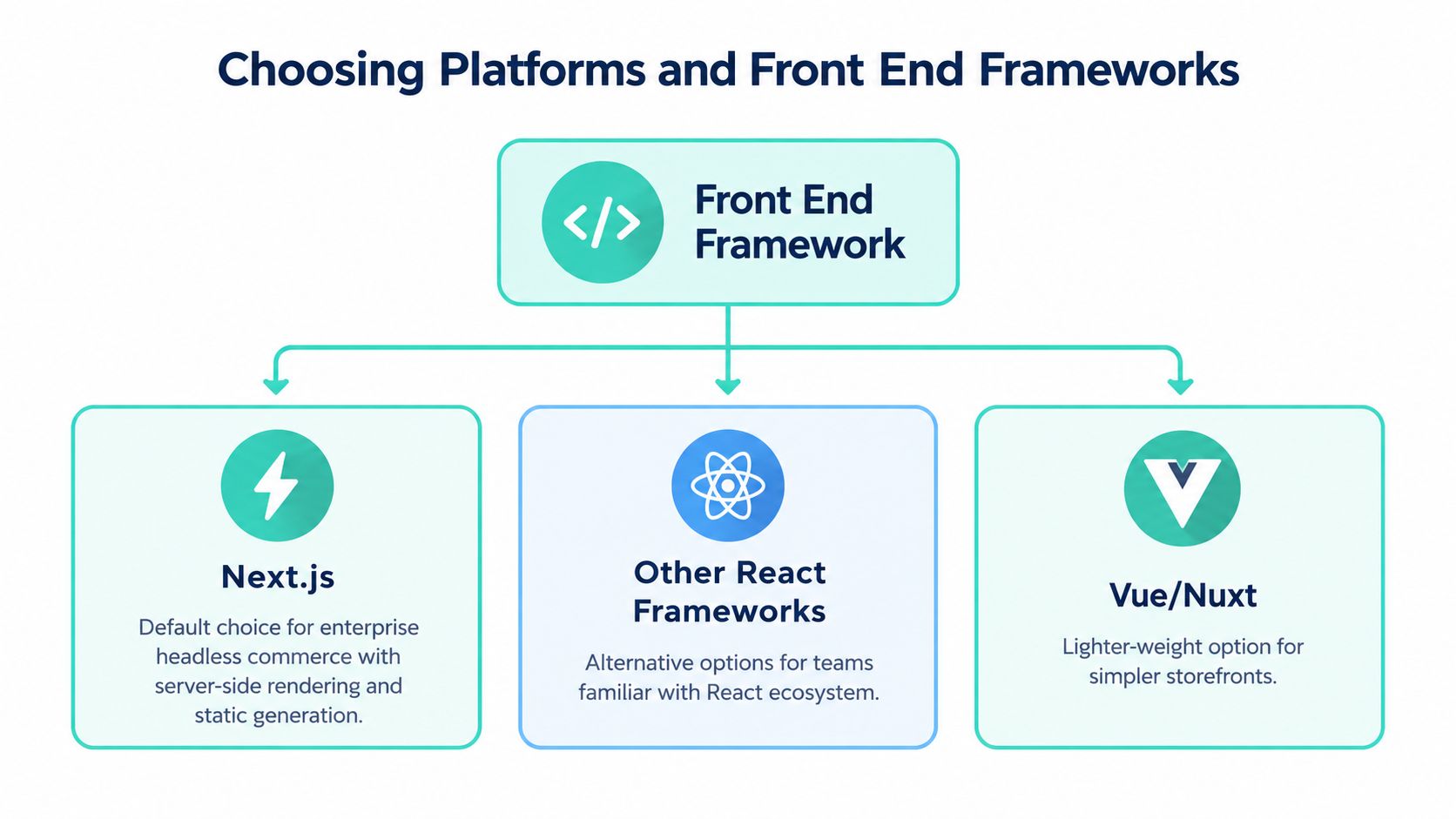
Next.js has become the default enterprise front end for a practical reason. It gives you server-side rendering, static generation, image optimization, and incremental regeneration in one framework, so teams can pick rendering per route instead of per platform. Product pages can be pre-rendered, while cart and checkout stay dynamic.
The Sitecore Delivery Stack
For the experience layer, Sitecore XM Cloud is the headless CMS at the center of many multinational builds. Sitecore documents the XM Cloud bundle as including the headless CMS, Pages editor, Sitecore Headless Experience Accelerator, Headless Services, the Sitecore Next.js SDK, and Experience Edge in its SitecoreAI platform bundle documentation. That combination matters because marketers keep visual authoring while developers get API delivery, which removes the most common headless complaint from content teams.
Commerce itself can come from an API-first engine composed alongside XM Cloud, and this overview of Sitecore commerce platform options maps how that pairing is typically structured. Search, payments, and identity follow the same rule. Compose them, but only where differentiation justifies another contract to maintain.
Reducing Duplication Across Brands
Multinational groups should invest early in Helix-based component libraries and a hub-and-spoke site model. Shared components, tokens, and templates live in the hub. Brands and regions extend rather than fork, which keeps accessibility fixes and performance work from being repeated in every market.
Defend a shortlist, not a religion. If your team can't explain why a framework fits its skills and release model, the framework isn't the problem.
Performance, Personalization, and the Conversion Question
Headless doesn't make a store fast. It makes performance your job, explicitly. A decoupled storefront can still drown in JavaScript hydration, personalization calls, search requests, tag managers, poor image delivery, and API waterfalls, and shoppers feel every one of those choices.
The frustration in the image below is what an unbudgeted headless build produces.

What Field Data Shows
Yottaa found that reducing mobile load time by one second increased conversions by 3%, while poorly optimized third-party applications reduced conversion by an average of 0.29% each, and HTTP Archive data shows 76% of Shopify sites passing all Core Web Vitals compared with 33% for WooCommerce, all summarized in Yottaa's 2025 Web Performance Index findings. Platform defaults matter, but so does discipline. A production measurement approach linking API latency thresholds to LCP and INP deterioration is documented in a 2026 headless storefront performance case study, and it's worth copying.
Set separate budgets for HTML delivery and commerce API calls. Instrument LCP, INP, and CLS by route type and geography, cache immutable content at the CDN edge, use tagged caching for catalog data, and test checkout separately from merchandising pages. Pair that technical work with a UX SEO audit checklist so search and experience regressions get caught together rather than in separate postmortems.
The video below walks through how these front end choices play out in a real build.
Every personalization call is a latency bet. Measure what each audience-specific decision earns against what it costs in milliseconds.
Adding AI, Search, and Personalization to the Stack
Treat AI as part of the authoring and decisioning layer, not as a chatbot bolted onto the footer. In a headless build, intelligence lives in the Sitecore service layer and rendering lives in your front end. That split keeps governance where marketers work and performance where developers work.
Sitecore Stream Inside the Workflow
Sitecore Stream is an AI layer integrated into supported Sitecore products, built on Microsoft Azure OpenAI Service. Sitecore documents it supporting ideation, content creation, refinement, campaign brief development, and message personalization inside tools like XM Cloud Page Builder, as described in the Sitecore Stream product documentation. Marketers generate, rewrite, or optimize component content through prompts or predefined quick actions without leaving their workflow.
That placement is the architectural lesson. AI output becomes governed content delivered through the same APIs as everything else, instead of unmanaged text injected at runtime.
Search, Data, and Decisioning
SitecoreAI connects Sitecore Search, Sitecore CDP, and Sitecore Personalize with the CMS, giving you retrieval, customer data, and decisioning as distinct services. Sitecore also documents generative Q&A grounded in a Search domain, plus visual search, brand kits, and brand-aware AI, in its Stream AI capabilities documentation. Answers come from your indexed content collection, so index quality becomes an operational responsibility, not a setup task.
For storefront implementation details, these ecommerce site search best practices cover how retrieval quality shows up in product discovery. Teams that also need customer-facing help can embed AI assistant in minutes for support use cases, keeping that separate from governed merchandising content.
Governance rule: prompts and quick actions need owners, brand constraints, and review steps. Ungoverned generation scales inconsistency faster than any CMS ever did.
Where SharePoint Fits in the Same Enterprise
Multinational groups run two experience problems at once. Customers need storefronts, personalization, and product search. Employees need intranets, documents, knowledge, and workflows. Collapsing those into one platform serves neither audience well.
A Hub-and-Spoke Boundary
SharePoint Online is the right home for the internal layer. SPFx components provide the extension model for custom SharePoint experiences, Power Platform supplies workflow and automation, and Microsoft 365 connectivity ties documents, communication, and identity together. Internal knowledge bases, approval flows, and document-centric processes belong there because that's the environment employees already authenticate into daily.
Sitecore XM Cloud owns the external layer in the same estate. Public-facing content, personalization, search, and omnichannel delivery stay in the customer experience stack, rendered through your headless front ends. This overview of SharePoint platform services shows how the internal side is typically delivered alongside a separate DXP.
- SharePoint owns: intranet publishing, internal search over documents, employee workflows, controlled document libraries
- Sitecore owns: storefronts, campaign pages, product discovery, audience personalization, multi-brand public sites
- Shared concerns: identity standards, accessibility requirements, analytics governance, release communication
Draw that line on a whiteboard and defend it in steering meetings. SharePoint isn't a substitute for the customer experience stack, and XM Cloud isn't an intranet. Enterprises that respect the boundary get governance across both without forcing one tool to imitate the other.
Enterprise Best Practices and Migration Playbook
Ask the five-year question first. When does headless lower total cost of ownership, and when does it just move cost from a platform license into specialist engineering and operations?
Staffing is the constraint nobody budgets. One industry survey reporting that 78% of 340 retailers struggled to find qualified headless developers, with delays averaging 3.2 months and typical mid-market implementation costs of $150,000 to $400,000, is presented in this headless commerce adoption and cost survey. Validate those figures against your own labor market, but don't ignore the signal. Model three to five years of cloud hosting, observability, QA, security patching, vendor lock-in, and rebuilding platform-native features before committing.
A Sequence That Survives Contact
- Audit the estate: inventory integrations, content models, and features the monolith gives you for free today.
- Prove one slice: launch a single brand or region on XM Cloud with Next.js and real commerce APIs.
- Industrialize reuse: expand through Helix component libraries, shared contracts, and multi-brand governance.
Operational discipline decides whether the migration holds. Run contract tests for product, price, inventory, cart, and checkout APIs. Enforce schema versioning, apply idempotency keys to payment and order mutations, propagate correlation IDs from browser to back end, and protect endpoints with OAuth, short-lived tokens, and rate limits. Monitor p95 and p99 latency, error budgets, and cache effectiveness, and load-test browse, search bursts, and flash-sale checkout separately. For the operational workflows around all this, MerchLoom's automation guide for retailers is a useful companion on reducing manual process overhead.
Kogifi delivers this kind of work as Sitecore XM Cloud and Next.js implementations with Helix-based component libraries, plus SharePoint Online intranets built with SPFx and Power Platform. That combination reflects the actual shape of enterprise estates, where customer storefronts and employee platforms modernize in parallel.
If you're weighing a move to headless e commerce on Sitecore XM Cloud, or untangling where SharePoint should sit in the same estate, our architects can audit your current platform, model the five-year cost, and prove the architecture on one brand before you scale it. Visit Kogifi to start that conversation with a team that ships and supports these platforms daily.