


Your global campaign was approved weeks ago, but it still hasn't launched. One market can't match its customer records to the central CRM, another is waiting for translation approval, and a simple hero change needs a developer release. Meanwhile, your analytics dashboard, ad platform, and CRM each report a different conversion count.
That's the pattern behind the most persistent Digital Marketing Challenges in enterprise teams. It's rarely a shortage of tools. It's disconnected content, data, approvals, and measurement slowing every launch while costs rise. The scale is unforgiving, since DataReportal reported 5.56 billion internet users at the start of 2025, up 136 million or 2.5% in one year. Audiences are spread across search, social, messaging, mobile, web, and commerce, so isolated campaign execution can't keep pace.
The eight challenges below are equally important. They're ordered from delivery foundations through data activation to enterprise adoption, each paired with a Sitecore led implementation pattern and, where employee workflow matters, SharePoint as the supporting layer. Each one gets a concrete acceptance test and an accountable owner, because a platform feature without ownership is just a capability demo.
Before any activation, treat measurement and privacy as cross cutting foundations. Agree conversion definitions, persistent campaign and content identifiers, consent states, and reporting ownership first. Architectural examples here are illustrative patterns, not verified client outcomes, and you should confirm current Sitecore AI product naming, licensing, and capability boundaries before publication or procurement. Teams exploring AI-powered funnel frameworks need those foundations in place before automation can prove incremental value.
Table of Contents
- 1. Slow Release Cycles on Monolithic CMS Paired with Sitecore AI Headless Delivery
- 2. Fragmented Customer Data Paired with Sitecore CDP
- 3. Generic Website Experiences Paired with Sitecore Personalize
- 4. Poor Product and Content Discovery Paired with Sitecore Search
- 5. Brand Sprawl and Inconsistent Governance Paired with Sitecore AI Multi-Site Hub-and-Spoke Architecture
- 6. Multilingual Content Bottlenecks Paired with Sitecore AI Localization Workflows
- 7. Accessibility and Compliance Gaps Paired with Accessible Sitecore AI Component Design
- 8. Disconnected Employee Communication Paired with SharePoint Online Intranets Using SPFx and Power Platform
Delivery Speed and Customer Data
1. Slow Release Cycles on Monolithic CMS Paired with Sitecore AI Headless Delivery
On a tightly coupled CMS, marketing waits for developer release windows to change a landing page, swap a campaign asset, or fix a conversion form. Engineering can't prioritize small editorial changes, and editors can't ship without them. Both teams look slow for structural reasons.
Sitecore AI, the platform formerly marketed as XM Cloud, separates content management from presentation. Authors work in a SaaS authoring environment, front ends are built with frameworks such as Next.js, and content is served through Experience Edge over GraphQL. Marketing and engineering release independently. Kogifi implements this with Helix based component libraries, so reusable components and templates are shared across brands and markets instead of rebuilt per site. For a practical overview of the trade offs, see this guide to the benefits of headless CMS architecture.

What the pattern looks like in practice
A multinational manufacturer replatforms regional sites onto a shared headless component library and launches new market sites from templates in weeks rather than months. An airport operator feeds its public website and its flight information front ends from a single Experience Edge content source. Customer stories on Sitecore document similar headless migrations in retail and financial services.
Don't start with front end code. Start with a content model audit and a component inventory, then define authoring roles and preview permissions early so editorial bottlenecks don't simply move to a new tool.
- Component library: Build shared components with versioning rules so brands reuse without forking.
- Front end ownership: Headless delivery doesn't remove hosting, caching, or performance responsibility for the front end.
- Release evidence: Measure publishing lead time and release frequency before and after migration.
Owner: Digital platform lead. Acceptance test: A trained editor publishes a new campaign page from shared components to preview and production without a code deployment, within the agreed lead time, while the engineering team ships an unrelated front end change in parallel.
2. Fragmented Customer Data Paired with Sitecore CDP
Your web analytics knows a device, your CRM knows an account, commerce knows an order, and email knows an address that may no longer match. Each system refreshes on its own schedule, so segments disagree and reports contradict each other in the same steering meeting.
That's a structural problem, not a reporting preference. Nielsen reports that 62% of global marketers use multiple tools for cross measurement, while 41% cite insufficient transparency into audience data as one of their two biggest problems. Adding another dashboard on top of conflicting identifiers won't fix it.
Sitecore CDP consolidates identity and behavioral data into unified profiles and segments that can be activated across channels. Combined with Sitecore AI and Sitecore Personalize, those profiles can feed on site experiences. Kogifi's integration work connects commerce, booking, and identity systems so segments reflect the full relationship, as described in these customer data integration solutions.

Separate integration from attribution
A CDP resolves identity and supplies segments. It doesn't independently prove which touchpoint caused a conversion, and conflating the two produces false confidence. A financial services provider, for example, may unify web behavior with CRM records to tailor messaging by life stage while respecting consent. A university may combine application portal activity with event registrations to segment prospective students. Both still need a canonical event taxonomy and documented attribution windows.
Define three to five priority segments before connecting sources. Map email, customer ID, and device ID, agree a master identifier, and involve legal and privacy teams in consent design from the first sprint. Start with one activation channel and expand after it works.
Owner: Customer data product owner, with privacy lead as approver. Acceptance test: For a consented test customer, events from web, CRM, and commerce resolve to one profile, invalid or non consented records are excluded from activation, and segment counts reconcile to source totals within documented tolerance.
Personalization and Discovery
3. Generic Website Experiences Paired with Sitecore Personalize
A first time visitor, a returning customer, and a distributor don't need the same homepage. When everyone gets the same experience, teams either accept weak conversion or build fragile manual rules nobody dares to touch.
Sitecore Personalize delivers real time personalization and experimentation across web and other touchpoints. It uses profile and behavioral signals to select content, offers, and layouts, and supports A/B and multivariate testing. Within Sitecore AI, decisions can be tied to headless components so the same logic applies across web and app experiences. Kogifi pairs this with governance rules so brand and legal constraints are enforced as part of delivery, which these website personalization tools and patterns explore further.

The harder problem is proving value. In a 2025 survey of 350 marketing leaders, 89% viewed AI as valuable but only 36% expressed high confidence in measuring campaign effectiveness. Production speed is an efficiency metric. Incremental conversion, retention, and margin are effectiveness metrics, and they need pre AI baselines and holdouts where feasible.
Keeping experiments honest
A retailer can test homepage variants for new versus returning visitors and roll out the winner by region. A B2B manufacturer can recommend case studies by industry and product interest captured in CDP profiles. In both cases, define one primary KPI before building variants and keep a governance log with rules, owners, and retirement dates.
Practical rule: If a personalization rule has no owner, no expiry date, and no holdout, it isn't a strategy. It's accumulated configuration.
Test every variant for accessibility and page performance, not only conversion. Run experiments long enough to reach significance and don't peek early to justify a launch date.
Owner: Experimentation lead. Acceptance test: The variant serves only to the intended eligible segment, consent non grant receives the default experience, events deduplicate correctly, and the experiment report separates attributed conversions from incremental lift against a control group.
4. Poor Product and Content Discovery Paired with Sitecore Search
Visitors who can't find a manual, a part number, or the right product variant don't admire your navigation. They leave, call support, or buy from a competitor whose filtering works. Large catalogs, technical documents, and multilingual content expose standard site search quickly.
Sitecore Search provides AI assisted search and discovery with relevance tuning, faceting, and merchandising controls, indexing content and product data for headless front ends. Sitecore's Stream capabilities include natural language question answering in Sitecore Search, with responses sourced from a configured content collection and search domain. That scoping matters, because AI answers grounded in a defined collection are easier to govern than open ended generation. It's also a reminder that AI drafting, search, and decisioning features may be native, separately licensed, or integration dependent, so verify scope before committing.
Where search programs usually stall
An energy company can index technical manuals and regulatory filings so engineers search by equipment ID and standard. A retailer can use faceted search and merchandising rules to promote seasonal ranges, which is where discovery connects to the ecommerce SEO specialist role and to landing page quality. Both fail if metadata is inconsistent, because relevance tuning can't compensate for missing taxonomy.
- Query audit: Review the top queries and null result queries before configuring relevance.
- Metadata first: Standardize taxonomy across content types before tuning boosts.
- Monthly relevance review: Give marketing, content, and merchandising owners a shared decision forum.
- Accessible results: Test keyboard navigation and screen reader announcements of result counts.
Kogifi's search driven portal work suits industrial, energy, and public sector sites with large document libraries, where filters and integrations carry more weight than visual design.
Owner: Search product owner. Acceptance test: For an agreed set of representative queries, including known null result terms, relevant results appear within the defined ranking threshold, filters return accurate counts, and expired or restricted documents don't appear.
Governance and Localization
5. Brand Sprawl and Inconsistent Governance Paired with Sitecore AI Multi-Site Hub-and-Spoke Architecture
Dozens of brand sites, regional domains, and campaign microsites usually means dozens of template sets, component forks, and release processes. Every rollout costs more than the last, and brand expression drifts because nobody knows which version is current.
A hub and spoke model in Sitecore AI establishes shared foundations, including a common component library, design tokens, content models, and governance workflows, while each brand or region adds local variation inside defined limits. Sitecore Stream uses Microsoft Azure OpenAI Service with retrieval augmented generation, pulling brand information from documents uploaded during brand ingestion and applying brand kits through the Sitecore Cloud Portal. That means AI assisted content in XM Cloud can be aligned to a selected brand's guidelines and tone, but only if the underlying brand material is curated and current.
Governance also protects trust. The Federal Trade Commission recorded more than 6.47 million consumer reports in 2024, with reported fraud losses exceeding US$12 billion. Impersonation, misleading offers, and unsafe landing experiences become easier when hundreds of unmanaged microsites sit outside monitoring and approval workflows.
Making shared actually mean shared
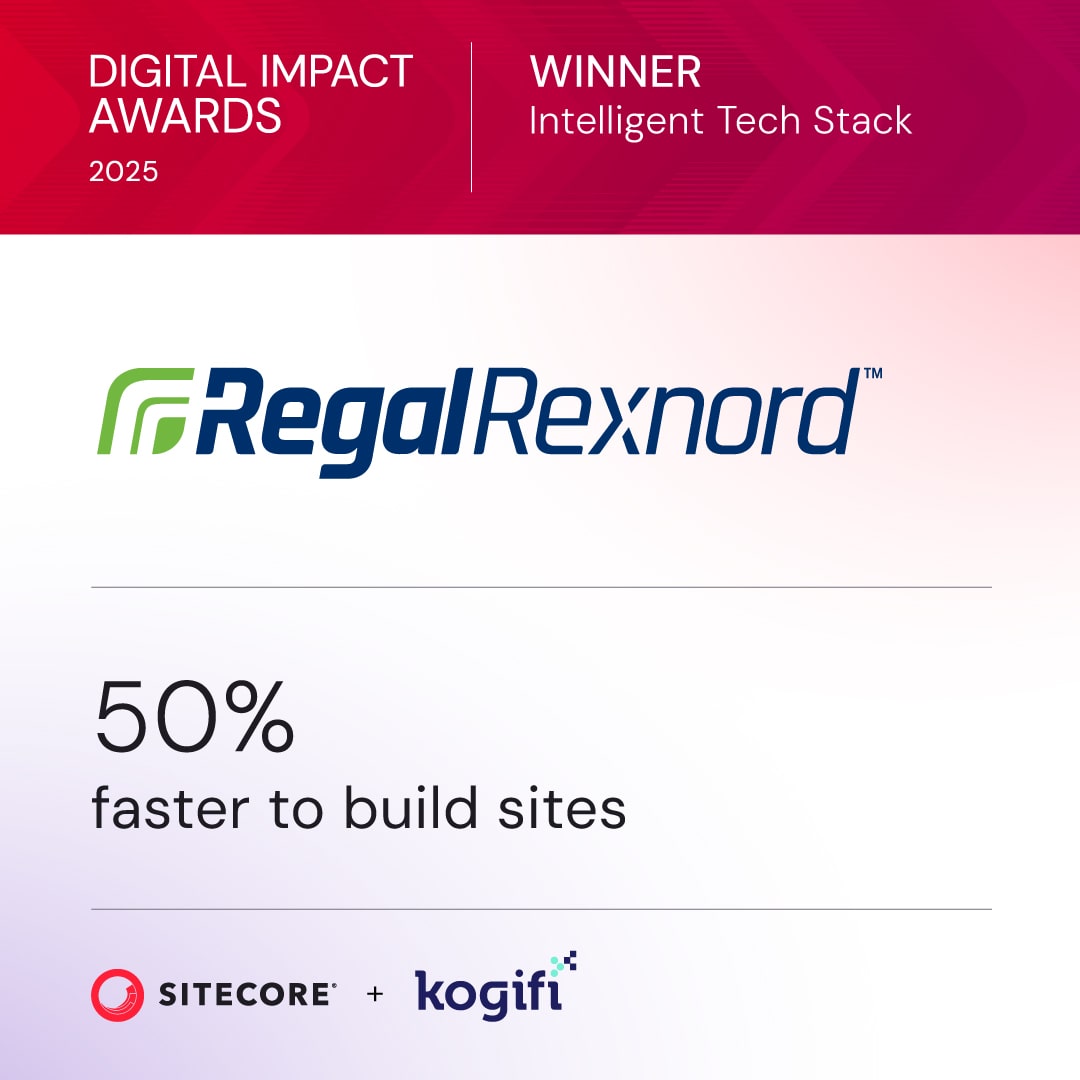
A global industrial group can launch regional sites from a shared library with localized content models. A hospitality group can consolidate separate brand sites around shared booking components. Kogifi builds these as standardized architectures with automated lifecycles, and its Sitecore Digital Impact Awards 2025 recognition for Market Trailblazer reflects this type of multi brand delivery.
Document a clear what is shared, what is local policy before writing components. Use semantic versioning for shared packages, publish release notes, and create a regional steering group that approves new shared components.
Owner: Global digital governance lead. Acceptance test: A new spoke site launches using only approved shared components and brand tokens, a component update propagates through versioned packages without breaking local variants, and time to launch is recorded against the previous baseline.
6. Multilingual Content Bottlenecks Paired with Sitecore AI Localization Workflows
Every content change multiplies across languages. Translation queues delay launches, terminology drifts between markets, and local versions lag behind the source, which creates compliance risk when regulated wording changes in one language but not another.
Sitecore AI supports multi language content structures, language fallback, and localized publishing, so regional teams manage their own versions inside a governed framework. Translation management integrations and AI assisted drafting can speed the first pass, provided human reviewers approve final output. That distinction between AI assisted production and human approval is non negotiable for legal, regulated, and high consideration content. Kogifi designs bilingual and multilingual architectures, including bilingual intranets, with terminology control and review workflows built in from the start.

Sequencing translation by risk, not by volume
A European enterprise may publish product pages in twelve languages from a single content model with vendor managed translation queues. A Middle Eastern organization may run Arabic and English sites with right to left layouts from one component library. Both need the same discipline that supports international SEO services, including consistent metadata, hreflang governance, and localized search intent rather than literal translation.
- Priority matrix: Legal and transactional content first, marketing content second, long tail last.
- Shared glossary: Link approved terminology directly to authoring guidance.
- Layout testing: Test right to left and long string languages during component design, not after launch.
- Turnaround KPI: Measure translation turnaround per market as an operational metric.
Owner: Localization lead, with regional content owners approving publication. Acceptance test: A source page update triggers the correct translation tasks, glossary terms are enforced, fallback behavior is verified for unpublished locales, and no localized page publishes without named human approval in the workflow history.
Accessibility and Employee Enablement
7. Accessibility and Compliance Gaps Paired with Accessible Sitecore AI Component Design
Accessibility defects usually start as small component decisions. A low contrast button, a broken focus order, an unlabeled form field. Reuse that component across brands, languages, and templates, and one defect becomes an estate wide remediation program discovered just before launch.
Designing accessibility into a Sitecore AI component library means reusable blocks inherit WCAG aligned patterns for contrast, focus management, heading structure, and form labeling. That improves the starting point for every page, but it doesn't guarantee page level WCAG compliance, because author content, media choices, and page composition still matter. Treat accessibility like performance or security engineering and measure task completion, form abandonment, search success, and support demand, not only audit findings.
Automated content raises the stakes. IAB research found more than 70% of surveyed advertising professionals had encountered an AI related incident, including hallucinations, bias, or off brand content, while fewer than 35% planned to increase investment in AI governance. AI generated alt text, headings, and summaries therefore need the same operational controls as any other content, not a policy statement.
Building checks into delivery
A university can redesign its component library around WCAG 2.2 AA criteria before migrating faculty sites. A financial services portal can ship keyboard accessible multi step forms with clear error messaging as shared components. Kogifi applies WCAG aware design and includes accessibility testing in its delivery pipeline, which matters most in public services, education, and financial services.
Name a single accessibility owner on every platform project and give that person release veto authority. Run automated scans in CI, schedule periodic manual audits with people who rely on assistive technology, and train authors using examples from your own site.
Owner: Accessibility lead. Acceptance test: Each shared component passes documented keyboard, focus, contrast, and labeling criteria in its acceptance tests, a representative page built from those components passes manual assistive technology checks, and blocking defects prevent release.
8. Disconnected Employee Communication Paired with SharePoint Online Intranets Using SPFx and Power Platform
Employees search email, shared drives, legacy intranets, and chat tools to find a policy, a form, or last week's announcement. Internal communication fragments, marketing and internal comms can't target the right audiences, and campaign assets circulate in outdated versions.
SharePoint Online provides the intranet foundation through communication sites, hub sites, and modern pages. SharePoint Framework, or SPFx, adds custom web parts connected to business systems, while Power Platform automates approvals, forms, and workflows. Microsoft Viva Connections can surface the intranet in Teams for mobile and frontline workers. Kogifi delivers bilingual, accessible intranets on this stack, detailed in its SharePoint intranet solutions.
AI assistance inside that environment has to respect permissions. Microsoft states that SharePoint agents answer questions about sites and document libraries only where the asker has permissions. Scale makes that control essential, since Microsoft reports organizations create more than two million SharePoint sites and upload more than two billion files daily.
Designing around employee tasks
A multinational manufacturer can launch a bilingual intranet with regional hubs, targeted news, and a Power Apps leave request workflow. An energy provider can use SPFx web parts to surface safety procedures on mobile for field staff. For marketing teams, the same structure supports campaign asset approval, brand guidance, and launch calendars in one governed place.
Design information architecture from real user tasks and card sorting before building web parts. Assign content owners and review dates to every site and major page, and use SPFx for reusable, supportable components rather than custom code embedded in pages.
Owner: Internal communications lead, with Microsoft 365 platform owner responsible for permissions. Acceptance test: A permission restricted document is invisible to unauthorized users in search and agent answers, a targeted news item reaches only its intended audience, and search success and task completion are measured against the pre launch baseline.
8 Digital Marketing Challenges & Solutions Compared
| Solution / Challenge | 🔄 Implementation Complexity & Resources | 📊 Expected Outcome | Ideal Use Cases | ⭐ Key Advantages |
|---|---|---|---|---|
| Sitecore AI Headless Delivery, slow CMS release cycles | High; requires headless front-end, DevOps, content-model planning, and migration work | ⚡ Faster independent content and application releases | Enterprise teams modernizing legacy CMS platforms and running multiple campaigns or sites | Decoupled publishing; reusable components; CDN-backed delivery |
| Sitecore CDP, fragmented customer data | High; needs integrations, identity mapping, consent design, and ongoing data governance | Unified profiles and more consistent cross-channel audiences | Organizations with customer data spread across CRM, commerce, web, and offline systems | 💡 Supports cross-channel activation and journey measurement |
| Sitecore Personalize, generic website experiences | Medium–high; requires audience data, testing expertise, clear KPIs, and governance | 📊 More relevant experiences and measurable conversion improvements | E-commerce, travel, and multi-brand businesses with varied audiences | Real-time personalization; experimentation validates changes |
| Sitecore Search, poor product and content discovery | Medium; depends on clean metadata, indexing, relevance tuning, and language testing | ⚡ Faster discovery, potentially higher conversion, and fewer support queries | Organizations with large catalogs, technical libraries, or multilingual content | Business-user controls; search analytics reveal content gaps |
| Sitecore AI Multi-Site Hub-and-Spoke, brand sprawl and inconsistent governance | High upfront; requires shared architecture, governance, versioning, and executive alignment | 📊 Faster site launches with more consistent branding and lower duplication | Multinational groups managing multiple brands, regions, or domains | Shared foundations balance central standards with local variation |
| Sitecore AI Localization Workflows, multilingual content bottlenecks | Medium–high; requires translation workflows, integrations, language testing, and human review | ⚡ Faster localized publishing with clearer review and approval | Multinational organizations and public-sector bodies serving multiple languages | Shared content models, language fallback, and governed localization |
| Accessible Sitecore AI Components, accessibility and compliance gaps | Medium–high; requires WCAG-aware design, automated checks, manual audits, and author training | 📊 Fewer late-stage fixes and more accessible experiences | Public services, education, financial services, and other regulated sectors | ⭐ Reusable accessible patterns reduce page-by-page remediation |
| SharePoint Online Intranet with SPFx and Power Platform, disconnected employee communication | Medium; requires information architecture, content ownership, and selective custom development | ⚡ Easier access to internal information and automated workflows | Organizations needing secure workforce communication across locations | Familiar Microsoft 365 tools; integrates intranet, Teams, and workflow automation |
Build a 90-Day Roadmap With Measurable Release Gates
Don't try to solve all eight challenges at full scale at once. Sequence the work in three phases, and let evidence from each phase decide whether the next one expands.
Days 1 to 30, baseline. Measure publishing lead time, identity match quality, search success, translation turnaround, accessibility defects, and approval delays. Audit every KPI for source system, identity key, attribution window, data latency, and confidence level. IAB's 2024 State of Data research found 71% of organizations were currently or planning to grow first party data collection, so confirm consent states, retention limits, and deletion propagation before collecting more.
Days 31 to 60, pilot. Run one campaign, one audience, and one market using reusable Sitecore components, CDP segments, governed localization, and a SharePoint supported approval process. Where asset operations are the bottleneck, scope Content Hub separately as an asset and content operations option, since its AI assisted visual search and text refinement support a different workflow from page delivery.
'A platform enables the workflow; ownership, evidence, and release gates make it reliable.'
Days 61 to 90, evaluate and expand. Compare results with the day 30 baseline and expand only after acceptance gates pass. Give each challenge a named owner, one outcome metric, and one safeguard, whether that's consent exclusion, accessibility veto, or translation approval.
Measurement deserves explicit handling. Validate event schemas and campaign tagging against CRM confirmed conversions, deduplicate events, document attribution windows, and use randomized holdouts where feasible to distinguish incremental lift from attributed conversions. A CDP supplies unified profiles, but it doesn't independently solve attribution, and reporting modeled conversions as observed fact will eventually undermine budget decisions.
Privacy and compliance sit separately from accessibility. Use consent aware ingestion and activation, data minimization, regional retention rules, least privilege access, and legal review of regional requirements, and report consent rates, match rates, and unavailable event percentages alongside performance. Which AI drafting, search, and decisioning features are native, separately licensed, or integration dependent should be confirmed in writing before a roadmap depends on them.
Kogifi can support that assessment with a Sitecore architecture, analytics, AI readiness, and governance review. The firm brings 70+ DXP projects and 50+ specialists across Sitecore, Adobe Experience Manager, and Microsoft 365 and SharePoint delivery, without extrapolating that experience into promised results for your estate.
If slow publishing, fragmented data, or ungoverned AI content is holding your campaigns back, Kogifi can assess your Sitecore and SharePoint estate, prioritize the eight challenges by business risk, and build a 90 day roadmap with measurable release gates. Visit Kogifi to discuss a Sitecore architecture, analytics, AI readiness, and governance assessment for your team.