


Website personalization tools are essentially software platforms that allow you to customize a website's content, offers, and the entire user journey based on who is visiting. These tools work by gathering data about each visitor and then using it to deliver relevant, real-time experiences designed to boost engagement and, ultimately, conversions.
Moving From Static Pages to Dynamic Experiences
Think about the difference between walking into a generic department store versus a high-end boutique. The department store has the same layout and products for everyone. The boutique, on the other hand, feels like it has a personal shopper who already knows your style, anticipates what you’re looking for, and points you toward things you'll actually love. That's the leap that modern website personalization tools make possible online.
For years, websites were just static, digital brochures. They were the online equivalent of a one-size-fits-all catalog where every single visitor—no matter their location, interests, or browsing history—saw the exact same thing. In a world where people expect digital interactions to feel as natural as a real conversation, that old approach just doesn't cut it anymore.
The Evolution to Conversational Commerce
The shift from static to dynamic is really about moving from a monologue to a dialogue. Instead of a website shouting one message at everyone, a personalized site actively listens and responds to each user. This is all powered by sophisticated platforms that can:
- Track user behavior: Watching what people click, which pages they view, and how long they stay.
- Analyze real-time data: Quickly spotting patterns to figure out what a visitor wants during their session.
- Adapt content dynamically: Instantly swapping out hero banners, product recommendations, and calls-to-action to match that visitor's intent.
This creates a truly responsive digital environment where the journey is almost co-created with the user, making every interaction feel unique and relevant. To really nail this, you have to understand the fundamental principles of web content personalization.
Why Dynamic Experiences Are a Business Imperative
This isn't just about making a website look cool; it's a core business strategy. When your site adapts to a visitor, it starts building a relationship, which fosters trust and long-term loyalty. Platforms like Sitecore are leading this charge, offering integrated Digital Experience Platforms (DXPs) that help turn anonymous traffic into known customers with individually tailored journeys. To learn more, check out our in-depth guide on what is content personalization and why it's so important strategically.
A dynamic website doesn't just display information; it anticipates user needs and solves problems before they're even fully articulated. This proactive engagement is what separates leading brands from the competition.
When you start thinking of your website as a living, responsive entity, you set the stage for much higher engagement, stronger customer relationships, and serious business growth. The right tools make this complex-sounding process manageable, turning raw data into meaningful conversations.
The Architecture of a Modern Personalization Engine
A powerful personalization strategy needs more than just good intentions—it needs a robust technical architecture humming along behind the scenes. This engine is what separates clunky, rule-based adjustments from the kind of predictive, genuinely helpful experiences that customers remember. At its core, this architecture isn't a single piece of software but an integrated ecosystem of powerful components. Sitecore's product portfolio is a perfect example of how these pieces fit together.
The demand for these advanced systems is exploding. The personalization software market is expected to jump from $9.94 billion to a staggering $45.07 billion by 2032. This isn't surprising when you consider that 73% of customers now expect technology to understand their unique needs. Businesses are listening, with over 92% already using AI-driven personalization to hit their goals, as highlighted in recent personalization market research.
The DXP as the Central Hub
The foundation of any modern personalization engine is the Digital Experience Platform (DXP). Think of a DXP as the central command center for all your digital interactions. It’s where your content lives, where marketing campaigns are launched, and where every customer touchpoint is managed. A DXP like Sitecore Experience Platform (XP) or Sitecore Experience Manager (XM) provides the content management muscle and the delivery channels needed to get that information in front of the user.
But the DXP doesn't work alone. Its real power is unlocked when it connects with other critical systems that feed it the data it needs to make smart decisions. This is where a Customer Data Platform comes in.
Unifying Customer Data with a CDP
While the DXP handles the what (content) and the where (channels), the Customer Data Platform (CDP) manages the who. A CDP, such as Sitecore CDP, acts as the central brain for all your customer data. It pulls in information from countless sources—website behavior, mobile app usage, CRM history, in-store purchases, support tickets—and stitches it all together into a single, unified customer profile.
This unified view is the bedrock of effective personalization. Without it, you’re only personalizing based on fragmented snapshots of behavior, not the complete picture of the individual. A CDP turns anonymous data points into a coherent customer story.
The relationship between visitor data, behavior, and content is a dynamic loop, as this graphic shows.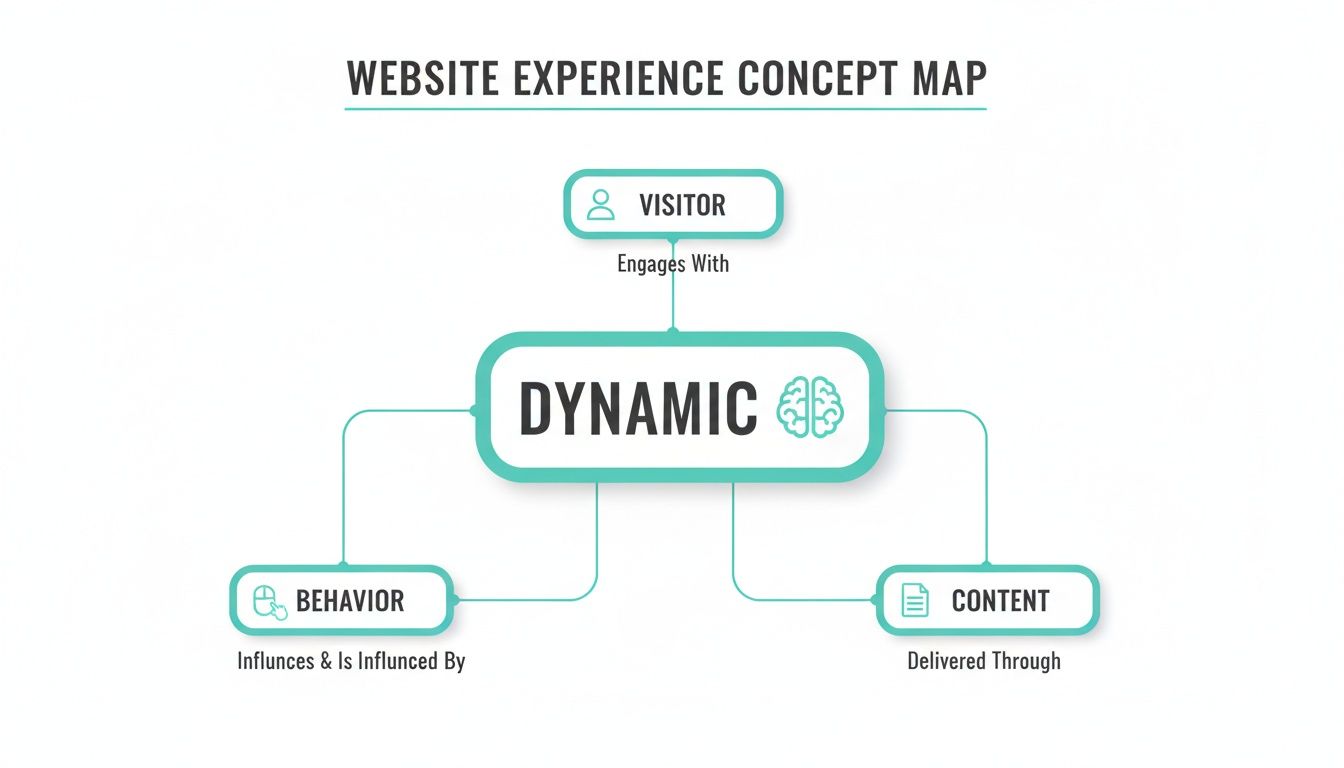
It's not a one-way street. Every action a user takes should inform the next piece of content they see, creating a continuous feedback cycle.
Rule-Based vs. AI-Driven Personalization
Once you have your data unified in a CDP and your content ready in a DXP, the next question is how to personalize. There are two main approaches here:
- Rule-Based Personalization: This is your classic "if-then" logic. For example, "If a visitor is from London, then show them the UK-specific homepage banner." It’s a great starting point and works well for straightforward segmentation. In a SharePoint environment, you could use its audience targeting features to show different content on an intranet portal based on an employee's department.
- AI-Driven Personalization: This is where the engine gets predictive. Instead of relying on predefined rules, machine learning algorithms analyze mountains of data to anticipate what a user wants next. Tools like Sitecore Personalize use AI to spot subtle patterns a human marketer would likely miss. It might figure out, for instance, that users who view Product A and spend over three minutes on a specific blog post are highly likely to buy Product B, then automatically show them that offer.
This AI-driven approach is a huge advantage of a mature DXP ecosystem like Sitecore's. The right architecture lets you move seamlessly from basic rules to sophisticated, predictive models. For a deeper look at modern DXP structures, check out our guide on composable DXPs for scalable personalization.
When the DXP, CDP, and AI engine all work in harmony, the result is an experience that feels less like a website and more like a helpful, intelligent conversation.
Connecting Personalization to Business Growth
Let's get straight to the point: advanced website personalization isn't just a fancy tech upgrade. It's a direct line to measurable business growth. While the architecture of a DXP like Sitecore provides the engine, the real magic happens when you translate its capabilities into tangible outcomes—higher revenue, deeper customer loyalty, and a more efficient sales process.
The connection between a tailored experience and bottom-line results is remarkably clear, and the impact is often immediate. Brands that get personalization right see an average 80% increase in conversion rates and 40% higher order values.
Think about the flip side. A staggering 76% of consumers say they get frustrated when they land on a website that isn't personalized. Even something as simple as a personalized call-to-action has been shown to outperform a generic one by 202%. You can dig deeper into these personalization statistics and their business implications to see just how much is at stake.
Driving Revenue with Sitecore DXP
This is where a platform like Sitecore comes in. It's engineered to turn these powerful statistics into your reality. By seamlessly integrating a powerful CMS, CDP, and personalization engine, the Sitecore DXP creates a closed-loop system where data drives action, and that action generates even more refined data. It’s a powerful cycle of continuous improvement that fuels revenue.
Here’s how Sitecore ties personalization directly to the KPIs that matter:
- Increased Conversion Rates: Sitecore's real-time personalization lets you test and deploy tailored content, offers, and CTAs based on what a visitor is doing right now. For an e-commerce site, that could mean showing a "Free Shipping" banner only to users who have abandoned a cart, giving them that final nudge to complete the purchase.
- Higher Average Order Value (AOV): With data from Sitecore CDP, you can serve up genuinely intelligent product recommendations. A visitor browsing high-end cameras can be shown compatible lenses and accessories, transforming a single-item purchase into a much larger, more valuable order.
- Shortened B2B Sales Cycles: The B2B sales journey is long and complex, but personalization can speed things up. Sitecore allows you to build personalized content paths for different industries or job roles, serving up the exact whitepapers, case studies, and webinars that address their specific pain points. You're not just selling; you're guiding them to a solution.
A personalized experience transforms the customer journey from a simple transaction into a guided conversation. Each interaction is an opportunity to prove you understand the customer's needs, which is the foundation of both immediate sales and long-term loyalty.
The real key is leveraging the unified customer profile inside the Sitecore CDP. When your DXP knows a visitor is a returning customer from the financial services industry who previously downloaded a report on cybersecurity, it can deliver a homepage experience that speaks directly to them, skipping all the generic noise.
Personalization for Internal Growth with SharePoint
Personalization isn't just for your external customers; it's just as powerful for your internal teams. For large enterprises using SharePoint as their intranet, personalization is a game-changer for employee engagement and productivity. It turns a static, one-size-fits-all information hub into a dynamic, role-specific workspace.
Imagine a global company's intranet. With SharePoint's audience targeting features, you can make sure that:
- An engineer in the Berlin office sees technical documentation and local office news right on their dashboard.
- A sales rep in New York is greeted with the latest sales numbers, CRM updates, and competitive intel.
- A new hire gets a personalized onboarding checklist and introductions to their immediate team.
This kind of internal personalization cuts down on information overload, helps employees find what they need faster, and fosters a much stronger sense of connection to the organization. By making the digital workplace more relevant and efficient, businesses can boost productivity and employee satisfaction—two crucial drivers of overall success.
Whether you're facing customers or supporting employees, the principle is the same: using data to deliver relevance is what drives growth.
Building Your Data and Integration Foundation
A powerful personalization engine is a lot like a high-performance race car—it looks impressive, but it’s completely useless without the right fuel. In the world of website personalization, that fuel is data. Getting your data and integration foundation right isn't just a preliminary step; it’s the single most critical factor that will determine if your strategy soars or sputters. This is about building an ecosystem, not just installing another tool.
It all starts with understanding the essential types of data that give you a complete, 360-degree view of your customers. Each piece of information is a different lens through which you can see their needs and motivations.
Unifying Your Core Data Types
To create experiences that genuinely resonate, you have to collect and unify three main categories of data. Think of them as the essential ingredients in your personalization recipe.
- Behavioral Data: This is the what and how. It tracks which pages a user visits, how long they stay, what they click on, and their path through your site. This data is fantastic for revealing a user's intent in real-time.
- Transactional Data: This covers a user's purchase history, abandoned carts, and past orders. It tells the story of their relationship with your brand and what they truly value.
- Demographic Data: This is the who and where. It can include anything from location and job title to industry or other details a user provides through a form or account creation.
The real challenge? This data is almost always scattered across separate, disconnected systems. That's where a Customer Data Platform (CDP) like Sitecore CDP becomes indispensable. It acts as a central nervous system, pulling in data from all these sources and stitching it together into a single, unified, and actionable customer profile.
The Critical Role of System Integration
Once your data is unified in a CDP, the next move is connecting your personalization engine to the rest of your tech stack. A personalization tool can't work in a vacuum; it needs to receive signals from and push actions to your other core platforms.
Effective personalization depends on seamless data flow between systems. When your CRM, e-commerce platform, and personalization engine are in constant communication, you can create a truly consistent and context-aware customer journey across all touchpoints.
This is where an integrated platform like the Sitecore DXP really shows its muscle. It’s designed to connect natively with essential business systems, creating an ecosystem where data flows without friction. For instance, integrating with a CRM lets you personalize a website experience based on a lead's sales stage. Connecting to an e-commerce platform enables real-time, inventory-aware product recommendations. Pulling this off requires a solid strategy for customer data integration solutions to get every system speaking the same language.
Navigating Privacy and Consent
Building this data foundation comes with some non-negotiable responsibilities. In an era of regulations like GDPR and CCPA, data privacy and consent are paramount. Your ability to personalize is entirely dependent on your customers' trust.
This means you must be crystal clear about what data you collect and how you use it. Consent management platforms (CMPs) are essential for managing user preferences and staying compliant. As you build your data foundation, it’s critical to factor in how data is collected and managed, which includes understanding cookie policies and their privacy implications.
But ethical considerations go beyond just legal compliance. The goal is to use data to be helpful, not creepy. An expert partner can be vital for navigating these technical and regulatory complexities, ensuring your personalization efforts are both effective and respectful of user privacy.
How to Choose the Right Personalization Tools
Picking the right website personalization tools can feel like you're navigating a maze. With countless platforms all making the same promises, it’s easy to get lost in a sea of marketing buzzwords. The best way forward is to create a structured evaluation plan that helps you cut through the noise and focus on what actually matters for your business—both now and down the road.
The trick is to look beyond a simple feature checklist. You need to assess how a tool fits into your bigger digital strategy, which means taking a hard look at its architecture, how it scales, and how well it plays with your other systems. For any company serious about creating sophisticated, real-time experiences, this evaluation almost always boils down to one key choice: go with a fully integrated Digital Experience Platform (DXP) or piece together a collection of separate, best-of-breed point solutions.
Frame Your Evaluation Around Strategic Goals
Before you even glance at a single demo, you have to define what success actually looks like for you. Are you trying to boost e-commerce conversion rates? Generate higher-quality B2B leads? Or maybe improve how your employees engage with your intranet? Your main goal will determine the kind of personalization you need, and by extension, the tools that are right for the job.
- For E-commerce Growth: Your focus will be on tools that are masters of real-time behavioral tracking, abandoned cart recovery, and AI-powered product recommendations. A tool like Sitecore Discover is a perfect example, as it's built from the ground up for commerce search and merchandising.
- For B2B Lead Generation: Here, you'll need a platform that can map out long customer journeys, identify anonymous visitors by their company, and serve up personalized content based on their industry or job title. Sitecore Personalize is a standout here, enabling complex A/B testing and decisioning.
- For Internal Engagement: If the goal is a more relevant intranet for your team, a platform like SharePoint with its audience targeting features is a great place to start for rule-based personalization.
The smartest approach is to map your business needs directly to the specific tools in a product portfolio. A mature ecosystem like Sitecore's lets you pick the right tool for the right job—whether it's the content foundation of XM Cloud, the data unification of its CDP, or the AI-driven decisioning of Personalize.
Getting this distinction right is a crucial first step. You can get a much deeper look into the available technologies by reading a detailed guide to content personalization software, which breaks down how different solutions are designed to solve these unique business challenges.
Critical RFP Questions to Ask Vendors
When you're putting together a Request for Proposal (RFP), your questions need to force vendors to show you the substance behind their sales pitch. Don't just ask, "Do you have AI?" Instead, ask questions that reveal the true power and flexibility of their platform.
- Data Integration: "How does your platform pull together data from online sources like our website and app, and offline systems like our CRM and ERP, into one customer profile? Can you walk me through the technical details?"
- Personalization Models: "Explain the difference between your rule-based and machine-learning models for personalization. How much control do our business users have over the AI algorithms?"
- Scalability and Performance: "What’s the typical delay from when data is captured to when a personalized experience is delivered on our site? How does your system handle sudden traffic spikes?"
- Developer Experience: "How easy is it for our developers to build custom integrations and components? Do you have solid API documentation and support?"
These kinds of questions move the conversation from a basic feature check to a strategic discussion about how the tool will actually perform in your specific tech environment.
Integrated DXP vs. Point Solutions
One of the biggest decisions you'll face is whether to go all-in on a unified platform or assemble a collection of specialized tools. While the "best-of-breed" approach gives you flexibility, an integrated DXP offers long-term strategic benefits that are incredibly difficult to match.
Comparing Personalization Approaches
Choosing between an integrated platform and a collection of individual tools is a major strategic decision. A DXP offers a cohesive, all-in-one system, while point solutions provide specialized functionality. The table below breaks down the key differences.
For businesses that are truly committed to making personalization a core engine for growth, the streamlined and efficient nature of an integrated DXP like Sitecore almost always delivers a better long-term ROI. The platform is designed to work as a cohesive whole, getting rid of the friction and headaches that so often come with trying to stitch together multiple vendor solutions.
Your Roadmap to a Successful Implementation
Rolling out a personalization strategy isn't like flipping a switch. It’s a journey that demands a clear map. A phased, strategic approach ensures your investment in powerful website personalization tools actually delivers, rather than turning into an expensive, overwhelming experiment. The secret is to start small, prove the value quickly, and then scale up intelligently.
First things first: set precise, measurable goals. Don't settle for a vague objective like "improve the user experience." Get specific. Aim for something concrete, like "increase conversion rates for first-time visitors from North America by 15% in the next quarter." That kind of clarity turns a fuzzy vision into a real, actionable plan.
With a clear goal, you can zero in on high-impact audience segments. Forget trying to personalize for everyone all at once. Pick a well-defined group where you have solid data and a clear hypothesis—think returning customers who previously browsed a specific product category.
Launching Your Pilot Program
A pilot program is your proving ground. It’s where you test your assumptions on a smaller scale before committing to a full rollout. For businesses in the Sitecore ecosystem, this could be as simple as using Sitecore Personalize to run an A/B test on a single landing page. You might show one segment a tailored hero banner while the control group sees the default version.
This initial phase helps you sidestep common pitfalls, like launching with flimsy data or having no baseline to measure success against. By focusing on one specific use case, you can gather clean data, demonstrate ROI, and start building some serious momentum within your organization.
The most successful implementations always start with a single, well-defined win. Proving the value of personalization on a small scale makes it infinitely easier to get buy-in for broader, more ambitious initiatives.
Scaling with a Strategic Partner
Once your pilot program proves your strategy is a winner, it’s time to scale. This is where an integrated platform like Sitecore DXP really starts to shine, letting you expand your efforts across more pages, channels, and audiences without creating messy data silos. The same logic applies to a SharePoint intranet—you can go from personalizing a departmental landing page to creating role-specific dashboards for the entire company.
This whole journey—from setting goals and picking segments to launching pilots and scaling up—is complex. An expert partner like Kogifi acts as your guide through every stage. We help connect the dots between your business objectives and the technical muscle of your DXP, making sure your implementation roadmap leads directly to a bigger return on your technology investment.
Frequently Asked Questions
Got questions about website personalization tools? You're not alone. It's a complex space, and it's easy to get tangled up in the terminology. Let's clear up a few of the most common questions, using platforms like Sitecore and SharePoint as real-world reference points.
What Is The Difference Between Personalization And Customization
It really boils down to who’s in the driver's seat. Think of customization as something the user does. When they switch a website to dark mode or rearrange widgets on a dashboard, they're manually tailoring the experience to their own liking. They're in control.
Personalization, however, is driven by the system. The platform analyzes data—behavior, context, past interactions—and automatically adapts the experience for the user. A powerful tool like Sitecore Personalize is a master at this, anticipating what a visitor needs and shaping the journey on the fly, all without the user having to lift a finger.
How Much Data Do I Need To Start Personalizing My Website
You can get started with less data than you might think. In fact, you probably have enough already. Basic information like pages visited, geographic location, and device type is often plenty to create meaningful segments and score some early wins.
The trick is to start small. Don't try to personalize for everyone at once. Pick a specific, high-value audience and a clear goal, then build from there. As your strategy grows, you can pull in more data sources with a Customer Data Platform like Sitecore CDP, which lets you build incredibly rich user profiles for true one-to-one experiences.
How Do You Measure The ROI Of Personalization Tools
Measuring the return on investment (ROI) from personalization isn't guesswork; it's about running controlled tests. The standard method is A/B or multivariate testing. You show a personalized experience to one group of users and the generic version to a control group, then you compare the results.
The KPIs that really matter here are conversion rates, average order value (AOV), and customer lifetime value (CLV). An enterprise DXP like Sitecore comes with built-in analytics that make this easy, showing you the direct financial lift from your personalization efforts so you can clearly prove its value to stakeholders.
At Kogifi, we specialize in implementing advanced DXP solutions that turn data into measurable growth. Our expertise with Sitecore and SharePoint ensures your personalization strategy is built on a solid foundation, ready to deliver exceptional customer experiences. Learn how our services can help you unlock the full potential of your digital platform.