


Calculating ROI for content marketing means pitting the total revenue your content generates against what you spent creating and distributing it. For large enterprises, this is about more than just page views. It's about translating actions—like a PDF download or a demo request—into hard numbers that connect directly to the sales pipeline.
Building Your Content ROI Measurement Framework
To really get a grip on content ROI, you need a framework that speaks the language of business revenue, not just marketing activity. That means ditching vanity metrics and getting crystal clear on what "Return" actually means for your organization. The formula itself is simple: (Return - Investment) / Investment. The tricky part? Nailing down those variables, especially the 'Return.'
Success here starts with assigning a specific dollar value to every key conversion. A demo request isn't just a click; it's a potential sales opportunity with an average contract value. A whitepaper download isn't just a lead; it's a prospect signaling clear intent.
This becomes much more manageable inside a Digital Experience Platform (DXP) like Sitecore. You can configure goals in Sitecore Analytics to track these conversions and assign a financial value to each. For example, if you know that 1 in 10 demo requests turns into a customer with a $50,000 lifetime value, you can assign an engagement value of $5,000 to every single request. Instantly, your content is tied to the pipeline.
Assigning Value in Different Environments
In a Sitecore environment, you have the power to trace a user’s entire journey, from their first blog visit to their final purchase. Using tools like Sitecore Personalize lets you attribute value across multiple touchpoints, giving you a complete picture of how different content pieces chip in to close a deal. For more on this, some excellent guides on measuring content marketing ROI offer additional perspectives on the practicalities.
This same logic applies to internal comms on platforms like SharePoint, too. Here, 'Return' isn't about revenue but about boosting efficiency and engagement. You could calculate the ROI of an internal training document by measuring:
- Reduced Support Tickets: A noticeable drop in help desk requests on that topic.
- Increased Productivity: The time saved when employees find information themselves instead of bugging colleagues.
- Adoption Rates: How many employees actually interact with key policy documents, which helps with compliance and reduces risk.
The process below lays out the foundational steps for building a clear, effective ROI framework.
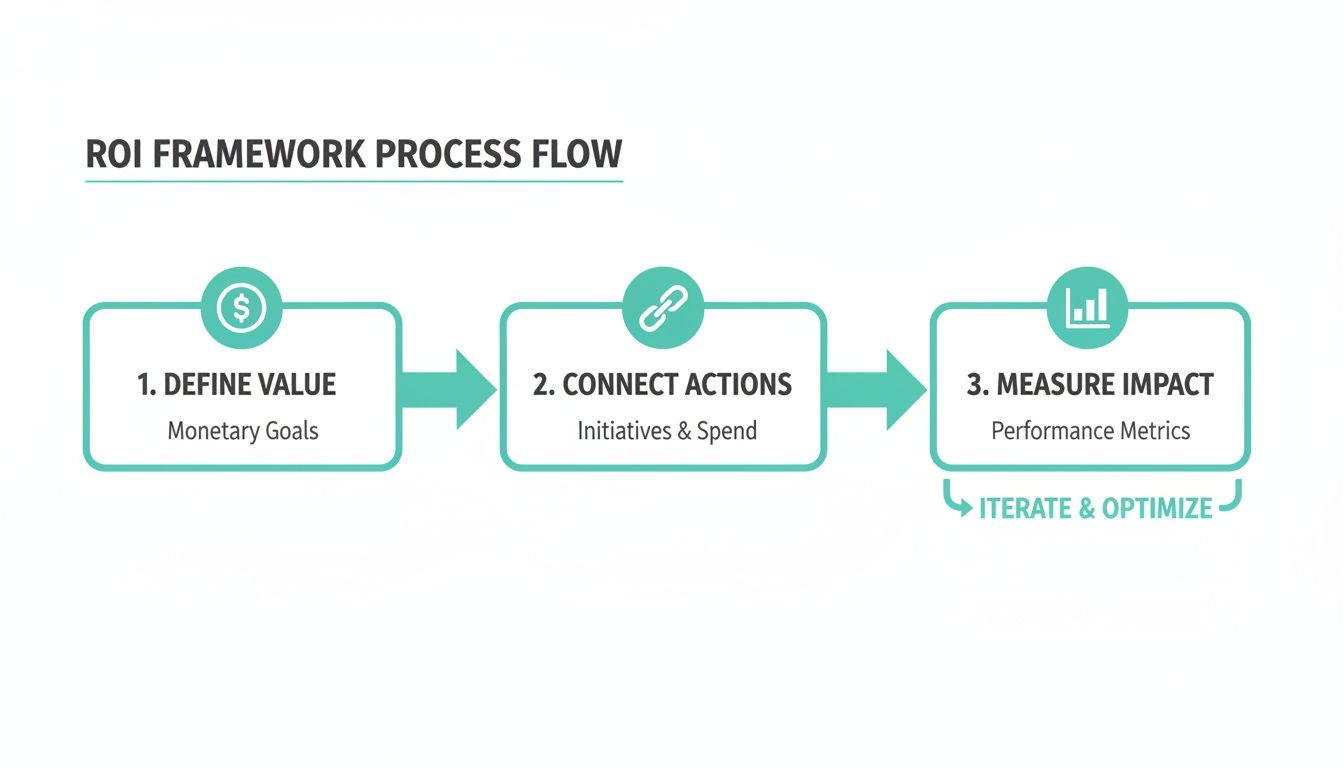
As you can see, defining what "value" means is the critical first step. Only then can you start connecting actions to real business impact.
From Metrics to Business Language
The table below helps translate common content metrics into tangible business outcomes, giving you a clearer definition of 'Return' in your ROI calculations.
Mapping Content KPIs to Business Impact
This foundational work ensures every piece of content has a clear purpose and a measurable path to generating value. Whether you’re driving external sales or improving internal operations, the goal is always to speak in terms of dollars and business outcomes.
By defining the monetary value of micro-conversions, you transform your DXP from a content publishing tool into a business intelligence engine. This shift is essential for proving the indispensable role of content in achieving strategic objectives.
A structured approach like this requires careful planning and oversight. To ensure your measurement strategy is consistent, scalable, and aligned with company goals from day one, it helps to have a system in place. You can learn more about how to structure these efforts in our guide on building a solid content governance framework.
Getting Your DXP Set Up for Flawless ROI Tracking

Your Digital Experience Platform (DXP) is the engine that will prove your content marketing ROI, but it’s not a plug-and-play solution. Out of the box, it won't give you the numbers you need. You have to configure it to track the specific user actions that signal real intent and nudge prospects closer to a sale.
Think of it as transforming a simple content repository into a powerful business intelligence tool. The goal is to build a single source of truth where every touchpoint is captured and assigned a value. Platforms like Sitecore are built for this, letting you go far beyond basic page views to see what’s really driving the business.
Setting Up Sitecore for Pinpoint Conversion Tracking
In the Sitecore world, accurate ROI tracking comes down to one thing: the strategic use of goals and events. Goals are your macro-conversions—the big wins. Events track the smaller micro-conversions that lead up to them.
A macro-conversion is a high-value action, like a user submitting a "Request a Demo" form. In Sitecore Analytics, you’d create a specific goal for this and assign it an engagement value based on what that lead is worth to the sales team.
Micro-conversions are all the smaller, supporting actions that show someone is engaged. These are just as important to track. For instance:
- Watching a Product Video: You can set up an event to fire when a user watches more than 75% of a key demo video.
- Downloading a Spec Sheet: Trigger an event when someone downloads a technical PDF. That’s a strong signal of deep product interest.
- Clicking "Contact Sales": Even if they abandon the form, the click itself is a valuable data point worth tracking.
By setting up both, you start to build a detailed, granular picture of the entire user journey. The Sitecore Experience Platform (XP) then pulls all this data together into a comprehensive Experience Profile for every single user, showing every interaction they've had with your content.
The real magic of Sitecore isn't just tracking what users do, but understanding who they are. By mixing explicit data from forms with implicit behavioral data, you build rich profiles that unlock truly effective personalization and, in turn, much more accurate ROI calculations.
Measuring Internal Communications ROI in SharePoint
While Sitecore is fantastic for tracking external customer journeys, many enterprises use SharePoint as the hub for internal communications. Proving ROI here isn’t about revenue; it’s about measuring efficiency gains, employee engagement, and even risk mitigation.
To get this right, you need to connect SharePoint with a solid analytics solution, whether it's Microsoft's own tools or a third-party platform. This setup lets you monitor the key metrics that prove your internal content is actually working.
You can finally get answers to critical business questions:
- Document Engagement: Are people actually reading the new compliance policy? Tracking downloads and view times tells you for sure.
- Intranet Adoption: Which departments are most active on the company portal? This helps you see where internal comms are landing and where they're falling flat.
- Search Effectiveness: Can employees find what they need quickly? Analyzing internal search queries uncovers content gaps and shows you how to improve your knowledge base.
Let’s say you publish a new HR benefits guide on SharePoint and see a 30% drop in related emails to the HR team. You can easily quantify the time saved, which translates directly into a positive ROI for that piece of content. Getting the right tracking in place is the first step, and you can learn more about the methodologies in this detailed guide on how to measure ROI.
By meticulously configuring both your external DXP and your internal platforms, you create a complete, 360-degree view of your content's real-world performance. This foundational work is what allows you to make data-driven decisions that consistently drive your content marketing ROI upward.
Choosing the Right Content Attribution Model
To prove your content marketing ROI, you have to know which content actually gets the credit. Was it the first blog post a prospect read six months ago? Or the case study they downloaded right before asking for a demo? This is the core question attribution modeling is built to answer.
For any enterprise with a long, complex sales cycle, this is far from simple. A single customer journey can stretch across dozens of touchpoints and multiple channels. If you’re relying on a simplistic model, you're getting a warped view of what’s really driving business—and that leads to bad investment decisions.
Demystifying Common Attribution Models
Most companies start with one of the standard, rules-based models. Each one gives you a different lens through which to view the customer journey. Knowing their strengths and weaknesses is the first step to picking the right one for your goals.
Let's break down the most common approaches marketers use:
First-Touch Attribution: This model gives 100% of the credit to the very first piece of content a user ever interacts with. It’s fantastic for identifying your top-of-funnel heroes—the content that successfully brings new people into your orbit. The problem? It completely ignores everything that happens after that initial discovery.
Last-Touch Attribution: As the name suggests, this is the exact opposite. All credit goes to the final interaction before a conversion. It helps pinpoint what closes deals, like a killer pricing page or a well-timed email offer. But its major flaw is giving zero credit to all the nurturing content that guided the user to that final step.
Linear Attribution: This model tries to be fair by spreading the credit equally across every single touchpoint. If a user read three blog posts and watched a webinar before converting, each asset gets 25% of the credit. While it provides a more holistic view, it can seriously undervalue the most decisive, impactful interactions.
Time-Decay Attribution: A slightly more sophisticated take on the linear model, Time-Decay gives more credit to touchpoints closer to the conversion. That case study they read yesterday gets more weight than the blog post from three months ago. This feels more realistic, as recent interactions often have more influence on a final decision.
A Practical Comparison of Content Attribution Models
Choosing the right model is all about aligning it with your business goals and the tools you have. This table breaks down the key differences to help you decide which approach fits best.
Ultimately, any of these rules-based models rely on assumptions. You're basically guessing which interactions matter most. This is where AI-driven platforms can give you a massive advantage.
Moving Beyond Rules with Sitecore AI
If you're using an advanced DXP like Sitecore, you can ditch the manual models and step into data-driven attribution. Sitecore’s AI analyzes thousands of unique user journeys to build a custom model based on what your customers actually do—not what you assume they do.
This is where the platform's power really shines. Sitecore AI can spot subtle patterns and influential touchpoints a human analyst would almost certainly miss. For instance, it might discover that users who view a specific technical whitepaper are 4x more likely to become high-value customers, even if that asset is rarely the first or last touch.
You can dig deeper into how these modern tools stack up against traditional analytics by checking out our comparison with Google Analytics.
This kind of insight is a game-changer for making smart investments. Instead of guessing, you know with a high degree of confidence which content is really influencing valuable conversions. This data is critical, especially when you consider that businesses prioritizing blogging see a remarkable 13x more positive ROI. In fact, websites, blogs, and SEO remain top ROI-generating channels, accounting for 16% of success and even beating out paid social.
Choosing the right attribution model—or letting an AI engine build one for you—is how you finally connect your content efforts to real business impact and invest where it counts.
How Sitecore AI Amplifies Your Content ROI
Just measuring your content marketing ROI is looking in the rearview mirror. It tells you what already happened. The real goal is to proactively multiply that ROI by getting the right content in front of the right person at exactly the right time. This is where an AI-powered DXP like Sitecore completely changes the game from simple reporting to active optimization.
Sitecore’s AI tools don't just count conversions—they actively create more of them. By learning from user behavior in real-time, the platform becomes a dynamic growth engine that gets smarter with every interaction.
From Static Personalization to Dynamic Experiences
Basic personalization, like swapping out a banner based on a visitor's industry, is a decent first step. But the big ROI gains come from truly dynamic, AI-driven experiences. That's the core job of Sitecore Personalize.
Instead of just following pre-set rules, Sitecore Personalize uses machine learning to analyze what a user is doing right now—every click, search, and page view. It then adjusts the content, offers, and calls-to-action on the fly.
Let's say a user reads a blog post on cloud security, then clicks on a case study from the financial services sector. Sitecore Personalize can instantly:
- Showcase a whitepaper on "Financial Services Cloud Compliance."
- Change the homepage hero image to promote a webinar on FinTech security.
- Display a targeted CTA to book a consultation with a financial industry specialist.
This level of real-time responsiveness makes a conversion far more likely, directly pumping up the 'Return' side of your ROI calculation.
Streamlining the Investment with Content Hub
A huge, and often ignored, part of the ROI equation is the 'Investment' itself. If content production costs are sky-high or your time-to-market is slow, it will drag your numbers down, no matter how well the content performs. This is precisely the problem Sitecore Content Hub was built to solve.
Think of Content Hub as a central command center for your entire content operation. It streamlines everything by breaking down the walls between planning, creating, and publishing.
By uniting content strategy, digital asset management (DAM), and marketing resource management (MRM) in one place, Content Hub cuts the friction and cost of production. This directly lowers your 'Investment,' making a positive ROI much easier to hit.
Your teams stop wasting hours hunting for the right asset or recreating content that already exists. With a single source of truth, they can focus their time on creating high-impact content instead of getting bogged down in logistical chaos. To see how this fits into a wider strategy, check out our article on automated content marketing.
Improving Discovery and Preventing Drop-Offs
You could have the greatest content in the world, but if users can’t find it, its ROI is zero. Sitecore Search goes beyond simple keyword matching by using AI to understand user intent and context.
This intelligent search function figures out what people are really looking for and serves up the most relevant articles, product pages, or resources. This prevents frustrating dead-ends and keeps visitors from bouncing. When a prospect finds exactly what they need, they stay engaged and are more likely to move down the funnel. While Sitecore’s tools are powerful, it's also worth exploring other AI Search Tracker Tools to get a broader view of how AI is shaping performance tracking.
The Impact of AI on Enterprise ROI
Weaving AI into your content workflow isn't just a nice idea—it delivers real, measurable results. Data shows that integrating AI can lead to an average 68% increase in ROI, changing how enterprise marketing teams work at scale. Specifically, AI-powered personalization on platforms like Sitecore can hyper-target global users and boost conversion rates by up to 4.5x.
These principles aren't just for external marketing. For companies using SharePoint for internal communications, the same logic applies. AI can surface relevant internal documents, connect employees with subject-matter experts, and personalize the intranet to boost productivity and cut down on internal support costs. The technology works whether your goal is external revenue or internal efficiency.
Ultimately, a platform powered by AI doesn't just report on your content's past performance. It actively learns from every single interaction to make the next one more valuable, creating a powerful, self-improving loop that continuously drives your content marketing ROI higher.
Building a Reporting Cadence That Drives Action

So, you've set up your analytics and are pulling in data. Now what? Without a consistent, insightful reporting cadence, all that information is just noise. The goal here is to establish a rhythm for creating and sharing ROI reports that actually mean something to every stakeholder—from the marketing managers deep in campaign specifics to the C-suite execs who only care about the bottom line.
This is less about exporting data and more about turning raw metrics into a compelling story of business impact. Your platform is central to this. If you’re in the Sitecore ecosystem, Sitecore Experience Analytics is a fantastic, integrated solution for visualizing user journeys and goal completions right inside the DXP.
For bigger organizations that need to merge DXP data with info from other systems like a CRM or ERP, you'll want to pipe that data into a dedicated BI platform. Tools like Power BI or Tableau are perfect for this. They let you build comprehensive dashboards that tell the complete ROI story, giving you the unified view you need for enterprise-level decisions.
Crafting Dashboards in Sitecore Experience Analytics
Right out of the box, Sitecore Experience Analytics gives you a window into how users are interacting with your content. But the real magic happens when you customize the dashboards to focus on the specific goals and engagement values you defined earlier. Don't just settle for the default views.
Build custom reports that answer the big business questions:
- What are our top value-generating paths? Identify which content sequences (like a blog post leading to a case study, then a demo request) are producing the most engagement value.
- Is our personalization actually working? Compare how personalized components are performing against the default experience. Sitecore makes this kind of A/B testing simple, letting you prove the direct ROI of your personalization efforts.
- Which campaigns are driving real conversions? Track this religiously to justify where your budget is going.
These dashboards should become your command center, giving you an always-on, at-a-glance view of performance.
Storytelling with Data Beyond Traffic Metrics
The biggest mistake I see in reporting is an obsession with vanity metrics. "Traffic is up by 20%" isn't an insight; it's an observation. Real data storytelling connects that metric to a business outcome, creating a narrative that forces action.
Instead of reporting that 'traffic is up,' your report should say something like, 'Our new blog series on cloud security drove a 30% increase in organic traffic from target financial services accounts, leading directly to a 15% lift in qualified demo requests from that segment.'
This one statement does three things perfectly:
- It points to the specific content responsible.
- It ties the traffic lift to a high-value audience segment.
- It links the marketing activity directly to a sales-oriented outcome (demo requests).
This is the kind of detail that turns a boring report into a strategic tool. The same logic applies if you're reporting on internal communications in SharePoint. You wouldn't just say, "intranet page views are up." You'd report, "The new onboarding portal saw 85% engagement from new hires in Q3, which correlates with a 40% drop in HR support tickets from that group." See the difference?
Establishing an Optimization Cycle
Once your reporting tools and storytelling framework are in place, the final piece of the puzzle is creating a repeatable optimization cycle. This is usually a monthly or quarterly meeting where key stakeholders review the ROI reports and make concrete decisions.
Keep the agenda for this meeting simple and action-oriented:
- Find the Winners: What content, campaigns, or user paths are crushing it? The decision here is to amplify them—more budget, more promotion, or repurpose them into new formats.
- Spot the Underperformers: Which assets aren't pulling their weight? The decision is to optimize, update, or kill this content. Don't be afraid to cut what isn't working.
- Reallocate Resources: Based on what the data is telling you, shift budget and team focus away from the low-ROI stuff and double down on what’s proven to work.
This disciplined cycle keeps your content strategy agile and ensures it's constantly being refined based on real-world performance. It creates a powerful feedback loop that will steadily push your overall content marketing ROI higher and higher.
Answering Your Top Content ROI Questions
Even with a solid framework, measuring content ROI in a large enterprise throws some serious curveballs. When you're working with powerful platforms like Sitecore or SharePoint, a few common questions always seem to pop up. Let's tackle them head-on.
How Do I Prove ROI with a Long Sales Cycle?
This is the classic B2B dilemma. The sales cycle drags on for months, sometimes years. How can you possibly credit a single blog post someone read ten months ago for a sale that just closed? With basic models, you can't.
This is exactly where tools like Sitecore AI really shine. Forget simplistic first-touch or last-touch models. Sitecore’s AI-driven attribution dives into thousands of customer journeys, spotting the patterns that actually influence deals. It might find that prospects who watch a specific webinar series are 80% more likely to become high-value clients, even if that webinar was one of their first interactions.
The conversation shifts from "Which asset closed the deal?" to a much more strategic question: "Which assets consistently move our best prospects forward?"
The same logic applies to SharePoint, but the focus is internal. You don't measure the ROI of a new training portal in one day. You prove its value over a quarter by showing a steady drop in IT support tickets or seeing project completion times speed up.
How Can I Justify Investing in Advanced DXP Tools?
Stakeholders always ask: why do we need a powerhouse DXP like Sitecore when simpler, cheaper tools are out there? The answer is about looking forward, not just backward. Basic analytics tools tell you what already happened. A platform like Sitecore Personalize actively increases your future ROI.
You justify the investment by building a clear business case based on results:
- Boosted Conversion Rates: Run a pilot project. Show how AI-driven personalization can serve up dynamic content that actually gets people to act. A 15% lift in demo requests from a personalized homepage is an argument no one can ignore.
- Serious Operational Efficiency: Use a tool like Sitecore Content Hub to demonstrate the time and money saved. Show how centralizing assets stops content duplication and slashes the time it takes to launch global campaigns.
A DXP isn't just another line item on the expense report; it's a revenue multiplier. The investment pays for itself by creating better customer experiences that drive sales and build loyalty.
What If I Have a Limited Budget and Team?
You don't need a massive budget to start measuring ROI effectively. If you're working with limited resources, whether on Sitecore or SharePoint, just narrow your focus. Nail the fundamentals first.
Start by picking one or two high-value conversions. For Sitecore, that could be a "Contact Us" form submission. On an internal SharePoint site, it might be the download of a critical sales enablement deck.
Then, pour all your energy into tracking and improving the journey to that one goal. Even small victories—like rewriting a CTA that bumps up form fills by 5%—deliver tangible proof of ROI. That initial data becomes your best ammunition for securing more resources to tackle bigger, more sophisticated initiatives later. The key is to start small, prove your value, and scale up from there.
Ready to turn your content from a cost center into a powerful revenue engine? The experts at Kogifi specialize in implementing and optimizing DXP solutions like Sitecore and SharePoint to deliver measurable ROI. Contact us today to build a digital experience that drives real business growth.