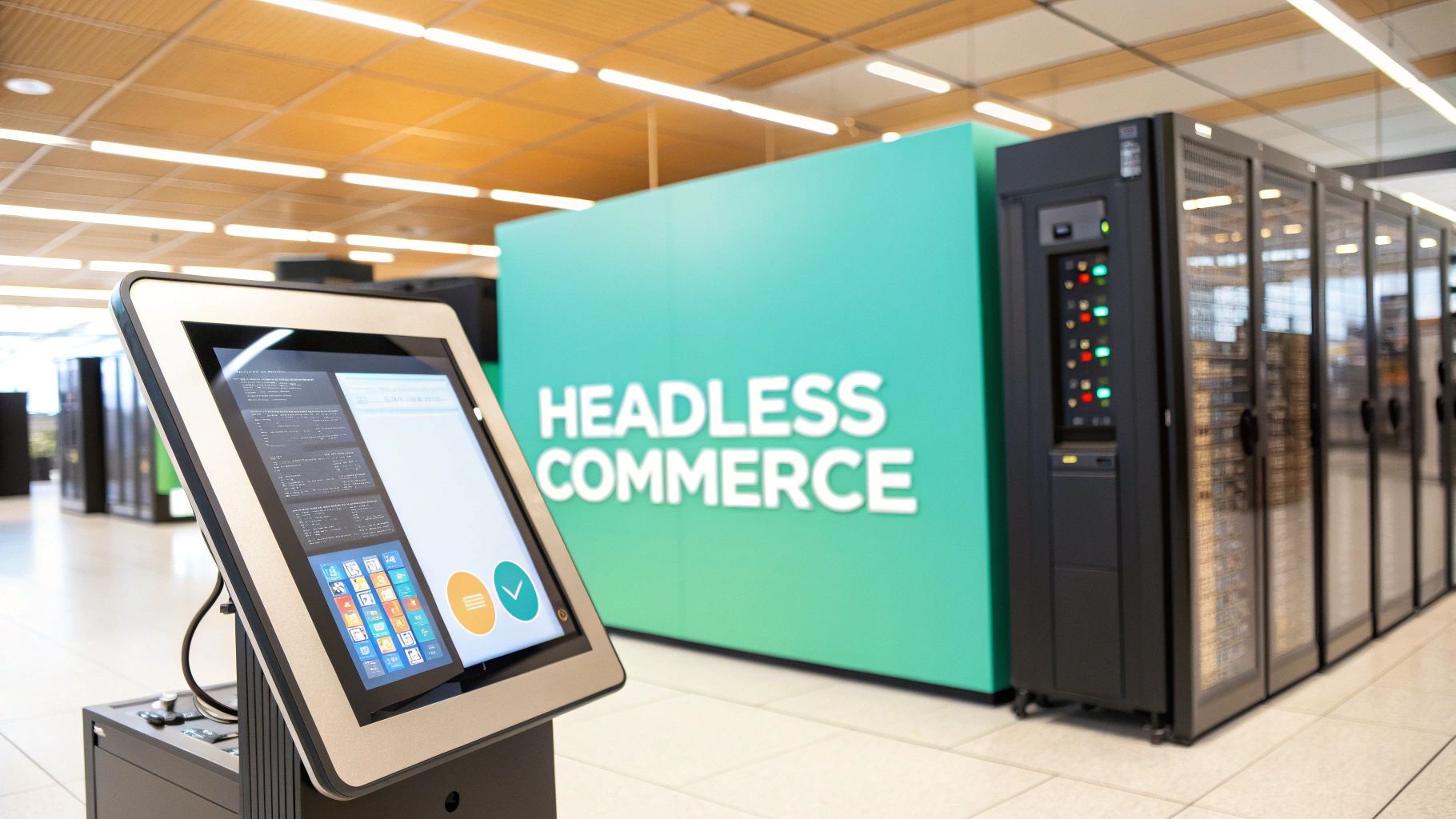



A headless commerce solution is a modern architectural approach that separates your customer-facing storefront (the "head") from the backend commerce engine that runs your business. This decoupling provides unparalleled flexibility, allowing core commerce functions—like product catalogs, payment processing, and order management—to power any customer experience imaginable through APIs, whether it’s a high-performance website, a mobile app, an in-store kiosk, or an IoT device.
What Is a Headless Commerce Solution and Why Does It Matter?
Think of a traditional e-commerce platform as a single, monolithic structure where the storefront, stockroom, and cash register are all rigidly connected. Changing one part often means disrupting the entire system, making innovation slow, costly, and complex.
A headless commerce solution strategically severs that connection. It decouples the frontend presentation layer from the backend commerce engine. This API-first architecture allows your backend to function as a central operational hub, managing inventory, processing orders, and handling complex business logic. This hub can then deliver data and functionality to any number of frontend experiences simultaneously.
The Power of Decoupling
Instead of being locked into a single storefront, this decoupled backend can power a multitude of touchpoints through a robust Application Programming Interface (API) layer.
- A flagship website: A blazing-fast, brand-centric online store.
- A native mobile app: A personalized and seamless shopping experience for iOS and Android.
- In-store kiosks: Digital interfaces that allow customers to browse inventory or place orders in physical locations.
- Voice assistants and IoT devices: Purchases initiated through smart speakers or connected home appliances.
This architectural shift gives businesses the agility to create consistent, personalized experiences wherever their customers are, without being constrained by a clunky, all-in-one system. To fully grasp the technical advantages, it’s helpful to understand the move away from older structures. For a good breakdown, check out resources on Microservices vs Monolithic Architecture.
Before we dive deeper, it’s helpful to see a side-by-side comparison of how these two approaches stack up.
Traditional Commerce vs Headless Commerce At a Glance
This table provides a quick, scannable comparison of the core differences between traditional (monolithic) e-commerce platforms and modern headless commerce solutions, highlighting the key advantages of the headless approach for enterprise teams.
As you can see, the headless model is built for the kind of speed and adaptability that modern commerce demands.
The Driving Force Behind Headless Adoption
The transition to headless is a strategic imperative driven by the need for omnichannel consistency and accelerated innovation. This is not just a trend; it's a fundamental shift, as businesses move away from rigid platforms toward flexible, API-first architectures that can power everything from websites to smartwatches.
A headless architecture empowers brands to innovate at the speed of customer expectations. It transforms the digital storefront from a static destination into a dynamic, adaptable experience layer that can be deployed anywhere, anytime.
This separation is a game-changer for how teams work. Marketers can rapidly launch new campaigns and refresh content on the frontend without waiting in line for backend developers. At the same time, developers can fine-tune the core commerce engine without any risk of breaking the customer experience. This parallel workflow slashes the time it takes to get new features and experiences out the door.
You can learn more about the fundamentals in our guide explaining headless commerce in greater detail.
Building Your Composable Architecture with Sitecore
Adopting a headless approach is the first step toward building a composable architecture—an ecosystem of powerful, specialized tools integrated via APIs to create a superior digital experience. With Sitecore's composable Digital Experience Platform (DXP), businesses can move beyond rigid, all-in-one systems and assemble an architecture where every component is best-in-class.
At the heart of this modern architecture lies a powerful, headless-native commerce engine. A premier example is Sitecore OrderCloud, designed from the ground up to handle complex B2B, B2C, and B2X scenarios. OrderCloud masterfully manages intricate inventory, pricing, and order workflows, completely independent of any specific storefront design.
This decoupling grants marketing and development teams the freedom to innovate in parallel. Marketers can design and launch unique customer journeys on any channel, confident that the backend business logic managed by OrderCloud will remain robust and consistent. This is the key to accelerating the delivery of new digital experiences.
The diagram below illustrates this core concept. Backend systems communicate through an API gateway to power a variety of frontend experiences, from websites to mobile applications.
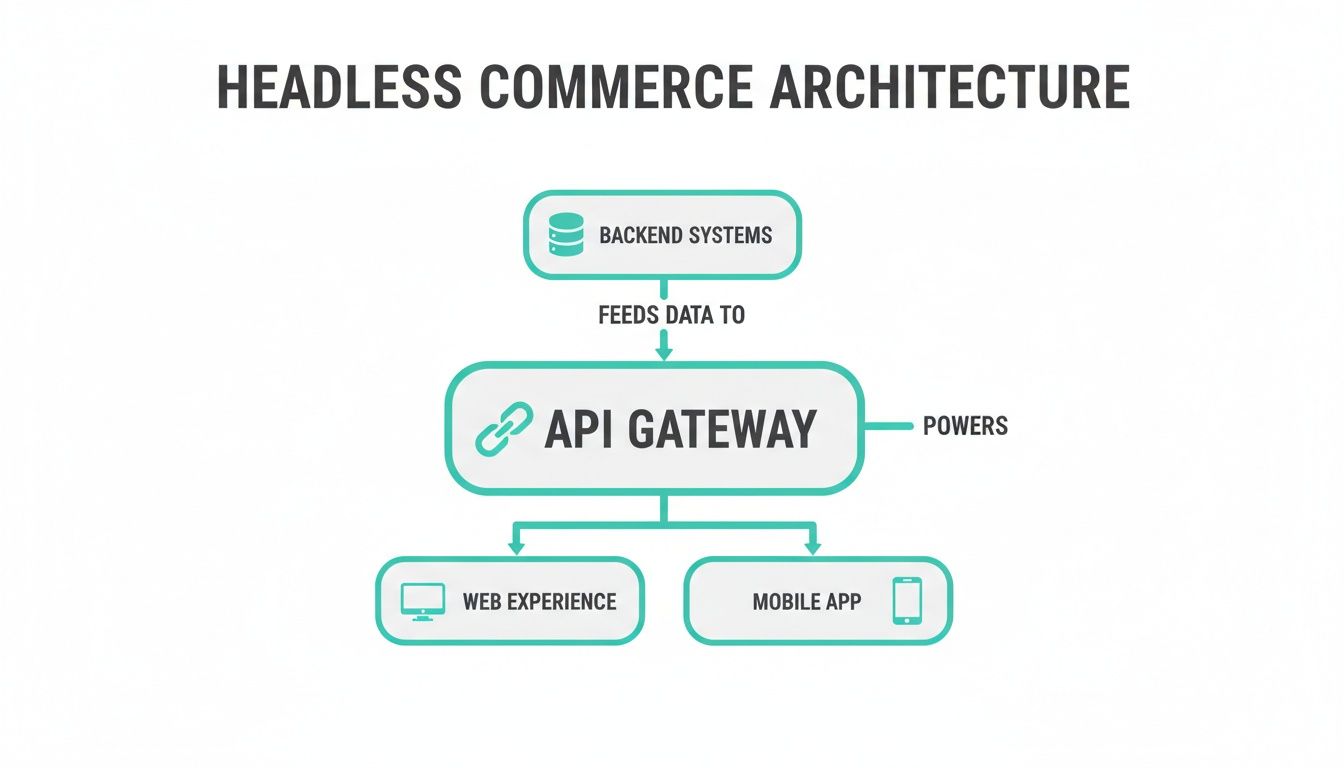
This visual clarifies the role of the API as the universal bridge between powerful backend systems and any customer-facing interface.
Integrating Sitecore's Powerhouse Components
A truly effective composable DXP is more than just a commerce engine. Our deep expertise lies in architecting a fully integrated ecosystem using Sitecore’s specialized products to build an unbeatable headless commerce solution. Each component adds a specific, high-value function, creating a whole that is far greater than the sum of its parts.
- Sitecore Content Hub: This serves as the single source of truth for all marketing assets. By integrating Content Hub, you centralize the management of product images, videos, and marketing copy, ensuring absolute brand consistency as assets are delivered via API to any channel.
- Sitecore OrderCloud: As the transactional core, OrderCloud provides a robust and scalable foundation for all commerce operations, handling everything from simple purchases to complex B2B quoting and ordering.
- Sitecore Personalize: This is where AI-driven intelligence enters the architecture. Sitecore Personalize tracks user behavior in real-time and leverages machine learning to deliver predictive recommendations, targeted offers, and individualized content, driving engagement and conversions on any frontend.
By combining these elements, you're not just selling products; you're creating intelligent, content-rich shopping experiences that adapt to each customer's needs in the moment. This is the essence of a modern, composable strategy.
Extending the Ecosystem with SharePoint
The flexibility of a headless architecture enables powerful integrations with essential enterprise systems like Microsoft SharePoint. Many organizations rely on SharePoint as a critical repository for technical documentation, internal knowledge bases, and partner resources.
In a headless framework, SharePoint is not an isolated silo. It can be seamlessly integrated as another "content source," with its data exposed through the same API layer that powers the rest of the DXP. This enables you to:
- Pull detailed product specifications or technical manuals from SharePoint and display them directly on e-commerce product pages.
- Power a secure partner portal with resources managed entirely within SharePoint's familiar interface.
- Serve content to internal, employee-facing applications from the same centralized repository.
This type of integration demonstrates the true power of a composable approach. It allows you to leverage the best tool for each job—Sitecore for marketing content and SharePoint for technical documentation—and unite them into a single, cohesive digital experience.
To dig deeper into this architectural style, you can learn more about what is composable commerce in our detailed guide. It's all about making your entire technology stack work together to crush your business goals.
How Headless and Sitecore AI Weave Together Seamless Omnichannel Journeys
A well-architected headless commerce solution is the engine that drives seamless, loyalty-building customer journeys. When this architecture is combined with the power of Sitecore’s composable DXP and its embedded AI capabilities, the walls between channels dissolve. This is where technical structure translates into tangible business impact.
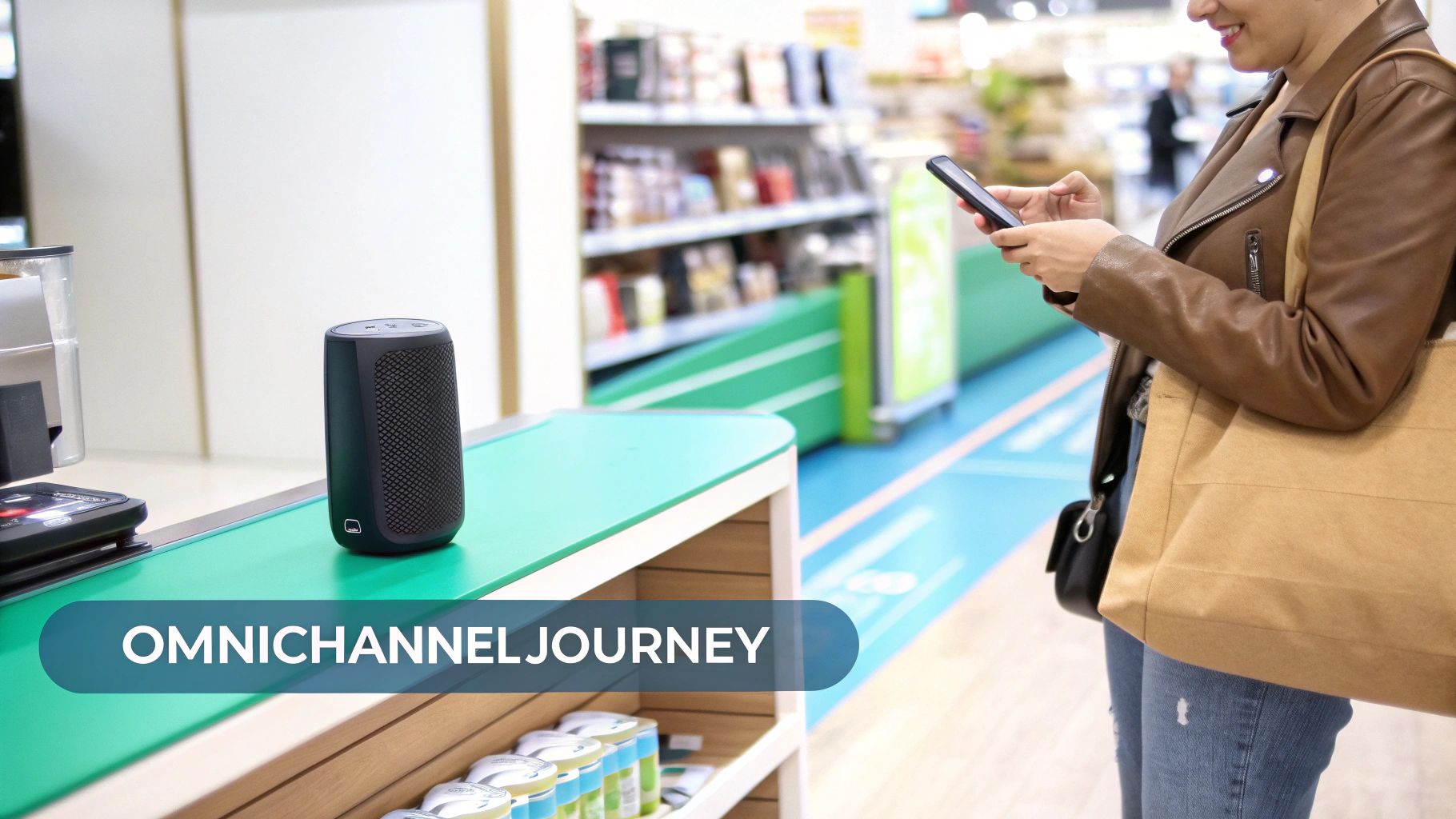
Modern customer journeys are not linear; they are fluid conversations that move between social media, voice assistants, mobile apps, and physical stores. The API-first design of a headless architecture is what makes this complex dance possible, connecting disparate systems into one cohesive experience. This has become table stakes for serious e-commerce players, allowing a single set of APIs to push product data and content to every touchpoint.
A Day in an AI-Powered Customer Journey
To make this tangible, let’s follow a customer whose experience is orchestrated by a headless setup powered by Sitecore’s product suite.
Discovery on Social Media: A customer sees a targeted ad on social media. She clicks and lands on a mobile-optimized page that loads instantly. This speed and consistent branding are delivered by Sitecore XM Cloud serving content headless-ly.
Voice-Assisted Cart: Later, she uses a smart speaker to add the product to her cart. An API call securely connects her voice command to the e-commerce backend (Sitecore OrderCloud), and the item is added to her universal shopping cart.
Personalized Mobile App Nudge: The next morning, she opens the brand's mobile app. Sitecore Personalize instantly recognizes her, uses its AI to analyze her browsing history, and displays a perfectly timed offer for a complementary product.
In-Store Kiosk Checkout: She visits a physical store and walks up to an interactive kiosk. She logs in and sees her cart, now with both items, ready for checkout. She completes the purchase and picks up her order.
This entire journey—from a social ad to a voice command to an in-store kiosk—feels like one continuous, intelligent conversation. That’s the power of a headless architecture driven by Sitecore. It erases the lines between channels to create a single, unified brand experience.
Integrating SharePoint for B2B Excellence
This omnichannel power extends beyond B2C retail. A headless approach can transform complex B2B scenarios, especially when integrating with systems like Microsoft SharePoint where content governance is paramount.
Consider a global manufacturer managing thousands of technical specifications, installation manuals, and compliance documents in SharePoint. In a traditional setup, distributing this information to partners or field technicians is a cumbersome, error-prone process.
With a headless solution, SharePoint becomes a dynamic content source. This means:
- A global partner portal can pull the latest technical documents directly from SharePoint via API, ensuring partners always have the most current information.
- A mobile app for field technicians can display interactive, step-by-step installation guides drawn from the same SharePoint repository.
- Internal training platforms can be powered by the same controlled content, guaranteeing consistency across all teams.
This integration transforms SharePoint from a static file repository into a powerful content engine that feeds a worldwide network of digital touchpoints. It ensures accuracy and control while delivering information instantly, wherever it’s needed. To drive real growth, you have to focus on the end-to-end journey and learn how to improve ecommerce customer experience at every step.
Building the Business Case for a Headless Transformation
Migrating to a headless commerce solution is a significant strategic investment, not just an IT project. To secure executive buy-in, the conversation must focus on measurable business outcomes like revenue growth, operational efficiency, and competitive advantage. The case must move beyond technical jargon and directly address return on investment (ROI).
The business case for headless, especially when powered by a platform like Sitecore’s composable DXP, centers on converting architectural agility into financial performance. It's about empowering your teams to execute faster and more intelligently, which translates directly to the bottom line.
Quantifying the Financial Impact
While a headless transformation requires a significant initial investment, the long-term returns are substantial. The flexibility, speed, and superior customer experiences enabled by an API-first architecture deliver a strong competitive edge that traditional platforms cannot match. Leading organizations invest in these architectures to achieve tangible wins: faster site performance, unparalleled flexibility for rapid updates, and the ability to build personalized journeys that drive conversions.
The core value proposition of a headless transformation is not just technological freedom, but economic efficiency. By decoupling your systems, you reduce the long-term friction and cost associated with innovation, allowing you to respond to market changes at a fraction of the time and expense of a monolithic platform.
This efficiency materializes in key operational gains that improve total cost of ownership (TCO) and strengthen ROI calculations.
Key Performance Indicators Fueled by Headless Agility
When building the business case, focus on the specific, measurable metrics that a headless architecture—enhanced with tools like Sitecore AI—is designed to impact.
- Accelerated Time-to-Market: With a headless setup, your frontend and backend teams work in parallel. Marketers can launch new campaigns or landing pages using Sitecore XM Cloud without being bottlenecked by backend development cycles, reducing launch times from months to weeks.
- Higher Conversion Rates: Site performance is a critical driver of conversions. Headless frontends are inherently faster, directly improving Google's Core Web Vitals. When this speed is combined with Sitecore Personalize, which uses AI to serve real-time, relevant product recommendations, it creates a direct path to higher add-to-cart rates and increased revenue.
- Increased Developer Efficiency: Developers are no longer constrained by a rigid, proprietary system. They can use modern frameworks and tools, which boosts productivity and reduces time spent on cumbersome workarounds. This efficiency leads to lower development costs and a faster rollout of new features.
Lowering Total Cost of Ownership
While the initial investment may be significant, a headless architecture is designed to lower long-term operational costs. With a traditional platform, every update or new channel integration can become a costly, high-risk project. In a headless model powered by Sitecore, adding a new touchpoint—like an in-store kiosk or a voice application—is as simple as connecting it to existing APIs, making future innovation dramatically more cost-effective.
Integrating enterprise systems like SharePoint also becomes a streamlined process. Instead of a massive custom integration project, you can expose SharePoint content through your API gateway. This lets you serve technical documentation or partner resources to any channel without building redundant systems, saving significant time and money. The agility gained is a strategic asset that pays dividends for years.
Your Strategic Checklist for a Successful Migration
Migrating to a headless architecture is a fundamental business transformation, not just a technical upgrade. A robust plan is essential to de-risk the project and ensure a smooth transition. This checklist provides a strategic framework for enterprise teams preparing to migrate to a powerful, new headless commerce solution.
Embarking on this journey without a clear roadmap can lead to missed deadlines and budget overruns. These steps will guide you from initial assessment to a successful launch, ensuring your investment delivers value from day one.
Audit Your Current Technology Stack
A deep audit of your existing technology is the first critical step. This involves more than just listing systems; it's about assessing their readiness for an API-first world.
- Identify Legacy Systems: Determine which platforms are monolithic and which already have APIs. Can your current ERP or CRM integrate with a modern headless environment?
- Map Data Flows: Gain a clear understanding of how information moves between systems to identify potential bottlenecks and integration challenges early.
- Assess Content Repositories: Identify where all your content resides. Is it siloed in a traditional CMS, or is it in a more flexible system like SharePoint? This will inform your content migration strategy.
Define Business Goals and Key Metrics
A headless migration must be driven by business outcomes. Setting clear, measurable goals is the only way to prove ROI and maintain project focus.
For instance, your goals might be to:
- Increase mobile conversion rates by 15% within six months.
- Reduce the time to launch marketing campaigns from eight weeks to two.
- Achieve "Good" Core Web Vitals scores across all key pages.
These specific KPIs will be the yardstick for measuring the success of your new headless commerce solution.
The most successful migrations are those where technology decisions are directly tied to strategic business imperatives. The goal isn't just to go headless—it's to become more agile, responsive, and profitable.
Design Your API and Frontend Strategy
With your goals defined, it's time for architectural design. This involves selecting the right frontend technology and designing a robust, scalable API strategy to connect all components.
For the frontend, the choice of technology should align with your team's skills and performance targets. For organizations within the Sitecore ecosystem, leveraging frontends that integrate seamlessly with XM Cloud and Sitecore Personalize is a significant strategic advantage.
Simultaneously, you must design your API layer—the central nervous system of your headless architecture. A well-designed API strategy ensures that data from Sitecore OrderCloud, Content Hub, and integrated systems like SharePoint can be delivered efficiently and securely to any frontend you build today or in the future.
Plan and Execute Data Migration
Data migration is often the most complex phase of a project. A meticulous plan is crucial. You must determine what data to move, how to cleanse and transform it, and the optimal sequence for the migration.
Consider different approaches:
- Phased Migration: Migrate one part of the business at a time, such as a single brand or region, to minimize risk and allow for iterative learning.
- Parallel Run: Operate both the old and new systems simultaneously for a period. This provides a safety net but can be resource-intensive.
The right approach depends on your organization's risk tolerance and operational requirements. For a deeper dive, check out our guide covering critical steps for a digital platform migration. Partnering with an expert who understands the nuances of migrating to a Sitecore-powered headless commerce solution can make all the difference.
Why an Expert Sitecore Partner Is Key to Your Success
Moving to a headless commerce solution isn't just a technology upgrade; it's a fundamental shift in how your business operates. The architecture promises incredible agility and a true omnichannel presence, but unlocking that value hinges entirely on the team steering the ship. The single most important decision you'll make is choosing the right partner—it directly shapes your ROI and long-term success.
This is where deep, specialized experience is non-negotiable. With over a decade focused on complex digital experience platforms and more than 50 successful global projects under our belt, we offer a level of predictability that generic IT firms just can't match. Our entire history is built on mastering the nuts and bolts of the Sitecore DXP and SharePoint ecosystems.
From Strategy to Support
A successful implementation is about so much more than just the technical setup. It demands a partner who thinks like a strategic guide, translating your business goals into a durable, scalable architecture. Our proven process covers the entire project lifecycle, making sure every choice aligns with your objectives.
- Strategic Planning: We start by mapping your business needs directly to the capabilities of Sitecore's composable stack, designing a solution built for tomorrow's growth, not just today's problems.
- AI-Powered Personalization: Our expertise with Sitecore Personalize allows us to build intelligent, data-driven experiences from day one, boosting conversions and customer loyalty.
- Seamless Integration: We specialize in connecting Sitecore's heavy hitters—like OrderCloud and Content Hub—with critical enterprise systems like SharePoint to create one unified digital ecosystem.
Choosing a partner isn’t about hiring a vendor to check off tasks. It's about finding a strategic ally who knows how to turn sophisticated technology into real, measurable business growth. An expert partner de-risks your investment and gets you to value faster.
Your Guide to Digital Transformation
Ultimately, our role is to help you navigate the complexities of this transformation with complete confidence. We don’t just handle the technical build; we provide the strategic oversight and ongoing support you need to thrive long after launch. This includes 24/7 SLA-based support to ensure your platform is always resilient and performing at its peak.
When you work with an experienced specialist, you're not just buying a service—you're investing in a predictable, high-value outcome. We help you transform your digital capabilities and achieve a significant, long-term return on your investment. To get a better handle on this critical selection process, check out our guide on how to choose the best Sitecore partner for your project.
Frequently Asked Questions
When you're thinking about shifting your architecture, a lot of questions come up. Here are some straightforward answers to the things we hear most often from enterprise leaders, especially those working in the Sitecore and SharePoint worlds.
Can Sitecore AI Work with a Headless Architecture?
Absolutely. In fact, going headless actually makes Sitecore’s AI tools even more powerful.
Think about something like Sitecore Personalize. It works by gathering user data and then pushing out tailored experiences through APIs. That’s a perfect match for a headless setup. It means you can drop AI-powered recommendations or personalized content onto any frontend you want—a website, a mobile app, an in-store kiosk, you name it. The headless model frees the AI engine from being locked into one traditional website, letting it shape the customer journey everywhere for a truly consistent, smart experience.
Is SharePoint a Good Fit for a Headless Solution?
Yes, SharePoint fits into a headless architecture surprisingly well, particularly for companies that use it as the single source of truth for documents.
We often set up solutions where SharePoint serves as a "content head." It might hold all your product manuals, partner resources, or internal knowledge base articles. We then pull that content through the same API gateway as your commerce and marketing content. This approach lets you keep sensitive or technical info under SharePoint’s strong governance but still deliver it smoothly to any digital channel. It effectively turns a powerful internal tool into a dynamic piece of your customer experience.
By treating SharePoint as a headless content source, you can consolidate your technology stack and ensure that authoritative information is managed in one place but distributed everywhere it's needed, from public websites to secure partner portals.
What Are the Main Differences Between Headless and Composable Commerce?
This is a common point of confusion, but the two concepts tackle different parts of your tech stack.
Headless commerce is very specific: it’s all about decoupling the frontend (the "head," or what customers see) from the backend commerce engine. The goal is to give you complete freedom over the customer-facing experience.
Composable commerce, on the other hand, is a much broader strategy. It’s about building your entire digital platform by picking and choosing best-in-class, independent tools (like a commerce engine, a CMS, a search tool, etc.) and connecting them all with APIs. A headless architecture is a key piece of a composable strategy, but composable thinking applies that modular, "Lego-block" approach to your entire stack, letting you swap components in and out as your business needs change.
Ready to transform your digital strategy with a powerful, AI-driven headless commerce solution? At Kogifi, our deep expertise in the Sitecore and SharePoint ecosystems ensures your project delivers maximum ROI and future-proof agility. Contact us today to start building your composable future.