


At its core, personalization is all about delivering uniquely relevant experiences to individual users. It's the strategy of using their behavior, context, and data to move beyond generic, one-size-fits-all interactions. The goal is to create a digital dialogue that feels personal and responsive, much like a conversation with a helpful expert.
Beyond First Names: What True Personalization Really Means
So, what is personalization in the context of a modern enterprise? It's a critical business strategy that goes far beyond simply dropping a user's name into an email. That's a dated tactic that lacks the depth needed for meaningful engagement.
True personalization is the digital equivalent of a five-star concierge. It’s a system that anticipates needs, understands preferences, and proactively delivers value before the user even has to ask. This proactive capability is the real engine behind a modern Digital Experience Platform (DXP), shifting the focus from who the user is to what they intend to do.
To illustrate the difference, let’s compare the old way with the new.
The Evolution From Generic to Hyper-Personalized Marketing
This table shows a clear shift. Modern personalization, powered by AI, isn't just a minor upgrade; it's a fundamental change in how businesses connect with their audiences.
The Role of Sitecore AI
The Sitecore AI portfolio is engineered to deliver this sophisticated level of interaction at scale. Instead of relying on static, pre-programmed rules, Sitecore’s AI tools use machine learning to analyze what users are doing in real-time.
This allows businesses to:
- Predict User Intent: Determine what a visitor is likely to do next based on their current and past actions, using powerful predictive models.
- Automate Content Delivery: Automatically serve the most relevant content, offers, or recommendations to each individual, orchestrated by the AI engine.
- Create Dynamic Segments: Group users into fluid audiences based on emerging behavioral patterns, not just predefined demographic boxes.
For example, Sitecore AI can identify a visitor who repeatedly views technical documentation and automatically present them with an invitation to a relevant webinar, moving them further down the funnel. That’s worlds away from just showing everyone the same generic homepage banner. You can dig deeper into the nuances of content personalization and its impact in our complete guide.
From Employee Portals to Customer Journeys
This same principle delivers immense value for internal platforms. Using SharePoint solutions, organizations can personalize the employee experience. An intranet's content can be tailored to an individual's role, department, or project, ensuring a developer sees updates about their codebase while a sales executive sees the latest performance dashboards.
True personalization is about proactively delivering value by understanding user intent, not just their identity. It’s the engine of a modern Digital Experience Platform (DXP), essential for competing in today's market.
Ultimately, mastering this concept means moving past superficial tactics. It’s about actively focusing on designing a digital customer journey that genuinely resonates with your audience. It requires a mindset shift from asking, "Who is this person?" to "What does this person need right now?" Answering that second question is where modern personalization creates a powerful, lasting advantage.
The Core Components of an Effective Personalization Strategy
A powerful personalization strategy is built from different approaches, each adding a new layer of sophistication. Getting a handle on these components is the key to understanding what personalization really is and how it works in platforms like Sitecore. Think of it as learning to cook—you have to master the basics before you can create a signature dish.
The infographic below shows how these strategies build on each other, moving from generic, one-size-fits-all interactions to truly insightful, intent-driven personalization.
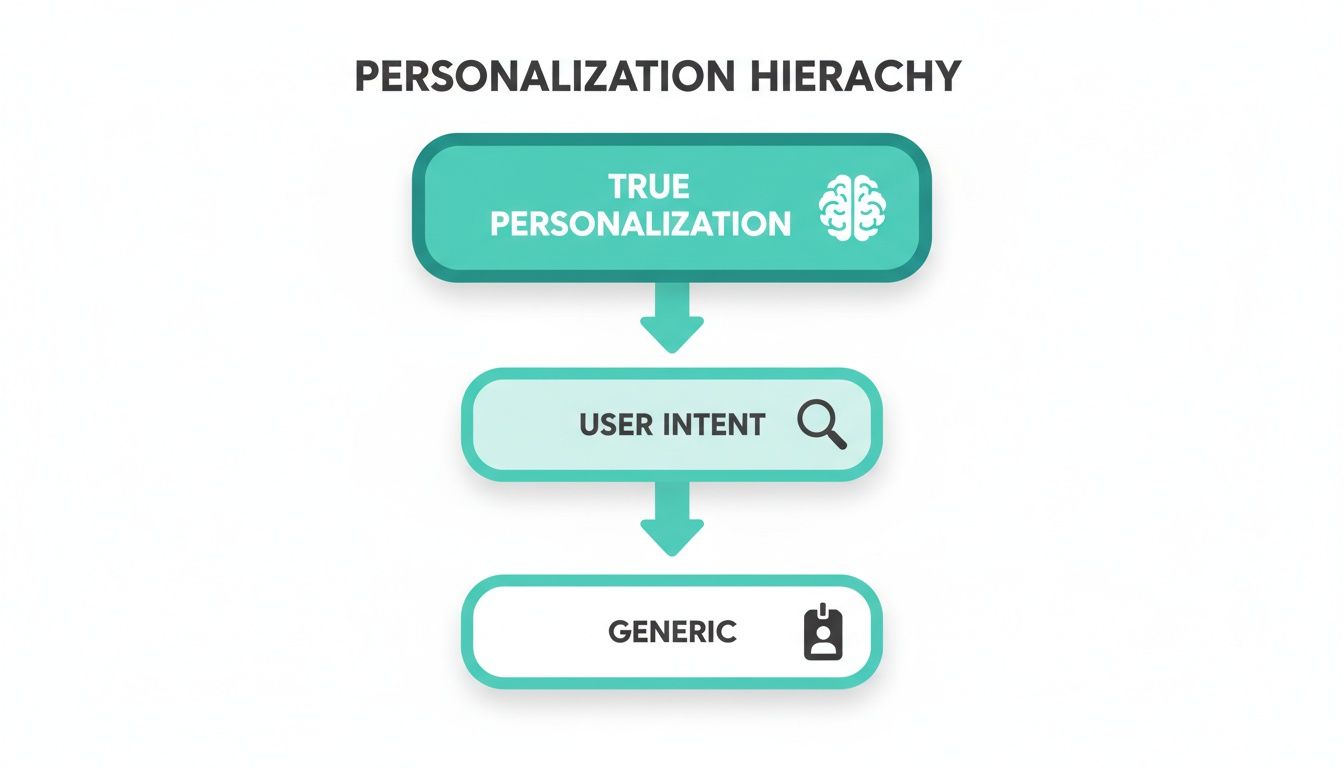
This hierarchy shows that the end goal is to move beyond basic data to actually anticipate what users need. That’s the mark of a truly mature digital experience.
Starting with Rule-Based Personalization
The most straightforward approach is rule-based personalization. It runs on simple "if-then" logic that you define yourself. If a user meets a certain condition, then the system shows them a specific piece of content.
This is the foundational layer—accessible, easy to implement, and a great place to start.
- How it works: You create explicit rules based on known data points.
- Sitecore Example: If a visitor lands on your site from a specific campaign URL for a new product, you can set a rule in Sitecore Experience Platform or Sitecore Personalize to show a homepage banner that matches the campaign’s message.
- SharePoint Example: On a SharePoint intranet, you could set a rule where employees listed in the "Sales" department automatically see the latest sales dashboards on their portal homepage.
While it’s a solid first step, this method is purely reactive. It’s limited to the scenarios you can predict and set up by hand.
Adding Contextual Personalization
The next step up is contextual personalization, which adapts the experience based on a user's immediate environment. This approach looks at data available in the moment—like their location, device type, or even the time of day.
This adds a layer of relevance without needing to know a thing about the user's past behavior.
Contextual personalization answers the question, "What is happening right now?" It uses real-time situational data to make the experience more relevant without needing extensive user history.
For example, you can show a visitor browsing on a mobile device a prominent "click to call" button instead of a long contact form. In Sitecore, this is easy to set up with a condition for device type, instantly making the site more usable for a huge segment of your audience.
Understanding Behavioral Personalization
Behavioral personalization is where things get much smarter. This method analyzes a user's actions over time, tracking what they click, view, download, and search for across sessions to build a picture of their interests and intent.
This is the point where the system starts learning directly from the user. It shifts from static rules to dynamic responses based on what someone has shown they're interested in.
- On-site Actions: A user repeatedly visits pages about "enterprise cloud solutions."
- Session History: Someone previously downloaded a whitepaper on data security.
- Purchase Data: A customer has bought products from a specific category in the past.
A Sitecore-powered B2B site could use this to automatically personalize the homepage. If a visitor reads three blog posts on AI integration, they could be shown a relevant case study on their next visit, nurturing their interest without anyone lifting a finger.
Reaching the Pinnacle with AI-Driven Personalization
The most advanced form is AI-driven personalization, and this is where platforms from the Sitecore AI portfolio really show their power. Instead of just reacting to past behavior, AI uses machine learning models to predict future intent and automate experiences at a scale that's impossible to manage manually.
Sitecore's AI tools, like Sitecore Personalize and Sitecore CDP (Customer Data Platform), ingest and process massive datasets in real time. They spot subtle patterns and create dynamic audience segments automatically.
This is the difference between following a recipe and having a master chef who invents new dishes just for you. AI can determine that visitors who view Product A and then read Blog Post B are 80% more likely to be interested in Service C, then automatically present that service. It flips your strategy from reactive to proactive, delivering experiences that feel insightful and perfectly timed.
The Business Impact of AI-Powered Personalization
While the concept of personalization is compelling, its real power is in the bottom-line results it delivers. For any enterprise leader, the question is always the same: what’s the ROI? AI-driven personalization isn't just another IT expense—it’s a revenue engine, especially within a mature ecosystem like Sitecore.
The move toward intelligent, data-informed strategies is no longer optional. Before we get into the specifics, it helps to have a solid grasp of what Artificial Intelligence in business entails. Understanding this context makes it clear why AI is now a fundamental part of modern marketing.
By shifting from basic rules to predictive analytics, organizations see immediate improvements in the KPIs that both marketing and technology leaders care about. It’s all about creating a shared strategy where technology directly serves business objectives.
Unlocking Higher Revenue and Conversion Rates
At its core, AI-powered personalization is about getting the right content in front of the right person at the perfect moment. That level of precision has a direct impact on your sales. When an e-commerce site using Sitecore Personalize shows a returning visitor products based on their past browsing and predicted future interests, the chance of a purchase goes up dramatically.
This isn’t just a theory; the results prove it. Companies consistently report higher conversion rates when they swap out generic experiences for finely-tuned ones.
By analyzing thousands of data points in real time, Sitecore AI can spot high-intent visitors and present them with a compelling offer or piece of content, turning a casual browser into a loyal customer.
For instance, a visitor who has looked at specific B2B service pages can be automatically shown a relevant case study on their next visit, which helps shorten the sales cycle. This automated nurturing drives revenue without any manual work from the sales team. For a deeper look at this topic, you can check out our guide on how AI enhances personalization in DXPs.
Building Deeper Customer Loyalty and Brand Affinity
Customer loyalty isn’t built on transactions. It’s built on feeling understood. When a brand consistently delivers experiences that feel relevant, customers feel seen and valued, creating an emotional connection that drives long-term loyalty and higher lifetime value (LTV).
- Anticipating Needs: Sitecore's Customer Data Platform (CDP) creates a single, unified view of each user. This lets the AI anticipate what a customer might need next and make helpful suggestions that build trust.
- Creating Seamless Journeys: From the first website visit to post-purchase support, a consistent, personalized journey reinforces a positive brand perception.
- Reducing Churn: By spotting signs of disengagement early, AI can trigger re-engagement campaigns with personalized offers, proactively keeping customers from walking away.
Leading organizations recognize this imperative. As detailed on sitecore.com, businesses that excel at personalization generate significantly more revenue and retain customers at a higher rate. This isn’t just about improving marketing; it’s a fundamental business advantage that creates a defensible moat against competitors.
Aligning Technology and Marketing Goals
Finally, one of the most important business impacts is how a unified personalization strategy brings technology and marketing departments together. The CTO is focused on scalability, security, and integration, while the CMO is chasing engagement, leads, and revenue.
AI-driven platforms like Sitecore bridge that gap:
- For the CTO: Sitecore’s composable architecture provides a scalable and secure foundation for personalization that integrates smoothly with existing enterprise systems.
- For the CMO: The platform gives marketers intuitive tools to create, test, and deploy personalized campaigns with clear ROI tracking.
This shared framework ensures that technology investments directly support marketing goals, creating a powerful synergy that pushes the entire business forward.
Building Your Personalization Tech Stack with Sitecore and SharePoint
Bringing a sophisticated personalization strategy to life depends entirely on having a powerful and cohesive technology stack. Truly understanding what personalization is means knowing the tools that make it happen. For any enterprise, this involves choosing platforms that can both capture rich user data and activate it instantly across every single channel.
The Sitecore product family is purpose-built for this exact challenge. At the heart of its offering are three key components that work together seamlessly: Sitecore CDP, Sitecore Personalize, and Sitecore Search.
Think of them as the brain, hands, and voice of your personalization engine. Together, they form a formidable system for delivering intelligent, real-time experiences.
The Power Trio of Sitecore's Product Portfolio
Sitecore CDP (Customer Data Platform) is the central brain. Its main job is to pull in data from every touchpoint—website visits, mobile app usage, CRM interactions, even offline purchases—and stitch it all together into one unified profile for each customer, whether they're known or anonymous.
This process directly solves a massive challenge for enterprises: data silos. Instead of having fragmented information scattered across dozens of systems, Sitecore CDP creates a true 360-degree view of the customer, capturing their entire journey and making that insight available for immediate action.
Next, Sitecore Personalize acts as the hands, putting the data from the CDP to work. This is the decisioning engine that runs real-time experiments and triggers personalized experiences on the spot. It uses those rich profiles to execute everything from simple rule-based content swaps to complex, AI-driven A/B/n tests.
Sitecore Personalize is where data meets action. It bridges the gap between knowing your customer and doing something about that knowledge, allowing marketers to launch and measure personalization campaigns without deep technical assistance.
Finally, Sitecore Search serves as the intelligent voice. Traditional site search just matches keywords. Sitecore Search, however, uses AI to understand user intent, delivering predictive and highly relevant results. It learns from user behavior to automatically promote the most relevant content, making discovery effortless and personal.
How SharePoint Enhances Internal Personalization
While Sitecore excels at creating world-class customer-facing experiences, the same principles can dramatically improve your internal operations. This is where a platform like SharePoint becomes a key part of the stack, turning its focus to the employee experience.
Within a corporate intranet, SharePoint can be set up to deliver personalized content based on an employee's role, department, project team, or even their physical location. This ensures every user's digital workspace is directly relevant to their specific day-to-day needs.
- Role-Based Dashboards: A developer sees updates on current sprints and code repositories, while a marketing manager views campaign performance dashboards and lead-generation reports.
- Targeted Announcements: Company-wide news can be supplemented with department-specific updates, which cuts down on noise and makes internal communications more impactful.
- Personalized Document Access: SharePoint can surface the most relevant documents and collaboration sites based on a user's recent activity and team memberships.
By personalizing the internal digital experience, organizations can boost productivity, increase employee engagement, and foster a more connected and efficient workplace.
The Rise of the Composable DXP
The modern enterprise needs agility. A monolithic, all-in-one suite isn't the only way forward anymore. This is where the Composable DXP (Digital Experience Platform) comes in. It's a "best-of-breed" approach where you select specialized tools from different vendors and connect them via APIs.
This model, which Sitecore champions, offers immense flexibility. You can pair Sitecore's best-in-class personalization and content management with other specialized tools for e-commerce, analytics, or marketing automation. For organizations wanting to fine-tune their capabilities, we have extensive experience in the personalization of content through these flexible architectures.
As experts in the Sitecore ecosystem, we guide enterprises through these complex architectural decisions. Whether you are building on a full Sitecore stack or designing a composable DXP, the goal is always the same: to create a seamless, powerful, and scalable tech foundation that turns your personalization vision into reality.
Your Practical Roadmap to Implementing Personalization
Jumping into personalization can feel like a massive undertaking, but with a solid roadmap, it becomes a series of manageable steps. The secret is to stop trying to personalize everything all at once. Instead, think of it as a "crawl-walk-run" journey that builds momentum with early, measurable wins.
This roadmap breaks down the entire process into clear, actionable stages. Following these steps will help you build a strong internal business case and make sure your investment in platforms like Sitecore starts delivering real results from day one.
Define Your Business Goals and KPIs
Before you touch a line of code or set up a single rule, you need to know what success actually looks like. What are you trying to accomplish? Your goals must be specific, measurable, and tied directly to real business outcomes.
Don't settle for vague objectives like "improving the customer experience." Get concrete.
- Increase Conversion Rate: Aim to lift conversions on key landing pages by 15% for returning visitors.
- Raise Average Order Value (AOV): Use product recommendations to increase AOV by 10% in the next quarter.
- Reduce Bounce Rate: Personalize the homepage for first-time visitors to cut the bounce rate by 20%.
These clear Key Performance Indicators (KPIs) become your benchmark for success and are vital for proving ROI to stakeholders. They are the North Star for your entire strategy.
Audit Your Data and Technology
With your goals in hand, it's time to take stock of what you already have. What data is available, and what technology can you use to put it to work? This audit is critical for understanding your starting point.
For an implementation on a platform like Sitecore, this means looking at how tools like Sitecore CDP can bring all your customer data together. For internal portals, it might involve figuring out how a SharePoint environment can show information specific to each user.
A thorough audit stops you from building a strategy on top of assumptions. It grounds your plan in the reality of your data maturity and technical capabilities, highlighting both strengths to lean on and gaps you need to fill.
This stage helps you figure out if your current tech stack can handle your ambitions or if you need to invest in new tools to capture the right data. It keeps your roadmap both ambitious and achievable.
Start Small with High-Impact Use Cases
The most successful personalization projects always start small. They begin with focused experiments that have a high chance of success. This is your "crawl" phase. The objective here is to get a quick win that demonstrates value and builds confidence across the organization.
Consider these powerful starting points:
- Personalize the Homepage Banner for Returning Visitors: Show a unique message or offer to users who have been to your site before. This simple rule acknowledges their return and can immediately lift engagement.
- Tailor Content by Geographic Location: Use a visitor's location to display relevant store information, local events, or promotions specific to their region.
- Recognize the Traffic Source: Customize the landing experience based on where the visitor came from, whether it's a specific social media campaign or a partner website.
These initial tests are typically easy to set up in a tool like Sitecore Personalize and deliver clear, measurable results. As you gain more experience, you can explore more simple steps toward better personalization with Sitecore Personalize and build on these foundations.
Develop a Content Strategy for Personalization
Personalization is nothing without the right content to back it up. You can't show a visitor from the finance industry a relevant case study if that case study doesn't exist. This step requires you to be proactive about content creation.
Your content strategy needs to account for the different segments and scenarios you plan to target. Map out what content variations you'll need for each personalized experience—this means different headlines, images, calls-to-action, and body copy. This planning ensures you have all the necessary assets ready to go when you start implementing.
Implement, Test, and Iterate
Finally, it’s time to put your plan into motion. Implement your first use case, and—this is the most important part—run it as an A/B test. You must have a control group that sees the generic experience so you can accurately measure the lift from your personalization efforts.
Use the built-in analytics in your DXP to keep a close eye on your KPIs. Did the personalized banner increase click-through rates? Did the location-based offer boost conversions? Use this data to refine your approach. Kill what isn’t working, and double down on what is. This continuous loop of implementing, testing, and iterating is the engine that drives long-term success.
Answering Your Top Personalization Questions
As you dive into personalization and what it can do for your business, practical questions always come up. Here are our expert answers to the most common queries we hear from enterprise teams, especially those working with platforms like Sitecore and SharePoint.
How Do We Get Started If We Have Limited Data?
You don’t need a massive data warehouse to get started. The trick is to begin with high-impact scenarios that don't require a lot of data, prove their value, and build momentum for a bigger program.
A great first step is contextual personalization, which uses real-time information you already have. For example, you can easily set a rule to show a mobile-optimized call-to-action for anyone visiting from a smartphone. Another excellent starting point is rule-based personalization. If someone visits your "Enterprise Solutions" page a few times, you can create a simple rule to show them a relevant case study on their next visit.
Platforms in the Sitecore portfolio start building anonymous user profiles from the very first click, enriching them over time. You can get started today with the data you already have.
What Is the Difference Between Personalization and Customization?
This is a critical distinction, and it's where a lot of confusion comes from. The core difference is all about who’s in control of the experience.
- Customization is user-driven. Think of it as an explicit command. The user tells the system their preferences, like choosing a language, setting a region, or arranging widgets on a dashboard.
- Personalization is system-driven. This is an implicit, intelligent response. The platform learns from user behavior and context to proactively adjust the experience without being asked.
For instance, an e-commerce site showing you recommended products based on your browsing history is personalization. Sitecore AI is designed to excel at this, using machine learning to anticipate needs a user hasn't even expressed. Both are valuable, but personalization is far more powerful for driving engagement because it doesn’t require the user to do any work.
How Do We Measure the ROI of Personalization?
Measuring the Return on Investment is non-negotiable, and it must tie directly to the business goals you set from day one. The best way to get clear, defensible data is by running A/B/n tests with control groups.
For any personalized experience you launch, you have to compare its performance against the generic, non-personalized version shown to a segment of your audience. Sitecore Personalize has built-in analytics and experimentation tools that make this measurement straightforward.
Key metrics you should be tracking include:
- Conversion Rate: Did the personalized experience lead to more form fills or sales?
- Average Order Value (AOV): Did personalized product recommendations result in larger purchases?
- Engagement Metrics: Did users spend more time on the site, view more pages, or have a lower bounce rate?
By isolating the impact this way, you can attribute a specific lift in revenue or engagement directly to a personalization rule. That’s how you get the concrete data needed to justify and expand your investment.
Can Personalization Work for B2B Companies?
Absolutely. In many ways, it's even more powerful in a B2B setting, where sales cycles are long and decisions are complex. The key is that B2B personalization focuses on a different set of data: firmographics, industry, company size, and a user's role in their organization.
For B2B, personalization is about recognizing professional context. It’s about understanding a visitor isn’t just a person, but a potential buyer from a specific industry with unique business challenges.
For example, a visitor from a known company in the financial services sector can be shown case studies relevant to their industry. A user identified as a CTO could see technical whitepapers, while a marketing manager is shown ROI-focused content. Sitecore's CDP is especially strong here, as it can unify data from your CRM with website behavior to build rich, account-level profiles.
This approach lets you deliver highly relevant experiences that speak directly to a prospect's business needs, guiding them through the complex B2B buying journey much more efficiently. It’s a proven way to shorten sales cycles and improve lead quality.
At Kogifi, we specialize in designing and implementing these sophisticated personalization strategies on platforms like Sitecore and SharePoint. If you're ready to turn your data into truly compelling customer experiences, explore how our expertise can help you achieve your goals at https://www.kogifi.com.