


Retention deserves a different level of attention than most enterprise teams give it. A 5% increase in customer retention can raise profits by 25% to 95%, and acquiring a new customer costs about 5 times more than retaining an existing one. That changes the conversation immediately. Retention isn't a soft brand metric. It's a capital allocation decision.
In large organizations, churn rarely starts with a single bad email or one weak offer. It usually starts earlier, inside the platform estate itself. Slow pages, fragmented identity, disconnected support data, inconsistent consent handling, weak search, and clumsy handoffs between content, commerce, and service all erode trust. If you're serious about how to improve customer retention, you have to solve those structural problems inside the DXP, not just add another campaign on top.
Table of Contents
- Use first-party identity as the foundation
- Turn Sitecore Personalize into a retention layer
- Reduce friction with Sitecore Search
- Sitecore AI components for retention
- Measure operational and behavioral outcomes together
- Run experiments the platform can support and the business can trust
Why Generic Retention Tactics Fail in the Enterprise
Generic retention advice usually sounds reasonable. Personalize more. Send lifecycle emails. launch loyalty incentives. ask for feedback. Improve onboarding. None of that is wrong. It just isn't enough when the enterprise stack itself creates the churn.
Most large organizations run across multiple brands, regions, business units, and content owners. They have a CMS, commerce engine, CRM, support platform, analytics tooling, consent tooling, and often a second layer of portals or intranets. The customer doesn't see that architecture, but they feel its consequences. Pages load inconsistently. Offers don't match previous interactions. Support can't see what marketing promised. Search returns the wrong content. Logged-in and anonymous journeys behave like two different companies.
That is why broad tactical advice often underperforms in enterprise environments. The retention problem is systems-level. Teams can build polished campaigns on top of a fractured estate and still lose customers because the underlying journey remains high-friction. A lot of the daily delivery pain described in common marketing platform challenges is really retention debt in disguise.
Enterprise churn often comes from architecture
A customer who leaves after repeated friction is not responding to one isolated failure. They're responding to a pattern.
- Identity fragmentation means the platform can't recognize behavior across sessions and channels.
- Content sprawl creates contradictory journeys, outdated assets, and weak governance.
- Performance issues turn basic tasks into effort.
- Broken handoffs between marketing, commerce, and service make the experience feel unreliable.
Generic tactics work best when the underlying platform is already coherent. In enterprise reality, that coherence usually has to be designed, governed, and maintained.
The teams that improve retention consistently tend to do two things differently. First, they diagnose churn by cohort and behavior instead of staring at aggregate loyalty metrics. Second, they use the DXP as an operating system for retention, not just a publishing layer.
Diagnosing Churn with DXP Analytics
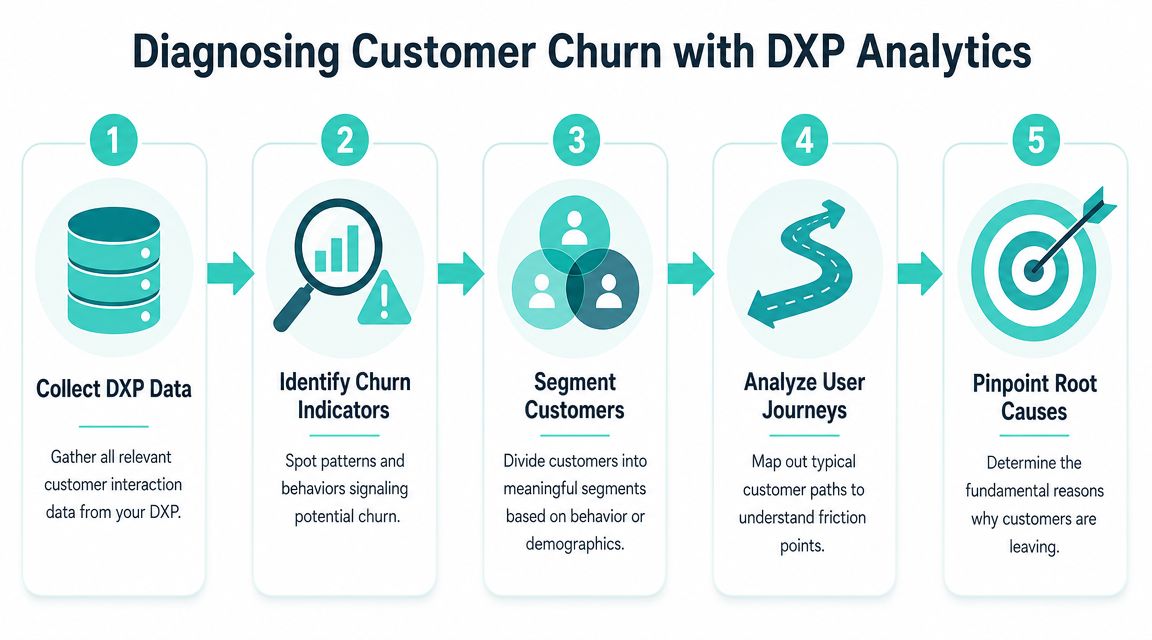
Most retention programs fail because they optimize the wrong population. They look at a blended churn number, launch a broad intervention, and assume the problem has been addressed. It hasn't. Different cohorts leave for different reasons, and aggregate reporting hides that.
A stronger workflow starts with cohort-based retention analysis. Paddle's guidance on customer retention analysis is useful here because it emphasizes defining a retention KPI, segmenting by acquisition time, persona, or usage level, and tracking behavior from acquisition to attrition. That matters in a DXP context because churn indicators often sit across interaction history, content consumption, conversion events, and support signals rather than in one report.
Start with cohorts, not averages
Cohorts should reflect how your business acquires and serves customers. In Sitecore environments, I usually see the most useful splits come from a mix of time, intent, and operating model.
Examples include:
- Acquisition window. Customers acquired during a migration, rebrand, or campaign spike often behave differently from steady-state cohorts.
- Persona or account type. Procurement buyers, daily users, editors, partners, and administrators rarely churn for the same reason.
- Usage depth. Early abandonment and mature disengagement need different remedies.
- Channel of entry. Search-led sessions, portal logins, campaign landings, and direct return visits often reveal different friction points.
Once cohorts are defined, map a narrow set of behaviors from first touch to exit risk. Don't try to instrument everything at once. Track the events that reflect progress, hesitation, escalation, and abandonment. If your implementation discipline is weak, it's worth tightening event quality first. A lot of false retention conclusions come from broken analytics tagging, not from customer behavior. That cleanup work is very similar to the discipline described in event tracking implementation for Google Analytics.
What to inspect inside the DXP
A DXP gives you more than conversion counts. It gives you sequence, context, and content interaction.
Look at the journey through these lenses:
- Entry experience. Did the user reach the right content, and did the page answer the job they came to do?
- Navigation depth. Are they exploring with confidence or looping across help, pricing, search, and account pages?
- Search behavior. Repeated reformulations often signal poor findability or weak content architecture.
- Authenticated transitions. Failed or awkward transitions from public content to logged-in tools are a common retention leak.
- Support-triggering moments. If certain tasks repeatedly end in support contact, the product or experience is carrying unnecessary friction.
Practical rule: if a cohort's churn signal only appears after data is blended across regions, brands, or channels, the segmentation is too broad to be useful.
This is also where enterprise teams need some humility. Not every churn pattern is visible in dashboards. Paddle rightly recommends validating patterns with direct customer feedback before changing the service. That's especially true when you think the answer is a new feature. Many churn problems come from discoverability, trust, or governance, not missing functionality.
A good diagnosis produces a short list of cohort-specific hypotheses. For example: new self-service users may be stalling because the first-value path isn't obvious. Returning B2B buyers may be dropping because portal search doesn't surface current documentation. High-value accounts may be disengaging because consent preferences block profile continuity across touchpoints. Those are solvable, but only if the platform team can see them clearly.
Building Retention Engines with Sitecore AI
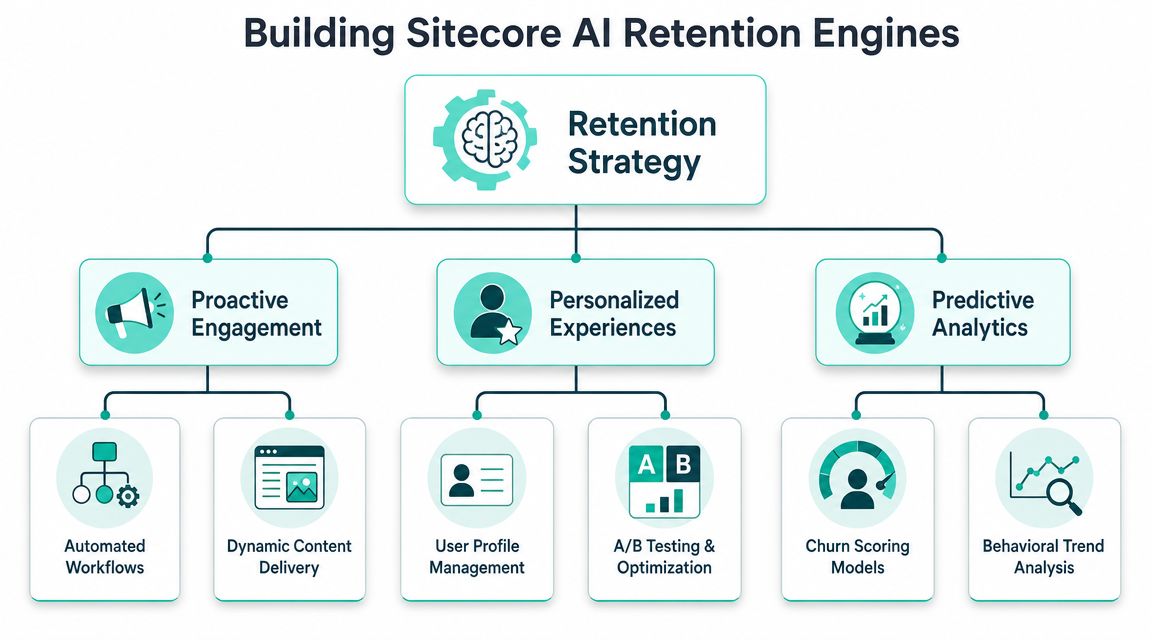
Sitecore is at its best when you stop treating it as a website platform and start using it as a coordinated experience stack. Retention improves when identity, decisioning, content delivery, and search work together under a clear operating model. That is where the Sitecore AI portfolio becomes practical, not theoretical.
A modern retention engine in Sitecore usually rests on three layers. Sitecore CDP provides profile and behavior unification. Sitecore Personalize makes decisions in real time. Sitecore Search reduces effort and dead ends. When those layers are connected properly, teams can respond to customer behavior while it still matters.
A visual model helps frame that architecture:
Use first-party identity as the foundation
Retention programs have become harder because data assumptions have changed. Braze notes that effective retention programs now need first-party data and consent-based profiling. That aligns directly with how Sitecore CDP should be used in enterprise environments.
The practical job of Sitecore CDP is not just to create a customer record. It's to make interaction history usable across channels while respecting consent and profile rules. In real delivery, this means:
- Resolving identity carefully across anonymous and known states, without pretending every visit is perfectly attributable.
- Capturing consent context so personalization logic only uses data the customer has permitted.
- Normalizing behavioral inputs from website, commerce, forms, and service-adjacent systems.
- Exposing profile attributes that marketers can understand and activate.
Often, implementations drift. Teams import too much low-value data, create bloated schemas, and then wonder why activation becomes slow and brittle. Good retention architecture is selective. You need the attributes that help you decide what to do next, not a warehouse of every field available.
The connection to AI personalization in DXP implementation is straightforward. AI only helps if the decision layer receives clean, permitted, and interpretable signals.
Turn Sitecore Personalize into a retention layer
Sitecore Personalize is where retention becomes operational. It can evaluate context, profile state, and behavior to serve the next best message, content block, journey branch, or offer. That sounds simple until you implement it in a large organization. The hard part isn't building one personalized experience. It's governing dozens of them across teams without creating contradiction.
A strong retention use case starts with a narrow intervention. Consider a high-value onboarding journey for new customers.
Use a time-bound journey instead of a vague welcome stream. Younium recommends a Day 1 to 7 roadmap with 5 to 7 key actions, progress indicators, self-service resources, proactive reminders, and support responses within one hour. That guidance translates cleanly into Sitecore:
- Day-specific content blocks in XM Cloud or your presentation layer
- Behavioral triggers in Personalize based on completed or missed onboarding milestones
- Profile state updates in CDP when a customer reaches first value, stalls, or requests help
- Experience variants by role, region, account tier, or product interest
- Escalation rules that surface service options instead of repeating promotional content
Later in the lifecycle, the same pattern can support win-back logic. If a previously active segment stops engaging with core content, Sitecore Personalize can shift the journey away from generic homepage promotion and toward reactivation content, education, support entry points, or account-specific recommendations. The important part is restraint. Win-back doesn't mean flooding a disengaged customer with urgency banners. It means reducing the effort required to re-enter a useful journey.
Here's a short demonstration of the broader Sitecore AI context:
Reduce friction with Sitecore Search
Search is often misclassified as a discovery tool rather than a retention tool. In practice, poor search drives abandonment faster than many teams realize, especially in complex product catalogs, support libraries, partner hubs, and multi-market content estates.
Sitecore Search helps retention when it does three things well:
- Understands intent instead of matching raw keywords only
- Prioritizes current, useful content over stale or duplicative assets
- Feeds downstream decisions so failed searches and result interactions become personalization signals
For enterprises, search quality depends as much on governance as on AI. If the index is full of duplicated PDFs, outdated pages, and poorly modeled metadata, relevance won't save you. Retention improves when search, taxonomy, and content lifecycle are managed together.
Sitecore AI components for retention
| Component | Primary Role in Retention | Example Use Case |
|---|---|---|
| Sitecore CDP | Unify first-party customer behavior and consent-aware profiles | Combine anonymous browsing, authenticated portal activity, and campaign response into one actionable profile |
| Sitecore Personalize | Trigger real-time decisions across journeys | Show onboarding milestones, service prompts, or reactivation content based on customer behavior |
| Sitecore Search | Reduce friction in content and product discovery | Surface relevant support articles, partner documents, or product content when users struggle to find answers |
The best Sitecore retention setups don't chase maximum personalization. They aim for reliable relevance with strong governance.
Leveraging SharePoint for B2B and Partner Retention
Enterprise retention isn't only about consumers, subscriptions, or storefronts. Some of the most expensive churn happens in B2B relationships where distributors, resellers, suppliers, franchisees, or institutional clients struggle to work with your organization. In that setting, SharePoint is often underused.
Many companies still treat SharePoint as an internal document repository. That's too narrow. When designed well, it becomes a controlled digital service layer for partners and account relationships. That matters because mature enterprises often suffer from platform sprawl and high-friction estates, and consolidating experiences on a modern platform can help fix broken handoffs that contribute to churn.

Why SharePoint matters for retention
B2B retention often fails through operational drag. A partner can't find the latest pricing sheet. A distributor submits a request and has no visibility into status. Sales collateral exists in several versions. Regional updates arrive by email, but the supporting files sit elsewhere. Every small delay tells the partner that your company is hard to do business with.
SharePoint can reduce that drag because it already handles permissions, document management, collaboration patterns, Microsoft 365 integration, and structured communication well. That gives enterprises a practical path to build partner portals without forcing every retention use case into the public website stack.
What a retention-focused SharePoint portal should include
The most effective setups usually combine a few core patterns:
- Communication sites for announcements, policy changes, regional updates, and launch information.
- Structured document libraries with ownership, version control, and clear metadata so users trust what they download.
- Request workflows through Power Automate for support, approvals, onboarding tasks, and recurring partner operations.
- Role-based access so distributors, vendors, and internal teams see what is relevant without noise.
- Integrated email discipline so operational messages land and support the portal experience. Teams managing partner communications should understand deliverability basics, and these mailX email deliverability insights are a useful primer when portal notices and lifecycle communications depend on inbox placement.
B2B customers rarely describe their frustration as "retention risk." They describe it as waiting, chasing, re-uploading, or not knowing where to go.
SharePoint isn't a replacement for Sitecore. It solves a different class of retention problem. Sitecore is stronger for public experience orchestration, personalization, and journey management. SharePoint is stronger when the retention issue is operational coordination among authenticated business users. In many enterprise programs, the best answer is both. Sitecore handles brand-led and commerce-led journeys. SharePoint handles structured partner service and account enablement.
Measuring Impact and Experimenting on Your DXP
Retention programs often fail at the measurement layer. Teams track clicks, opens, and page views inside the DXP, then struggle to connect those signals to renewal, repeat purchase, or account health. In enterprise environments, that gap usually comes from fragmented systems, inconsistent identity resolution, and experiments that were never designed around the platform's real constraints.
General engagement reporting is not enough. Sitecore CDP, Personalize, XM Cloud analytics, CRM data, commerce events, and service signals all need to resolve to a usable measurement model. Without that, retention becomes a debate about anecdotes instead of a decision about evidence.
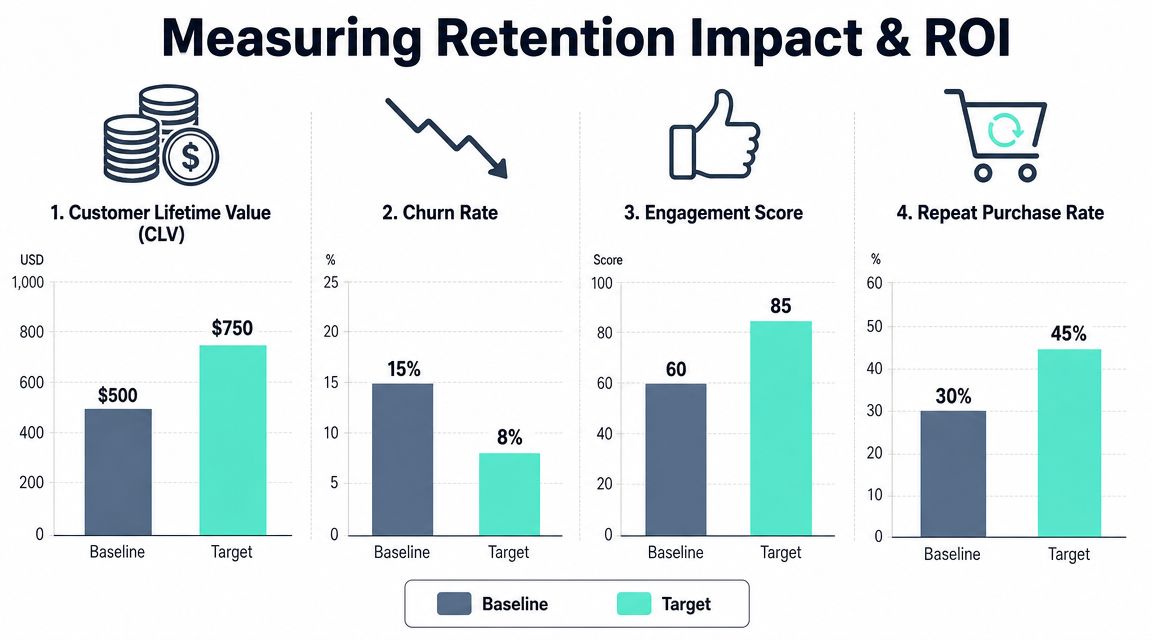
Measure operational and behavioral outcomes together
The most reliable approach is to define a compact scorecard that combines commercial outcomes with journey evidence from the DXP.
| Metric | What it tells you in practice | DXP interpretation |
|---|---|---|
| Customer churn rate | Whether customers are leaving faster than expected | Review by cohort, channel, and exposure to retention interventions, not just at total-account level |
| Customer lifetime value | Whether retained customers are becoming more valuable over time | Compare across audience segments, content paths, and personalization treatments |
| Repeat purchase rate | Whether journeys bring customers back for another transaction | Useful in commerce flows, renewals, replenishment, and account-led self-service |
| Net Promoter Score | Whether customers are willing to recommend the experience | More useful when mapped to journey stage, account type, and verbatim feedback |
Those lagging metrics matter, but they move slowly. In practice, retention improvements usually appear earlier in operational signals such as onboarding completion, return usage of key tools, search reformulation, case creation rate, or time to complete a partner task. Sitecore teams should instrument those milestones directly, then tie them back to account-level outcomes in downstream reporting.
That connection is where enterprise work gets difficult. A reduced support rate can indicate better self-service, but it can also mean customers gave up. Higher repeat visits can indicate healthy adoption, or unresolved friction. Analysts need journey context, service data, and cohort logic before calling any movement a retention win.
A useful discipline is to require shipped improvements from customer feedback, not just collected feedback. For teams looking at broader customer retention strategies, that sounds obvious. Inside a DXP program, it means tagging feedback themes, routing them into backlog categories, and tracking whether the platform team released anything that addressed them. If no change shipped, there is nothing meaningful to measure.
Run experiments the platform can support and the business can trust
A/B testing in enterprise DXPs breaks down when the test design ignores traffic volume, governance, and data quality. I have seen teams create elegant experiment plans that collapse because one audience depends on CRM fields that sync once a day, another spans regions with different consent rules, and a third never reaches statistical confidence.
Sitecore Personalize can support disciplined retention testing, but the scope has to match the operating reality. Start with one variable, one audience definition, and one measurable downstream action. Keep attribution clean. If multiple channels are active, document which system owns the intervention and which event defines success.
Useful experiments often look like this:
- Personalized onboarding modules versus role-neutral onboarding for first-session users
- Search-informed support components versus static help links on service-heavy pages
- Authenticated homepage variants by partner role, product ownership, or lifecycle stage
- Reactivation journeys that prioritize education, service access, or commercial offers for dormant cohorts
Teams that want a cleaner testing method should use a more formal A/B and multivariate testing framework for enterprise experimentation. That matters when retention decisions affect content teams, platform owners, regional stakeholders, and service operations at the same time.
Field note: If an experiment depends on manual audience uploads, spreadsheet-based reporting, and exceptions to normal governance, it will produce political debate faster than usable learning.
Interpret results with discipline. A variant that increases engagement but also drives more support tickets, longer task completion time, or lower performance in a valuable cohort should not be rolled out broadly. Retention work should reduce friction, improve confidence, and support account growth. More clicks alone do not meet that bar.
The strongest teams review experiment results alongside qualitative feedback, service outcomes, and data quality notes from the platform itself. That is how retention measurement becomes credible in a Sitecore estate. It stops being a marketing report and starts functioning like product evidence.
Operationalizing Retention for Continuous Improvement
Retention doesn't stay fixed after a successful quarter. New products launch, consent models change, content ages, taxonomies drift, and support patterns evolve. Teams that improve customer retention over time treat it as an operating discipline, not a campaign objective.
Build a retention operating model
The most resilient setup is cross-functional. Marketing can define lifecycle intent. Product and platform teams can remove friction. Analytics can identify cohort-specific loss patterns. Service teams can validate whether the experience solved the issue customers were raising.
That group needs a regular cadence. Review cohort performance. Review experiment results. Review support themes. Review the backlog of requested improvements. Then decide what ships next, what gets retired, and what needs deeper diagnosis.
A simple operating rhythm works well:
- Monthly review of churn indicators, onboarding drop-off, search issues, and support-triggering journeys
- Quarterly prioritization of platform and journey changes based on impact and effort
- Shared governance for profile attributes, personalization rules, content ownership, and portal standards
Treat retention work like product work
The wrong model is a burst of optimization followed by silence. The better model is continuous iteration with measurable hypotheses. That often means saying no to attractive but ungovernable ideas.
Some teams also benefit from outside comparison when pressure builds to default back to generic lifecycle tactics. This overview of customer retention strategies is a useful reminder of the common playbook, but enterprise teams usually get more value when they translate those ideas into platform architecture, data design, and operational routines.
Retention improves when the digital estate becomes easier to trust. Sitecore helps when personalization, search, and profile orchestration are governed well. SharePoint helps when partner and account journeys need structured self-service. Measurement keeps the work honest. Operational discipline keeps it moving.
If your team is trying to improve customer retention by fixing the platform, not just the messaging, Kogifi can help assess your Sitecore AI or SharePoint maturity, identify the friction points driving churn, and design a retention program that your architecture can sustain.