


B2C in ecommerce is operating at global infrastructure scale now, not campaign scale. The market reached approximately $7.25 trillion to $7.81 trillion in 2025, and projections place it at $9.21 trillion by 2029 under a 6.2% CAGR from 2025 through 2029 according to the B2C ecommerce global forecast report. That changes the conversation. Winning in B2C ecommerce isn't about launching another storefront. It's about building an experience stack that can adapt, personalize, govern content, and support teams operating across regions, brands, and channels.
From a Sitecore architecture standpoint, that usually means one conclusion. Monolithic commerce thinking breaks down long before enterprise ambition does. The brands that keep up are the ones that treat the customer journey, content supply chain, and internal collaboration model as one connected system.
Table of Contents
- The Unstoppable Rise of B2C Ecommerce
- How B2C buying differs from B2B buying
- Why legacy ecommerce stacks fall behind
- Personalize decision points, not decorative elements
- How Sitecore AI fits the content and commerce workflow
The Unstoppable Rise of B2C Ecommerce
B2C ecommerce now operates at trillion-dollar scale. For enterprise teams, that changes the brief. Digital commerce is no longer a channel decision. It is an operating model decision.
As noted earlier, the market size is already large enough that weak architecture shows up fast in revenue, margin, and retention. A slow search experience reduces conversion. Disconnected content increases bounce. Poor inventory visibility drives service costs because customers ask support questions the storefront should have answered.
I see the same failure pattern across enterprise programs. Brands invest in design refreshes and campaign tooling, but the underlying stack still splits content, commerce, customer data, and internal workflows across disconnected systems. The customer gets inconsistency. The business gets delays, duplicate work, and limited visibility into what changed performance.
That is why the storefront is no longer the center of strategy. The full experience is. Product discovery, promotional logic, consent handling, fulfillment signals, post-purchase service, and loyalty interactions all shape whether a customer buys once or keeps buying.
A modern digital consumer experience strategy has to connect those layers in one operating model.
For enterprise B2C, a composable DXP demonstrates its value. Sitecore gives teams a way to manage content, commerce-adjacent experiences, search, and personalization without forcing every business unit into a monolith. Add AI to improve relevance and decisioning. Add SharePoint integration to connect the internal documents, approvals, and operational content that often slow execution behind the scenes. That combination solves a real enterprise problem. It reduces the gap between what the brand promises on the front end and what the organization can deliver.
B2C growth raises the technical standard. Architecture determines whether your team can meet it.
Decoding the Modern B2C Ecommerce Landscape
B2C ecommerce serves consumer-scale demand. By 2026, global B2C ecommerce is projected to serve 2.86 billion online shoppers, about 33% of the world's population, and mobile commerce is projected to account for $2.74 trillion in sales, according to these ecommerce statistics. At that volume, weak architecture shows up fast in bounce rates, abandoned carts, support load, and merchandising delays.
How B2C buying differs from B2B buying
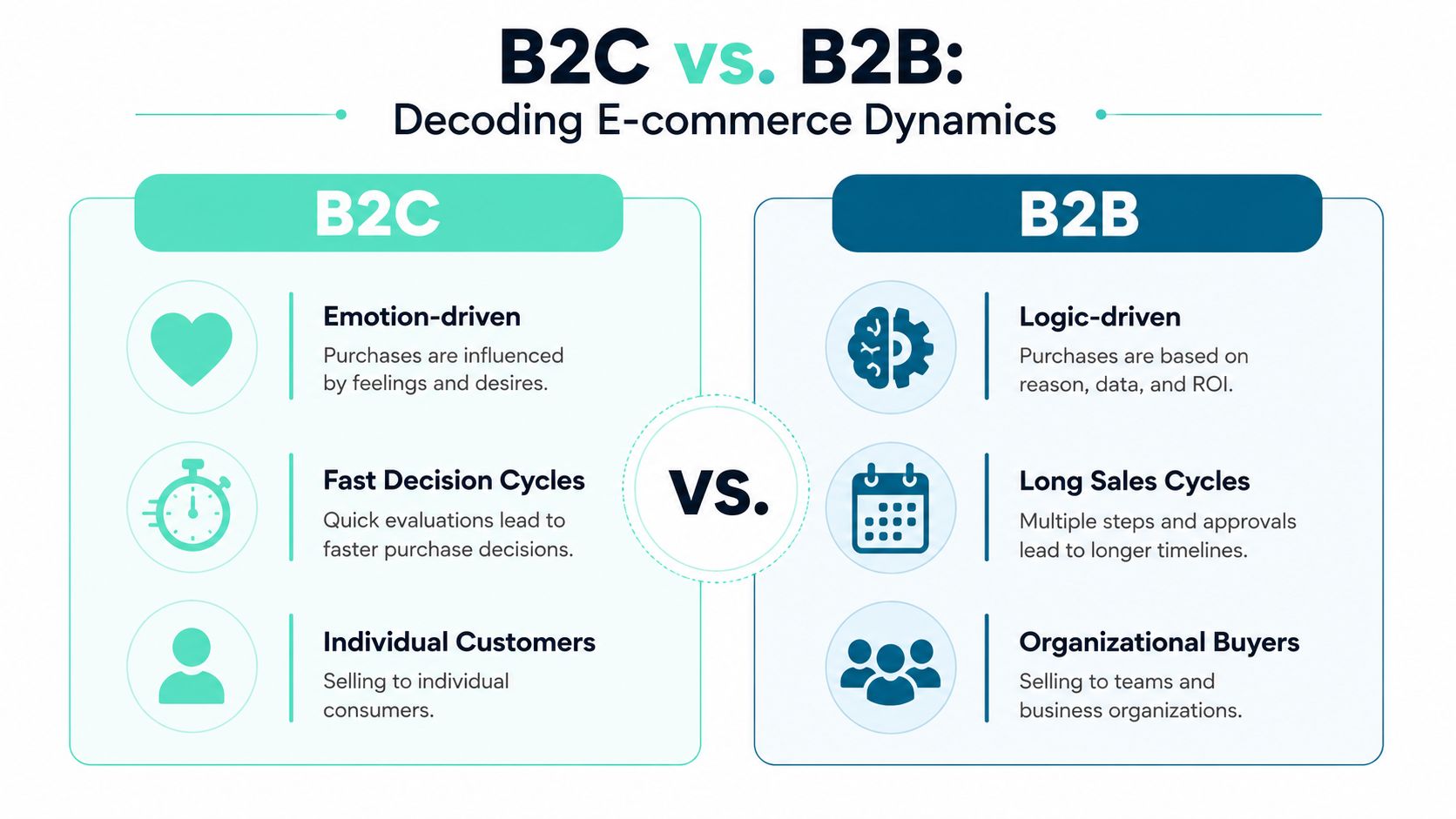
B2C buying is fast, emotional, and context-sensitive. Customers compare quickly, react to relevance in seconds, and leave just as quickly when search is weak, product detail is thin, or checkout adds friction. B2B buying usually tolerates a longer path because multiple stakeholders review, approve, and justify the decision.
That difference changes platform requirements. In B2C, navigation must be obvious, search must interpret intent, product content must answer questions early, and promotions must reflect the customer's current context. Mobile experience also needs its own design and decisioning logic. Treating it as a compressed desktop journey usually hurts conversion.
This is one reason enterprise teams keep shifting toward composable DXPs for scalable personalization. They need faster control over search, content, and experience logic without waiting on full-suite release cycles.
Why legacy ecommerce stacks fall behind
Legacy stacks usually break down in the same three areas.
| Pressure point | What customers expect | What older platforms often do |
|---|---|---|
| Speed | Fast product discovery and low-friction checkout | Slow page rendering and heavy page-level dependencies |
| Relevance | Useful recommendations, refined search, tailored content | Rules spread across disconnected systems |
| Consistency | Similar experience across web, mobile, support, and campaigns | Channel silos and duplicated content operations |
The core problem is operational. A customer might discover a product from a paid campaign, compare options on mobile, return through organic search, ask a support question, and complete the purchase later on another device. If intent signals sit in one system, content lives in another, and service or fulfillment updates depend on manual handoffs, the brand cannot respond with consistency.
I see teams misdiagnose this all the time. They focus on visual polish because it is visible and easier to fund. The larger issue is system inconsistency. Search relevance, promotion logic, product content governance, and service visibility often run on separate processes with separate owners. That is why enterprise B2C programs need more than a storefront refresh. They need an experience model that connects front-end decisions to the systems and workflows behind them.
Field observation: Teams usually overestimate design inconsistency and underestimate system inconsistency. Customers notice both, but system inconsistency costs more.
Architecting the Experience with a Composable DXP
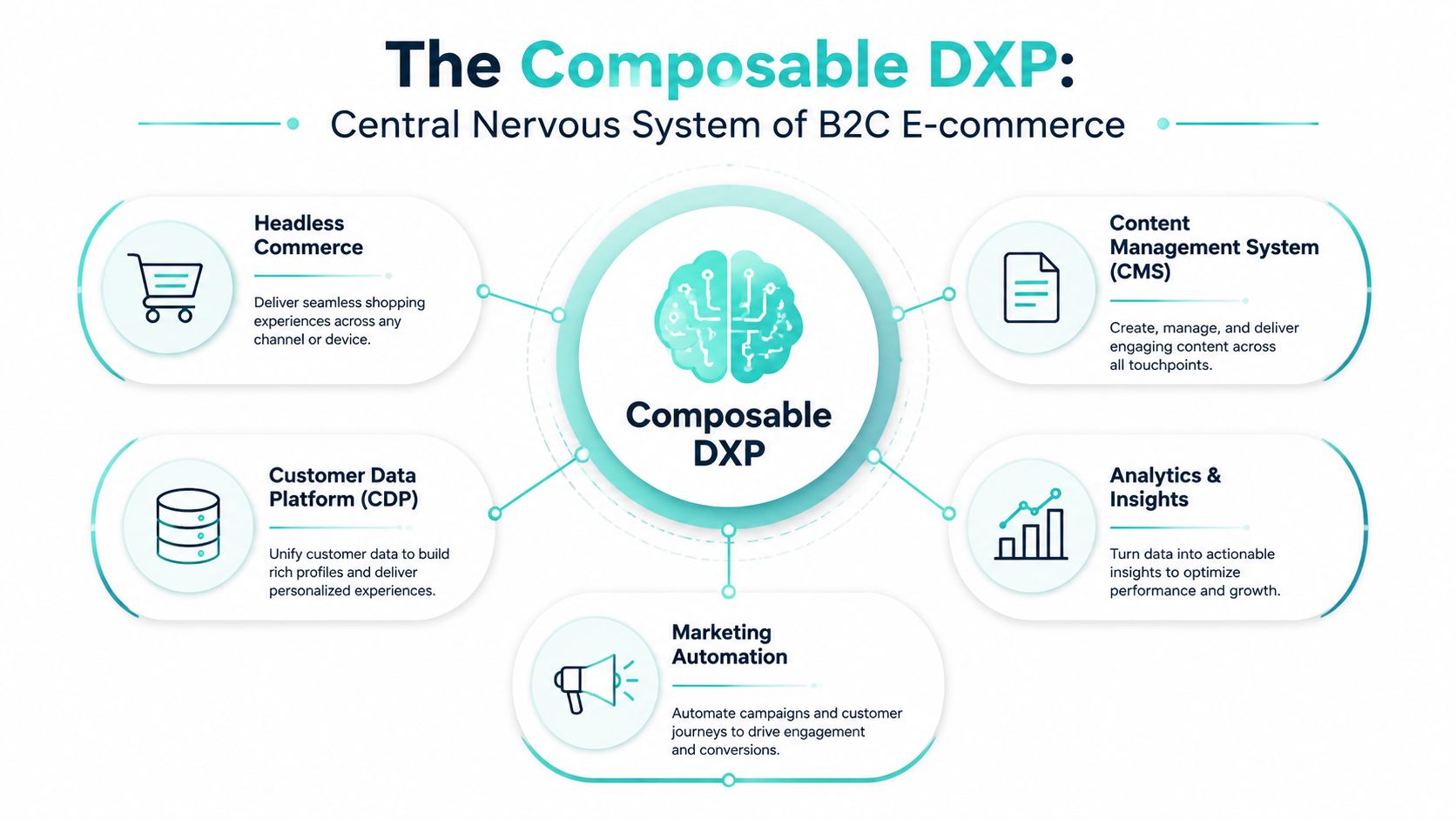
Composable architecture is the cleanest answer I know for enterprise B2C complexity. It allows teams to stop forcing one platform to do every job badly and start connecting specialized services that do specific jobs well.
Why composability matters in practice
In enterprise commerce, rigid suites create release bottlenecks. A front-end change waits on back-end release windows. Search tuning gets trapped in full-platform deployment cycles. Teams delay experimentation because every dependency is attached to something else.
That's why MACH architecture has become the enterprise standard by 2025, and why it matters beyond technical fashion. According to this ecommerce development architecture analysis, MACH enables a 40-60% reduction in page load times and a 25-35% increase in conversion rates for enterprise retailers because headless models separate front-end customization from back-end order management.
For Sitecore-led delivery, that separation is where the value shows up. Sitecore XM Cloud handles structured content and experience management. Sitecore Search improves discovery. Sitecore Personalize handles decisioning. Sitecore CDP supports audience context. Front-end teams can build in Next.js and ship quickly without dragging the entire commerce engine into every release.
A well-designed composable DXP for scalable personalization also changes team behavior. Marketing can move faster because componentized content models reduce dependency on developers for routine changes. Architects can govern integration patterns through APIs instead of custom point-to-point patches. Engineering gets cleaner separation of concerns.
Here's a useful overview of how Sitecore frames composable digital experience in practice:
What a Sitecore-centered stack looks like
A strong Sitecore implementation for B2C ecommerce usually includes these layers:
- Experience layer: XM Cloud with headless front ends such as Next.js for presentation flexibility.
- Search and discovery layer: Sitecore Search to improve product finding, refine results, and influence progression.
- Personalization layer: Sitecore Personalize and CDP for audience logic and next-best experience decisions.
- Content operations layer: Content Hub for governance, reuse, workflows, and omnichannel asset control.
- Integration layer: APIs that connect commerce engine, inventory, payment, CRM, and service systems.
- Internal operations layer: SharePoint and Microsoft 365 for collaboration, approvals, and knowledge workflows.
Architecture rule: Don't buy composability and then rebuild a monolith through custom coupling.
What doesn't work is a fake-composable implementation where teams add modern front ends on top of old process design. If catalog, pricing, campaign content, and consent logic are still governed manually in separate silos, the stack looks modern but behaves like a legacy platform.
Driving Hyper-Personalization with Sitecore AI
Personalization in B2C ecommerce often fails because teams try to personalize everything. That's the wrong target. The goal isn't maximum variation. The goal is better decisions at moments that move the customer forward.
Personalize decision points, not decorative elements
The practical Sitecore rule is clear. Personalize only the decision points that affect customer progression, such as search refinement or next-best content, instead of every piece of page chrome, as explained in this Sitecore personalization guidance.
That's the difference between useful AI and noisy AI.
If a shopper lands on a category page, the high-value decisions usually include:
Search refinement
Search suggestions, facet ordering, synonym handling, and result ranking influence whether the customer finds a viable product set fast.Recommendation logic
Cross-sell, substitute, and replenishment suggestions should reflect intent, not generic popularity.Promotional sequencing
Banner messages, urgency copy, or loyalty nudges work when tied to audience state and basket context.Next-best content
Buying guides, comparison modules, compatibility details, and FAQs can remove friction more effectively than another hero banner.
Sitecore Search and Sitecore Personalize work well together. Search interprets intent from behavior. Personalize turns that context into experience decisions. Content Hub supports the asset and copy workflow behind those decisions so teams don't create chaos with unmanaged variants.
How Sitecore AI fits the content and commerce workflow
AI should support the content supply chain, not just the last inch of delivery. In practice, I'd structure it this way:
| Sitecore capability | Best use in B2C ecommerce | Common mistake |
|---|---|---|
| Sitecore Search | Improve findability and guide discovery | Treat search as a utility instead of a conversion surface |
| Sitecore Personalize | Trigger experience changes at high-impact moments | Over-personalize low-value visual elements |
| Content Hub | Govern product, campaign, and brand content | Let teams produce variants without taxonomy discipline |
| CDP | Build audience context for decisions | Collect data without a clear activation plan |
Strong product content still matters. AI can support that work, especially for large catalogs where consistency is hard to maintain across categories and regions. For teams thinking about scalable content operations, these AI product description strategies are useful because they focus on workflow and quality, not just output speed.
A solid implementation path starts with a narrow set of measurable use cases, then expands. This AI personalization in DXP implementation guide for 2025 aligns well with that approach.
Personalization should reduce customer effort. If it mainly increases system complexity, the design is wrong.
Another practical constraint matters here. Ethical personalization will become a bigger differentiator than aggressive personalization. Customers accept relevance when the value exchange is clear. They reject experiences that feel manipulative, uncanny, or opaque. Sitecore's AI capabilities are powerful, but governance decides whether the result feels helpful or invasive.
Unifying Operations with SharePoint Integration
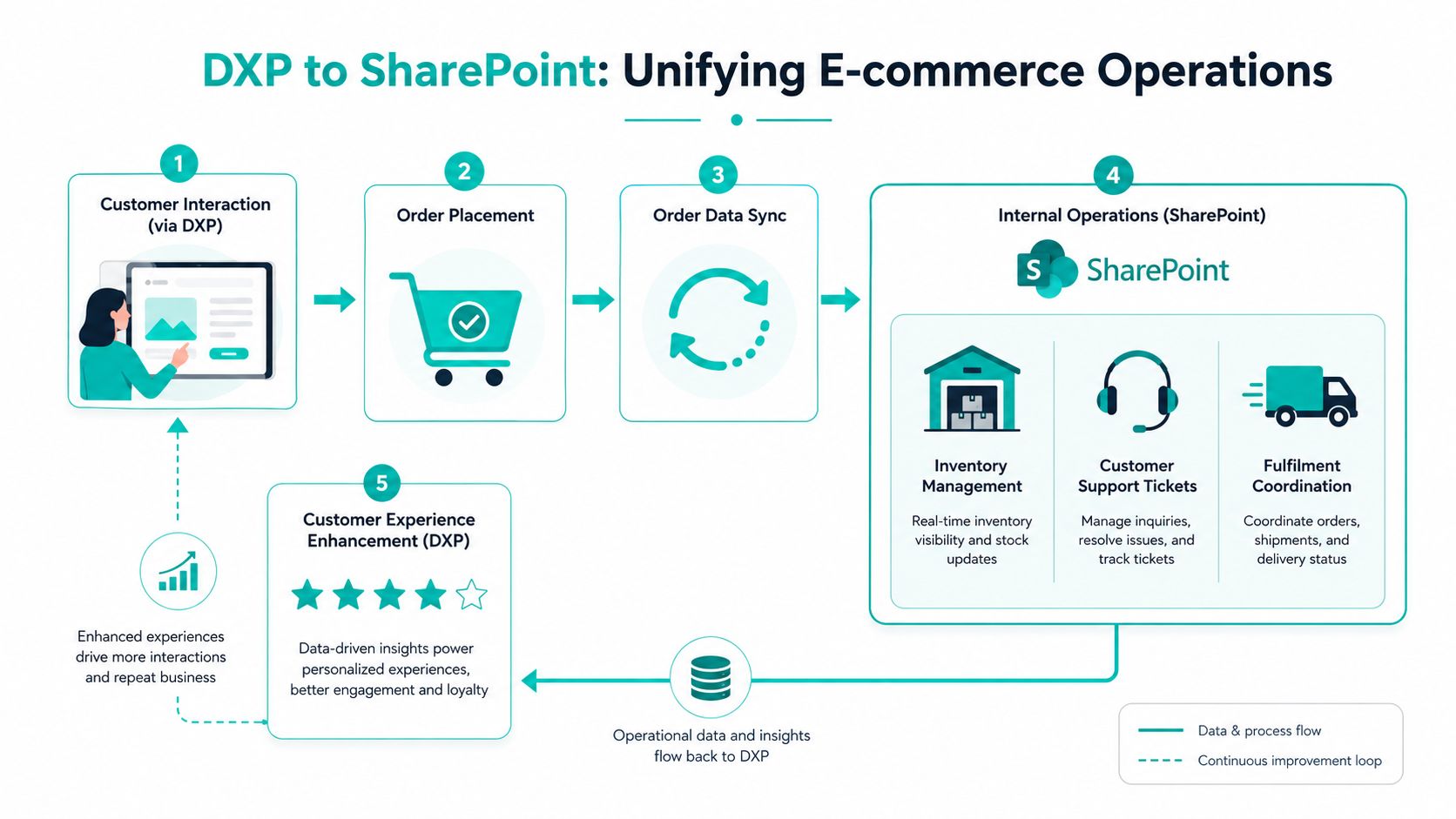
Many enterprise commerce programs focus so heavily on customer-facing experience that they ignore the internal machinery behind it. That's a mistake. Storefront quality depends on operational quality, and operational quality depends on where teams collaborate, govern content, and resolve exceptions.
Why the intranet affects the storefront
In real enterprise environments, product launches, campaign approvals, legal reviews, market localization, asset governance, and service playbooks don't live inside the DXP alone. They span teams. That's where SharePoint Online earns its place.
A well-designed SharePoint intranet acts as mission control for the people running B2C ecommerce. Merchandising teams manage launch calendars. Compliance teams review consent text and disclosures. Regional marketers access approved assets. Support teams work from current knowledge articles. Operations teams coordinate fulfillment exceptions and escalations.
This matters even more in regulated or multilingual environments. If front-end personalization is advanced but internal guidance is scattered across email threads and old file shares, execution breaks down fast.
Where SharePoint improves execution
The strongest Sitecore and SharePoint patterns I've seen use each platform for what it does best.
- SharePoint for governance: Document control, workflow approvals, policies, internal campaign hubs, and operational documentation.
- Sitecore for experience delivery: Public content, structured presentation, personalization logic, and omnichannel experience orchestration.
- Microsoft 365 for collaboration: Teams, lists, forms, and automations that support the process around experience delivery.
Consent is a good example. In Sitecore and DXP delivery, the rule is to capture consent at the edge of the experience by presenting the consent UI on the front end and blocking all non-essential behavior until the CMP returns a resolved state, as described in this consent management implementation guidance. But the operating model behind that rule often lives in SharePoint. Policy versions, approval workflows, training content, legal references, and regional process notes need one governed internal home.
A clean SharePoint estate also makes migration and modernization easier, especially when legacy intranets or document structures are slowing down cross-functional delivery. Under these circumstances, SharePoint migration services become part of the B2C conversation, not a side project.
The storefront is only as reliable as the internal process that feeds it.
What doesn't work is using SharePoint as a dumping ground. If teams throw files into libraries without taxonomy, ownership, or lifecycle rules, the intranet becomes another silo. The fix is architecture and governance, not another folder.
Enterprise B2C Strategies and Success Metrics
Enterprise B2C strategy works best when each move has a measurable operational consequence. Loyalty, personalization, and omnichannel consistency sound good in workshops. They only matter when teams can prove the system is improving customer progression and reducing friction.
Use zero-party data to earn relevance
The most useful strategic shift right now is the move toward zero-party data, where customers intentionally share preferences and context. According to this B2C ecommerce trends analysis, that approach is associated with a 28% increase in customer trust and a 15-20% uplift in repeat purchase rates. The same source notes that unified commerce ecosystems can reduce stockout errors by 30-40% through real-time inventory management.
Those figures matter because they connect trust, repeat buying, and operational visibility. In practice, this means enterprises should stop treating preference collection as a form field exercise and start using it as part of a value exchange. Ask for size, category interest, frequency, or style preference when it improves recommendations, replenishment logic, or service relevance.
A mature Sitecore setup supports that by joining several layers:
- Audience understanding: CDP and behavioral context inform who the customer is becoming, not just what they clicked.
- Experience adaptation: Personalize can respond with next-best content, offer sequencing, or journey changes.
- Operational follow-through: Commerce, inventory, and service integrations ensure the promise made on the front end is deliverable.
Measure the system, not just the campaign
I don't recommend managing B2C in ecommerce with vanity reporting. Open rates and generic traffic trends rarely explain why customer progression improved or stalled. The better lens is system health tied to commercial outcomes.
A practical enterprise scorecard often includes:
| Strategic objective | What to measure | Why it matters |
|---|---|---|
| Improve product discovery | Search refinement usage, zero-result queries, progression from listing to product detail | Discovery failure kills conversion before persuasion begins |
| Increase repeat buying | Repeat purchase behavior by audience and experience pattern | Retention shows whether relevance is actually useful |
| Reduce operational friction | Stockout-related service issues, fulfillment exception patterns, content approval delays | Customer experience fails when internal workflows lag |
| Strengthen trust | Consent completion patterns, preference sharing behavior, support signals around confusion | Trust is visible in what customers willingly share and continue doing |
What works is connecting these metrics to platform capabilities. Search performance should influence search tuning. Repeat purchase patterns should shape personalization logic. Content approval lag should trigger internal workflow fixes, often inside Microsoft 365 and SharePoint rather than inside the DXP.
The main point is straightforward. B2C strategy becomes durable when experience design, data collection, and operations all show up in the same measurement model.
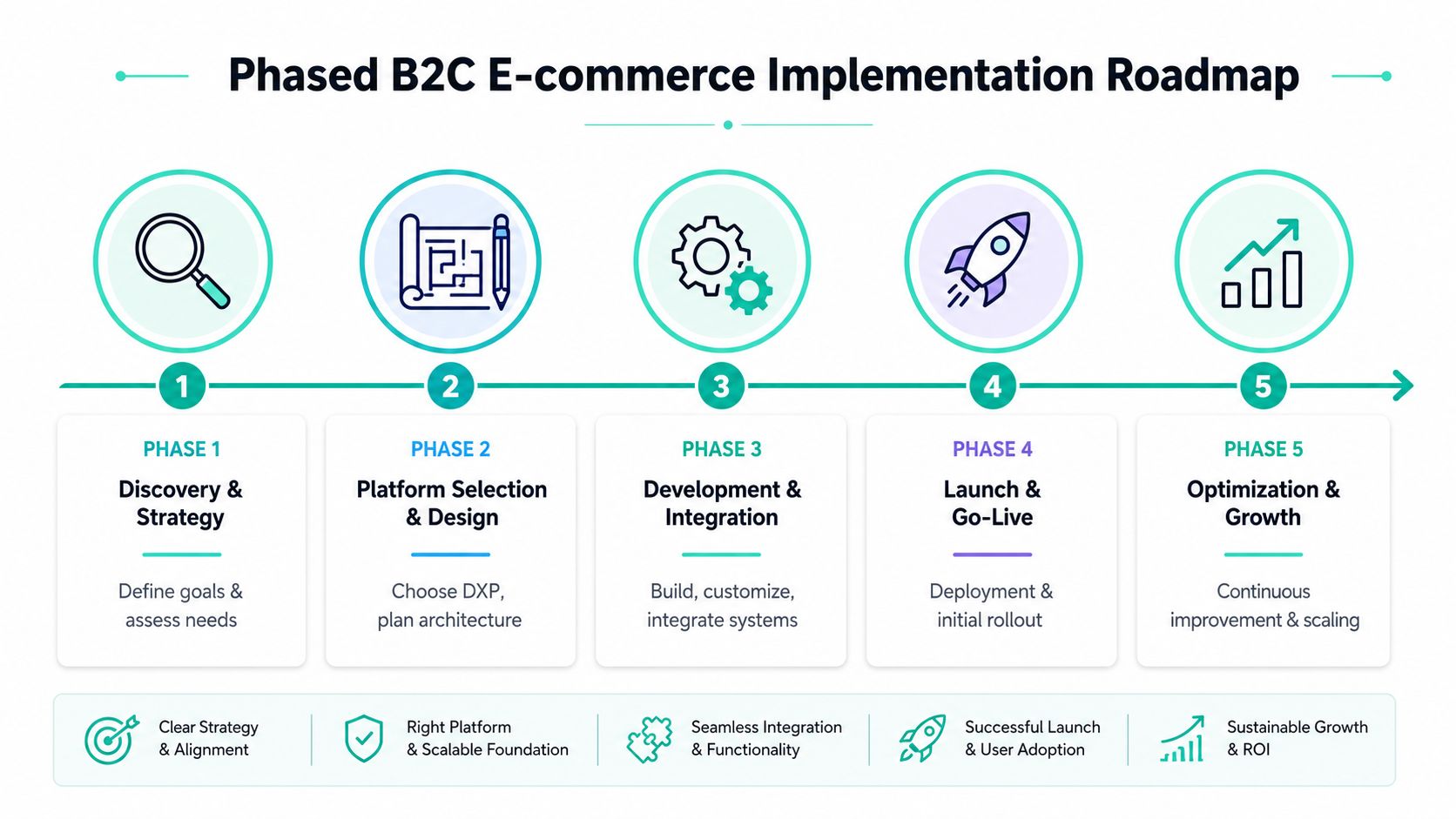
Your Phased B2C Implementation Roadmap
Most enterprise B2C programs fail by doing too much in the wrong order. They buy a platform, rush into front-end design, and postpone data, governance, and operating model decisions until after launch. Then every improvement costs more than it should.
A better approach is phased, but not rigid. The roadmap should protect architectural quality while letting teams deliver value early.
Phase 1 and Phase 2
Phase 1 is discovery and strategy.
During this phase, teams define business priorities, operating constraints, integration realities, and governance requirements. It also involves deciding what not to personalize first. That choice matters as much as what you do personalize.
Phase 2 is platform selection and experience design.
For Sitecore programs, this is usually where XM Cloud, Search, Personalize, CDP, and Content Hub decisions get aligned with the front-end model and integration boundaries. SharePoint should be considered here too, especially if campaign governance, approvals, or internal knowledge operations are fragmented.
The biggest risk in these first phases is abstract planning. If workshops don't produce concrete content models, integration contracts, ownership definitions, and KPI decisions, the program will drift.
Phase 3 through Phase 5
Phase 3 is development and integration.
Build the foundational experience layer, wire core commerce and operational systems, and create reusable component libraries. If you're running multi-brand delivery, hub-and-spoke architecture becomes valuable. Shared patterns reduce duplication without forcing every market into the same front-end expression.
Phase 4 is launch and go-live.
This phase should focus on release discipline, monitoring, consent behavior, search relevance, and fallback plans. Don't treat launch as the moment the strategy ends. It's the point where the data becomes honest.
Phase 5 is optimization and growth.
Now AI, audience refinement, experimentation, and catalog-scale content improvement start compounding. Teams often benefit from looking outside their immediate channel too. For marketplace-heavy operators or hybrid retail brands, this guide to scaling Amazon brands profitably is useful because it highlights growth discipline rather than channel hype.
A simple implementation checklist helps keep the roadmap grounded:
- Define one operating model for content, personalization, analytics, and approvals.
- Launch with a minimal decisioning set instead of trying to automate every journey.
- Treat search as a priority surface, not a utility page.
- Connect internal and external systems early, especially governance and service workflows.
- Review customer effort signals often, because they reveal architecture problems faster than brand metrics do.
Start with the flows that affect progression. Expand after the data shows the system is stable.
The best B2C ecommerce programs don't aim for a perfect future-state diagram. They build a flexible foundation, prove value in focused increments, and scale what works.
Kogifi helps enterprise teams turn that roadmap into a working platform with Sitecore, composable DXP, and SharePoint expertise. If you're modernizing B2C ecommerce, consolidating fragmented experience stacks, or building a governed AI-driven delivery model, Kogifi can design, implement, and support the architecture behind it.