


Your marketing team wants Sitecore to personalize every journey. Your legal team wants proof that every data touchpoint respects user choice. Your analytics team wants clean attribution. Your IT team wants something that won't turn into another brittle integration layer six months from now.
That tension is where most enterprise consent projects begin.
In practice, a consent management platform becomes far more than a banner at the bottom of a page. It decides whether personalization can scale without undermining trust, whether Sitecore CDP profiles remain usable, whether SharePoint intranet components behave consistently, and whether downstream systems honor what the user chose. If that sounds less like a legal widget and more like core platform infrastructure, that's because it is.
Table of Contents
- Sitecore integration patterns that actually hold up
- Why Sitecore AI raises the bar for consent quality
- SharePoint and Microsoft 365 need consent awareness too
The Modern Enterprise Dilemma Personalization vs Privacy
Enterprise teams rarely struggle because they lack tools. They struggle because the tools pull in different directions. Sitecore gives marketers the ability to tailor content, journeys, and offers across channels. Privacy obligations force teams to slow down, question every tracker, and document every decision. Both sides are right.
The mistake is treating this as a fight between growth and governance. It isn't. Personalization only works long term when the customer believes your brand handles data carefully. Without that trust, every optimization effort sits on shaky ground.
That gets even more complicated as AI enters the delivery layer. If you're reviewing how US privacy expectations are shifting around AI-enabled systems, Generative AI and US data privacy laws is a useful legal read because it frames the broader regulatory pressure behind today's architecture decisions.
Why the conflict shows up in real projects
In most DXP programs, the friction appears in familiar places:
- Marketing wants faster activation. Teams want Sitecore Personalize, CDP-driven segmentation, and campaign testing to run without constant manual approvals.
- Legal wants defensible records. They need confidence that consent capture, storage, and downstream enforcement match what the user saw and selected.
- IT wants predictable integrations. They don't want a banner script that claims compliance while analytics, email, and personalization continue processing data anyway.
- Leadership wants business value. They'll fund privacy infrastructure when it improves trust, data quality, and platform resilience, not when it looks like a stand-alone compliance spend.
A weak setup usually creates false comfort. The interface looks compliant, but the platform underneath isn't consent-aware.
The real enterprise risk isn't the banner you can see. It's the processing you can't see.
Where the CMP changes the conversation
A well-implemented consent management platform acts as the bridge between ambition and restraint. It lets a business personalize where permission exists, suppress where it doesn't, and prove the difference later. That's what turns privacy from a blocker into an operating model.
For Sitecore teams especially, this matters because the whole value of the stack depends on usable first-party signals. If consent is vague, delayed, or trapped in the front end, personalization logic becomes unreliable. The better pattern is to build anonymous and permission-aware journeys deliberately, then expand only when the user grants the right level of consent. That's the same principle behind personalizing without compromising anonymity.
When a CMP is handled properly, privacy doesn't reduce personalization. It makes personalization credible.
What Is a Consent Management Platform Really
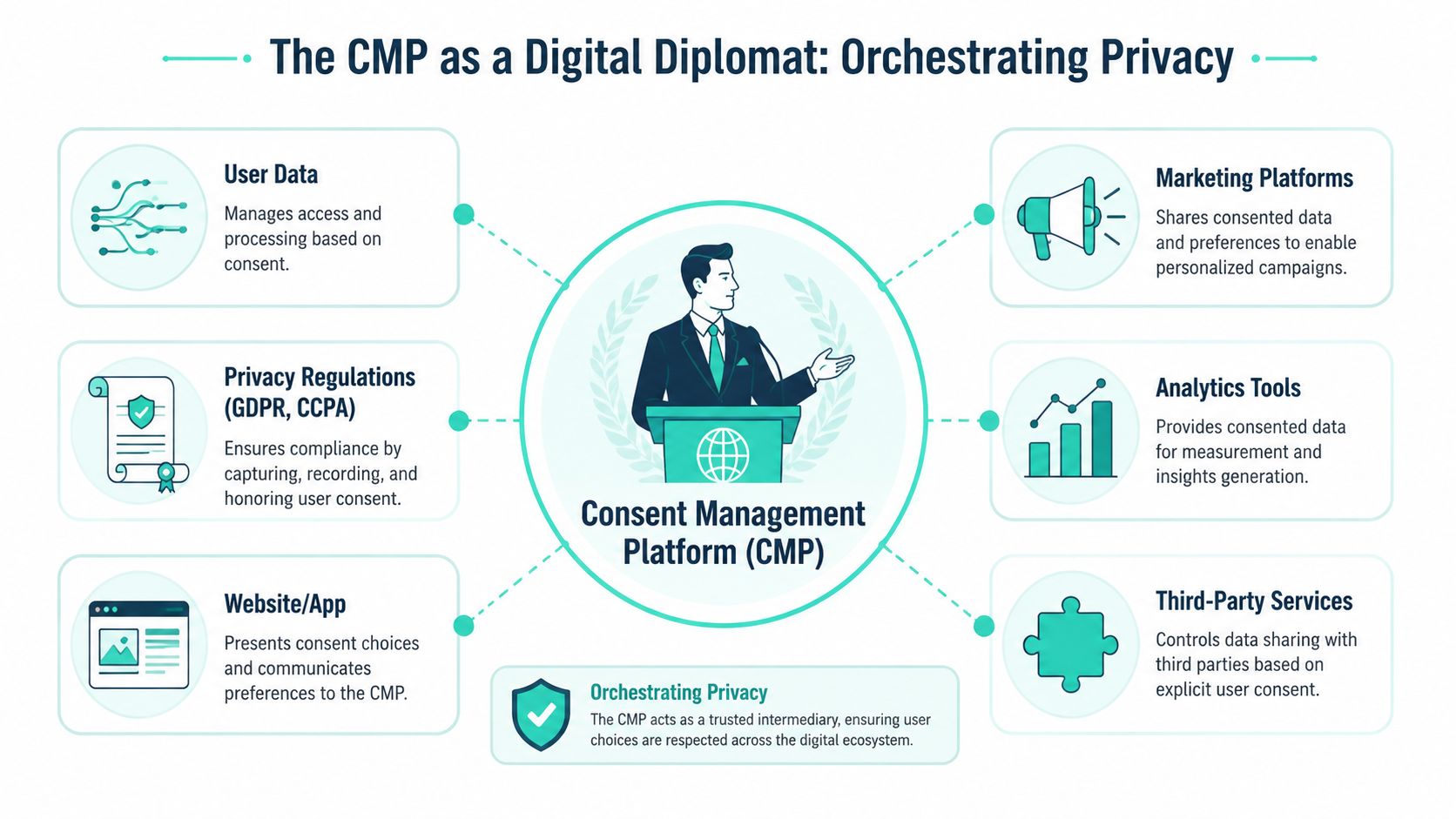
A consent management platform is best understood as a privacy orchestration layer. It sits between the user, your digital properties, and the systems that want to collect or activate data. It doesn't just display choices. It captures them, stores them, and makes them enforceable across the stack.
The simplest analogy is a digital diplomat. The user states boundaries. The CMP translates those boundaries into rules your website, analytics, ad tools, CRM flows, and personalization engines can follow.
A banner is the surface, not the platform
Many implementations go wrong at this juncture. Teams buy a tool that produces a banner and assume they've bought a full consent capability. They haven't.
A banner is only the visible interface. The platform behind it should do far more:
- Capture the decision. Accept, reject, or granular purpose-based choices.
- Store the decision. That record needs to persist in an auditable form, often with policy and interface version context.
- Enforce the decision. Tags, trackers, and downstream processing must honor the selected permissions.
- Propagate the decision. Other systems need the updated state, not a stale snapshot from the first visit.
That distinction matters a lot in large DXP estates, especially where Sitecore is paired with commerce, CRM, analytics, and campaign tooling.
If your data architecture already includes a data management platform view of audience activation, the CMP should be treated as the permission layer that determines what activation is allowed in the first place.
How the orchestration layer actually works
At a practical level, most enterprise CMPs perform a sequence of jobs.
| Function | What it does in practice | Why it matters |
|---|---|---|
| Consent capture | Presents region-appropriate choices to the user | Aligns front-end experience with legal requirements |
| Consent vault | Stores choices as durable records | Gives legal and audit teams evidence |
| Policy enforcement | Gates scripts, tags, and processing actions | Prevents unauthorized collection |
| Integration signaling | Sends consent state to other platforms | Keeps Sitecore, analytics, and marketing systems aligned |
The important point is that a CMP shouldn't operate as an island. It should behave like a decisioning service for privacy.
Practical rule: If the CMP can't influence what downstream systems do, it's a banner product with extra branding.
In enterprise work, that usually means evaluating APIs, event hooks, tag gating behavior, preference center support, and whether the platform can work across web, app, and non-web channels. The front-end experience still matters. But the core value sits in the enforcement path between the user choice and the systems that process data afterward.
That's why mature teams stop asking, “Do we have a cookie banner?” and start asking, “Can our stack act on consent as a real-time operational signal?”
Why CMPs Are a Strategic Imperative Not Just a Legal Checkbox
The business case for a consent management platform has changed. This is no longer niche spend reserved for legal departments. It's now a platform investment tied to customer trust, first-party data quality, and the viability of personalization programs.
The market reflects that shift. The global consent management market was valued at USD 0.91 billion in 2025 and is projected to reach USD 2.34 billion by 2031, expanding at a 17.05% CAGR, while cloud solutions are forecast to grow at an 18.0% CAGR according to Mordor Intelligence's consent management market analysis. That growth tells you something simple. Enterprises aren't treating consent as a side project anymore.
Privacy now shapes platform investment decisions
When organizations modernize Sitecore, move toward composable DXP patterns, or rationalize analytics and activation tooling, privacy controls become architectural criteria. They affect procurement, implementation sequencing, and operating models.
A strong CMP supports that shift in several ways:
- It reduces ambiguity. Teams know what data they can use, for which purpose, and under what user permission state.
- It strengthens governance. Consent records and policy logic become part of platform operations, not scattered spreadsheets and ad hoc scripts.
- It supports global delivery. Different regions require different experiences and controls, and enterprise platforms have to account for that without fragmenting the stack.
If your governance team needs a practical overview of overlapping compliance obligations, Cyber Command's compliance resource is a useful reference because it frames how businesses can map requirements instead of handling each law in isolation.
Consent improves the quality of first party data
There's also a commercial reason to take consent seriously. In modern DXP programs, the goal isn't just to collect more data. It's to collect data you can use with confidence.
That matters for any organization building a unified customer profile. A customer data platform strategy for the enterprise only works when incoming signals have clear permissions attached. Otherwise, your segmentation logic, suppression rules, and personalization models become questionable.
A practical way to think about it is this:
| Weak consent model | Strong consent model |
|---|---|
| Data enters systems with unclear permissions | Data enters systems with explicit usage boundaries |
| Personalization logic becomes risky | Personalization logic becomes governable |
| Legal review slows delivery | Legal review becomes part of a repeatable model |
| Users see privacy messaging as defensive | Users see privacy choices as transparent |
The organizations getting this right don't frame privacy as the cost of doing business. They use it to establish a cleaner contract with customers. That contract makes first-party data more defensible, and therefore more valuable.
The legal requirement is real. But the strategic upside is what justifies doing the work properly.
Anatomy of an Enterprise Consent Management Platform
Enterprise CMPs look very different from banner tools. The difference isn't cosmetic. It shows up in architecture, integration depth, auditability, and the platform's ability to control data use beyond the website.
What separates enterprise CMPs from banner tools
A basic product can display a notice and record a click. That's not enough for a serious DXP estate.
The first red flag is channel coverage. Cookie banner-only CMPs miss cross-channel consent for email, mobile apps, and offline interactions, and those non-cookie consent failures were responsible for 68% of GDPR fines in 2025 according to Secure Privacy's analysis of CMP types. That's why enterprise teams need to think beyond browser cookies from day one.
In practice, the most important distinction is whether the platform can govern consent as a business rule across systems, not just as a web interaction.
The components that matter in architecture reviews
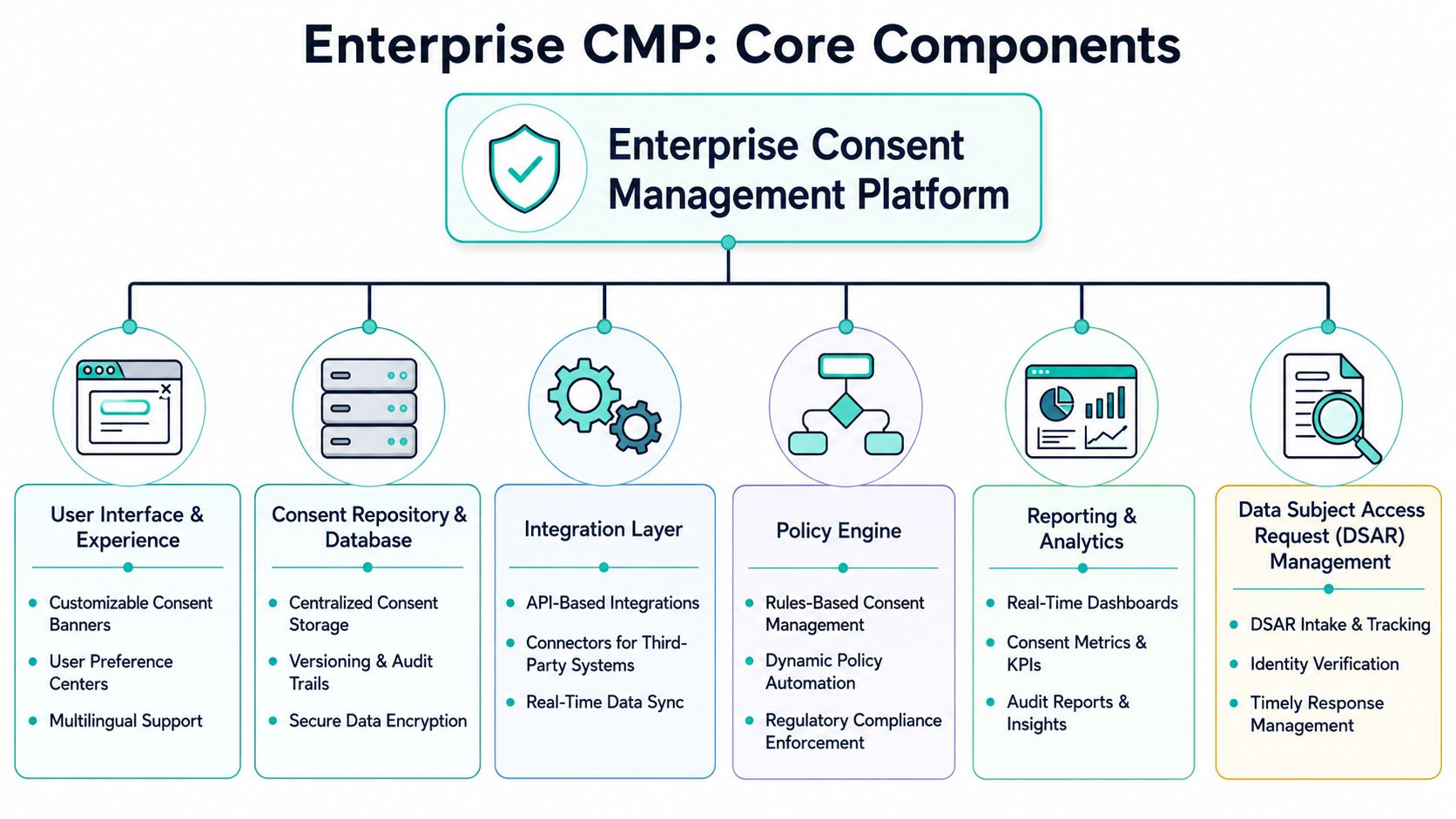
When I review CMP architecture for a Sitecore or Microsoft estate, I look for six capabilities before I care about banner styling.
Consent repository and receipt history
The platform needs a durable consent vault. That means storing who consented, what they consented to, which policy version applied, and what interface or jurisdiction logic was in effect. Without that, legal teams have little evidence and technical teams have no reliable source of truth.
Policy versioning
Privacy text changes. Purpose categories evolve. Regional logic shifts. A mature CMP versions all of this so you can tie a consent record to the exact experience shown at the time.
That matters because a raw “accepted analytics” record isn't very useful if nobody can reconstruct what that meant on that date.
Geotargeting and jurisdiction handling
Enterprise websites serve users across multiple regions. The platform should adapt consent behavior according to location and legal basis. This isn't a nice extra. It's what keeps a global web estate from collapsing into a one-size-fits-none implementation.
Tag gating and script control
A frequent occurrence is project failure. If analytics tags, ad pixels, or third-party embeds can fire before the CMP has applied the user's choice, the interface promise is already broken.
A consent banner that loads after the trackers has only documented the failure.
API and event model
For Sitecore, SharePoint, CRM, analytics, and identity integrations, APIs and event hooks matter more than template libraries. The platform should expose consent state in a way other systems can consume consistently.
Preference management beyond the first visit
Users need a way to revisit and change choices. Enterprise CMPs should support persistent preference centers and downstream revocation handling, not just first-session capture.
A quick evaluation matrix helps separate mature tools from cosmetic ones:
| Capability | Basic tool | Enterprise-ready platform |
|---|---|---|
| Web banner | Yes | Yes |
| Consent vault | Limited | Auditable and version-aware |
| Geotargeting | Sometimes | Core feature |
| Tag gating | Partial | Enforced by design |
| Cross-channel consent | Weak | Supported operationally |
| Integration APIs | Minimal | Required for downstream orchestration |
The lesson is simple. If the platform only manages browser consent on one site, it won't support enterprise personalization strategies for long.
Integrating a CMP with Sitecore and SharePoint
Most value is won or lost at this stage. Buying a consent management platform is straightforward. Making Sitecore and SharePoint behave according to consent in a consistent, auditable way is the hard part.
For enterprise teams, the integration design should start with one principle. Consent is not presentation logic. It is operational data that must move through the platform.
Sitecore integration patterns that actually hold up
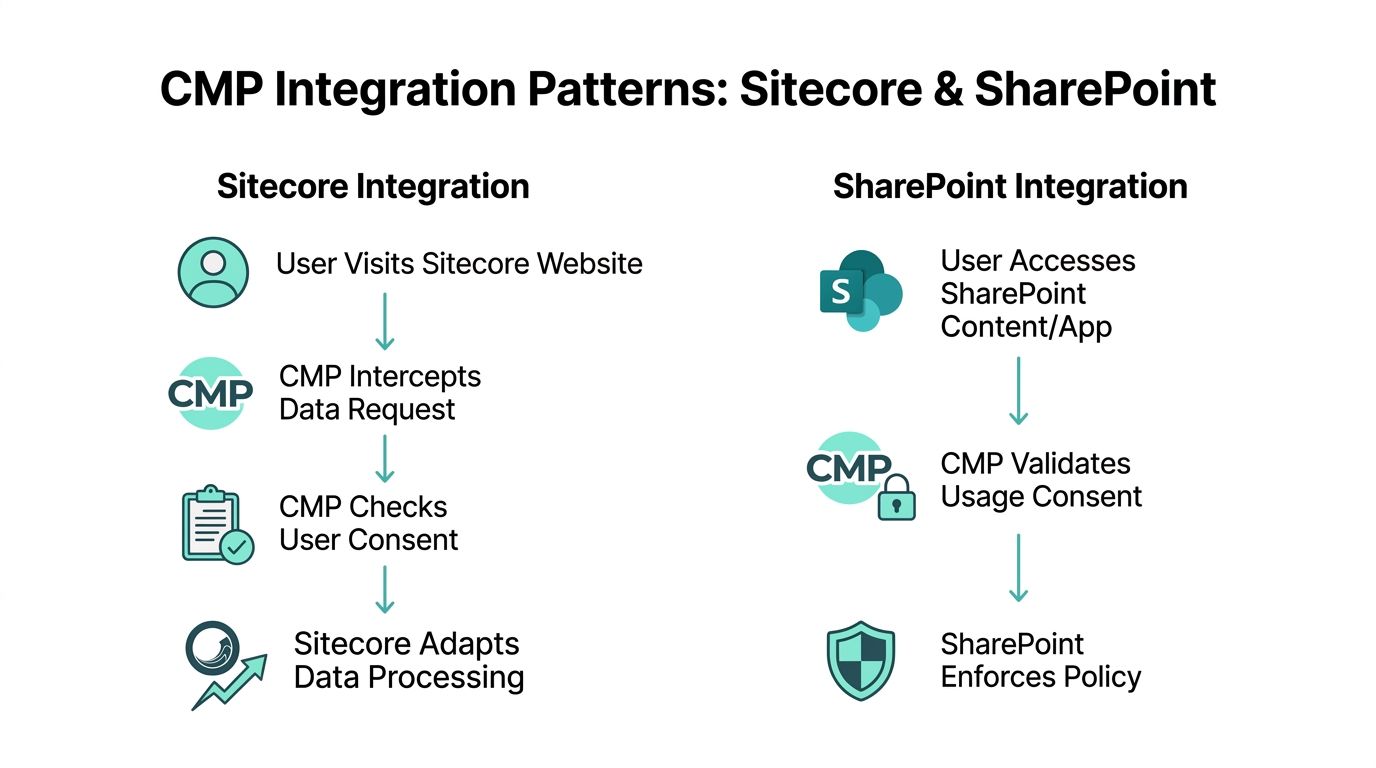
In the Sitecore ecosystem, the CMP should sit early in the request and client behavior flow. That's true whether you're running XM Cloud with a headless front end, Sitecore XP, or a composable architecture that combines CMS, CDP, Personalize, and external services.
A practical pattern looks like this:
- Capture consent at the edge of the experience. The front end presents the consent UI and blocks non-essential behavior until the CMP returns a resolved state.
- Persist the state in a controlled identity model. Anonymous users still need a consent state, often tied to a browser or session-level identifier until a known profile exists.
- Pass approved signals only. Sitecore analytics, CDP ingestion, and personalization triggers should receive only the categories the user has permitted.
- Handle withdrawal as an update event. If the user changes preference later, that update must flow back through the same integration path.
This is one reason server-side tracking patterns matter in Sitecore programs. Moving collection logic server-side can improve control, but it does not remove the need for consent gating. It increases the need to model consent explicitly, because hidden processing is still processing.
A few implementation choices consistently work better than others:
- Keep consent categories aligned with activation use cases. Don't create labels that look legally neat but are impossible to map to Sitecore decisioning logic.
- Separate anonymous personalization from identified personalization. Some experience shaping can happen without personal data, but teams need clear boundaries.
- Treat consent updates as events, not page-level variables. Sitecore-connected systems need state changes they can react to.
Why Sitecore AI raises the bar for consent quality
Sitecore's product direction makes consent orchestration even more important. Sitecore AI unifies products like CMS, CDP, and Personalize into a single composable platform, and 67% of marketers identify data integration as their biggest personalization hurdle according to Altudo's Sitecore guide.
That matters because AI-assisted personalization only performs well when the underlying data is clean, timely, and permissioned. If the consent layer is inconsistent, the problem doesn't stay in compliance. It spills directly into content targeting, audience logic, and trust in AI outputs.
SitecoreAI also has a broader platform implication. It unifies the Sitecore product ecosystem, including CMS, DAM, MRM, CMP, CDP, Personalize, and Search, into a composable SaaS model designed for high-velocity campaigns and AI-enabled workflows, as described in this overview of SitecoreAI and the Sitecore ecosystem. In that model, consent data can't remain trapped in a banner script. It has to become part of the orchestration fabric.
If you want AI to personalize responsibly, the CMP has to define what the AI is allowed to know and use.
SharePoint and Microsoft 365 need consent awareness too
SharePoint is often ignored in CMP discussions because teams associate consent only with public websites. That's a mistake.
In Microsoft 365 environments, consent issues show up in different forms:
- Employee intranets with analytics or embedded third-party tools
- SPFx web parts that call external APIs or load external scripts
- Power Platform apps that collect preference or profile data
- Hybrid portals that combine SharePoint content with customer or partner access
The architecture is different from Sitecore, but the principle is the same. The system needs a clear policy for what data is collected, for which purpose, and how that choice is represented in downstream services.
For SharePoint Online and SPFx, good practice usually includes:
| Area | What to implement |
|---|---|
| SPFx components | Load third-party libraries conditionally based on consent state |
| Embedded tools | Review whether each embed introduces its own cookies or tracking |
| Power Platform forms | Make purpose and retention clear where personal data is captured |
| Intranet analytics | Distinguish service improvement measurement from optional tracking |
In employee-facing platforms, the challenge is often less about ad-tech and more about governance clarity. Teams assume internal users have already consented because they authenticated through Microsoft 365. That assumption is usually too broad. Authentication is not a universal permission model for every processing purpose.
The best SharePoint implementations make privacy choices explicit where needed, document those choices in governance standards, and ensure custom components follow the same pattern as public-facing applications.
Implementation Roadmap and Vendor Selection
Most CMP projects fail before launch, not because the product is wrong, but because the buying criteria were shallow. Enterprises focus on the banner, the legal text editor, or a polished sales demo. Then the actual work begins and the platform can't support the data flows that matter.
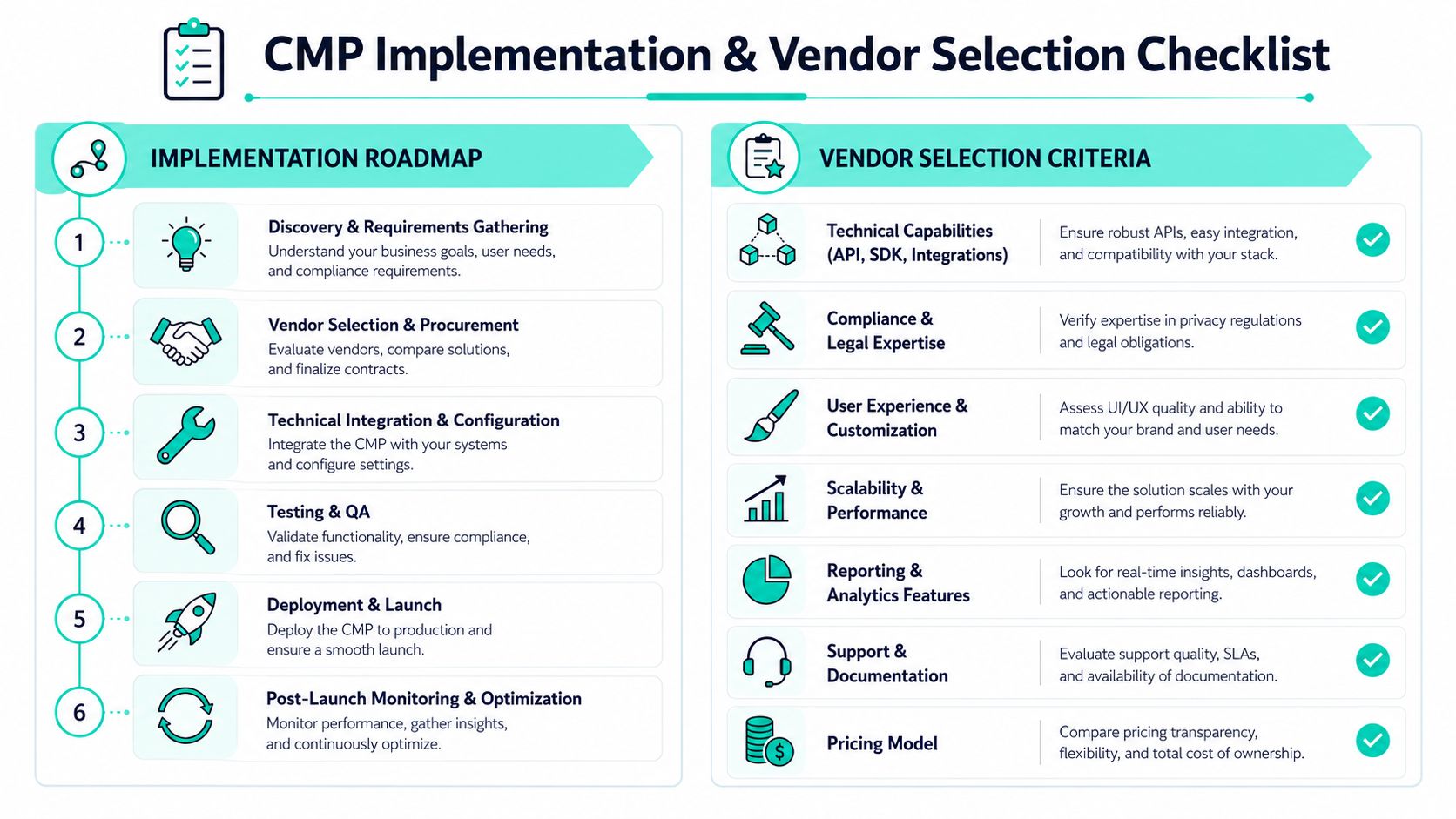
A better approach is to buy for enforcement and integration first, interface second.
How to shortlist vendors without buying the wrong platform
Start with architecture questions, not procurement questions.
A useful shortlist should test whether the vendor can support:
- Real integration depth. Can the platform pass consent state into Sitecore, analytics tools, CRM journeys, and custom applications through APIs or events?
- Cross-channel reach. Can it govern more than browser cookie choices?
- Operational auditability. Can legal and technical teams reconstruct what happened later?
- Geographic flexibility. Can it support region-specific behavior without duplicating your implementation model?
- Preference lifecycle management. Can the platform handle updates, withdrawals, and persistent preference access?
One implementation risk deserves special attention. In 2025, 54% of enterprises reported that their CMPs failed to pass real-time consent updates to downstream analytics and personalization systems, causing data leakage, according to Ketch's analysis of consent propagation failures. That's a major warning sign for any Sitecore program. If consent changes don't propagate quickly, your CDP and personalization tools can continue acting on invalid assumptions.
A short scoring model helps keep evaluations grounded:
| Criterion | Why it matters |
|---|---|
| Real-time consent propagation | Prevents stale permissions from leaking into downstream tools |
| API and webhook support | Enables Sitecore, SharePoint, and custom integration patterns |
| Consent record quality | Supports audit, dispute handling, and governance review |
| Script and tag control | Prevents accidental collection before permission |
| Channel coverage | Reduces gaps between website, app, and other touchpoints |
A rollout model that reduces risk
For large estates, a phased rollout works better than a portfolio-wide launch.
Begin with one high-traffic public property or one business-critical digital journey. Validate the full chain, not just the UI. That includes the banner behavior, consent storage, analytics suppression, Sitecore signal passing, and preference update handling.
Then expand in waves:
- Pilot one property. Use a site with enough complexity to expose integration weaknesses.
- Verify downstream enforcement. Confirm that analytics, personalization, and marketing tools react correctly.
- Add governance artifacts. Document category definitions, ownership, testing rules, and exception handling.
- Roll out across brands or regions. Reuse the model rather than reinventing it.
- Review after launch. Treat CMP operations as ongoing platform governance, not a one-off compliance project.
Buy the platform for the consent event that changes tomorrow, not just the banner that renders today.
Teams that skip the phased approach usually end up debugging invisible failures across multiple systems at once. That's avoidable. The more complex your DXP and Microsoft estate becomes, the more important it is to treat consent management as integration architecture, not front-end decoration.
Conclusion Building a Foundation of Trust
A consent management platform has become foundational to modern digital experience delivery. Not because regulations made banners unavoidable, but because enterprise platforms now depend on permission-aware data flows to function properly.
That's especially true in the Sitecore world. When CMS, CDP, Personalize, Search, and AI-enabled workflows operate together, consent can't remain trapped in a front-end widget. It has to inform how the whole stack behaves. The same applies, in a different way, to SharePoint and Microsoft 365 environments where intranets, SPFx solutions, and embedded tools collect or expose user data.
The practical distinction is clear. Weak CMP implementations create a visible privacy layer and an invisible operational gap. Strong implementations connect user choice to platform behavior, downstream integrations, and governance evidence. That's what turns consent from a checkbox into a strategic enabler.
The broader business outcome is trust. When users can see their choices respected, personalization becomes easier to justify. When internal teams can rely on permissioned data, analytics and activation become more credible. When legal, marketing, and IT work from the same consent model, delivery gets faster because fewer decisions are left ambiguous.
Technology still won't solve this on its own. The platform matters, but the architecture, integration model, and rollout discipline matter just as much. Enterprises that treat consent as a core part of DXP design end up with cleaner data, safer activation, and a stronger basis for long-term personalization.
If you're planning a Sitecore, SharePoint, or composable DXP program and want a consent model that supports personalization without creating downstream risk, Kogifi can help design and implement the architecture properly.