


Most enterprise teams already have customer data everywhere. Sitecore analytics captures digital behavior. The CRM stores account history. Commerce platforms hold orders. Email tools track engagement. Service desks log complaints and renewals. SharePoint often contains documents, forms, and portal activity that matter to the customer journey but rarely make it into activation.
The problem isn't a lack of data. It's that each system answers a narrow question, while the business needs one reliable customer context that marketing, sales, service, and digital teams can all use at the same time.
In Sitecore programs, that gap shows up quickly. XM Cloud can deliver fast, composable content experiences, and Sitecore Personalize can make strong decisions in-session, but only if the underlying customer signals are unified, current, and governed. That's where an enterprise customer data platform stops being a marketing add-on and becomes part of the operating model for the whole DXP.
Table of Contents
- What to measure beyond campaign lift
- Compliance gets more manageable when customer context is governed in one place
- Do I need a separate CDP if I already have Sitecore xDB or an older Sitecore experience setup
- What is the difference between a packaged CDP and a composable CDP
- How does a CDP enable real-time personalization in Sitecore
- How long does a typical enterprise CDP implementation take
- Should the CDP be the system of record for customer identity
The Disconnected Customer Data Challenge
A familiar enterprise pattern looks like this. Marketing knows what happened on the website. Sales knows what happened in the pipeline. Service knows who opened tickets. Commerce knows what was purchased. SharePoint knows which documents were downloaded or which portal tasks were completed. None of those systems can confidently answer one simple question: what should we do for this customer right now?
That fragmentation creates practical problems, not just reporting problems. One team suppresses a campaign because the CRM says the contact is inactive, while Sitecore shows active engagement. A service agent can't see that the customer abandoned a renewal flow. A content team in XM Cloud publishes region-specific content, but audience logic is based on stale lists exported from another tool. Every handoff adds delay, manual work, and inconsistency.
In large Sitecore estates, this gets worse when teams modernize the front end before fixing the data layer. They move to composable delivery, wire up APIs, launch personalization rules, and still struggle because customer identity remains split across platforms. The DXP looks modern, but decisioning is still fed by disconnected records.
What the business actually needs
An enterprise customer data platform solves a specific operational problem. It creates a governed customer context that other systems can use without each team rebuilding identity logic on its own.
That means:
- Profiles persist over time: not just one session, one campaign, or one channel.
- Known and unknown behavior can connect: anonymous browsing can later attach to a customer record when consent and identification are in place.
- Activation happens across systems: not only email and ads, but web, service workflows, portals, and analytics.
- Governance becomes enforceable: consent, data use rules, and profile access can be managed centrally instead of improvised in each platform.
The most expensive part of customer data fragmentation isn't bad targeting. It's that every team builds its own version of customer truth.
For Sitecore users, that distinction matters. A CDP isn't there to replace good CMS, commerce, or CRM design. It's there to stop those platforms from operating with different assumptions about the same person.
Defining the Enterprise Customer Data Platform
An enterprise customer data platform is the customer context layer of the stack. I usually describe it as the central nervous system for customer data. It receives signals from many systems, resolves identity across them, maintains persistent profiles, and makes that context available for decisioning and activation.

That role has become more important as enterprises shift toward first-party data strategies. The enterprise customer data platform market projection from Mordor Intelligence values the market at USD 4.58 billion in 2026 and projects USD 13.14 billion by 2031, with a 23.47% CAGR over that period. The same market breakdown says large enterprises accounted for 63.41% of revenue in 2025. That's a useful signal that CDPs are no longer niche tooling. They're being bought and operated as enterprise infrastructure.
What the platform actually does
A real enterprise CDP has four jobs.
First, it ingests data from websites, mobile apps, commerce systems, CRMs, support platforms, event streams, and batch sources. Second, it unifies identity, so the same person doesn't live as five unrelated records. Third, it maintains a usable profile, including attributes, behavior, and derived audiences. Fourth, it sends that context back out to systems that need to act on it.
That last part is where many definitions fall short. A CDP isn't just storage. If it can't support activation into Sitecore Personalize, XM Cloud decisioning, service workflows, analytics pipelines, or portal experiences, it becomes another repository that teams query but don't operationalize.
Why enterprise adoption looks different
Mid-market discussions often frame CDPs as campaign tools. Enterprise reality is broader. The best value usually comes from reducing fragmentation across teams and systems, not from one personalization use case alone. The Omeda perspective on enterprise CDPs captures that shift well, arguing that the fastest-growing value case is reducing data fragmentation across IT, sales, and service rather than focusing only on better audience targeting.
Practical rule: If your CDP discussion stays inside marketing, you're probably buying too small or designing too narrowly.
In a Sitecore program, that means treating the CDP as shared infrastructure for content, personalization, commerce, and service journeys. It should help XM Cloud know who the visitor is, help Personalize know what decision to make, and help surrounding systems trust the same profile logic instead of inventing their own.
Core CDP Architecture and Capabilities
A strong enterprise CDP is usually easy to explain at a whiteboard and hard to implement well. The reason is simple. It sits in the middle of many systems, each with different data quality, timing, ownership, and integration patterns.
A good technical reference point is the AWS view of customer data platform architecture, which describes a layered approach with distinct ingestion, processing, storage, governance, cataloging, and consumption responsibilities. That separation matters because customer data doesn't arrive in one format or one cadence. Some events stream in immediately. Some records land in scheduled batches. Some reference data changes slowly.
The layers that matter in practice
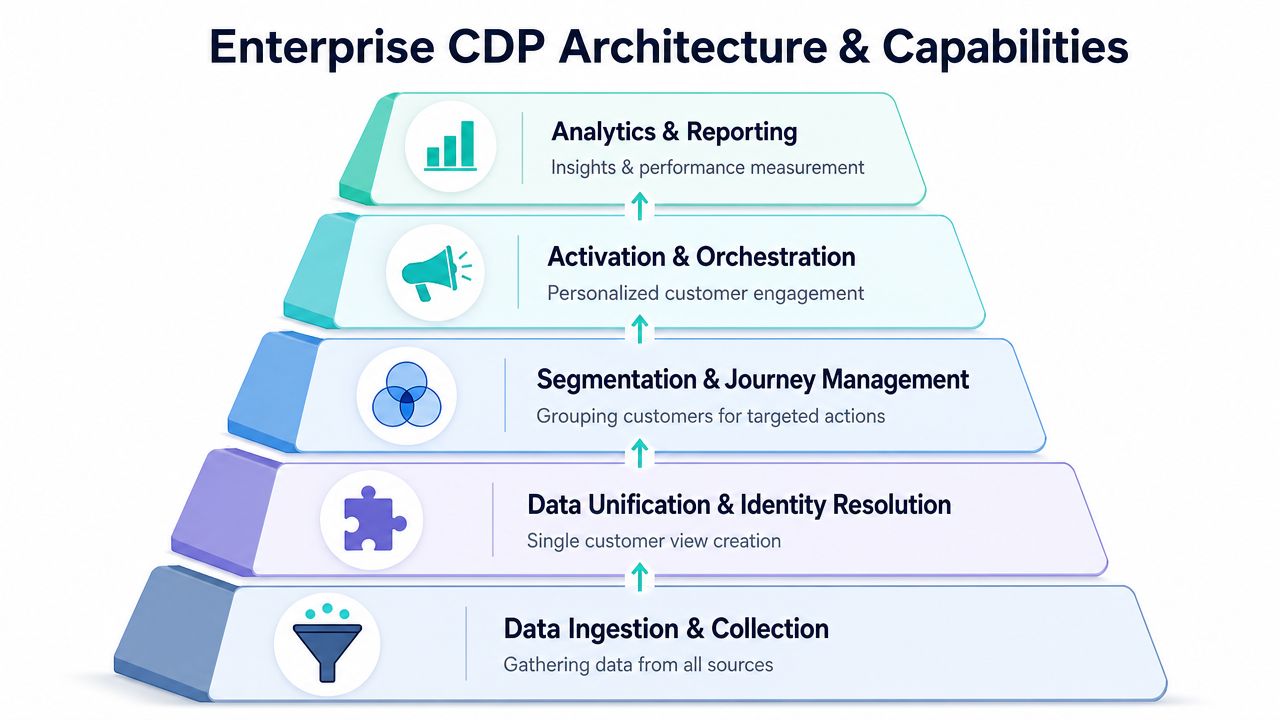
At minimum, I expect five capabilities in enterprise architecture:
- Collection and ingestion: SDKs, APIs, connectors, and batch pipelines pull in behavioral, transactional, and reference data from Sitecore properties, CRM, commerce, support, and collaboration platforms.
- Unification and identity resolution: duplicate people, devices, and accounts are stitched into something the business can use.
- Segmentation and journey logic: profile rules, audiences, suppression logic, and event triggers turn raw data into decisions.
- Activation and orchestration: audiences and attributes flow back to channels such as web, email, service tooling, and analytics destinations.
- Measurement and governance: profile lineage, consent, policy enforcement, and observability keep the platform trustworthy.
That layered design also fits modern composable architecture. Teams that are still moving away from monoliths, SOA, and microservices often underestimate how important clear service boundaries are inside the customer data layer itself. If identity, ingestion, and activation are tightly coupled, every new source becomes a risky deployment.
For a more applied view of this integration problem in digital programs, Kogifi's article on customer data integration solutions is a useful companion because it focuses on how customer signals move between platforms rather than treating the CDP as an isolated tool.
A short explainer helps if you're mapping this internally:
What works and what usually breaks
The architecture is only half the story. The operating choices are what make or break it.
What works:
- A small canonical profile model: define a manageable set of profile attributes and events before adding every possible field.
- Clear event naming: Sitecore page views, form events, commerce actions, and portal actions need consistent semantics.
- Channel-specific activation contracts: decide what XM Cloud needs, what Personalize needs, what service tools need, and don't send everything everywhere.
What usually breaks:
- Treating the CDP like a dump: if every team sends raw payloads with no ownership, the profile becomes unusable.
- Ignoring latency requirements: some use cases tolerate batch updates. In-session personalization doesn't.
- No identity policy: merging profiles sounds attractive until one bad rule connects the wrong customer records.
The best enterprise CDP designs are boring in the right places. Predictable schemas, clear ownership, and limited profile sprawl beat feature-heavy chaos every time.
Distinguishing CDPs from CRM, DMP, and MDM
Teams often ask whether they already own this capability in another product. Usually they own part of it.
A CRM is valuable, but it's centered on managed business relationships and operational records. An MDM program is also valuable, but it focuses on authoritative master data and governance across domains. A DMP has historically been associated with advertising use cases and anonymous audience management. A CDP sits in a different position. It unifies customer behavior and identity across channels, then makes that data usable for activation.
A practical comparison
| System | Primary Purpose | Data Type Focus | Key Use Case |
|---|---|---|---|
| CDP | Unify customer data and activate it across channels | Known and anonymous customer data, behavioral and transactional signals | Personalization, audience activation, journey orchestration |
| CRM | Manage customer relationships and operational interactions | Known contacts, accounts, pipeline, service records | Sales execution, account management, service case handling |
| DMP | Support audience targeting in advertising contexts | Primarily anonymous audience data | Ad targeting and media audience use |
| MDM | Govern and manage authoritative master data across the enterprise | Master data entities and data quality controls | Cross-system consistency, stewardship, governance |
The difference becomes clearer when you map real tasks. If sales needs to see account activity and opportunity history, that belongs in CRM. If data governance teams need a mastered customer or product entity with stewardship controls, that leans toward MDM. If the digital team needs to decide what homepage experience, product recommendation, or service message should appear based on recent behavior and known profile context, that's CDP territory.
Where Sitecore teams get confused
Older Sitecore conversations often blur analytics, profile storage, and full CDP capability. That's why buyers still compare platform features at the wrong level. A CMS with tracking isn't automatically a CDP. A CRM with customer records isn't automatically suited for real-time audience activation. A warehouse with customer tables isn't automatically able to orchestrate profile-driven decisions.
If this comparison is part of an internal evaluation, Kogifi's piece on CDP vs CRM is a practical read because it addresses the overlap from a platform selection angle rather than abstract definitions.
A useful test is this: can the system ingest behavior from multiple channels, resolve identity, maintain a persistent profile, and push actionable audiences back into web, commerce, and service experiences without custom rebuilding every time? If not, it may be an important adjacent system, but it isn't filling the CDP role.
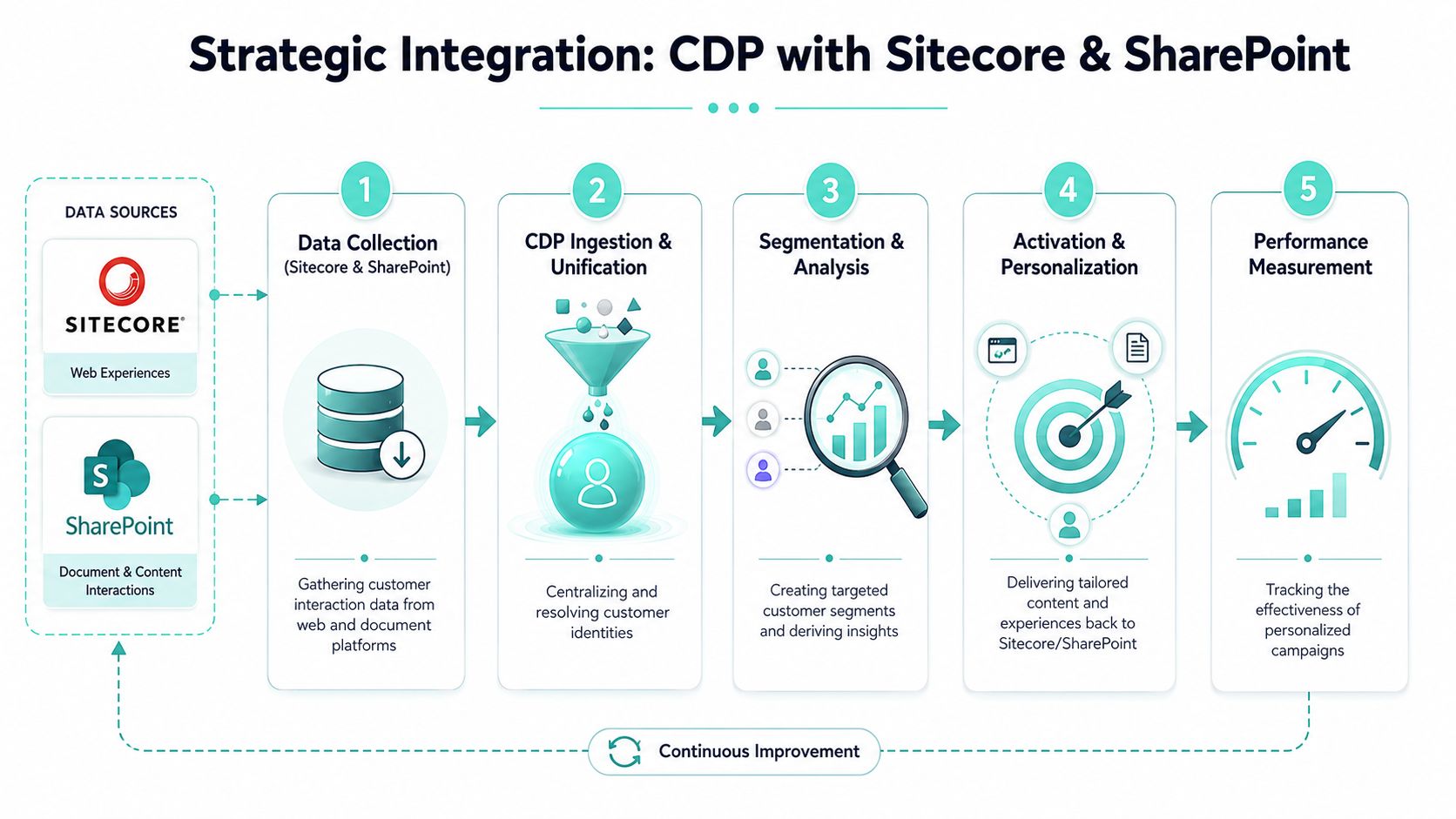
Strategic Integration with Sitecore and SharePoint
The enterprise customer data platform strategy takes practical form. In a modern Sitecore stack, the CDP shouldn't sit at the edge. It should sit in the flow of experience delivery.
A composable Sitecore pattern
For Sitecore XM Cloud, the most common pattern is this: content is authored and governed in XM Cloud, customer context lives in the CDP, and decisions are applied at render time or during orchestration based on profile signals, session behavior, or known audience membership.
Sitecore CDP and Sitecore Personalize fit naturally here. The CDP side collects and unifies behavior. Personalize turns that context into decisions such as offers, content variants, next-best actions, or suppression rules. In practical terms, XM Cloud shouldn't own customer identity logic. It should consume it.
For commerce scenarios, OrderCloud becomes more effective when the CDP can connect browsing, product interest, cart behavior, and completed orders into a profile that other channels can use. That lets a content experience reflect commerce intent without requiring the CMS to become a transaction engine.
A useful adjacent concept is the data cloud model explained here. The important distinction is that the CDP in a composable DXP often acts as the operational customer context layer, while broader cloud data platforms may still handle analytics, storage, or enterprise reporting responsibilities.
Where SharePoint fits
SharePoint is often overlooked in customer data architecture because teams treat it as a document platform only. In enterprise reality, it can be part of the customer journey or employee journey in meaningful ways.
Examples include:
- Partner portals: document access, policy acceptance, and portal navigation can be useful customer or partner signals.
- Customer self-service areas: form submissions, knowledge article use, and workflow status can enrich profile context.
- Employee-facing experiences: account teams, service agents, or regional marketers may use SharePoint surfaces that benefit from CDP-driven personalization or profile-aware content targeting.
The integration pattern usually isn't “make SharePoint the experience hub.” It's “capture relevant portal signals, unify them in the CDP, and feed useful context back where decisioning happens.” Sometimes that means profile-aware web parts or embedded experiences. Sometimes it means passing customer segment context to workflows, approvals, or case handling.
How AI gets better with cleaner customer context
Sitecore AI discussions require greater scrutiny. AI-driven content decisions, recommendations, and experimentation only perform well when the context is clean. If identity is fragmented, AI models optimize against noise.
In practical architecture terms:
- AI needs stable inputs: profile traits, event histories, and consent state must be trustworthy.
- Decisioning needs current context: in-session behavior should be available quickly enough to influence the next interaction.
- Content needs business guardrails: AI suggestions should still respect region, product line, account status, and compliance rules.
That's why a CDP is so important inside a composable DXP. It doesn't replace Sitecore AI capability. It improves the quality of the context that AI uses.
At Kogifi, this is usually the turning point in architecture workshops. Once teams see the CDP as the decision context layer for XM Cloud, Personalize, commerce, portals, and supporting workflows, they stop evaluating it as a marketing database and start treating it as part of enterprise experience infrastructure.
Don't wire AI directly to every silo. Give it a governed customer context layer first.
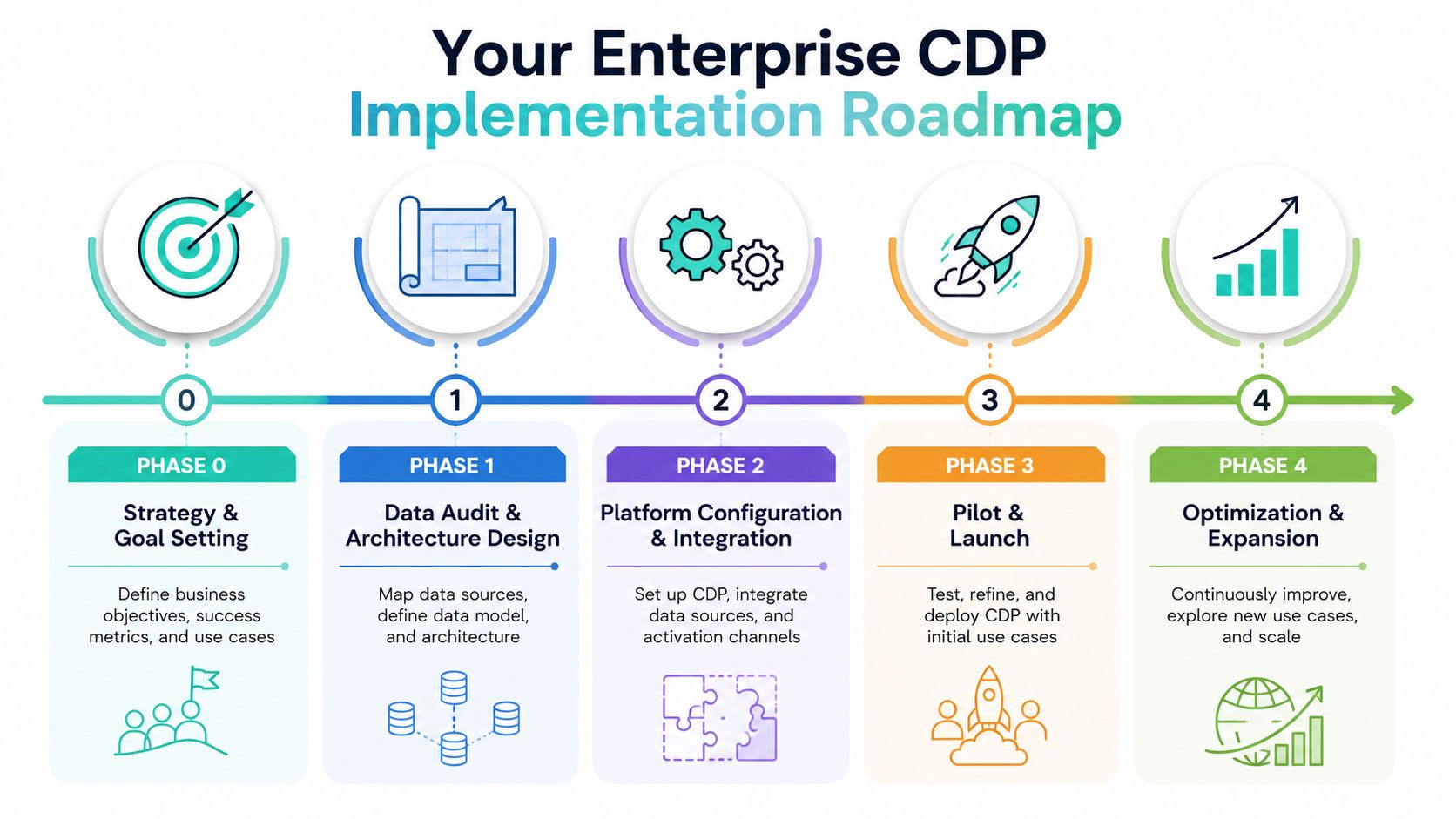
Your Enterprise CDP Implementation Roadmap
Most CDP projects fail for organizational reasons before they fail for technical ones. The platform gets selected too early, the use cases are too broad, or nobody defines who owns profile logic.
One decision needs attention early: build, buy, or buy and integrate. The Coworker.ai discussion of enterprise CDP trade-offs makes the right point here. Packaged CDPs can speed delivery, but enterprises often need streaming ingestion, graph relationships, and tight integration with stacks such as Sitecore and cloud data warehouses. In practice, architectural fit and implementation risk matter more than a polished feature checklist.
Phase 0 and Phase 1
Phase 0 starts with business decisions, not connectors. Pick a small number of use cases that need shared customer context. Good examples include anonymous-to-known personalization in Sitecore, profile-based suppression across channels, or unified service and web visibility for a key account segment.
Phase 1 is a data audit. Map systems, owners, identifiers, event quality, and consent sources. During this phase, teams usually discover that three platforms claim to be the customer source of truth and none of them are.
A few checkpoints help:
- Name the profile owner: not one person, but one function accountable for profile design and merge policy.
- Document identity inputs: email, CRM ID, account ID, device ID, commerce customer ID, and portal identifiers need rules.
- Separate analytical from operational use cases: the warehouse may remain the reporting truth while the CDP becomes the activation layer.
Phase 2 through Phase 4
Phase 2 is platform configuration and integration. Connect the highest-value sources first. In Sitecore programs, that often means digital behavior, CRM context, and one transactional source before adding every downstream system.
Phase 3 is the pilot. Pick one audience, one journey, and one measurable workflow. Don't launch a grand enterprise unification program without proving that profile data can drive a real experience in XM Cloud, Personalize, service operations, or a portal.
Phase 4 is expansion. Add more data sources, more segments, more activation endpoints, and stronger governance after the first pattern works.
What consistently works in enterprise delivery:
- Start narrow: one journey is enough to expose identity, latency, and consent gaps.
- Model events carefully: especially if Sitecore, commerce, and portal interactions need to line up.
- Design rollback paths: profile merges and activation rules need reversibility.
- Create a governance forum: marketing, architecture, security, data, and service teams all need a say.
A CDP implementation is rarely just a martech rollout. It's a data operating model project with experience delivery attached.
Measuring CDP Success and Ensuring Compliance
A CDP proves its value after the implementation deck is gone and delivery teams are dealing with live data, real identity conflicts, and audit requests. In Sitecore programmes, I judge success by one question first. Can the business use the same customer context across XM Cloud, Personalize, CRM-connected processes, and adjacent platforms such as SharePoint without rebuilding the logic every time?
If the answer is no, the platform may still be collecting data, but it is not yet operating as an enterprise CDP.
What to measure beyond campaign lift
Campaign response still matters, but it is rarely the best primary measure for an enterprise deployment. The stronger scorecard combines operating efficiency, activation quality, and control over customer data use.
Track measures such as:
- Retired point integrations: count the customer exports, custom sync jobs, and duplicate segment pipelines that can be removed because Sitecore CDP or your wider customer data layer now serves the same purpose.
- Cross-system profile reuse: confirm whether identity and audience rules created for Sitecore can also support service workflows, portal experiences, and reporting without separate remapping.
- Decision timing: measure whether profile updates arrive quickly enough to influence the next XM Cloud or Personalize interaction, not just the next-day report.
- Operational effort: review how much spreadsheet reconciliation, manual audience building, and IT ticketing still sits behind everyday activation work.
- Data quality under real conditions: test whether anonymous, known, and account-linked behaviour resolves consistently once traffic comes from web, app, commerce, and intranet or portal touchpoints.
Many programmes expose a hard trade-off. Tight real-time use cases usually require stricter event design, cleaner identity inputs, and less tolerance for delayed source data. Broader enterprise coverage often means slower onboarding of systems with poor identifiers or inconsistent consent history.
Collection design affects both measurement and compliance. Browser-side tracking alone leaves gaps, especially where consent choices, ad blockers, and script performance interfere with event capture. Kogifi's guide to server-side tracking for enterprise measurement and governance is relevant if your Sitecore setup still depends heavily on client-side collection.
A CDP starts earning its keep when architecture, marketing, and service teams stop maintaining separate customer truths.
Compliance gets more manageable when customer context is governed in one place
A central profile layer helps because consent state, identity relationships, and activation rules can be applied closer to the systems that use the data. That matters in a composable DXP, where XM Cloud, Personalize, analytics tooling, CRM-connected services, and collaboration platforms may all consume customer context differently.
In practice, well-governed CDP programmes make it easier to handle:
- Consent-aware activation: personalisation and audience sharing can respect regional, channel, and purpose limits before data is pushed into Sitecore or downstream platforms.
- Data subject requests: access, correction, and deletion processes have a clearer execution path when identities are linked and data flows are documented.
- Retention control: profile and event data can be kept for defined periods instead of lingering across disconnected systems.
- Access boundaries: teams can be given the level of profile visibility they need without exposing every attribute to every tool.
The common failure point is assuming the CDP product itself solves governance. It does not. The operating model still matters. Security, legal, platform owners, and data stewards need agreed rules for consent capture, profile merge review, retention windows, and downstream activation approval.
In Sitecore estates, I also recommend checking compliance at the integration boundary, not only inside the CDP. If SharePoint, service portals, or internal tools consume customer attributes, those endpoints need the same scrutiny as public-facing personalisation in XM Cloud. That is usually where compliance drift starts.
Enterprise CDP Frequently Asked Questions
Do I need a separate CDP if I already have Sitecore xDB or an older Sitecore experience setup
Usually, yes, if your requirement is enterprise-wide customer unification across multiple systems and channels. Older experience databases were valuable for web-centric behavioral tracking, but modern enterprise programs need broader identity resolution, activation across more systems, and stronger support for composable architecture. If your customer truth has to inform XM Cloud, Personalize, commerce, CRM-adjacent workflows, and portals, the scope is wider than classic web analytics storage.
What is the difference between a packaged CDP and a composable CDP
A packaged CDP gives you more out-of-the-box capability in one product. That can accelerate early delivery. A composable approach uses a mix of services, cloud data platforms, identity logic, event pipelines, and activation tools assembled for your architecture.
The trade-off is speed versus control. Packaged products can simplify adoption, but composable patterns often fit better when the business already has strong warehouse, streaming, and integration capabilities. The right answer depends on latency needs, governance requirements, and how much of your customer model already exists elsewhere.
How does a CDP enable real-time personalization in Sitecore
The core loop is straightforward. A visitor interacts with a Sitecore touchpoint. Behavioral events and profile cues enter the CDP. Identity resolution or audience logic updates the profile. Sitecore Personalize or another decision layer consumes that context and returns the next experience or offer. XM Cloud then renders content against that decision.
The important nuance is timing. “Real-time” isn't just a product claim. It depends on event collection, profile update latency, decisioning speed, and how the front end consumes the response.
How long does a typical enterprise CDP implementation take
It depends on scope, integration depth, and data quality. A focused pilot can move quickly when the use case is narrow and the source systems are well understood. A full enterprise rollout takes longer because identity policy, governance, consent, and organizational alignment usually require more effort than connector setup.
The wrong way to estimate is by counting integrations only. The right way is to assess use cases, data readiness, profile complexity, and activation paths.
Should the CDP be the system of record for customer identity
Sometimes, but not always. In many enterprise architectures, the warehouse or lakehouse remains the broader analytical truth, while the CDP becomes the operational customer context layer for identity and activation. In other cases, the CDP takes a stronger role in persistent profile management. The decision should be made deliberately, based on activation needs, stewardship model, and existing platform maturity.
If you're planning a Sitecore modernization, evaluating Sitecore CDP and Personalize, or trying to connect XM Cloud with CRM, commerce, and SharePoint signals in a governed way, Kogifi can help you design the target architecture, integration model, and rollout approach.