


Your team probably knows the pattern already. Marketing wants a new landing page, a campaign-specific personalization rule, and a content update for mobile at the same time. The monolithic DXP turns that simple request into a release train problem. Developers wait on shared deployments, authors work around rigid templates, and every change feels riskier than it should.
That tension is why enterprises are revisiting the MACH architecture principles now. This isn't just a developer preference for newer tooling. It's a response to a business reality: digital teams need to ship faster, test more often, and support more channels without rebuilding the whole estate each time. For Sitecore and Microsoft-centric organizations, the shift matters even more because the strongest modernization path now combines composable delivery, cloud operations, and AI-driven experience optimization.
Table of Contents
- What composable Sitecore looks like in practice
- Where Sitecore AI creates business value
- What works and what usually fails
- Start with a business capability not a platform rewrite
- Control integration fatigue before it controls the program
Beyond the Monolith The Rise of Composable Experiences
A common enterprise scenario starts with good intent. The organization bought a full-suite platform years ago because one vendor, one deployment model, and one content layer seemed safer. Then reality changed. New brands appeared, regional teams needed more autonomy, mobile experiences became first-class, and personalization stopped being optional.
The monolith didn't break overnight. It got slower. A campaign page depended on release windows. A search enhancement touched too many shared dependencies. A design refresh dragged because front-end freedom was tied to back-end constraints. When that happens, digital leaders stop asking for more features and start asking for maneuverability.
That's where MACH stops being a buzzword and becomes a board-level architecture discussion. According to Gartner, over 60% of commerce solutions for both B2C and B2B markets are predicted to be designed in accordance with MACH principles by 2027 (Sam Solutions summary of Gartner's projection). That matters because it signals a market-wide shift toward modular platforms that can change in parts instead of only as a whole.
Why the pressure feels higher now
Customer experience teams now design for websites, apps, authenticated portals, service interfaces, kiosks, and emerging touchpoints. Front-end teams also need room to work with modern delivery patterns and established mobile app UI design frameworks when experiences span web and native channels. The old “CMS page equals digital experience” model doesn't hold up.
For organizations evaluating personalization at scale, a composable operating model is often the missing piece. The reason is simple. AI, testing, search, commerce, and content all need to move without waiting on the slowest layer. A useful primer on that shift is this perspective on composable DXPs for scalable personalization.
Monoliths usually fail the business before they fail the platform. Release friction shows up first, then missed opportunities, then rising support costs.
Decoding The Four MACH Architecture Principles
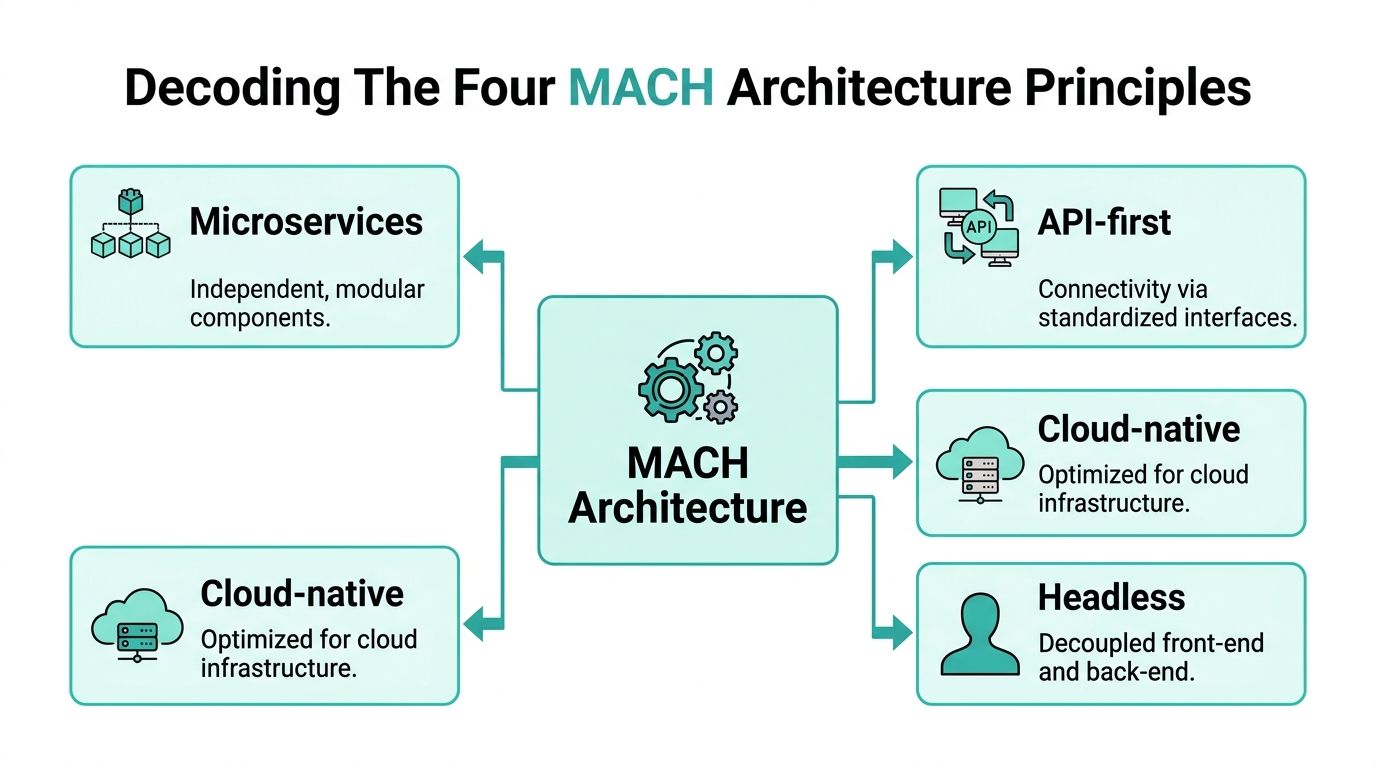
MACH stands for Microservices, API-first, Cloud-native, and Headless. Taken separately, each principle solves a technical problem. Used together, they change how teams design, release, and govern digital experiences.
Microservices
Microservices split a large application into smaller services aligned to business capabilities. Search can evolve independently from profile management. Checkout logic can change without forcing a full-platform regression cycle. That's the practical advantage leaders care about.
The architectural discipline matters here. The Microservices principle enforces strict data isolation where each service stores and manages its own data without sharing it across system boundaries, creating loosely coupled units that can be deployed independently and reducing the chance that one failure brings down the wider system (Hygraph on MACH architecture).
That sounds clean on paper. In practice, it works only when teams map services to clear business boundaries.
- Good fit: search, catalog enrichment, profile preferences, content delivery APIs, campaign orchestration
- Poor fit: carving a monolith into tiny technical fragments with no service ownership
- Best outcome: teams release features in parallel because each service has a defined contract and lifecycle
API-first
API-first means teams define how systems communicate before they design the user interface around them. That order matters. It prevents one channel from becoming the default model for every other channel.
For an enterprise DXP, API-first design creates several advantages:
- Channel flexibility: web, mobile, kiosk, and intranet consumers can use the same underlying capabilities.
- Integration discipline: identity, CRM, DAM, search, and analytics systems connect through explicit contracts.
- Replaceability: when a component no longer fits, teams can swap it with less disruption.
If your current stack still treats APIs as an afterthought, composability will feel brittle. If APIs are treated as products with versioning, ownership, and documentation, composability becomes manageable.
Cloud-native
Cloud-native is often misunderstood as “hosted in the cloud.” That's not enough. A cloud-native service is designed for elastic infrastructure, automated deployment, resilience, and operational visibility.
In enterprise delivery, this changes how teams think about uptime and change. Instead of coordinating heavyweight platform releases, they automate deployment pipelines, monitor services independently, and scale the parts under load. That's especially relevant for organizations standardizing on Azure, where infrastructure, observability, and security policies can be aligned across DXP and collaboration platforms.
Headless
Headless separates content and business logic from presentation. The back end manages structured content and capabilities. The front end decides how to render and orchestrate the experience.
The strongest explanation of the value is operational. Content is modeled as structured data rather than tied to rendered HTML, which lets teams publish once and deliver consistently across websites, apps, and other digital interfaces. It also means the front end can use modern frameworks while the content platform remains stable behind the scenes, as outlined in this overview of headless architecture.
Practical rule: If your front-end roadmap is blocked by CMS release dependencies, you don't have a front-end problem. You have a coupling problem.
The Business Case For MACH In Enterprise DXPs
Enterprises rarely move away from a monolith because architecture diagrams look better. They move because the operating model becomes expensive, slow, and politically difficult. Every release needs coordination. Every customization deepens platform dependency. Every urgent business request competes with technical risk.
Where monoliths hold teams back
The biggest issue isn't that monolithic DXPs can't do useful work. Many still power important websites and portals. The problem is that they bundle unrelated concerns into one release surface. Content changes, personalization rules, search updates, integration fixes, and front-end improvements all land in the same change queue.
That creates familiar outcomes:
- Marketing waits: campaign velocity depends on shared sprint capacity.
- Engineering over-defends the platform: because one bad deployment can affect everything.
- Innovation gets deprioritized: because low-risk maintenance always wins over experimentation.
- Procurement inherits lock-in: because replacing one capability often means reconsidering the full suite.
How composability changes operating speed
MACH changes the business case by letting organizations modernize selectively. You don't have to replace everything at once. You improve the layers that create bottlenecks, then expand from there.
The contrast looks like this:
| Aspect | Monolithic Architecture | MACH Architecture |
|---|---|---|
| Release model | Shared deployments across tightly coupled features | Independent deployment of modular capabilities |
| Change risk | Broad regression surface for small changes | Fault isolation at service or component level |
| Front-end flexibility | Limited by platform rendering model | Any front-end that can consume APIs |
| Scalability | Scale the platform as a whole | Scale only the services under pressure |
| Vendor dependence | Deep platform coupling | Replaceable components with defined contracts |
| Experimentation | Hard to test quickly without release overhead | Easier to test and iterate in smaller units |
| Operating model | Centralized control with heavy coordination | Cross-functional ownership by capability |
This doesn't mean MACH is automatically cheaper or easier. It means the spending aligns better with business capabilities. Teams can invest where differentiation matters. Commodity capabilities can remain standardized.
A well-run enterprise program usually sees the strongest value in three places. First, developers stop treating every release as a system-wide event. Second, marketers gain faster paths to launch and refine experiences. Third, architects gain room to evolve the stack without rewriting the estate every few years.
A composable DXP is less about buying many tools and more about creating a system where each capability can change at the speed the business actually needs.
For Sitecore users, that's why the conversation often starts with front-end decoupling and ends with operating model reform. Once teams can deliver experience layers independently, they begin to redesign governance, testing, and ownership around business outcomes instead of around the legacy platform boundary.
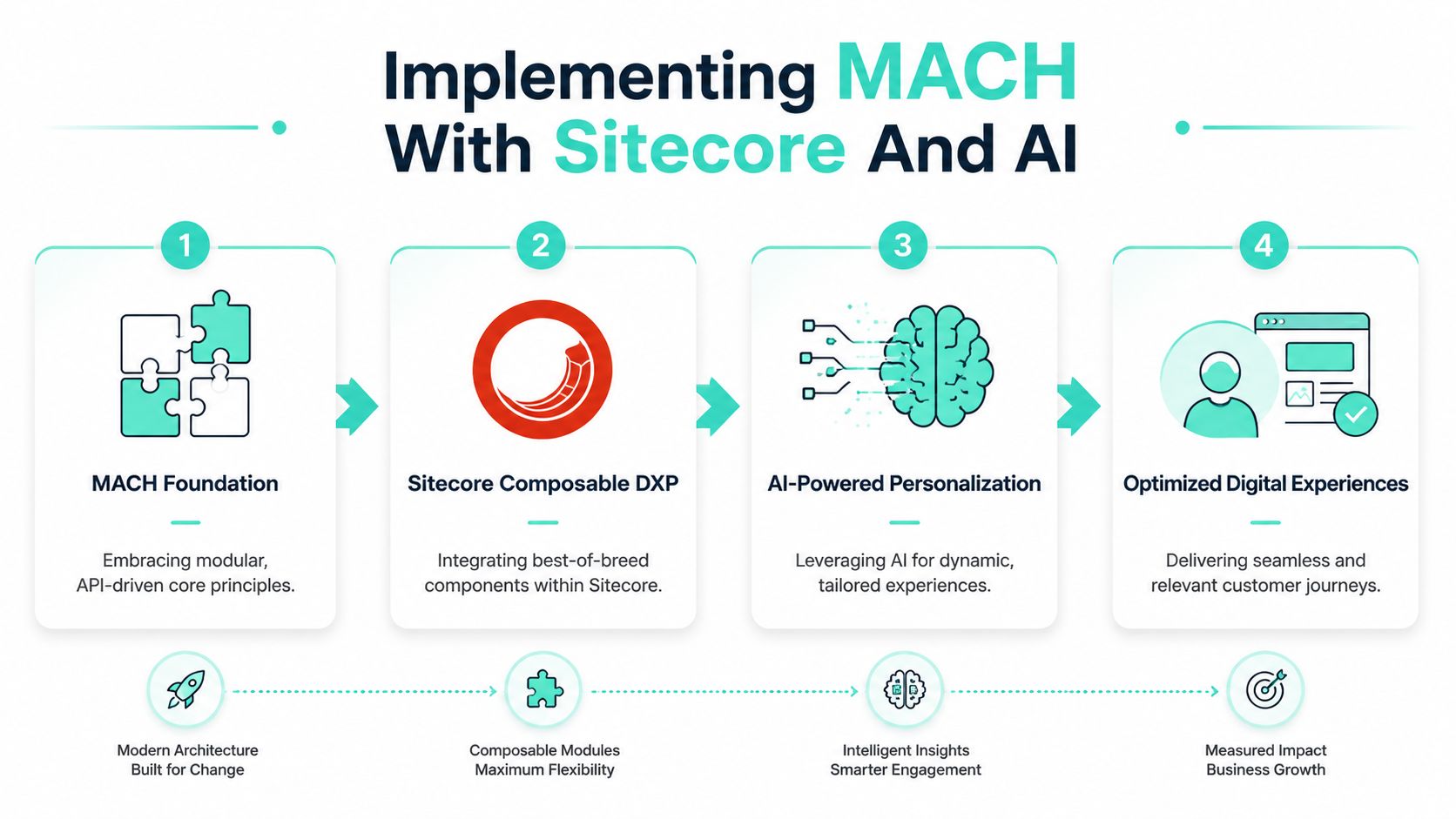
Implementing MACH With Sitecore And AI
For enterprises already in the Sitecore ecosystem, MACH becomes real when the platform is treated as a composable DXP rather than a single rendering stack. That means structured content, API delivery, modern front ends, independent integrations, and AI features that operate across channels instead of being trapped in one website implementation.
What composable Sitecore looks like in practice
In practice, the strongest implementations use XM Cloud as a content and experience backbone, a front end such as Next.js, and shared component governance based on a Helix-style approach. That gives enterprise teams a stable model for multi-site and multi-brand delivery without forcing the front end to behave like a legacy CMS rendering engine.
Composability moves beyond theory as content authors work in a governed environment. Front-end teams iterate in a modern JavaScript stack. Integration teams expose search, customer data, forms, or booking functions through APIs. The result is a DXP that can support regional rollout patterns, accessibility requirements, and different release cadences across business domains.
Where Sitecore AI creates business value
The AI layer matters because composable architecture alone doesn't create relevance. It creates flexibility. Relevance comes from how the platform interprets behavior, orchestrates content, and adapts journeys.
SitecoreAI is powered by Microsoft Azure and integrates content management, customer data, personalization, and search into a single secure and scalable platform, representing the next evolution of XM Cloud (CMSWire coverage of SitecoreAI). For enterprise teams, that has direct implications:
- Personalization becomes operational: the platform can use live behavior signals to shape experiences across websites, mobile apps, email, and social channels.
- Content optimization becomes practical: teams can tune messaging and journeys without hard-coding every experience path.
- Search and relevance sit closer together: content discovery and user intent stop living in separate workstreams.
SitecoreAI also supports content optimization and the creation of A/B tests through its AI capabilities, helping teams fine-tune workflows and improve customer interaction while fitting headless implementations with Next.js and component libraries (Sitecore AI capabilities documentation). That's where the business value sharpens. A composable foundation gives teams freedom to build. AI helps them decide what should be shown, tested, and improved next.
When teams are evaluating automation maturity more broadly, it helps to compare AI workflow automation solutions so the DXP strategy stays connected to the wider operating model, not just the CMS stack.
A more detailed planning perspective sits in this guide to AI personalization in DXP implementation.
What works and what usually fails
The patterns that work are usually disciplined rather than flashy.
- Use Sitecore for orchestration, not for everything. Keep core experience capabilities in the platform, but don't force every downstream business function into the same implementation model.
- Build shared front-end foundations. A reusable Next.js component library reduces divergence across brands and regions.
- Treat content models as products. If content structures are inconsistent, AI and personalization outputs become inconsistent too.
- Tie Azure operations to DXP governance. Security, observability, and deployment standards need to extend across the composable stack.
The patterns that fail are also predictable.
- Recreating the monolith with APIs: teams keep central approvals, shared deployments, and tangled dependencies, then call it composable.
- Chasing tools before ownership: no one owns contracts, taxonomies, or service quality.
- Adding AI before content discipline: poor metadata and weak content modeling limit every downstream optimization.
The best Sitecore composable programs don't start by asking which feature to turn on. They start by deciding which business capability needs to move faster and which team will own it end to end.
Practical Migration And Implementation Strategies
Most failed modernization programs make the same mistake. They frame migration as a platform replacement exercise instead of a business capability redesign.

Start with a business capability not a platform rewrite
A safer path is phased. Pull out one capability that suffers under the monolith and has visible business value. That might be campaign landing pages, a knowledge center, site search, a product content flow, or authenticated profile features. Deliver that capability in a composable pattern, prove governance, then expand.
The migration sequence usually works best when teams follow a few rules:
- Choose a bounded first move: pick a capability with clear ownership and manageable dependencies.
- Define APIs before rebuilding UI: avoid front-end work that guesses at back-end contracts.
- Set editorial governance early: structured content, taxonomy, and localization rules should exist before scale.
- Prepare rollback paths: every early release should be reversible without harming the broader estate.
For organizations planning the mechanics of replatforming, a structured CMS migration checklist helps reduce avoidable risk.
Control integration fatigue before it controls the program
Composable programs can create a new problem if governance is weak. Industry practitioners note that 40% of composable implementations face “integration fatigue”, where teams spend more time managing connectors than delivering features (commercetools on MACH and composable trade-offs). That warning matters because many enterprise teams underestimate API lifecycle work, event orchestration, and service ownership.
What helps in the field is straightforward:
- Establish API governance: versioning, naming, ownership, and deprecation policies can't be optional.
- Limit unnecessary service sprawl: not every function deserves its own microservice.
- Use integration patterns consistently: event-driven where needed, synchronous where justified, and documented throughout.
- Track operational overhead: if teams spend more time wiring systems than improving journeys, the architecture needs correction.
This walkthrough is a useful visual reference before you lock the migration sequence:
Start small, but architect seriously. Early shortcuts in content modeling, API design, or service ownership become expensive once multiple teams depend on them.
MACH Principles In Action With SharePoint
MACH isn't limited to public-facing DXPs. It applies just as well to the employee experience, especially when an organization is still carrying a heavy SharePoint on-premise footprint or an over-customized intranet that no longer supports modern collaboration.
A composable intranet model
In a Microsoft 365 environment, SharePoint Online becomes stronger when it's treated as a composable platform rather than a page repository. SPFx components behave much like business-aligned modules. They can be designed, deployed, and governed as discrete experience elements for news, policies, dashboards, service requests, or knowledge discovery.
The API-first layer comes from the wider Microsoft ecosystem. Power Platform, Microsoft Graph, and line-of-business integrations allow intranet experiences to connect with workflows, approvals, employee data, and document services without hardwiring everything into a single SharePoint customization model.
Cloud-native behavior changes the maintenance story too. Instead of carrying infrastructure upgrades and brittle farm-level dependencies, teams operate in Microsoft 365 with standardized identity, security, and service delivery patterns. That's especially useful for multilingual intranets, accessibility-focused design, and internal portals that need to evolve continuously instead of waiting for periodic rebuilds.
The headless mindset also applies. SharePoint can remain the collaboration and content layer while custom interfaces, dashboard widgets, or embedded business tools present information in the context employees need. The business result is a more usable intranet. Communication lands faster, workflows become easier to complete, and IT spends less time preserving outdated custom stacks.
Partnering For Your Composable Transformation
The main challenge with MACH isn't understanding the acronym. It's making the architecture operational across content, front-end delivery, integration governance, AI, and platform ownership. That's where many enterprise programs stall. The technology choices are usually available. The missing piece is execution discipline.
For Sitecore-centric organizations, the strongest path tends to combine composable content delivery, modern front-end engineering, Azure-aligned cloud operations, and an AI strategy that improves real journeys instead of adding novelty. For Microsoft 365 and SharePoint teams, the same principles help replace rigid intranet estates with modular, service-connected experiences that are easier to govern and evolve.
A capable delivery partner matters because composability introduces freedom and responsibility at the same time. Teams need help deciding what to decouple first, how to structure service boundaries, where Sitecore AI will add measurable value, and how to avoid connector sprawl. That's not solved by software alone.
Kogifi brings that depth. The company holds Sitecore Silver Partner status with formal partnerships across the Adobe and Microsoft ecosystems, and has delivered 70+ DXP projects over 12+ years with a team of 50+ specialists, including multiple Sitecore Digital Impact Awards 2025 recognitions for Market Trailblazer and Intelligent Tech Stack (Sitecore partner profile for Kogifi). That combination matters when the brief spans Sitecore XM Cloud, AI-driven personalization, SharePoint Online, multilingual governance, accessibility, and cloud-native delivery patterns.
The best enterprise programs don't try to become composable everywhere on day one. They pick the capabilities where speed, relevance, and resilience matter most, then build a repeatable model around them. That's how MACH becomes a business advantage instead of a technical aspiration.
If your organization is planning a move from a monolith to a composable DXP, Kogifi can help shape the roadmap, define the right Sitecore AI and SharePoint architecture, and deliver a phased migration that reduces risk while improving digital agility.