


A familiar pattern shows up in enterprise DXP programs. A campaign underperforms, the team debates whether the issue is content, layout, personalization logic, or release timing, and somebody makes the call based on experience. Sometimes that instinct is right. Often, it locks the organization into expensive rework because nobody isolated what specifically altered user behavior.
That problem gets sharper in a Sitecore estate. XM Cloud, XP, Content Hub, search, personalization, analytics, middleware, and front-end frameworks all influence the experience. In a composable stack, you can move faster, but you can also create more variables. Without a disciplined experimentation platform, speed turns into noise.
For Sitecore and Microsoft-centric teams, experimentation isn't just about button tests. It's about validating AI-generated content variants, checking whether a personalization rule improves the journey, confirming that a new SPFx intranet component helps employees complete tasks faster, and proving which changes deserve a full rollout.
Table of Contents
- Why generic integration falls short in Sitecore
- A practical integration pattern for XM Cloud and XP
- Where Sitecore AI changes the experimentation loop
From Guesswork to Growth The Rise of Experimentation
A marketing leader approves a homepage redesign because it looks cleaner. A product owner rolls out a new account journey because stakeholders prefer it. A content team publishes AI-assisted copy because it sounds stronger in review. Those decisions happen every day, and they're rarely irrational. They're just incomplete.
An experimentation platform changes the decision model. Instead of arguing over opinions, teams define a hypothesis, expose a controlled audience to a variation, measure the result, and decide based on observed behavior. That shift matters in enterprise environments where one change can affect content operations, lead generation, support load, and downstream revenue reporting.

The market trajectory shows why this is no longer a niche capability. The global experimentation platform market was valued at USD 4.2 billion in 2024 and is projected to reach USD 11.6 billion by 2033, growing at a compound annual growth rate of 11.8% from 2025 through 2033, according to Growth Market Reports on the experimentation platform market. That projection reflects a broader enterprise shift toward evidence-driven delivery across product, marketing, and content teams.
Why this matters inside a DXP program
In a Sitecore program, the pressure points are usually obvious:
- Content velocity increases: Teams can create more variants, but they still need proof that those variants help.
- Composable architecture adds flexibility: Front-end teams can ship quickly, yet every release introduces more paths and more risk.
- AI raises output: Sitecore can generate summaries, variants, and journey elements, but generated content still needs validation in the live experience.
Practical rule: If a team can't explain which audience saw which version, and which outcome changed, it isn't experimenting. It's just releasing.
The same discipline applies to softer metrics too. Some teams need to test perception, trust, or internal alignment, not only clicks. That's why methods for quantifying brand awareness and morale can be useful alongside platform analytics, especially when an experience change influences both behavioral and attitudinal outcomes.
What changes when teams adopt experimentation
The biggest gain isn't a dashboard. It's operational clarity.
Teams stop treating launch as the finish line. They treat launch as the start of measurement. That mindset reduces risky full-rollouts, gives architects a cleaner way to validate changes in composable environments, and helps leadership prioritize what deserves engineering time next.
What Is an Enterprise Experimentation Platform
Teams often first encounter experimentation through simple A/B testing. Enterprise reality is broader. A proper experimentation platform is a control tower for digital experiences that manages design, exposure, measurement, and decisioning across websites, apps, portals, and internal tools.
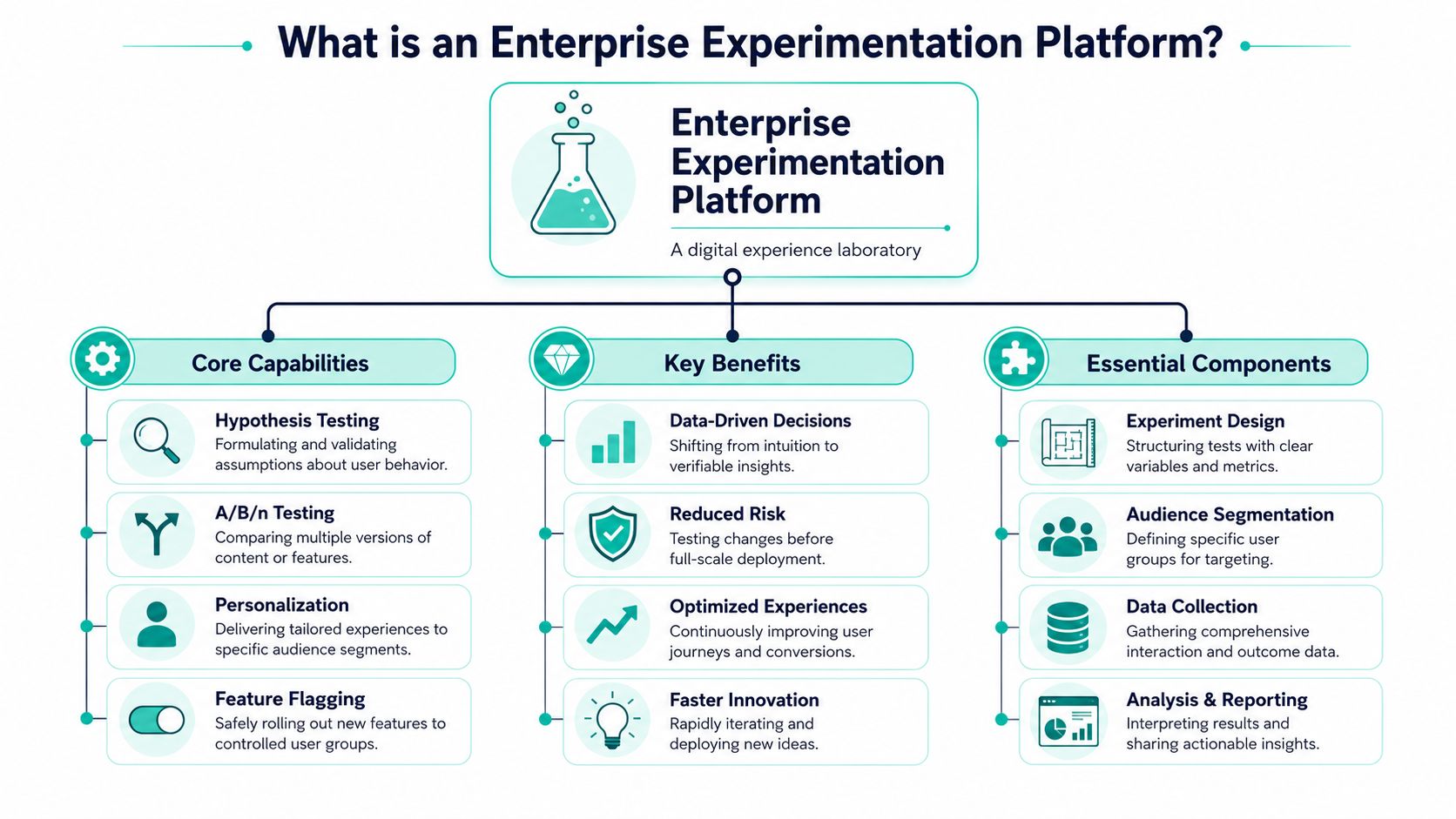
A useful definition comes from Code with Fimi's explanation of how experimentation platforms work in tech companies. It describes an experimentation platform as a unified system that manages the full lifecycle of controlled experiments, including hypothesis definition, user assignment, variation delivery, event tracking, statistical analysis, and winner deployment. The same source also breaks the design component into four steps: defining a hypothesis, determining primary success and guardrail metrics, selecting the target audience, and conducting power analysis.
A control tower for digital experiences
That definition matters because many organizations still buy point tools. One tool handles feature flags. Another handles front-end testing. Analytics lives somewhere else. Data warehouse metrics live somewhere else again. The result is fragmented evidence.
A stronger model treats the experimentation platform as the place where four things come together:
| Layer | What it does | Why it matters in enterprise delivery |
|---|---|---|
| Design | Captures the hypothesis, audience, and success criteria | Prevents vague tests that nobody can interpret later |
| Execution | Assigns users to variants and serves the right experience | Keeps exposure consistent across channels and sessions |
| Measurement | Captures event and outcome data | Connects what users saw to what they did |
| Analysis | Determines whether the result is trustworthy enough to act on | Stops teams from overreacting to noise |
The capabilities that matter in practice
The platform usually expresses those layers through a small set of practical capabilities.
- Feature flagging for safe rollout: Release a new search component or personalization rule to a limited audience before exposing everyone.
- A/B/n and multivariate testing: Compare multiple content treatments, navigation models, or call-to-action structures instead of debating them in workshops.
- Audience targeting: Split new visitors from returning visitors, or route users by geography, channel, or authenticated state.
- Integrated analytics: Measure both direct outcomes and guardrails so a local improvement doesn't inadvertently hurt another part of the journey.
A short primer on A/B/n testing approaches in DXP delivery is useful here because enterprise teams often need more than a binary control-versus-variation setup.
This walkthrough is worth watching if your team needs a visual overview before getting into architecture:
A good experimentation platform doesn't just tell you which variation won. It gives engineering, content, and analytics teams a shared operating model.
What doesn't work is using a visual testing tool as a thin overlay on top of a complex DXP stack and assuming that equals enterprise experimentation. It may be enough for headline swaps. It won't be enough for server-side metrics, cross-channel consistency, or governed releases.
Core Architecture for Scalable Experimentation
Once traffic, channels, and stakeholders increase, architecture starts deciding whether the program is trustworthy. If user assignment drifts, event pipelines lag, or analysis happens outside the serving logic, the organization ends up with attractive reports and shaky evidence.
A strong reference point comes from IEEE guidance on scalable enterprise experimentation architecture. It identifies four core architectural components: an experimentation portal for hypothesis definition, an experiment execution service for user assignment and flag management, a log processing engine for high-volume metric ingestion, and an analysis service for statistical validation.
The four services you actually need
In practice, each service solves a different failure mode.
- Experimentation portal: The experimentation portal allows teams to define the hypothesis, choose metrics, set audiences, and establish ownership. If this layer is weak, experiments become impossible to audit.
- Execution service: This service assigns users deterministically and handles flag evaluation. It has to be reliable across front-end and back-end surfaces.
- Log processing engine: This ingests exposure and outcome events at scale. Without it, you can't align what users saw with what happened later.
- Analysis service: This validates whether observed differences are meaningful enough to support a release decision.
The same IEEE source notes that execution should support deterministic user hashing, such as MurmurHash, so variant assignment remains consistent across microservices and sessions. That detail is easy to overlook and expensive to ignore. If one service thinks a user belongs in control while another serves the variant, your dataset becomes contaminated.
Why consistency matters more than flashy dashboards
In enterprise Sitecore estates, consistency problems usually show up in three places:
| Failure point | Typical symptom | Architectural fix |
|---|---|---|
| Front-end and API mismatch | User sees one experience but events are recorded against another | Centralize assignment in the execution layer |
| Delayed event processing | Teams can't monitor regressions early | Use a log pipeline designed for high-volume ingestion |
| Local team workarounds | Different brands instrument experiments differently | Standardize portal templates and metric definitions |
A lot of teams focus on the final chart. The harder work is upstream. Exposure logging, guardrail capture, assignment consistency, and metric normalization create the conditions for a result you can trust.
Architecture checkpoint: If the experiment can't be reproduced from assignment logs, exposure records, and metric definitions, it shouldn't drive a production rollout.
For teams exploring adaptive allocation models, multi-armed bandit testing in enterprise delivery is relevant, but it only works well when the foundational services are stable. Bandits can't rescue weak instrumentation.
The same architectural discipline becomes even more important when the DXP stack is composable. You have more freedom to insert experimentation into the journey, but you also have more points where identity, rendering, and measurement can drift apart.
Integrating with Sitecore DXP and Leveraging Sitecore AI
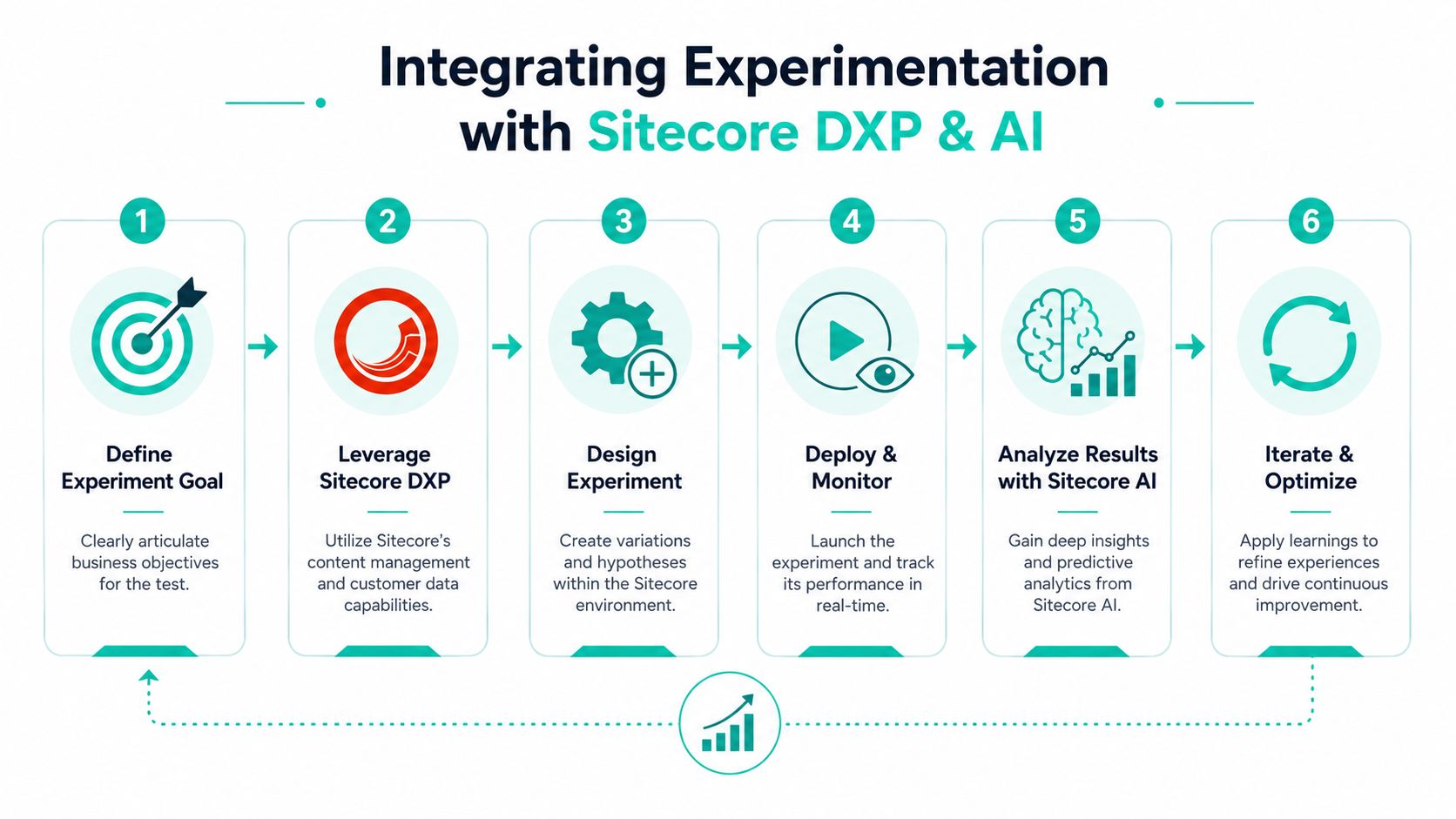
A generic experimentation setup rarely fits a mature Sitecore environment. It might handle client-side swaps on a landing page, but Sitecore programs usually need more. They need content variant control, component-level experimentation, personalization validation, server-side measurement, and governance that works across brands and regions.
Why generic integration falls short in Sitecore
The gap usually appears when teams rely only on front-end clickstream data. That misses a large part of enterprise value. Eppo's analysis of experimentation beyond features points out that existing content often lacks concrete guidance on integrating platforms with enterprise data warehouses for server-side metrics like revenue margins and activation, and emphasizes the value of a fully native integration with the data warehouse. That matters in Sitecore programs where business-critical outcomes may live outside browser events.
Another common gap is operational. Mixpanel's discussion of how to choose an experimentation platform highlights the missing link between experimentation results and engineering workflows in composable architectures, including the need for launch, debug, measure, and monitor capabilities across complex app portfolios. In a Sitecore estate, if experiment outcomes don't feed release governance, backlog prioritization, and component lifecycle decisions, the platform stays peripheral.
A practical integration pattern for XM Cloud and XP
For XM Cloud, the cleanest model is usually headless. Sitecore owns content modeling, authoring, workflow, and content delivery orchestration. The experimentation platform handles assignment logic, variant exposure, and analysis. The front end, often Next.js, consumes both content and decisioning signals.
For XP, integration tends to be broader because personalization, content, profile data, and legacy implementation patterns may already be embedded in the platform. The key is to avoid duplicating decision logic in too many places. One system should decide assignment. Sitecore should render the appropriate experience and persist context where needed.
A practical pattern looks like this:
- Content stays in Sitecore: Editors manage base content, variant copy, and reusable components in a governed workflow.
- Decisioning stays centralized: The experimentation layer assigns users and returns variation decisions.
- Events flow to analytics and warehouse layers: Client-side and server-side outcomes are both captured, then reconciled for analysis.
- Release logic stays operational: Winning treatments become backlog inputs, feature flag updates, or component defaults, not manual one-off edits.
A related pattern for real-time personalization in composable experience stacks becomes more valuable when the experimentation layer validates which personalization rule improves the journey.
Where Sitecore AI changes the experimentation loop
Sitecore differentiates itself from a plain CMS. Perficient's overview of AI in Sitecore notes that Sitecore AI capabilities are embedded across products including Content Hub and XM Cloud, supporting content summaries, multiple text variants for SEM, long-form blog generation, language variants, and visual recognition and tagging.
For Sitecore XP specifically, Sitecore's Experience Platform AI documentation says the platform uses AI to enhance content creation with brand-aware tools and AI-assisted generation while also delivering hyper-personalization through customized product descriptions and personalized customer journeys.
That creates a practical experimentation flywheel:
- Sitecore AI generates candidate content variants.
- The experimentation platform assigns audiences and exposes those variants safely.
- Analytics capture both engagement and business outcomes.
- Teams promote validated variants into the standard experience or use them to refine the next set of AI prompts and journey rules.
The best use of AI in Sitecore isn't automatic publishing. It's faster hypothesis generation under tight editorial and brand controls.
What works is pairing AI-assisted content creation with governed experimentation. What doesn't work is flooding the stack with auto-generated variants and measuring only superficial engagement. In enterprise programs, AI needs validation, not applause.
Experimentation for the Modern Intranet with SharePoint
External journeys get most of the attention, but the same experimentation discipline belongs inside the intranet. SharePoint Online environments often carry critical tasks: policy access, HR workflows, approvals, knowledge discovery, and employee communications. When those experiences are hard to use, the cost shows up as friction, duplication, and support tickets.
Where intranet testing creates value
A modern SharePoint intranet gives you many things worth testing without turning the workplace into a lab.
- Navigation and findability: Test whether employees discover common resources faster when key links move from nested hubs to role-based landing pages.
- SPFx component layouts: Compare two versions of a homepage card set to see which one helps users reach forms, announcements, or service pages more effectively.
- Workflow prompts: Adjust wording or placement inside Power Platform-driven processes to reduce abandonment and confusion.
- Search experience: Evaluate whether a promoted result, refined metadata, or curated vertical improves success for high-intent internal queries.
This is especially relevant when intranet programs are part of a broader modernization effort, such as SharePoint migration services for fragmented internal platforms.
What a practical SharePoint experiment looks like
Consider a global intranet homepage. Employees in different business units need different tasks at the start of their day. One version of the page pushes corporate news high in the layout. Another prioritizes quick actions, team tools, and workflow entry points.
The mistake is deciding the winner based on executive preference or design review feedback alone. The better path is to assign audiences carefully, define task-oriented success metrics, and observe whether users complete meaningful actions with less friction.
A good intranet experiment usually includes:
| Intranet area | Variation example | Better metric type |
|---|---|---|
| Homepage modules | News-first versus task-first layout | Task completion or resource access |
| HR workflow page | Long instructional text versus shorter guided prompts | Workflow completion quality |
| Department hub | Broad navigation versus audience-targeted shortcuts | Discovery of priority resources |
Internal users deserve the same rigor as customers. If a SharePoint change affects how people work, test it.
What doesn't work is importing consumer web metrics blindly. An intranet isn't judged by ad-style clicks. It should be measured by whether employees find, complete, and trust the tasks the platform was built to support.
Your Implementation Roadmap and Governance Model
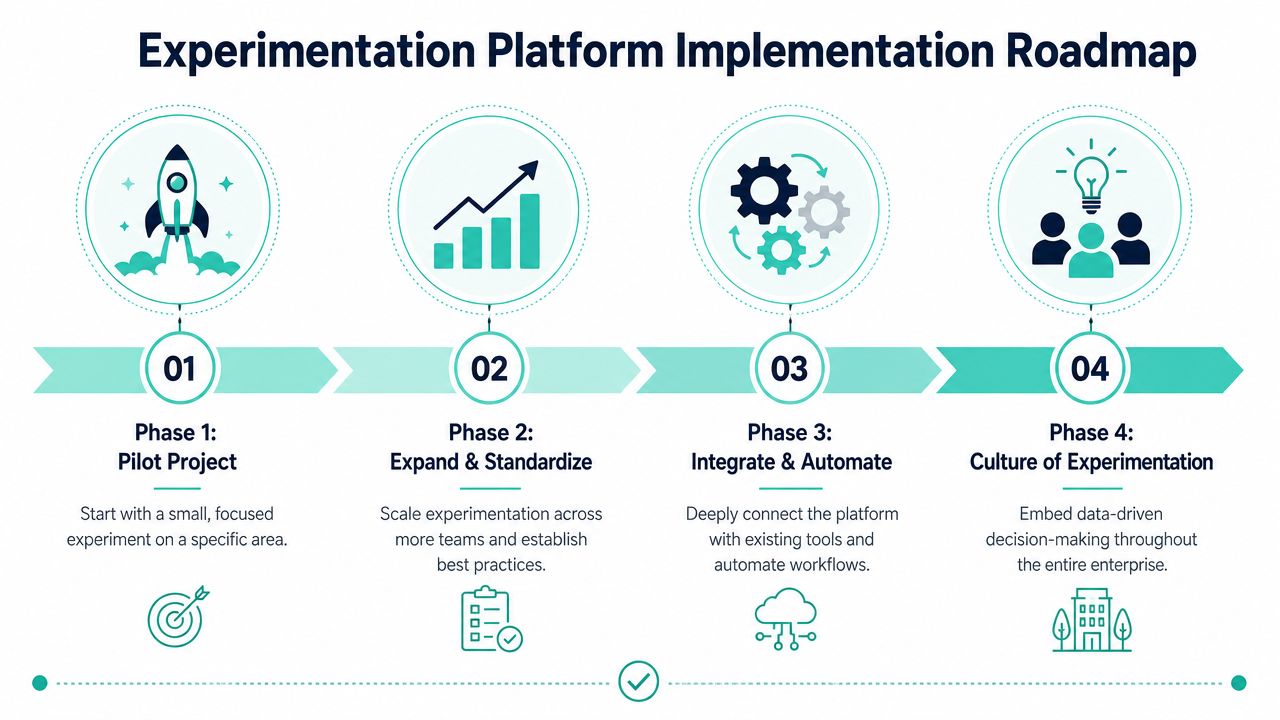
Most experimentation programs fail for organizational reasons, not tool reasons. Teams launch a pilot, get a few interesting results, and then stall because nobody agreed on ownership, metric definitions, approval paths, or how outcomes should influence delivery.
Start small but instrument properly
A workable roadmap starts with one domain, one surface, and one clear decision type. For a Sitecore team, that might be AI-assisted content variants on a high-value page, or a controlled release of a new journey component in XM Cloud. For SharePoint, it might be a homepage module or workflow entry point.
The pilot should establish a durable template:
- Hypothesis format: What change are you making, for whom, and why should it matter?
- Metric framework: Define one primary metric and a small set of guardrails before launch.
- Technical ownership: Assign who controls rendering, assignment, event capture, and analysis validation.
- Decision policy: Decide in advance what outcomes lead to rollout, iteration, or rollback.
Once that template exists, standardization gets easier. Teams stop inventing new rules for every test.
Operational integration is the real scaling challenge
Scaling doesn't come from running more tests. It comes from making results usable in day-to-day delivery. That means experiment outcomes must flow into backlog refinement, feature flag updates, component defaults, content operations, and governance boards.
Advanced statistical capability starts to matter, as advanced experimentation platforms integrate an AI-driven stats engine that automatically performs sequential testing and Bayesian inference to reduce the required sample size by 30 to 50 percent compared to traditional fixed-horizon A/B tests, enabling faster decision-making, according to Statsig's overview of experimentation. For low-traffic features, regional properties, or niche intranet experiences, that can make experimentation more practical.
Still, advanced stats don't replace governance. They support it.
A mature governance model usually includes:
- Experiment review: Architects, analysts, and channel owners validate setup before launch.
- Reusable metric definitions: Teams use standard business and guardrail metrics instead of local interpretations.
- Change control alignment: Experiment status links to release workflow, especially for feature flags and component rollouts.
- Auditability: Every test has a traceable owner, decision record, and implementation history.
Governance insight: Good governance doesn't slow experimentation down. It removes the ambiguity that causes bad tests, disputed results, and uncontrolled rollouts.
The final shift is cultural. Teams need permission to learn from neutral or negative outcomes. If every test must produce a winner to be considered useful, people will stop asking the right questions. Strong programs treat experimentation as a decision system, not a theater of constant uplift.
Choosing the Right Partner for Enterprise Success
When organizations evaluate experimentation, they often focus too much on platform screens and too little on implementation depth. For a simple web property, that might be survivable. For a Sitecore-centric enterprise stack, it isn't.
What to evaluate beyond the platform demo
A partner needs to understand more than test setup. They need to understand content modeling, headless rendering, identity boundaries, data capture, governance, and release workflows. In Sitecore environments, those disciplines intersect every time an experiment touches personalization, AI-assisted content, or reusable component libraries.
The shortlist should favor partners that can handle:
- Composable DXP architecture: They should know how experimentation fits into headless delivery, not just traditional page testing.
- Cross-platform execution: Many enterprises need continuity across Sitecore, Microsoft 365, analytics stacks, and warehouse layers.
- Governed operating models: They should help define ownership, review processes, and rollout standards, not only install tooling.
A useful lens here is planning discipline. Teams that already use structured goal systems often make better experimentation decisions because they connect tests to strategic outcomes. Resources like The OKR Hub's OKR software guide can help leadership teams think more clearly about how objectives, measurement, and execution tooling align.
Why DXP integration depth matters
For enterprise success, domain expertise usually matters more than vendor familiarity alone. A partner can know an experimentation tool well and still struggle if they don't understand how Sitecore XP handles personalization, how XM Cloud shapes front-end delivery, or how SharePoint intranets should be measured differently from marketing sites.
Kogifi's company profile is relevant here because it reflects the kind of implementation depth complex programs require. The firm holds Sitecore Silver Partner status with certified expertise across the Adobe and Microsoft ecosystems, and has delivered 70+ DXP projects over 12+ years of operation with a team of 50+ specialists.
That combination matters because enterprise experimentation isn't a side feature. It's an architectural capability embedded in content, delivery, analytics, and governance. The right partner helps you wire those parts together so the program keeps working after the first pilot ends.
If you're running Sitecore, SharePoint, or a broader composable DXP program and need an experimentation platform strategy that fits real enterprise delivery, talk to Kogifi. Their teams build and modernize Sitecore XM Cloud, Sitecore XP, Adobe, and Microsoft 365 platforms with the architectural discipline needed to turn experimentation into an operational capability, not just another dashboard.