


Global teams usually notice the localization problem late. A campaign is ready in Sitecore, product documentation lives somewhere else, the intranet sits in SharePoint, and regional teams are still passing spreadsheets, screenshots, and email threads back and forth to get translated content approved. By the time legal reviews the German version and marketing spots a terminology mismatch in French, launch dates have already moved.
That operating model doesn't break all at once. It breaks gradually through duplicated work, inconsistent brand language, missing context for translators, and too many manual handoffs between content authors, reviewers, and vendors. The cost isn't only linguistic quality. It's slower releases, weaker governance, and a digital estate that can't scale globally with confidence.
A proper translation workflow needs more than a CAT tool and more than a machine translation plug-in. It needs orchestration across content systems, language assets, approvals, and publishing. That's why translation management systems have become core infrastructure for enterprise digital operations. The market reflects that shift. The global Translation Management Systems market reached approximately USD 2 billion in 2023 and one major forecast projects it to reach USD 5.7 billion by 2030 at a CAGR of 17.2%, according to GM Insights on the TMS market.
Table of Contents
- Introduction Going Global Without the Chaos
- Why a TMS behaves like the control layer
- The components that matter in practice
- Integration patterns that work
- Sitecore and Sitecore AI in real localization workflows
- SharePoint Online for multilingual intranets and knowledge hubs
- The hidden complexity in composable architectures
Introduction Going Global Without the Chaos
Enterprise teams rarely struggle because they lack content. They struggle because content moves through too many systems without a shared localization model. One team authors campaign pages in Sitecore XM Cloud. Another team stores product assets in a DAM. HR publishes internal communications in SharePoint Online. Regional reviewers then try to localize all of it with inconsistent processes.
That creates a familiar pattern. Content gets exported manually. Context gets lost. Terminology drifts between markets. Local teams make fixes directly in-channel, which means the source of truth disappears. Then every new campaign starts from scratch again.

A TMS changes that operating model. Instead of treating translation as a side process, it centralizes workflow, language assets, review stages, and system integrations so authors, localization managers, reviewers, and publishers work from one controlled pipeline. In enterprise environments, that matters most when content spans websites, portals, intranets, support content, and regulated documentation.
Practical rule: If your global release process still depends on file exports and email approvals, your problem isn't translation quality alone. It's missing orchestration.
The strongest enterprise setups don't separate localization from platform architecture. They design translation management systems as part of the digital experience stack itself. In Sitecore programs, that means connecting content modeling, component strategy, AI-assisted workflows, and multilingual publishing. In SharePoint programs, it means structuring pages, news, documents, and approval flows so language variants stay governed instead of fragmenting by region.
A TMS is no longer optional infrastructure for organizations that publish at scale across markets. It is the layer that keeps global content operations stable when brands, channels, and languages multiply.
What Is a Translation Management System
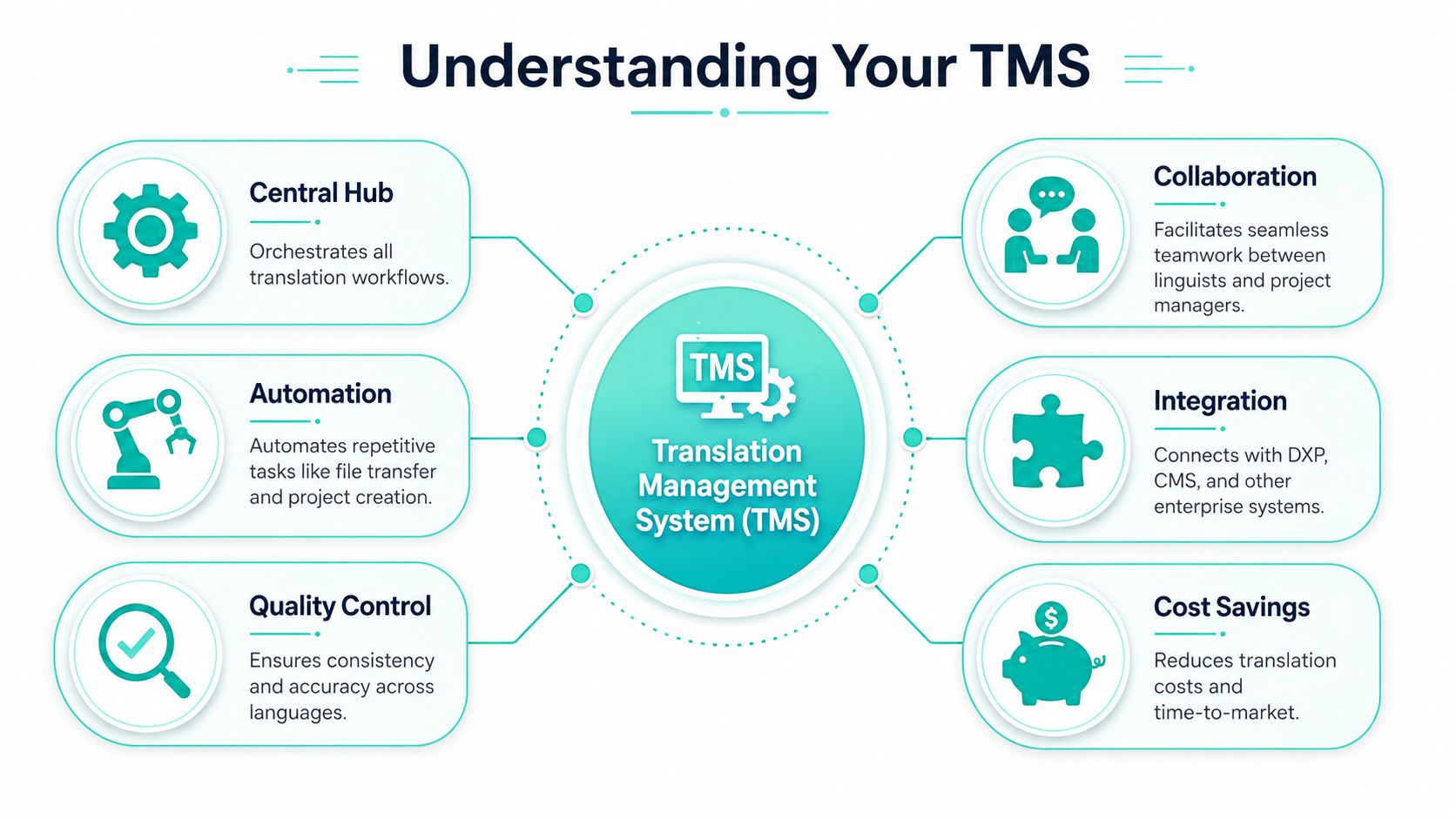
A translation management system is the control layer that coordinates multilingual content from source creation to approved publication. If a CAT tool helps a translator work on text, a TMS manages the whole operating environment around that work. It handles intake, routing, reuse, review, quality checks, reporting, and return delivery into the systems where content resides.
The easiest way to think about it is as the central nervous system for localization. Your CMS, DXP, DAM, product systems, and intranet are the organs doing the work. The TMS carries signals between them, applies rules, and keeps memory of what has already been approved.
Why a TMS behaves like the control layer
The defining feature isn't translation itself. It's coordination.
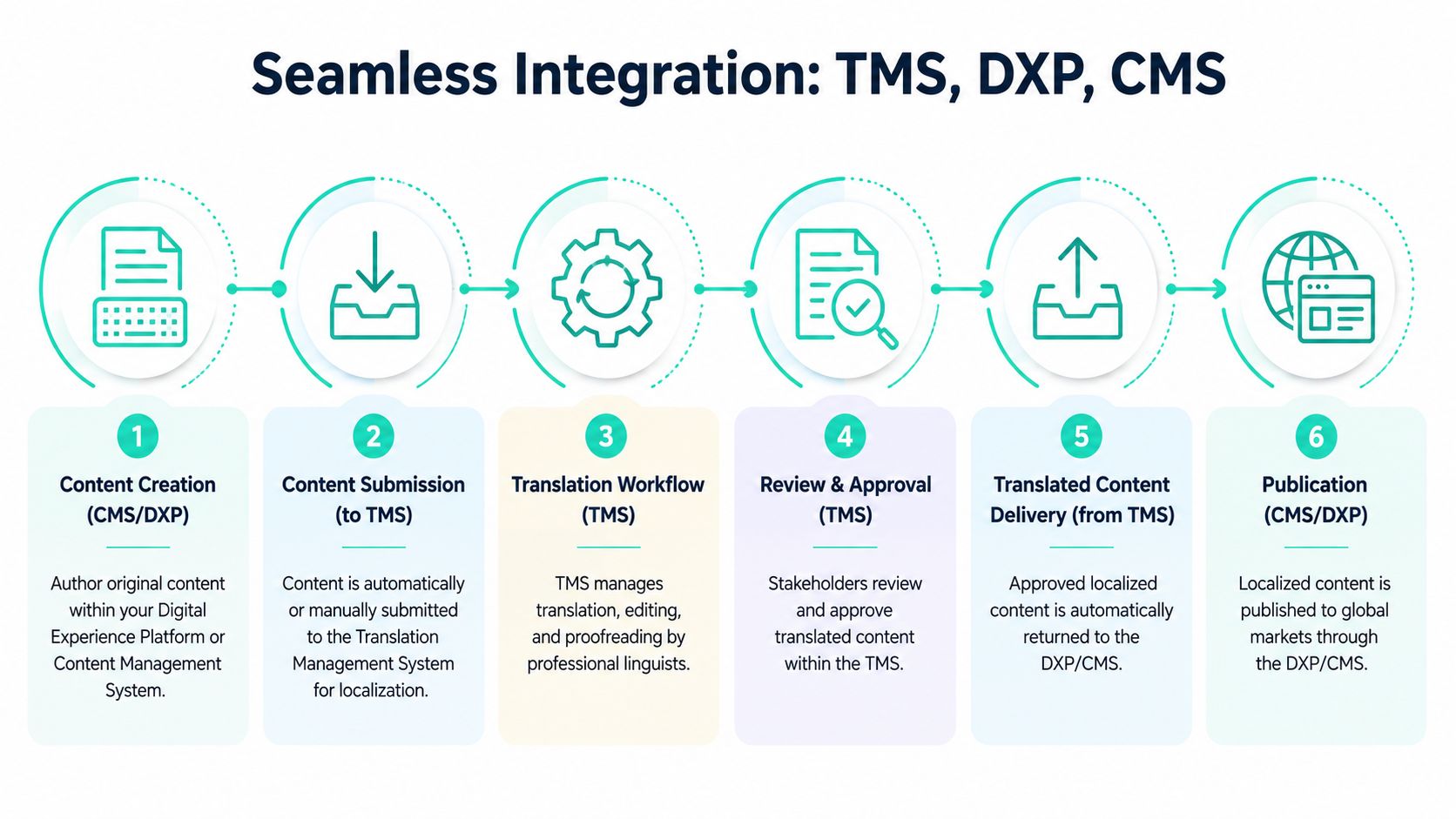
A TMS receives content from upstream systems, packages it with context, sends it through the right workflow, checks quality, and pushes approved variants back into publishing platforms. That orchestration is what separates enterprise translation management systems from disconnected tools that solve only one part of the problem.
According to Nimdzi's explanation of translation management systems, Translation Memory stores approved translations to prevent redundant work and ensure consistency across projects, which is a core reason enterprises save money compared with standalone CAT-only setups. In practice, that means the system remembers previously approved phrases, UI strings, product terms, and standard copy so teams don't keep paying to recreate the same work.
The components that matter in practice
Three components determine whether a TMS helps or just adds another layer.
- Translation Memory matters most when content repeats. Product descriptions, legal disclaimers, UI labels, navigation items, and campaign templates often recur across markets and releases. If those segments aren't reused systematically, teams waste budget and introduce inconsistency.
- Terminology management protects brand language. This is where approved terms, forbidden terms, naming conventions, and market-specific vocabulary live. It matters more than many teams expect, especially in regulated sectors and multi-brand environments.
- Workflow automation keeps throughput predictable. Good systems route jobs automatically, trigger review steps, and track status without project managers chasing every handoff manually.
A mature TMS also handles QA rules, permissions, vendor coordination, and connector logic to upstream and downstream systems. That's where the architectural difference shows up. A lightweight tool may support translation work. An enterprise-grade TMS governs multilingual content operations.
Don't judge a TMS by the editor alone. Judge it by how well it preserves structure, context, and accountability across your whole stack.
There is also a practical distinction between a TMS and a multilingual feature inside a CMS. Sitecore and SharePoint can both support multilingual content structures. Neither replaces the language orchestration layer a TMS provides when multiple markets, reviewers, vendors, and repositories are involved.
The teams that get this right treat language assets as reusable enterprise data, not as one-off project files. That's the mindset shift that turns localization from a recurring bottleneck into a managed capability.
The Business Case for TMS in Global Enterprises
Most enterprise buyers don't need another generic productivity argument. They need a clear explanation of where money, speed, and governance improve. A TMS earns its place when it reduces rework, standardizes multilingual operations, and gives leadership visibility into how localization performs across business units.
The business case gets stronger as content volume rises. Once a company is localizing websites, campaign assets, support content, documents, and internal communications across several regions, manual coordination becomes expensive even before anyone measures translation quality.
Where the savings actually come from
The biggest savings usually come from reuse and process discipline, not from replacing humans. Enterprise-scale TMS platforms such as XTM Cloud and Trados Enterprise can reduce costs by 20–35% through translation memory reuse, with reuse rates often exceeding 50% in mature implementations, according to Lokalise's overview of translation management systems. That's significant because it reflects how much enterprise content repeats once terminology, disclaimers, interface strings, and structured components are managed centrally.
A second source of value is release velocity. Teams stop rebuilding translation packages manually, stop duplicating review effort, and stop hunting for the latest approved copy. That directly helps campaign launches, product updates, and regional rollouts.
For web teams, governance and localization quality often improve together. The same workflow that preserves translation memory also creates a cleaner path for approvals, source updates, and change tracking. If you're standardizing multilingual website operations, these website localization best practices align closely with the governance model a strong TMS should enforce.
Why executives care about control
Executives care about three things. Predictability, accountability, and risk reduction.
A TMS makes localization measurable. Leaders can see which workflows are slow, which content types cause repeated review cycles, which markets need tighter terminology control, and where vendors or internal teams are creating bottlenecks. That visibility is often more valuable than the software features themselves because it turns localization from a black box into an operational function.
Consider the difference between two models:
| Operating model | What leadership sees |
|---|---|
| Email, spreadsheets, and file exports | Fragmented status updates, weak auditability, unclear costs |
| TMS-led workflow with connectors and approvals | Centralized job status, reusable assets, consistent review path |
The board-level version of this conversation is simple. If global content is strategic, then the process that governs it must be structured, repeatable, and observable.
A TMS isn't just a language tool. In enterprise programs, it's a governance tool with direct impact on launch readiness.
That matters even more when digital teams are running multiple brands or shared component libraries across regions. Reuse only creates value when the organization trusts the underlying language assets. A TMS provides the framework for that trust.
Integrating TMS with Your DXP and CMS
Most implementation failures happen at the integration layer. On paper, a TMS and a CMS look easy to connect. Content goes out, translations come back, pages publish. In real enterprise estates, it isn't that tidy. Components have context. Fields have different business meaning. Metadata affects rendering, accessibility, personalization, and approval logic. If the integration ignores those details, the workflow may still function technically while producing poor localization outcomes.
Integration patterns that work
Three integration patterns appear most often in enterprise delivery.
Native connector model
This works well when the CMS and TMS already support stable field mapping, job creation, status callbacks, and content return. It shortens implementation time, but only if the connector handles your actual content model.API-led orchestration
This is the better option when teams need control over event triggers, content packaging, metadata, and routing logic. It also fits composable estates where content comes from more than one repository.Hybrid pattern with middleware
This usually appears in large environments where the TMS must integrate not only with Sitecore or SharePoint but also with DAM, PIM, CRM, and workflow systems. It adds flexibility, but governance becomes critical fast.
The right choice depends on the architecture, not the software demo. If content is highly structured, component-based, and reused across channels, integration must preserve far more than raw text.
A quick rule set helps:
- Use connectors when the content model is stable
- Use APIs when business rules are specific
- Use middleware only when orchestration spans multiple systems and teams
Later in the workflow, teams often need to see the platform in action. This walkthrough is useful for that discussion:
Sitecore and Sitecore AI in real localization workflows
Sitecore is where translation architecture gets interesting, especially in XM Cloud and other composable setups. Authors aren't just managing pages. They're managing components, shared content, personalization inputs, assets, and reusable content fragments. A TMS integration has to respect that structure.
The most effective Sitecore implementations localize by content type and publishing intent, not by page export. For example, hero text, CTA labels, form messaging, SEO fields, and reusable promo blocks shouldn't all follow the same review path. Some need strict terminology checks. Some need market adaptation. Some require in-context review before publication.
That is where SitecoreAI changes the conversation. SitecoreAI unifies the Sitecore product ecosystem, including CMS, DAM, MRM, CMP, CDP and Personalize, and Search, into a composable SaaS platform with translation and localization agents built around generative AI capabilities. Powered by Microsoft Azure, it enables marketers to launch campaigns in days instead of weeks. At the same time, industry analysis notes that 60% of enterprises still struggle with context loss in dynamic, component-based headless setups, as described in CMSWire's coverage of SitecoreAI and composable digital experience.
That combination matters. SitecoreAI can accelerate campaign operations, but acceleration only helps if your localization design preserves context. In practice, that means:
- Passing component metadata into the translation package
- Preserving field purpose, not just field value
- Keeping accessibility labels, alt text, and structured attributes in scope
- Separating translatable content from non-translatable rendering logic
- Returning approved variants into the correct Sitecore items and language versions
For teams refining multilingual experiences on the platform, this guide to customizing multilingual features in Sitecore is a useful companion to TMS integration planning.
The best Sitecore localization architecture doesn't start with translation. It starts with content modeling.
When content models are clean, AI-assisted translation and localization agents become much more useful. When models are messy, AI just processes messy input faster.
SharePoint Online for multilingual intranets and knowledge hubs
SharePoint solves a different problem. The focus is usually employee communications, internal documentation, policies, knowledge bases, and multilingual intranet experiences. The translation workflow must still be governed, but the content patterns are less about marketing composition and more about page templates, news posts, document libraries, and review permissions.
A SharePoint TMS integration works best when teams decide upfront which content belongs in formal localization and which content can stay local to a region. Not every HR update needs the same treatment as a compliance policy. Not every document library should be synchronized through the same workflow.
The practical model usually looks like this:
| SharePoint content type | Better localization approach |
|---|---|
| Global policies and compliance pages | Central TMS workflow with controlled approvals |
| Executive communications and recurring news | TMS workflow with faster review path |
| Departmental content and local operations pages | Regional ownership with lighter governance |
| Knowledge articles with frequent revision | Structured sync with language asset reuse |
This is where SharePoint architecture matters. If pages, metadata, and approval flows are inconsistent, a TMS won't rescue the process. It will only expose the inconsistency faster.
The hidden complexity in composable architectures
The biggest blind spot in current TMS planning is composable DXP complexity. Teams often assume "API integration" means the problem is solved. It isn't. Headless and component-based architectures introduce context gaps that traditional page-based workflows never had.
A translator may receive a short field like "Learn more" without knowing whether it appears on a regulated product page, an employee portal card, or a campaign landing page. The language itself is simple. The context is not.
That is why composable integration must preserve:
- Component hierarchy
- Content relationships
- Personalization context where relevant
- Accessibility-related attributes
- Regional publishing rules
- Ownership boundaries between global and local teams
If those elements are stripped out during submission to the TMS, review quality drops. Rework rises. Regional teams start bypassing the system. That's the point where a localization stack stops being a business enabler and becomes another source of friction.
How to Select the Right TMS Platform
The selection mistake I see most often is buying for features instead of buying for fit. A polished editor, a long list of connectors, and a good machine translation story can look convincing in a demo. None of that tells you whether the platform fits your Sitecore architecture, your SharePoint governance model, your approval chain, or your security requirements.
A better approach starts with the shape of your content operations. How many systems originate content. Who approves by market. How much content is structured. Which teams own terminology. Where accessibility review happens. Whether the organization needs centralized governance or federated control.
Start with architecture fit, not feature lists
Selection gets easier when you separate must-haves from nice-to-haves.
The must-haves are usually technical and operational. Can the TMS preserve field-level context. Can it integrate cleanly with your DXP and document platforms. Can it support role-based workflows across internal teams and vendors. Can it report in a way that supports operational governance. Can it handle your security and compliance expectations.
The next layer is business fit. Does pricing align with actual usage. Does the vendor support implementation well. Can the platform scale with additional brands, regions, and repositories without redesigning the whole process.
If your organization is also improving wider content operations, this content supply chain perspective is useful because TMS selection shouldn't happen in isolation from authoring, review, asset management, and publishing.
A TMS should fit your operating model on day one and your governance model two years later.
TMS Selection Criteria Checklist
| Criterion | Description | Importance (High/Med/Low) |
|---|---|---|
| Integration with Sitecore | Supports connectors or API patterns that preserve language versions, structured fields, and publishing workflows | High |
| Integration with SharePoint | Handles multilingual pages, document flows, metadata, and approval scenarios cleanly | High |
| API quality | Enables custom orchestration, event-driven submission, and controlled return delivery | High |
| Translation Memory control | Supports reusable language assets with clear ownership and maintenance processes | High |
| Terminology management | Provides termbases, approval control, and market-specific variations | High |
| Workflow customization | Adapts to marketing, legal, intranet, and product content review paths | High |
| QA configuration | Flags terminology, formatting, missing tags, and structural issues before publication | High |
| Reporting and visibility | Gives operational insight into status, costs, delays, and quality trends | High |
| Security and access control | Matches enterprise requirements for permissions, auditability, and data handling | High |
| Vendor management | Supports multiple language providers or internal teams without workflow confusion | Medium |
| Usability for reviewers | Makes business review easy for non-linguists who approve content in context | Medium |
| AI and MT options | Supports the right level of AI-assisted drafting and post-editing for your content mix | Medium |
| Pricing model clarity | Makes implementation, usage, and support costs understandable | Medium |
| Roadmap alignment | Shows continued investment in enterprise integrations and AI-enabled workflows | Medium |
| Partner ecosystem | Includes implementation support and practical integration expertise | Medium |
A scorecard helps, but workshops help more. Run the evaluation against real content, not sample strings. Use an actual Sitecore component set. Use an actual SharePoint page template. Test multilingual review with the people who will have to live inside the workflow. That exposes weak platforms quickly.
Implementation and Governance Best Practices
Buying a TMS is the easy part. The hard part is making it work across authors, reviewers, regional teams, developers, and language vendors without creating a second layer of process overhead. The organizations that succeed treat implementation as a governance program, not a software deployment.
Roll out in controlled stages
A phased rollout is usually the safest path. Start with one business unit, one brand, or one content domain that has enough complexity to prove the model but not so much complexity that every issue becomes political.
That first scope should validate four things:
- Content intake works cleanly from the source system into the TMS
- Language assets are usable by translators and reviewers
- Approval routing matches reality rather than an idealized workflow chart
- Published content returns correctly into the destination platform without manual patching
Once that works, expand by content type or region. Don't start by onboarding every market at once. That usually hides workflow flaws until they become expensive.
Rollout should follow governance maturity, not organizational ambition.
Governance is where most programs succeed or fail
Strong governance starts with ownership. Someone must own translation memory strategy. Someone must approve terminology changes. Someone must define which content requires full review, which can use lighter workflows, and which shouldn't enter the TMS at all.
A practical governance model usually includes these roles:
Platform owner
Maintains connectors, permissions, workflow rules, and operational reliability.Localization lead
Owns language assets, review policies, vendor coordination, and quality thresholds.Business approvers
Review market suitability, regulated wording, and brand accuracy for their domain.Regional stakeholders
Escalate market-specific issues and prevent central teams from over-standardizing content that needs local adaptation.
Teams also need standards before launch. Build the termbase early. Define naming conventions. Document what counts as translatable content. Decide how screenshots, component context, and accessibility metadata are passed into review.
A short governance table helps avoid confusion:
| Governance area | What to define before launch |
|---|---|
| Ownership | Who controls language assets, connectors, and release approvals |
| Workflow | Which content types follow which review paths |
| Quality | What QA checks are mandatory and who resolves exceptions |
| Change management | How authors, marketers, and reviewers are trained |
| Escalation | What happens when source content changes near release |
Change management matters more than teams expect. Authors need to understand how to write for reusable content. Reviewers need lightweight tools and clear deadlines. Regional teams need confidence that the system supports local nuance rather than suppressing it.
The best implementations make the right path easier than the workaround. When teams can submit, review, and publish faster through the TMS than outside it, adoption usually follows.
The Future of TMS AI Automation and Analytics
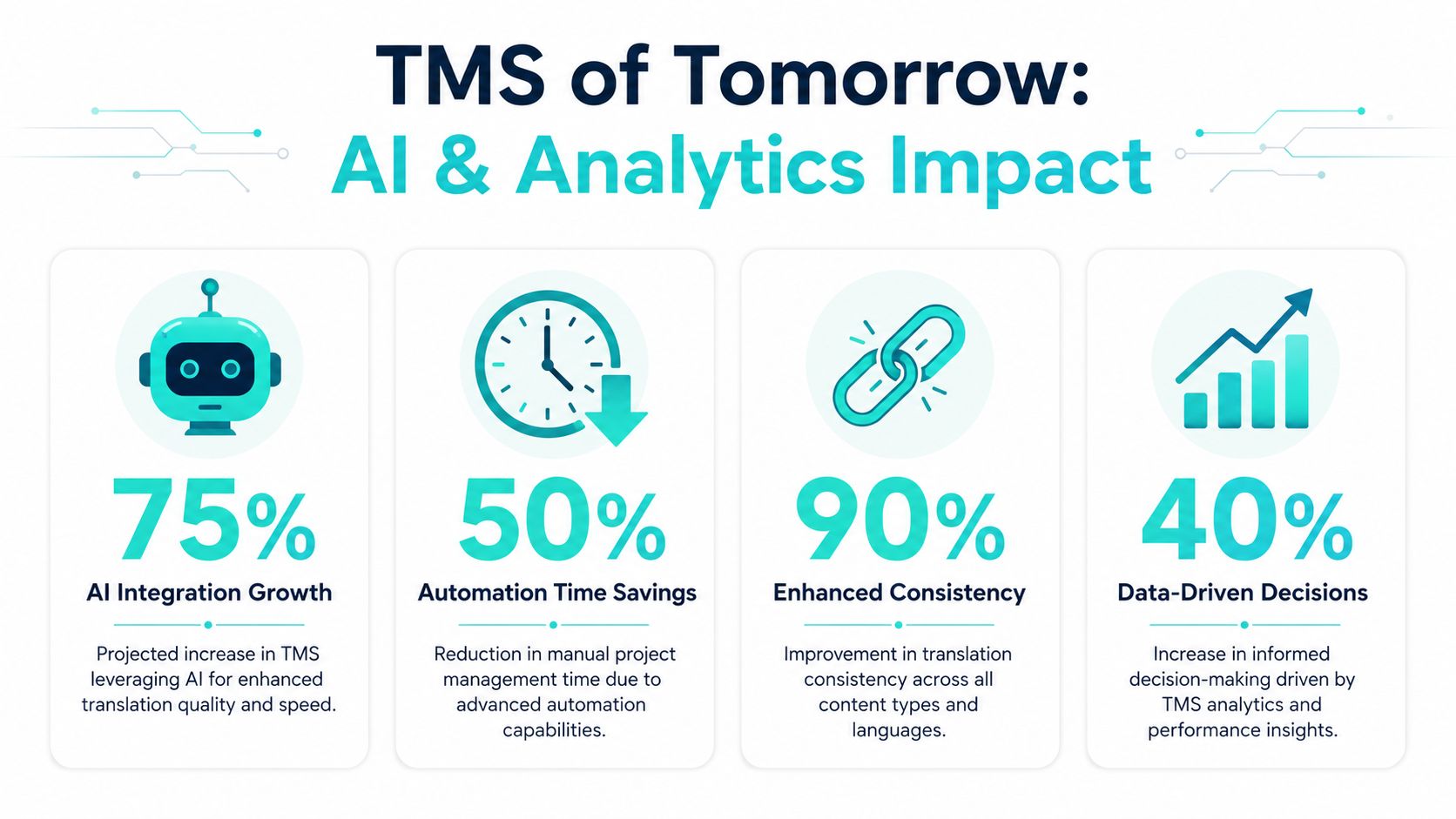
The next phase of translation management systems isn't just better machine translation. It's deeper automation inside the workflow itself. That includes AI-generated draft translation, assisted review, automated quality checks, content classification, and smarter routing based on content type and risk.
AI is changing throughput and review models
Modern TMS platforms already use cloud architecture to connect multiple MT engines and support AI-first workflows. AI-generated first drafts with human post-editing can reduce translation time by up to 40–60% compared with manual translation from scratch while automated QA checks help maintain quality, according to Gridly's overview of modern TMS capabilities.
That doesn't remove the need for human review. It changes where human effort creates the most value. Reviewers spend less time on repetitive baseline translation and more time on nuance, brand fit, legal wording, and market appropriateness.
For teams comparing options in that area, it's useful to find the best AI translation platforms before deciding how much AI capability should live inside the TMS versus alongside it.
Analytics will decide which workflows survive
The more important long-term shift is analytics. Enterprise teams will increasingly expect localization data to answer operational questions. Which content types are over-reviewed. Which markets generate the most rework. Which source teams create strings that lose context repeatedly. Which approvals delay launch without improving quality.
That is where AI inside broader DXP ecosystems becomes relevant, especially in Sitecore environments where content creation, assets, personalization, and search already sit close to each other. The discussion isn't only about translation speed. It's about using AI to improve the entire multilingual content path. This broader view of AI in DXPs, including benefits and challenges connects directly to where TMS design is heading.
The strongest future model is clear. Structured content enters from governed systems. AI accelerates the first pass. Human reviewers focus on the decisions that matter. Analytics then tell the organization which workflows deserve to stay, simplify, or disappear.
If your team is planning multilingual architecture on Sitecore, SharePoint, or a composable enterprise stack, Kogifi can help you design the integration, governance, and delivery model so translation becomes a scalable operating capability instead of a recurring release risk.