


73% of global businesses had adopted headless architecture by 2024, up from 59% in 2021 according to Swell's composable commerce statistics. That number matters because it changes the question. For enterprise teams, the issue isn't whether headless is still emerging. It's whether your current platform model is limiting how fast you can launch, personalize, govern, and scale digital experiences.
In practice, headless stops being a technical buzzword the moment a marketing team wants faster campaign delivery, a platform team wants cleaner integrations, or a regional business unit needs the same content to work across web, mobile, portal, and internal channels. That's where architecture becomes a business decision.
For Sitecore XM Cloud programs, headless is now the default operating model for modern DXP delivery. For SharePoint environments, the same architectural principles show up in decoupled intranets, SPFx-based extensions, and Microsoft 365 integrations that separate content, workflow, and presentation concerns. The value is real, but so are the trade-offs. API contracts, middleware ownership, caching strategy, and long-term operating cost need to be designed deliberately.
If you're evaluating what a headless CMS actually means in practice, it helps to look beyond product labels and focus on how teams build, publish, and govern experiences at enterprise scale.
Table of Contents
- Where monolithic platforms still work
- Where they start breaking down
- What this means for content teams
- Content source and structured authoring
- API layer and orchestration
- Presentation layer and delivery performance
- What works and what usually fails
- The sources of business value
- Why the value looks different in Sitecore and SharePoint programs
- The operational costs vendors tend to understate
- Sitecore XM Cloud in a real delivery model
- Where Sitecore AI fits
- SharePoint uses the same principles differently
- What tends to work best
- Start with ownership boundaries
- Hidden complexity sits in the middle layer
- A practical migration checklist
- Watch total cost, not just platform cost
What Is Headless Architecture and Why It Matters in 2026
Gartner and every major DXP vendor are pushing the same message: enterprises need content that can move across channels faster. The part many leadership teams miss is that headless changes more than delivery. It changes team boundaries, integration design, support ownership, and long-term operating cost.
Headless architecture separates the presentation layer from the systems that manage content, business rules, and services. Instead of forcing the website or portal to render from one tightly coupled platform, the backend exposes content and capabilities through APIs so different frontends can consume them in the format they need.
For enterprise teams, that matters because channel growth did not stop at the corporate website. Content now has to serve marketing sites, authenticated portals, mobile apps, search experiences, commerce journeys, and employee touchpoints. If you are evaluating what a headless CMS means in practice, the key question is not whether APIs sound modern. It is whether your current platform model can support that delivery pattern without slowing releases or multiplying rework.
Why enterprise teams care now
In client programs, the move toward headless usually starts with one business problem. It rarely stays there.
A marketing team wants faster release cycles. A digital team needs one content model feeding multiple frontends. An IT function is tired of customising a monolithic platform every time search, DAM, analytics, or personalisation requirements change. Those pressures tend to converge, especially in global Sitecore and Microsoft estates where content, identity, documents, and workflow already sit across several systems.
The appeal is clear. Frontend teams can build in modern frameworks. Content teams can manage structured content with stronger reuse. Architecture teams can avoid tying every new experience to one rendering engine.
The trade-off is clear too.
Headless does not remove complexity. It redistributes it into APIs, middleware, frontend hosting, caching, observability, security, and release coordination. Vendor demos often emphasise freedom at the presentation layer. Enterprise delivery teams spend more time dealing with API contracts, preview environments, content governance, and the total cost of operating several connected services.
Why it matters in 2026
By 2026, headless is less a trend and more a fit assessment. It fits organisations that need speed across multiple channels and are prepared to run a more distributed architecture.
That is particularly true in the Sitecore ecosystem. XM Cloud works well when content management, experience delivery, search, personalisation, and adjacent services are treated as composable parts of a broader stack. It gives teams more flexibility in how experiences are built and deployed. It also demands stronger architecture discipline around orchestration, data flow, and support boundaries.
SharePoint-led organisations face a related challenge from a different angle. The problem is usually not public web delivery alone. It is the need to combine Microsoft 365 content, business applications, documents, and workflow into a modern intranet or employee experience without turning SharePoint into a catch-all presentation and integration layer.
That is where headless becomes commercially relevant. Used well, it improves reuse, speeds up delivery, and gives teams more choice in how they build experiences. Used poorly, it creates a costly web of services that looks flexible on a roadmap and expensive in production.
Understanding Headless vs Monolithic Architecture
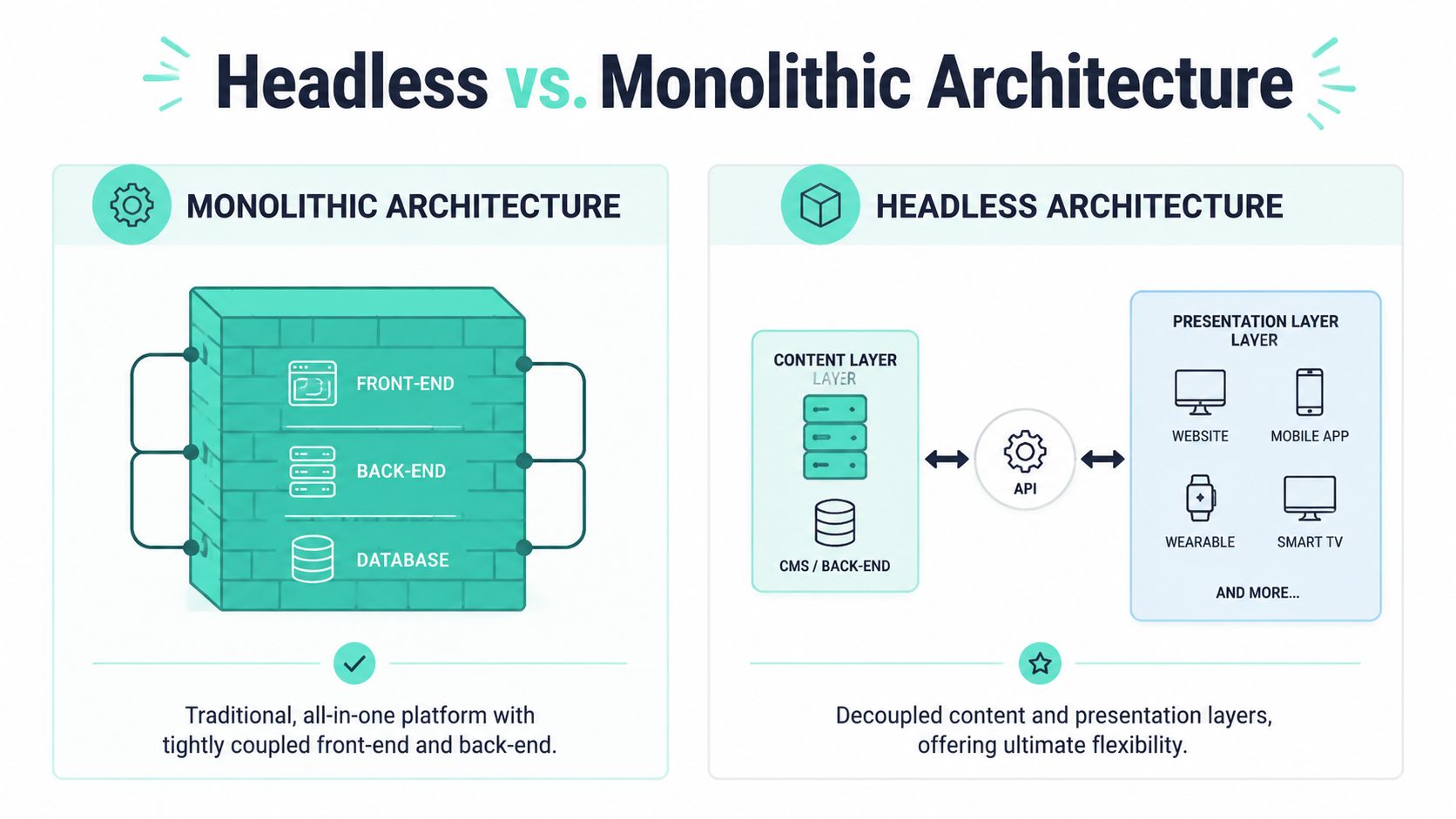
A monolithic CMS is like a pre-packaged meal. The ingredients, container, heating instructions, and serving format all come together as one unit. It's convenient when your needs are simple, but hard to change when you want something outside the preset menu.
A headless architecture is closer to a professional kitchen. The ingredients are prepared centrally, but different teams can plate them for different audiences and channels. The backend stores and governs the content. The frontend decides how to present it.
Where monolithic platforms still work
Monolithic platforms still make sense when the scope is narrow. If a team needs one website, limited integrations, predictable templates, and modest publishing complexity, an all-in-one stack can reduce setup effort.
That's why this isn't a religion. Some organizations overcorrect and choose headless before they've validated the operational need. If the business doesn't need channel flexibility or frontend independence, the extra architecture may not pay off.
Where they start breaking down
Enterprise teams usually hit the wall when they need one or more of these capabilities:
| Architecture model | Common strength | Common limitation |
|---|---|---|
| Monolithic | Faster to start with built-in templates and page tooling | Harder to customize deeply across channels and integrations |
| Headless | Flexible frontend choice and reusable content across channels | Requires stronger API, governance, and deployment discipline |
The core difference is coupling. In a monolith, content structure, rendering logic, and backend behavior are intertwined. That means a frontend change can ripple into backend work, and a content model decision can be constrained by page templates.
In a headless model, those concerns are separated. Frontend and backend teams can work in parallel, content becomes reusable data, and the presentation layer becomes replaceable over time. That's especially relevant in Sitecore programs where enterprise teams want XM Cloud for structured content and orchestration, but prefer Next.js for delivery.
What this means for content teams
For editors, monolithic systems often feel easier at first because page-building and content entry happen in one place. The downside shows up later, when content is so tied to a page layout that reuse becomes messy.
With headless, content teams have to think more structurally. Content types, relationships, metadata, and reusable components matter more than page-specific fields. That shift takes governance, but it creates cleaner reuse across brands, regions, and channels. A useful comparison is in this breakdown of headless CMS vs traditional CMS.
Practical rule: If your business is managing multiple channels, multiple brands, or multiple frontend experiences, a tightly coupled CMS usually becomes an operating constraint before it becomes a licensing problem.
The Key Components of a Modern Headless Stack
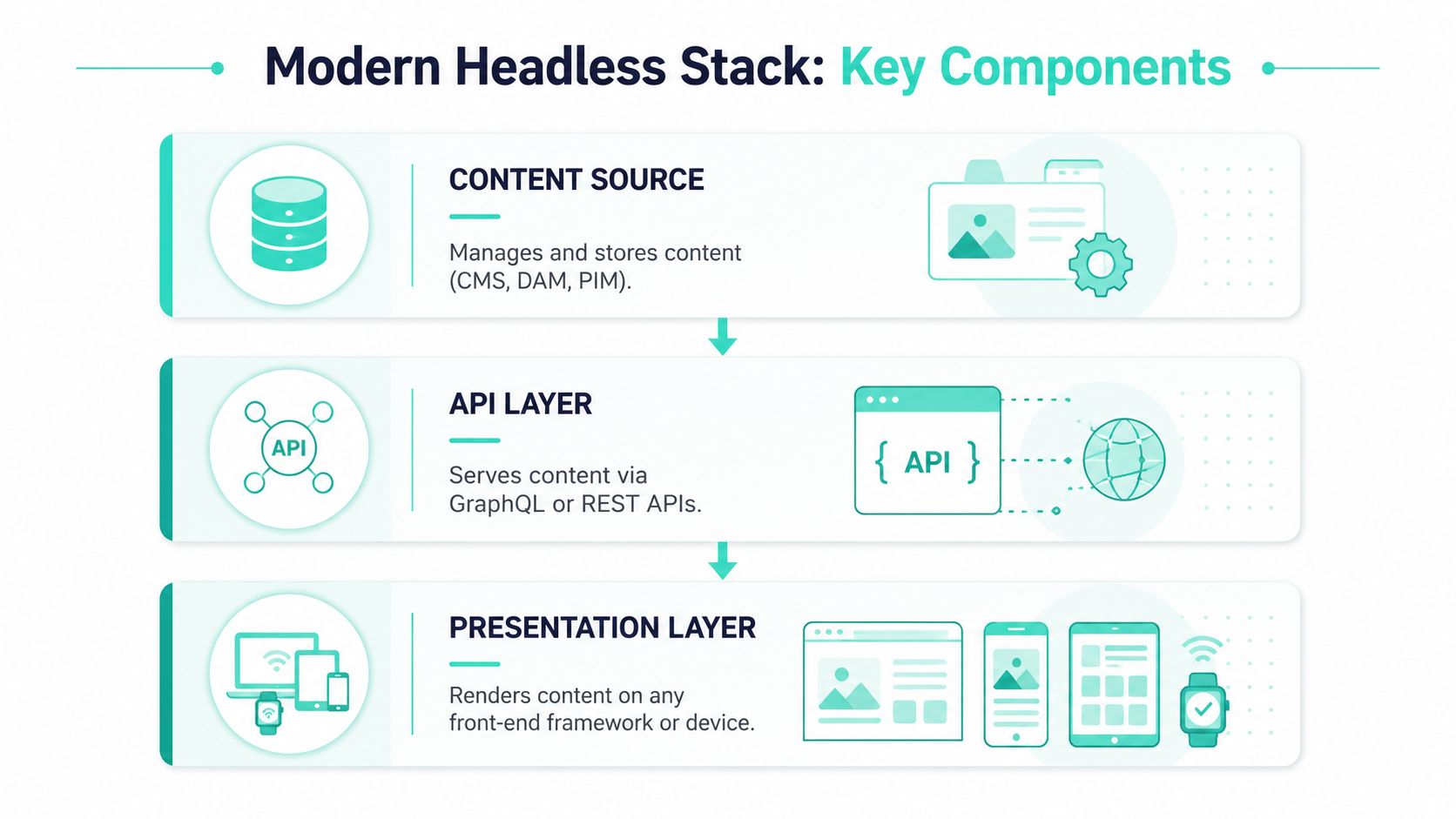
A modern headless stack isn't one product. It's a set of layers that each do a specific job well. When enterprise teams struggle with headless, it's often because these layers haven't been defined clearly enough from the start.
Content source and structured authoring
At the center is the content source. In a Sitecore program, that's often Sitecore XM Cloud for content management, sometimes paired with Content Hub, commerce services, search tools, or external systems such as PIM and DAM platforms.
The key change is that content is modeled as structured data, not as page-bound fragments. Editors manage content types, fields, relationships, workflow, permissions, and versions. The CMS becomes a governed source of truth rather than the system that directly renders every experience.
API layer and orchestration
The API layer is where headless either stays clean or becomes chaotic. APIs expose content and business capabilities to consuming applications. That can include Sitecore layout data, search responses, personalization inputs, product data, employee profile data, or workflow outputs.
The reason this layer matters so much is simple. It's the contract between teams.
According to Fishtank's explanation of Sitecore XM Cloud with Next.js, Sitecore JSS dynamically maps rendering names in Sitecore to React components in Next.js through componentBuilder.ts, and the Layout Service sends JSON that Next.js uses to render components based on placeholders. That pattern is one of the clearest enterprise examples of headless in action. Sitecore manages content and layout intent. Next.js handles the rendering.
For teams building API-driven solutions beyond websites, an API-first approach is what keeps the stack maintainable. Without that discipline, headless turns into a collection of point integrations with unclear ownership.
Presentation layer and delivery performance
The presentation layer is usually a modern frontend such as Next.js. In this layer, developers control component design, rendering strategy, routing, accessibility, and user experience behavior.
A practical stack often includes:
- Frontend framework: Usually Next.js for Sitecore XM Cloud because it fits JSS patterns and enterprise delivery needs.
- CDN and caching: Critical for speed, resilience, and global delivery.
- Composable services: Search, forms, analytics, personalization, authentication, and commerce capabilities can sit beside the CMS rather than inside it.
The frontend should be free to evolve. The content model should be stable enough to support that evolution without constant remodeling.
What works and what usually fails
What works is a stack where each layer has a clear owner. Platform teams own content models and integration standards. Frontend teams own presentation. Security and DevOps teams own delivery, identity, and monitoring.
What fails is the common “we'll just connect the APIs later” mindset. Headless rewards architecture discipline early. It punishes vague contracts later.
Realizing the Business Value of Headless DXPs
A reported 320% ROI within 18 months gets attention, but enterprise approval rarely hinges on a single number. Leaders fund headless because it can reduce delivery cost, shorten release cycles, and support more channels without multiplying platform debt, as noted in Gitnux headless commerce statistics.
The business case becomes stronger in complex estates. A single brand site may see moderate gains. A multi-brand, multilingual, integration-heavy environment usually sees more because the biggest costs sit in duplicated logic, slow release coordination, and brittle platform dependencies.
The sources of business value
Headless creates business value through operating model changes as much as technical design.
- Reusable services reduce repeat build work: Teams can use the same content, search, forms, or profile data across websites, apps, portals, and campaign experiences instead of rebuilding each function per property.
- Independent delivery teams ship faster: Frontend teams, CMS teams, and integration teams can work against defined contracts. That reduces waiting time between disciplines.
- Structured content improves reuse and governance: Content designed as reusable entities is easier to publish across regions, channels, and business units while keeping approval rules intact.
- Frontend freedom improves customer experience: Teams can choose rendering strategies that improve page speed, accessibility, and conversion performance.
- Incremental modernization lowers transformation risk: Enterprises can replace the presentation layer or a service domain without replatforming everything at once.
This is why headless tends to produce the strongest return where coordination cost is already high.
Why the value looks different in Sitecore and SharePoint programs
For Sitecore XM Cloud customers, the commercial value is not limited to a faster website. It comes from building a content platform that can support brand sites, campaign landing pages, regional variations, and connected services without forcing every change through the CMS rendering layer. Teams that want a practical implementation path can review how to implement a headless site with JSS in XM Cloud.
For SharePoint users, the value case is different but just as relevant. Headless patterns help when SharePoint content needs to appear in better digital experiences than classic page templates can support. That often matters in employee portals, knowledge hubs, partner experiences, and mixed Microsoft 365 environments where content lives in one place but needs to be delivered through more controlled frontend applications.
In both ecosystems, the same rule applies. Headless pays off when content services, governance, and delivery standards are designed together.
The operational costs vendors tend to understate
Vendor messaging often focuses on speed and flexibility. Enterprise teams also need to account for the ongoing work required to keep a headless estate reliable.
API orchestration becomes a real program concern once content, search, identity, analytics, DAM, personalization, and line-of-business systems all need to cooperate. Someone has to define contracts, manage versioning, monitor failures, and resolve ownership when one service changes and five downstream applications break.
Total cost of ownership can also rise before it falls. A monolithic platform hides complexity inside one product. A headless stack distributes that complexity across frontend hosting, middleware, observability, cache strategy, security review, integration support, and release management. The architecture is often better. The operating model is not automatically simpler.
That trade-off is manageable, but it needs to be budgeted realistically.
| Business concern | How headless helps |
|---|---|
| Brand consistency | Shared content models and component standards support repeatable delivery across markets |
| Time to launch | Teams can reuse services and frontend patterns for new sites, microsites, and campaigns |
| Platform resilience | Changes in one service are less likely to force a full-platform regression cycle |
| Governance at scale | Central teams can define standards without blocking local teams from shipping market-specific experiences |
| Modernization risk | Enterprises can replace parts of the stack in phases instead of funding a single large rebuild |
Headless creates business value when it cuts coordination overhead, not when it simply adds newer technology to the stack.
Headless in Practice with Sitecore XM Cloud and SharePoint
The enterprise value of headless becomes easier to see when you stop talking about architecture in abstract terms and look at how teams use it.

Sitecore XM Cloud in a real delivery model
With Sitecore XM Cloud, the headless pattern is direct. Content authors work in Sitecore. Developers build the experience layer in Next.js. JSS connects the two. Shared components can support hub-and-spoke models across brands and regions, and Helix-style organization helps teams keep component libraries and feature boundaries manageable over time.
In enterprise programs, this usually supports several outcomes at once. Marketing gets cleaner publishing workflows. Platform teams get a composable architecture. Developers get frontend freedom without abandoning editorial governance.
For content that changes regularly, Next.js Incremental Static Regeneration can regenerate static pages at set intervals without a full rebuild, which is especially useful for news, campaign pages, and promotional content, as explained in Altudo's XM Cloud and Next.js overview. That's a practical example of headless doing real work. Editors publish in Sitecore, and the delivery layer stays fast without forcing full-site deployment cycles.
A more implementation-focused example is this walkthrough on implementing a headless site with JSS in XM Cloud, which reflects the kind of delivery pattern enterprise teams typically adopt.
Where Sitecore AI fits
Sitecore's modern portfolio makes more sense in a headless estate than in a tightly coupled one. XM Cloud manages content. Search improves discovery. Personalize supports decisioning. AI-assisted content and experience capabilities become more useful when data, content, and rendering are already separated.
In practical terms, that means a team can enrich content operations and customer experience without turning the CMS into the frontend runtime. That separation is one reason Sitecore's cloud direction has become more attractive for organizations modernizing legacy XP estates.
Here's a concise product view that often helps enterprise stakeholders align on the model:
| Sitecore capability | Role in a headless setup |
|---|---|
| XM Cloud | Content management, workflow, structure, editorial governance |
| JSS and Next.js | Frontend rendering and component delivery |
| Search and Personalize | Experience optimization services connected through APIs |
| Content Hub or external sources | Additional governed content and asset services |
A short overview of the broader model is useful here:
SharePoint uses the same principles differently
SharePoint doesn't get labeled “headless” as often, but modern Microsoft 365 intranet architecture uses many of the same ideas. SPFx components can consume data from Microsoft Graph, SharePoint lists, document libraries, Power Platform flows, HR systems, and line-of-business APIs while presenting that information through a customized intranet experience.
That matters because most enterprise intranets aren't just publishing platforms. They're operational portals. They need policy content, employee services, workflow entry points, document access, announcements, knowledge surfaces, and personalized navigation. Treating content and business data as services, then rendering them through decoupled components, is often the cleanest way to modernize those experiences.
What tends to work best
The strongest implementations usually keep the boundaries clear:
- Sitecore owns experience content for external digital channels
- SharePoint owns collaboration, internal publishing, and Microsoft 365-native workflows
- APIs and integration services connect shared data where needed
- Frontend components stay reusable and governed across environments
That's where a composable DXP approach becomes practical rather than theoretical.
Planning Your Enterprise Migration to Headless
Enterprise headless programs rarely stall because teams picked the wrong CMS. Delays usually start earlier, during migration planning, when architecture decisions, delivery ownership, and operating model changes are left loosely defined.
That pattern shows up often in Sitecore XM Cloud and SharePoint programs. Teams approve a modern frontend, then discover that content models are inconsistent, API contracts are unclear, and release coordination now spans more systems than before. Headless can improve speed and flexibility, but only if the migration plan covers how the platform will be run after go-live.
Start with ownership boundaries
Strong migration plans define platform ownership before teams discuss features. In practice, that means deciding what moves into Sitecore XM Cloud, what stays in SharePoint, what sits behind integration services, and which team owns each dependency.
Three decisions usually shape the rest of the program:
- Which channels move first
- Which content types need redesign instead of lift and shift
- Which integrations need stable API contracts before frontend work starts
For most enterprises, phased delivery is the safer option. A regional site, campaign platform, customer support area, or a discrete intranet service usually gives the team enough scope to prove the architecture without putting every business function at risk.
Hidden complexity sits in the middle layer
Vendor diagrams tend to make headless look cleaner than it feels in production. Someone still has to handle contract versioning, authentication, retries, response shaping, observability, and incident ownership across multiple services.
That operational load is where many programs lose time. I see it most often when frontend teams are ready to ship, but upstream APIs are still changing, or when content authors are asked to work in a new model that was never properly designed for reuse. The result is predictable. Releases slow down, support effort rises, and the total cost of ownership starts climbing before the business sees the expected return.
If you cannot name the owner of each API contract, the migration plan is not ready for enterprise delivery.
A practical migration checklist
Use this as a working plan:
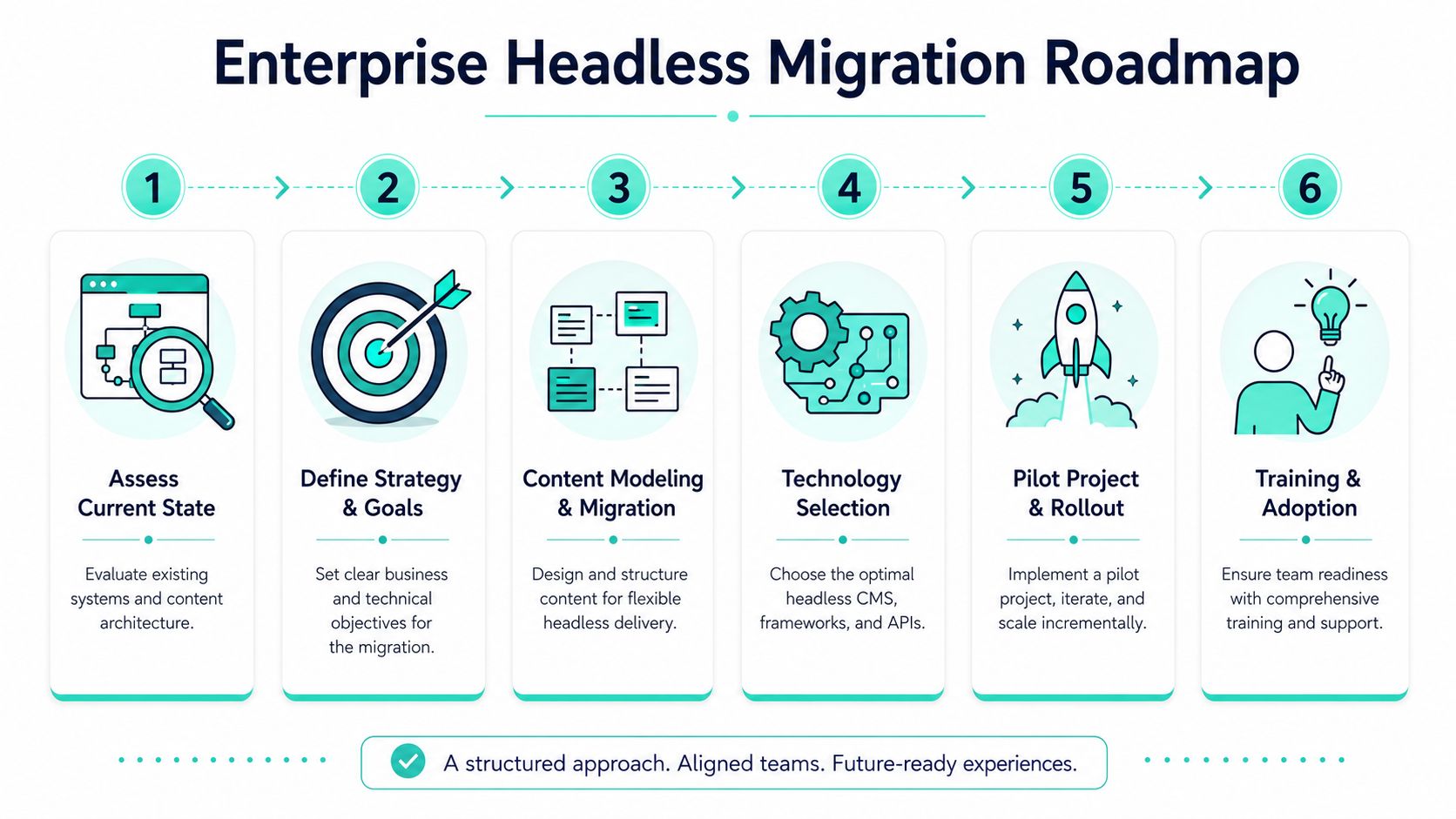
- Audit the current estate: Identify duplicated content, brittle integrations, page-level dependencies, custom workflow logic, and authoring friction.
- Redesign content models for reuse: Migrate business entities and reusable content types, not just legacy page fields.
- Define service ownership early: Assign responsibility for each API, schema, authentication pattern, and versioning policy.
- Choose the rendering model deliberately: Static, server-side, and hybrid patterns each affect personalization, preview, performance, and hosting cost differently.
- Plan editor and developer change together: Sitecore authors, SharePoint owners, and engineering teams all work differently in a headless model. Training only one group creates delivery friction later.
- Set integration guardrails: Define monitoring, logging, retry rules, and fallback behavior before multiple channels depend on the same services.
Watch total cost, not just platform cost
Headless often removes constraints in the CMS layer while adding responsibility in the integration and delivery layers. That trade-off can be worth it, especially for enterprises that need multi-channel delivery, faster frontend iteration, or a cleaner split between external experience management and Microsoft 365 collaboration. But the financial case only holds if teams budget for API orchestration, frontend maintenance, hosting, observability, and governance from the start.
Migration planning should cover more than implementation. It should define how the architecture will be operated, supported, and funded over time.
Next Steps for Your Headless Transformation Journey
A useful headless strategy starts small enough to govern and large enough to matter. Enterprise teams don't need another abstract modernization roadmap. They need a first move that proves the architecture under real business conditions.
What to do first
Start with a focused assessment of one digital journey, one content domain, or one site group. In most organizations, a pilot should be visible enough to test value but contained enough to manage risk. A regional marketing site, product information layer, campaign platform, or intranet service area usually works better than an enterprise-wide rebuild.
Then validate the delivery fundamentals early:
- Performance targets: Optimal headless systems aim for sub-100ms API latency and 90%+ cache hit ratios, as described in this headless architecture technical discussion.
- Security controls: OAuth 2.0 and JWT should be built into the API layer from the start, not added later.
- Contract discipline: Define schemas, versioning rules, and deprecation policies before multiple teams begin consuming the same services.
What strong enterprise teams do differently
They treat headless as a capability model, not just a replatform. That means the CMS decision, frontend decision, and integration decision are made together. It also means content governance, DevOps, and security are involved before implementation gets busy.
A practical sequence looks like this:
- Pick a pilot with real business value
- Define content models and API contracts before visual build-out
- Establish frontend, CMS, and middleware ownership
- Measure performance, authoring efficiency, and release stability
- Scale the pattern only after governance is proven
For Sitecore XM Cloud users, that often means validating JSS, Next.js, structured authoring, and service integration patterns in one bounded implementation before rolling them into a broader DXP estate. For SharePoint-led organizations, it usually means modernizing one intranet service domain with SPFx and Microsoft 365 integrations before standardizing the pattern more widely.
If you want a practical path forward, Kogifi works with enterprise teams on Sitecore XM Cloud, composable DXP delivery, and SharePoint intranet modernization to define architecture, delivery patterns, and migration plans that fit real operating constraints.
If you're evaluating headless for Sitecore XM Cloud, SharePoint, or a broader composable DXP roadmap, Kogifi can help assess your current estate, define a workable target architecture, and shape a phased migration plan around governance, performance, and business value.