


90 percent of organizations are undergoing digital transformation, yet only 35 percent succeeded in their goals in 2021 according to Mooncamp's digital transformation statistics roundup. That gap is where most enterprise programs stall. The ambition is there. The budget often is too. What fails is execution across platforms, data, governance, and adoption.
In enterprise environments, digital transformation for enterprises isn't a single migration, a new CMS, or an AI pilot in isolation. It's the disciplined redesign of how customer experiences, internal operations, and decision-making systems work together. The enterprises that get this right build around platforms that can scale, integrate, and adapt. The ones that don't usually end up with disconnected tools, duplicated content, and teams forced back into manual workarounds.
The practical playbook is platform-led. For customer experience, that increasingly means Sitecore XM Cloud, Sitecore Search, Sitecore Personalize, and Sitecore Stream. For internal operations, it often means SharePoint Online, SPFx, and Power Platform. Those stacks solve very different problems, but in successful programs they reinforce each other.
Table of Contents
- Phase one starts with business friction
- Platform choices decide delivery speed later
- Governance has to exist before scale
- Where Sitecore AI fits in the operating model
- What teams should automate and what they should keep human
The Urgent Case for Digital Transformation
Enterprise leaders do not need another argument for why digital transformation matters. They need a clearer view of why so many programs stall after budget approval.
Across large organizations, the pattern is familiar. A customer platform goes live, but content teams still work through manual handoffs. The intranet is redesigned, but employees keep relying on email and scattered documents to complete routine tasks. AI tools are added, but the underlying taxonomy, permissions, and governance model are still weak. The result is spend without operating change.
That is where enterprise programs break down. The risk is not whether to transform. The risk is transforming badly.
At Kogifi, we see failed initiatives tied less to ambition and more to platform fragmentation. Marketing selects tools around campaign needs. IT prioritizes stability in the legacy estate. Internal communications own SharePoint, digital teams own Sitecore, and data ownership sits somewhere else entirely. Each decision can make sense on its own. Together, they produce duplicate workflows, inconsistent content, and integration debt that gets harder to fix every quarter.
Why enterprise programs miss the mark
Four delivery mistakes show up again and again:
- Technology gets chosen before the business constraint is defined: Teams approve a platform without agreeing whether the immediate goal is faster publishing, better personalization, lower service costs, or improved employee self-service.
- Ownership is split at the wrong layer: Customer experience, content operations, search, intranet governance, and analytics are managed in separate queues, so no one owns the end-to-end workflow.
- Legacy integration is deferred: Core systems are left for phase two, which usually means new platforms launch with partial data and manual workarounds.
- AI is added without operating foundations: Generative tools can speed up drafting and classification, but they cannot fix poor content models, inconsistent metadata, weak approval flows, or broken permissions.
Practical rule: If a team cannot point to a workflow that will become shorter, a decision that will become faster, or an experience that will become more relevant, the program is still in planning mode.
The strongest business cases are operational. They show how Sitecore AI can reduce content production bottlenecks, improve relevance, and support governed personalization at scale. They show how SharePoint can become the working front door for policies, tasks, forms, and internal communications instead of another document repository. Those are measurable improvements in speed, consistency, and adoption.
Platform discipline matters more than broad slogans. Enterprises need architecture choices that reduce daily friction, support governance, and connect customer-facing and employee-facing work. For teams shaping that delivery model, this guide to digital transformation best practices is a useful reference, and these external insights on digital transformation show how the gap between intent and execution appears in real programs.
Beyond Buzzwords What Digital Transformation Means for Your Enterprise
Digital transformation for enterprises is the redesign of how the business operates using modern platforms, integrated data, and governed workflows. It's not a website refresh. It's not moving servers to the cloud and calling the job done. It's closer to rebuilding a city's transport system while the city is still running.
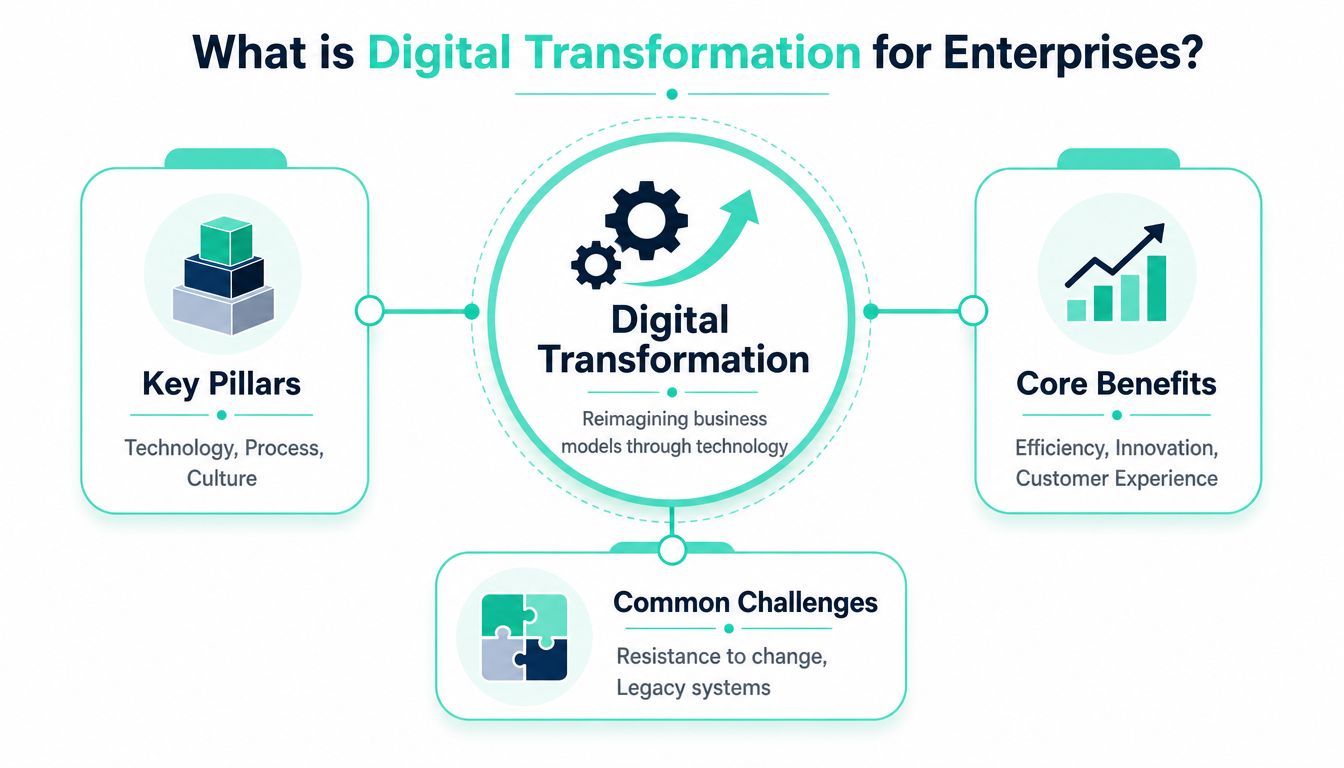
The scale of the shift reflects that reality. The global digital transformation market is projected to reach $1,009.8 billion by 2025, and operational transformation holds the largest market share at 37 percent according to Kissflow's digital transformation statistics. Enterprises are prioritizing internal process change because that's where transformation becomes durable.
Transformation is operational, not cosmetic
A useful way to define it is to separate surface change from operating change.
| Focus area | Cosmetic change | Operational change |
|---|---|---|
| Customer experience | New page templates | Personalized journeys, connected search, governed content reuse |
| Internal work | New interface | Automated approvals, shared knowledge, integrated employee workflows |
| Data usage | More dashboards | Data feeding decisions, segmentation, search relevance, and orchestration |
| Governance | Post-launch cleanup | Rules for content, access, compliance, and ownership from day one |
An enterprise can modernize the front end and still remain slow internally. That happens when authors can't find assets, legal reviews stay manual, intranet requests still move by email, and each region maintains its own content conventions.
The enterprise lens
What matters is continuity. The organization has to improve how it serves customers and how employees do the work behind those experiences.
That usually means three active pillars:
- Experience platforms: Sitecore gives enterprise teams the structure for composable content delivery, personalization, search, and AI-assisted operations.
- Workplace platforms: SharePoint Online supports internal knowledge, policy management, collaboration spaces, and workflow entry points.
- Integration and governance: APIs, middleware, taxonomy, identity, and approval models keep the estate coherent.
Transformation doesn't happen when a business launches a new platform. It happens when teams stop depending on manual exceptions to make the platform useful.
For leaders comparing approaches, it helps to study practical insights on digital transformation that show how different organizations connect technology choices to operating outcomes. The lesson is consistent. The winning pattern isn't “buy more tools.” It's “make platforms carry more of the operational load.”
Your Phased Roadmap to a Transformed Enterprise
A workable roadmap has to reduce risk while still producing visible progress. Enterprises don't transform in one motion. They move in phases that let teams modernize without breaking business continuity.
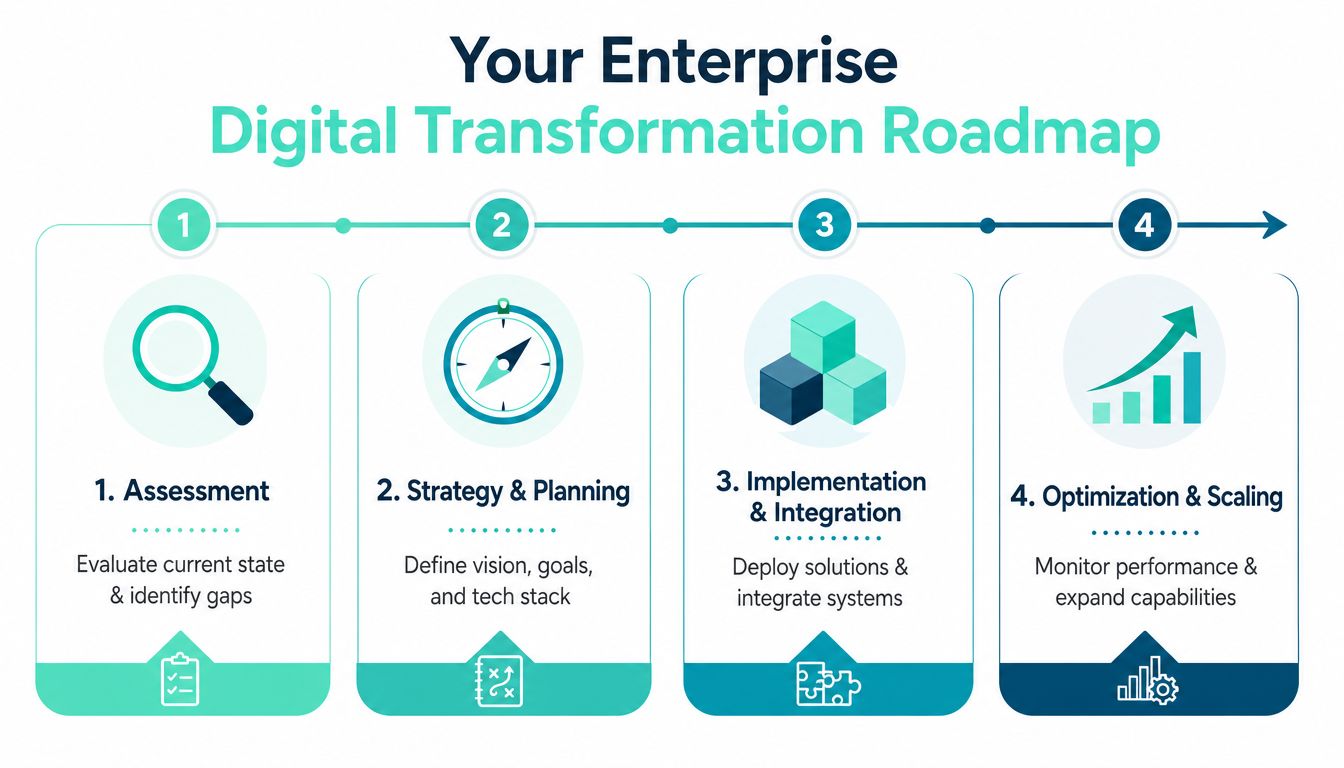
The sequence matters. If you start with delivery before architecture, you create rework. If you start with architecture before business priorities, you build elegance without adoption.
Phase one starts with business friction
Start with the points where the business is already paying a tax.
A few examples make this concrete. Marketing can't reuse components across brands. Regional teams publish inconsistent content. Product data lives outside the search experience. Employees can't find current policies. Service teams rely on attachments and ad hoc approvals. These are transformation signals because they show where time, quality, and governance are breaking down.
The first phase should answer five questions:
- Which journeys or workflows are slowing the business down
- Which legacy systems must stay for now
- Where content and data ownership currently sits
- What can be standardized across brands or business units
- Which pilot can prove value without forcing a full estate rewrite
A short diagnostic period is usually enough to identify the first meaningful release. If AI is part of the target state, teams should also prepare operationally. This checklist on Preparing for your AI launch is useful because it pushes the conversation beyond model excitement into readiness, ownership, and execution.
A structured consulting approach helps here. Digital transformation consulting services typically cover digital maturity review, platform fit, integration planning, and delivery sequencing.
Later in the roadmap, leaders often need a shared narrative for the wider organization. This short overview is useful at that stage:
Platform choices decide delivery speed later
The second phase is where many enterprises lock in their future pace. This is the point to decide whether the stack will support composability, shared governance, and incremental modernization.
For customer-facing estates, a practical enterprise pattern looks like this:
- Sitecore XM Cloud for content management: Keeps content operations structured and cloud-aligned.
- Next.js for the presentation layer: Allows front-end teams to ship faster without coupling every experience change to the back end.
- Sitecore Search and Personalize for relevance: Connects content and intent in ways a static CMS cannot.
- Middleware and APIs: Handle integration with commerce, CRM, identity, booking, or product systems.
- Azure-native services where appropriate: Support scale, security patterns, and operational consistency.
For internal estates, the equivalent pattern often uses SharePoint Online as the employee hub, Power Automate for process routing, and SPFx where the default UI isn't enough.
This is also where central funding logic matters. Enterprise pilots usually die when every business unit has to absorb early-stage risk from its own annual budget. The more durable approach is to fund pilot value centrally until the use case proves itself. That protects momentum and reduces political drag.
Governance has to exist before scale
Enterprises often postpone governance because they want speed. In reality, governance is what allows speed to continue after the first release.
A good governance model covers:
- Content model ownership: Who approves schema changes, reusable templates, and taxonomies.
- Integration ownership: Which team owns contracts between platforms.
- Security and compliance controls: Access roles, auditability, and data handling embedded into architecture.
- Release process: How teams ship changes without blocking each other.
- Measurement: Which operational and experience indicators define success.
Good governance doesn't slow delivery. It removes the arguments that stop delivery.
The final phase is optimization. That includes refining search relevance, improving component reuse, simplifying authoring paths, tuning workflows, and reducing duplicated effort across business units. AI also becomes much more useful here because the underlying content, data, and approval systems are cleaner.
Accelerating Personalization and Content Velocity with Sitecore AI
Enterprise personalization usually fails for a simple reason. Teams expect AI to compensate for weak content operations and fragmented data. It won't.

The more effective model is to use AI inside a governed platform where content, brand rules, and decisioning already have structure. That's why Sitecore's current AI direction is so relevant for enterprise teams. Sitecore's platform now integrates brand-aware AI to align generated content with brand identity, AI copilots to assist marketers in content creation, and agentic workflows to balance human input with automation, directly addressing the 67% of marketers who cite data integration as a key barrier to personalization according to CMSWire's coverage of Sitecore Stream.
Where Sitecore AI fits in the operating model
In practice, these capabilities matter because they target real bottlenecks.
Brand-aware AI helps when organizations have strict voice, legal, and brand consistency requirements across markets. That's common in regulated sectors, global brands, and multi-brand portfolios. Without guardrails, generative output creates more review work than it saves.
AI copilots are useful inside the content lifecycle itself. They help teams draft variants, summarize source material, repurpose approved messaging, and move from blank page to reviewable asset faster. That doesn't replace editorial control. It reduces low-value production time.
Agentic workflows matter because enterprise work rarely ends at generation. Content still needs routing, approval, enrichment, localization, and publishing logic. Automation is valuable when it respects those steps instead of skipping them.
What teams should automate and what they should keep human
A sensible split looks like this:
- Automate first drafts: Product summaries, campaign variants, metadata suggestions, and internal summaries are good candidates.
- Keep brand and legal review human: High-risk messaging still needs accountable review.
- Use AI to accelerate testing: More content variants make experimentation more practical.
- Use search and personalization together: Relevance improves when content discovery and audience intent are connected.
A lot of marketers are trying to solve this from the data side as well. This perspective on how to unify marketing data with AI is useful because it focuses on the operating challenge behind personalization, not just the campaign layer.
Sitecore Search and Sitecore Personalize are important here even when teams focus on generative AI. Search reveals intent. Personalize acts on context. Content operations supply the assets. Sitecore Stream adds assistance across that chain instead of sitting outside it.
The biggest win from Sitecore AI usually isn't that it writes content. It's that it shortens the distance between intent, approved messaging, and publishable experience.
For enterprise teams already designing real-time experiences, real-time personalization becomes more manageable when content production and audience decisioning live in the same ecosystem.
Unifying Your Workforce with Modern SharePoint Intranets
Transformation often gets framed as a customer-facing problem. Inside most enterprises, the bigger day-to-day drag comes from fragmented internal systems. Policies are outdated in one location and duplicated in another. Staff use Teams, email, shared drives, and line-of-business apps without a clear front door. Approval-heavy processes become tribal knowledge instead of managed workflows.

That's where SharePoint Online earns its place in digital transformation for enterprises. Not as a document dump. As the operational layer for internal communication, knowledge access, and workflow entry.
What a modern intranet should actually do
A SharePoint intranet should reduce employee effort in routine work. If it doesn't, adoption will drift.
The most useful intranets usually combine:
- A governed knowledge hub: Policies, HR resources, operational guidance, forms, and business updates in one searchable structure.
- Task-oriented entry points: Leave requests, onboarding tasks, approvals, and service requests surfaced clearly.
- Role-based experiences: Different content views for regions, departments, or job functions.
- Power Platform automation: Power Automate routes approvals. Power Apps handles forms and process steps that need more logic than lists alone.
- Custom SPFx components: Used where standard web parts can't deliver the needed UX or integration behavior.
A well-designed SharePoint environment also supports hybrid work properly. Employees shouldn't need to remember which team owns which resource. They should have a clear place to start.
SharePoint works when it becomes the front door
The mistake many enterprises make is publishing a SharePoint intranet and assuming the launch itself creates value. It doesn't. The value comes from replacing scattered habits with a governed path.
A strong internal model usually includes a homepage for corporate communications, departmental hubs for local ownership, and workflow surfaces that connect people to actions, not just documents. It should also integrate cleanly with Microsoft 365 tools people already use.
Here's a practical way to evaluate scope:
| Need | Standard SharePoint can cover it | Customization is usually needed |
|---|---|---|
| News and policy publishing | Yes | Sometimes |
| Document libraries and permissions | Yes | Rarely |
| Structured forms and approvals | Partly | Often with Power Apps or Power Automate |
| Branded employee experience | Partly | Often with SPFx |
| Line-of-business integrations | Limited | Often |
The result is more than better internal comms. It's lower friction across the organization. Employees find the current version of a policy, submit the request, track status, and move on. Managers stop approving work from email threads. New starters know where to go. Regional teams work within a shared framework rather than inventing their own intranet logic.
For organizations planning that kind of internal platform, SharePoint solutions usually include intranet architecture, SPFx development, workflow design, and Microsoft 365 integration planning.
Navigating the Real-World Challenges of Transformation
Enterprise transformation programs usually stall for familiar reasons. The blockers are operational. They sit in brittle integrations, release dependencies, unclear ownership, and teams that inherit new platforms without a usable delivery model.
Dataversity notes that legacy integration and skills gaps are two of the common causes of digital transformation delays in enterprise programs, according to Dataversity's analysis of common digital transformation challenges. In practice, those problems are rarely separate. A team can buy the right platform and still miss the outcome if the architecture depends on aging systems and nobody owns the standards for how the platform is used.
Legacy integration is usually the first hard stop
Legacy systems still run revenue, service, and compliance processes in many enterprises. Identity, pricing, inventory, approvals, customer records, and product data often live in platforms that cannot be replaced on a clean timeline.
That changes the delivery model.
The safer approach is staged modernization around stable interfaces. Sitecore can sit at the experience layer and handle content delivery, personalization, and AI-assisted operations while core systems continue to process transactions behind the scenes. SharePoint can standardize internal workflows and knowledge access without forcing a full rebuild of every departmental tool at the same time.
A practical pattern usually looks like this:
- Separate experience from transaction processing: Let digital teams improve customer journeys and internal usability without tying every release to a legacy backend change.
- Use APIs and middleware with discipline: Normalize data contracts early so each new integration does not become another one-off dependency.
- Modernize by business domain: Move search, content, identity, service workflows, or knowledge access in the order that reduces risk and operational drag.
- Reuse components and governance rules: Shared patterns lower support overhead and make future releases easier to test.
The goal is not technical purity. It is release control. If one dependency still dictates your delivery calendar, isolate it first, then decide whether to replace, wrap, or retain it.
Skills gaps undermine good architectures
Architecture alone does not carry a transformation program into production. Teams need enough capability to run the platform after launch, which includes content operations, analytics, security, workflow administration, and release management.
Many programs lose momentum after an impressive implementation phase. Sitecore AI can help teams speed up tagging, summarization, content generation, and personalization decisions, but it still needs governance. Someone has to define prompt controls, approval paths, content ownership, and measurement rules. SharePoint can centralize documents, forms, and collaboration, but it also needs information architecture, permission discipline, and clear ownership across departments.
Training is only one part of the fix. Enterprises also need operating standards that hold up under day-to-day use:
- Defined ownership: Decide who owns templates, components, taxonomies, workflows, and reporting.
- Role-based enablement: Authors, marketers, intranet owners, admins, and developers need different guidance and different success metrics.
- Live governance: Review real content, real workflows, and real releases. Theory does not expose platform drift.
- Support coverage: Give teams a clear path for incidents, enhancement requests, and backlog decisions.
I have seen technically sound programs slow down because no one settled basic questions early. Who approves AI-assisted content in Sitecore. Who maintains SharePoint metadata. Which team owns cross-platform search. Which release board decides when a dependency is safe to change. Those decisions shape adoption more than another strategy workshop.
A stronger model treats transformation capability as a product. Build the platform. Define the rules. Train by role. Review production usage. Then expand scope once the operating model proves it can hold.
Begin Your Transformation Journey with an Expert Partner
Successful digital transformation for enterprises is rarely the result of one big decision. It comes from a sequence of correct ones. Choosing a platform model that fits the estate. Designing integrations that reduce coupling. Giving content teams governed tools they'll use. Building intranets that solve operational friction instead of adding another layer to it.
The practical stack is clear in many enterprise programs. Sitecore handles the customer experience side when personalization, composable delivery, content governance, search, and AI-assisted operations all need to work together. SharePoint handles the internal side when collaboration, knowledge access, and workflow consistency matter. What decides success is how well those platforms are implemented, connected, and governed.
One delivery option in that model is Kogifi, which works across Sitecore, Microsoft 365, and enterprise platform modernization for organizations that need implementation, migration, support, or stabilization capacity.
If your estate is already under strain, start with a platform audit. If the direction is still being defined, start with architecture and roadmap validation. Both approaches are better than launching another disconnected initiative and hoping adoption catches up later.
If you're planning a Sitecore modernization, a SharePoint intranet rebuild, or a broader enterprise platform roadmap, Kogifi can help assess the current estate, define the target architecture, and map the delivery path in practical terms.