


Personalization stopped being a design enhancement a while ago. It became a revenue model. Companies that provide personalized experiences generate 40% more revenue than their competitors, while in-house marketers personalizing their web experiences see an average 19% uplift in sales according to Barilliance's analysis of personalization impact.
That single point changes the conversation for enterprise teams. Web site personalization isn't about swapping a homepage banner or inserting a first name into a headline. It's about building a decisioning layer that can match content, offers, navigation, and journey progression to actual visitor intent. For enterprise marketing leaders, that means three practical questions matter more than the theory. What data should drive the experience, what platform can orchestrate it cleanly, and how do you scale it without creating governance problems.
The strongest answer today sits inside a composable architecture, and Sitecore's AI portfolio is unusually well aligned to that model. Sitecore Stream, AI copilots, and Sitecore Send give teams a way to move from static publishing to adaptive experience delivery, while Microsoft services provide the cloud, data, and integration backbone most enterprises already depend on. The same logic also applies beyond customer experience. SharePoint can bring similar personalization discipline to intranets, knowledge portals, and employee communications.
Table of Contents
- What Is Web Site Personalization Today
- Why the ROI conversation has changed
- Where the commercial impact actually shows up
- From fixed rules to adaptive decisioning
- Comparison of Personalization Models
- How mature teams combine these models
- The architecture pattern that holds up at enterprise scale
- How Sitecore Stream changes the operating model
- Where Sitecore Send and SharePoint fit
- The privacy mistake that hurts performance
- Governance standards that keep programs usable
- Measurement needs a wider lens
What Is Web Site Personalization Today
Web site personalization today is the practice of changing the experience in response to context, behavior, and known audience signals, not just serving the same page to every visitor. That sounds simple, but the operational implication is significant. A personalized site is no longer a publishing destination. It becomes a live decisioning environment.
The enterprise shift is this. Teams used to think in terms of pages and campaigns. Mature teams think in terms of audience conditions, reusable content variants, decision logic, and measurable outcomes. The visitor doesn't see the mechanics, but they feel the difference in navigation, recommendations, calls to action, form experiences, and the timing of prompts.
A modern personalization program creates one-to-one dialogue at scale without requiring manual intervention for every scenario. That doesn't mean every interaction needs AI. It means the site should be capable of responding differently when a visitor arrives from a paid campaign, browses a product family repeatedly, returns from a specific geography, or signals hesitation on a pricing page.
Practical rule: If the same hero, same proof points, and same CTA are shown to every audience, the site is publishing content, not personalizing experience.
The power of relevance lies in its compounding effect. Better relevance improves the first click, the next action, and the probability of conversion. It also reduces wasted traffic. Enterprise brands spend heavily to earn visits. Web site personalization protects that investment by making the visit more useful.
Sitecore is especially strong in this space because it supports the full operating model, not just isolated widgets. Content, workflow, AI assistance, experimentation, and orchestration can sit inside one broader DXP strategy. That's the difference between occasional tailoring and an actual personalization engine.
The Undeniable Business Case for Personalization
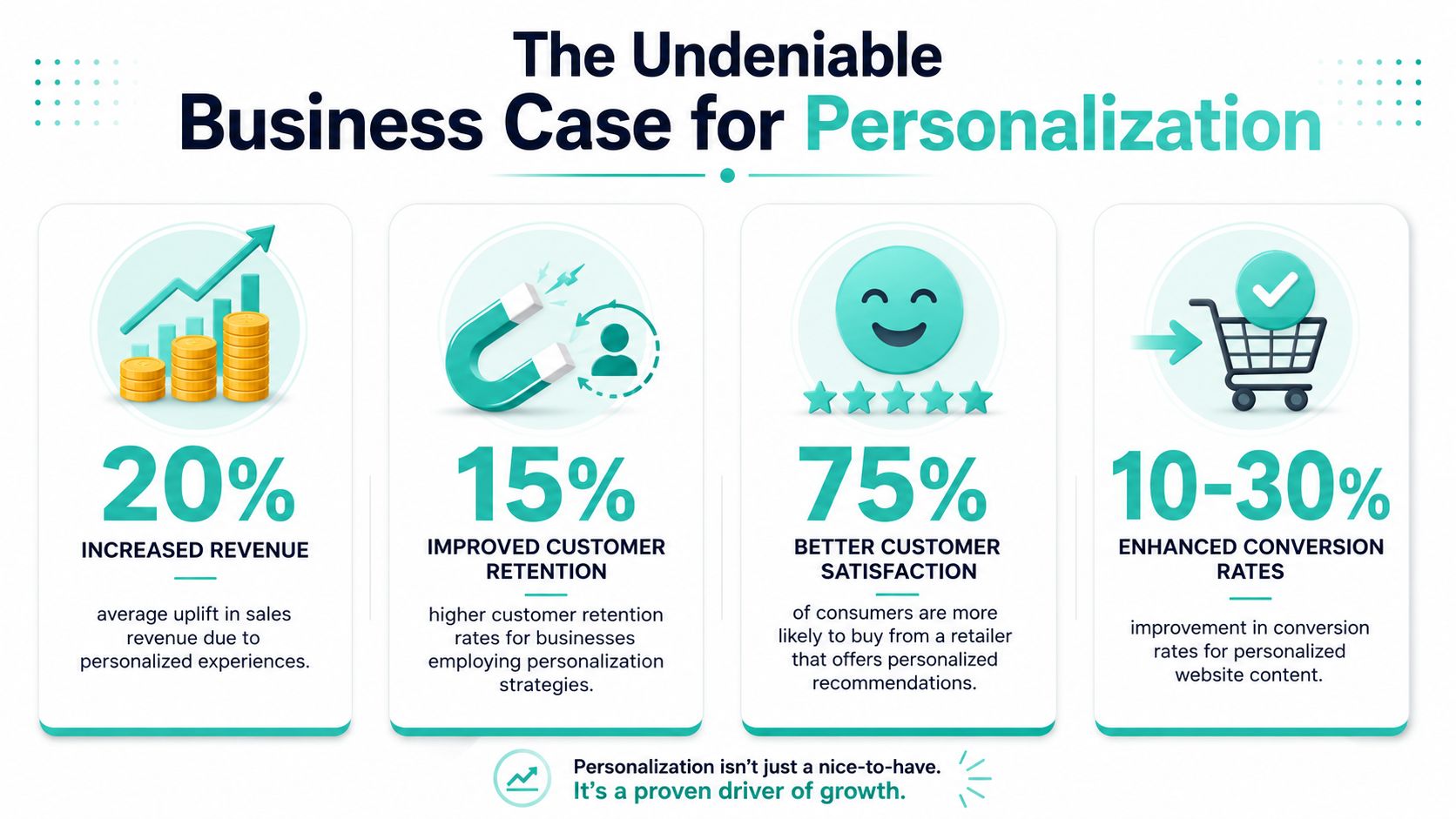
McKinsey found that companies that grow faster derive 40% more of their revenue from personalization than their slower-growing peers in its research on personalization at scale. That is why personalization now sits in budget discussions with conversion rate optimization, paid media efficiency, and retention, rather than in a narrow content workstream.
Why the ROI conversation has changed
The commercial case is stronger because the cost of generic experiences has gone up. Traffic is expensive. Content operations are stretched. Enterprise buyers expect relevance across anonymous visits, known contacts, and account-based journeys.
Barilliance reports that 65% of eCommerce stores see higher conversion rates after adopting personalization, and 94% of companies report improved conversion rates from website personalization in its conversion rate analysis. The same source notes that shoppers are more likely to buy when recommendations are customized, and that recommendation engines can influence a meaningful share of revenue. Those numbers should not be read as a promise of universal uplift. They do show that personalization affects commercial outcomes often enough to justify investment when the program is targeted and measured.
The broader market signal points in the same direction. In its State of Personalization report, Twilio Segment found that 56% of consumers say they will become repeat buyers after a personalized experience. For enterprise teams, that matters more than a single-session conversion lift. It connects personalization to retention, lifetime value, and the economics of acquisition recovery.
Where the commercial impact actually shows up
In practice, the return rarely comes from “personalizing the whole site.” It comes from improving a small number of high-value decisions.
The strongest gains usually show up in four places:
- Conversion efficiency: relevant content reduces hesitation on pricing, product detail, and form pages. Barilliance also notes that basic personalization can improve sales performance, which is why simple use cases often outperform ambitious programs that take too long to launch.
- Revenue per visit: recommendations, cross-sell logic, and audience-specific proof points increase basket quality, not just order count.
- Media efficiency: if paid traffic lands on pages that reflect campaign intent, more of that spend turns into pipeline or revenue.
- Retention and repeat purchase: Twilio Segment's repeat-buyer finding is a useful reminder that personalization should be measured beyond the first conversion.
At this stage, platform choice starts to matter. Sitecore gives enterprise teams a practical way to connect these outcomes to execution. Sitecore Personalize can make real-time decisions across web sessions. Sitecore CDP can unify behavioral and customer signals. Sitecore Stream, AI Copilots, and Send AI reduce the content production burden that usually slows programs down. In a composable setup, that means teams can move from broad segmentation to decisioning and content variation without rebuilding the stack each quarter.
I have seen the strongest ROI cases start with one costly friction point. A pricing page for mixed audiences. A campaign landing page that serves the same CTA to every segment. A product family page where known intent is ignored. Fixing those moments usually beats a large redesign because the business value is clearer and the measurement is cleaner.
For teams evaluating platforms, our guide to website personalization tools for enterprise teams breaks down what to compare beyond feature lists.
The best personalization investments improve expensive moments of decision. They do not add novelty for its own sake.
For enterprise leaders, the priority is straightforward. Start where traffic volume is high, intent is visible, and Sitecore can connect the experience change to a measurable revenue outcome.
Core Personalization Models and Techniques
A practical personalization program starts with the decision model, not the tool. The wrong model creates content overhead, weak testing discipline, and data dependencies the team cannot support yet.
From fixed rules to adaptive decisioning
Rule-based personalization is the first model to get right. It uses explicit conditions to serve a defined variant. Geography, campaign source, device type, language, account type, and login status are common triggers. In Sitecore, this is often the fastest route to production because marketers can understand the logic, legal teams can review it, and performance can be measured against a clear baseline.
Behavioral personalization reacts to what the visitor is doing, not just who they are. Viewed categories, repeat visits, search terms, downloads, cart actions, and depth of engagement all help shape the next experience. This model usually produces better commercial results than static audience targeting because it reflects current intent, but it also depends on cleaner event tracking and stronger taxonomy discipline.
Dynamic Yield makes this point well in its guidance on web personalization foundations. Its team argues that effective personalization depends on a unified data architecture that combines real-time signals with customer attributes so platforms can make content decisions quickly enough to affect the current visit.
The next model is segment-based personalization. Here, teams define audiences around shared value, lifecycle stage, industry, product fit, or buying role, then tailor proof points, offers, and calls to action to those cohorts. This works well for enterprise marketing because it aligns with campaign planning and sales motions, but segments need regular review or they become too broad to stay useful.
Then there is AI-led predictive personalization. Instead of manually writing every audience rule, the platform identifies patterns, predicts likely needs, and recommends the next best content, product, or message. In doing so, Sitecore's newer AI stack changes the operating model. Sitecore Stream can help teams generate and adapt variant content faster. AI Copilots can reduce the manual work required to produce, tag, and refine experiences. Send AI extends that logic into coordinated messaging so web and outbound engagement are less likely to drift apart.
Comparison of Personalization Models
| Model | Mechanism | Example Use Case | Primary Benefit |
|---|---|---|---|
| Rule-based | Predefined conditions mapped to content variants | Show regional messaging by visitor location | Fast setup and clear governance |
| Behavioral | Real-time reaction to browsing, search, or repeat visits | Surface category-specific content after repeated product views | Better alignment with live intent |
| Segment-based | Audience groups defined by shared traits or value | Tailor proof points for high-value customers versus first-time visitors | More relevant messaging for known cohorts |
| AI-led predictive | Models infer likely needs or value signals in real time | Curate recommendations and offers based on likely purchase behavior | Scales relevance beyond manual rules |
| Journey orchestration | Multiple signals coordinate content across moments and channels | Align site experience with triggered email or follow-up sequence | Stronger continuity across touchpoints |
A fifth model matters in larger estates. Journey orchestration coordinates decisions across touchpoints rather than treating the website as an isolated channel. A visitor who clicked a product-specific email, abandoned a form, and returned through paid search should not receive generic homepage messaging. Sitecore is strong here because Personalize, CDP, and campaign execution tools can work from shared context instead of disconnected audience lists.
The trade-off is operational complexity. Each step up the maturity curve increases demand on data quality, content supply, QA, and governance.
How mature teams combine these models
The strongest enterprise programs do not replace one model with another. They layer them.
Rule-based logic handles obvious, high-confidence scenarios such as country, consent state, customer status, or campaign source. Behavioral logic responds to live signals during the session. Segment strategies shape messaging and proof for known cohorts. AI improves scale when manual audience logic becomes too slow to maintain across hundreds of pages, products, and markets.
That layered approach fits Sitecore particularly well in composable environments. Teams can start with deterministic experiences inside a controlled scope, then add CDP-driven audience logic, then bring in AI-assisted content operations and predictive decisioning where the economics justify it.
A simple test helps identify the right model. If the team can clearly explain the audience and the trigger, start with rules. If intent changes quickly during the session, use behavioral logic. If value depends on pattern recognition across many signals, AI is usually the better fit. For teams comparing those maturity stages across platforms, this guide to website personalization tools for enterprise teams is a useful reference.
One caution matters more than teams expect. Personalization techniques fail when content and measurement models are vague. If a team cannot define which component changes, which signal triggers it, and which KPI should move, the result is usually extra complexity with no reliable ROI.
In enterprise Sitecore programs, the objective is not to use the most advanced technique available. The objective is to choose the simplest model that can improve an expensive customer decision.
Architecting for Personalization with Sitecore and Microsoft
If personalization is going to work beyond a pilot, the architecture has to support speed, governance, and reuse at the same time. That's where Sitecore and Microsoft fit naturally together.
The architecture pattern that holds up at enterprise scale
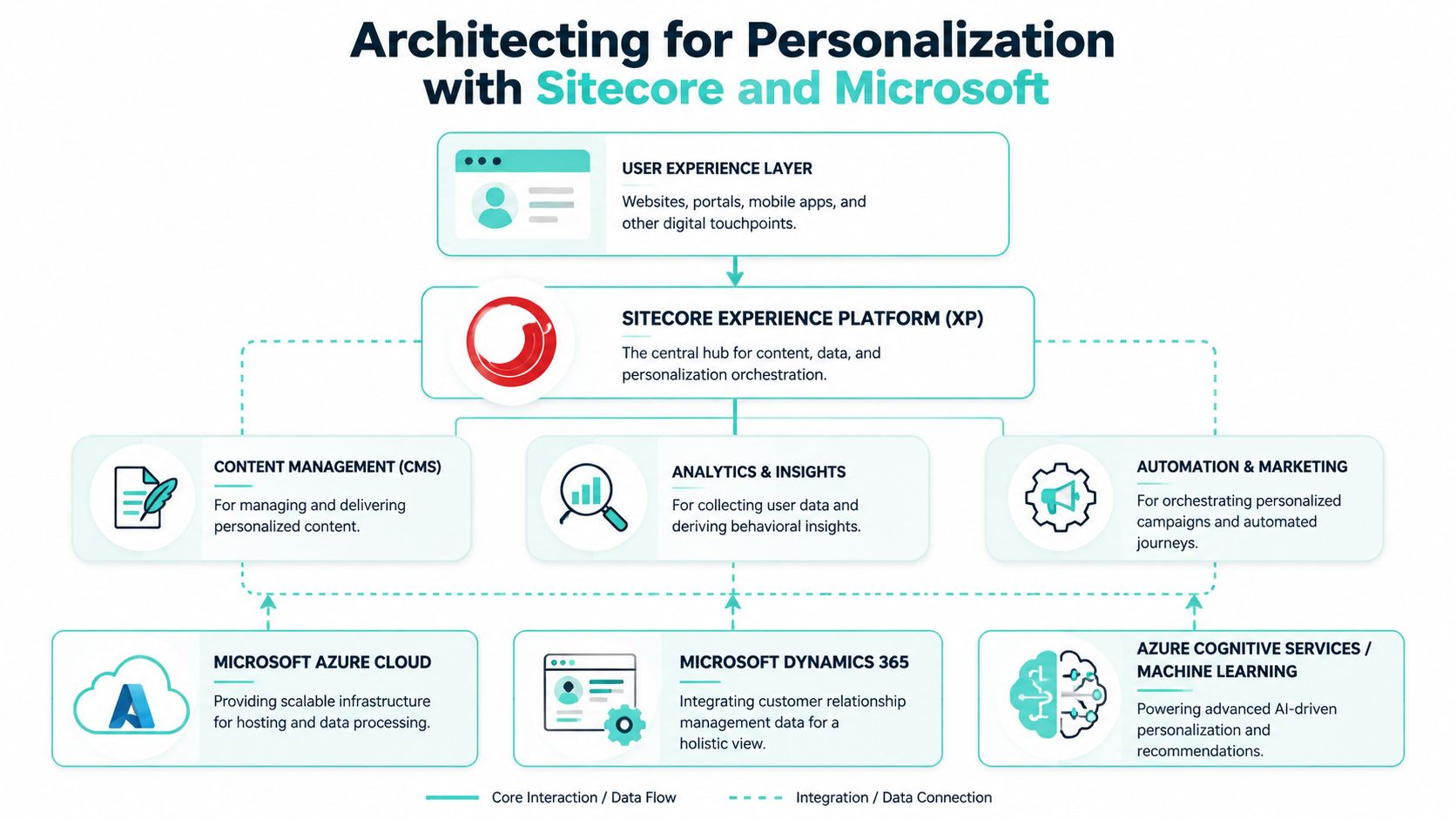
A workable enterprise setup usually starts with a composable DXP. That means content management, customer data, experimentation, campaign orchestration, AI support, and front-end delivery can evolve without forcing every change through one monolithic release cycle.
In practice, the stack needs four capabilities working together:
- Unified customer context: Behavioral signals, campaign origin, profile data, and transactional history need to be usable in one decision flow.
- Structured content operations: Personalization fails when content variants are unmanaged. Components, taxonomies, and approval workflows have to be designed for variation from day one.
- Real-time decisioning: The platform must evaluate intent quickly enough to affect the current session, not the next reporting cycle.
- Composable delivery: Front-end applications, APIs, cloud services, and analytics should integrate cleanly without trapping the team in one deployment model.
Sitecore XP and XM Cloud both support this direction, with different operating assumptions. XP remains strong where organizations want tightly integrated content and experience control. XM Cloud aligns well with headless, Next.js-driven delivery and distributed release ownership. In both cases, Microsoft Azure typically provides the cloud foundation for hosting, integration, and scalable processing.
A practical architecture also needs to prevent silos. CRM data from Microsoft Dynamics 365, behavioral signals from the web layer, campaign context from marketing systems, and content metadata from Sitecore need to form a coherent profile. Without that, teams create isolated personalization moments that don't add up to a coherent journey.
Don't build personalization as a front-end trick. Build it as a content, data, and decisioning capability that the front end can express.
For teams working on adaptive journey design, this perspective on real-time personalization maps well to how enterprise architectures need to behave under live traffic.
How Sitecore Stream changes the operating model
Sitecore's recent AI direction becomes important as Sitecore Stream, the AI-powered layer across Sitecore's DXP, introduces over 250 new AI-driven features that enable brand-aware personalization and agentic workflows for marketers, according to CMSWire's coverage of Sitecore Stream.
That matters less as a headline and more as an operating model shift. Brand-aware AI gives marketers a way to generate and adapt content while staying aligned with brand standards. In enterprise environments, that's a real constraint. Teams often don't struggle to create one personalized asset. They struggle to create hundreds without fragmenting message quality or governance.
Sitecore XP 10.2 and above also includes access to Sitecore Stream capabilities such as brand-aware AI, marketing copilots for brand, campaign, content, experience, and optimization, plus agentic workflows that balance human-in-the-loop interactions with chain-of-thought prompting, as outlined in Sitecore's product announcement distributed via PR Newswire.
For enterprise marketing leaders, the practical implications are clear:
- Brand copilots help maintain tone and brand fidelity across variants.
- Campaign copilots accelerate planning and orchestration.
- Content copilots reduce the production bottleneck around personalization.
- Experience and optimization copilots help teams refine journeys rather than just publish them.
This doesn't remove the need for human review. It changes where humans spend their time. Less effort goes into repetitive drafting and tagging. More effort goes into defining segments, validating decision logic, and reviewing business outcomes.
Where Sitecore Send and SharePoint fit
Sitecore Send extends the stack into audience understanding and activation. According to Brimit's summary of Sitecore AI capabilities, Sitecore Send's Audience Discovery AI analyzes visual content for classification, tagging, emotional tone, and personalized discovery, while also generating product recommendations and hyper-personalized content suited for user-specific audience queries. For commerce and campaign teams, that makes Send more than an email tool. It becomes part of the recommendation and segmentation workflow.
The same architecture principles apply to SharePoint solutions, though the objective changes. On a SharePoint intranet, personalization usually supports employee relevance rather than commercial conversion. A regional employee might see different news, policies, or task shortcuts than a corporate manager. A new hire might get onboarding pathways, while field teams receive operational resources first. Microsoft 365 signals, SPFx components, and Power Platform workflows can support that experience cleanly.
That's why personalization shouldn't be boxed into e-commerce thinking. In the enterprise estate, Sitecore handles customer-facing experience orchestration exceptionally well, and SharePoint can apply the same relevance discipline to internal knowledge, communications, and employee self-service.
Your Phased Implementation Roadmap
The fastest way to stall a personalization program is to start with ambition that outruns content, data, and ownership. A phased model works because it forces the team to prove value before multiplying complexity.
Phase one starts with constraints, not campaigns
Before anyone defines segments, the team needs to understand what can be supported. That means auditing data quality, content structure, tagging discipline, consent coverage, component flexibility, and reporting maturity. Most roadmaps improve once teams stop asking “what could we personalize?” and start asking “what can we personalize reliably?”
Then strategy gets narrower and better. Pick a few business moments that matter, such as high-intent landing pages, product discovery, lead capture friction, or repeat-visitor journeys. Attach each to a measurable business outcome and a clear owner.
A short visual overview helps align stakeholders on the sequence of work.
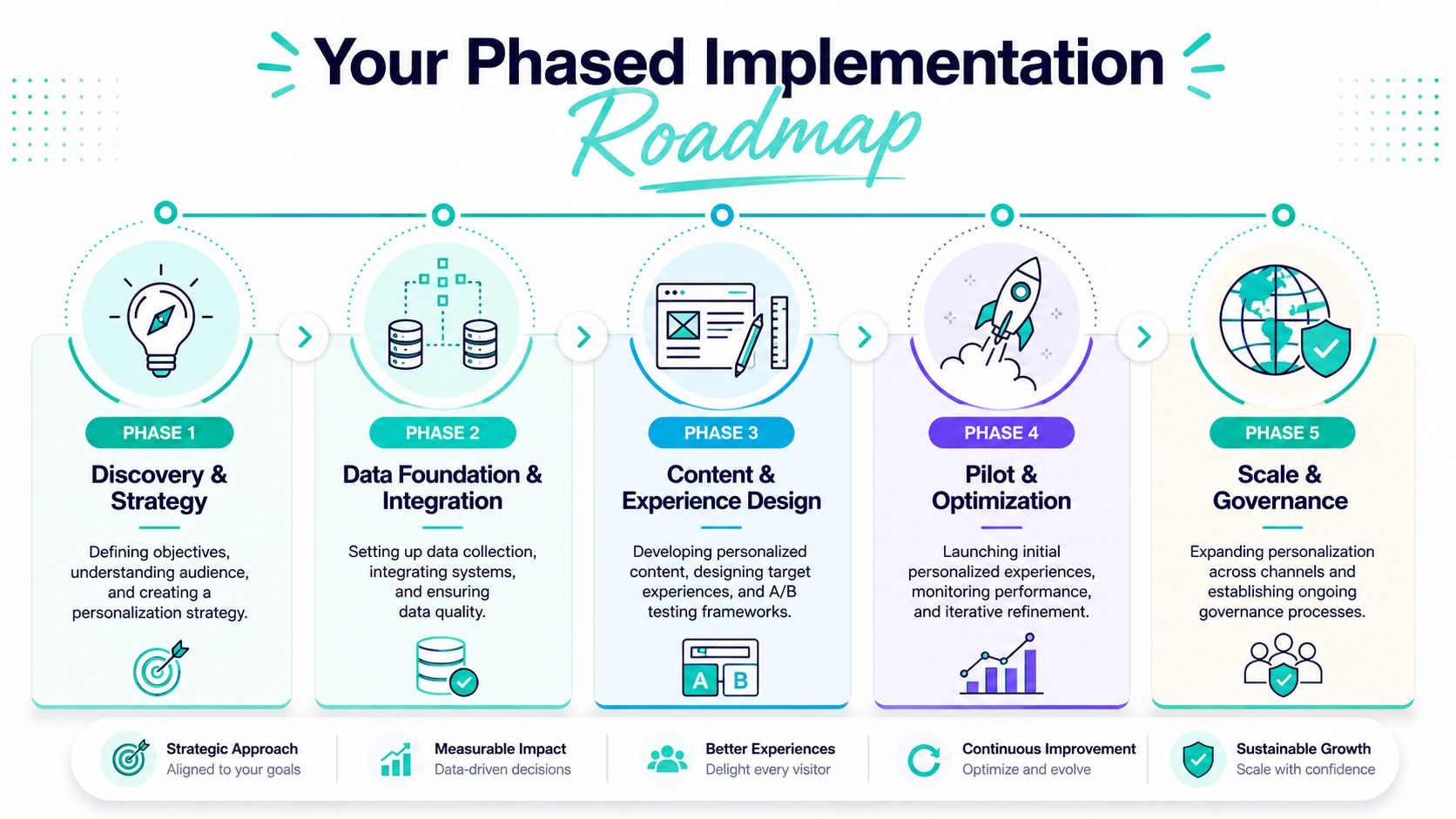
A sensible phased roadmap often looks like this:
Discovery and strategy
Clarify the audience problems worth solving. Focus on moments where better relevance can remove friction or improve progression.Data foundation and integration
Connect the systems that hold behavior, customer context, and content metadata. If profile logic is fragmented, the experience will be fragmented too.Content and experience design
Build reusable variants, not one-off pages. Define the decision rules, fallback states, and test design before launch.
Pilot narrow, then industrialize
The pilot should be deliberately small, but economically meaningful. A narrow pilot does two things well. It limits risk and exposes the operational bottlenecks that broad programs usually hide at first.
Start with one journey where intent is already visible. Personalization performs best when the signal is strong and the next action is easy to measure.
Once the pilot is live, optimization becomes a standing discipline. Review who qualified for each experience, what they saw, what they did next, and where content operations slowed the process down. Teams usually learn as much from editorial and workflow issues as they do from performance data.
Scaling comes last. At that stage, the organization is building governance, shared components, reusable audience logic, QA standards, reporting conventions, and multilingual rollout patterns. That's also when enterprise teams decide which experiences should stay centrally managed and which can be controlled by regional or business-unit marketers.
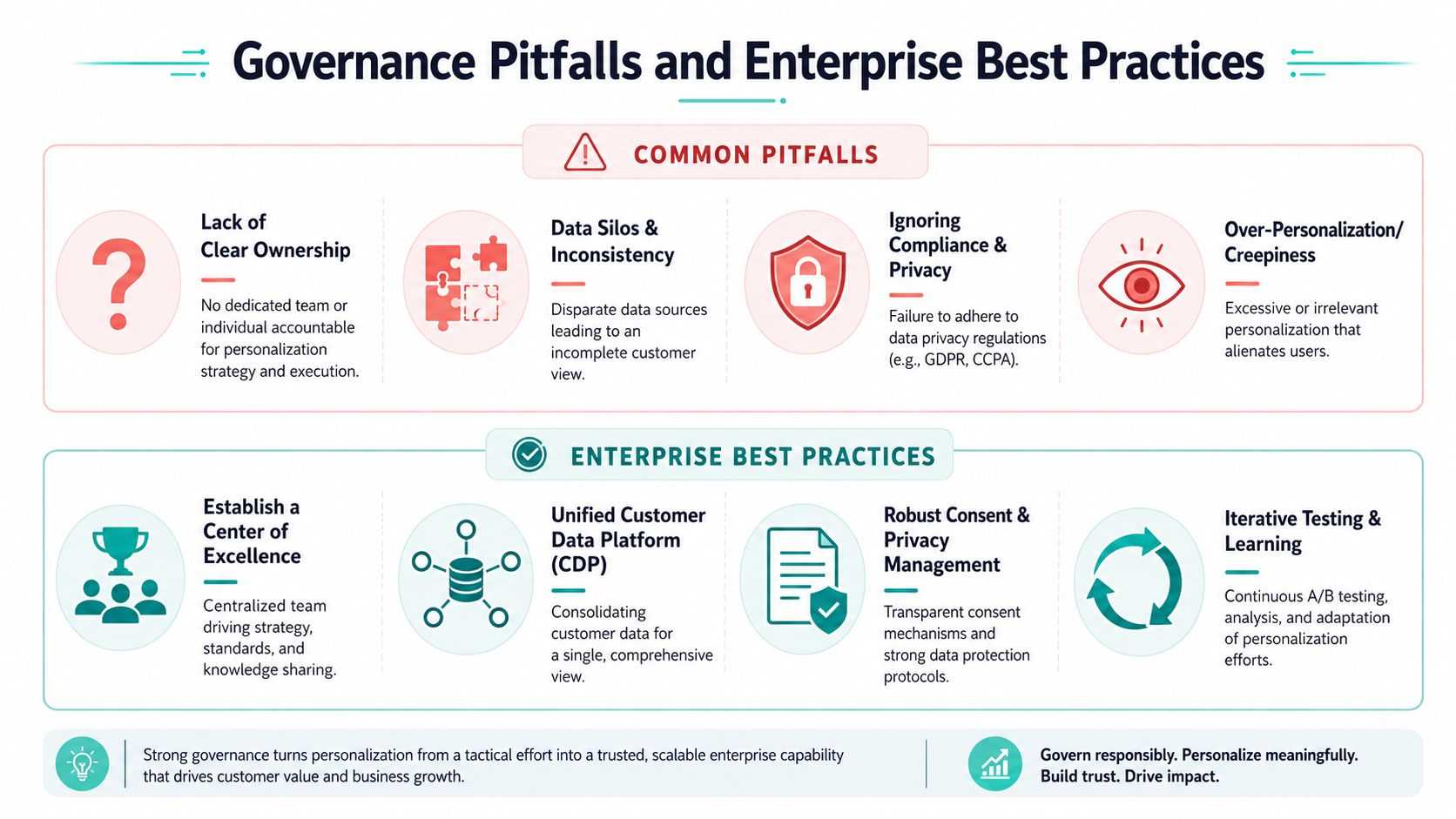
Governance Pitfalls and Enterprise Best Practices
Personalization programs often underperform for reasons that have nothing to do with technology. These failures usually come from weak ownership, inconsistent content operations, or data choices that damage trust.
The privacy mistake that hurts performance
One of the most persistent myths in web site personalization is that more personal data automatically creates better results. That isn't always true. In fact, it can work against you.
A study published through the NIH found that when consumer privacy concerns are high, highly intrusive personalization using Personally Identifiable Information can underperform contextual personalization, creating a backfire effect that undermines purchase intention. The practical takeaway from the NIH-published study on personalization intrusiveness and privacy concern is straightforward. Contextual triggers such as geo-location or situation-based relevance can outperform PII-heavy tactics when trust is fragile.
That changes how enterprise teams should think about maturity. Better personalization doesn't always mean deeper identity resolution. Sometimes it means better judgment about what data to use and when to use it.
Governance standards that keep programs usable
Good governance is what allows personalization to scale without becoming chaotic. In practice, that means the organization needs standards across content, privacy, localization, and accessibility.
The minimum set usually includes:
- Clear ownership: Someone needs authority over audience logic, testing standards, and release decisions.
- Structured content models: Components must support variation without content editors duplicating pages or improvising layout workarounds.
- Consent-aware delivery: The experience should respect what data the visitor has permitted you to use.
- Accessibility controls: Personalized content still has to remain understandable, keyboard-usable, and consistent with WCAG-aware design practice.
- Localization rules: Global organizations need to decide whether variants are centrally translated, regionally adapted, or independently governed.
For teams formalizing these operating rules, a documented content governance framework is often the difference between a repeatable program and a series of disconnected experiments.
Governance insight: The more variants you create, the more your taxonomy, workflow, and QA discipline matter. Personalization magnifies weak content operations.
Measurement needs a wider lens
A/B testing is necessary, but it isn't enough on its own. Mature programs measure whether personalization improves meaningful business progression, not just click behavior.
That usually means looking at a mix of indicators such as:
- Immediate interaction quality: Did the personalized element change engagement in a useful direction?
- Journey progression: Did the visitor move to the next meaningful step?
- Commercial outcome: Did the experience improve conversion quality, lead quality, or order composition?
- Operational efficiency: Could the team produce, approve, and maintain the personalized variants at sustainable cost?
Enterprises that skip this wider lens often report isolated wins but struggle to sustain the program. The experience may test well while content operations become unmanageable, or privacy concerns start undermining user trust. Governance protects the long game.
Actionable Checklist and Enterprise Examples
Enterprises usually do not fail at personalization because the idea is weak. They fail because the operating model, content supply, and decisioning logic are not ready for scale.
That is why this section should function as a go or no-go filter. If a team cannot answer these questions with confidence, the next investment should go into foundations first, not more variants.
Enterprise readiness checklist
Use this checklist before expanding budget, channels, or use cases:
- Audience priority: Have you identified the few audiences or buying contexts that justify different experiences first?
- Usable signals: Can Sitecore collect and use the behavioral, firmographic, and contextual data needed for decisioning?
- Content modularity: Do editors have reusable components and approved message variants, or only page-level content?
- Architecture fit: Can Sitecore and connected systems deliver the experience in real time without brittle integrations or manual workarounds?
- Experimentation process: Does the team run structured tests with clear success criteria and post-test decisions?
- Operating controls: Are privacy, accessibility, localization, and ownership defined before launch?
- Reuse at scale: Can a successful pattern be repeated across brands, markets, or business units without rebuilding it each time?
In Sitecore programs, I look for one more signal. Teams should know which personalization decisions belong in the CMS, which belong in the CDP or decisioning layer, and which should stay rule-based until the data is mature enough for AI-led optimization. That separation keeps complexity under control and improves ROI.
What good execution looks like
Strong enterprise execution is usually quiet. The experience feels relevant because the team made disciplined choices about audience, content, and orchestration.
In commerce, a practical pattern is to tailor category pages, promotional emphasis, and recommendation logic based on intent and value signals. A returning customer with premium purchase history should not see the same entry experience as a first-time visitor responding to a price-led campaign. Sitecore can support this with behavioral signals, audience conditions, and AI-assisted content production through tools such as Sitecore Stream and AI Copilots. The commercial gain comes from better product discovery and stronger average basket quality, not from personalization for its own sake.
In B2B manufacturing or complex solution sales, the pattern is different. Personalization should reduce friction in the buying journey. An engineer may need specifications, compatibility details, and implementation content early. A commercial decision-maker may need proof points, service coverage, and a clear path to speak with sales. With Sitecore in a composable setup, teams can combine CMS content, CRM data, and campaign context to serve the right next step without forcing every visitor through the same path.
For teams that want more concrete delivery patterns, these website personalization examples for enterprise teams show how the approach translates into actual experiences.
The common thread is straightforward. Personalization performs well when it narrows choice, reflects real intent, and fits the way the organization operates. In Sitecore estates, that usually means starting with a few high-value journeys, using AI where it improves speed or relevance, and keeping governance tight enough that the program can scale without creating content debt.