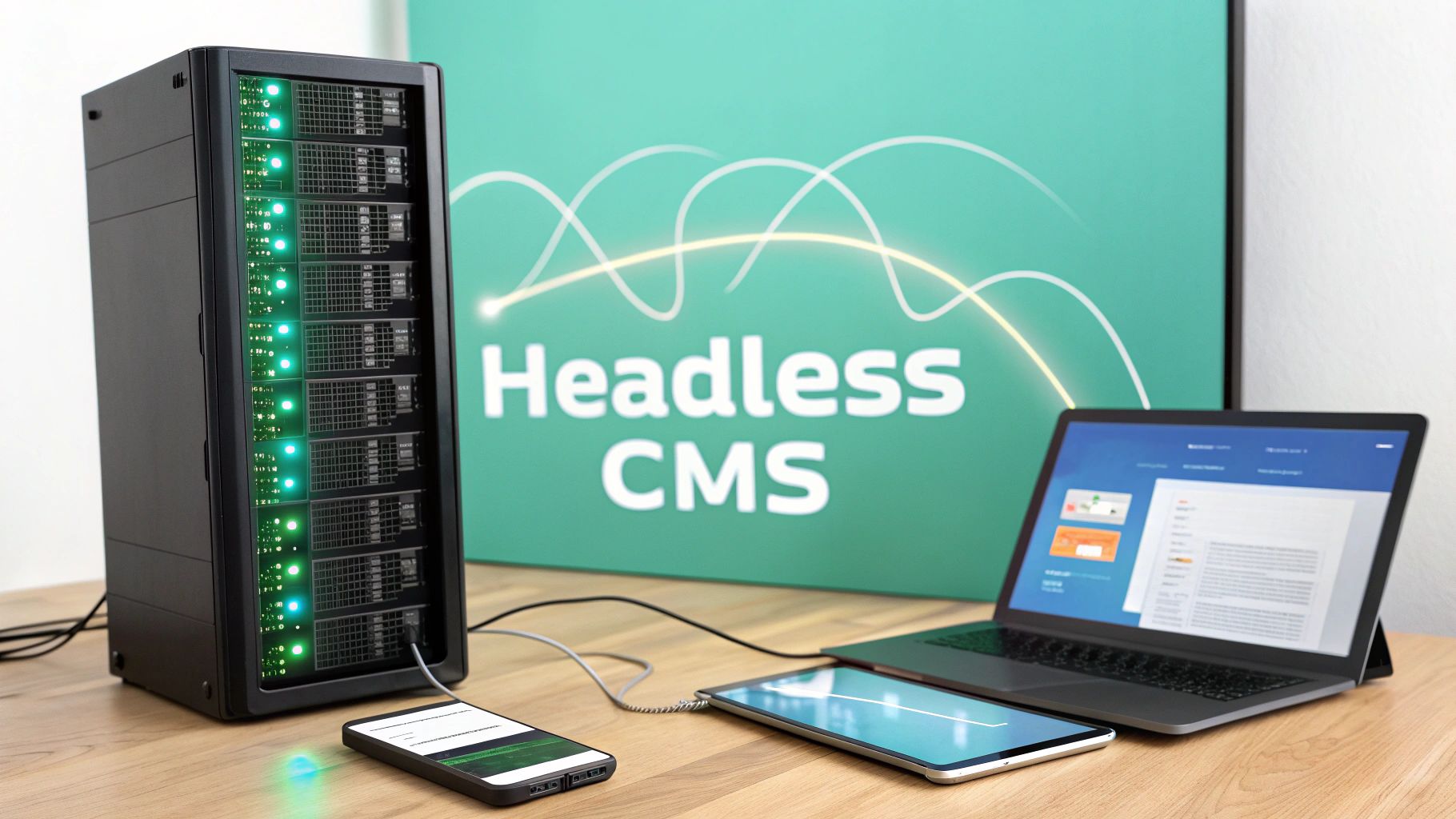



A headless CMS works by separating your content repository (the "body") from its presentation layer (the "head"). This lets you deliver content as pure data through APIs to any device or channel imaginable. The architecture gives developers immense flexibility to use modern frameworks, while content creators get to manage everything from a single, central hub.
Decoding Headless Content Management
Let’s cut through the jargon. Think of a traditional CMS as a standard restaurant where the kitchen (your content backend) and the dining room (your website front end) are fused together. You can only serve one type of meal on one type of plate, specifically designed for that dining room. It’s a monolithic system, which you can read more about in our guide to what is a CMS platform.
A headless CMS, on the other hand, is like a master commercial kitchen. It has one job: creating incredible food—your structured content. This kitchen then sends the food out via delivery drivers, which are Application Programming Interfaces (APIs). These APIs can deliver your content to any dining experience you can dream up:
- A fancy restaurant (your corporate website)
- A food truck (a native mobile app)
- A digital menu board (an IoT device or kiosk)
- A voice assistant ordering system (like Alexa or Google Home)
This separation is the core idea behind headless CMS. Your content exists on its own, completely independent of where or how it will be displayed. This decoupling empowers organizations to innovate faster and reach customers on new channels without getting locked into a single presentation technology.
The Sitecore and SharePoint Perspective
In this model, powerful platforms like Sitecore and Microsoft SharePoint can act as the central content engine. Sitecore’s hybrid headless capabilities, for example, allow marketing teams to keep their familiar visual editing tools while developers get the freedom to build with modern JavaScript frameworks. Similarly, SharePoint can serve as a headless content source for internal applications, feeding data to intranets or partner portals through its robust API framework.
To really get it, it helps to see how this fits into modern web application architecture, where decoupling and flexibility are key.
A headless architecture fundamentally changes the content lifecycle. Instead of creating "web pages," teams create structured, reusable content components that can be assembled and delivered to any frontend, ensuring brand consistency and operational efficiency across all digital touchpoints.
This approach transforms your content from a static page element into a dynamic, flexible asset that’s ready for any future digital channel. The table below breaks down the key differences between these two architectural philosophies.
Headless vs Traditional CMS: A Quick Comparison
To put it all into perspective, here’s a straightforward comparison that highlights the fundamental differences between the traditional, all-in-one approach and the modern, decoupled headless model. This table contrasts everything from architecture and developer experience to how content is ultimately delivered to your audience.
As you can see, the headless approach offers a level of adaptability and future-readiness that traditional systems just can't match. It’s about treating your content as a versatile asset, ready for whatever comes next.
To really get what a headless CMS is, you have to look under the hood at the architectural thinking that powers it. The story starts with a big shift away from the old-school, all-in-one monolithic systems.
In a monolith, everything—content management, e-commerce, personalization, the works—is crammed into a single, tightly-knit codebase. It's simple at first, but over time, it becomes rigid and a real pain to update.
That stiffness is a massive bottleneck. Change one tiny piece, and you often have to redeploy the whole thing, which is risky and slows down innovation. This is where a flexible, API-first microservices architecture comes in. Instead of one giant system, you break the application into a collection of smaller, independent services that talk to each other through APIs.
This isn't just a technical tweak; it's a strategic pivot that changes the entire game of building and managing digital experiences. And the headless CMS is a star player in this new setup.
Headless CMS as a Content-as-a-Service Engine
In this new model, a headless CMS acts as the core Content-as-a-Service (CaaS) engine. Its one and only job is to manage, store, and deliver structured content whenever it's asked. It couldn't care less about how the content looks in the end; it just serves up the raw goods to any application that requests it via an API.
This "content-first" thinking is central to the composable DXP vision that platforms like Sitecore are championing. In a composable world, you're no longer stuck with a single vendor’s toolkit. Instead, you can pick and choose the best tools for each job to build a custom tech stack.
- Content Management: A headless CMS like Sitecore XM Cloud is your content hub.
- E-commerce: A dedicated platform like Sitecore OrderCloud handles all the transactions.
- Personalization: An engine like Sitecore Personalize crafts those tailored experiences.
- Analytics: A separate tool tracks what users are doing and how things are performing.
Each of these is its own independent microservice, all connected through APIs. This structure gives you the power to build agile, scalable digital platforms that can actually keep up with what the market throws at you next. The diagram below really clears up the architectural difference between a content-first headless approach and a traditional, coupled one.
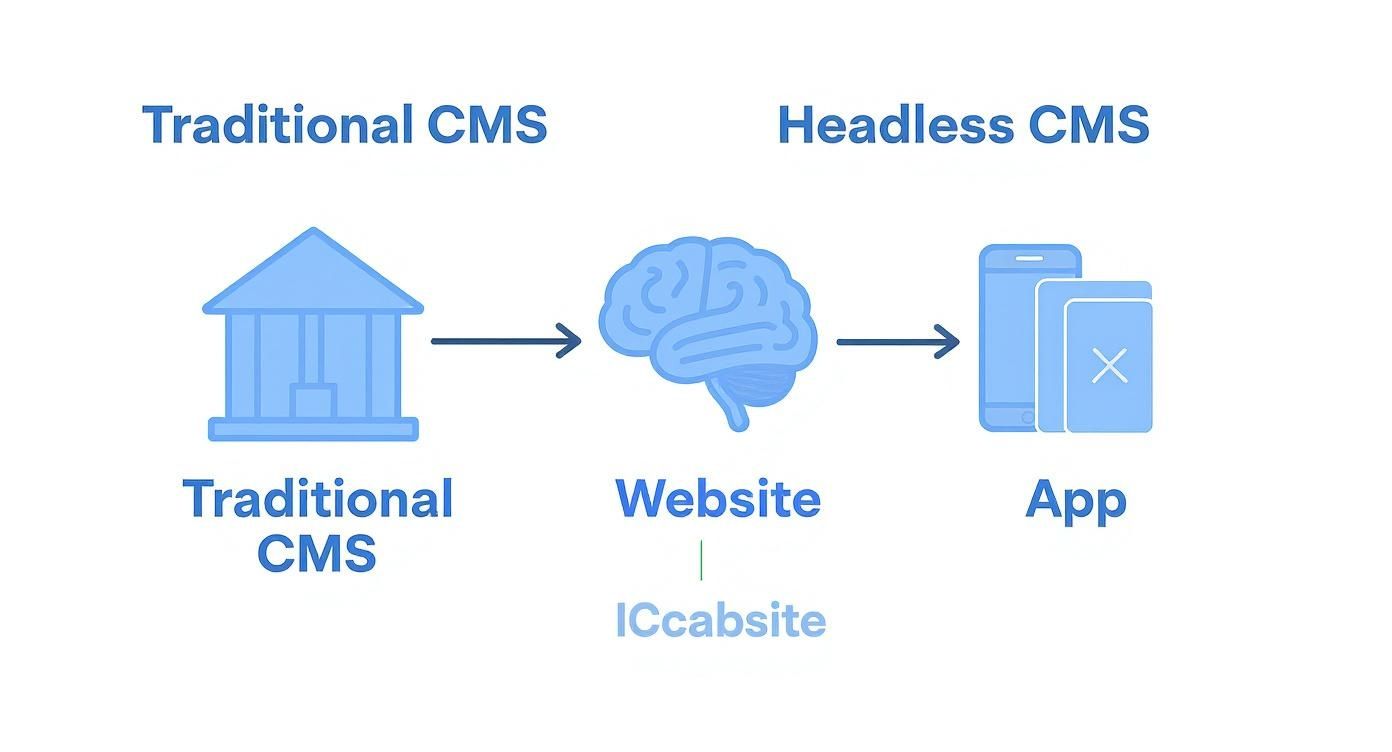
You can see how a traditional CMS is hardwired to a single website, while a headless CMS can seamlessly push content to anything from websites to mobile apps and beyond.
The Rise of the Composable Enterprise
This architectural change has huge implications for business. The headless CMS market is exploding, and this shift is the reason why. Companies are figuring out fast that a microservices-based approach is non-negotiable for staying in the game.
Platforms like Sitecore Content Hub and XM Cloud are built on this composable model from the ground up. Content Hub acts as the central brain for all marketing content and digital assets, while XM Cloud provides a pure SaaS, headless CMS for delivering experiences across the globe. You can even adapt tools like Microsoft SharePoint to this model, using it as a headless content source for internal apps through the Microsoft Graph API.
The core benefit of a microservices architecture is agility. When IT teams can update, scale, or replace individual services without disrupting the entire system, the business moves faster. This transforms IT from a cost center into an engine for business innovation.
This flexibility lets you dodge those massive, eye-wateringly expensive rebuilds. Instead of ripping out and replacing an entire DXP every few years, you can evolve your technology stack one piece at a time. For a deeper dive into this idea, check out our article on future-proofing with composable DXP architecture. This freedom ensures your digital platform stays modern, efficient, and ready for whatever’s next.
What's the Real Business Value of Going Headless?
Switching to a headless CMS isn't just a tech upgrade—it's a strategic move that delivers real, measurable results. When you break free from a traditional, coupled architecture, you open up entirely new ways to connect with customers and give your teams the freedom to innovate. This shift brings practical benefits that show up on the bottom line, improving everything from the customer experience to your own operational workflow.
So let's get into the benefits that enterprise leaders really care about, especially for those running on platforms like Sitecore or SharePoint.
Finally Achieve True Omnichannel Delivery
In a traditional setup, your content is usually stuck inside your website's templates. A headless architecture shatters those limitations, letting you create content once and push it everywhere. This is the absolute bedrock of a genuine omnichannel strategy.
Content managed in a central hub—say, Sitecore—can be delivered seamlessly to any customer touchpoint. You get a consistent brand message and experience whether a customer is on your website, using your mobile app, tapping an in-store kiosk, or talking to a smart device. For SharePoint users, this means internal communications can hit custom portals or mobile apps just as easily as the company intranet.
A headless CMS shifts your focus from building web pages to creating a library of structured content. These content assets can be pulled together on the fly and sent to any channel, making your strategy ready for whatever new device comes next.
Empower Your Developers and Ship Faster
One of the biggest wins is the freedom a headless approach gives your development teams. By decoupling the frontend from the backend, developers are no longer boxed in by the constraints of a monolithic CMS. They can pick and choose their favorite modern frameworks—like React, Vue, or Angular—to build incredibly fast and engaging user experiences.
This autonomy is a huge deal for attracting and keeping top tech talent. When developers get to use the tools they love, they’re more productive and motivated. For a business running Sitecore, your team can use Sitecore JSS to build lightning-fast applications that still tap into Sitecore’s powerful marketing features. The result? You get new features and digital products out the door much faster.
Supercharge Performance and Scalability
Site speed isn't just a technical detail anymore; it's a core business metric that directly impacts user experience, SEO rankings, and sales. A headless architecture is inherently faster because it separates the frontend presentation from the backend logic.
Here’s how that translates into real business value:
- Faster Load Times: Modern frontend frameworks and Static Site Generation (SSG) can serve up pre-rendered pages to users almost instantly.
- Independent Scaling: Got a high-traffic event like a product launch? You can scale your frontend delivery infrastructure separately from the CMS backend, keeping things stable and preventing crashes.
- Global Reach: When paired with a service like Sitecore Experience Edge, your content is served from a global Content Delivery Network (CDN), guaranteeing snappy performance for users anywhere on the globe.
This setup creates a more resilient, high-performing digital presence that's essential for staying competitive. For a deeper dive into these advantages, you can explore the primary benefits of headless CMS in our detailed guide.
Strengthen Security and Future-Proof Your Tech
By separating your content management system from the public-facing site, you dramatically shrink your attack surface. Your CMS backend can sit safely behind a firewall, accessible only to your internal teams, while content is delivered through read-only APIs. This makes your digital properties far more secure right out of the box.
On top of that, a headless approach helps future-proof your tech stack. When new frontend technologies or customer channels pop up, you can adapt without having to rip out and replace your entire CMS. That kind of agility lets you stay current and respond to market shifts without kicking off expensive, disruptive replatforming projects.
Mastering Headless with Sitecore and SharePoint
Moving from theory to practice with headless CMS means getting your hands dirty with specific enterprise platforms. For companies already invested in a serious digital ecosystem, Sitecore and SharePoint are two of the biggest players, though they solve very different problems. Each offers a unique path to decoupling content from its presentation, built for different business goals and tech stacks.
This section gets into the nitty-gritty of implementing a headless architecture on these two platforms. We’ll look at how Sitecore’s product lineup delivers a fantastic hybrid model that keeps both developers and marketers happy, and how SharePoint can be surprisingly effective as a headless content source for your internal apps.
Sitecore: The Hybrid Headless Powerhouse
Sitecore has smartly carved out a niche in the headless world by refusing to make businesses pick a side. Instead of a "pure" headless approach that often leaves marketers feeling like they've been locked out of the car, Sitecore champions a hybrid headless model. It’s the best of both worlds.
This is a huge deal for enterprises that can't afford to throw away powerful marketing tools just for developer freedom. The magic really comes together through a few key pieces of their ecosystem.
- Sitecore JavaScript Services (JSS): Think of this SDK as the essential bridge connecting Sitecore’s powerful backend to modern frontend frameworks like React, Angular, and Vue.js. Developers get the API-first workflow they crave, building blazing-fast apps while still pulling in all the rich, structured content managed in Sitecore.
- Sitecore Experience Edge: This is Sitecore's answer to global, scalable content delivery. When you publish content, it goes to Experience Edge and is served up through a high-performance GraphQL API. The result? Lightning-fast content on any channel, anywhere in the world, without bogging down your core CMS.
- Sitecore XM Cloud: This is where Sitecore is headed. XM Cloud is a pure SaaS, cloud-native CMS built from the ground up for headless and composable architectures. It gives you auto-scaling infrastructure, built-in frontend hosting, and updates that happen seamlessly in the background.
This view of the Sitecore XM Cloud interface shows the clean, component-based approach that is so critical for a successful headless strategy.
What you’re seeing here is content structured as reusable blocks. This empowers content authors to assemble experiences without being handcuffed to a specific page template.
The single biggest advantage of Sitecore’s hybrid model is that it doesn’t abandon marketers. While many pure headless systems ditch visual editing, Sitecore’s Experience Editor still works with JSS applications. Marketers can perform in-context editing, preview pages, run A/B tests, and apply personalization rules. That’s a game-changer that most other platforms can't match.
This hybrid capability solves the number one headache marketing teams have with going headless, keeping them firmly in the driver's seat. It's a major reason why so many organizations rely on Sitecore for their enterprise content management solutions.
Using SharePoint as a Headless Content Source
While Sitecore owns the customer-facing digital experience space, SharePoint is still the undisputed king of internal collaboration and document management. With a little creativity, you can also adapt it to work as a headless CMS for specific internal use cases—think intranets, partner portals, or knowledge bases.
The key that unlocks this is the Microsoft Graph API. It’s a powerful, unified API that gives you access to data across the entire Microsoft 365 world, including SharePoint lists and libraries.
Here’s how a typical implementation might look:
- Structure Your Content: Use SharePoint lists to create structured content types, just as you would in a regular CMS. For example, a "Company News" list might have columns for Title, Body, Author, and Publication Date.
- Expose It via API: The Microsoft Graph API automatically makes this list data available as a queryable endpoint. No extra work is needed.
- Build a Custom Frontend: Your development team can then build a modern web app using a framework like React to pull content from that SharePoint list and display it in a custom, polished interface.
This strategy is incredibly effective for companies already heavily invested in Microsoft 365. It lets them use a tool they already own to power modern internal applications without having to buy and manage a separate CMS.
The push toward headless is becoming a strategic imperative. The market is shifting toward more flexible, API-first systems. Whether you go with Sitecore's sophisticated DXP or leverage SharePoint's internal muscle, a headless architecture is a clear path to a more flexible future.
Navigating the Real-World Challenges of Headless
Going headless offers incredible flexibility, but let's be honest—it’s not a magic wand. Any successful strategy has to start with a clear-eyed look at the potential hurdles. The benefits are real, but the transition involves trade-offs you need to prepare for. Understanding these challenges is the first step toward a realistic plan that actually works.
One of the biggest anxieties, especially for marketing teams, is the fear of losing familiar tools. In a pure headless setup, the intuitive WYSIWYG (What You See Is What You Get) editors and live previews that marketers rely on can simply vanish. This creates a frustrating disconnect where content creators are flying blind, unable to see how their work will actually look on the website or app.
Solving the Marketer's Dilemma
This is exactly where Sitecore’s hybrid headless approach shines. Tools like Sitecore JSS let marketers keep the powerful in-context Experience Editor they know and love. They can see changes live, run A/B tests, and apply personalization rules right on the page. This preserves the intuitive workflow that often gets sacrificed in other headless solutions, ensuring developer freedom doesn't come at the cost of marketing agility.
But the challenges go beyond the marketer’s user experience. A headless architecture introduces other operational shifts that demand careful planning and the right resources.
A headless implementation is not just a technology swap; it's a shift in team structure and process. Success hinges on having the right skills, a robust API strategy, and clear communication between backend content teams and frontend developers.
Addressing Increased Technical Complexity
When you go headless, you're managing a decoupled system, which naturally makes the architecture more complex. Instead of one monolithic application, you suddenly have a separate content backend and one or more frontend applications to wrangle. This requires specialized frontend development teams who are fluent in modern JavaScript frameworks like React or Vue.js.
Your API strategy also becomes absolutely critical. The APIs are the lifeline between your content and your audience, so they demand meticulous design, documentation, and security. In a composable, headless world, you also have to think about resilient content delivery. That means planning for scenarios that demand multi-provider failover reliability to keep the user experience seamless, no matter what.
The rapid move to headless architecture speaks for itself. The market has made a clear shift toward more flexible, API-first systems, and the growth continues to accelerate. You can learn more about the rapid growth of headless architecture from recent studies.
By tackling these considerations head-on, you can build a realistic roadmap for your headless migration and ensure you’re fully prepared for the journey ahead.
Why Your Future Is Composable
Throughout this guide, we've broken down how a headless CMS works by separating your content from its presentation. But this "decoupling" is far more than just a technical tweak. It’s the first, most critical step toward a much bigger prize: a fully composable Digital Experience Platform (DXP). For any company serious about leading in their market, making this architectural shift isn't just an option—it's a necessity.
Think of decoupling your content as opening the door to a truly agile, best-of-breed digital ecosystem. Instead of being locked into one vendor’s clunky, all-in-one suite, you get the freedom to handpick a stack of specialized tools that perfectly match what your business actually needs. This means plugging in best-in-class services for commerce, personalization, search, and analytics to build a DXP that is 100% yours.
The Sitecore Path to Composability
Modern platforms like Sitecore are leading this charge, offering a clear roadmap for businesses to build the scalable, personalized experiences that customers now expect. A product like Sitecore XM Cloud is the perfect embodiment of this vision. As a pure SaaS, API-first CMS, it acts as the nimble content hub for a much broader composable DXP.
From there, you can seamlessly layer in other specialized Sitecore products:
- Sitecore OrderCloud for powerful headless commerce.
- Sitecore CDP to create a single, unified view of your customers.
- Sitecore Personalize for delivering AI-powered, one-to-one experiences.
This model is a game-changer. Each component can be updated, scaled, or even swapped out independently. You're no longer staring down the barrel of a massive, high-risk replatforming project every few years. Even legacy systems like SharePoint can get in on the action, serving as a headless content source for internal apps within this modern, composable setup.
The ultimate goal of a composable architecture is business agility. By breaking down the DXP into interchangeable components, organizations can adapt to market changes, adopt new technologies, and launch new digital products faster than ever before.
The takeaway here is simple. The future isn't just about going headless; it’s about becoming composable. A headless CMS is the essential launchpad for that journey. For enterprises that plan on winning, the time to start building that future is now.
Unpacking Headless CMS: Your Questions Answered
When you're exploring a move to headless, a lot of questions pop up for everyone from the marketing team to the lead developers. Let's tackle some of the most common ones, especially as they relate to powerful platforms like Sitecore and SharePoint.
Think of this as your practical guide to making a clear, informed decision.
Is a Headless CMS Really the Right Move for Us?
Honestly, not for everyone. A headless CMS is a game-changer for organizations juggling multiple digital touchpoints—think websites, mobile apps, kiosks, and even IoT devices. It’s perfect for companies with skilled dev teams who want to use the latest frontend frameworks to build blazing-fast, custom experiences.
But if your business runs a single, straightforward website and your team relies heavily on an all-in-one visual page builder, a traditional CMS might still do the job just fine. That said, as soon as your digital ambitions start to grow, the sheer flexibility of a headless architecture gives you a serious competitive edge. It’s a strategic choice for any company with an eye on the future.
How Is Sitecore's Hybrid Model Different from "Pure" Headless?
A pure headless CMS completely decouples the content backend from any specific frontend. This gives developers total freedom, which is great, but it often leaves marketers high and dry, staring at content forms with no way to see how their work will actually look to a customer.
Sitecore's hybrid headless approach, especially with Sitecore JSS, is the best of both worlds. It gives developers the API-first freedom they crave while still empowering marketers with the familiar, powerful in-context editing and personalization tools of the Experience Editor.
This brilliantly solves the biggest complaint about going headless: marketing teams losing their visual workflow. For any large business that refuses to sacrifice marketing agility for technical flexibility, Sitecore's model is incredibly compelling.
Can We Actually Use SharePoint as a Headless CMS?
Absolutely, and for certain internal scenarios, it's a very clever move. While SharePoint isn’t a dedicated DXP like Sitecore, it can serve content headlessly through the Microsoft Graph API, turning it into a surprisingly capable and cost-effective content repository.
This approach is ideal for powering custom frontends for employee intranets, partner portals, or internal knowledge bases where all the content is already managed within the Microsoft 365 ecosystem. You get to play to SharePoint's strengths—rock-solid document management and security—while delivering a modern, slick user interface to your internal teams. It's a smart way to get more value from the tools you already own.
At Kogifi, we specialize in designing and implementing powerful headless and composable DXP solutions using Sitecore and SharePoint. Our expert teams can help you build an agile, future-proof digital platform that drives results. Discover how we can transform your digital strategy today.