


When we talk about the digitalization of customer experience, we’re not just talking about adding a chatbot to your website. We’re talking about a complete reinvention of how your business connects with people, creating interactions that are smart, seamless, and genuinely feel human at every single touchpoint.
It's about using technology to do more than just serve customers. The goal is to anticipate their needs before they even have to ask, building the kind of loyalty that drives real, sustainable growth.
The New Reality of Customer Experience Digitalization
Customers today don't just buy products; they invest in the entire experience surrounding them. This marks a massive shift from simple, one-off transactions to ongoing, intelligent conversations. In this new reality, your digital presence needs to act like a personal concierge for every user who interacts with your brand.
This isn’t just a passing trend—it's a core business imperative. The digitalization of the customer experience has fundamentally shifted expectations, turning once-cold transactions into deeply personal interactions that directly impact buying decisions.
The proof is in the results. High-growth companies are already pulling away from the pack by leveraging digital CX to deliver significant business results. This demonstrates a clear correlation between a sophisticated digital strategy and market leadership.
From Static Websites to Living Ecosystems
The days of a static website acting as a digital brochure are long gone. Today's market leaders are building living, breathing digital ecosystems. These are powered by platforms like Sitecore, which acts as the central nervous system for every customer interaction, turning raw data into predictive, delightful journeys.
A truly digitalized experience doesn’t just respond to a customer’s click; it understands the intent behind it. It knows their history, anticipates their future needs, and delivers a one-to-one journey that feels uniquely theirs. This is the power of a well-architected Digital Experience Platform (DXP).
To truly grasp this new reality, you have to start by understanding every step your customer takes. A thorough B2B Customer Journey Mapping is the essential first step, allowing you to pinpoint every touchpoint and uncover hidden opportunities for improvement.
The Power of Integrated Platforms
This is where the right technology stack makes all the difference. The Sitecore platform, with its AI capabilities, brings the machine learning muscle needed to analyze behavior in real-time. Meanwhile, SharePoint solutions ensure your internal teams are perfectly aligned and have the information they need at their fingertips.
When your internal content and collaboration engine (SharePoint) is seamlessly connected to your external customer experience engine (Sitecore), you create a consistent, informed, and ultimately superior journey for your customers. The rapid acceleration in digitization and automation has only made this integration more critical. At Kogifi, our expertise lies in architecting this powerful synergy to drive tangible business outcomes.
Building Your Digital Experience Foundation
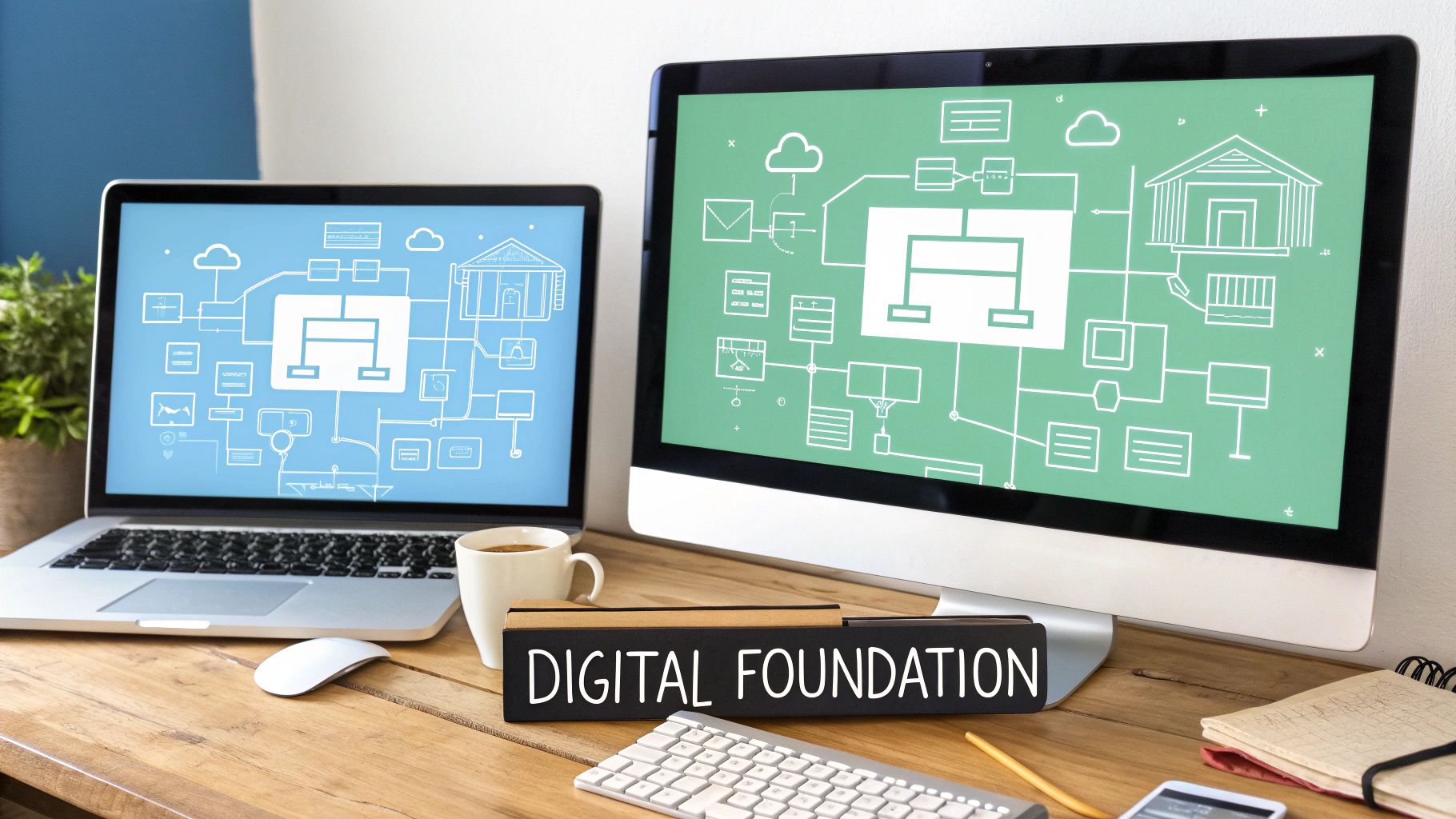
To deliver a truly modern digital customer experience, you need more than a great idea—you need the right technology supporting it. This is where a Digital Experience Platform (DXP) comes in. Think of it as the central nervous system for every single customer interaction your brand creates. It’s the conductor making sure every part of the orchestra plays in perfect harmony.
A DXP is designed to break down data silos. It pulls together information from website visits, mobile app activity, purchase histories, and social media engagement, weaving it all into a single, cohesive story for each customer. This unified view is the bedrock of meaningful personalization, allowing you to move beyond generic marketing blasts and into genuine one-to-one conversations.
The Power of Sitecore DXP and Composability
At the heart of any world-class digital foundation, you'll often find Sitecore, a leading DXP engineered to manage the entire customer journey. It gives you the tools to create, manage, deliver, and fine-tune experiences across every digital channel you can imagine, from that first moment of awareness to long-term loyalty.
One of Sitecore’s biggest strengths is its composable architecture. In the past, companies were often stuck with monolithic, all-in-one platforms that were rigid and a nightmare to update. A composable DXP, on the other hand, is like building with high-tech LEGOs. It lets digital leaders and CTOs pick best-in-class tools for specific jobs—like e-commerce, search, or analytics—and snap them together into one seamless system.
This approach gives you incredible flexibility and scalability. It creates a future-proof foundation that can grow and change right alongside your business and your customers' expectations. You can add new features or swap out components without having to tear down and rebuild the whole thing.
"A composable DXP empowers organizations to build a digital experience stack that is uniquely theirs. It’s about choosing the right tools for the job, not being forced to use a one-size-fits-all solution, which is fundamental for creating a competitive advantage."
If you're new to the concept, our guide explains in detail what is a Digital Experience Platform and why it’s such a critical investment.
SharePoint: The Engine for Internal Excellence
While Sitecore brilliantly handles the external, customer-facing world, another platform plays a vital role behind the curtain: SharePoint. You simply can't sustain a superior external customer experience without superior internal processes to back it up. SharePoint acts as the internal engine for content management, team collaboration, and knowledge sharing.
Think about a customer service agent trying to solve a tricky problem. Their ability to give a fast, correct answer hinges on having instant access to internal knowledge bases, product guides, and collaboration tools. A properly integrated SharePoint ensures your teams have a single source of truth, empowering them to deliver consistent, informed, and helpful service every time.
Kogifi’s expertise lies in building this powerful synergy. We architect digital foundations where Sitecore’s customer data and personalization tools are fueled by SharePoint’s rock-solid internal framework. This creates a smooth flow of information from your internal teams to your external audiences, resulting in a more responsive, accurate, and satisfying customer journey. When internal efficiency and external excellence are aligned, that's where true digital transformation happens.
Unlocking Hyper-Personalization with Sitecore AI
Moving past basic segmentation is where the digitalization customer experience really starts to pay off. This is the world of hyper-personalization, a one-to-one engagement model that turns a brand’s monologue into millions of individual, meaningful conversations. At Kogifi, our deep expertise with Sitecore AI is what makes this sophisticated level of interaction a reality for enterprise businesses.
Traditional personalization might show a customer products based on a single past purchase. Sitecore AI goes much, much deeper. Its machine learning algorithms analyze thousands of data points in real-time, blending historical data, current on-site behavior, and rich contextual clues to predict what a customer wants before they even know they want it.
From Data Points to Predictive Journeys
Think about a major retailer's website. A first-time visitor browsing for running shoes is completely different from a loyal customer who regularly buys hiking gear. Sitecore AI doesn’t just see clicks; it understands the story behind them. It can dynamically reorder product categories, surface a relevant blog post about trail running, or even adjust promotional banners to match that specific user's predicted interests—all within a single session.
This predictive power isn't just for retail. Take a financial institution, for example. A user who has been researching mortgage rates and using loan calculators is sending clear signals. Instead of just waiting for them to fill out a form, the system can proactively offer a chatbot connection to a mortgage specialist or display a targeted article on "First-Time Homebuyer Tips." This is the magic of turning passive browsing into an active, helpful dialogue.
The Technology Powering Individual Experiences
This kind of intelligent automation is orchestrated by a suite of powerful, interconnected tools within the Sitecore ecosystem. Two of the most critical pieces of the puzzle are Sitecore Personalize and the Sitecore Customer Data Platform (CDP).
- Sitecore Customer Data Platform (CDP): This is the central brain for all your customer data. It pulls in information from every touchpoint—website, mobile app, CRM, in-store purchases—to build a single, unified profile for each person. It smashes data silos, giving you a true 360-degree view of your customer.
- Sitecore Personalize: This is the action engine. It takes the rich data from the CDP and uses it to execute real-time personalization decisions. It powers A/B testing, AI-driven recommendations, and triggered experiences across all your channels, ensuring a consistent and relevant journey no matter where your customer is.
Together, these tools create a continuous loop of learning and action. The CDP gathers data, Sitecore's AI models analyze it to create micro-segments (sometimes a segment of one), and Sitecore Personalize delivers the tailored experience. The results of that interaction are then fed back into the CDP, making the customer profile even richer and the next interaction even smarter. For a closer look at this process, check out our guide on AI personalization in DXP implementation.
SharePoint’s Role in Empowering Personalization
While Sitecore handles the external experience, a well-organized SharePoint intranet plays a crucial supporting role. For personalization to work, the content itself needs to be relevant, accurate, and easy for your teams to find and use.
SharePoint acts as the single source of truth for product information, marketing assets, and internal knowledge. When your content creators and marketers can quickly grab the assets they need for different audience segments, the entire personalization workflow becomes smoother and more effective. This internal alignment is the unsung hero that supports a world-class external experience.
By connecting a powerful internal content hub like SharePoint with a customer-facing intelligence engine like Sitecore AI, you create a seamless information supply chain. This ensures the right content is delivered to the right person at the right moment, every single time.
Ultimately, consumers expect brands to meet them where they are. In fact, a majority of consumers state they will spend more with brands that resolve issues in their preferred channels. Looking ahead, a growing number of customers will choose brands based on the quality of service they expect to receive, proving that investments in a frictionless experience directly impact retention and revenue. You can learn more about what's next for experience strategy in the digital-first era on movate.com. Kogifi leverages the Sitecore AI portfolio to turn this expectation into your operational reality, building systems that don’t just respond but anticipate, delight, and build lasting loyalty.
Your Roadmap to Digital Experience Maturity
Transforming your customer experience into a digital powerhouse doesn't happen with the flip of a switch. It's a strategic journey, one that requires a clear, phased roadmap to turn ambitious goals into manageable, bite-sized steps. Think of it as evolving your business, built on a solid foundation of strategy, technology, intelligence, and a commitment to getting better every day.
For any company serious about taking customer interactions to the next level, breaking the journey into distinct stages is the smartest way to go. It minimizes risk and gets you to those valuable wins faster. A structured approach, guided by an expert partner like Kogifi, ensures each phase builds logically on the last, creating a powerful and sustainable digital engine for growth.
Phase 1: Discovery and Strategy
Every great journey starts with a map, and in this case, that means taking a deep, honest look at where you are right now. This isn't just about listing your existing tech; it's about understanding how all the pieces work together (or, more often, don't work together) to serve your customers. We kick things off with a full audit of your digital ecosystem to find the critical gaps, data silos, and friction points that are tripping up your customer journey.
This discovery phase is all about asking the tough questions:
- Where is our customer data actually stored, and can we even get to it? So often, priceless insights are locked away in disconnected CRM, ERP, and marketing automation systems.
- What are the biggest headaches for our customers? We dig into analytics and user feedback to pinpoint exactly where the experience is falling short.
- How is our current tech stack holding back our personalization goals? We’ll assess the real-world capabilities of your existing CMS, e-commerce platforms, and other tools.
The result of this phase isn’t just a report; it’s a strategic blueprint. This roadmap connects technology investments, like a Sitecore DXP implementation, to specific, measurable business goals. From here on out, every action has a purpose.
Phase 2: Foundational Build and Integration
With a clear strategy in hand, it's time to build the technological backbone of your new customer experience. This is where we implement and integrate the core components of your digital experience platform. For many organizations, this means bringing in a powerhouse like Sitecore DXP, chosen for its flexible composable architecture and world-class content management.
But just having a DXP isn't enough. The real magic happens during integration. We connect all your critical data sources—from a SharePoint-based intranet to your customer data platform—into one unified system. This creates that elusive single view of the customer, which is the absolute bedrock of any meaningful personalization. Kogifi’s technical experts architect this foundation to be scalable, secure, and ready for whatever comes next.
The goal is to create a seamless flow from raw data collection to AI-driven analysis and, ultimately, to a personalized interaction.
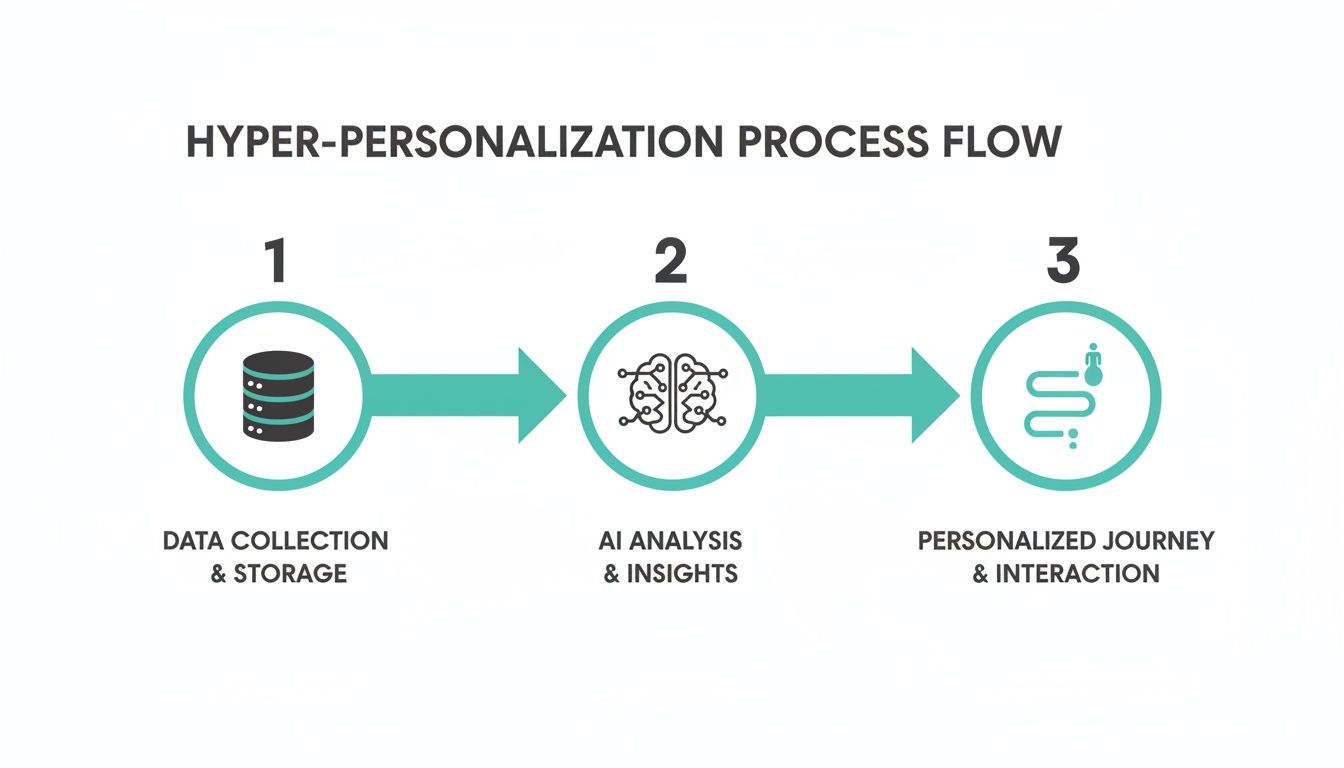
This process is what transforms disconnected data points into intelligent actions, forming the basis for a customer journey that feels truly responsive and individual.
Phase 3: Intelligence Activation
Once the foundation is rock-solid, it’s time to flip the switch and bring it to life with intelligence. This phase is all about activating the advanced capabilities of your platform, focusing on tools like Sitecore Personalize and Sitecore CDP. Here, we graduate from a static, one-size-fits-all website to a dynamic, adaptive experience that feels alive.
We deploy machine learning algorithms to analyze user behavior in real-time, predict what they want next, and automate the delivery of one-to-one content. This could be as simple as reordering the navigation for a returning visitor or as powerful as presenting a perfectly tailored offer the exact moment they’re ready to buy.
This is the turning point. Your platform stops being just a content library and becomes an active partner in the customer relationship, learning and adapting with every single click.
Phase 4: Continuous Optimization and Scaling
A digital transformation is never truly "finished." The final phase is really a continuous loop of measuring, analyzing, and refining. Using the powerful analytics built right into the Sitecore ecosystem, we track key performance indicators (KPIs) to get a clear picture of what’s working and what needs a rethink.
This data-driven approach fuels ongoing optimization. We run A/B tests on personalization rules, fine-tune audience segments, and scale the winning strategies across all your channels. It's an iterative process that ensures your investment keeps delivering better returns over time, keeping you one step ahead of your competition. Kogifi’s partnership extends deep into this phase, providing the insights and technical support you need to lock in long-term success.
Measuring What Matters in Your Digital CX Strategy
A brilliant strategy for digital customer experience is only as good as the results it delivers. To prove its worth, you have to look past vanity metrics like page views and zero in on Key Performance Indicators (KPIs) that directly tie back to business growth. It's all about tracking tangible outcomes that show how your investments in platforms like Sitecore are making a real, measurable difference.
A solid measurement framework isn’t just a random collection of numbers; it paints a complete picture of your performance. It connects the dots between how customers engage with your brand online, their long-term loyalty, and how efficiently your own teams are working. This holistic view is what truly proves the ROI of a well-executed digital strategy.
Engagement KPIs That Signal Intent
Engagement metrics are the pulse of your customer interactions. They don’t just tell you if people are visiting, but how deeply they’re connecting with your content. Think of deep engagement as a strong leading indicator—it points toward future conversions and stronger brand affinity.
Within the Sitecore ecosystem, powerful analytics tools let you monitor these crucial signals in real-time.
- Conversion Rate: This is the bottom line—is your digital experience actually persuasive? With Sitecore's A/B and multivariate testing tools, you can fine-tune every part of the user journey to push this critical KPI higher.
- Interaction Depth: This goes way beyond simple clicks. It tracks how many meaningful actions a user takes, like downloading a whitepaper, using a calculator, or watching a product demo.
- Time on Page & Bounce Rate: While basic, these metrics offer a quick pulse check on your content's relevance. When you pair them with personalization from Sitecore AI, you can see exactly how tailored content keeps users hooked and encourages them to dig deeper.
Loyalty KPIs That Measure Long-Term Value
Engagement is immediate, but loyalty is the real prize. These KPIs tell you if you’re building lasting relationships or just processing one-off transactions. A superior digital customer experience is the single most effective way to move these numbers in the right direction.
A truly successful digital experience doesn't just close a sale; it opens a relationship. Loyalty metrics like Customer Lifetime Value (CLV) are the ultimate proof that your strategy is building sustainable, profitable connections with your audience.
- Customer Lifetime Value (CLV): By bringing all your data together in the Sitecore CDP, you can get a clear picture of how much revenue a customer brings in over their entire relationship with your brand.
- Churn Rate: This is the percentage of customers who walk away. A low churn rate is a direct reflection of a satisfying and frictionless digital experience.
- Net Promoter Score (NPS): You can integrate surveys directly into your site to capture customer sentiment, giving you a straightforward score for brand loyalty and the likelihood of referrals.
Operational KPIs That Prove Efficiency
Finally, a mature digital CX strategy has to drive internal efficiency, too. It’s about doing more with less and automating repetitive tasks so your teams can focus on work that actually adds value. When integrated with Sitecore, SharePoint solutions are fantastic for streamlining workflows and locking down content governance.
Metrics like cost-per-interaction and time-to-resolution for support tickets show just how effective your self-service portals and smart chatbots are at lightening the load on your support staff. As we detail in our guide, a well-structured DXP ROI calculator can help you model these savings. By tracking these operational gains, you can prove that your DXP investment isn’t just a marketing cost—it's a smart business decision that directly boosts your bottom line.
Navigating the Common Pitfalls of Digital Transformation
Embarking on a journey to overhaul your customer's digital experience is exciting, but it’s a path riddled with potential stumbles. Ambitious projects often run into trouble not because of the technology itself, but due to overlooked obstacles that can quietly derail progress. Knowing what these common pitfalls are is the first step to building a strategy that's resilient enough to succeed.
The most frequent and damaging issue we see is the persistence of data silos. This happens when customer information is trapped in separate, disconnected systems—like a CRM that doesn't talk to the e-commerce platform. When data is fractured like this, it’s impossible to create that single, unified view of the customer you need. This directly undermines powerful tools like Sitecore AI, starving personalization engines of the comprehensive data required to make smart decisions. The result? A disjointed and inconsistent customer journey.
From Vague Goals to Wasted Spend
Another major pitfall is diving in without a clear, strategic vision. Too often, organizations invest heavily in advanced platforms like a Sitecore DXP without first defining what success actually looks like. This leads to what’s known as "shiny object syndrome," where technology is bought for its features, not for how it solves specific business problems.
Without a well-defined strategy, the implementation becomes unfocused, leading to wasted resources and a platform that never delivers on its promise. As you navigate the complexities of digital transformation, effectively managing and reducing technical debt is crucial to avoid common pitfalls and ensure long-term success.
Poor user adoption can also render an otherwise perfect system useless. This goes for both your customers and your internal teams. If a new digital portal is confusing for customers, they’ll simply abandon it. In the same way, if your marketing and content teams find their new SharePoint or Sitecore environment a pain to use, content goes stale, and the platform’s potential is never realized.
The biggest risk in digital transformation isn't the technology failing; it's failing to align that technology with clear business outcomes and human behavior. A powerful DXP without a strategy is like a sports car without a map—it has potential but is going nowhere fast.
Kogifi’s Proactive Mitigation Strategy
At Kogifi, our approach is built on getting ahead of these challenges from day one. We mitigate the risk of failure by weaving solutions directly into our implementation process, turning potential pitfalls into stepping stones for success.
- Unified Data Architecture: We kick things off with comprehensive data audits to map out and break down existing silos. By architecting a unified data layer, often using Sitecore CDP, we ensure a clean, continuous flow of information that fuels true one-to-one personalization.
- Strategy-Led Implementations: Our process starts with strategic consulting, not a sales pitch for a tool. We work with you to define measurable KPIs and tie every single technological decision back to your core business objectives. This guarantees a clear return on your investment.
- User-Centric Training and Support: To fight poor adoption, we provide extensive, hands-on training for your internal teams. Beyond that, our 24/7 SLA-based support ensures your platform stays optimized and any issues are resolved quickly, maintaining a healthy and effective digital ecosystem long after the launch.
Your Questions on Digital Experience Answered
Diving into a major digitalization customer experience project always brings up a few big questions. We get it. Leaders need clear answers before they commit to this kind of investment. Let’s tackle some of the most common ones we hear, especially when platforms like Sitecore and SharePoint are in the mix.
What Is the First Step in Digitalizing Our Customer Experience?
The most critical first step isn't about buying new software; it's about conducting a thorough audit of your current digital ecosystem and customer journey. You have to know where you stand before you can map out where you're going.
Before you even think about implementing powerful tools like Sitecore AI, you need a crystal-clear picture of your existing data sources, technology gaps, and—most importantly—where your customers are running into friction. Kogifi specializes in these foundational audits, creating a strategic roadmap that ties every tech investment back to measurable business goals. This ensures you're building on solid ground.
How Does Sitecore AI Differ from Basic Personalization Tools?
Think of basic personalization as a simple set of instructions. It often relies on straightforward rules, like, 'if a user is in New York, show them content about New York.' It's useful, but it's not very sophisticated.
Sitecore AI plays in a completely different league. It uses machine learning to sift through thousands of data points in real time, going far beyond simple rules. It actively predicts what a user wants, uncovers hidden audience segments you didn't even know existed, and automates one-to-one content and product recommendations at a massive scale.
This creates a truly dynamic and adaptive experience that feels uniquely tailored to each individual, driving significantly higher engagement and conversion rates compared to rule-based approaches.
Can We Integrate Our Existing SharePoint Intranet with Sitecore?
Absolutely, and it’s a powerful strategy we often recommend. Integrating SharePoint with a DXP like Sitecore creates a best-of-both-worlds scenario. While Sitecore is busy managing your external customer experience, SharePoint can continue to serve as the reliable backbone for all your internal content and knowledge management.
This integration is key because it ensures your customer-facing teams always have access to the latest, most accurate information. The result? They can provide more consistent and informed service. Kogifi has extensive experience architecting these integrations to create a seamless flow of information between your internal and external platforms, making both of them work harder for you.
Ready to transform your customer journey with expert guidance? Contact Kogifi to discover how our Sitecore and SharePoint solutions can accelerate your digital growth. Learn more at Kogifi.com.