


Think about your company's most valuable content for a moment—all the images, videos, and documents that fuel your brand. Now, imagine if all of it were locked away in a single, physical library. It might be secure, but for a global team, it’s practically useless.
A cloud-based digital asset management (DAM) system is the solution. Specifically within a modern composable DXP, a DAM like Sitecore Content Hub is not just a storage solution; it's the intelligent content core that powers personalized digital experiences, moving your asset library into a secure, globally accessible space where teams find and use exactly what they need, instantly.
Why Modern Enterprises Are Moving DAM to the Cloud

The shift from on-premise servers to the cloud isn't just an IT trend; it's a strategic necessity for any business aiming to stay competitive. On-premise DAM systems literally tethered organizations to physical hardware. This created content silos that crippled marketing campaigns and made global collaboration a logistical nightmare.
Every software update was a manual, resource-intensive project, and scaling up meant purchasing expensive new hardware with long lead times. A cloud-based DAM, particularly a SaaS solution like Sitecore Content Hub, cuts those tethers. It’s like upgrading from a local library with set hours to a 24/7 global information network. This freedom is fundamental to business agility, letting marketing and IT teams focus on creating value instead of managing infrastructure.
The Strategic Imperative for Scalability and Access
Today's digital experiences, especially those powered by composable platforms like Sitecore XM Cloud, demand a constant stream of fresh, relevant content. An on-premise system simply cannot keep up with the demands of a modern Digital Experience Platform (DXP) designed to serve personalized content across countless touchpoints.
Cloud infrastructure provides the elastic scalability needed to handle massive asset libraries and spikes in user demand without performance degradation. For instance, Sitecore’s cloud-native architecture allows it to dynamically scale resources, ensuring that asset delivery remains fast and reliable, even during peak traffic events like a global product launch.
A cloud-based DAM, such as Sitecore Content Hub, acts as the single source of truth for an entire organization. It ensures that a product photo used in a North American email campaign is the exact same high-resolution, approved version used on an Asian e-commerce site, all managed from one central hub.
Empowering a Connected Digital Ecosystem
The true power of a cloud DAM is realized when it’s deeply integrated into your broader tech stack. For companies leveraging the Sitecore ecosystem, a cloud DAM becomes the intelligent core of their entire operation. It feeds the DXP the right assets at the right time, making AI-driven personalization possible at a massive scale.
Even enterprise platforms like SharePoint can be elevated from a simple document repository into a dynamic, enterprise-wide media hub when connected to a central DAM. This integration drives brand consistency and streamlines workflows for every department. The benefits are impossible to ignore:
- Global Collaboration: Teams can access, edit, and share assets from anywhere, anytime, ending version control chaos.
- Reduced IT Overhead: The vendor handles server maintenance, security updates, and backups, freeing up your internal IT team for strategic work.
- Enhanced Agility: Marketers find approved assets in seconds and launch campaigns faster than ever before.
- Future-Proof Foundation: Cloud architecture is built to evolve. It easily integrates with new tools and channels as your business grows, providing a solid foundation for your composable DXP.
Key Capabilities of an Intelligent Cloud DAM

A modern cloud-based digital asset management system isn't just a place to dump your files. It's an intelligent content engine built to move your business forward. We’ve moved past basic storage; today’s DAM is all about transforming how your teams create, manage, and deliver your most important brand materials. It is the central nervous system for your entire marketing tech stack.
This represents a major shift: from a passive digital filing cabinet to an active, automated hub that anticipates the needs of your marketing, sales, and creative teams. This is the key difference between a legacy system and a platform designed for the modern, composable enterprise.
Automated Intelligence and Asset Discovery
The most immediate impact of a smart DAM comes from its use of artificial intelligence. Manually tagging files with keywords is not just tedious—it’s a major bottleneck that can grind entire campaigns to a halt. A platform like Sitecore’s DAM leverages AI to automate this process entirely.
When you upload a new image, the system's AI services analyze it to identify objects, colors, concepts, and even text within the image. It then applies relevant metadata tags without any manual intervention. This saves thousands of hours annually, but more importantly, it makes every asset instantly discoverable. Instead of digging through folders with cryptic file names, a marketer can simply search for "red running shoe on a city street" and retrieve the perfect asset in seconds.
This AI-powered metadata enrichment ensures that your assets don't just get stored—they get found. It transforms your library from a digital graveyard into a living, searchable ecosystem where content value is maximized through constant reuse and repurposing.
Seamless Integration and Content Federation
A truly intelligent DAM never operates in a silo. Its real power is unlocked through deep integration with the tools your teams rely on daily. This is especially critical in a composable DXP architecture, where the DAM must seamlessly communicate with your Content Management System (CMS), e-commerce platform, and marketing automation tools.
For example, a cloud-based digital asset management system can act as a single source of truth for a platform like SharePoint. Instead of creating duplicate files and version control nightmares, teams in SharePoint can pull assets directly from the DAM. This guarantees that only approved, on-brand materials are used in documents and presentations, turning SharePoint into a secure endpoint for your official brand assets. To dig deeper into this, our guide on the best digital asset management software breaks down what sets the leading platforms apart.
Robust Version Control and Governance
Maintaining brand consistency across a global organization is a monumental task. A smart DAM addresses this with powerful version control and digital rights management (DRM) features. Every edit, update, or revision to an asset is tracked, providing a clear, auditable history.
This prevents outdated logos, old product shots, or unapproved campaign visuals from accidentally entering the market. Furthermore, DRM features allow you to:
- Set Asset Expiration Dates: Automatically lock down assets when a license or campaign ends, mitigating serious legal risks.
- Define User Permissions: Control precisely who can view, download, edit, or share specific assets, keeping sensitive materials secure.
- Apply Watermarks: Dynamically add watermarks to images to protect copyrights when sharing assets with partners or for review.
These governance tools provide enterprises with the control and security needed to operate confidently, ensuring every piece of content representing their brand is accurate, compliant, and effective.
Integrating Cloud DAM into Your Sitecore AI Ecosystem
Connecting your cloud-based digital asset management system to your tech stack is where its true value is unlocked. In a modern, composable setup, the DAM ceases to be just another tool and becomes the central nervous system for your content, intelligently pushing assets to every customer touchpoint. This is particularly true within the Sitecore ecosystem, where a cloud DAM is the engine that drives truly personalized experiences.
For any organization invested in Sitecore, linking a cloud-based digital asset management system like Content Hub DAM with XM Cloud creates an exceptionally powerful, unified platform. Content Hub acts as the intelligent core—a single source of truth for every image, video, and PDF.
Thanks to this native integration, a content author building a page in XM Cloud has the entire library of approved, up-to-the-minute assets directly at their fingertips. There is no need to jump between systems. This completely eliminates the friction of downloading files from one place to upload them to another, ensuring every asset is governed by the same rules and metadata for unwavering brand consistency.
Fueling Personalization with Sitecore AI
The primary advantage is how this setup fuels Sitecore’s AI capabilities. A cloud DAM provides the structured, metadata-rich content that AI algorithms thrive on. The AI can analyze asset attributes—such as color, subject matter, or campaign affiliation—and instantly match them with real-time user behavior.
This is what enables hyper-personalization at scale. For instance, an e-commerce site can dynamically serve product images based on a visitor's browsing history or even their location. A visitor from a cold climate might see a winter coat styled for snow, while a visitor from a warmer region sees the same coat styled for a cool evening. It's the same product, but the experience is tailored, all powered by AI selecting the perfect asset from the DAM.
Sitecore's AI uses the DAM as its palette, painting a unique experience for every visitor. It transforms content from a static element into a dynamic component that actively adapts to customer context, serving the perfect asset at the perfect moment to drive engagement and conversions.
This level of intelligent content delivery is unattainable with a siloed or on-premise DAM. It is the seamless data flow between Content Hub DAM and XM Cloud that makes these sophisticated, AI-driven scenarios a practical reality. To see how this works, it's worth exploring how you can start streamlining your workflows with Sitecore Content Hub.
Elevating SharePoint from Storage to Strategy
While Sitecore offers a deeply integrated ecosystem, a cloud DAM also brings immense value to other enterprise platforms like SharePoint. For years, SharePoint has often been used as a simple document repository or a basic intranet. However, when connected to an intelligent cloud DAM, its role is completely transformed.
Instead of being a dumping ground for disorganized files, SharePoint becomes a powerful endpoint for consuming curated, approved brand assets. Teams working on internal presentations or partner documents can pull content directly from the DAM without ever leaving the SharePoint environment.
This integration solves several critical business challenges:
- Ensures Brand Consistency: It prevents employees from using outdated logos or unapproved images saved on their desktops.
- Improves Governance: All asset usage is tracked and managed through the DAM, providing a clear audit trail.
- Boosts Productivity: Teams find what they need in seconds, not hours, accelerating the creation of all communications.
A Real-World Scenario: Product Launch Orchestration
Imagine a global electronics brand launching a new smartphone. The campaign involves dozens of videos, thousands of product images, and unique marketing collateral for North America, Europe, and Asia—a logistical challenge.
With a tool like Sitecore Content Hub DAM, the global marketing team orchestrates this entire process from a single hub. AI-powered workflows automatically route assets for regional legal approval based on their metadata. High-resolution product shots are automatically resized into web-optimized formats for each regional website managed in XM Cloud. If a product specification changes, the team updates one master file in the DAM, and the system automatically flags all related content for review across every channel.
This orchestrated approach, powered by a connected cloud-based digital asset management system, ensures a consistent, timely, and impactful global launch. It transforms potential chaos into a streamlined, automated process, demonstrating the clear business value of a truly connected content ecosystem.
Securing Your Digital Assets in the Cloud
For any IT leader, moving critical brand assets to a cloud-based DAM places security at the forefront. This is especially true in sectors like finance or public administration, where compliance and data protection are non-negotiable. The good news is that enterprise-grade cloud platforms often deliver security that is far more robust and layered than legacy on-premise systems could ever achieve.
There is a common misconception that "on-premise" automatically means more secure. In reality, that model saddles an internal team with the entire burden of physical security, network monitoring, and endless software patching. A modern cloud DAM, especially one integrated into an ecosystem like Sitecore, leverages the massive security investments of cloud giants like Microsoft Azure to provide enterprise-class protection out of the box.
A Modern Framework for Asset Protection
The security of a cloud DAM is built on multiple layers, beginning with granular control over who can access what. This goes beyond a simple login to a sophisticated permissions system. For instance, a freelance designer can be granted access to a single project folder for a limited time, while the in-house marketing team has broader rights to view and download campaign materials.
This control extends to how assets are used. Digital Rights Management (DRM) is a core component, allowing usage rights to be embedded directly into an asset's metadata. This can automatically prevent a licensed stock photo from being used after its expiration date, saving you from costly compliance issues. This proactive governance is a significant leap forward from manually tracking rights in a spreadsheet. To effectively protect your digital assets, it's also essential to understand the principles of information security compliance.
Encryption and Compliance by Design
Beyond access control, data encryption is fundamental. Leading cloud DAMs ensure your assets are protected at every point in their lifecycle.
- Encryption in Transit: When you upload or download a file, it is secured using protocols like TLS, making it unreadable to anyone who might intercept it.
- Encryption at Rest: Once stored in the cloud, assets are encrypted on the server itself. This means the raw files are protected even if someone were to gain physical access to the hardware.
Platforms built on enterprise cloud infrastructure also come with a host of compliance certifications, such as SOC 2 and ISO/IEC 27001. This is a massive benefit, as it means the vendor has undergone rigorous third-party audits to validate their security controls, saving your organization significant time and resources in its own compliance efforts.
By shifting to a cloud-based DAM, you are not just outsourcing storage; you are adopting a comprehensive security posture managed by dedicated experts. This allows your team to focus on strategic goals, confident that your most valuable digital assets are protected by world-class infrastructure and protocols.
For organizations running on a Sitecore DXP, understanding the specific security measures available is key. Learn more about the best practices for cloud security for Sitecore DXP in our detailed guide, which covers how to implement a secure and reliable solution. By asking the right questions and prioritizing vendors who demonstrate a deep commitment to security, you can turn a perceived risk into a strategic advantage.
Your Blueprint for Migrating to a Cloud DAM
Switching to a cloud-based digital asset management system is not just another IT project—it's a strategic move that fundamentally changes how your business handles its most valuable content. Successful execution requires a thoughtful, phased approach, starting with an honest assessment of your current asset landscape and a clear vision for how content should operate within your ecosystem.
The journey begins with a full-scale audit of every digital asset your company owns. This is more than just counting files; it’s about evaluating their quality, relevance, and business value. For most organizations, this process uncovers years of rampant duplication, outdated materials, and off-brand content that has been quietly draining productivity.
Phase 1: Laying the Foundation with an Asset Audit
Before migrating a single file, a thorough asset audit is essential. This discovery phase involves cataloging every digital file—images, videos, design files, documents—to understand what you have, where it is, and how it’s being used. This groundwork will shape your entire migration strategy.
You will almost certainly find content scattered across local hard drives, legacy servers, forgotten SharePoint sites, and various cloud storage accounts. The goal is to consolidate this chaotic mess into a single, organized inventory. This provides a clear picture of the migration's scope and helps you decide what is worth moving, what can be archived, and what should be discarded.
Phase 2: Designing a Future-Proof Metadata Strategy
With a clean inventory, it's time to tackle metadata. Metadata is the language your DAM speaks; it's what makes your assets discoverable. A weak metadata plan is one of the quickest ways to ensure a DAM implementation fails to deliver on its promise. It’s like building a massive library without a cataloging system.
If you’re running a Sitecore-powered DXP, your metadata must be rich enough to power AI-driven personalization. Think beyond basic keywords and consider attributes that define an asset's strategic role:
- Campaign Association: Which marketing initiative does this support?
- Target Audience Persona: Who is this content intended for?
- Product Line: What specific product or service does this image feature?
- Usage Rights and Expiration: What are the legal constraints for using this asset?
The same logic applies to enterprises using SharePoint. A solid metadata structure transforms it from a simple document repository into a searchable content hub where assets are easily found and properly governed.
Phase 3: Executing a Seamless Technical Migration
Once the strategic planning is complete, the technical migration can begin. This is where you physically move the selected assets from their various old locations into your new cloud-based digital asset management platform. This process requires careful planning to avoid disrupting daily operations, which is why it's often executed in phased batches.
This visualization shows the core security principles that should guide a secure cloud DAM, emphasizing access control, copyright management, and data protection.
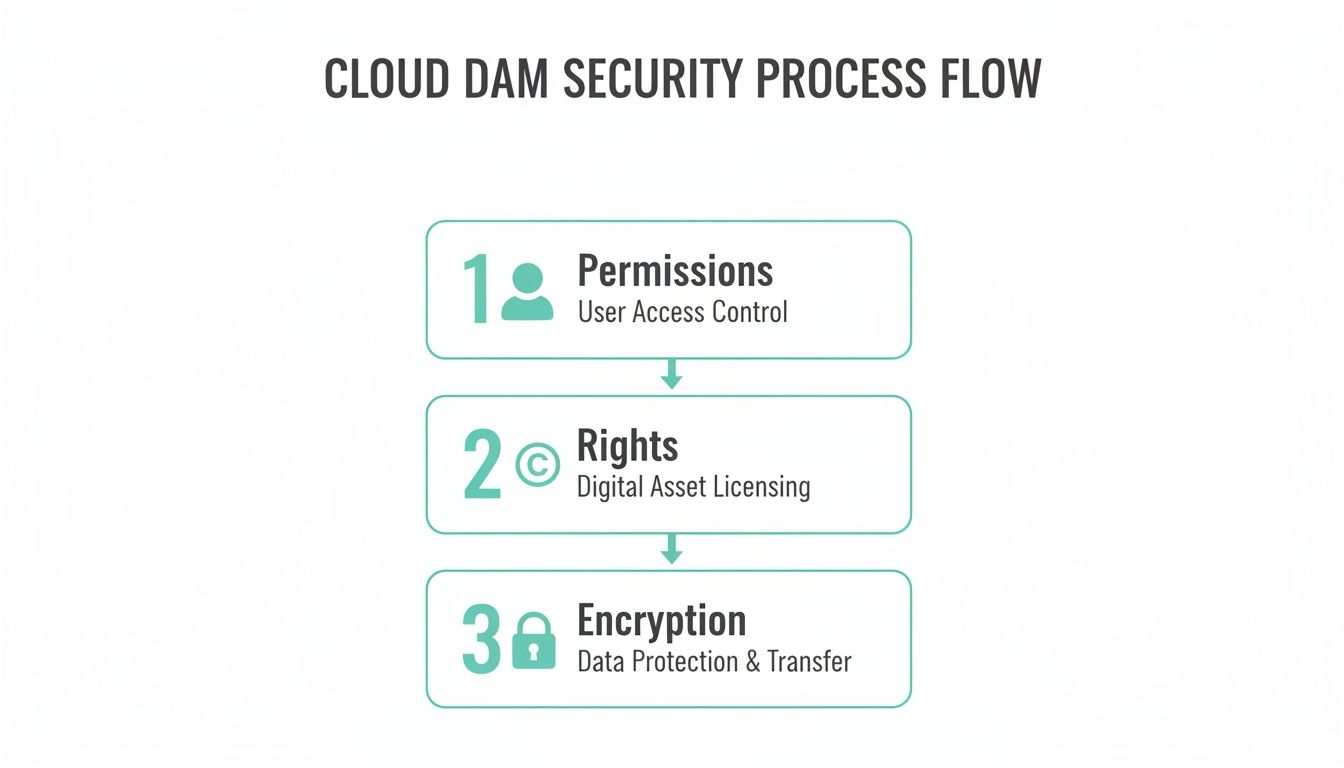
The flow from permissions to encryption highlights the layered security approach that’s critical for protecting your assets both during and after the migration.
Automated scripts can help apply your new metadata schema during the move, but manual review will still be necessary to ensure accuracy. This is especially true for your most valuable assets, where precise tagging is non-negotiable for discovery and compliance.
Phase 4: Driving Adoption Through User Training
The final, and arguably most important, step is training. A state-of-the-art DAM is useless if your teams don’t know how to use it. Training should not be one-size-fits-all. It needs to be role-specific: show marketers how to find campaign assets, teach designers how to manage creative workflows, and guide legal teams on overseeing rights management. This focused approach is what ensures the platform becomes an indispensable tool.
The global DAM market is proof of this shift. It hit USD 4.11 billion in 2023 and is expected to soar to USD 18.23 billion by 2032. Cloud solutions are fueling this explosive growth, thanks to their scalability and integration-friendly nature. You can explore the full market analysis of these trends to get a deeper sense of where the industry is heading.
Driving Measurable ROI from Your Cloud DAM Investment
A cloud-based digital asset management system is much more than a technical upgrade. It is a strategic investment designed to generate real, measurable business value. The ultimate measure of success is not just increased efficiency—it's connecting every operational improvement back to a financial return. This is how you shift the conversation from DAM as a cost center to a revenue-generating engine.
For marketing leaders and e-commerce managers, the return on investment (ROI) is direct and powerful. With a well-integrated DAM, especially one tied into an ecosystem like Sitecore AI, you drastically reduce the time it takes to launch campaigns. Instead of teams wasting weeks searching for and reformatting assets, they can launch new product promotions or seasonal campaigns in a fraction of the time. This allows you to capitalize on market opportunities much faster than competitors, translating directly into increased revenue.
Quantifying the Business Impact
The value extends far beyond speed. By feeding platforms like Sitecore XM Cloud a constant stream of high-quality, metadata-rich assets, you can deliver far richer, more personalized product experiences. This alone can lead to a 10-15% uplift in conversion rates, simply because customers are seeing more relevant and visually compelling content.
For global marketing leaders, the savings are just as significant. Centralizing assets eliminates redundant content production. This has been shown to slash creative operational costs by 20% or more, all while ensuring perfect brand consistency across every region.
And for IT directors managing complex SharePoint environments, the ROI is crystal clear. Migrating to a cloud DAM completely eliminates the hefty costs of on-premise server maintenance, hardware refreshes, and manual software updates. This frees up both budget and your most valuable IT resources to focus on innovation instead of routine maintenance.
The true value of a cloud DAM is realized when it stops being seen as an IT tool and is embraced as a core business asset. It directly fuels sales, cuts operational waste, and provides the scalable foundation needed for future growth, making it a critical driver of profitability.
Calculating Your Long-Term Value
To fully grasp the financial upside, it helps to model the potential returns. By analyzing metrics such as reduced asset creation costs, improved team productivity, and increased conversion rates, you can build a powerful business case for your investment. To help assess the financial benefits of your investment, you might find value in exploring various ROI payback tools.
Ultimately, a cloud DAM transforms your digital assets from static files collecting dust on a server into active contributors to your bottom line. It’s the engine that powers a modern, agile, and profitable digital presence.
We Get These Questions All The Time
Let's address some of the most common questions we hear about moving to a cloud-based digital asset management system, especially concerning its integration with platforms like Sitecore and SharePoint.
How Does a Cloud DAM Make Sitecore AI Smarter?
Think of a cloud DAM like Sitecore Content Hub as the high-octane fuel for Sitecore's AI engine. It’s not just a folder of images; it's a structured, centralized library where every single asset is loaded with rich metadata.
Sitecore's AI leverages this data to understand the context behind every image and video. This enables it to automatically select the perfect asset for each user based on their real-time behavior, which is the key to delivering genuinely dynamic personalization.
Can a Cloud DAM Actually Work with SharePoint?
Absolutely, and it completely enhances SharePoint's role. Instead of being a simple document folder where assets slowly become outdated, integrating a cloud DAM transforms SharePoint into a governed, reliable source for your teams.
They can pull approved, on-brand assets directly from the DAM right into their SharePoint environment. This guarantees consistency and finally puts an end to the use of rogue, outdated files found on desktops.
Many people think migration is just a technical task of moving files from point A to B. The reality is that a successful migration is 80% strategy—auditing assets, defining metadata, planning governance—and only 20% technical execution. Getting the groundwork right is everything.
What's the Single Biggest Hurdle in a DAM Migration?
The biggest challenge, and the one most often underestimated, is establishing the metadata strategy. Moving your assets without a clear and consistent metadata schema is like building a massive library without a catalog. You have all the content, but no one can find or use it effectively.
A successful migration hinges on creating a thoughtful metadata framework that makes every asset easily discoverable for platforms like Sitecore and SharePoint. Nailing this strategic step is what ensures the entire system delivers real value from day one.
Ready to finally get your content strategy in order and see what your DXP can really do? Kogifi offers expert implementation and support for cloud-based DAM solutions built for the Sitecore and SharePoint ecosystems. Visit us at https://www.kogifi.com to get started.