


Imagine your company's entire media collection—every image, video, and brand document—scattered across countless drives and platforms. Bynder’s Digital Asset Management (DAM) system steps in to create a single, organized hub for all of it. It’s more than just storage; it's a command center that organizes, controls, and distributes your brand’s most valuable assets.
The Foundation of Modern Content Ecosystems

Think of Bynder as the single source of truth that powers your composable digital experience platform (DXP). In a world where content is the engine of marketing, Bynder ensures that every asset is organized, approved, and instantly accessible to the teams who need it.
For enterprises using platforms like Sitecore and SharePoint, this centralized control is a game-changer. Instead of managing assets in disconnected silos, Bynder integrates directly into these systems, creating a unified content supply chain. This approach ends the chaos of inconsistent branding, outdated files, and inefficient workflows that slow everyone down.
Powering Sitecore and SharePoint Environments
A well-integrated Bynder digital asset management system completely changes how content is handled within Sitecore’s product portfolio. When your teams build customer experiences using Sitecore XM Cloud, they can pull from the entire Bynder library without ever leaving the Sitecore interface.
This direct connection guarantees every image and video is on-brand and its usage rights are automatically checked, which is essential for delivering personalization at scale. Bynder becomes the authoritative media engine behind a sophisticated DXP driven by Sitecore AI, enriching the data available to tools like Sitecore Personalize and CDP.
For organizations that rely on SharePoint for internal collaboration, Bynder replaces disorganized file shares with a structured, searchable library. This means your employees always find and use the most current versions of sales presentations, HR documents, and brand guidelines, creating a seamless internal workflow.
Bynder is more than a file repository; it's a strategic asset that enforces brand governance and accelerates content velocity across the entire organization. It provides the control needed to manage a global brand while offering the flexibility required for agile marketing.
Unlocking Potential Through Expert Integration
The real power of Bynder digital asset management comes to life through expert integration. Connecting it to complex enterprise ecosystems like the Sitecore composable DXP and SharePoint requires deep technical knowledge to ensure seamless data flow and high user adoption.
A successful implementation solves several core business challenges. The table below outlines how Bynder addresses common enterprise problems and delivers tangible business impact.
Ultimately, these solutions combine to create a more agile and compliant content operation. A well-integrated DAM doesn't just store files—it drives efficiency and protects the brand at every touchpoint. For enterprises invested in the Sitecore ecosystem, Bynder provides a solid foundation for building consistent, high-impact digital experiences.
Exploring Bynder's Core Capabilities

To really get what a Bynder digital asset management system can do, you have to look past simple file storage. The real magic happens in the features that make your entire enterprise more efficient. At its core, Bynder turns a messy pile of files into a smart, searchable library. It does this through a smart mix of metadata, AI-powered automation, and specialized portals built for every team’s needs.
The whole system is built on a solid foundation of metadata and taxonomy. Think of metadata as a digital fingerprint for each asset, holding all the important details like creation dates, usage rights, and descriptive keywords. A well-planned taxonomy then organizes these assets into a logical structure, making it incredibly intuitive to find what you need, fast.
Instead of digging through folders with vague names, your teams can find assets based on what they actually are, not just where someone decided to save them. It’s the first real step from content chaos to content control—a make-or-break shift for any company that’s growing.
Intelligent Automation and Asset Discovery
Bynder kicks things up a notch with a powerful AI engine that handles the tedious tasks that used to eat up so much time. One of the biggest game-changers is its AI-powered auto-tagging. When you upload a new image, the system scans its contents and automatically suggests relevant tags based on objects, people, and even text it finds in the image.
This is a massive time-saver for content managers and a huge win for everyone else. A marketing manager can just search for "red running shoe" or "woman smiling" and instantly pull up relevant, tagged visuals without needing to know a single filename. For a platform like Sitecore AI, this rich metadata is gold, giving personalization engines the detailed attributes needed to serve up the right content at the right time.
Bynder's AI does more than just add tags; it weaves a web of connections between your assets. Features like Similarity Search let you find visually similar content, while Duplicate Detection keeps the library clean by flagging redundant files, locking in that single source of truth.
It's no surprise the platform scores so high in customer satisfaction. In the G2 Grid® Report for Digital Asset Management from Fall 2026, a remarkable 91% of users said they would recommend Bynder. The platform earned the highest satisfaction score of any DAM product, a testament to its user-friendly design and powerful features. You can dive into the specifics in the G2 report on Bynder's performance.
Controlled Access Through Brand Portals
Brand Portals are another pillar of Bynder’s enterprise solution. Think of them as custom, secure gateways that give specific groups—like your sales team, external agencies, or the press—self-service access to a hand-picked collection of approved assets.
For example, a global sales team could have a portal with the latest product one-sheets and presentations. Meanwhile, a company intranet built on SharePoint could use a portal to give all employees access to current HR documents and brand guidelines. This ensures everyone gets exactly what they need without being overwhelmed or compromising security.
Dynamic Asset Transformation for Omnichannel Consistency
This might be one of Bynder's most powerful features for modern marketing: Dynamic Asset Transformation (DAT). This tech lets your team resize, crop, and change the format of images and videos on the fly, right inside the platform.
Imagine you have a single, high-resolution product photo stored in Bynder. With DAT, a marketer can instantly create versions optimized for:
- A website banner on a Sitecore-powered page
- A square-format social media post
- A thumbnail for an email campaign
This completely eliminates the endless back-and-forth with creative teams for simple asset resizing. It guarantees your brand looks consistent on every channel and seriously speeds up how fast you can get content out the door. Your teams can finally react to market opportunities in real time, not days or weeks later.
Mastering Integration With Sitecore and SharePoint
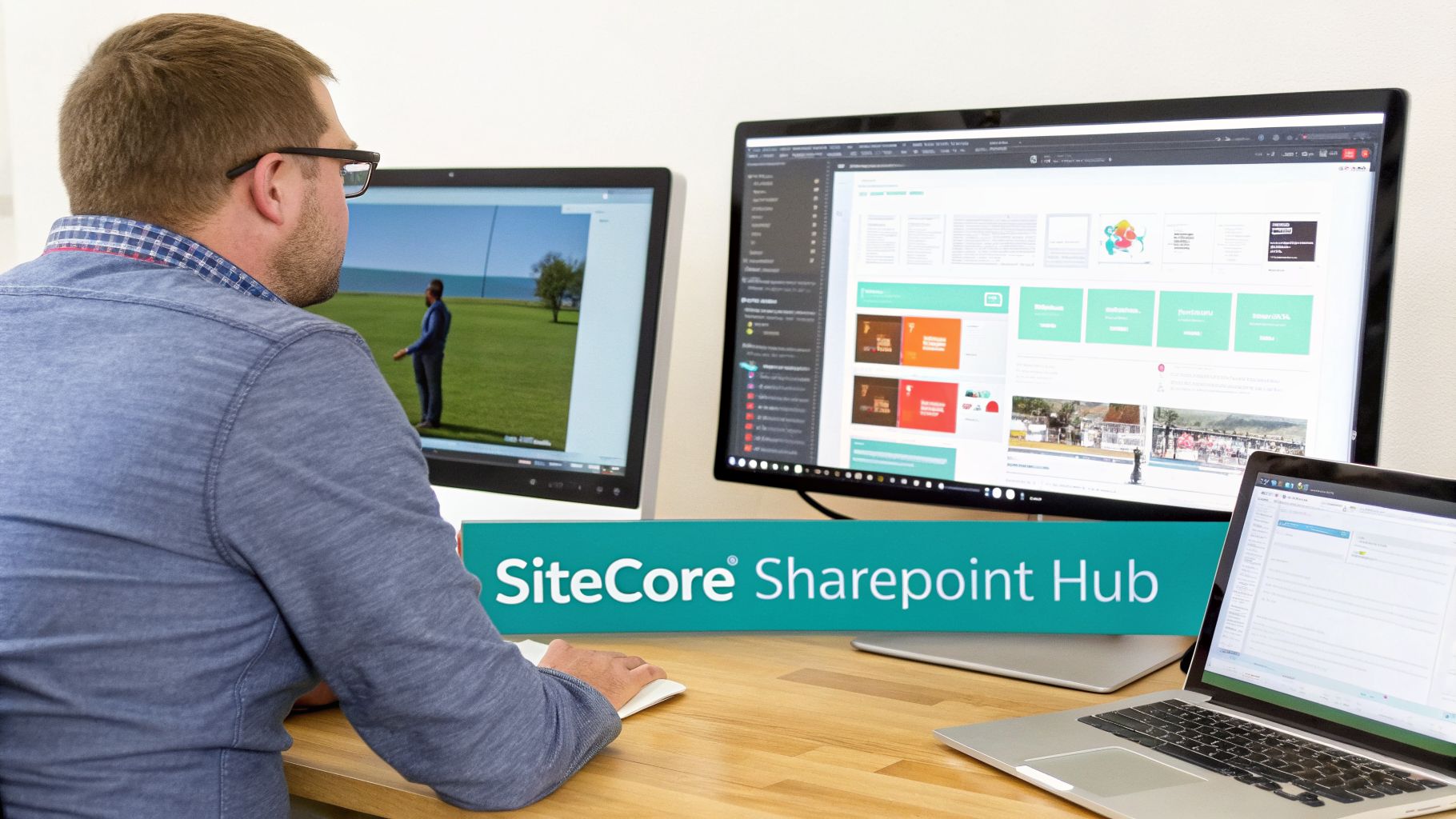
A standalone Bynder digital asset management system is useful, but its real value emerges when it’s connected to your core technology. For any large organization, this means building a seamless bridge to foundational platforms like Sitecore and SharePoint. A smart integration turns these systems from isolated content silos into a single, high-performance content engine.
This connection removes the constant friction that slows down marketing and content teams. No more downloading assets from one platform just to upload them to another. Your teams can finally work inside the tools they already use every day. This isn’t just about convenience—it’s a strategic move that directly boosts content velocity, brand consistency, and operational efficiency.
Revolutionizing Content Operations With Sitecore and Bynder
Integrating Bynder with Sitecore completely transforms the content authoring experience. Picture your editors building a webpage in Sitecore's page editor. Instead of navigating away to hunt for visuals, they access the entire, approved Bynder library right from a native, embedded interface.
This integration goes far beyond a simple file picker. When an editor selects an image or video from Bynder, it’s not just the file that moves over. All the critical metadata—copyright details, usage rights, expiration dates, and descriptive tags—syncs automatically. This embedded intelligence helps Sitecore make smarter decisions, especially when paired with its own AI capabilities.
The Bynder-Sitecore connection creates a truly composable Digital Experience Platform (DXP). Bynder acts as the definitive source for all media, while Sitecore focuses on orchestrating and delivering personalized customer experiences. This separation of concerns is the hallmark of a modern, agile, and scalable architecture.
This deep connection offers several game-changing advantages for Sitecore users:
- Guaranteed Brand Governance: Only approved, on-brand assets from Bynder can be used. This eliminates the risk of outdated or non-compliant content ever appearing on your live site.
- Enhanced Personalization: Rich metadata from Bynder fuels Sitecore's personalization engine. You can dynamically show assets based on user segments, location, or behavior—for instance, displaying a winter coat ad to a user in a cold climate.
- Optimized Performance: Bynder’s built-in Content Delivery Network (CDN) and Dynamic Asset Transformation (DAT) mean assets are delivered to the end-user in the perfect size and format. This directly improves page load speeds and SEO rankings.
Establishing a Single Source of Truth for SharePoint
For organizations that depend on SharePoint for internal collaboration and document management, a Bynder integration solves a chronic headache: content chaos. SharePoint environments often become a confusing maze of nested folders, duplicate files, and outdated documents. Integrating Bynder establishes it as the single authoritative media library for the entire organization.
This connection turns your SharePoint intranet into a reliable, trustworthy hub for corporate assets. Employees searching for the latest sales presentation, brand guidelines, or HR policy are directed to the one correct version stored and managed in Bynder. You can learn more about managing assets in our article on cloud-based digital asset management.
The benefits are immediate and clear. You eliminate version control nightmares and ensure everyone—from sales to legal to HR—is working with the most current and approved materials. This doesn't just boost productivity by slashing the time spent searching for files; it also reduces the risk that comes from using incorrect or outdated information. By centralizing assets in Bynder, you extend its governance and control directly into your daily workflows, creating a far more organized and efficient workplace.
When you look past the individual features, you start to see where a Bynder digital asset management system really shines: driving the core business goals of a global organization. Its true value isn’t just in storing files. It’s about building a solid foundation for governance, global reach, and secure growth. For any large company, especially those juggling complex systems like Sitecore or SharePoint, these benefits aren't just nice-to-haves—they're essential.
This strategic impact rests on four key pillars: airtight governance, streamlined localization, massive scalability, and enterprise-grade security. Together, they give large companies the framework they need to manage their brand with precision while keeping pace with the market.
Enforcing Governance and Reducing Risk
For any global brand, keeping control over brand identity and digital rights is a never-ending battle. Bynder tackles this directly by creating powerful guardrails for governance. It becomes the central gatekeeper for brand compliance, making sure only approved, on-brand assets ever reach your marketing, sales, and partner teams.
This is all done through granular user permissions, automated workflows that demand approvals before an asset goes live, and crystal-clear version control. For a CTO or CMO, this translates to a major drop in legal risk. Bynder's built-in digital rights management (DRM) keeps a close watch on licensing agreements and expiration dates, automatically flagging assets or archiving them when their usage rights are up. This simple function prevents costly compliance slip-ups and protects the brand's reputation.
Powering Global Localization Efforts
Global marketing teams have the monumental job of creating content that connects with diverse, multilingual audiences. Bynder gives them the tools to manage these complex localization efforts without the chaos. Instead of juggling disconnected asset versions for every region, teams can manage a primary asset and all its localized variants from one organized hub.
- Manage Multilingual Variations: Store and tag assets for different languages and cultural contexts, so regional teams can find what they need in seconds.
- Streamline Regional Workflows: Give local marketers access to a curated collection of assets through Brand Portals. This empowers them to launch campaigns fast while staying perfectly on-brand.
- Connect to Translation Services: Integrate with translation tools to speed up the process of localizing text within images, documents, or video subtitles.
For a global website powered by Sitecore, this is a game-changer. It means a user in Japan sees a campaign image tailored to their market, while a user in Germany sees a completely different one—all managed and served from a single Bynder repository. It’s the key to achieving global consistency with local relevance.
Scaling to Meet Enterprise Demands
The world’s biggest brands are dealing with millions of assets, and their DAM has to perform flawlessly. Bynder was built for exactly this kind of scale. It has a proven track record of handling enormous asset libraries for top global companies, ensuring that performance never lags, even as content volumes explode. This reliability is a huge reason why it’s so common in large-scale operations.
Bynder holds a significant position in the DAM market, particularly among large organizations. In fact, 46% of its users come from companies with over 1,000 employees, and 58% are from businesses pulling in over $1,000 million in annual revenue. Its strong presence in sectors like Food & Beverages and Manufacturing just goes to show it can handle the most complex, high-volume content operations. You can dig deeper into Bynder's market position and user demographics to see for yourself.
Delivering Enterprise-Grade Security
Last but not least, security is a non-negotiable for any CTO, especially in regulated industries. Bynder is built with enterprise-grade security at its core, bringing the certifications and compliance needed to operate in sensitive environments. These security credentials are a major selling point for large businesses.
Key security assurances include:
- ISO/IEC 27001 Certification: This is the international gold standard for information security management, proving Bynder's commitment to protecting customer data.
- HIPAA Compliance: This makes Bynder a secure and viable choice for healthcare and life sciences organizations that handle protected health information (PHI).
This robust security posture gives IT leaders the peace of mind they need, ensuring that valuable corporate assets are always protected from unauthorized access and cyber threats.
Planning Your Bynder Implementation Strategy
Rolling out a Bynder digital asset management platform isn't just another software installation; it's a major business initiative. A successful launch lives or dies by the quality of your plan—one that has to account for the tech, the people, and your internal processes right from the start. Without a solid strategy, you're looking at a recipe for low adoption, a messy library, and a weak return on your investment.
A good plan takes the guesswork out of the project, breaking a massive migration into a series of clear, manageable phases. It all starts with a deep dive into your organization’s unique content ecosystem. This discovery work lays the foundation, ensuring your new DAM is built to solve the problems you actually have.
Defining Your Content Architecture
The first, and most crucial, step is to map out your content architecture. This is your blueprint. It defines your metadata schema, taxonomy, and user permissions before a single file gets moved. Rushing this stage is a classic mistake that creates a disorganized, unsearchable library—the very chaos a DAM is supposed to fix.
This architectural planning is even more critical if your organization uses tools like Sitecore AI. The quality of your metadata directly impacts how well Sitecore’s personalization engine can do its job. A well-designed schema makes sure every asset is tagged with the right attributes to power those context-aware, personalized customer experiences.
Your taxonomy—the folder and category structure—needs to be intuitive for everyone, from your marketing team to your legal department. Think of it as building the Dewey Decimal System for your company’s content; it has to be logical and built to scale.
A thoughtful implementation plan is your roadmap to a smooth transition. It anticipates challenges like data cleansing and change management, ensuring that your team is prepared and your assets are ready for their new home. A partner with deep expertise can guide this process, preventing common missteps.
This infographic breaks down the key strategic goals—Governance, Localization, and Scalability—that a well-planned implementation helps you hit.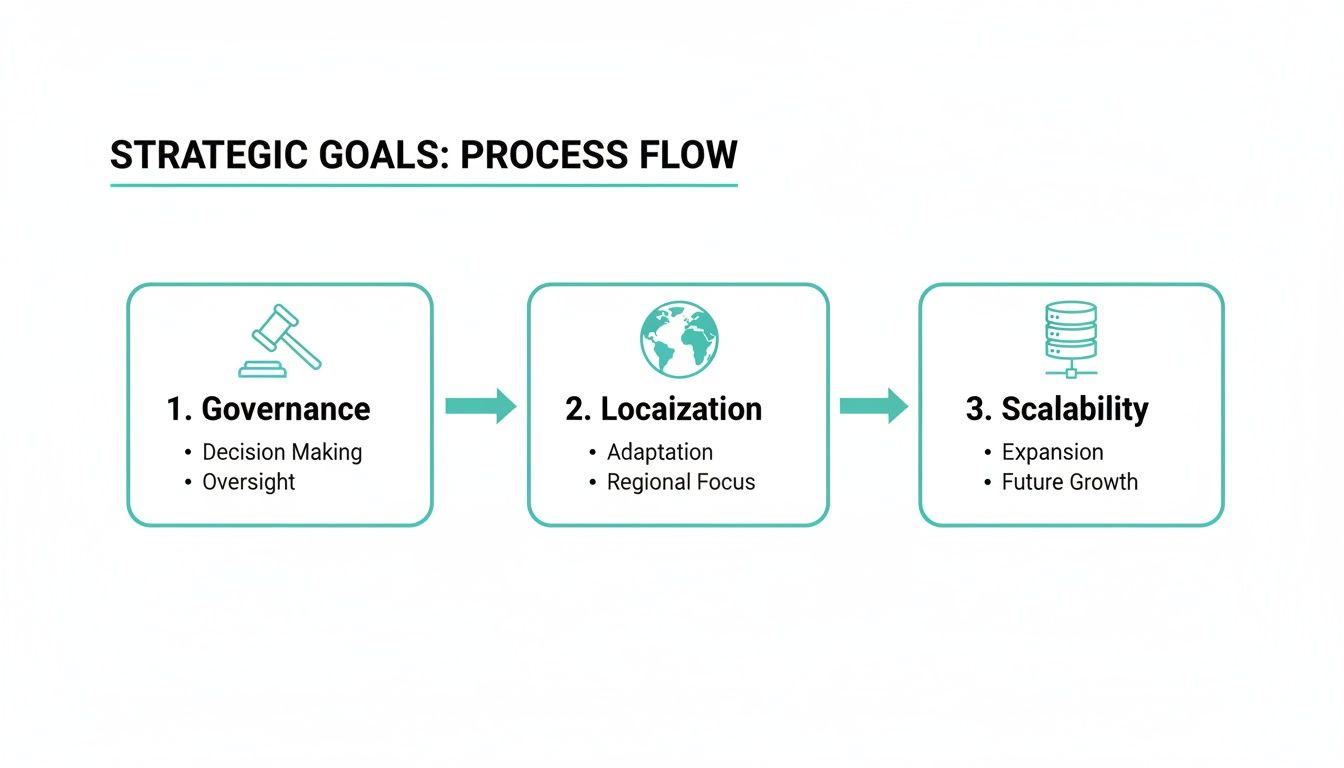
As you can see, a structured approach turns these high-level objectives into concrete, achievable outcomes.
Executing Asset Migration and Change Management
Once you’ve locked down the architecture, the next big job is the asset migration itself. We're talking about moving thousands, sometimes millions, of files from old systems, scattered network drives, and random cloud accounts. The key to a successful migration is a thorough data cleanse to weed out duplicate, outdated, or irrelevant assets before you move them.
Smart migration strategies often include:
- A Phased Rollout: Don't try to go live for everyone at once. Start with a pilot group or a single department to test everything out and get feedback.
- Clear Communication: Keep everyone in the loop. Make sure all stakeholders know the timeline, what’s expected of them, and how the new system will make their jobs easier.
- Comprehensive Training: Run hands-on training sessions customized for different users, whether they’re Sitecore authors or SharePoint admins.
Change management is just as critical as the technical lift. Getting your team to actually use a new tool takes more than a company-wide email. You need to show them the value, offer great support, and build real enthusiasm around the new way of working. For a detailed guide on structuring this kind of project, you can learn more about creating a software implementation project plan in our dedicated article.
Calculating the ROI of Bynder
Getting approval for a Bynder digital asset management system means showing its financial impact. A strong business case goes beyond just listing features; you need to calculate the Return on Investment (ROI) by looking at both direct cost savings and the bigger strategic wins.
The process kicks off by identifying the tangible, or "hard," savings. This is where you put real numbers to the financial benefits of adopting Bynder. One of the biggest savings comes from slashing the time your teams spend hunting for assets. When they can find what they need in seconds instead of hours, that reclaimed time translates directly into higher productivity and lower operational costs.
Measuring Hard Savings and TCO
To build a rock-solid business case, focus on these measurable areas:
- Reduced Asset Search Time: Start by calculating how many hours your teams waste digging through shared drives and different platforms for files. Multiply that by their hourly cost. Bynder’s centralized, AI-tagged library can cut this time by over 70%.
- Lower Content Production Costs: With features like Dynamic Asset Transformation, your marketing team can resize and reformat assets on their own. This cuts down on the need to pull in creative teams or hire freelancers for small tweaks.
- Eliminated Duplicate Content Creation: When existing assets are easy to find and repurpose, you stop paying to recreate content your organization already owns. The cost savings here can be massive.
Of course, savings are only half the story. You also need to analyze the Total Cost of Ownership (TCO). This isn't just about the Bynder license fees; it includes implementation, data migration, team training, and ongoing maintenance. A complete TCO picture makes your ROI calculation credible. For a deeper dive, our guide on a DXP ROI calculator can help you measure digital investment impact.
Quantifying Soft Benefits and Strategic Value
Beyond the hard numbers, the "soft" benefits are where Bynder delivers huge strategic value. While these gains are trickier to put a price tag on, they often have a much bigger long-term impact on the business. For instance, better brand consistency strengthens how your customers see you, which directly builds brand equity.
Quantifying soft benefits involves connecting Bynder’s capabilities to key business metrics. Faster speed-to-market allows you to capitalize on opportunities sooner, while enhanced brand governance reduces the risk of costly legal and compliance issues.
This is also where you need to look at the broader market. The Digital Asset Management market, where Bynder is a dominant force, is booming. It was valued at USD 4.22 billion in 2023 and is projected to hit USD 11.94 billion by 2030, growing at a powerful 16.2% CAGR. This trend, driven by cloud solutions, confirms that investing in platforms that improve user experience is a smart move. You can explore more about the DAM market's explosive growth on grandviewresearch.com. Investing in Bynder isn't just an operational fix; it's a strategic decision to stay ahead in a fast-moving digital world.
Frequently Asked Questions About Bynder
When enterprise teams consider Bynder, a few key questions always come up. Let's get you some clear, straightforward answers about how Bynder works in a real-world corporate environment.
How Does Bynder Integrate With Sitecore?
The integration between Bynder and Sitecore is seamless, thanks to a pre-built connector. It essentially embeds Bynder’s asset library right into the Sitecore content editing screen, so your teams can browse, search, and drop in approved media without ever having to switch tabs.
When an author selects an asset, all its critical metadata—like copyright details and usage rights—is synced automatically. This connection brings a few big wins:
- Faster Workflows: Content authors can stay in their flow, accessing all media from a single, familiar interface.
- Guaranteed Brand Consistency: Only approved, on-brand assets from the central DAM are available, which all but eliminates compliance headaches.
- Smarter Personalization: The rich metadata from Bynder can fuel Sitecore AI and personalization engines, helping you deliver more relevant content to your audience.
In the end, you get a powerful, composable DXP where Bynder stands as the single source of truth for every media asset you own.
What Is a Typical Implementation Timeline?
For a large enterprise, a typical Bynder implementation usually takes anywhere from three to six months. The final timeline really depends on a few moving parts, like the sheer volume of assets you need to migrate, how complex your metadata taxonomy and user permissions are, and how many other systems (like SharePoint or a PIM) you need to connect.
We strongly recommend a phased rollout to get everyone on board and ensure a smooth transition. Kicking things off with a pilot group lets you test the waters and fine-tune the setup before going live company-wide, which massively boosts the odds of long-term success.
Working with an experienced implementation partner can definitely speed things up. They know how to navigate the common roadblocks through structured discovery, careful planning, and expert data migration, getting your team to a return on investment much faster.
Is Bynder Suited for Regulated Industries?
Yes, absolutely. Bynder is built from the ground up for organizations in regulated industries that have to meet strict compliance rules. The platform is designed around enterprise-grade security and holds key certifications like ISO/IEC 27001, the global standard for information security management.
On top of that, Bynder is HIPAA compliant, making it a secure and proven solution for healthcare and life sciences companies handling sensitive data. Its powerful Digital Rights Management (DRM) features and fine-grained user permission controls give you the exact level of governance needed to lock down asset access, track usage, and avoid the legal risks that come with managing content.
Ready to see how a unified content ecosystem can transform your operations? The experts at Kogifi specialize in implementing and integrating Bynder with enterprise platforms like Sitecore and SharePoint to drive efficiency and protect your brand. Visit https://www.kogifi.com to start the conversation.