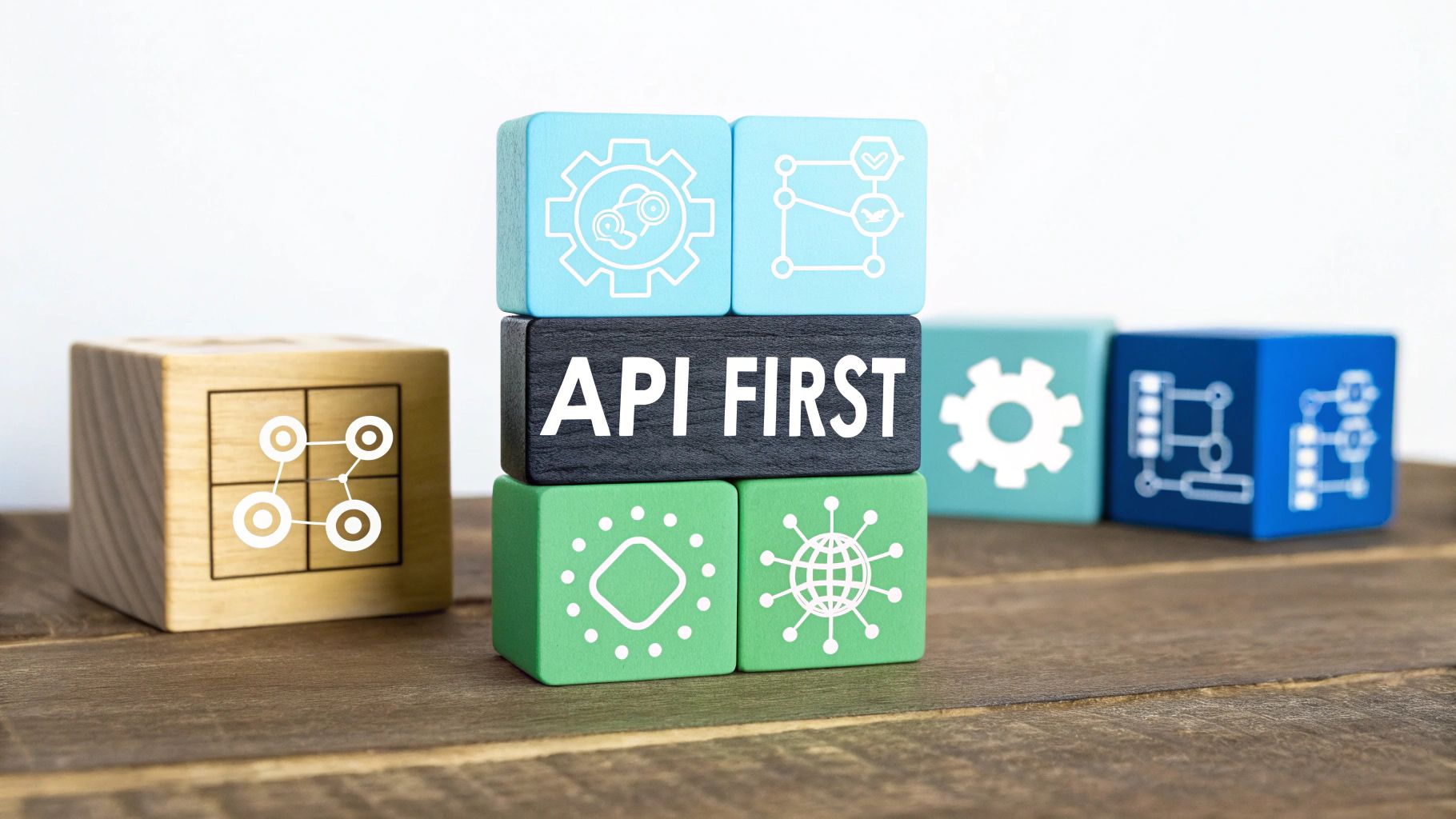



Think about building a house. You could custom-make every single brick, a slow and rigid process. Or, you could use standardized LEGO blocks. The LEGO way is faster, more flexible, and lets you build just about anything you can imagine. That’s the core idea behind the API-first approach: you design the connections—the APIs—as if they are the primary product, creating reusable building blocks for your entire digital ecosystem.
Why Modern Digital Experiences Start with APIs

In the traditional development model, you’d build an application first and then tack on APIs later to connect it to other systems. This almost always leads to clunky, fragile integrations that become a nightmare to maintain. The API-first approach completely flips that model on its head. It insists that you start by designing the API contract before writing a single line of application code.
This is a strategic shift. It treats APIs not as technical afterthoughts, but as foundational products in their own right. This mindset is crucial for any business using a modern Digital Experience Platform (DXP) like Sitecore. It lays the groundwork for creating seamless, connected customer journeys across every channel you can think of.
The Foundation for Omnichannel Delivery
An API-first approach is the engine that truly powers omnichannel experiences. When your content and services are available through a well-designed set of APIs, you separate your back-end systems from the front-end presentation. This decoupling is what makes it possible to serve a huge variety of digital endpoints.
Take a Sitecore-powered DXP, for example. With an API-first model, the exact same piece of personalized content can be delivered at the same time to:
- A responsive corporate website built with React or Vue.
- A native iOS or Android mobile app.
- An internal SharePoint portal for your employees.
- An in-store digital kiosk or smart display.
- Even voice assistants or IoT devices.
This consistency creates a unified brand message and customer experience, no matter how someone chooses to interact with your business. Nailing this model is often a key part of effective Digital Transformation Strategies that aim to build adaptive and scalable digital platforms.
Enabling Composable Architectures
The real magic of an API-first approach shines when you start building a composable DXP. Instead of being locked into a single, monolithic system, a composable architecture lets you assemble a custom tech stack using best-in-class services from different vendors. Sitecore's headless capabilities, for instance, were built for this kind of environment.
An API-first strategy transforms your technology from a rigid structure into a flexible ecosystem. You can integrate specialized services for e-commerce, search, AI-driven personalization, and analytics—all communicating through a common set of API standards.
For instance, a Sitecore instance can act as the central content hub, while a dedicated e-commerce platform handles transactions and a separate AI engine delivers real-time product recommendations. The APIs act as universal translators, allowing these independent systems to work together flawlessly. If you want to dig deeper into this, you can learn more about the benefits of headless CMS architecture in our detailed guide. This adaptability doesn't just speed up development; it makes your entire digital foundation more resilient and ready for whatever comes next.
The Business Case for an API-First Strategy
Making the switch to an API-first strategy isn't just a technical upgrade—it’s a direct investment in business agility, cost reduction, and future-proof growth. This isn't just theory; it’s an approach that delivers tangible outcomes that resonate in the boardroom by changing the very foundation of how you build and ship digital products.
The most immediate win is a dramatic acceleration in your time-to-market. In a traditional setup, front-end teams (designing the user experience) are stuck waiting for back-end teams (building the core logic) to finish their part. This sequential process is a recipe for bottlenecks and delayed launches.
An API-first approach completely flips that model on its head. By defining the API contract upfront, both teams can get to work in parallel. The front-end team builds against a mock API that simulates responses, while the back-end team implements the real logic. This concurrent development can slash project timelines from months to weeks.
Driving Efficiency and Reducing Costs
Beyond just speed, this strategy unlocks powerful new efficiencies. Every API you create becomes a reusable asset—a standardized, documented building block that can be repurposed across countless projects. This simple shift puts an end to redundant work and drives down long-term development costs.
Instead of your teams building a new data connection for every single application, they can just plug into an existing, proven API. This creates a library of reliable services that only grows more valuable over time, compounding your initial investment with every new project.
The financial returns from an API-first approach are both quantifiable and compelling. Rigorous analysis shows organizations can achieve a 50% faster time-to-market for new services. But it's not just about speed. These strategies also lead to substantial cost savings and productivity gains, with API-first companies seeing 12.7% higher market capitalization growth compared to their peers. You can discover more about what industry research reveals about APIs to see the full picture.
Unlocking True Omnichannel Success
This is where an API-first approach really shines, especially within a sophisticated ecosystem like Sitecore. A single, well-designed API acts as the central nervous system for your entire digital presence, guaranteeing brand consistency and operational excellence across every single touchpoint.
Think about a real-world scenario: your marketing team publishes a new promotional campaign in Sitecore. With an API-first foundation, that one piece of content can instantly and simultaneously power:
- Your primary website: The hero banner and campaign details pop up on the homepage, delivered through Sitecore Experience Edge.
- Your native mobile app: A push notification goes out, and the campaign appears in the app's offer section.
- Your internal SharePoint intranet: Sales and support teams get a briefing on the new campaign, pulled directly from Sitecore to get them ready for customer questions.
This seamless distribution isn't some complex, multi-step headache; it's the natural outcome of designing your architecture around a central set of APIs. You manage the content once, and the APIs make sure it gets to every audience on every platform. This model squeezes maximum value from your content and technology investments, from Sitecore to SharePoint and beyond.
Building a Resilient Digital Foundation
Ultimately, the business case for an API-first strategy comes down to building resilience. Markets shift, customer expectations evolve, and new technologies pop up constantly. A tightly coupled, monolithic system just can't keep up with this constant state of flux, often requiring expensive and time-consuming overhauls to adapt.
An API-driven architecture, on the other hand, is inherently flexible. When a new channel like a voice assistant or an IoT device becomes relevant, you don’t have to rebuild your core platform from scratch. You just create a new front-end experience that consumes the APIs you already have.
This adaptability turns your technology stack from a rigid liability into a dynamic asset. It lets you experiment with new ideas quickly, respond to market opportunities faster, and build a digital foundation that’s ready for the future, not just the present. It’s how you stop reacting to change and start leading it.
Building a Future-Proof DXP with Sitecore
An API-first approach isn't just a technical buzzword; it's the engine driving a modern Digital Experience Platform (DXP). For businesses running on Sitecore, this way of thinking is at the very heart of its composable and headless architecture. It unlocks a level of flexibility and power that older, monolithic systems just can't touch, giving you a digital foundation that’s strong today and ready for whatever comes next.
This isn't a niche trend anymore. The API-first mindset has gone mainstream, with many organizations now building their systems this way. A significant number of businesses have already made the complete switch, proving this is a core business strategy, not just a development fad. If you're building a modern DXP, API-first is no longer optional—it's essential. You can read the full research on this rapid adoption to see just how widespread this shift has become.
Decoupling Content and Presentation with Sitecore
The magic of Sitecore's modern architecture lies in decoupling—splitting the back-end where you manage content from the front-end where your customers see it. This is all made possible by a robust, API-first design, perfectly illustrated by products like Sitecore Experience Edge. Think of Experience Edge as a super-fast delivery service just for your content.
Your marketing team stays in the familiar Sitecore environment they know and love, creating and personalizing content. Once they hit "publish," that content is sent to Experience Edge, where it becomes available through a fast, scalable GraphQL API. This separation is a game-changer for your developers.
- Front-End Flexibility: Developers are free from the constraints of Sitecore’s rendering engine. They can pick the best tools for the job—like modern JavaScript frameworks such as React, Angular, or Vue—to build beautiful, snappy user interfaces.
- Marketing Autonomy: Your marketing team keeps full control. They can launch campaigns, tweak personalized components, and run A/B tests right inside Sitecore, all without needing to file a ticket with the development team for front-end tweaks.
This setup creates two parallel tracks of work, which dramatically speeds up project timelines and lets both teams innovate faster.
Assembling a Best-of-Breed Composable DXP
The real power of an API-first approach with Sitecore goes way beyond a single website. It's what allows you to build a truly composable DXP. Instead of being locked into one vendor for everything, you can hand-pick the best services for each specific need and assemble a custom digital ecosystem.
A composable DXP lets you plug in specialized services for search, commerce, analytics, and AI. They all talk to each other through APIs, turning your DXP from a rigid, one-size-fits-all box into a flexible platform built just for your business.
A typical setup might look something like this:
- Content Hub: Sitecore acts as the brain, holding all your structured content and personalization logic.
- Commerce Engine: A dedicated e-commerce platform handles all things transactional—products, pricing, and checkouts—through its APIs.
- Search Functionality: A powerful, specialized search service delivers smart, relevant results.
- Data & Analytics: A customer data platform (CDP) pulls user data from everywhere to deliver truly personal experiences.
This table shows just how different this model is from the old way of doing things.
Monolithic DXP vs Composable DXP Architecture
The API-first, composable model gives you the freedom to build a DXP that perfectly fits your business, rather than forcing your business to fit the DXP.
The infographic below shows how this API-driven agility creates real business value by boosting development speed and making operations more efficient.
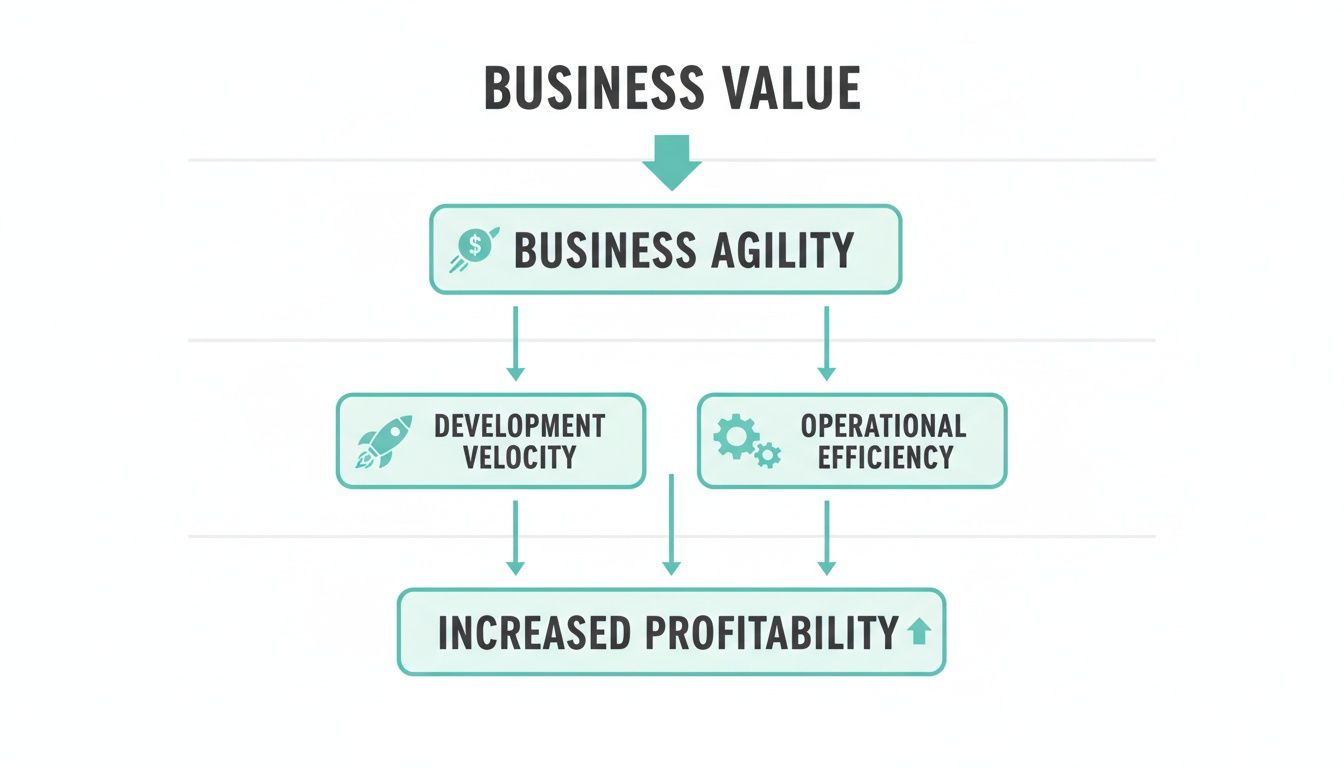
When you treat your APIs as the core product, you build a system that can adapt to new market demands almost instantly.
This approach gives you better functionality today and protects your investment for tomorrow. If a groundbreaking new search provider appears in a couple of years, you can swap it in by just updating the API integration—no need to rip out your entire platform. You can explore our deep expertise in Sitecore solutions to see how we help clients build these powerful composable systems. It's how you break free from the limits of old-school DXPs and create an agile foundation that grows with your business.
Unlocking Personalization with Sitecore AI
An API-first architecture is about more than just hooking up systems; it’s the essential plumbing that feeds intelligent platforms the data they need to really shine. This is where the synergy between APIs and Artificial Intelligence becomes critical, especially inside the Sitecore ecosystem. A well-designed API layer acts as the main channel for rich customer data, transforming your DXP from a simple content database into a predictive powerhouse.
This connection is what lets you move beyond basic, rule-based personalization. Instead of just showing content based on a user’s last click, you can start delivering hyper-relevant, predictive experiences in real time. APIs are constantly feeding Sitecore’s machine learning models the behavioral data, purchase history, and interaction details needed to understand what a user wants and anticipate their next move.
Fueling Intelligent Customer Experiences
Sitecore's composable product suite, with tools like Sitecore Personalize and Sitecore CDP (Customer Data Platform), is built entirely on an API-first foundation. These systems are designed to ingest a constant stream of data from countless sources—your website, mobile app, CRM, and even in-store point-of-sale systems. APIs are the universal translators that make this possible, standardizing all that data so the AI models can make sense of it.
This continuous flow of information allows Sitecore AI to:
- Build Unified Customer Profiles: APIs pull together fragmented data points from multiple channels into a single, comprehensive view of each customer in Sitecore CDP.
- Predict User Behavior: Machine learning models analyze patterns to forecast which content, offers, or products a user is most likely to engage with next.
- Trigger Real-Time Actions: An API can instantly trigger a personalized web experience or A/B test in Sitecore Personalize the moment a user adds a specific item to their cart on your e-commerce site.
Without a solid API strategy, this level of sophisticated, AI-driven personalization is simply out of reach. You can discover our guide on implementing AI personalization in your DXP to see how these components work together.
When AI Becomes the API Consumer
The relationship between AI and APIs is quickly becoming a two-way street. AI is no longer just a passive recipient of data; it's becoming a primary consumer of APIs, using them to autonomously pull information and execute complex tasks. This marks a fundamental shift in how we think about digital architecture.
The intersection of API-first development and artificial intelligence is the next phase of digital evolution. Industry analysis indicates that the majority of new applications are already using AI-driven APIs. This transforms APIs from static interfaces into dynamic systems serving intelligent, autonomous agents. You can read more about these crucial API trends to understand their impact.
In this new model, an AI agent within Sitecore could use an API to query an external inventory system, check stock levels for a product a user is viewing, and then use another API to surface a personalized "low stock" alert—all without a human lifting a finger. This forward-looking capability makes an API-first approach a non-negotiable prerequisite for any organization serious about building truly responsive and intelligent customer experiences.
Integrating SharePoint Into Your API Ecosystem

Many businesses still see platforms like SharePoint as isolated content silos, completely separate from their modern Sitecore DXP. But in an API-first world, that’s a missed opportunity. It’s time to shift that mindset and see SharePoint for what it can be: a powerful, headless content source ready to feed data across your entire digital workplace.
This transformation is made possible by modern interfaces like the Microsoft Graph API. Instead of being trapped inside the SharePoint UI, all your content—documents, lists, and metadata—becomes accessible through code. Suddenly, its value extends far beyond the company intranet.
Unlocking Content with SharePoint APIs
The API-first approach lets you treat SharePoint just like any other composable service in your Sitecore ecosystem. By tapping into its APIs, you can build a unified content strategy where internal assets seamlessly enrich external customer experiences, all while respecting enterprise-grade security and permissions.
This integration delivers practical results that bridge the gap between internal operations and external marketing. You can learn more about how to modernize your digital workplace with SharePoint solutions and unlock these powerful capabilities.
Think about these real-world scenarios:
- Secure Document Delivery: Imagine a customer portal built on Sitecore that pulls specific, permission-controlled product manuals or compliance forms directly from a SharePoint library. No duplicates, no hassle.
- Mobile App Integration: A simple SharePoint list containing event schedules or product specs could easily power a customer-facing mobile app. The data stays consistent and is managed in one place.
- Workflow Automation: You could connect internal SharePoint workflows to your martech stack, triggering personalized email campaigns in Sitecore whenever a document status changes in SharePoint.
By treating SharePoint as an API-driven service, you extend the life and value of your existing technology investments. It stops being just an intranet and becomes a vital node in a connected, efficient digital ecosystem.
This strategic integration creates a frictionless flow of information. It breaks down departmental silos, improves how you work, and ensures that the valuable content locked away in your enterprise systems can finally be put to work everywhere it's needed. This is the heart of building a truly composable and intelligent digital workplace.
Putting Your API-First Strategy into Action
Making the switch to an API-first approach is more than just a technical update—it’s a strategic shift that needs a clear plan. It’s about creating a disciplined process that treats every API as a valuable, reusable, and secure product. The whole journey starts with a new way of thinking: you’re not just building apps anymore, you’re creating the foundational services that power them.
The single most important step is adopting a design-first methodology. This means your teams map out a detailed API contract before writing a single line of code. This contract, often built with a tool like OpenAPI, becomes the single source of truth for what the API does. It’s the blueprint that lets front-end and back-end developers build their parts at the same time, which breaks down dependencies and speeds everything up.
The Power of the API Contract
Think of an API contract as a formal agreement between the API and whatever is using it. It lays out every single detail of the interaction—from request and response formats to authentication rules and error codes. Getting this sorted out early prevents the expensive mix-ups and rework that happen when APIs are just an afterthought.
By locking in the contract first, you unlock parallel work. Your front-end team can get started right away, building the user experience against a mock server that mimics the API's behavior. Meanwhile, the back-end team can build the logic to match the contract, knowing that everything will connect perfectly in the end.
Establishing Robust API Governance
As you build more and more APIs, keeping things consistent and high-quality gets tricky. Without clear rules, you’ll end up with a mess of mismatched, poorly documented, and insecure APIs. This is where API governance comes in. It sets the standards and processes needed to manage your APIs like the enterprise-grade products they are.
Strong governance stands on a few key pillars:
- Standardized Design Principles: Enforce consistent naming, data formats, and endpoint structures for all APIs. This makes them predictable and much easier for developers to use.
- Clear Versioning Strategy: APIs will change. A solid versioning plan (like using
/v1/,/v2/in the URL) lets you roll out updates without breaking older apps that depend on them. - Rigorous Security Protocols: APIs are the front door to your data. Strong security, like OAuth 2.0 for authentication, input validation, and rate limiting, is non-negotiable for protecting against threats.
An API-first approach treats APIs as first-class citizens, not secondary features. This means establishing a centralized set of guidelines for schema design and naming conventions is essential. This governance prevents fragmentation and supports mass collaboration, ensuring long-term maintainability and consistency.
A Checklist for Implementation Success
For any leader driving this change, a structured plan is a must. A successful rollout moves from big-picture strategy to focused execution, making sure everyone is on the same page. This high-level checklist covers the key stages for a smooth and scalable implementation.
Initial Assessment and Strategy: Start by looking at your current architecture and figuring out the key business drivers. Define what a win looks like and how an API-first approach fits with goals for platforms like Sitecore and SharePoint.
Gain Stakeholder Buy-In: Spell out the business value—faster time-to-market, lower costs, and more agility—to executives, product owners, and development teams. Get the resources and champions you need to drive the change.
Select the Right Tooling: Pick tools that support the whole API lifecycle. This includes design tools (like Swagger or Stoplight), API gateways for management and security, and testing platforms to ensure quality.
Execute a Pilot Project: Begin with a single, well-defined project. This lets your team learn the design-first process, refine your governance rules, and score a tangible win before you go all-in across the organization. This controlled start builds momentum and teaches valuable lessons for what’s next.
Frequently Asked Questions
Got questions about making the switch to an API-first approach? Here are some straightforward answers to the questions we hear most often, especially from teams working with enterprise platforms like Sitecore and SharePoint.
What Is the Main Difference Between API-First and Code-First?
Think of it this way: in a code-first world, you build the house first and then figure out where to put the doors later. The application gets built, and an API is tacked on afterward to let other systems talk to it. It often feels like an afterthought.
With an API-first approach, the doors—and windows, and hallways—are the very first thing you design. The API is treated as the core product. Its "contract" is designed and agreed upon before a single line of application code is written, which guarantees it’s consistent, reusable, and works with any system you can imagine.
This simple shift in perspective allows your teams to work in parallel. Front-end developers can start building against the API contract immediately, while the back-end team works on bringing the logic to life. It's a massive accelerator for any project.
How Does an API-First Approach Benefit My Sitecore DXP?
For Sitecore users, especially those tapping into its headless features like Sitecore Experience Edge, an API-first strategy is a game-changer. It cleanly separates your content management from how that content is displayed. Your marketing team gets one central hub to manage everything, while your developers are free to push that content to websites, mobile apps, smart watches, or anything else using the best modern tech.
This separation unlocks some serious advantages:
- Faster Development: Teams can work at the same time without stepping on each other's toes.
- Improved Scalability: You can scale your front-end delivery network without touching your core CMS.
- Future-Proofs Your DXP: Adopting the next big front-end framework doesn't require a painful, full-scale rebuild.
Can I Integrate Older Systems Like SharePoint into This Model?
Absolutely. You might think of SharePoint as a more traditional, internal-facing tool, but modern versions come with powerful APIs, like the Microsoft Graph API. These APIs turn SharePoint into a headless content repository, ready to be plugged into a composable DXP.
An API-first strategy is the glue that makes this possible.
By using its APIs, you can securely pull SharePoint documents, lists, and other data into your broader digital ecosystem. Imagine connecting your internal knowledge base directly with your public-facing Sitecore website or a customer portal—it’s a powerful way to get more value out of the content you already have.
Ready to build a future-proof digital platform with an API-first strategy? Kogifi provides expert implementation and support for Sitecore and SharePoint to help you create a scalable, composable DXP. Learn how we can help you succeed.