


Information architecture (IA) is the art and science of organizing your digital world. Forget the technical jargon for a moment. Think of it as the invisible blueprint for your website, app, or digital platform—the thoughtful structure that makes everything feel intuitive and easy to use.
The Strategic Blueprint for Digital Experiences
Ever tried finding something in a massive, disorganized warehouse? It’s frustrating, confusing, and you probably give up. Now, picture that same warehouse with clear aisles, logical signage, and neatly organized shelves. That’s what good information architecture does for your digital presence. It transforms chaos into clarity, guiding users exactly where they need to go without them even noticing the underlying structure.
This isn't just about being tidy; it's the absolute foundation for any successful Digital Experience Platform (DXP). For enterprise teams using powerful systems like Sitecore, a solid IA is non-negotiable. It's the first step to unlocking true personalization and scale. Without it, even the most advanced AI tools, like those in the Sitecore ecosystem, can't connect the right content with the right person at the right time.
From Theory to Modern Practice
While the idea of organizing information has been around forever, it was the explosion of the World Wide Web in the 1990s that brought IA into the digital spotlight. This era was defined by Louis Rosenfeld and Peter Morville's 1998 book, which nailed down IA as 'the structural design of shared information environments.' They took decades of library science and cognitive psychology and applied them to the web, popularizing practices like user-centered design and card sorting that are still standard today.
Fast forward to now, and those same principles are what allow modern composable DXPs to handle complex cloud migrations and meet the demanding 24/7 service level agreements global clients expect. A quick look into the history of information architecture shows just how far these ideas have come.
At the end of the day, IA isn’t just an IT problem to solve. It’s a core business strategy that directly impacts user satisfaction, search engine performance, and your team's efficiency. A strong IA is essential to delivering a great user experience (UX) design, which is fundamental for business growth.
A well-planned IA ensures that as your organization grows, your digital assets can scale efficiently without requiring costly overhauls. It’s the difference between building a digital presence on solid bedrock versus shifting sand.
On platforms like Sitecore or SharePoint, IA is what dictates how your content is structured, tagged, and linked together. This behind-the-scenes organization powers everything from simple website menus to sophisticated, AI-driven personalization campaigns. When your system understands the relationships between different pieces of content, it can unlock powerful features like automated recommendations and dynamic user journeys.
To see how this fits into the bigger picture, you can learn more from our guide on https://www.kogifi.com/articles/what-is-web-content-management. By putting a clear framework in place from the very beginning, you’re not just building a website—you’re creating a high-performing digital ecosystem that delivers real business value.
The Four Pillars of Effective IA
To really get what information architecture is all about, we have to move past the definition and break it down into its core pieces. Think of these four pillars as the essential ingredients that work together to create a logical and intuitive digital space. When you get them right inside a Digital Experience Platform (DXP) like Sitecore, they become the foundation for a truly great user experience.
This diagram shows just how critical a solid IA is. It's the base layer that supports a successful digital experience and helps you hit your bigger DXP goals.
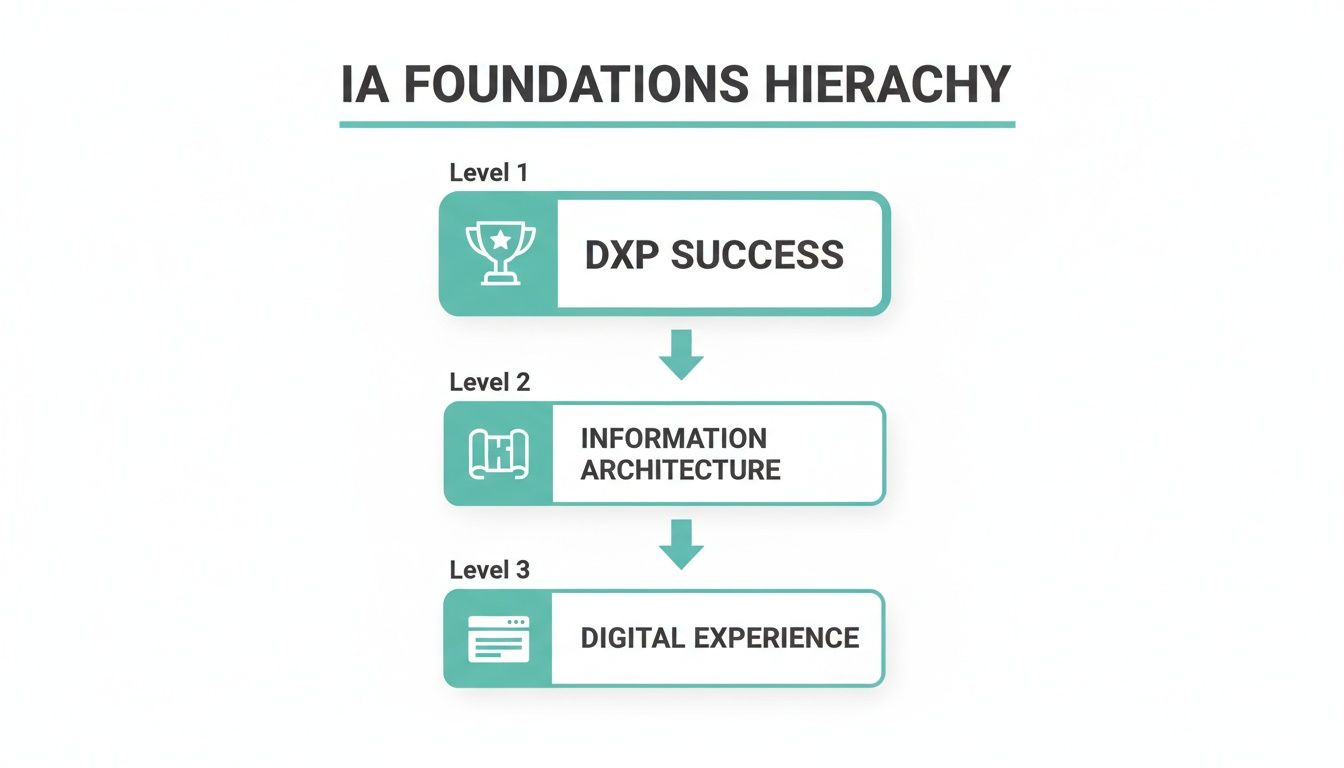
It’s pretty clear: without a well-planned structure, your whole digital strategy is built on a shaky foundation, making it nearly impossible to succeed in the long run.
Organization and Taxonomy
The first pillar is organization and taxonomy. This is all about how you group and categorize your information. Picture a global company with thousands of products, articles, and support documents. A well-thought-out taxonomy makes sure all that content is structured in a way that makes sense, so users can easily find what they need, no matter how they arrived at your site.
For example, on a site powered by Sitecore, a product could be tagged by industry, its application, and product type. This multi-layered taxonomy enables dynamic filtering and personalized content delivery, often supercharged by Sitecore AI, which learns user preferences based on the categories they interact with. In a similar vein, SharePoint uses its Term Store to establish controlled vocabularies, keeping metadata consistent across an entire corporate intranet.
A robust taxonomy isn't just for user convenience; it's a machine-readable map that tells your DXP how different pieces of content relate to one another. This unlocks powerful capabilities for content reuse and personalization.
This kind of structural clarity has a direct impact on the bottom line. When people can find information easily, bounce rates go down and time-on-site goes up. An organized structure also makes content governance much simpler for global teams managing their own sections. To see how this fits into the bigger picture, check out these best practices in user experience (UX) design.
Navigation and Wayfinding
Next up is navigation and wayfinding. If organization is how you arrange the shelves in your digital warehouse, then navigation is the system of signs and pathways that guides people through it. This covers everything from the main menus and breadcrumbs to the internal links that connect your content into a cohesive journey.
In Sitecore, for instance, architects can design complex, multi-level menus that change based on a user's role or geographic location. A global corporation might show a different set of menu items to visitors from North America than it does to visitors from Asia, making the experience immediately more relevant. The key is to make the wayfinding system predictable, so users always have a clear sense of where they are, where they've been, and where they can go.
Good wayfinding gives users a feeling of control and confidence. When they feel lost or confused, they're much more likely to just leave. A well-designed navigation system, on the other hand, encourages them to explore and engage more deeply with your content.
Labeling and Terminology
The third pillar is labeling and terminology, which is all about the words you use to represent information. It’s about choosing clear, simple language for your navigation links, headings, and call-to-action buttons. The main goal is to use words your audience actually understands and expects to see.
For example, a B2B tech company might label a section of its site "Solutions," while a direct-to-consumer brand would probably use "Shop." It seems like a small difference, but it has a huge impact on whether people can find what they're looking for. Using industry jargon that your audience doesn't recognize just puts up a wall.
A great IA is built on user research to get the labels right. Techniques like card sorting are perfect for this, as they reveal how real users naturally group and name content, ensuring the final terminology matches their mental models. This audience-first approach is vital for both user satisfaction and SEO, because it aligns your site's language with the search terms people are actually typing into Google.
Search and Retrieval Systems
Finally, we have search and retrieval systems. No matter how intuitive your navigation is, some users will always head straight for the search bar. This pillar is about making sure that when they do, they get fast, accurate, and relevant results.
This is where metadata and structured data become absolutely essential. In platforms like Sitecore and SharePoint, content is tagged with metadata—data about the data—like the author, publication date, and relevant keywords. This rich metadata is what fuels the internal search engine.
A powerful search experience does more than just match keywords. It can:
- Offer faceted search, letting users filter results by category, date, or other attributes.
- Provide "Did you mean?" suggestions to correct typos.
- Prioritize results based on relevance or popularity.
In Sitecore, a well-architected content model ensures every piece of information is structured for ideal search retrieval. This not only makes users happier but also gives you valuable data on what people are searching for, which you can then feed back into your overall content strategy.
How Sitecore and SharePoint Power Enterprise IA
Information architecture stops being a theoretical exercise and starts driving real business value when it’s put to work inside enterprise-grade platforms. A smart IA is the scaffolding that unlocks what market-leading systems like Sitecore and SharePoint can really do, turning them from simple content buckets into intelligent digital experience engines.
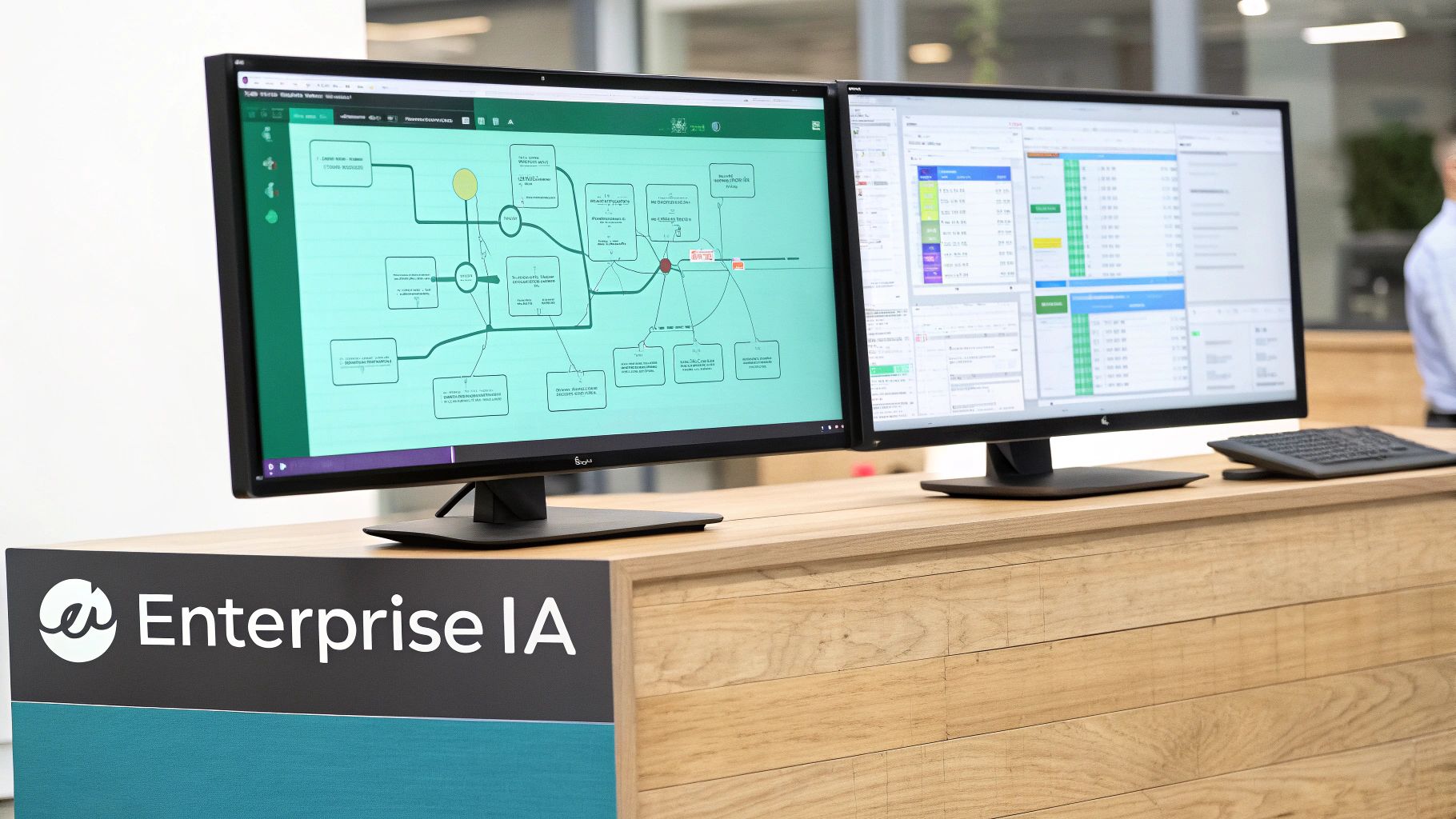
This setup is a great visual for how enterprise IA connects structured data with user-focused design—which is exactly what platforms like Sitecore and SharePoint are built to do. By getting the organization right, these systems can power sophisticated digital experiences across every channel you can think of.
Architecting Personalized Experiences with Sitecore
Sitecore’s real magic is its ability to deliver deeply personalized content at scale, a feature that leans entirely on a well-thought-out IA. The platform’s content modeling and taxonomy tools aren’t just for backend admin; they’re the very foundation of its AI-driven personalization engine.
Think of every piece of content in Sitecore—an article, a product description, a video—as a component rich with data. A solid IA ensures each one is meticulously tagged with metadata and filed into a logical taxonomy. This structure is what lets Sitecore AI understand the context, see relationships, and grasp user intent behind every click.
When a user clicks on a product tagged with "sustainability" and "manufacturing," Sitecore AI doesn't just see a click. It sees a signal of interest in a specific topic, which it can use to dynamically surface related case studies, blog posts, and solutions, creating a truly one-to-one journey.
This level of organization is crucial for Sitecore Content Hub, where a clear IA makes content reuse incredibly efficient. A single, well-architected marketing asset can be seamlessly adapted and deployed across websites, mobile apps, and email campaigns worldwide, locking in brand consistency and making operations far more efficient.
Structuring Knowledge with SharePoint Solutions
While Sitecore nails customer-facing experiences, SharePoint provides the architectural backbone for internal knowledge management. Its strength comes from features built specifically to organize and govern massive amounts of corporate information, making it findable and trustworthy for employees.
The cornerstone of SharePoint’s IA toolkit is the Term Store, a central hub for managing metadata. This is where organizations can build and enforce a controlled vocabulary—a standardized set of terms used to tag documents, pages, and list items. That consistency is non-negotiable for accurate search and solid governance.
To really get how these platforms operate in a large organization, understanding what is SharePoint Online is a must, given its role in centralizing content and collaboration. It’s the hub where all this structured information lives and breathes.
This structured method tackles a classic enterprise headache: information silos. When documents are tagged using a centrally managed taxonomy, they become discoverable across departmental lines. A salesperson can easily find technical specs from the engineering team if both departments use the same product terms defined in the Term Store. This interconnectedness is a clear sign of strong enterprise content management solutions.
The Historical Imperative for Structured Data
This need for structure isn't a new idea; it has deep roots in computing history. The formal use of information architecture in computing began way back in 1959 when IBM researchers first used the term 'architecture' in a research paper. This thinking evolved at Xerox PARC in the 1970s and was later famously defined by Richard Saul Wurman in 1975 as 'organizing patterns in data to make the complex clear.' This history makes it obvious why scalable IA is so vital today—it prevents the data chaos that sinks AI personalization and omnichannel strategies.
Ultimately, both Sitecore and SharePoint prove that IA isn't a passive, one-and-done task. It's an active, strategic discipline that, when done right, transforms a platform's potential into tangible business results, whether that’s through better customer engagement or sharper internal productivity.
The Business Case for Investing in IA
Beyond the technical jargon, a strategic information architecture delivers real, measurable business results. Investing in IA isn't just some academic exercise—it's a direct investment in your digital platform's performance, efficiency, and future readiness. A well-planned IA provides a clear return by boosting user engagement, improving SEO, enabling long-term growth, and driving serious operational efficiency.
When you prioritize this foundational work from day one, it creates a powerful ripple effect across the entire digital experience. It’s what transforms a simple website or intranet into a high-performing business asset that actively helps your organization hit its goals.
Enhances User Engagement
The most immediate impact of a solid IA is on the user experience. It’s simple: when people can find what they need quickly and without thinking too hard, frustration drops and engagement soars. A logical structure reduces cognitive load—the mental effort needed to use a site—which keeps users on your platform longer and encourages them to explore.
For platforms like Sitecore, this is the first and most critical step toward meaningful personalization. Before Sitecore AI can deliver a one-to-one experience, it needs a clear map of your content. A good IA provides that map, helping the AI understand content relationships and user intent, which leads to far more relevant recommendations. This translates directly into key metrics:
- Lower bounce rates as users find what they’re looking for right away.
- Increased time on site because navigation is clear and frictionless.
- Higher conversion rates since the path to key actions (like a purchase or inquiry) is obvious.
Improves SEO Performance
Search engines like Google are basically just sophisticated users trying to understand and categorize your content. A well-organized information architecture acts as a crystal-clear roadmap for search engine crawlers, making it easier for them to index your entire site and grasp the relationship between different pages.
This structural clarity sends powerful signals to search engines about what your site is about and why it's an authority. A logical hierarchy, consistent labeling, and a clean internal linking structure all contribute to better search rankings.
An IA creates a "semantic core" for your website. When Google understands that pages about "enterprise software," "cloud solutions," and "data security" are all contextually related, it rewards your site with higher authority on those topics.
This is especially critical for massive enterprise sites built on Sitecore or SharePoint, which can contain thousands of pages. Without a clear IA, many of those pages can become "digital orphans," invisible to both users and search engines. A smart architecture ensures every single piece of content contributes to your overall SEO footprint.
Enables Scalability and Future-Proofing
One of the most common mistakes is designing a digital platform only for today's needs. A strong IA, however, is built for growth. It allows your digital presence to expand without demanding a costly and disruptive rebuild every few years. It establishes a flexible framework that can easily accommodate new product lines, service offerings, or even entire business units down the road.
Think of it like building a skyscraper. You wouldn't construct a ten-story building on a foundation designed for a single-family home. In the same way, an IA provides the foundational support needed for future expansion. When your content models and taxonomies are designed with scalability in mind, adding a new section or integrating a new system becomes a manageable task, not an architectural crisis. This future-proofing is vital for platforms like Sitecore Content Hub, where content must be adaptable for channels that may not even exist yet.
Drives Operational Efficiency
Finally, a powerful IA creates significant operational efficiencies, especially through content reuse. In systems like Sitecore Content Hub, a well-architected piece of content—like a product description or a customer testimonial—can be created once and deployed across dozens of channels and regions.
This is only possible when the content is structured and tagged correctly from the start. A clear taxonomy allows teams to quickly find and repurpose existing assets instead of creating them from scratch, saving an immense amount of time and resources. For a global enterprise, this means a marketing team in North America can easily leverage content created by their counterparts in Europe, ensuring brand consistency while dramatically reducing redundant work. The same principle applies to SharePoint, where a well-organized document library with consistent metadata prevents duplication and makes knowledge instantly accessible across the entire organization.
Your Practical Guide to Implementing IA
Alright, you understand the "why" behind information architecture. Now for the "how." Moving from theory to hands-on execution isn't a one-and-done task; it’s a journey that methodically transforms digital chaos into clarity. This guide gives you an actionable blueprint for doing just that, with a focus on making it work in platforms like Sitecore and SharePoint.
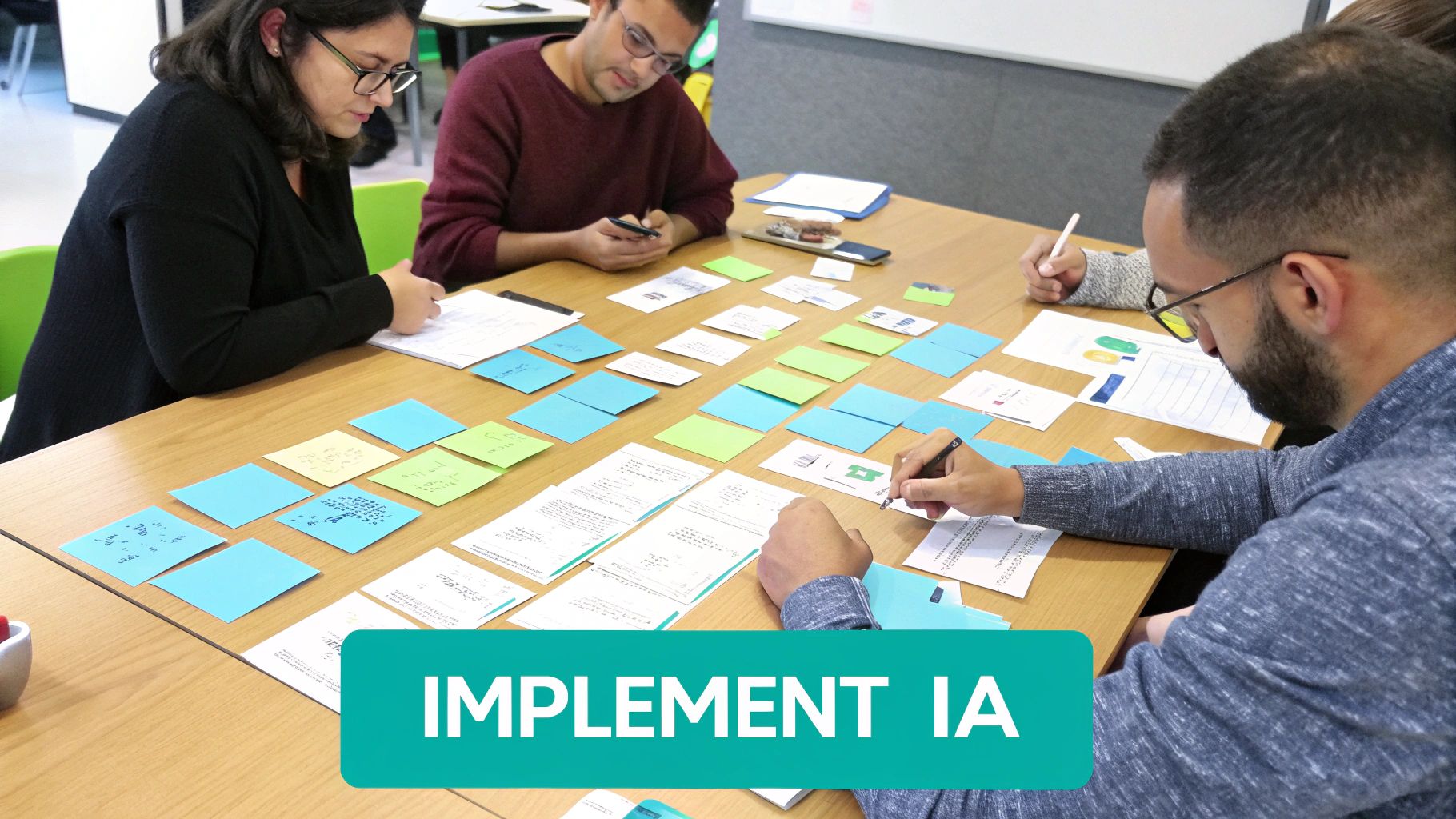
This is a team sport. It brings everyone to the table—stakeholders, users, designers—to agree on how your information should be structured to meet real-world needs and hit business goals. Let’s break the process down into three manageable phases.
Phase 1: Audit and Discovery
Before you can build anything new, you have to know what you’re working with. The audit and discovery phase is all about gathering intelligence. Good decisions are based on data, not assumptions, and this is where you get that data.
This first step boils down to three key activities:
Conduct a Content Inventory: This isn’t just a simple list of pages. We’re talking about a comprehensive spreadsheet of every digital asset—pages, documents, videos, product data—fleshed out with metadata like author, creation date, and performance metrics. In a Sitecore environment, this inventory becomes a crucial map for planning content migrations and deciding what to keep, update, or ditch.
Analyze User Behavior: Fire up your analytics tools and see how people actually use your site. Heatmaps, user flow reports, and internal search queries will show you exactly where the pain points are. For example, if dozens of users search for "product specs" only to land on a generic marketing page, you’ve found a clear disconnect your new IA needs to fix.
Align with Business Goals: Talk to stakeholders across different departments. What are the key performance indicators (KPIs) for marketing? What information does the sales team need right at their fingertips to close deals? This ensures your IA supports tangible business outcomes, not just a slick user interface.
Phase 2: Strategy and Design
With a clear picture of your content, user behavior, and business goals, it’s time to start designing the new structure. This is where you create the architectural blueprint for your DXP, using proven, user-centered techniques to build something truly intuitive.
Two foundational methods here are card sorting and tree testing.
Card Sorting: This is a fantastic exercise. You give representative users a set of digital "cards"—each one representing a piece of content—and ask them to group the cards in a way that makes sense to them. It’s a bottom-up approach that uncovers your audience’s mental models, helping you define categories and labels that actually resonate. This forms the basis for your SharePoint Term Store or Sitecore taxonomy.
Tree Testing: Once you have a proposed structure (your "tree"), you test it before building it. You give users tasks like "Find the warranty information for Product X" and track whether they can navigate the proposed menu successfully. This validates your navigational design before you sink a single hour into development.
A successful design phase translates these user insights into a concrete sitemap, wireframes, and a detailed content model. This model defines the content types and their relationships, which is essential for enabling Sitecore AI to deliver effective personalization.
Phase 3: Implementation and Governance
The final phase is all about bringing your blueprint to life and putting processes in place to keep it healthy over time. This is where your strategy becomes a functional reality inside your chosen platform.
For a Sitecore implementation, this involves migrating content into the new, structured content models you've designed. It’s a meticulous process that ensures every piece of content is correctly tagged and categorized, which is critical for findability and reuse in something like Sitecore Content Hub. For those looking to go deeper, our guide offers more on the best practices for enterprise IA design.
Once live, governance is everything. An IA is a living system, not a static document, and it needs ongoing maintenance. Establishing clear governance means:
- Defining Roles and Responsibilities: Who is responsible for creating and tagging new content? Who gets to approve changes to the taxonomy?
- Creating Documentation: Maintain clear guidelines on labeling standards, metadata requirements, and content archival policies.
- Regular Audits: Periodically review the IA to make sure it still aligns with user needs and business goals, making adjustments as the world changes.
By following this phased approach, you can lead a digital project with an IA-first strategy that minimizes risk, aligns everyone on the same goals, and sets you up for long-term success and scalability.
Common Questions About Information Architecture
As you start putting information architecture principles into practice, a few questions always seem to pop up. Here are some straightforward answers to the most common ones, designed to help you solidify your understanding and have confident conversations with your team and stakeholders.
Think of these as the bridge between theory and the real-world challenges you'll face, especially in enterprise systems like Sitecore and SharePoint.
What Is the Difference Between IA and UX Design?
Let's use an analogy. Think of information architecture as the blueprint of a house. It’s the structural plan that decides where the rooms go, how big they are, and how the hallways connect everything. A good blueprint makes sure the house is logical and easy to get around in.
UX design, then, is the experience of living in that house. It’s the interior design—the paint colors, the furniture, the lighting, and how it all makes you feel. IA provides the essential foundation—navigation, taxonomy, and clear labels—that UX designers build upon to create a journey that feels effortless and enjoyable.
The bottom line is simple: You can't have great UX without a solid IA.
How Does IA Impact AI Personalization in Sitecore?
Information architecture is the fuel that runs Sitecore's powerful AI engine. For the AI to deliver truly relevant, one-to-one personalization, it needs well-organized, structured data. A strong IA with clear taxonomies and rich metadata is what lets Sitecore AI understand complex relationships between content and correctly interpret what a user is trying to do.
Without that organized foundation, the AI is essentially flying blind. It might make generic recommendations, but it will consistently miss the mark. A well-designed IA ensures the AI can connect the right content to the right user at the perfect moment, which is what truly drives engagement and conversions.
A robust IA doesn't just help Sitecore's AI find content; it teaches the AI what the content means. This contextual understanding is the secret to moving from basic personalization to creating truly predictive, high-impact digital experiences that drive business results.
This structure allows the AI to make intelligent connections that would be impossible in a disorganized content environment, unlocking the full power of the platform.
How Do You Measure the Success of a New Information Architecture?
Measuring the success of a new IA isn't about a single metric; it’s about looking at both quantitative and qualitative data. Together, they paint a complete picture of its business impact and return on investment.
On the quantitative side, you need to track key performance indicators that show people are finding things more easily and sticking around longer. Look for tangible improvements like:
- Lower bounce rates, which tells you users are finding what they expected when they land on a page.
- Increased pages per session, showing that your navigation encourages them to explore more deeply.
- Higher task completion rates, like finishing a purchase or submitting a form successfully.
- Fewer failed searches, which is direct proof that your search and retrieval systems are working better.
Qualitatively, user feedback is gold. Run user testing sessions or send out satisfaction surveys to ask people directly: "Is the new site easier to navigate?" or "Can you find information more quickly?" Positive feedback here confirms your structural changes have genuinely made the user experience better, giving you the "why" behind your hard numbers.
At Kogifi, we specialize in designing and implementing enterprise-grade information architectures that unlock the full potential of platforms like Sitecore and SharePoint. If you're ready to build a scalable, intuitive, and high-performing digital foundation, let's talk. Explore our DXP and CMS solutions to learn more.