


The idea of personalization of content is pretty straightforward: you dynamically change what a user sees based on who they are, what they’ve done, and what they seem to like. It’s about turning a generic, one-size-fits-all website into a one-to-one conversation. Instead of shouting the same message at everyone, you deliver content that actually connects with each visitor on a personal level.
Moving Beyond One-Size-Fits-All Content

In a world drowning in digital noise, generic messages just don't cut it anymore. Real connection happens when you speak to customers as individuals, not as a faceless crowd. This guide will show you exactly how to transform your digital presence from a static brochure into a living, breathing conversation that adapts to every user.
Think of it this way: personalization is the difference between a cold sales pitch and a chat with a trusted advisor who already knows what you need, sometimes even before you do. It's about creating those small moments of relevance that build genuine trust and get people to act.
The Business Value of Individualized Experiences
At its core, the logic behind content personalization is simple but incredibly powerful. When people feel seen and understood, they're far more likely to stick around, make a purchase, and come back for more. This isn't just a feel-good metric; it translates directly into tangible business results.
The benefits ripple out, creating a positive feedback loop that strengthens your business:
- Increased Engagement: When content is relevant, it grabs attention. People spend more time on your site and are more likely to interact with your brand.
- Higher Conversion Rates: Showing the right offer at the right time smooths out the customer journey, gently guiding them toward checkout or another key goal.
- Enhanced Customer Loyalty: Consistently delivering experiences that meet a user's needs builds serious brand affinity. It's how one-time buyers become lifelong advocates.
Personalization is no longer a "nice-to-have" feature—it’s a baseline expectation. A staggering 80% of consumers say they are more likely to do business with a company that offers personalized experiences. That makes it an essential part of any modern digital strategy.
The Role of Technology in Personalization
Of course, delivering this kind of relevance at scale isn't something you can do manually. It takes powerful technology. Platforms like Sitecore DXP are built for this exact purpose, giving you a sophisticated set of tools to gather data, segment audiences, and serve up tailored content across all your channels. In a similar vein, tools like SharePoint bring the same power to internal communications, making sure employees see information that’s relevant to their specific roles.
Throughout this guide, we'll unpack how these platforms provide the engine for building truly individualized digital experiences—from the foundational concepts to advanced, AI-driven strategies that deliver a clear return on your investment.
How Content Personalization Actually Works
Content personalization isn't a single "flip-the-switch" action. Think of it more as a journey, one that starts with simple, foundational tactics and builds toward sophisticated, data-driven experiences that feel almost intuitive to the user. Layering your approach like this is the secret to a successful and scalable strategy.
The easiest place to start is with rule-based personalization. This is essentially creating a set of "if-then" instructions for your website. A classic example? Showing a different homepage banner to a first-time visitor versus a logged-in, returning customer. It’s a powerful first step because you, the marketer, are in direct control.
The Foundation: Rules and Segmentation
Inside a platform like Sitecore, the Rules Engine is your command center for this foundational level. It lets marketers visually build conditions without touching a line of code, using explicit data points that are readily available.
At the heart of it all is a solid understanding of segmentation and how it drives sales. Simple but effective segments can be built around:
- Geolocation: Showing content relevant to a visitor's country or city.
- Referral Source: Displaying a tailored welcome message for users coming from a specific ad campaign.
- Device Type: Optimizing the layout and content for someone on their phone versus a desktop.
- Time of Day: Promoting a breakfast special during the morning commute.
Even platforms like SharePoint use this concept with "audience targeting." Administrators can show specific news, documents, or navigation links to employees based on their department or role, making sure internal communications are just as relevant as external marketing.
Evolving to Behavioral and Profile-Based Personalization
Rules are a great starting point, but real engagement happens when you respond to a user's behavior in real-time. This is where behavioral targeting enters the picture. Instead of just reacting to who a user is, you start reacting to what they do.
This next level means tracking the implicit signals—the digital breadcrumbs users leave as they explore your site. This is where Sitecore really shines with its Profile and Pattern Cards. As a user clicks on content about a specific topic, they accumulate "profile points," building an affinity score. The system can then match them to a predefined persona, or "Pattern Card," which triggers automated personalization.
For instance, imagine a visitor who keeps reading articles about enterprise-level software. The system can match them to a "Technical Decision-Maker" persona and automatically start surfacing relevant case studies and technical whitepapers. The journey instantly becomes far more compelling.
The Personalization Maturity Model
This journey from simple rules to automated profiling is best understood as a maturity model. It makes it clear that you don’t have to achieve perfect one-to-one personalization overnight. Instead, you can build your capabilities strategically, proving value at each step.
Below is a table outlining the typical stages. It’s a useful tool for figuring out where you are now and what your next move should be.
The Four Levels of Personalization Maturity
The path forward is clear. For enterprises using platforms like Sitecore, moving up the maturity ladder—from manual segmentation to intelligent, automated content delivery—is how you gain a real competitive advantage and create experiences that truly connect with people.
Driving Hyper-Personalization with AI
While rule-based and behavioral targeting are powerful, they have a ceiling. They're built on human logic, which means a person has to define every rule and anticipate every user journey. To deliver millions of unique experiences at once—true personalization at scale—you need an engine that can think and adapt on its own. This is where AI stops being a buzzword and becomes a core business asset.
AI is what unlocks hyper-personalization. Instead of just following a script, AI algorithms dive into massive datasets to find hidden patterns and connections in user behavior that a marketer might never catch. This predictive power flips the script, turning your digital platform from reactive to proactive. It starts anticipating what users need and serves up the right content before they even know to ask for it.
Sitecore AI and Autonomous Personalization
Sitecore has been a leader in weaving AI directly into its platform, especially with its Sitecore AI Auto-Personalization feature. This isn't just some bolt-on tool; it’s a fundamental part of the system designed to take the heavy lifting of data analysis and content delivery off your team's plate.
Here’s a look at how it operates:
- Real-Time Analysis: Sitecore AI is always watching, constantly monitoring every click, view, and form submission on your site.
- Predictive Intent: It uses machine learning to build models that understand the why behind a user's actions. It doesn't just see what someone did; it predicts what they're likely to do next.
- Automated Content Delivery: The system then automatically serves the content variation, offer, or CTA most likely to connect with that specific user in that exact moment. All without anyone needing to manually intervene.
This frees up your marketing team from the never-ending grind of creating and managing hundreds of personalization rules. They can shift their focus to defining strategy and creating great content, letting the AI figure out the best way to deliver it to each individual.
The Personalization Maturity Hierarchy
Making the jump from manual rules to AI-driven experiences is a big leap in sophistication. This progression is often visualized as a maturity hierarchy, moving from simple tactics to the predictive power of AI.
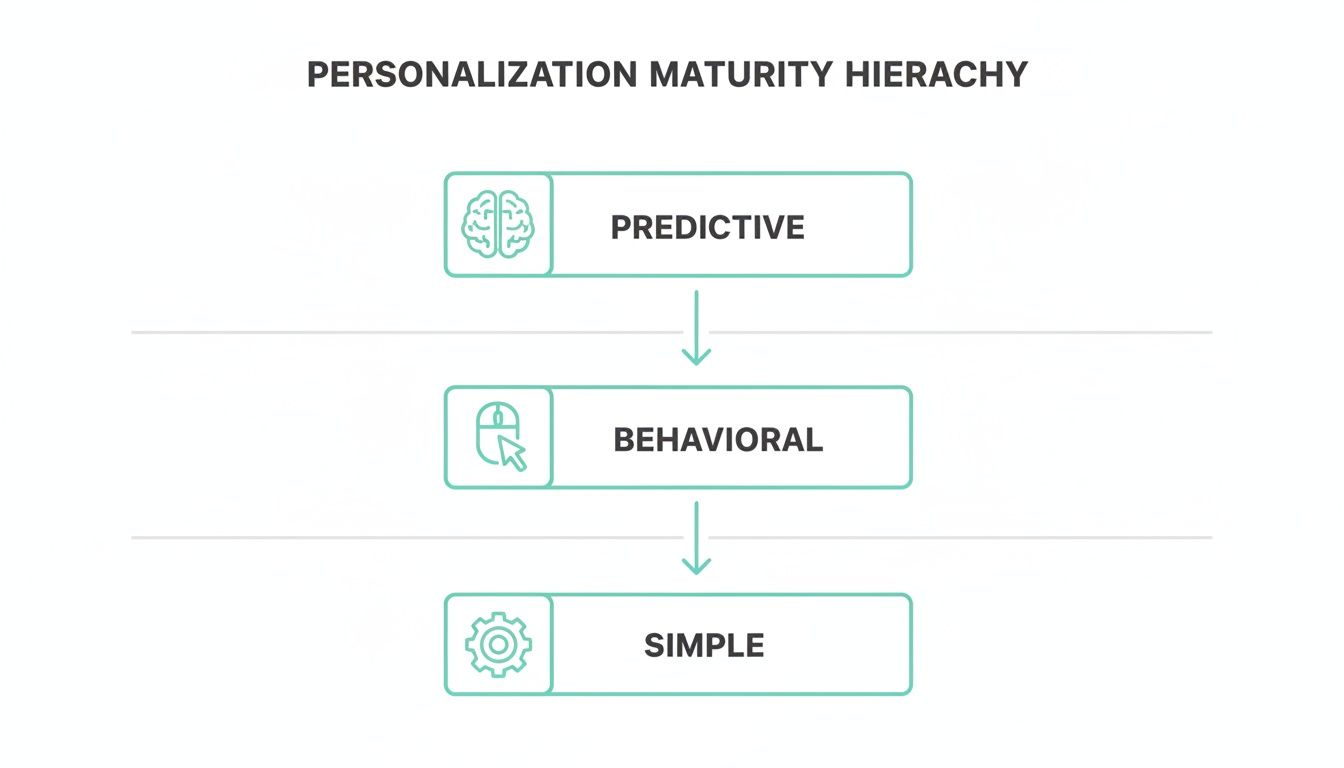
As the hierarchy shows, reaching that predictive level is the endgame. It's where AI takes over the complex decision-making to create genuinely one-to-one user journeys.
Practical Applications of AI in Personalization
Beyond the tech, the real value of AI is in how you use it. To truly leverage its power, a deep understanding of your audience is paramount.
Getting a deep understanding of your audience through advanced methods like AI customer profiling and personalization is the foundation for any hyper-personalization strategy. AI doesn’t replace strategy; it gives it a massive data-driven boost.
This level of insight unlocks sophisticated use cases that drive real business results. The gap between basic and full-journey personalization represents a massive opportunity for growth.
Even platforms like SharePoint benefit from AI, just in a different arena. Within the Microsoft 365 ecosystem, AI powers features like Microsoft Viva and Delve to surface relevant documents and contacts for employees. This internal personalization cuts through information overload and boosts productivity. The principle is exactly the same: use AI to understand context and deliver relevance, whether it’s for a customer or a colleague.
Your Playbook for Personalization in Sitecore DXP
A great personalization of content strategy is more than just a collection of good ideas; it needs a practical, step-by-step process to bring it to life. This is especially true within the Sitecore Digital Experience Platform (DXP). This playbook is where your strategy gets its hands dirty, turning Sitecore's powerful features into real business outcomes.
The first move is always to define what winning looks like. Are you trying to generate more leads, drive e-commerce revenue, or build stronger customer loyalty? Your core business goals will shape every decision you make, from the audience segments you build to the content you serve them.
Building Your Audience Profiles
With your goals locked in, it's time to focus on your audience. Sitecore’s personalization engine runs on two key tools: Profile Cards and Pattern Cards. Think of them as a system for tracking your visitors' digital body language.
A Profile Card is basically a tag for a category of interest. You might create profiles like "Product Features," "Pricing Information," or "Industry Solutions." You then apply these profiles to the relevant content across your website.
As a visitor clicks around, they start to accumulate points for these different profiles, building a unique affinity score. This data gives you a real-time picture of what they actually care about.
From Profiles to Personas
The next layer is the Pattern Card, which is where you define a specific user persona you want to engage with, like a "Budget-Conscious Buyer" or a "Technical Evaluator." These patterns are mapped to the profiles you just created. When a user’s profile scores match a pattern you've set up, Sitecore automatically slots them into that persona.
This is the magic that unlocks automated personalization. The system now understands not just what a visitor is looking for, but who they are in the context of your business.
For example, imagine a visitor who spends most of their time on pages about technical specs and API docs. They'll rack up points in the "Technical Details" profile. If this aligns with your "Developer" Pattern Card, Sitecore can automatically start showing them content like code examples and integration guides.
Activating Personalization with the Rules Engine
Once your audience profiles and personas are ready, you can start making your pages dynamic with Sitecore's visual Rules Engine. This is a game-changer for marketers, allowing them to create simple "if-then" conditions to show specific content components—no coding required.
You can set up rules based on all sorts of criteria:
- Persona Match: If a visitor matches the "Technical Evaluator" pattern, show them the "Advanced Features" component.
- Goal Completion: If a visitor already downloaded a whitepaper, hide that CTA and show a "Request a Demo" button instead.
- Campaign Tracking: If a visitor came from a specific email campaign, show a hero banner that matches the campaign's message.
This kind of component-level personalization is incredibly powerful. Instead of building different versions of the same page, you create one flexible page where the components adapt to each user. It's an efficient, scalable way to make sure every visitor sees the most relevant content.
Extending Your Reach with Sitecore's Composable DXP
While Sitecore XP is a fantastic all-in-one platform, the modern Sitecore ecosystem gives you composable tools to push personalization even further. This is where tools like Sitecore CDP and Sitecore Personalize shine.
Sitecore Customer Data Platform (CDP) acts as the central hub for all your customer data. It pulls in information from every touchpoint—website, mobile app, CRM, even offline interactions—to build a single, unified view of each customer. This demolishes data silos and gives you the rich context needed for true omnichannel personalization.
Building on that unified data, Sitecore Personalize is the orchestration engine. It uses the information from the CDP to run sophisticated, real-time personalization and A/B tests across all your channels, not just your website. You can deliver consistent, tailored experiences through email, mobile notifications, and even in-person interactions. Our guide offers five simple steps toward better personalization with Sitecore Personalize, giving you a clear roadmap for these advanced strategies.
By following this playbook, you can methodically build a personalization machine that drives meaningful engagement and delivers results you can actually measure.
Using SharePoint for Targeted Content Delivery
While platforms like Sitecore are the undisputed champions for customer-facing digital experiences, you can't forget about your internal audience. The principles of personalization are just as critical inside your organization, and that’s where SharePoint shines. As a cornerstone of the Microsoft ecosystem, SharePoint is brilliant at turning a static company intranet into a dynamic, secure productivity hub.
Its real power comes from tapping into the identity and access management infrastructure most companies already have. Instead of building user profiles from scratch, SharePoint hooks right into your organization's user directory. This makes it a remarkably efficient tool for getting the right information to the right people at exactly the right time.
Personalizing the Employee Experience
The most common use for SharePoint’s personalization features is boosting internal employee engagement. Let’s be honest, a generic intranet showing the same news and documents to everyone is just noise. People tune it out. SharePoint's audience targeting feature is the perfect fix, transforming the employee portal into a tool that actually helps people do their jobs.
You can set up web parts—things like news feeds, document libraries, and even navigation links—to appear only for members of specific groups. This simple capability unlocks a deeply contextual experience based on an employee's actual role in the company.
- By Department: The marketing team sees the latest campaign briefs front and center. Meanwhile, the engineering team gets updates on the current development sprint.
- By Role: A regional sales manager logs in to a dashboard with their team’s performance metrics. A new hire sees a welcome message, onboarding materials, and training schedules.
- By Project Team: Members of a cross-functional project get a dedicated space with shared files, calendars, and task lists relevant only to their work.
This is about more than just cleaning up a cluttered homepage. It streamlines access to information, cuts down on wasted time searching for resources, and ensures critical communications are seen by the employees who need them most. The result? A measurable boost in productivity.
Creating Secure Portals for External Partners
SharePoint’s reach also extends beyond the company firewall. It's incredibly effective for serving specific external audiences like partners, vendors, or key clients. Its strength in secure, targeted content delivery makes it ideal for building custom portals where you control exactly who sees what.
By using Microsoft Entra ID (what used to be Azure Active Directory) to manage external users, you can create secure groups and apply the same audience targeting logic. This is a powerful way to share sensitive information without having to build a completely separate, custom-coded website. For businesses looking to get the most out of their Microsoft investment, exploring SharePoint solutions can unlock huge opportunities for better collaboration, both inside and out.
Imagine a manufacturer that needs to share different product specs and inventory data with dozens of distinct distributors. Instead of getting buried in endless email threads, they can create a single SharePoint portal. Each distributor logs in and sees only the documents and data relevant to their account, all secured by their unique identity.
This creates a self-service model that is both highly secure and incredibly efficient. It strengthens partner relationships by providing a professional, personalized digital experience while keeping a tight lock on proprietary information—proving SharePoint's unique role in a complete enterprise content strategy.
Measuring the ROI of Your Personalization Strategy
A personalization of content strategy, no matter how clever, is only as good as the results it delivers. Without clear, data-driven proof of its impact, even the most sophisticated setup is just a costly experiment. To prove your efforts are paying off, you need to look past vanity metrics and tie personalization directly to real business outcomes.
It’s about shifting your focus from tracking simple page views to measuring actual financial returns. A solid measurement framework really boils down to one question: are the personalized experiences driving better results than the generic, one-size-fits-all version? The only way to answer that is with structured, rigorous testing.
Validating Your Strategy with Testing
A/B and multivariate testing are non-negotiable for proving your personalization hypotheses. Within a platform like Sitecore, this isn’t just an add-on; it’s a core function. The built-in testing tools let you put a personalized component up against a control version and let real user behavior tell you which one wins.
This creates a powerful feedback loop driven by data. Instead of guessing which message works best, you can prove it with statistical confidence. This process is absolutely essential for refining your audience segments, making your content more relevant, and showing a clear return on your investment.
For instance, you could test a personalized "Welcome back, [Name]!" hero banner against a generic one. By tracking goal completions—like newsletter sign-ups or product views—you can calculate the exact conversion uplift that tiny touch of personalization generated.
Key Metrics to Track in Sitecore
Sitecore Experience Analytics gives you a rich dashboard to see what's working. To effectively measure ROI, you need to zero in on the metrics that translate directly into revenue and deeper engagement.
- Conversion Rate Uplift: This is your ultimate proof point. Measure how much goal completions (like form submissions or downloads) increase for users who see personalized content versus those who see the default.
- Engagement Value Score: Sitecore lets you assign a value to every goal. By tracking the average engagement value per visit for personalized segments, you can see exactly how much more these users contribute to your business objectives.
- Average Order Value (AOV): For e-commerce sites, this is huge. Compare the AOV of customers who interact with personalized product recommendations against those who only browse the standard catalog.
The numbers don't lie. Data suggests that consumers are significantly more likely to buy when they get relevant product recommendations. We've seen real-world examples where implementing behavior-based recommendations boosted AOV by over 10%. It’s a direct line from smart personalization to revenue growth. You can dig into more of these data-driven insights over on TTEC's blog.
Ultimately, measuring the ROI of your strategy is about connecting every personalization rule and content variation back to a specific business goal. By using the analytics and testing tools inside platforms like Sitecore, you can turn personalization from a marketing tactic into a measurable engine for business growth.
Common Questions About Content Personalization
As you start mapping out a personalization of content strategy, some questions and practical challenges are bound to pop up. Here are some clear, direct answers to the queries we hear most often, helping you navigate the real-world details of getting it done.
What Is the Difference Between Personalization and Customization
This is a really common point of confusion, but the distinction is critical for your strategy.
Personalization is system-driven. The platform, like Sitecore, uses data and automation to automatically adjust the experience for a user without them having to lift a finger. Think of Netflix suggesting a new show based on what you’ve already watched.
Customization, on the other hand, is user-driven. This is when a person manually changes settings to fit their own preferences, like switching an app to dark mode or rearranging widgets on a dashboard. A truly mature digital strategy often uses personalization to serve up a relevant starting point that users can then fine-tune with customization.
How Much Data Do I Need to Start Personalizing Content
You really don't need massive, complex datasets to get started. In fact, it's usually better to start small and focused. You can get immediate value by using basic, explicit data you likely already have in your DXP.
- Geographic Location: Show different promotions to visitors from different countries. Simple, but effective.
- Device Type: Optimize content layouts for mobile users versus those on a desktop.
- Referral Source: Display a tailored welcome message to visitors who clicked through from a specific ad campaign.
The key is to define a clear, high-value segment, prove the impact with these straightforward data points, and then progressively layer in more sophisticated behavioral data as your strategy matures and proves its worth.
Can Personalization Hurt My Website SEO
This is a big one, but the short answer is no—not when implemented correctly. Personalization is SEO-friendly and won't hurt your search rankings. Modern platforms like Sitecore are engineered to handle this gracefully.
Search engine crawlers, like Googlebot, are typically served the default, non-personalized version of your page. You just need to ensure this default version is fully optimized for your target keywords. This allows search engines to crawl and index your core content just as they always have. The personalized variations are then shown only to actual human visitors who meet your criteria. It's a practice that's perfectly safe and completely distinct from "cloaking," which search engines penalize.
Personalization delivers tailored experiences to real users while presenting a consistent, optimized view to search crawlers. You get all the benefits of relevance without taking a hit on your SEO performance.
Is Sitecore or SharePoint Better for Personalization
This isn't really an "either-or" question because they're built for entirely different jobs.
Sitecore is a purpose-built Digital Experience Platform (DXP). It's designed from the ground up for sophisticated, data-driven marketing and omnichannel personalization aimed at external customers. Its entire feature set revolves around creating those engaging, one-to-one marketing journeys.
SharePoint is a premier platform for secure collaboration and internal communication. Its strength lies in powerful audience targeting for internal employees or specific partners, pulling from existing user directories like Microsoft Entra ID.
The right choice depends entirely on your primary goal. Are you trying to drive external marketing results (Sitecore) or boost internal engagement and secure collaboration (SharePoint)?
Ready to transform your digital presence with a powerful personalization strategy? The experts at Kogifi specialize in implementing advanced Sitecore and SharePoint solutions that deliver measurable results. Start your personalization journey today.