


A headless commerce platform is an e-commerce solution where the back-end functions—like inventory, pricing, and orders—are completely separated, or decoupled, from the front-end presentation layer, which is the website or app your customers see. This API-first architecture gives you the freedom to send product data to any customer touchpoint, from a classic website to a mobile app, a smart kiosk, or even a voice-activated device, without being stuck with a rigid front-end design.
Unlocking a New Era of Digital Experiences
Think of your e-commerce business as a high-end restaurant. In a traditional, monolithic setup, the kitchen (your back-end) is physically attached to the dining room (your website). You can't change the dining room's layout or decor without causing a major disruption in the kitchen.
A headless commerce platform completely changes this model by separating the two.
Your back-end becomes a central, high-tech commissary that can fulfill orders for any dining experience you can dream up. It can seamlessly serve:
- A fine-dining website with rich, immersive visuals.
- A food truck’s streamlined mobile app for quick orders on the go.
- A pop-up event kiosk with a simple touchscreen interface.
- A voice-activated ordering system for smart home devices.
This separation is made possible by an API-first architecture. Application Programming Interfaces (APIs) act as the universal messengers between your back-end "kitchen" and any front-end "dining room" you create. This gives you the creative freedom to build unique and compelling customer experiences on any channel, free from the constraints of your back-end systems. You can learn more about this foundational concept in our detailed guide on headless commerce.
Headless Commerce vs Monolithic Commerce at a Glance
To really understand the shift, it helps to see the two approaches side-by-side. The traditional monolithic model bundles everything together, while headless separates the front-end from the back-end, offering far more flexibility.
This table shows just how different the two philosophies are. Headless isn't just a technical tweak; it's a completely new way of thinking about how to build and deliver digital commerce.
The Strategic Shift from Rigid Systems
Moving to headless is more than just a technical upgrade—it’s a strategic move essential for staying competitive. The headless commerce market is growing at a staggering pace, projected to jump from US$ 1.74 billion in 2025 to US$ 7.16 billion by 2032. This explosive growth shows just how quickly businesses are ditching rigid, all-in-one platforms for more flexible, composable solutions that allow for rapid innovation.
By decoupling the front-end, you empower your marketing and development teams to work independently. Marketers can launch new campaigns, test UIs, and create fresh experiences without waiting for back-end development cycles, slashing time-to-market.
For businesses already invested in powerful Digital Experience Platforms (DXPs), this agility is a game-changer. When you integrate a headless commerce platform with systems like Sitecore, it becomes the transactional engine that fuels a world-class digital ecosystem. For instance, Sitecore AI can tap into rich data from a headless system to deliver hyper-personalized content and product recommendations to any front-end you choose.
Likewise, a tool like SharePoint can be transformed into a dynamic B2B purchasing portal by pulling live product data directly from your headless back-end. This kind of orchestration creates a unified, high-performing digital presence that gets the most out of your technology investments.
Understanding the Core API-First Architecture
To really get what makes a headless commerce platform tick, you have to look under the hood at its API-first architecture. This isn't just a technical footnote; it’s a strategic decision that splits the whole system into three distinct, independent layers. This separation is exactly what gives businesses the agility and control they’re looking for.
The Back-End: Your Commerce Engine
At the very bottom, you have the back-end commerce engine. Think of it as the central nervous system for your entire operation. This is the workhorse handling all the critical, non-customer-facing logic—things like inventory, pricing rules, order processing, and customer data. It’s built for one thing: raw processing power and stability, completely detached from any specific design or user interface.
This is where platforms like Sitecore OrderCloud shine. As a MACH-aligned solution, it acts as that powerful back-end engine, managing complex B2B and B2C logic with total precision.
The API Layer: The Universal Translator
The magic really happens in the middle layer: the Application Programming Interface (API). The API acts as a secure, universal go-between. It’s the conduit that lets the powerful back-end engine talk to any front-end experience you can dream up.
When a customer taps "add to cart" on a mobile app, that app isn’t talking directly to your inventory database. Instead, it sends a secure request to the API, which then verifies the action with the back-end and sends a confirmation back to the app. This creates a clean, orderly flow of information, keeping your core business logic safe and sound. To see how this works in more detail, it's worth exploring the basics of an API-first approach.
This layered structure is what you see in the diagram below—a clear separation between the front-end, the API layer, and the back-end.
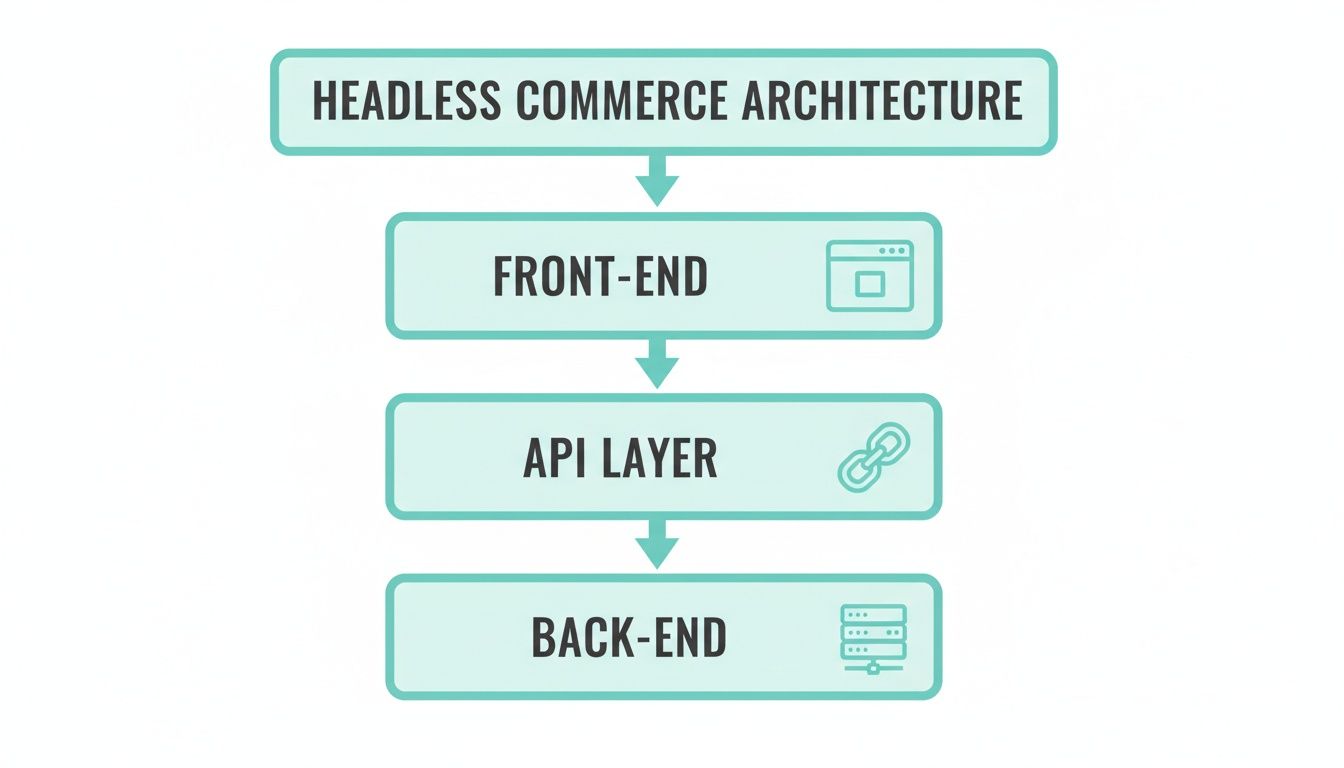
The diagram makes it easy to see how each part has its own job, with the API layer serving as that essential bridge between raw functionality and the customer experience.
The Presentation Layer: Where Creativity Thrives
Finally, we get to the presentation layer, also known as the "head." This is everything your customer sees, touches, and interacts with. And because it's completely decoupled, this layer can be anything you want it to be:
- A sleek, modern website built with React or Vue.js.
- A native mobile app for iOS and Android.
- An interactive kiosk or smart mirror in a physical store.
- A voice-activated shopping assistant.
- An internal procurement portal built on SharePoint.
This separation allows for completely independent development cycles. Your front-end team can experiment with new designs or run A/B tests on the user interface without ever needing to touch—or risk breaking—the core back-end systems. For anyone wanting to go deeper, understanding how to design robust software architecture is fundamental to building an effective API-first system.
This API-first model is the foundation of a composable strategy. It allows you to plug in best-of-breed services for search, payments, or personalization, creating a highly customized and scalable digital ecosystem that perfectly matches your business needs.
Driving Business Growth and Customer Loyalty
A flexible architecture means nothing if it doesn't move the needle on business goals. This is where headless commerce truly shines—it translates technical advantages into real, measurable growth in revenue, customer retention, and market agility. Separating the front-end from the back-end stops being a developer talking point and becomes a powerful business strategy.
By freeing front-end developers from back-end constraints, brands can create lightning-fast, engaging experiences. That speed has a direct impact on user behavior and, most importantly, conversion rates. We all know slow load times are the number one reason for cart abandonment, making speed non-negotiable for e-commerce success.
Accelerating Performance and Conversions
Page load speed isn't just a nice-to-have; it's a core part of the customer experience and a major SEO ranking factor. A headless commerce platform enables lightweight, optimized front-ends built on modern frameworks that serve up content almost instantly. This isn't a small tweak—it's a performance boost with a tangible effect on your bottom line.
Just look at the numbers. Brands that adopt headless commerce have seen significant improvements in conversion rates and page speeds. They’re also slashing the time it takes to launch new digital experiences by half. It’s no surprise that a vast majority of businesses point to greater flexibility and customization as the key benefits.
The ability to launch new features, campaigns, and enter new markets significantly faster gives businesses a critical competitive edge. What might take months on a monolithic system can be accomplished in weeks with a headless approach.
This agility becomes even more powerful when paired with sophisticated platforms like Sitecore. For example, Sitecore AI, which is integrated into products like Sitecore Personalize, can tap into the clean data streams from a headless system to deliver hyper-personalized product recommendations to any front-end. This creates a more relevant journey for each customer, which naturally boosts conversion rates and lifetime value.
Fostering Omnichannel Loyalty
Today’s customers don’t see channels; they see one brand. They expect a seamless experience, whether they're shopping on a mobile app, a desktop site, or an in-store kiosk. Headless architecture is the only way to deliver a true omnichannel presence. Using APIs, you can push consistent product and customer data to any touchpoint, anywhere.
This consistency builds trust and reinforces your brand. A customer might browse on their phone, add items to their cart on a laptop, and complete the purchase through an email link. A headless system orchestrates that entire journey flawlessly, making it feel like a single, unified conversation.
Ultimately, a headless setup is how you drive customer experience across every touchpoint and build lasting loyalty.
Integrating Headless Commerce with Sitecore and SharePoint
This is where the architectural theory of headless commerce really comes to life—when you pair a powerful commerce engine with an enterprise-grade Digital Experience Platform (DXP). For organizations already invested in robust ecosystems like Sitecore or SharePoint, this integration isn't just an upgrade. It's how you turn separate systems into a unified, high-octane engine for growth.
Think of it this way: your headless commerce backend provides all the transactional muscle, while the DXP acts as the maestro, orchestrating the entire customer-facing experience.
By connecting these systems, you create a composable architecture, giving you the freedom to pick the absolute best tool for every job. Your headless platform expertly handles the nuts and bolts—orders, products, and pricing. Meanwhile, your DXP is free to excel at content management, personalization, and customer analytics. The API layer is the crucial handshake between them, ensuring data flows seamlessly and instantly.
Fusing Sitecore AI with Headless Commerce
Modern Sitecore, especially when combined with a MACH-aligned solution like Sitecore OrderCloud, is practically built for this kind of headless integration. OrderCloud becomes the powerful, API-first commerce engine humming in the background, effortlessly managing even the most complex B2B and B2C logic.
This setup frees up the Sitecore Experience Platform (XP) or XM Cloud to do what it does best: craft and deliver truly exceptional, personalized digital experiences.
But the real magic happens when you bring Sitecore AI into the mix. A headless commerce platform is a goldmine of data, constantly generating a stream of valuable transactional and behavioral insights—every product view, every abandoned cart, every purchase. This data is fed directly into Sitecore's personalization and AI engines through APIs.
By tapping into these rich data streams, Sitecore AI can deliver hyper-personalized content and product recommendations to any front-end. It's no longer about showing generic promotions; it's about predicting customer intent and presenting the perfect offer at the perfect moment, on any device.
This creates a powerful, self-improving feedback loop:
- Data Capture: The headless commerce backend records every single customer interaction.
- AI Analysis: Sitecore AI crunches this data, identifying patterns and individual preferences.
- Personalized Delivery: The DXP then serves up tailored content and product carousels to the customer’s chosen front-end—be it a website, mobile app, or kiosk.
- Iterative Improvement: The cycle repeats, getting smarter and more refined with every interaction.
This synergy empowers marketing teams to design and launch sophisticated campaigns without ever needing to touch the core commerce logic. The result? A dramatic reduction in time-to-market for new initiatives.
Transforming SharePoint into a Commerce Powerhouse
While many think of SharePoint as just an intranet or document library, it has the flexibility to become a powerful front-end for very specific commerce scenarios—especially in the B2B world. When you connect it to a headless commerce platform, SharePoint can be transformed into a secure, feature-rich portal for internal procurement or partner purchasing.
Imagine a global company with hundreds of departments constantly ordering supplies. Instead of a clunky, manual process, you could build a SharePoint-based portal that feels completely familiar to your employees. Using APIs, this portal would pull live product catalogs, pricing, and inventory levels directly from your headless commerce platform.
This integration allows you to:
- Build Custom B2B Portals: Create secure, authenticated purchasing experiences for partners, distributors, or internal teams within an environment they already know.
- Leverage Existing Infrastructure: Maximize your current SharePoint investment by using it as the foundation for a modern e-commerce solution.
- Streamline Workflows: Weave purchasing directly into your established business processes and approval chains right inside SharePoint.
The headless back-end does all the heavy lifting—managing complex logic like customer-specific pricing tiers or bulk ordering rules—while SharePoint provides the user-friendly interface. It's an expert integration that maximizes your investment in both platforms, creating a cohesive digital ecosystem that serves everyone.
If you want to dive deeper, you can explore our comprehensive headless commerce solution guide.
How to Select the Right Headless Platform
Choosing a headless commerce solution isn't just about ticking off features on a list; it's a major strategic decision. You’re not just buying software—you’re picking a long-term partner for your digital journey. The right platform has to solve today’s problems and be ready for whatever comes next, especially when it needs to play nicely with a sophisticated DXP like Sitecore.
A solid evaluation framework cuts through the marketing fluff and gets to the heart of what will actually help your business grow. This means taking a hard look at the core components that will give your teams, from developers to marketers, the power to create standout customer experiences.
Assessing API Maturity and Documentation
The API is the absolute backbone of any headless setup. Its maturity is a direct reflection of the platform's power and reliability. When you’re evaluating a solution, look for documentation that is comprehensive, well-structured, and easy for your developers to work with. A powerful API gives you both flexibility and stability, letting you hook into your existing tech stack without a headache.
For example, a mature API will connect seamlessly with Sitecore AI, allowing the rich flow of transactional data needed to fuel hyper-personalization. On the other hand, a poorly documented or rigid API just creates development bottlenecks and kills your ability to innovate.
The quality of a platform's API directly impacts your total cost of ownership (TCO). A well-designed API reduces development hours, simplifies integrations, and lowers long-term maintenance costs, while a weak one creates technical debt.
Evaluating Scalability and Ecosystem Strength
An enterprise-grade headless commerce platform has to be built to handle massive traffic spikes from anywhere in the world without breaking a sweat. You need to dig into its underlying cloud-native architecture and look for proven examples of it scaling on demand. This is non-negotiable for any business looking to break into new markets or survive high-volume events like Black Friday.
Just as important is the strength of the developer community and ecosystem around the platform. A vibrant community and a clear product roadmap are tell-tale signs of a healthy, forward-thinking company. This ecosystem ensures you can find skilled talent when you need it and see what new features are coming down the line that might align with your own goals.
This is especially true when looking at solutions like Sitecore OrderCloud, which is built on a MACH architecture (Microservices, API-first, Cloud-native, Headless) from the ground up to scale and evolve. A strong platform also makes it easier to integrate with tools like SharePoint, letting you build powerful B2B portals that pull in live product data effortlessly.
To help you cut through the noise, here's a table outlining the critical factors your enterprise should consider when choosing a headless commerce platform. Think of it as a guide to asking the right questions and understanding why each element is crucial for a future-proof investment, especially in the context of your DXP.
Key Enterprise Selection Criteria for Headless Platforms
Ultimately, selecting the right platform comes down to finding a partner that not only provides a powerful API and scalable architecture but also aligns with your long-term vision. A thorough evaluation focused on these key criteria will ensure you make a choice that fuels growth for years to come.
A Phased Roadmap to Headless Implementation
Making the move to headless commerce isn’t like flipping a switch. It’s a journey that needs a clear, structured roadmap to make sure the transition is smooth, hits your business goals, and doesn’t cause chaos along the way. A methodical, phased approach turns a massive technical project into a manageable, value-driven process.
Everything kicks off with deep discovery and strategy. This is where your business ambitions meet the technical blueprint. We're talking about mapping out customer journeys, nailing down the key performance indicators (KPIs) that actually matter, and doing a full audit of your current tech stack—your DXP, CRM, ERP, the works. The goal here is to create an ironclad plan that guides every single step that follows.
For companies already on Sitecore, this stage is absolutely critical. You have to map out exactly how a solution like Sitecore OrderCloud will talk to the Sitecore Experience Platform. The strategy needs to detail how transactional data will feed into Sitecore AI to drive truly effective personalization.
The Implementation Phase
With a solid strategy in hand, the implementation phase can begin. This is where the real technical heavy lifting happens, but it’s broken down into smaller, parallel workstreams to keep things moving and under control.
This phase typically includes these key steps:
- Data Migration: The careful, often tedious, process of moving your product catalogs, customer data, and order histories from the old system to the new headless commerce platform.
- API Integration: Building out the sturdy API connections between your headless back-end and your other core business systems, like Sitecore or SharePoint, to ensure data flows freely and accurately.
- Front-End Development: Bringing the new customer-facing experiences to life on your chosen frameworks, all hooked up to the back-end through those powerful APIs.
This whole phase is iterative, not linear. Your teams should be working in parallel. While the front-end developers are busy crafting the user interface, the back-end specialists can be configuring the commerce engine and setting up integrations. For example, connecting SharePoint to pull real-time product data for a B2B portal can happen at the same time the consumer-facing mobile app is being built.
Launch and Optimization
The final phase is all about the launch and what comes next: continuous optimization. A smart launch is often staggered. You might start with a single market or one specific brand to minimize risk before going all-in. Once you’re live, the focus immediately shifts to monitoring and improving performance.
This means keeping a close eye on site speed, API response times, and of course, conversion rates. Using tools like A/B testing, you can constantly refine the user experience based on what real customers are actually doing. This is where the true agility of a headless commerce platform shines—you can make quick tweaks and improvements to the front-end without ever having to touch the back-end.
This global shift is happening fast. North America currently holds a huge chunk of the market, but the Asia Pacific region is showing the fastest growth. This trend is particularly important for public sector organizations and Saudi Arabian firms that require platforms with robust multilingual and accessibility features. Headless architecture is perfect for omnichannel strategies and AI-powered personalization, which are central to Kogifi's work with Sitecore AI and AEM. You can dig deeper into these trends by exploring the headless commerce market size and growth. Partnering with an experienced implementation specialist is the best way to navigate these phases and maximize your ROI right from the start.
Frequently Asked Questions
When you're thinking about a big architectural shift like moving to headless commerce, it’s natural to have questions. This is a major investment in your digital future, so getting the details right is crucial. Here are some of the most common questions we hear from enterprise leaders, especially those working within a Sitecore-centric world.
Is Headless More Expensive Than Traditional Commerce?
It’s true that the initial setup cost for headless can seem higher, mostly because you're developing the front-end separately. But when you look at the total cost of ownership (TCO), the story changes completely. A headless architecture is an investment that pays off by making you more agile.
Over the long haul, this approach actually saves you money by:
- Allowing for quick, isolated updates without putting the whole system at risk.
- Making it simple to plug in new technologies as they come along.
- Getting rid of those massive, expensive, platform-wide overhauls you have to do every few years.
How Does Headless Commerce Enhance Sitecore AI?
A headless architecture and an advanced personalization engine like Sitecore's are a perfect match. Because your front-end presentation layer is completely separate, you can hook in powerful tools like Sitecore Personalize without any back-end headaches.
The real magic is in the data flow. Sitecore's AI can pull rich, real-time data on transactions and customer behavior directly from your headless commerce back-end and Customer Data Platform (CDP) through APIs. This is what lets it deliver truly hyper-personalized content, smart product recommendations, and offers that feel perfectly in-context, no matter which front-end you're using.
Do We Need a Large In-House Team?
To manage a headless setup, you definitely need skilled people—front-end developers who know their way around modern JavaScript frameworks and back-end developers who are comfortable with API integrations. However, you don't necessarily have to hire them all yourself. Many enterprises choose to bring in a specialized agency instead.
Partnering with an expert gives you instant access to a team that already understands both DXP systems like Sitecore and the specific challenges of a headless commerce platform. This move sidesteps hiring delays, gets your project off the ground faster, and ensures everything is built on proven best practices from the very start. It’s a strategic way to get the maximum return on your investment without the overhead of building a huge internal team from scratch.
At Kogifi, we specialize in integrating powerful headless commerce solutions with enterprise DXPs like Sitecore and SharePoint to create seamless, high-performing digital ecosystems. Discover how our expertise can accelerate your digital growth.