

Effective marketing automation is way more than just a fancy email scheduler. Today, it’s the engine that powers scalable, personalized customer engagement inside an enterprise Digital Experience Platform (DXP). For marketing and IT leaders, the real game is turning mountains of customer data into smart, real-time actions that actually move the needle on business growth. This is exactly where a modern, composable DXP like Sitecore becomes your most valuable player, particularly with its advanced Sitecore AI capabilities.
Why Marketing Automation Is A Core Enterprise Strategy
Let's be clear: marketing automation has officially graduated from a tactical tool to a foundational part of digital business. It's the connective tissue linking every customer touchpoint, from their first click to their hundredth purchase. It creates a system that doesn't just talk at customers but intelligently orchestrates their entire experience. When you weave automation deep into your DXP, you’re building a competitive advantage that’s incredibly hard for others to copy.
The market growth tells the same story. The global marketing automation software market is expected to jump from USD 8.16 billion in 2026 to a massive USD 14.98 billion by 2031, growing at a 12.92% CAGR. This isn't just a trend; it's a fundamental shift showing how enterprises are leaning on automation to manage complex digital experiences on platforms like Sitecore AI—a specialty we live and breathe at Kogifi. You can dig into the full market research on Mordor Intelligence.
The Strategic Value Beyond Efficiency
Sure, many organizations get into automation for the efficiency gains—and who doesn't love cutting down on manual tasks? But that’s just scratching the surface. The real power is in driving strategic outcomes. It's about building a system that learns from every interaction, adapts on the fly, and delivers tangible value at every stage of the customer lifecycle.
To get there, your strategy needs to be built on a few core pillars. Think of them as the non-negotiables for a modern, enterprise-grade approach.
We've summarized these essential components below, connecting the technology you use with the business outcomes you're aiming for.
Core Pillars Of An Enterprise Automation Strategy
By grounding your strategy in these pillars, automation stops being about just "running campaigns" and starts becoming about building genuine relationships at an enterprise scale.
The goal is to anticipate what your customers need before they even know they need it. That’s the shift from reactive to proactive engagement.
Sitecore and SharePoint: A Powerful Combination
In any large enterprise, no platform is an island. While Sitecore AI acts as the brain for customer-facing interactions, SharePoint often serves as the backbone for internal content and collaboration. Integrating the two isn't just a good idea; it's a strategic move that creates powerful synergy.
Imagine your marketing assets, legal disclaimers, and compliance-approved content are all managed within SharePoint. By integrating it with Sitecore, you can seamlessly pull that approved content directly into your automated customer journeys. This is a game-changer for global organizations juggling multiple brands or navigating strict regulatory environments.
This kind of architectural decision transforms SharePoint from a simple document library into a vital part of your marketing automation machine, ensuring governance and speed can finally coexist. It’s this unified approach that unlocks the full potential of your DXP investment.
Architecting Your Composable DXP For Automation
Great marketing automation runs on a great technical foundation. Let's move past the strategy slides and get into the practical blueprint for architecting a composable Digital Experience Platform (DXP). We'll put Sitecore at the center and strategically plug in essential systems like SharePoint. This isn't just about connecting apps; it's about making smart architectural choices that pave the way for real intelligence and scale.
Think of the process as a simple, logical flow: from raw data to a meaningful customer interaction.
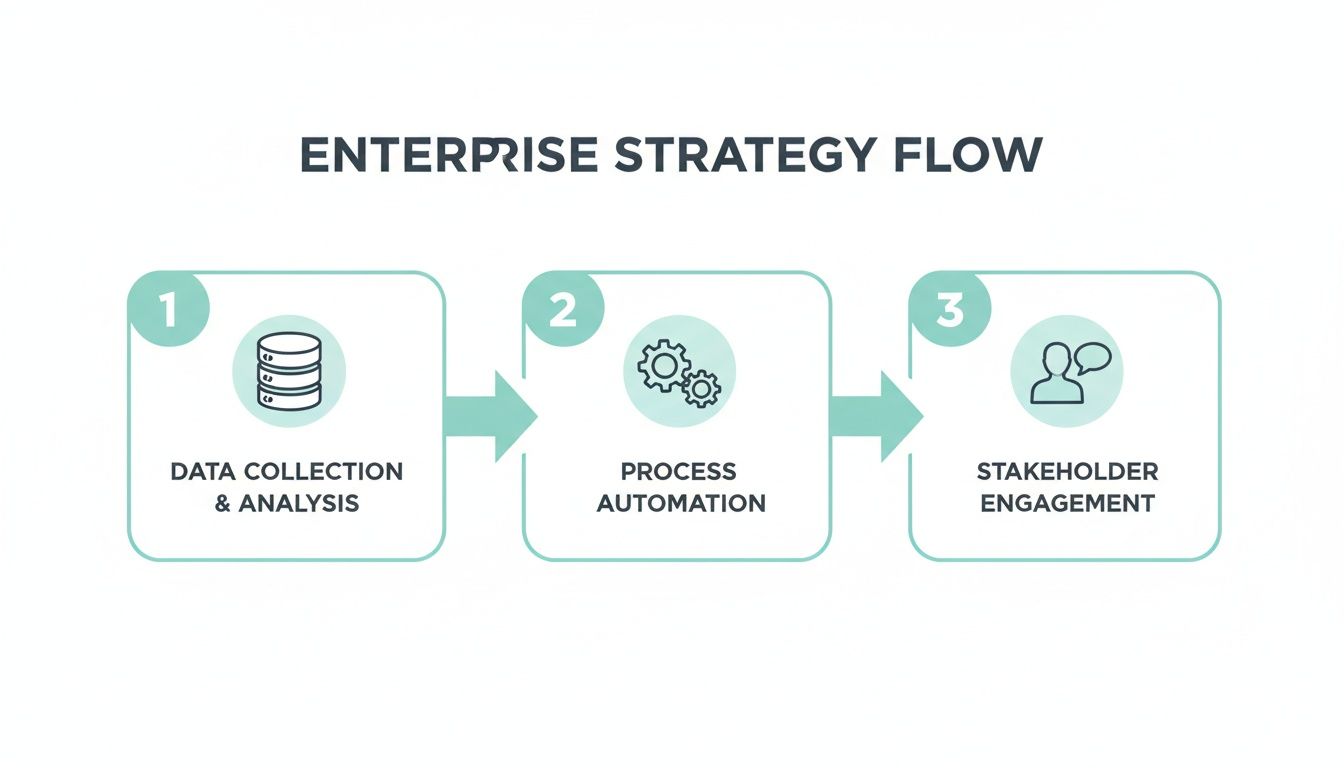
This diagram nails the core enterprise strategy. Unified data feeds intelligent automation, which then drives personalized engagement everywhere your customers are. If your data is a mess, any automation you build is on shaky ground, leading to fragmented and frustrating customer experiences.
Building The Unified Customer Profile With Sitecore
The first big architectural hurdle is breaking down data silos. Right now, your customer data is probably scattered across a CRM, an ERP system, and a dozen other platforms. A composable DXP tackles this head-on by putting a powerful data engine at the heart of your tech stack.
This is exactly what Sitecore’s product suite is built for. The two key players here are Sitecore Customer Data Platform (CDP) and Sitecore Personalize.
- Sitecore CDP: This is the central nervous system for all your customer data. Its main job is to pull in data from every source imaginable—website behavior, transaction history from your ERP, support tickets from your CRM—and stitch it all together into a single, cohesive customer profile.
- Sitecore Personalize: This is the action engine. It takes those rich, unified profiles from the CDP and uses them to deliver real-time, 1:1 personalization on your website, in your mobile app, and across other digital channels. This is where data becomes a relevant, context-aware experience.
By taking an API-first approach, you design a system where information flows freely. For instance, when a customer’s support ticket is closed in your CRM, that event data can be pushed to Sitecore CDP in an instant. This updates their profile and could trigger an automated "How was your support experience?" email journey.
Integrating SharePoint For Enterprise Content Governance
While Sitecore is busy managing the front-end customer experience, SharePoint often remains the undisputed champion of internal content management and collaboration. A well-designed DXP architecture doesn't try to replace SharePoint; it leverages it as a governed repository for marketing assets, legal disclaimers, and official product information.
The real architectural win here is creating a headless content flow. Imagine this: a marketing team gets a new campaign asset approved in a SharePoint library. Via an API, that asset is automatically synced to Sitecore's content repository, making it instantly available for an automated email campaign or a personalized web component.
This integration solves a classic enterprise bottleneck. It guarantees that only compliance-approved content makes it into customer communications, which keeps your brand consistent and your legal team happy—all without slowing marketers down. This structure gives your marketing automation strategies the agility they need while maintaining the governance enterprises demand. For a deeper dive, check out our guide on how to build composable DXPs for scalable personalization.
Designing For Cloud-Native Scalability
Finally, your entire architecture needs to be built for the cloud. Deploying Sitecore on a platform like Microsoft Azure gives you the elasticity to handle sudden traffic spikes and massive data loads—an absolute must for real-time personalization.
This means designing data schemas that can grow and adapt as you start collecting new types of customer information. It also means thinking in terms of microservices, where different parts of your DXP can scale independently. Your personalization engine might need more resources during a holiday sale, but your content repository might not.
This modern approach ensures your marketing automation engine can support millions of personalized interactions without a hint of performance lag, future-proofing your investment for whatever comes next.
Unlocking True Hyper-Personalization With Sitecore AI
Moving past basic triggers is where your marketing automation strategy really starts to pay off. This is where Sitecore AI comes in, a set of tools designed to turn customer data into predictive, personalized experiences that actually drive growth. It’s a shift from just sending the right message to sending it to the right person at the perfect moment—sometimes before they even realize they need it.
The real power of Sitecore AI is its ability to learn from every single interaction. It digs into behavioral data across your website, apps, and other touchpoints to build a deep understanding of what each user intends to do. This constant learning loop is what makes its predictive features so sharp, making your automation smarter over time.
Predictive Segmentation Beyond The Obvious
Traditional segmentation looks backward, focusing on what a customer has already bought or which pages they’ve visited. Sitecore AI flips that script with predictive segmentation. It spots high-value customer groups based on how likely they are to take a future action, whether that’s making a purchase or churning.
Imagine spotting a group of users whose subtle behaviors are known to lead to high cart abandonment rates. The system can flag them as "at-risk" before they even add an item to their cart. This lets you step in proactively with a personalized pop-up offering free shipping or a timely chat prompt, heading off the problem before it even happens.
This predictive power is a complete game-changer. Instead of reacting to abandoned carts, you start preventing them. You're no longer cleaning up missed opportunities; you're creating successful conversions from the start.
Automating Dynamic Content And Offers
Once you have your predictive segments, the next step is to automate the delivery of hyper-relevant content. Sitecore AI is fantastic at dynamic content optimization, automatically testing and serving up the content variations most likely to click with each individual user.
Here’s how that looks in the real world:
- Homepage Hero Banners: An anonymous visitor who has been reading business-focused blog posts is automatically shown a banner for a new B2B case study. Meanwhile, a returning customer who just bought a specific product sees a banner promoting a related accessory.
- Personalized Offers: A user has viewed a high-end product multiple times but hasn't pulled the trigger. On their next visit, AI-detected purchase intent can automatically trigger a limited-time offer for that exact item.
- Mobile App Engagement: In a retail app, the AI can reorder product categories on the home screen to match a user's browsing history, putting their favorite items right at the top without any manual work.
This isn't about setting a few rules; it's about giving a system the power to make millions of micro-decisions in real-time to optimize every journey. For a full breakdown, our AI personalization in DXP implementation guide is a great resource.
SharePoint’s Role In AI-Powered Personalization
Even in an AI-driven world, content governance is non-negotiable. This is where a tool like SharePoint provides massive value. It serves as the secure, central hub for all the content components—images, copy, legal disclaimers, and promotional assets—that Sitecore AI will use.
By integrating SharePoint, you ensure the AI is personalizing experiences using only brand-approved, compliant content. This creates a powerful partnership: SharePoint provides the trusted ingredients, and Sitecore AI acts as the master chef, assembling them into a unique, personalized dish for every customer.
Designing And Executing Omnichannel Customer Journeys
Let's be real: effective marketing automation is all about meeting customers on their terms, wherever they are. This means you have to move beyond siloed channels like email and start building truly connected, omnichannel customer journeys. The orchestration tools within a composable DXP like Sitecore are perfect for this, letting you design sophisticated workflows that deliver a seamless experience as customers hop between your website, mobile app, and social media.

The foundation for any of this to work is a unified customer profile, powered by a tool like Sitecore CDP. This ensures every automated touchpoint is informed by a customer's complete history, not just their last click. If someone browsed a product on your app, they should see relevant content about it when they visit your website later that day—without you lifting a finger.
Mapping Enterprise-Grade Journey Workflows
For large organizations, customer journeys are rarely a straight line. They often involve multiple brands, different global regions, and a web of complex business rules. Let's walk through how you might map out a couple of essential enterprise workflows using Sitecore's capabilities.
Global Re-engagement Campaign
One of the most common challenges we see is re-engaging customers who've gone dark across different regions. Here’s a practical, automated approach:
- The Trigger: The journey kicks off when a customer in your CDP hasn't made a purchase or logged in for 90 days.
- First Touch (Email): The system automatically sends a personalized "We Miss You" email. This isn't just a generic blast; it features dynamic content based on their last purchase category.
- Branching Logic: If the user clicks a link in the email, they get tagged as "re-engaged" and exit the workflow. If they don't open it within three days, the journey continues.
- Omnichannel Follow-up: The next step triggers a targeted ad on their preferred social media platform, showcasing new arrivals in their favorite category.
- Final Nudge: If there's still no engagement after a week, a final, time-sensitive discount is delivered via a push notification to their mobile app.
This multi-step, multi-channel flow dramatically increases the odds of winning back a customer compared to just sending a single email.
The key to a successful omnichannel journey is intelligent escalation. Start with the least intrusive channel and progressively use more direct touchpoints based on the customer's lack of response.
SharePoint as Your Central Content Hub
Consistency is everything in an omnichannel world. This is where a platform like SharePoint becomes an indispensable part of your marketing automation engine. By using it as a central repository for all your marketing assets—from email banners to social ad copy—you create a single source of truth.
When Sitecore's automation engine needs to pull content for a journey, it can fetch the latest, compliance-approved version directly from SharePoint via an API. This setup ensures a customer in Germany sees the GDPR-compliant disclaimer, while a customer in California sees the CCPA version, all without anyone having to intervene manually. You can get more ideas for creating a stellar omni-channel customer experience in our detailed guide.
Tying Journeys Directly to Revenue
At the end of the day, these journeys have to prove their worth. Well-executed marketing automation strategies deliver tangible ROI. The power of Sitecore's automation is evident in its ability to drive revenue through intelligent campaigns like abandoned cart, welcome series, and browse abandonment flows, which are consistently the most profitable.
By leveraging Sitecore's journey orchestration and analytics capabilities, marketers can move beyond simple campaigns to build sophisticated, revenue-generating automated systems. The scope for this is massive, and a composable DXP provides the ideal foundation.
By using Sitecore's analytics to track journey completion rates, conversion values at each stage, and the overall lift in customer lifetime value, you can draw a straight line from your omnichannel efforts to bottom-line growth. For a deeper dive into practical implementation, particularly for a key channel, check out this comprehensive Founders Guide Email Automation Campaigns.
Measuring The Real Business Impact Of Your Automation
A powerful marketing automation strategy is impressive, but a profitable one is essential. Your investment in platforms like Sitecore AI demands a clear return, which means looking past vanity metrics like open rates and digging into real business outcomes. The goal isn't just to be busy; it's to build a measurement framework that directly connects your automated efforts to revenue, customer loyalty, and long-term growth.
This requires a fundamental shift in how we think about measurement. Instead of just asking, "Did they click?", we need to be asking, "Did this automated journey actually increase their lifetime value?". Sitecore's analytics capabilities are built for this exact kind of deep-dive, letting you track the sophisticated KPIs that truly matter to the C-suite.
Defining KPIs That Drive Business Value
To prove the worth of your automation, you have to track metrics that resonate with leadership. Within the Sitecore ecosystem, we've found that a specific set of performance indicators paints the clearest picture of financial impact and customer engagement.
These aren't your run-of-the-mill marketing metrics; they are direct measures of business health that your automation strategies can directly influence.
- Customer Lifetime Value (CLV) by Segment: Use Sitecore Analytics to track the CLV of customers who have been through specific AI-driven journeys versus those who haven't. This gives you hard evidence that your personalization efforts are building more valuable, long-term relationships.
- Journey Completion and Conversion Rates: It's not enough to know how many people started a journey. You need to measure the percentage who actually finish it and, more importantly, the conversion rate at critical decision points. This is how you spot—and fix—bottlenecks in your workflows.
- Lead-to-Revenue Time: Especially in B2B, you need to track how long it takes for a lead nurtured through an automated workflow to become a paying customer. A shorter timeline is one of the strongest indicators of an effective strategy.
Measuring the impact of your automation is crucial for demonstrating its value and securing ongoing investment. The right KPIs connect your team's daily activities directly to the company's bottom line. Here's a breakdown of the metrics that matter most.
Key Performance Indicators For Enterprise Automation
Tracking these KPIs provides a comprehensive view of your automation's performance, allowing you to make data-driven decisions that fuel real growth.
Building Accurate Attribution Models In Sitecore
One of the trickiest parts of measurement is accurately attributing revenue to your automated campaigns. Was it the first email, the targeted web banner, or the final SMS that sealed the deal? Sitecore allows for flexible attribution modeling to help you find the right answer for your business.
We often recommend clients start with a time-decay attribution model. This model gives more credit to the touchpoints that happened closer to the conversion, which often reflects the reality that the final interactions are the most influential. However, you can also set up custom models within Sitecore to test different hypotheses and discover what truly drives conversions for your unique customer journeys.
The goal of attribution isn't to find one perfect answer but to gain directional insight. By understanding which automated touchpoints consistently contribute to revenue, you can double down on what works and optimize what doesn't.
The widespread adoption of marketing automation is pushing organizations to automate ever more sophisticated processes, particularly with composable DXPs like Sitecore. Fully or mostly automated cross-channel customer journeys are becoming the norm, a testament to the power of these integrated systems.
Conducting Quarterly Performance Reviews
Data is only useful if you act on it. That's why we implement a rigorous quarterly performance review process with our clients to ensure continuous improvement. This isn't just a data dump; it's a strategic meeting laser-focused on making smart decisions.
Here’s a practical checklist you can use to guide your own reviews:
- Review Core KPIs: How have CLV, conversion rates, and journey performance trended over the last 90 days?
- Identify Top and Bottom Performing Journeys: Which automated workflows are generating the most revenue? Which ones are falling flat?
- Analyze Segment Performance: Are your AI-identified segments converting at a higher rate than the ones you created manually?
- Action Plan for Optimization: Based on the data, what are the top three A/B tests or journey modifications you'll implement in the next quarter?
This disciplined cycle of measuring, analyzing, and optimizing is what turns a good marketing automation strategy into a great one. For more guidance on this topic, check out our article on measuring digital marketing effectiveness.
Common Questions About Enterprise Marketing Automation
When you're looking to implement enterprise-grade marketing automation, a lot of tough but necessary questions come up. Based on our hands-on experience architecting these systems, we've put together answers to the most common queries we hear from marketing and IT leaders working with Sitecore and SharePoint.
How Do We Justify the Investment In Sitecore AI?
The easiest way to justify an investment in a platform like Sitecore AI is to stop thinking about it as a cost center and start seeing it as a revenue driver. It's not just about making things more efficient; it's about enabling true 1:1 personalization at a scale that directly lifts conversion rates and customer lifetime value.
Unlike basic automation tools that react to what a user has already done, Sitecore AI uses predictive analytics to figure out what customers will need next. That shift leads to much higher-value interactions and a tangible ROI. We typically see this in a few key areas:
- Smarter Cart Abandonment: It can spot at-risk shoppers before they even think about leaving and intervene with the right offer to keep them on track.
- Better Cross-Sell Opportunities: Instead of generic suggestions, it recommends the most relevant products based on what a user is doing in real-time.
- Deeper Content Engagement: It dynamically personalizes web and app content, which keeps people clicking, reading, and interacting for longer.
When we build a business case for our clients, we model the potential revenue lift based on their own data. This creates a clear, believable path to profitability that executives can get behind.
The real power of Sitecore AI is its move from reactive marketing to proactive, predictive engagement. It’s about solving customer needs before they're fully formed, creating a far better brand experience that builds genuine loyalty.
How Does SharePoint Fit Into a Modern Marketing Automation Strategy?
While SharePoint isn't a marketing automation engine on its own, it plays a critical supporting role as the central hub for content and collaboration. In many of our projects, we architect the solution so that SharePoint becomes the single source of truth for all marketing assets, campaign briefs, and compliance documents.
From there, we use its powerful integration capabilities to programmatically push approved content directly into Sitecore. That content then gets pulled into automated email campaigns, landing pages, and personalized web experiences. This setup is a game-changer for ensuring brand consistency, streamlining content workflows, and getting marketing, sales, and legal on the same page. It’s a foundational piece of a well-oiled DXP ecosystem.
What Is the Biggest Challenge When Migrating to an Enterprise DXP?
Hands down, the biggest hurdle is usually data integration and governance. Moving to a powerful DXP like Sitecore means you have to unify customer data from all over the place—your CRM, ERP, e-commerce platform, and more—into a single, coherent customer profile inside the Sitecore Experience Platform (XP) or a composable CDP. It's a heavy lift.
The process demands a strategic approach to cleaning, mapping, and establishing a rock-solid governance framework to keep the data trustworthy over the long term. We get ahead of this by starting every project with a thorough data audit and discovery phase. This lets us map out a phased migration plan that prioritizes the most critical data sources first, ensuring a smooth transition that doesn't bring your day-to-day marketing to a halt.
How Long Does a Sitecore Automation Implementation Take?
The timeline always depends on the complexity, but a phased approach is almost always the most effective way to go.
For a foundational implementation, you can realistically expect a timeline of 3-4 months. This initial phase usually gets you:
- The core Sitecore platform set up and running.
- Integration with a primary data source, like your CRM.
- A few key automated journeys launched, such as a welcome series or a re-engagement campaign.
From there, more advanced phases can extend the timeline as we layer in multi-channel orchestration, deep AI-driven personalization, and integrations with other business systems. Our goal is always to deliver value fast. We focus on 'quick wins' in the first phase so your team can see tangible results and get comfortable with the platform while we build out the more sophisticated capabilities in later stages.
Ready to build a marketing automation strategy that drives real business impact? At Kogifi, we specialize in architecting and implementing world-class DXP solutions with Sitecore and SharePoint. Contact us today to start your digital transformation.