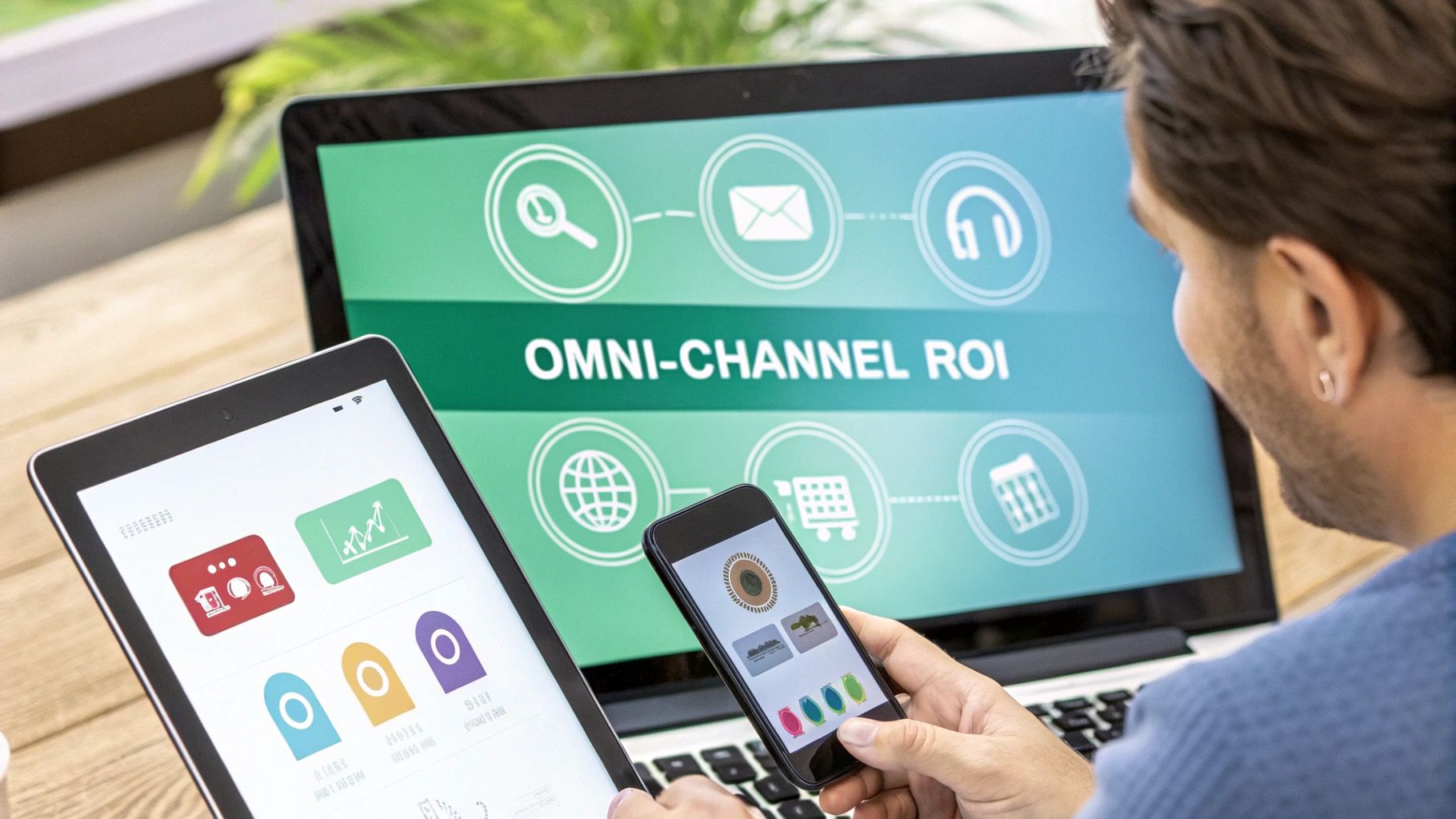



An omni-channel customer experience is the gold standard for modern engagement. It’s a completely integrated approach where a customer's journey flows seamlessly from one touchpoint to the next, creating a single, continuous conversation with your brand.
This isn't just about being present on multiple channels—that’s multi-channel. Omni-channel goes a step further by ensuring that context, history, and personalization follow the user everywhere, from your website to a mobile app, social media, and even in-store.
What Is a True Omni-Channel Customer Experience
Let's ditch the buzzwords for a moment. Think of a multi-channel strategy like a series of separate conversations happening in different rooms. What's discussed in one room stays there, forcing the customer to start over every time they walk into a new one. It's fragmented, repetitive, and often frustrating.
In contrast, a true omni-channel customer experience is one fluid conversation that moves with your customer. It tears down the walls between those rooms, ensuring the context from a late-night website browse session instantly informs a mobile app interaction or a follow-up email the next morning.
To help clarify the distinction, here’s a quick breakdown of how these two approaches differ at their core.
Multi-Channel vs Omni-Channel Core Differences
Ultimately, the shift from multi-channel to omni-channel is a shift in perspective—from focusing on your channels to focusing on your customer.
The Foundation of a Unified Journey
This unified approach is built on a simple yet powerful idea: the customer, not the channel, is the center of your strategy. Pulling this off means you need a digital foundation capable of demolishing the data silos that create those disjointed experiences. This is where platforms like Sitecore's Digital Experience Platform (DXP) come in.
A DXP acts as the central nervous system for your customer interactions. It connects all your different systems and data sources to build a single, actionable view of each person. This is what allows you to orchestrate consistent, context-aware interactions at scale.
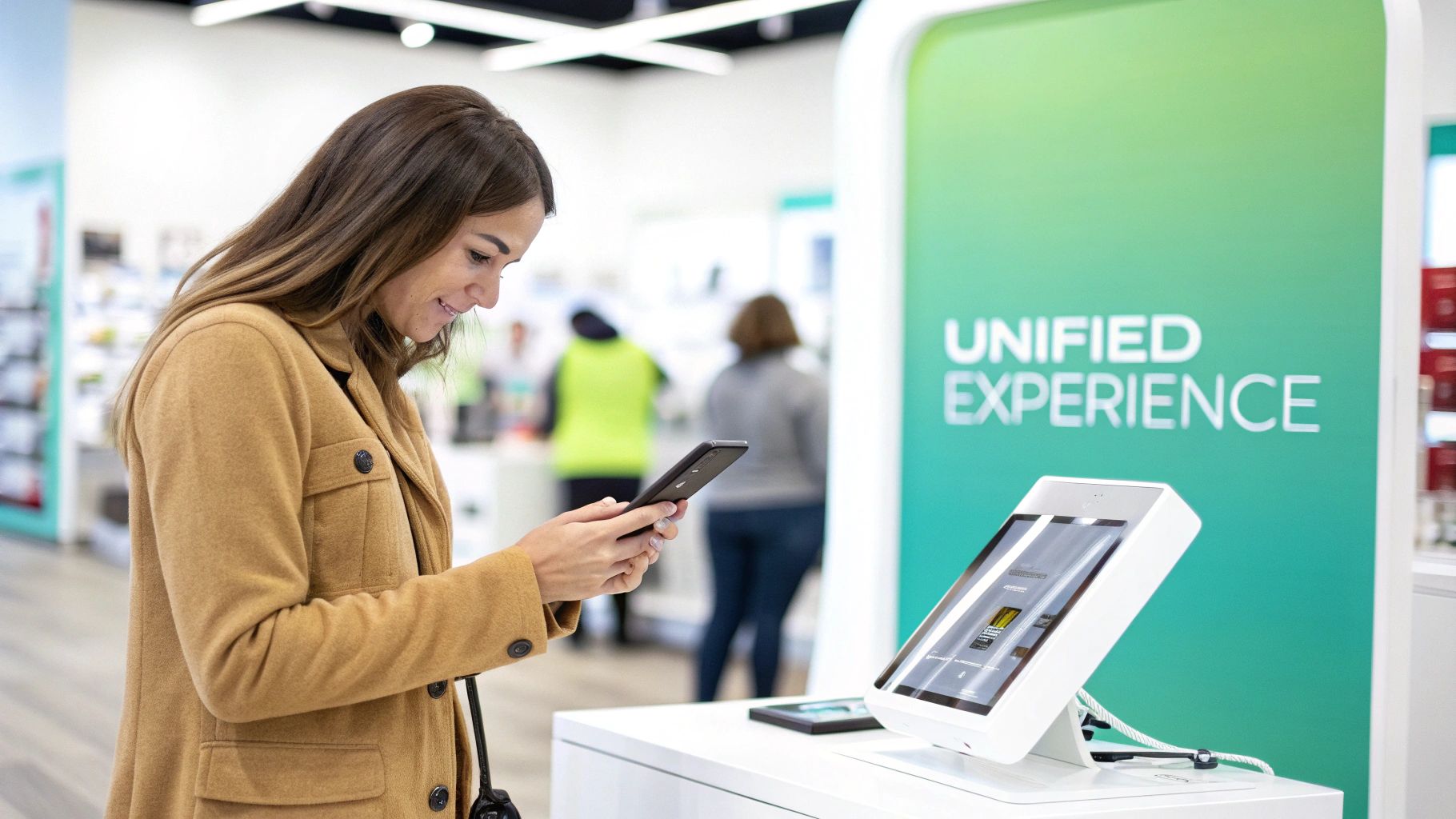
A truly connected experience means a customer can add an item to their cart on a laptop, get a reminder on their phone an hour later, and then use an in-store kiosk to complete the purchase—all without missing a beat.
Why Consistency Drives Growth
The business impact of this consistency is huge. Companies with strong omni-channel strategies retain around 89% of their customers, a stark contrast to the 33% retention rate for organizations with weak channel integration. That means businesses orchestrating consistent journeys are keeping nearly three times more customers than their disconnected peers.
Delivering a superior omni-channel experience is no longer a "nice-to-have"—it's the new standard for building brand loyalty and achieving sustainable growth. When powered by a modern DXP, this seamless vision becomes a reality, setting the stage for genuinely personal engagement. For a deeper dive, check out our complete guide on the omni-channel experience.
Why Modern Customer Journeys Demand an Omni-Channel Strategy
The way people interact with brands has completely changed. Gone are the linear, predictable paths to purchase we used to map out. Today's customer journey is a tangled, dynamic web of interactions happening across dozens of digital and physical touchpoints. This massive shift in behavior is exactly why an omni-channel customer experience is no longer a nice-to-have—it's a requirement for staying in the game.
Customers expect their conversation with you to be continuous, no matter where it starts or ends. They might research a product on their laptop, ask a question on social media from their phone, and then walk into a physical store to see it in person. In their mind, it's all one single journey. When a business fails to connect those dots, the experience falls apart.
The Real Cost of a Fragmented Experience
A disconnected approach, often called multi-channel, creates friction that kills brand trust. When a customer has to repeat their issue, re-enter their details, or explain their history to multiple people, it sends a clear message: you don't know who they are, and you don't value their time. This isn't just a minor annoyance; it's a huge reason why customers leave.
This fragmentation leads to some very real, negative outcomes:
- Customer Frustration: Being forced to start over on each new channel is one of the biggest complaints from consumers today.
- Erosion of Brand Trust: Inconsistent messaging and a lack of awareness make a brand look disorganized and unreliable.
- Lost Revenue Opportunities: Without a single view of the customer, you can't anticipate their needs or deliver the relevant, timely offers that actually lead to a sale.
Adapting to the Hyper-Connected Customer
Modern customers don't think in terms of channels; they just pick whatever is most convenient in the moment. This behavior is the new normal. For example, customers now use an average of nine different channels to engage with just one company. What’s more, a massive 74% of them get extremely frustrated when they have to repeat the same information over and over again.
This data highlights a critical reality: your customers are already living in an omni-channel world. The only question is whether your business is set up to meet them there. A true omni-channel strategy is designed to mirror this fluid behavior, making every transition between channels feel seamless and intelligent.
An omni-channel approach isn't about being everywhere. It's about being a single, unified presence everywhere your customer is, ensuring the conversation is never dropped.
This pivot from a channel-first mindset to a customer-first one is fundamental. It changes your digital presence from a random collection of websites and apps into a cohesive, connected ecosystem. When you link these customer pain points directly to business outcomes, it becomes obvious that a unified journey builds deep loyalty and drives a much higher customer lifetime value. To get a better handle on the thinking behind this, you can explore effective strategies to improve customer experience. It’s clear that omni-channel isn't just a marketing tactic anymore—it's an essential business strategy for any company that wants to thrive.
Building Your Foundation with the Sitecore DXP
Creating a true omni-channel customer experience isn't about just buying another piece of software. It’s about building a digital foundation that connects every single customer interaction into one cohesive conversation. This means moving away from the old, rigid, all-in-one systems and embracing a more flexible, composable approach. Sitecore’s Digital Experience Platform (DXP) is the perfect toolkit for this modern architecture, letting you assemble a best-fit technology stack without giving up on seamless integration.
Think of it this way: a composable model lets you pick the best tools for each specific job and then wire them together to create a powerful, unified system. Instead of being locked into one vendor's way of doing things, you get the freedom to build a platform that fits your business like a glove. It’s the difference between buying a pre-built house and hiring an architect to design a custom home—one is functional, but the other is built just for you.
Today's customer journey is anything but linear. It zigs and zags across a complex map of interactions, moving fluidly between your website, mobile app, and physical stores.
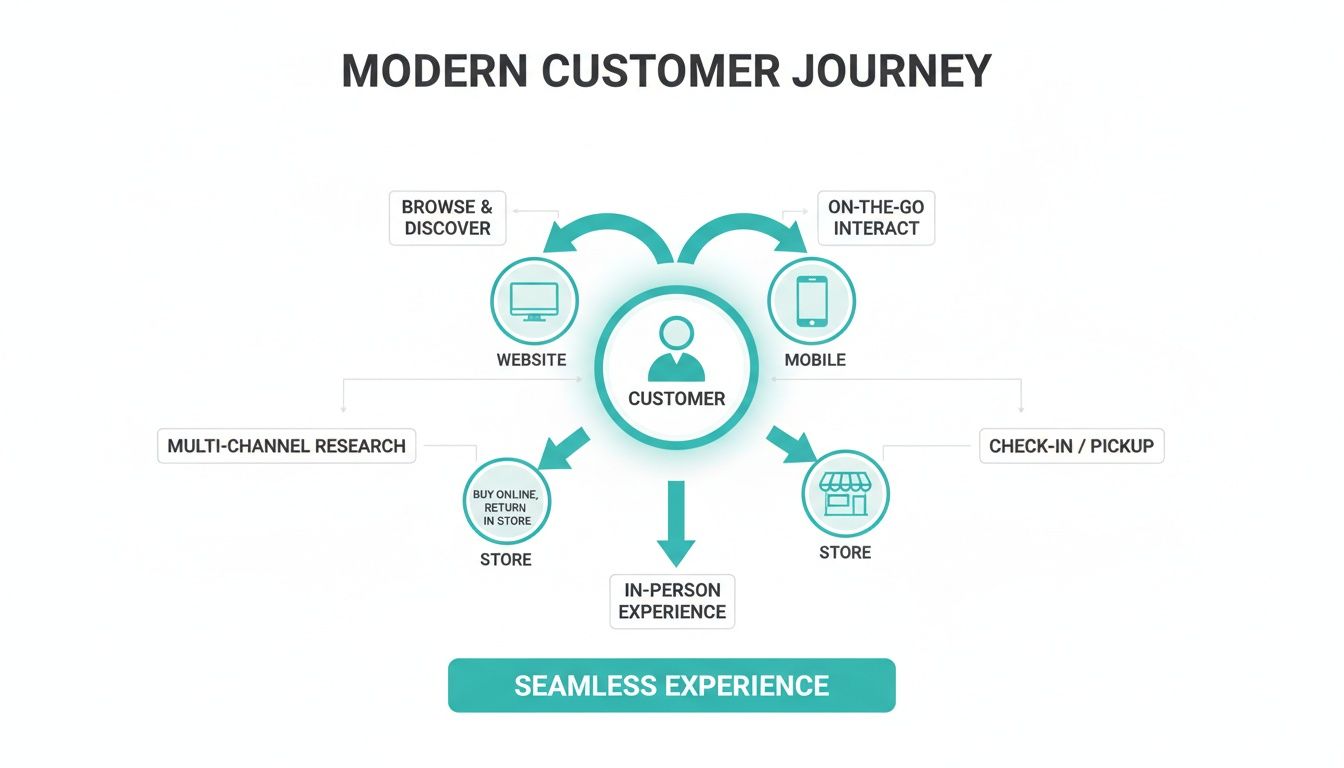
This journey highlights exactly why a unified data layer is so critical. Without it, the customer’s experience is fragmented, and the conversation starts over at every touchpoint.
The Core Components of Sitecore’s Composable DXP
Sitecore’s entire portfolio is built around this composable philosophy. Each product serves a vital function in the omni-channel engine, and when they work together, they demolish the data silos that stand in the way of a true omni-channel customer experience. The goal is to create that single, actionable view of every customer.
Here are the key pillars that make up the Sitecore DXP:
- Sitecore XM Cloud: This is the heart of your content operations. As a cloud-native, headless CMS, XM Cloud lets you create content once and push it anywhere—your website, mobile app, in-store digital signage, you name it. Its agility gives marketing teams the speed they need to launch new experiences quickly.
- Sitecore Customer Data Platform (CDP): The CDP is the central brain of the operation. It pulls in data from every touchpoint to build a rich, 360-degree profile of each customer. It captures everything from website clicks and app usage to in-store purchases and support calls, blending anonymous and known user data into a single, persistent record.
- Sitecore Personalize: This is where data gets turned into action. Fueled by the unified profiles from the CDP, Sitecore Personalize orchestrates real-time, AI-driven interactions. It allows you to run sophisticated A/B tests, trigger personalized offers at just the right moment, and deliver context-aware content across all your channels.
- Sitecore OrderCloud: For businesses with complex commerce needs, OrderCloud offers a headless, API-first commerce platform. It’s built to handle any business model—from B2C storefronts to B2B marketplaces—and integrates smoothly with your content and personalization efforts to create shoppable experiences absolutely anywhere.
How Sitecore Components Create a Unified View
The real magic happens when these components are wired together. Let's walk through an example. A customer browses a product on your website. Sitecore CDP captures that behavior. Later, when they open your mobile app, Sitecore Personalize uses that data to show them a relevant promotion for that same product. If they add it to their cart but don’t check out, an automated email can be triggered with a special offer to nudge them over the line.
This entire sequence is powered by the seamless flow of data between the platform's components. The CDP knows the customer, XM Cloud delivers the content, and Personalize decides the next best action. This integrated system ensures the conversation never drops, no matter which channel the customer uses next.
A composable DXP doesn't just manage channels; it unifies them. It transforms a collection of separate touchpoints into a single, intelligent ecosystem built around the customer.
This approach creates a digital foundation that is both scalable and future-proof. As new channels pop up, you can easily integrate them into your architecture without having to tear down and rebuild everything. This adaptability is key to staying relevant. For a deeper dive into the strategic advantages of this architecture, you can learn more about what a Digital Experience Platform is and the business value it drives.
Integrating SharePoint for a Holistic Enterprise View
The omni-channel vision doesn’t have to stop with the customer. A truly connected business aligns its external customer experiences (CX) with its internal employee experiences (EX). This is where integrating a tool like SharePoint becomes incredibly valuable.
SharePoint can act as your central hub for internal knowledge, product specifications, and company communications. By connecting SharePoint with Sitecore, you create a single source of truth that flows directly to your customer-facing channels.
For instance, a product data sheet updated in a SharePoint library can automatically sync with the product page on your Sitecore-powered website. This not only ensures customers always see the most accurate information but also makes your internal content management far more efficient. This kind of integration closes the gap between your internal operations and your external brand, creating a consistent experience for everyone.
How Sitecore AI Powers Your Unified Experience
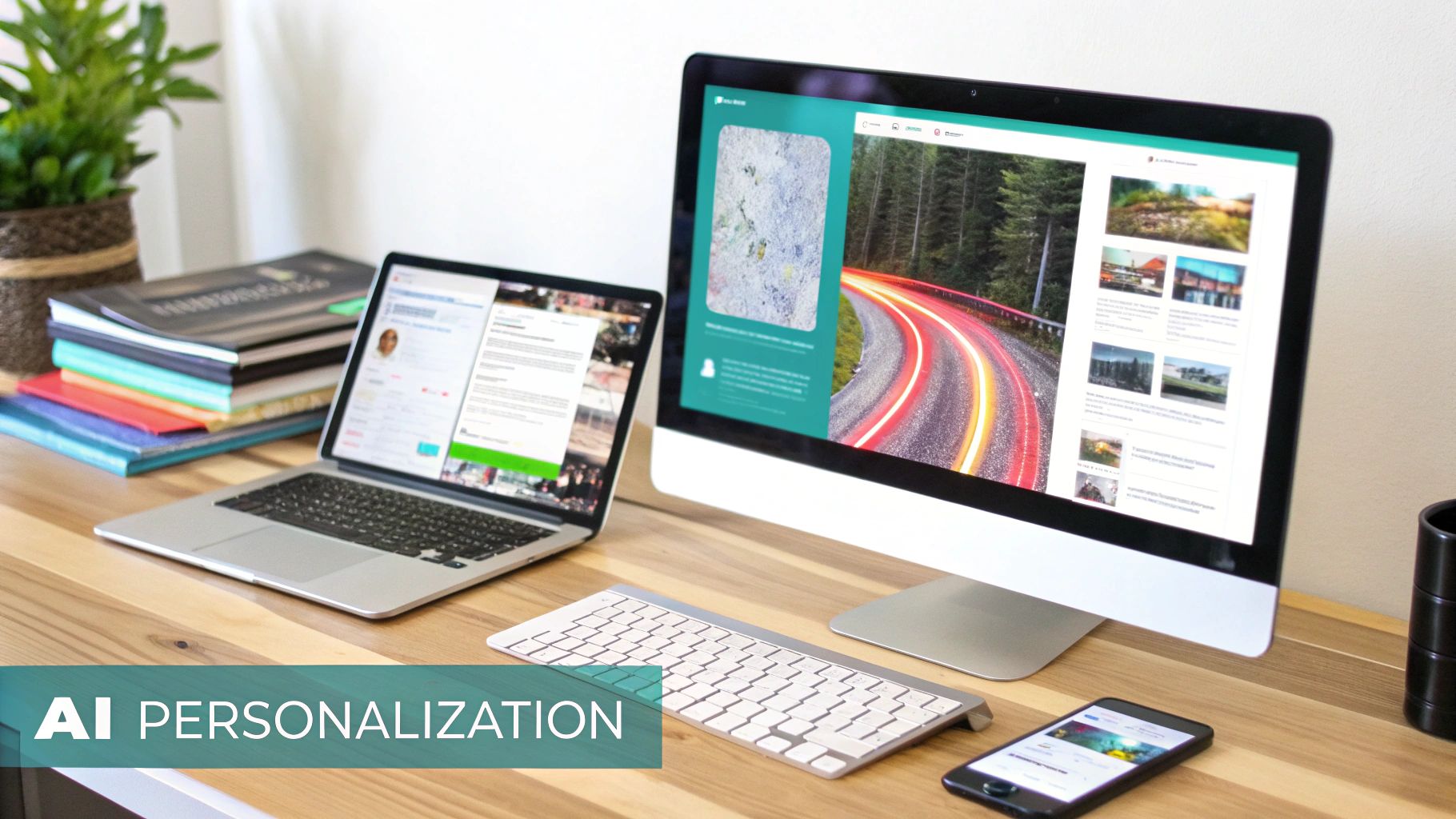
If a composable DXP is the skeleton of your omni-channel strategy, then Sitecore’s Artificial Intelligence is the central nervous system that brings it to life. This is the “magic” that turns a predictable, static journey into a dynamic, adaptive conversation with each customer.
This intelligent layer goes far beyond basic rules or simple segmentation. Instead, it gives you the power to anticipate what your customers need—and act on those needs instantly.
At the core of this is Sitecore Personalize, which uses sophisticated AI and machine learning to make sense of the tidal wave of data collected by the Sitecore CDP. It crunches cross-channel behaviors in real time, spots patterns, and predicts what a customer will do next with impressive accuracy. It’s a fundamental shift from reactive personalization (showing content based on what they did) to predictive personalization (showing content based on what they’re likely to do).
Turning Insights Into Real-Time Action
The real genius of Sitecore AI is how it translates these predictions into immediate, concrete actions on any channel. This is where the theory of a unified customer journey becomes a practical, revenue-driving reality.
Let’s walk through a classic example: a customer adds a pricey item to their cart on your website but gets distracted and clicks away. Without an integrated AI engine, that’s probably a lost sale. But with Sitecore Personalize, the system instantly flags this "cart abandon" event and orchestrates a series of smart, automated responses:
- Mobile App Notification: A few minutes later, a push notification hits their phone—maybe a gentle reminder or a surprise offer for free shipping.
- Personalized Web Experience: The next time they land on your website, the hero banner prominently features the very product they left behind, reigniting their interest.
- Email Nudge: If they still haven't returned, a personalized email might land in their inbox 24 hours later, maybe even suggesting a few complementary items.
Every one of these touchpoints is part of a single, coordinated strategy. It's all driven by automated decisioning that calculates the next best move for that specific person at that exact moment.
Sitecore AI doesn't just collect data; it activates it. It empowers you to deliver the perfect message on the right channel at the exact moment it will have the most impact, transforming raw data into intelligent engagement.
Demystifying AI-Powered Decisioning
Two core concepts drive these intelligent interactions: predictive personalization and automated decisioning. Think of them as the brain and the reflexes of your omni-channel customer experience.
- Predictive Personalization: This is the AI’s ability to forecast future behavior. By analyzing thousands of data points—from browsing history and purchase patterns to real-time context like location or device—the system can identify customers who are likely to churn, ready to buy, or in need of support.
- Automated Decisioning: This is the system's ability to act on those predictions without needing a human to press a button. You set the goals and business rules, and the AI automatically tests different offers, messages, and content variations to figure out which combination is most likely to hit the target for each individual user.
This powerful duo allows marketers to operate at a scale and speed that is simply impossible to achieve manually. To see how these technologies fit into the bigger picture, our AI personalization implementation guide offers a deep dive into making them work for your DXP.
Extending Intelligence Across the Enterprise
The omni-channel vision shouldn’t stop at customer-facing channels. Sitecore’s intelligence can also sharpen internal and partner-facing experiences, especially when connected with platforms like SharePoint.
Imagine a partner logs into your SharePoint portal to look up some technical documentation. The AI registers this interaction. Later, when that same partner visits your public Sitecore website, the system can recommend relevant case studies or new product updates related to the very documents they were just viewing.
This creates a seamless, cohesive journey that bridges both internal and external digital properties, showing a deep understanding of the partner’s immediate needs.
This level of intelligence ensures every interaction—whether from a customer, an employee, or a partner—adds another layer to a richer, more complete profile. For a broader look at how AI is reshaping business operations, check out these top AI business solutions. By applying AI across the entire digital ecosystem, you build an organization that isn't just responsive, but genuinely predictive and customer-obsessed.
Integrating SharePoint for a Complete Enterprise Ecosystem
A truly powerful omni-channel customer experience doesn’t just face outward; it reaches deep into the heart of your business. The goal is to build a fully connected, intelligent operation where both customer and employee experiences are seamless. This is where we bring SharePoint into the picture, bridging the gap between your external customer journey and your internal ecosystem.
Think about it: a top-tier customer experience (CX) is almost always a mirror of a well-oiled employee experience (EX). When your teams can instantly find accurate, centralized information, they’re empowered to serve customers better. On the flip side, siloed internal systems are a recipe for inconsistent messaging and frustrated customers.
Bridging the CX and EX Divide
SharePoint often serves as the backbone of an Enterprise Content Management (ECM) strategy, acting as the single source of truth for business-critical assets. We frequently architect solutions where SharePoint is the master repository for:
- Internal Knowledge Hubs: The go-to place for training materials, company policies, and best practices.
- Secure Document Repositories: A controlled environment for sensitive product specs, legal documents, and marketing collateral, complete with robust version control.
- Employee and Partner Portals: A central hub for internal news, project updates, and collaborative workspaces.
By treating SharePoint as this definitive source, you dismantle the data silos that create internal confusion and lead to mistakes that customers see. It builds a rock-solid foundation for operational excellence.
The Critical Sitecore and SharePoint Connection
The real magic happens when you build a seamless bridge between your internal SharePoint environment and your customer-facing Sitecore DXP. This integration allows content and data to flow intelligently between platforms, creating a cohesive digital workplace that directly fuels a better customer experience.
Let’s look at a real-world example. A product manager updates the technical specifications for a new product inside a secure SharePoint document library.
With a well-designed integration, that one update in SharePoint can automatically kick off a workflow. This pushes the new, approved information straight to the right product pages on your Sitecore-powered public website.
This direct connection ensures your brand messaging is consistent and accurate everywhere, without anyone having to manually upload files. It eliminates the risk of an old PDF floating around on your website or a sales rep quoting outdated specs. The entire content lifecycle becomes automated, efficient, and reliable—a perfect example of internal efficiency creating a more trustworthy omni-channel customer experience.
Creating a Unified Digital Workplace
This integration strategy goes far beyond just product data. Imagine your marketing team finalizing campaign assets—banners, copy, and promo details—within a SharePoint workflow. Once approved, those assets are automatically pushed into Sitecore's content library, ready for marketers to deploy across websites, apps, and email campaigns using XM Cloud.
This synchronization gets your entire organization—from product development to marketing and sales—working from the same playbook. It aligns both CX and EX, making sure what your employees know internally is perfectly reflected in what your customers see externally. For any business looking to streamline its internal content, getting the structure right is everything. To explore this topic further, our detailed guide on SharePoint migration services offers valuable insights into modernizing and organizing enterprise content. When you optimize how information flows inside your company, you directly improve the quality of every single customer interaction.
Your Omni-Channel Implementation Roadmap
Building a true omni-channel experience isn't something you can flip a switch on. It’s a journey, one that requires a clear and actionable roadmap to get you from A to B without costly detours. We break down what can feel like a massive project into distinct, manageable phases.
This isn’t just about project management; it's about delivering value at every single step. A structured approach turns the big idea of an omni-channel customer experience into a concrete plan, ensuring every decision aligns with your business goals.
Phase 1: Discovery and Audit
You can't build the future without understanding the present. This first phase is all about a deep dive into your current setup. We map out your entire technology stack, trace every customer touchpoint, and hunt down the data silos that are creating those frustrating, disconnected experiences.
Think of it as creating a detailed blueprint of your existing digital house. During this audit, we analyze:
- Current Technology: We take a full inventory of your core systems—your CMS, CRM, commerce platforms, and the rest of your marketing tech.
- Data Sources: We pinpoint exactly where your customer data lives, how it's being gathered, and—more importantly—where the gaps are.
- Customer Journeys: By mapping the paths your customers currently take, we can spot the friction points and moments of frustration that need fixing.
Phase 2: Strategy and Architecture
Once we have a crystal-clear picture of your starting point, we shift our focus to designing your destination. This is where the strategy comes to life. We architect your composable DXP, carefully selecting the right Sitecore components—like XM Cloud, Sitecore Personalize, and Sitecore CDP—that are perfectly matched to your goals.
This architectural design is the blueprint for your entire omni-channel engine. It details how data will flow between systems, including critical integrations with platforms like SharePoint, to create a single, unified view of the customer.
This isn't just a technical diagram; it's the plan that ensures every piece of the puzzle fits together seamlessly.
Phase 3: Phased Implementation
With the blueprint in hand, it's time to start building. We execute the plan through a phased implementation. Forget the old "big bang" launch that's fraught with risk. Instead, we take an agile approach, prioritizing the channels and integrations that will deliver the most impact first.
This lets you see tangible results quickly, which is fantastic for building momentum and getting stakeholders excited. Often, the first phase focuses on connecting your most critical channels, like your website and mobile app, to create immediate, visible improvements.
Phase 4: Optimization and Support
An omni-channel strategy is never "finished." It's a living, breathing system that needs to evolve. After launch, our focus shifts to a continuous cycle of optimization and support.
We dive into the analytics and performance data to refine personalization strategies, test new user journeys, and make sure your platform keeps up with ever-changing customer expectations. This final, ongoing phase is what guarantees the long-term success and growth you expect from your investment.
Frequently Asked Questions
Jumping into a true omni-channel customer experience always brings up a few good questions. Here are some of the most common things we get asked when helping businesses unify their strategy with platforms like Sitecore.
What Is the First Step to Moving from Multi-Channel to Omni-Channel?
The first move, without a doubt, is a full data and journey audit. Before you start connecting anything, you have to know exactly what you’re working with. This means mapping out every single customer touchpoint and figuring out where data is being collected—and more importantly, where it’s stuck in silos.
This process shines a light on all the friction points in your current customer journey. Once you see where the conversation breaks down between channels, you can build a smart strategy to bring all those data sources together in a platform like the Sitecore CDP.
How Does Sitecore CDP Differ from a Traditional CRM?
While a traditional CRM is fantastic for managing interactions with customers you already know, a Sitecore CDP is designed to see the entire picture. The biggest difference is its power to unify data from both anonymous and known users across every touchpoint, all in real time.
A CRM usually starts tracking people after they've become a lead. A CDP, on the other hand, captures all the behavior that happens before that—like website clicks or abandoned carts—and stitches it all together into a single profile once that user identifies themselves. This creates a complete, living history you can use for personalization on the spot.
How Long Does a Typical Sitecore Omni-Channel Implementation Take?
Timelines can really vary depending on how complex the setup is and how ready your organization is to adapt. A foundational project connecting a few of your most important channels can often be up and running in three to six months.
For more ambitious projects—think integrating lots of legacy systems, migrating huge amounts of data, or setting up custom SharePoint connections—you could be looking at six to twelve months, or sometimes longer.
Success really comes down to taking it one step at a time and delivering value quickly. As an experienced partner, we always focus on the highest-impact integrations first. This way, you start seeing a real return on your investment early on while we build out the rest of your fully connected ecosystem.
At Kogifi, we specialize in architecting and implementing sophisticated DXP solutions. Discover how our Sitecore expertise can transform your customer experience.