


Omnichannel marketing is more than just a buzzword—it’s a commitment to creating a single, continuous conversation with your customers, no matter where they are. It ensures that whether they interact with you online, in a physical store, or through a mobile app, the experience feels seamless, consistent, and personal. This approach goes far beyond simply being present on multiple channels.
What Omnichannel Marketing Really Means
Let's cut through the jargon. Think of true omnichannel marketing as giving every customer a personal concierge—someone who remembers their history, understands their preferences, and anticipates their needs, regardless of how they choose to connect with your brand.
This unified approach is a world away from multichannel marketing. In a multichannel setup, each channel often operates in its own silo, leading to a disjointed and frustrating customer experience. It feels like explaining your problem to a different employee every time you call, forcing you to start over again and again.
We've written a detailed guide on the key differences between omnichannel and multichannel strategies if you want to explore this further.
The Big Shift From Channel-First to Customer-First
The core of an omnichannel strategy is a fundamental shift in mindset: from being channel-focused to being customer-focused. The goal is no longer to independently sell products on your website, in your app, or at your store. Instead, the objective is to serve the customer wherever they are, making their entire journey feel effortless and connected.
To see the contrast clearly, let's break down how these two approaches operate.
Omnichannel vs Multichannel A Core Distinction
This integration is where the magic happens. A customer who adds an item to their cart on your mobile app but gets distracted can see that same item waiting for them when they log into your website later. That's only possible when all your channels are working together intelligently.
The Technology Powering a Unified Experience
The engine driving a true omnichannel experience is a robust Digital Experience Platform (DXP). A DXP acts as the central hub, collecting and unifying customer data from all sources into a single, comprehensive profile. This complete view of the customer is the foundation for creating meaningful, personalized interactions at every step.
This is where the right omnichannel marketing automation tools become critical. A modern DXP like Sitecore can:
- Track behavior across your website and mobile app.
- Connect online activity with in-store purchase history.
- Deliver personalized content and offers based on a user's complete interaction history.
- Ensure consistent messaging whether the customer is reading an email or speaking to a support agent.
It’s not just about being everywhere; it’s about delivering one intelligent, cohesive brand story.
The Business Case For An Omnichannel Strategy
Thinking of an omnichannel approach as just another marketing trend is a mistake. It’s a fundamental business strategy that hits your bottom line directly. When companies get it right, they stop just communicating with customers and start building genuinely profitable, long-term relationships. This shift turns a bunch of disconnected interactions into one smooth, continuous customer journey—and that’s where the measurable gains happen.
The magic really starts with a unified customer view. Think about it: if your e-commerce data lives in one system, your in-store sales in another, and your mobile app data in a third, you never truly know your customer. A Digital Experience Platform (DXP) like Sitecore acts as the central brain, pulling in data from every single touchpoint to build one dynamic profile for each person. Everything else is built on this foundation.
Right away, this solves one of the biggest headaches in any large company: data silos. These silos are what stop different departments from working together and lead to those frustratingly inconsistent brand messages that kill customer trust.
Driving Tangible Business Outcomes
Once you can see the entire customer journey, you unlock some seriously powerful ways to increase revenue and lock in loyalty. The business case becomes crystal clear when you look at the three core metrics that an omnichannel strategy directly improves.
- Higher Customer Lifetime Value (LTV): When you understand a customer's history and what they actually like, you can serve up relevant recommendations that keep them coming back. A customer who feels understood is one who sticks around.
- Increased Retention Rates: A seamless, friction-free experience is a major driver of loyalty. Companies with strong omnichannel engagement see significantly higher retention because they remove the frustrating roadblocks that send customers to competitors.
- Improved Average Order Value (AOV): With a unified profile, you can get smart about upselling and cross-selling. For example, Sitecore's AI can see what a customer browsed on your site and what they bought in-store last month, then ping them with a personalized email or app notification for a perfect add-on product. It’s a simple way to boost the value of their very next purchase.
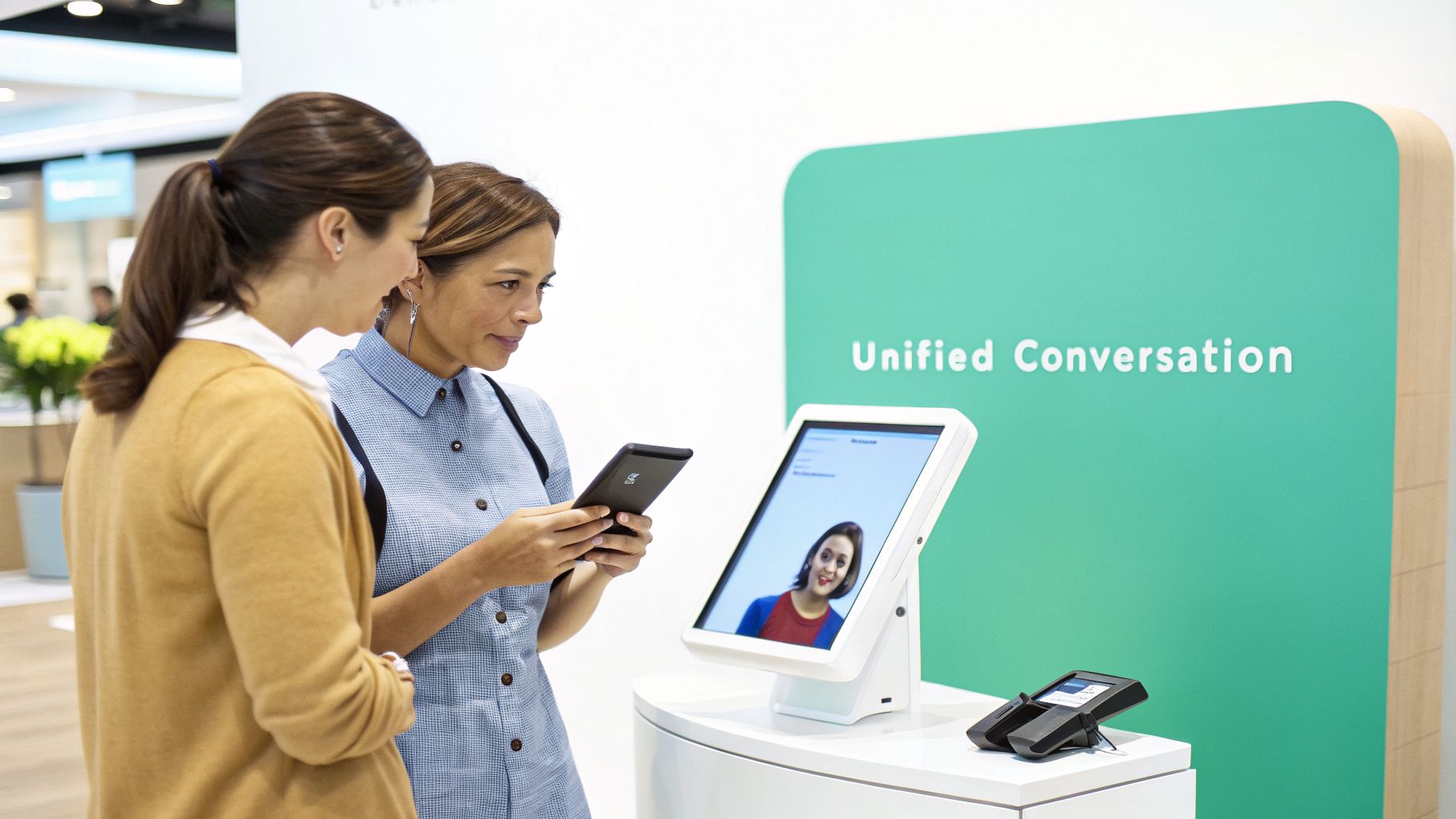
A truly connected experience means the conversation never drops. If a customer adds a product to their cart on a mobile app, that information should be instantly available to a sales associate on a store tablet, ready to assist them in person. This is the practical power of an integrated DXP.
Solving Critical Enterprise Challenges
Beyond just boosting metrics, a solid omnichannel strategy fixes deep-rooted operational problems that are holding back growth. In big organizations, how your teams talk to each other is just as important as how you talk to customers.
Take a customer support team, for instance. If they’re using a knowledge portal built on SharePoint, they can access the latest product info. But when that portal is integrated with your DXP, the agent can also see the customer’s recent activity and provide help that’s actually relevant to their situation. This kills the all-too-common problem of a customer getting conflicting information from different departments.
By tearing down data silos and connecting internal systems with customer-facing platforms, you solve several critical issues at once:
- Inconsistent Brand Messaging: Everyone is finally working from the same script.
- High Customer Churn: You can spot and fix the friction points that cause people to leave.
- Missed Revenue Opportunities: You start seeing—and acting on—upsell and cross-sell chances you were blind to before.
Ultimately, defining what omnichannel means for your business is about investing in a system that doesn't just understand your customer but aligns your entire organization to serve them better. You can explore a variety of successful examples of omnichannel in action to see how leading brands are pulling this off today.
The Tech Behind the Scenes: Building Your Omnichannel Engine with Sitecore
A great omnichannel strategy is more than just a customer-first mindset—it needs a powerful technical foundation to actually work. This is where a composable Digital Experience Platform (DXP) like Sitecore comes in, acting as the central nervous system for your entire customer experience. It’s the architecture that connects all your different systems into one, seamless conversation.
The heart of this engine is a unified Customer Data Platform (CDP). Think of it as the single source of truth for every piece of customer information. It gathers data from every touchpoint—website visits, mobile app activity, in-store purchases, support calls—and merges it into a single, detailed profile for each person. Without this unified view, true personalization is just a guessing game.
Predicting What Customers Want Next with Sitecore AI
This is where things get really interesting. Once you have that clean, unified data, Sitecore AI can dive in and analyze billions of data points to spot patterns and predict what a customer might do next. It goes way beyond basic segmentation to understand individual intent in real-time, letting your brand be proactive instead of just reactive.
This predictive power is what separates a decent marketing setup from a true omnichannel machine. Instead of just reacting to a customer's last click, Sitecore's AI can anticipate their needs, then deliver the right content or offer at the perfect moment to nudge them along their journey. The system is always learning and adapting, making every interaction more relevant than the last. You can dive deeper into crafting a better omni-channel customer experience with this kind of technology.

As you can see, AI-driven insights fuel the entire process, from data collection all the way to real-time decision-making and content delivery.
The Key Pieces of the Sitecore Ecosystem
To really understand how omnichannel marketing works in practice, you have to look at the specific tools that make it all happen. Sitecore's composable DXP isn't just one big product; it's a suite of powerful, interconnected solutions.
- Content Orchestration (XM Cloud): A headless or hybrid Content Management System like Sitecore XM Cloud lets you create content once and publish it absolutely anywhere. This keeps your brand message consistent, whether someone sees it on your website, a mobile app, or a digital kiosk in a store.
- Real-time Decisioning (Sitecore Personalize): Using the insights from the CDP and AI, Sitecore Personalize makes split-second decisions about what content or offer to show each user. If a customer abandons their cart, it can automatically trigger a follow-up email, a targeted ad, or a special offer the next time they open your app.
This diagram breaks down the core business case for building an integrated system like this, showing the direct line from a unified customer view to real results.
It clearly maps out how starting with a single view of the customer directly enables strategies that boost lifetime value and keep customers coming back.
Tying It All Together: Integrating Your Enterprise Systems
A DXP can't do its job in a bubble. For a truly seamless experience, it has to connect with other critical business systems. That means linking your DXP with your Customer Relationship Management (CRM) and Enterprise Resource Planning (ERP) platforms.
By integrating your CRM, you enrich customer profiles with sales history and service interactions. Connecting your ERP provides real-time inventory and order data, which is essential for "buy online, pick up in-store" (BOPIS) scenarios and accurate product availability information across all channels.
This level of integration makes sure that everyone, from customer-facing teams to internal operations, is working from the same complete, up-to-the-minute information.
Don't Forget Your Internal Teams: Empowering Them with SharePoint
Finally, a world-class external experience depends on a well-informed internal team. Customer-facing employees in sales, service, and support need to deliver a consistent and accurate message every time. This is where using SharePoint for internal knowledge management becomes a critical part of your omnichannel architecture.
By building a central knowledge base in SharePoint and connecting it to your DXP and CRM, you give your teams a massive advantage. A support agent can instantly pull up the latest product specs, marketing campaign details, and even a customer's recent interaction history—all from one place. This ensures that when a customer reaches out, the employee they talk to is fully equipped to provide a consistent, informed, and valuable response, closing the loop on a truly unified brand experience.
Delivering Personalized Experiences At Scale
An omnichannel architecture is the blueprint; personalized experiences are the finished product. This is where the technical setup translates into real-world customer interactions, and it’s where a platform like Sitecore truly shines. It’s all about shifting from broad, one-size-fits-all marketing campaigns to millions of unique, one-to-one conversations that happen automatically and at scale.
This is where Sitecore AI puts the data you've collected to work. It’s not just about knowing a customer's name; it's about understanding their context, predicting what they’ll do next, and responding with the most relevant action in that exact moment. The goal is to make every interaction feel less like a transaction and more like a helpful, continuous dialogue.

From Theory to Real-World Scenarios
So, how does this actually work in practice? A Sitecore-powered system can orchestrate complex customer journeys that move seamlessly across digital and physical boundaries. The system doesn't just see different channels—it sees a single customer moving between them.
Here are a few common scenarios that a well-built omnichannel engine can execute flawlessly:
- The Abandoned Cart Recovery: A customer adds a pair of running shoes to their cart on your website but gets distracted. Sitecore’s platform flags this event. A few hours later, an automated email lands in their inbox with a small incentive, like free shipping, to nudge them toward completing the order. The next time they open your mobile app, a banner at the top prominently features those same running shoes.
- The In-Store Loyalty Engagement: A member of your loyalty program walks into a physical store. Because they have your app installed, a beacon or geofence technology triggers an alert. As they browse the electronics department—a category they’ve frequently looked at online—they get a push notification with a special, member-only offer on smartwatches.
- The Connected Customer Service Call: A customer calls your support line about an issue with a recent online order. The support agent, using a system integrated with Sitecore's CDP, can immediately see the customer’s entire history: past purchases, recently viewed products, and even the web pages they visited right before calling. This gives the agent all the context they need to provide fast, helpful support without making the customer repeat themselves.
These examples show how an omnichannel strategy, powered by Sitecore AI, transforms generic brand messages into meaningful, personal engagements. It’s the difference between shouting a message to a crowd and having a quiet, relevant conversation with an individual.
Sitecore AI: The Engine of Personalization
What makes these scenarios possible is the real-time decisioning built into the Sitecore ecosystem. The platform continuously analyzes user behavior, updating customer profiles with every click, tap, and purchase. Sitecore AI uses this live data to decide the "next best action" for each individual. Beyond general personalization, specialized tools like an AI healthcare assistant show how AI can deliver highly tailored and consistent experiences in specific industries.
This level of automation is essential for delivering personalization on the web and across all touchpoints at an enterprise scale. Manually creating rules for every possible customer journey would be impossible. Instead, Sitecore’s machine learning models handle the complexity, identifying subtle patterns and opportunities a human analyst might miss.
For instance, the AI might notice that a segment of customers who buy a specific coffee machine also tend to buy a certain brand of coffee pods within the next 30 days. It can then automatically create a personalized campaign targeting new coffee machine buyers with a timely offer on those pods, driving a cross-sell without any manual intervention.
Empowering Teams with SharePoint Integration
Finally, a truly great customer experience is backed by well-informed employees. When your customer-facing teams have access to the right information, they can deliver on the promise of a seamless journey. Integrating your DXP with an internal knowledge base built on SharePoint is a critical final step.
This connection ensures that sales associates, support agents, and in-store staff are all working from the same playbook. If a customer asks a question about a new product in-store, an employee can quickly pull up the official specs, marketing materials, and inventory levels from a SharePoint portal on their tablet. This empowers them to be true brand experts, reinforcing the consistent, reliable experience that builds lasting customer loyalty.
How to Overcome Common Implementation Hurdles
Shifting to a true omnichannel strategy is a major undertaking. It’s more than just plugging in new technology; it’s a fundamental change in how your organization is structured, how data is managed, and how teams work together. Tackling these hurdles head-on is the difference between a successful transformation and a plan that fizzles out.
The biggest barrier is almost always internal: organizational silos. Marketing, sales, customer service, and IT departments often operate in their own little worlds, with their own goals, budgets, and—most importantly—their own data. This separation makes a unified customer experience impossible. To get omnichannel right, you first have to break down these internal walls.
Dismantling Organizational Silos
The first step is to create cross-functional teams with shared objectives and KPIs. It’s amazing what happens when marketing and customer service are both measured by the same customer retention metric—suddenly, collaboration becomes a top priority. A steering committee with leaders from each department can align everyone’s efforts and make sure the entire organization is working toward a single, customer-centric vision.
This alignment has to be backed up by shared tools. A central knowledge base, perhaps built on a platform like SharePoint, is critical. When integrated with your DXP, it ensures that a sales associate in a store, a marketer building an email campaign, and a support agent on the phone all have the same, up-to-date product information and customer history. This is how you deliver the consistency customers now expect.
Think about this all-too-common scenario: a customer gets a promotional email for a product they just returned. This happens when the marketing and e-commerce systems aren't talking to each other. A unified platform like Sitecore's DXP prevents this by making sure all systems work from a single, real-time customer profile, stopping frustrating and brand-damaging mistakes before they happen.
Integrating Legacy Systems with Modern DXPs
Many businesses find themselves tethered to outdated, monolithic IT systems. These legacy platforms often lack the API-first architecture and flexibility needed to connect with a modern, composable DXP. A full "rip and replace" is rarely practical or wise. A phased implementation is a much smarter strategy.
This is where the composable nature of platforms like Sitecore offers a huge advantage. Instead of a massive, high-risk overhaul, you can introduce new capabilities one piece at a time. For instance, you could start by implementing Sitecore's Customer Data Platform (CDP) to begin unifying customer data from all your existing systems.
- Phase 1: Data Unification: Use Sitecore CDP to pull in data from your CRM, ERP, and e-commerce platform. This gives you an initial single customer view without disrupting your core operations.
- Phase 2: Personalized Web Experience: Next, connect Sitecore Personalize to your main website. Now you can use that unified data from the CDP to deliver targeted content and offers, showing immediate value.
- Phase 3: Channel Expansion: From there, you can extend these personalization capabilities to your mobile app and other digital touchpoints, building out your omnichannel presence incrementally.
This phased approach minimizes risk, lets you score some quick wins, and helps build momentum across the organization for the broader transformation.
Ensuring Data Privacy and Governance
As you start centralizing all this customer data, privacy and governance become absolutely critical. Customers are more aware than ever of how their data is being used, and regulations like GDPR and CCPA come with strict compliance rules. A failure to manage data responsibly can lead to massive fines and completely shatter brand trust.
A robust DXP must have built-in tools for managing data consent and privacy. Sitecore's platform, for example, provides granular controls for data governance, allowing you to:
- Track Consent: Manage and honor customer consent preferences across every channel from one central location.
- Anonymize Data: Automatically anonymize or delete personal data to comply with "right to be forgotten" requests.
- Secure Information: Implement strong security protocols to protect sensitive customer information from breaches.
By building data governance into the core of your architecture from the start, you ensure that your omnichannel efforts are not only effective but also responsible and compliant.
Your Path To Omnichannel Excellence
Alright, let's talk about turning all this omnichannel theory into reality. The goal is to move from a collection of siloed customer interactions to one, single, seamless experience. This is where the strategy meets the pavement, moving from concept to execution.
The first, non-negotiable step? A full audit of your current channels and data infrastructure. You have to get brutally honest about where customer information is getting trapped and where the customer journey is breaking down. This initial deep-dive is the blueprint for everything that follows.
Charting Your Course
Once you have a clear picture of where you stand, it's time to set your sights on where you're going. Define your business goals with precision. Are you trying to boost customer retention, increase average order value, or lift conversion rates? Your answer will shape your priorities.
This leads directly to your technology plan, which should be built around a flexible, composable DXP. A modern platform like Sitecore gives you modular building blocks—like a CDP, AI-driven personalization, and a headless CMS. This approach lets you build a solution for your exact needs without the risk of a massive, all-at-once overhaul. And don't forget about internal knowledge sharing; tools like SharePoint are crucial for getting your teams aligned behind this new customer-first model.
The most successful omnichannel projects don't try to boil the ocean. They start with a focused pilot project. Instead of connecting every channel at once, unify the journey between two high-impact touchpoints—like your website and mobile app—to prove the value quickly.
Taking The First Step
Let's be real: building a true omnichannel engine is complex. From wrangling legacy systems to structuring your data for tools like Sitecore AI, the process demands a very specific set of skills. This is exactly where bringing in an experienced partner pays for itself.
An expert can help you navigate the technical and strategic minefields, making sure your technology choices actually support your business goals from day one. They provide the guidance needed to not just implement the right tools, but also to build the organizational alignment required to make it all work in the long run. Your path to excellence starts with a solid plan and the right people to help you bring it to life.
Frequently Asked Questions
Let's tackle some of the most common questions we hear from enterprise leaders about omnichannel marketing.
How Is Omnichannel Different From Multichannel Marketing?
Think of it this way: multichannel marketing is like having a bunch of separate conversations. Your brand might have a website, a mobile app, and a physical store, but none of them are really talking to each other. They operate in silos, giving the customer a fragmented experience.
Omnichannel, on the other hand, weaves all those channels into a single, continuous conversation. The focus shifts from the channel to the customer. An item added to a cart on their laptop is instantly visible to a store associate on their tablet. It’s one seamless journey, no matter how or where the customer chooses to interact.
What Is The Role Of Sitecore AI In An Omnichannel Strategy?
If omnichannel is the strategy, Sitecore AI is the engine that makes it run. It acts as the intelligent core, collecting and analyzing massive amounts of customer data from every single touchpoint—all in real time. Its job is to figure out what customers are doing, predict what they’ll do next, and then automate the perfect response.
For example, Sitecore AI might notice a customer has browsed a specific product category a few times online. Instead of just waiting, it can automatically send a personalized offer for a related item straight to their preferred channel, whether that's an email or a push notification. It turns a generic marketing blast into a genuinely helpful, one-to-one interaction.
Sitecore AI doesn't just personalize content; it orchestrates the entire customer journey. It decides the "next best action" for each individual, ensuring that every interaction is contextually aware and moves the customer seamlessly toward their goal.
What Is The First Step To Implement An Omnichannel Strategy?
The first, non-negotiable step is to get all your customer data into one place. You need a single, unified view of each customer. Without it, you're just guessing, because your customer information is scattered across a dozen disconnected systems. This is where a Customer Data Platform (CDP) comes in.
A DXP with a built-in CDP, like Sitecore, creates this central hub for you. It pulls together data from your website, CRM, mobile app, and even in-store purchases to build a rich, dynamic profile for every person. Once you have that unified profile, you can start to accurately map, personalize, and optimize their entire experience from start to finish.
At Kogifi, we specialize in building the powerful DXP and CMS architectures that turn omnichannel visions into reality. Our experts in Sitecore AI and SharePoint can help you unify your data and create seamless, personalized customer journeys. Learn how we can build your omnichannel engine.