


A cloud migration strategy is your master blueprint for moving digital operations to the cloud. It’s the critical link that connects technical decisions—like which cloud provider to use or how to move an application—with core business goals, such as improving scalability or operational efficiency. For complex platforms like Sitecore, a solid strategy transforms what could be a high-risk technical headache into a predictable, value-driven business initiative.
What Is a Cloud Migration Strategy
Think of a cloud migration strategy less as a simple moving plan and more like the detailed architectural drawings for relocating your entire digital headquarters. It’s the difference between haphazardly packing boxes and hoping for the best, versus executing a meticulously planned corporate move where every department, asset, and process is accounted for. This framework ensures every technical choice you make directly supports a business objective.
This level of planning is non-negotiable for enterprises running sophisticated Digital Experience Platforms (DXP). A generic, one-size-fits-all approach just won’t cut it for systems like Sitecore, which are often tangled with intricate dependencies, custom code, and personalization engines. Winging it is a recipe for disaster, leading to costly downtime, data loss, and a final cloud setup that fails to deliver on its promises.
From Technical Task to Business Advantage
A well-crafted strategy elevates the migration from a routine IT task to a powerful business enabler. It lays out a clear roadmap for achieving specific outcomes, guaranteeing that the final result is an agile, intelligent, and scalable digital foundation ready for future growth.
A good strategy is built on several key pillars. The table below outlines the core components and what they aim to achieve.
Core Components of a Cloud Migration Strategy
This forward-thinking approach is more important than ever. The global cloud migration market is projected to grow at a staggering CAGR of 21.8% through 2035, as more organizations move away from rigid, on-premises systems. This trend highlights just how critical it is to get the strategy right from the very beginning.
A cloud migration strategy is the essential framework that turns a complex technical project into a predictable, value-driven business initiative. It ensures you mitigate risks, maximize your return on investment, and set the stage for future growth.
Navigating the landscape of providers can be tough, so it’s helpful to know who the top cloud migration services are. By defining a clear path forward, you ensure your investment in the cloud pays dividends for years to come. For more platform-specific insights, you can also explore our detailed guide on managing your CMS in the cloud.
Choosing Your Migration Path with the 6 R's Framework
Once you’ve locked down your business goals, the next big question is how each application will actually make the move to the cloud. Let’s be clear: not all applications are the same, and trying to force them all down a single path is a surefire way to waste money and miss out on huge opportunities.
The industry has settled on a handy framework known as the "6 R's" to sort this out. It gives you a clear way to evaluate your options and pick the best route for every piece of your IT portfolio.
Think of it like this: if your overall strategy is the blueprint for a new company headquarters, the 6 R's are the specific moving plans for each department. Your mission-critical DXP (the executive suite) needs a very different plan than the dusty old servers in the archival room (your legacy data). Getting this right for each one is absolutely critical for a smooth transition.
The flowchart below shows how your main business drivers—be it scalability, cost savings, or pure innovation—naturally point you toward the right migration path.
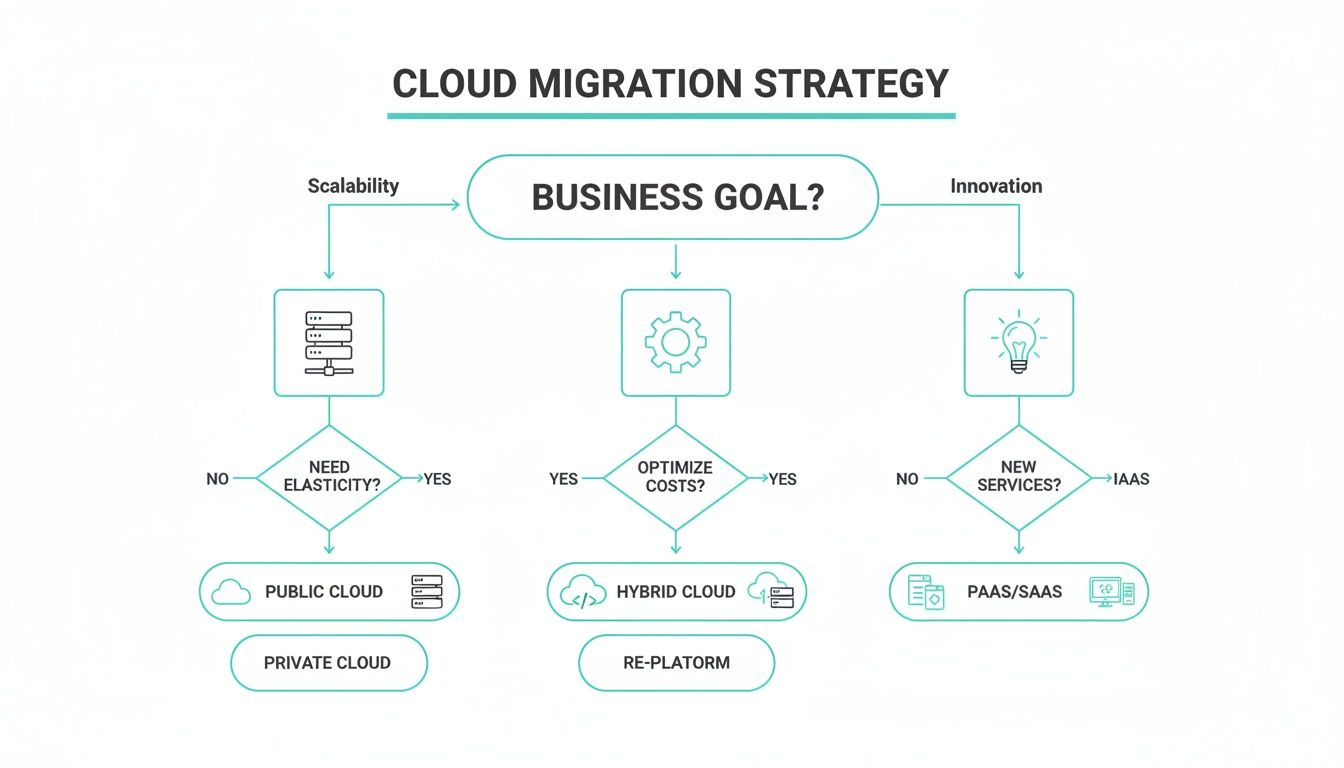
As you can see, different goals lead to very different strategies. This really drives home the importance of tying your technical decisions back to what you want to achieve as a business, right from the very start.
The Six Foundational Migration Strategies
Let's unpack each of the 6 R's, keeping in mind how they apply to complex enterprise systems like Sitecore and SharePoint.
1. Rehost (Lift-and-Shift)
This is the most direct route. You’re essentially picking up your application and moving it to the cloud with few, if any, changes. Imagine moving your office to a new building but keeping all the old furniture and layouts exactly as they were.
It’s fast and relatively simple, making it the go-to choice when speed is everything. For a Sitecore instance, this might mean shifting your existing virtual machines over to a cloud IaaS (Infrastructure-as-a-Service) provider.
2. Replatform (Lift-and-Tinker)
A small step up from rehosting, replatforming involves making a few smart tweaks to take advantage of cloud features without overhauling the core application.
For a SharePoint on-premises setup, this could look like migrating the data to SharePoint Online but swapping out a clunky custom search feature for a managed cloud search service. It strikes a nice balance, giving you some cloud benefits without the time and expense of a full redesign.
3. Refactor/Re-Architect
This is where the real magic happens. Refactoring is the most intensive strategy, but it often delivers the biggest rewards. It involves significantly redesigning an application to make it truly cloud-native.
For a monolithic Sitecore XP instance, this would mean re-architecting it into a modern, composable DXP model running on Sitecore XM Cloud. This is how you unlock the full power of the cloud—auto-scaling, microservices, and serverless functions—and it’s a must for integrating powerful tools like Sitecore AI for personalization.
4. Repurchase (Drop-and-Shop)
Sometimes, the best move is to simply start fresh. This strategy means retiring your old application and moving to a new, cloud-based solution, usually a SaaS (Software-as-a-Service) product.
Instead of trying to migrate a clunky, on-premises CRM, you might just switch to a modern, cloud-native platform that does the job better. This is often the smartest path for generic business functions where a custom-built solution offers no real competitive edge.
5. Retire
As you go through your portfolio, you'll undoubtedly find applications that are redundant, obsolete, or just not providing any real business value. The "Retire" strategy is the simple act of turning them off for good.
Don't underestimate this step. Decommissioning old systems is a crucial part of any migration. It cuts complexity, slashes maintenance costs, and frees up your team to focus on the applications that actually matter.
6. Retain
Finally, some applications just aren't ready to move. This could be due to strict regulatory rules, data sovereignty laws, or deep-rooted dependencies that make migration too risky or expensive right now.
Retaining is a conscious decision to leave these applications on-premises and revisit them later. This ensures they don’t become a roadblock that slows down the momentum of your wider migration project.
Choosing the right "R" for each application is a balancing act between cost, time, and long-term value. A lift-and-shift might be quick, but a refactor is what builds a competitive advantage for the future.
Comparing Cloud Migration Strategies (The 6 R's)
To make the decision clearer, here’s a quick comparison of the most common approaches. This table breaks down the effort, benefits, and ideal scenarios for each, especially in the context of a DXP or CMS.
Ultimately, a successful enterprise migration rarely relies on a single strategy. It’s almost always a thoughtful combination tailored to your specific application portfolio.
Beyond the 6 R's, getting familiar with various migration patterns in cloud computing can help you further refine your plan. For a deeper look at overhauling older systems, our guide on legacy system modernization strategies is a great next step.
Building a Foundation with Strategic Planning and Assessment
A successful cloud migration is built long before the first server is moved. The most critical phase isn't the technical execution but the meticulous planning and assessment that come first. This foundational stage is the architectural blueprint for your entire project, turning a complex technical shift into a predictable, business-driven evolution.
Without it, you’re flying blind.
This process kicks off with a comprehensive discovery of your entire IT portfolio. Think of it as a detailed inventory—not just listing servers but uncovering the hidden web of application dependencies. A seemingly standalone SharePoint portal might have deep hooks into a legacy CRM, and failing to map this connection upfront can lead to disastrous failures after you’ve made the move.
Uncovering Opportunities in Sitecore and SharePoint Environments
For complex platforms like a DXP, a generic assessment just won’t cut it. You need a specialized audit to identify both risks and opportunities for optimization. At Kogifi, our in-depth audits of Sitecore environments are all about preparing you for a future powered by Sitecore AI and composable architectures.
We dig into custom code, database performance, and integration points to figure out the most effective path to Sitecore XM Cloud. This isn't just about moving your CMS; it’s about unlocking the ability to use predictive personalization and advanced analytics that modern cloud-native DXPs are built for.
It's a similar story for SharePoint. A strategic assessment goes far beyond a simple file migration. We evaluate usage patterns, security protocols, and custom web parts to map out a seamless transition to SharePoint Online. The real goal is to enhance collaboration and security within the Microsoft 365 ecosystem, not just replicate an old on-premises setup in the cloud. You can find more details on this in our guide to conducting a pre-migration risk assessment.
Defining Success with Business-Driven KPIs
A migration without clear goals is just a costly relocation of hardware. Strategic planning anchors every technical decision to a measurable business outcome. These KPIs have to be established from day one to define what success actually looks like.
Key performance indicators might include:
- Reduced Page Load Times: Aiming for a 25% improvement in global page load speeds to boost user engagement.
- Increased Developer Velocity: Targeting a 40% reduction in deployment times for new features on your Sitecore platform.
- Lowered Operational Costs: Defining a goal to decrease infrastructure spending by 30% through auto-scaling and managed services.
These metrics provide the business case for the migration and serve as the benchmarks to measure its ultimate success.
The market reflects this need for strategic, data-driven planning. By 2026, the cloud migration services market is forecasted to hit $29.6 billion, with growth fueled by AI-driven assessments that reduce migration times and errors. For IT leaders modernizing platforms like SharePoint, this trend highlights the absolute necessity of meticulous planning to capitalize on the opportunity.
Calculating True TCO and Building the Roadmap
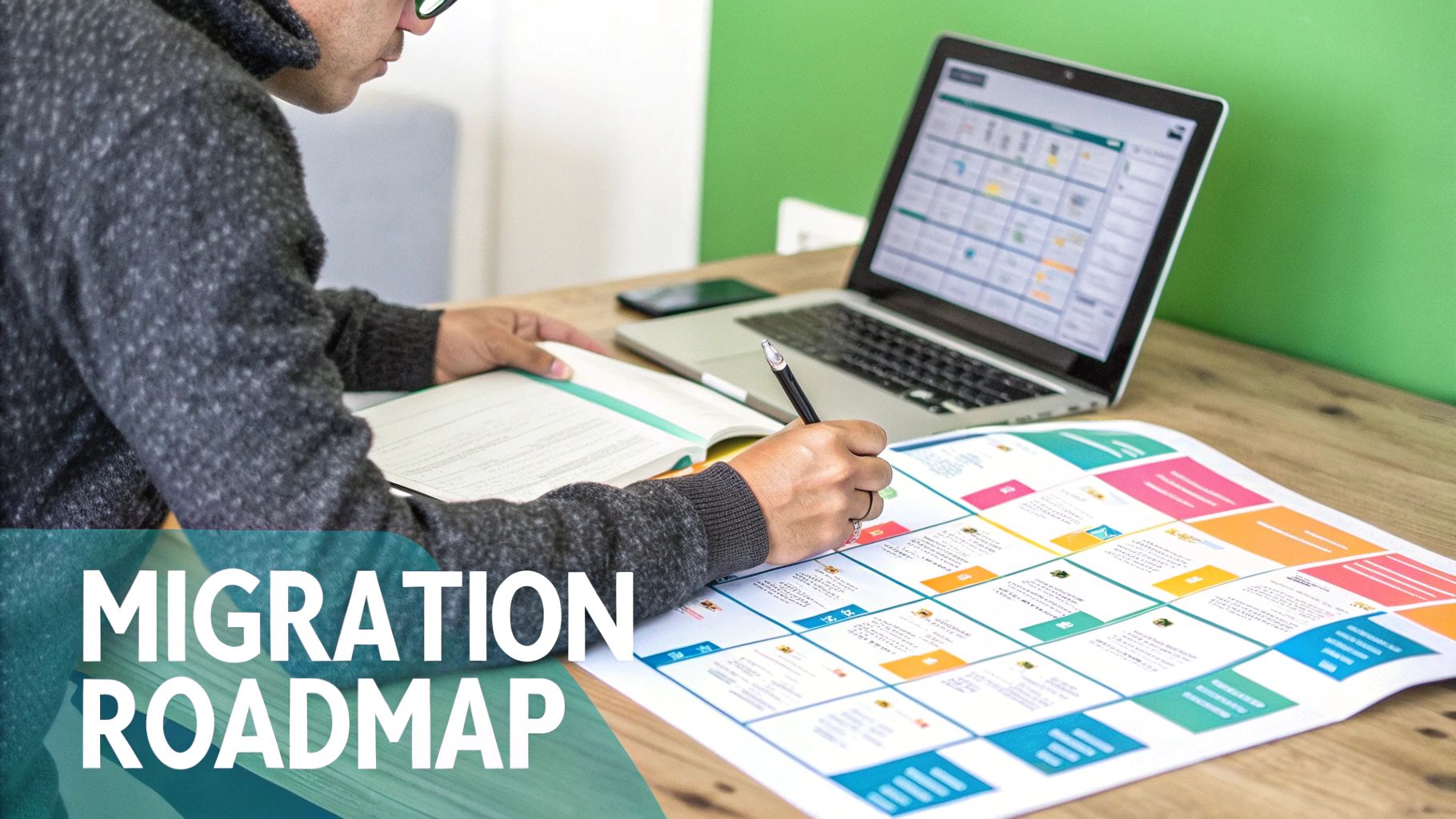
Finally, a solid assessment produces two critical deliverables: a detailed migration roadmap and an accurate Total Cost of Ownership (TCO) calculation. The TCO goes beyond server costs to include things like licensing, retraining, and potential productivity gains, giving you a true picture of the investment.
A proper assessment doesn’t just tell you what you have; it builds the business case for what you could achieve. It’s the difference between simply moving your digital assets and strategically repositioning them for future growth.
The roadmap visualizes the entire journey. It prioritizes applications, sets realistic timelines, and defines security and compliance guardrails right from the start. This document becomes the single source of truth for the project, aligning technical teams and business stakeholders so everyone is working toward the same strategic objectives.
Mastering DXP Migration for Sitecore and SharePoint
Moving a standard application to the cloud is one thing. Migrating an enterprise Digital Experience Platform (DXP) like Sitecore or SharePoint is a completely different ballgame. These aren't just isolated pieces of software; they are sprawling ecosystems woven deep into the fabric of your business operations.
For platforms this complex, a basic "lift-and-shift" migration is often a recipe for disappointment. You might move your servers, but you leave all the real potential on the table. A true DXP migration is a strategic evolution that demands a specialized touch.
You need to understand the platform's architecture inside and out, from tangled content dependencies to sophisticated personalization rules. For Sitecore users, this usually means shifting from a monolithic on-premise setup to a flexible, composable architecture with Sitecore XM Cloud. For SharePoint users, the goal is moving to SharePoint Online to create a secure, modern collaboration hub within the Microsoft 365 ecosystem.
The Sitecore Journey From Monolith to Composable Power
Think of a traditional on-premises Sitecore XP instance as a powerful but monolithic beast. Simply moving it "as-is" to a cloud server might solve a few infrastructure headaches, but it does nothing to unlock the platform’s modern capabilities. The real transformation happens when you refactor the architecture into a composable model.
This is where Kogifi’s experience comes in. We guide companies through this shift, carefully breaking down the monolith into a collection of best-in-class, interconnected services. The ultimate goal is to transition to a headless architecture using Sitecore XM Cloud, which completely separates your content management backend from the frontend user experience.
This strategic move brings several huge advantages:
- Greater Agility: With the front and back ends decoupled, your developers can work on them independently. This means faster development cycles and quicker feature rollouts.
- Enhanced Performance: A headless setup delivers content through APIs, which translates to lightning-fast page loads and a much better user experience, no matter the device.
- Future-Ready Foundation: A composable DXP makes it easy to plug in new tools and technologies as they come along. You’re no longer locked into a single vendor’s ecosystem.
Unlocking Predictive Personalization with Sitecore AI
One of the most exciting reasons to modernize your Sitecore platform is the ability to tap into Sitecore AI. Moving to a composable, cloud-native architecture is the essential first step to making these advanced features work effectively. Sitecore AI automates personalization at a scale that's simply impossible for human teams to manage.
By analyzing user behavior in real-time, it can:
- Predict user intent and automatically deliver the most relevant content or product recommendations.
- Optimize customer journeys by spotting friction points and suggesting improvements.
- Deliver hyper-personalized experiences that significantly boost engagement and conversion rates.
At Kogifi, we don’t just move your platform. We help you build the foundation needed to harness these intelligent tools, turning your DXP from a static content repository into a dynamic, data-driven marketing engine.
Migrating a DXP isn't about moving servers; it's about re-architecting your digital foundation to be more agile, intelligent, and scalable. For Sitecore, this means embracing a composable architecture to unleash the power of AI-driven personalization.
This forward-thinking approach is quickly becoming a necessity. The cloud migration services market is projected to skyrocket from $19.28 billion to $143.7 billion by 2035, a growth spurt driven heavily by legacy-to-cloud modernizations. Trends like generative AI refactoring and the rapid adoption of hybrid deployments are completely changing how businesses approach complex platforms like Sitecore. You can read more about the key opportunities in the cloud migration services market to get a better sense of this evolving landscape.
Elevating Collaboration with SharePoint Online Migration
While Sitecore is all about the external customer experience, SharePoint is the heart of internal collaboration for countless enterprises. When planning a SharePoint migration, the top priorities have to be security, data governance, and seamless integration with the wider Microsoft 365 suite. Just moving files from one place to another simply won’t cut it.
Our approach is centered on a complete migration to SharePoint Online that transforms how your teams work together. We look beyond the basics to tackle the tricky parts, like custom workflows, complex permissions, and third-party integrations, to build a truly secure and efficient digital workplace.
Key steps in our SharePoint migration process include:
- Comprehensive Content Audit: We start by identifying all the redundant, obsolete, or trivial (ROT) data to make sure only valuable, relevant content makes the move.
- Permissions Restructuring: We redesign your access controls to align with modern security best practices and leverage Microsoft 365 Groups for streamlined management.
- Workflow Modernization: Outdated custom workflows get rebuilt using Power Automate, creating more efficient and cloud-native business processes.
By thoughtfully planning and executing the move to SharePoint Online, we help organizations create a truly collaborative environment that is both powerful and secure. For a deeper dive, check out our complete guide to SharePoint migration services. Modernizing these critical platforms is the key to achieving a scalable, intelligent, and global digital presence.
Embedding Security and Governance into Your Cloud Strategy
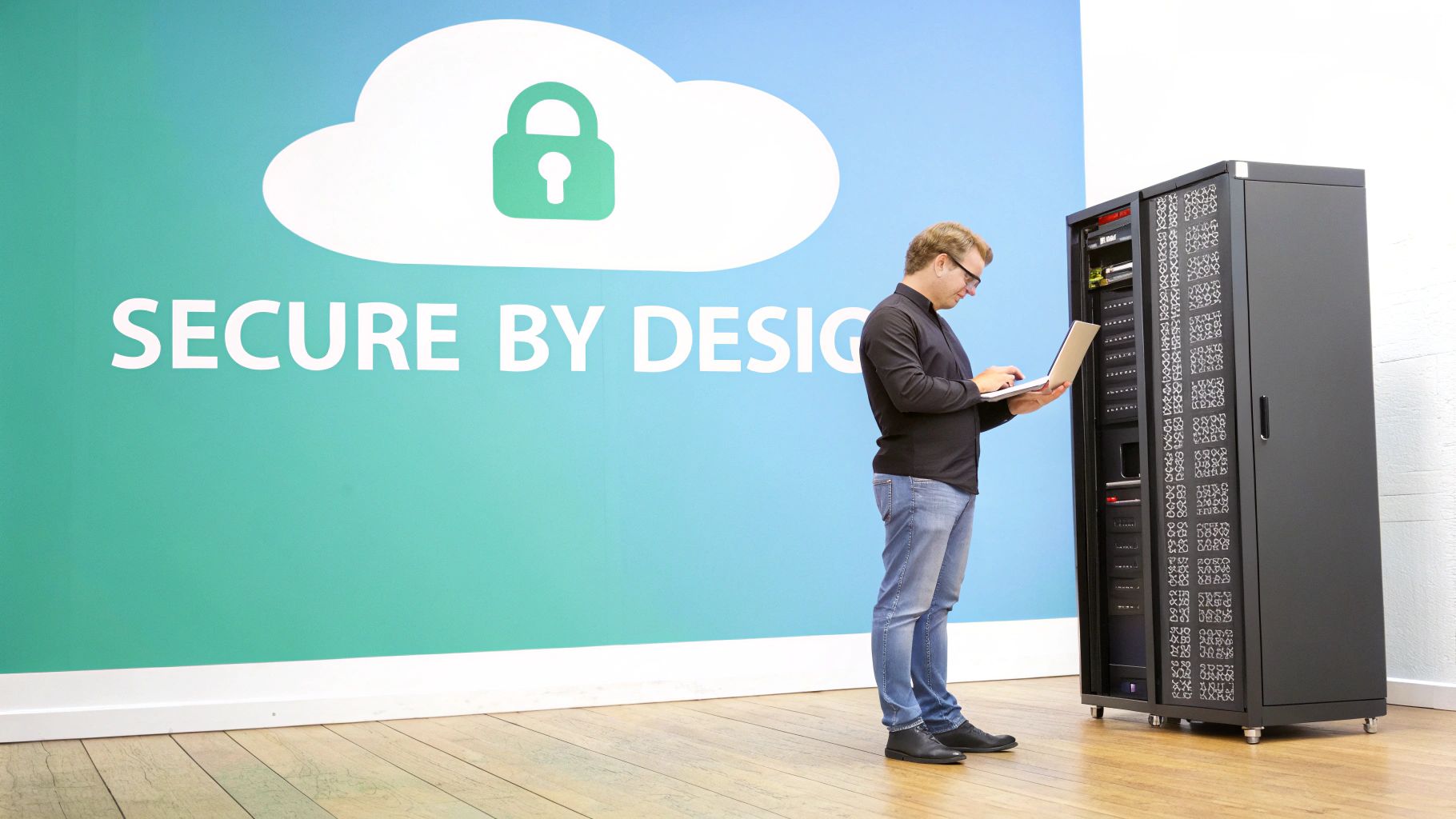
Moving to the cloud isn't just about switching data centers. It’s a fundamental redesign of your security perimeter, swapping static walls for a dynamic, identity-driven framework. For CTOs and IT leaders, this means weaving a proactive risk management strategy into your migration plan from day one, not bolting it on as an afterthought. Your goal should be to create a cloud environment that doesn't just meet but exceeds the security posture of your old on-premise setup.
A huge part of this is getting to grips with the shared responsibility model. Your cloud provider secures their infrastructure—the physical buildings, the servers, the core network—but you're on the hook for securing everything you put in the cloud. That includes your data, your applications like Sitecore or SharePoint, and, most importantly, who has access to it all.
Implementing Robust Identity and Access Management
In the cloud, identity is the new perimeter. That's why a rock-solid Identity and Access Management (IAM) strategy is the foundation of your security. This is especially true for platforms holding sensitive customer or corporate data. For a Sitecore DXP, this means setting up granular roles that let marketers manage content without ever touching critical administrative functions.
It's the same story for a SharePoint Online environment, where IAM policies are vital for protecting confidential documents while still allowing teams to collaborate. By sticking to the principle of least-privilege access, you ensure users only have the permissions they absolutely need to do their jobs. This simple step drastically shrinks your attack surface and is a core part of how Kogifi implements governance in every migration.
Shifting to the cloud means your security focus must move from protecting network perimeters to protecting identities and data. Strong governance isn't a barrier to agility; it's the framework that enables it safely.
Securing Data and Maintaining Compliance
Protecting your data demands a multi-layered approach. You need to secure it both in transit (as it travels between users and services) and at rest (when it's sitting in a database or cloud storage). This means enforcing encryption across the board—no exceptions.
For any business handling personal information, compliance with regulations like GDPR or HIPAA is non-negotiable. Your cloud migration strategy has to be built with these rules in mind from the very beginning. Key considerations include:
- Data Residency: Making sure data is physically stored in specific geographic regions to comply with local laws.
- Audit Trails: Setting up comprehensive logging to track every single access attempt and change made to sensitive data.
- Automated Monitoring: Using cloud-native tools to constantly scan for misconfigurations or vulnerabilities that could expose you.
When migrating a platform like Sitecore, which often handles massive amounts of customer data for personalization engines like Sitecore AI, these compliance guardrails are essential for building and keeping customer trust.
Building Governance from Day One
Good governance isn't just about security; it's also about managing costs and ensuring operational consistency. Cloud costs can spiral out of control without the right guardrails in place. A smart governance strategy uses automation to enforce policies that keep spending in check.
At Kogifi, we build strong governance into every migration project from the outset. We set up automated budget alerts, enforce resource tagging policies to track costs, and deploy automated security checks that run continuously. This proactive approach ensures your new cloud infrastructure is secure, compliant, and cost-effective from the moment it goes live, giving you complete confidence in your new digital foundation.
Ready to Make Your Move? Let's Talk Strategy.
Understanding the theory behind a cloud migration strategy is a great start, but turning that knowledge into business-changing results takes experience. A strategy that's custom-built for your goals is non-negotiable, especially when you’re dealing with complex enterprise platforms. This is where a true partner makes all the difference.
We live and breathe the Sitecore product portfolio. We can guide you through the nitty-gritty of preparing a monolithic setup for the cloud or help you unlock the power of a composable architecture with Sitecore XM Cloud. We'll even show you how to weave in the impressive capabilities of Sitecore AI. Our goal isn’t just to move your platform—it's to transform it into an intelligent, future-ready foundation for your business.
Your End-to-End Migration Partner
We're with you for the entire journey, covering every phase of your transition to make sure it's smooth and secure. It all starts with a deep-dive platform audit to build a detailed roadmap, and it doesn't end until we've provided comprehensive post-migration support to guarantee your long-term success.
Our specialized expertise includes:
- Sitecore Modernization: We specialize in re-architecting Sitecore platforms for XM Cloud, unlocking predictive personalization and a serious performance boost.
- SharePoint Optimization: We migrate and modernize SharePoint environments, turning them into secure, efficient collaboration hubs that fit perfectly within the Microsoft 365 ecosystem.
- 24/7 Global Support: Our dedicated teams are always on, providing continuous monitoring and maintenance to keep your cloud environment stable, secure, and running at its peak.
A successful migration isn’t just about adopting new technology. It’s about aligning that technology with your core business objectives to drive measurable growth and a strong return on investment.
Ready to put the theory into practice? Our solutions are designed to accelerate your digital transformation and get you the best possible ROI.
Let's schedule a consultation to talk through your specific challenges. We can show you how our proven expertise will make your transition to the cloud a strategic success.
Frequently Asked Questions
What Is The Best Cloud Migration Strategy For A Large Enterprise?
There’s really no single "best" strategy that fits every large company—the most successful approach is almost always a hybrid one. Many organizations get their feet wet with Rehosting (lift-and-shift) for lower-risk applications. It's a great way to score some quick wins and build momentum. But for your mission-critical systems, that's rarely the smartest path.
For a complex platform like a Sitecore DXP, you'll get far more long-term value from a Replatform or Refactor strategy. These approaches actually modernize your application to use cloud-native services like auto-scaling and serverless functions. That's how you unlock the full power of tools like Sitecore AI. A smart enterprise strategy carefully mixes the '6 R's' based on how valuable each application is to the business.
How Long Does A Typical DXP Cloud Migration Take?
Honestly, the timelines can vary dramatically depending on how complex your setup is. Moving a simple, standalone application might only take a few weeks. On the other hand, migrating a deeply integrated DXP like Sitecore—especially if it involves refactoring for a composable architecture like XM Cloud—will typically take several months to over a year.
The single most critical factor that shapes the timeline is the initial assessment and planning phase. A thorough discovery process, like the detailed audits Kogifi performs for Sitecore and SharePoint environments, gives you a realistic timeline by uncovering all the dependencies, custom code, and technical debt right from the start.
The depth of your initial planning directly determines the speed and success of your execution. A rushed assessment almost always leads to a delayed and over-budget migration.
How Do You Maintain Business Continuity During Migration?
Keeping the lights on during a migration is everything. It isn’t about hoping for the best; it’s about engineering a process that minimizes risk at every single step.
Here are a few key methods we rely on:
- Phased Migrations: We break the entire project into smaller, more manageable stages. This limits the impact of any single step. For a massive SharePoint portal, for example, we might move one department's site collection at a time.
- Detailed Rollback Plans: Before any cutover happens, a clear and tested rollback plan is already in place. If anything unexpected occurs, we can revert immediately.
- Parallel Environments: For critical platforms like Sitecore, we often run the new cloud environment and the old on-premises system in parallel for a set period. This gives us time for rigorous validation, ensuring performance and data integrity are perfect before we decommission the legacy infrastructure. The result is a zero-downtime transition for your users.
Your cloud migration is a major step. Kogifi has the specialized expertise in Sitecore AI and SharePoint to ensure your journey is a strategic success, not just a technical one. Let's build your migration roadmap together.