


Tackling technical debt isn't just about cleaning up old code; it's a strategic mission to assess legacy systems, prioritize fixes that matter to the business, and methodically refactor or migrate the parts that are holding you back. For a platform like Sitecore, this means zeroing in on the issues blocking big-ticket initiatives like AI-driven personalization and modernizing your codebase piece by piece to get your agility back.
The Real Cost of Technical Debt in Your DXP

Let's be clear: technical debt is more than just messy code. It's a silent tax on your digital experience platform (DXP) that slowly chokes innovation and eats away at your ROI. For leaders managing complex Sitecore and SharePoint ecosystems, this "tax" shows up as rushed updates and deferred maintenance that eventually cripple your ability to compete.
Imagine your team is finally ready to launch that groundbreaking Sitecore AI personalization initiative. The strategy is sharp, the content is perfect, but the whole project grinds to a halt. Why? Because years of tangled, undocumented code make it impossible to integrate the new AI capabilities without a massive, unplanned overhaul. This isn't just a hypothetical; it's a scenario we see play out all the time.
The Hidden Financial Drain
The financial bleed from unaddressed debt is staggering. In the enterprise world, where our team has implemented solutions for over 50 global clients, we've seen firsthand how technical debt quietly hijacks budgets. A survey from Protiviti found that firms globally dedicate a shocking 30% of their IT spending and 20% of their resources just to manage it.
This guide isn't about theory. It’s a practical framework for reducing technical debt, built on a proven three-part strategy that can turn this liability into a genuine competitive advantage:
- Assess: First, you have to find and quantify the debt lurking in your DXP.
- Prioritize: Next, focus on fixing the issues causing the most business friction.
- Act: Finally, execute targeted refactoring and modernization strategies.
Technical debt isn’t a sign of failure; it’s a natural outcome of evolution. The crucial step is transforming that debt from a roadblock into a strategic opportunity for building future agility and growth.
A Path to Renewed Agility
Think about a corporate SharePoint intranet bogged down by outdated web parts and a spaghetti-like permissions structure. It doesn't just frustrate employees—it opens up security risks and kills productivity. A smart approach would be to prioritize fixing the most-used but least-stable components first. This delivers immediate value and builds the momentum you need for a broader modernization push.
This is the path forward. By understanding the true costs and adopting a structured approach, you can systematically dismantle the barriers holding your DXP back. The goal isn't just to fix old problems but to build a more resilient, scalable, and innovative digital foundation. To get a better handle on these platforms, take a look at our guide on what is a digital experience platform.
The table below outlines the core strategies we'll be diving into, providing a high-level look at the actions and their impact on your business.
Core Strategies for Technical Debt Reduction
Each of these strategies plays a critical role in a comprehensive debt reduction program. By combining them, you create a powerful system for not only clearing existing debt but also preventing its return.
Auditing and Measuring Your DXP's Technical Debt

You can't effectively tackle technical debt until you understand its true scope and impact. A vague feeling that your Sitecore instance is "slow" or that your SharePoint customizations are "buggy" won't be enough to get the resources you need for a fix. A thorough, data-driven audit is the only way to translate those abstract problems into a concrete business case for action.
The best approach is a hybrid one, pairing quantitative code analysis with qualitative feedback from the people who actually use the platform every day. It's only by combining hard metrics with human experience that you can get a true picture of where the debt lies and, more importantly, what it’s costing you.
Establishing a Quantitative Baseline
First things first, you need to establish an objective baseline with automated code analysis. For a platform like Sitecore, this means digging deeper than the surface to check the health of your custom renderings, pipelines, and integrations. In a SharePoint environment, you’d be analyzing custom web parts, event receivers, and any other bespoke solutions layered on top.
A few key metrics are non-negotiable here:
- Cyclomatic Complexity: This measures the number of independent paths through your code. A high score (typically above 15) in a Sitecore rendering or SharePoint feature points to overly complex logic that’s a nightmare to test and maintain—a prime candidate for refactoring.
- Maintainability Index: Scored from 0 to 100, this index gives you an overall measure of code health. If you see consistently low scores (below 60) across a module, it’s a red flag for systemic issues that will slow down future development.
- Code Duplication: This metric sniffs out repeated blocks of code that should have been centralized. High duplication rates not only bloat the codebase but also mean a single bug fix might need to be applied in ten different places, multiplying risk and effort.
These metrics aren't just for developers. They are the hard data you'll use to build a compelling argument for leadership, showing exactly where the platform is brittle.
Translating Technical Metrics into Business Impact
Data without context is just noise. The most crucial part of the audit is connecting these technical scores to tangible business outcomes. This is how you calculate the "interest" on your technical debt.
Your goal is to reframe the conversation from "fixing bad code" to "unlocking business value." By linking a high Cyclomatic Complexity score to a 30% longer development time for a new marketing feature, you make the problem real for non-technical stakeholders.
For instance, a poorly optimized Sitecore component might be directly responsible for slow page load times, which in turn kills your SEO rankings and conversion rates. In SharePoint, a complex, debt-ridden workflow for document approvals could be costing the company hours of lost productivity every single week.
This translation step requires collaboration. You'll need to talk to everyone—developers, content authors, marketers, and end-users. A holistic performance review is essential for a complete picture; for a closer look, our guide on how to audit your digital experience platform performance offers a deeper dive.
The Hybrid Audit Checklist
To give your audit some structure, use a blended approach that captures both the code and the context around it. Your process should include these steps:
- Automated Code Scan: Run static analysis tools against your entire custom codebase for your Sitecore or SharePoint solution to gather those initial metrics.
- Architectural Review: Manually assess the solution's architecture. Are you relying on outdated patterns? Is the solution so tightly coupled that any small change becomes a major project? In Sitecore, this could mean checking for overuse of monolithic renderings instead of modern, component-based approaches.
- Team Interviews: Talk to your development team. Find out which areas of the code they absolutely dread working on. These "no-go zones" are almost always hotspots for technical debt.
- User Feedback Sessions: Engage with your marketing and content teams. Ask them about their biggest frustrations with the platform. A content author struggling with a slow, unreliable interface in Sitecore provides powerful anecdotal evidence to back up your quantitative findings.
By combining these elements, you elevate your audit from a simple code scan to a comprehensive diagnostic. This gives you the clear, evidence-backed foundation you need to prioritize your efforts and show exactly how reducing technical debt will drive the business forward.
Prioritizing Technical Debt for Maximum Business Impact
So, your technical debt audit is done. Now you’re staring at a list of issues that probably feels a mile long. It’s tempting to dive in and start fixing the oldest or gnarliest-looking problems first, but a “fix-everything” approach is a surefire way to burn through your budget with little to show for it. The secret to actually reducing technical debt isn’t about fixing everything—it's about fixing the right things first.
This is where a business-first prioritization framework comes in. It shifts the entire conversation from "what's the messiest code?" to "what's actively hurting our business?" For anyone managing a complex platform like Sitecore, this means pointing your engineering talent at the fixes that will actually unlock revenue, make customers happier, or clear the path for your DXP roadmap.
Creating a Business Impact Matrix
To cut through the noise, you need a prioritization matrix. It’s a simple but incredibly effective tool that helps you visually map every piece of debt on two axes: Technical Severity (how hard is it to fix?) and Business Impact (what do we gain by fixing it?).
Let’s say you’re running a Sitecore Commerce site. Your audit flags two big problems:
- A clunky, multi-step checkout flow is causing a 15% cart abandonment rate. This is a high-impact issue that’s bleeding revenue every single day.
- An old internal content approval workflow is awkward but still works. It only really annoys a handful of your internal team.
The approval workflow might be built on ancient, messy code (high technical severity), but fixing that checkout flow delivers an immediate, measurable boost to your bottom line. The matrix makes this choice a no-brainer. You put your resources where they’ll make the biggest difference, period.
The most successful debt reduction programs are relentless about business value. A small fix that unblocks a major Sitecore AI personalization campaign is infinitely more valuable than a massive refactor of a low-traffic, internal-facing module.
Aligning Debt Reduction with the DXP Roadmap
Prioritization isn't a one-and-done task; it has to live and breathe alongside your strategic goals. If your roadmap includes launching a new omnichannel strategy using Sitecore Content Hub, then any technical debt strangling your content syndication or API integrations needs to jump to the top of the list. This way, your cleanup efforts aren’t just about tidying up the past—they’re actively building the future.
Or imagine a SharePoint environment where the big goal is to integrate with Microsoft Teams to boost collaboration. Suddenly, that old, crusty permissions model or the slow document search APIs become top-priority targets. Fixing them directly supports a core business objective and creates a better employee experience.
Quantifying the Business Case
To get the buy-in and budget you need, you have to speak the language of business. Vague technical complaints won’t get you very far. You need to connect each high-priority item to a specific metric. This is how you turn a technical request into a compelling business case.
Just look at the difference:
This is the level of detail that gets a CFO’s attention. It frames the cost of inaction in clear financial terms. To sharpen your arguments even further, you can use tools like our DXP ROI calculator to better measure the impact of your digital investments. When you talk about technical debt in terms of revenue, efficiency, and customer satisfaction, you transform it from a cost center into a value driver. That’s how you get the support you need.
Modernization Patterns for Sitecore and SharePoint
Once you’ve got your technical debt prioritized, the real work begins. Moving past simple code cleanup means adopting powerful modernization patterns, especially for big enterprise platforms like Sitecore and SharePoint. This isn’t just about squashing bugs; it’s about fundamentally reshaping your architecture to pay down that debt while unlocking new capabilities.
The end game is to shift from a rigid, monolithic structure to a more flexible, composable DXP. A methodical approach doesn't just fix old problems—it builds a resilient foundation that stops new debt from piling up.
This simple, three-stage process shows how to tackle tech debt, moving from audit to action.
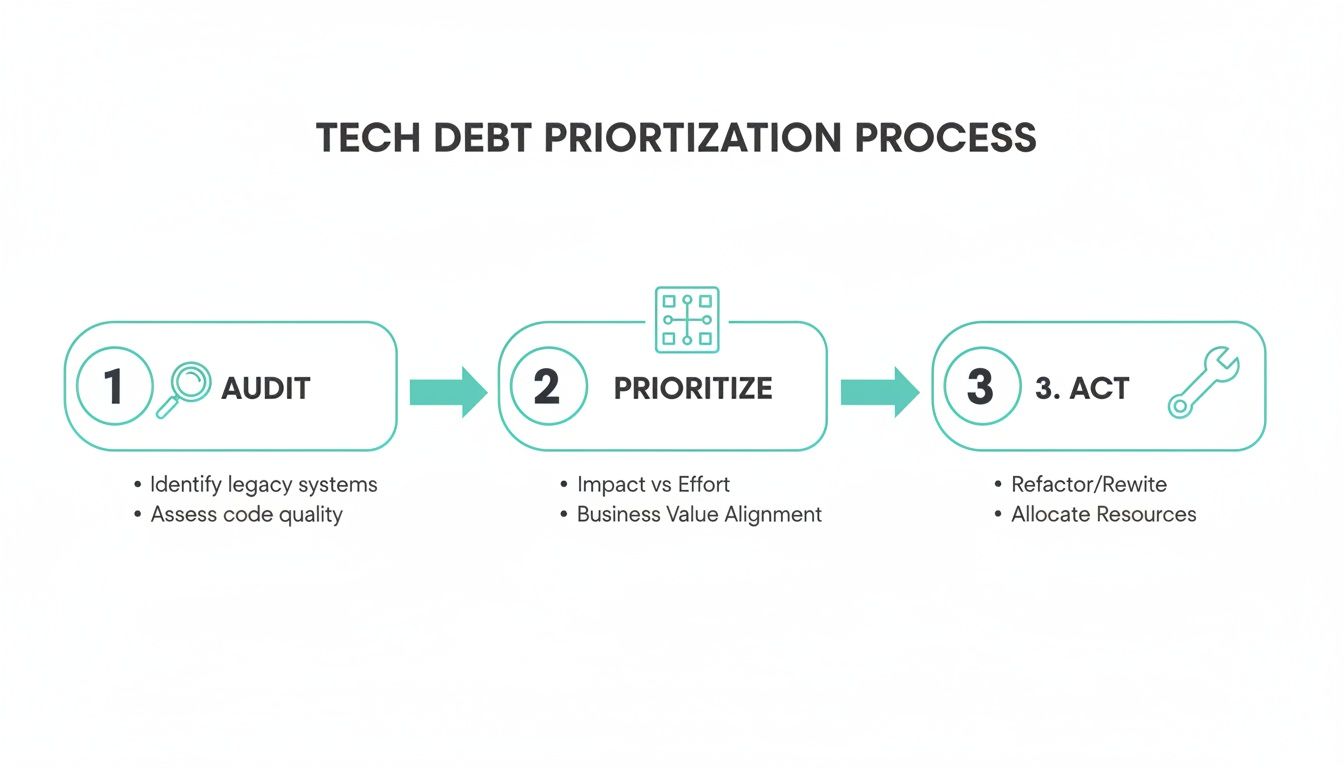
As you can see, effective debt reduction is a structured process, not a chaotic scramble. You move from understanding the problem to implementing a targeted solution.
Adopting the Strangler Fig Pattern
For sprawling, legacy Sitecore and SharePoint implementations, a "big bang" migration is usually a recipe for disaster. It’s too risky and disruptive. The Strangler Fig Pattern offers a much safer, more pragmatic path forward.
Named after a plant that wraps itself around a host tree until it eventually takes over, this pattern is all about incrementally replacing pieces of your old system with new applications and services.
Let's say your aging Sitecore instance has a clunky, custom-built e-commerce module. Instead of rewriting the whole thing at once, you could:
- Find a seam: Start with a distinct piece of functionality, like the product search feature.
- Build a new service: Create a modern search service using a platform like Sitecore Search, which gives you AI-powered, headless capabilities.
- Redirect traffic: Set up a proxy that sends all search-related traffic to your new service. The rest of the old e-commerce module keeps humming along in the background.
- Repeat and strangle: Do this again for other components—the shopping cart, checkout, order management—until the old module is completely "strangled" and can be safely shut down.
This approach keeps risk low by isolating changes and lets you deliver value piece by piece. It's a proven way to modernize complex systems without causing chaos in your day-to-day operations.
The beauty of the Strangler Fig Pattern is that it turns a daunting monolithic problem into a series of manageable, low-risk steps. Each new service you build not only pays down debt but also adds immediate value and modern capability.
Moving Toward a Composable DXP Architecture
Ultimately, the goal of modernization is often a move to a composable DXP. This API-first architecture breaks down monolithic platforms into a collection of independent, best-of-breed services that talk to each other via APIs. This modularity is the perfect antidote to the tightly coupled code that creates so much technical debt.
A key part of reducing technical debt, especially on aging platforms, involves modernizing outdated IT systems to boost both performance and security.
For Sitecore, this means evolving from a traditional all-in-one instance to a constellation of specialized services:
- Content: Sitecore Content Hub or XM Cloud for headless content delivery.
- Personalization: Sitecore Personalize for AI-driven, real-time experiences.
- Commerce: Sitecore OrderCloud for headless, API-first commerce.
- Search: Sitecore Search for intelligent, AI-powered search.
This shift lets you update or replace individual components without torpedoing the entire system. If a better search solution comes along, you can swap it in without a massive replatforming project. This architectural agility is your best long-term defense against technical debt. To dig deeper, check out these different legacy system modernization strategies that can help guide your transition.
The SharePoint Modernization Journey
SharePoint has its own modernization path, and it also hinges on breaking down monolithic structures. For years, organizations built complex solutions with custom farm solutions and web parts that were deeply tangled with the core platform. This created a massive technical debt burden, making every upgrade painful and risky.
The modern approach for SharePoint decouples customizations from the core platform by using the SharePoint Framework (SPFx).
- From Farm Solutions to SPFx: Instead of deploying server-side code, SPFx uses client-side development (like JavaScript and TypeScript) to build web parts and extensions. They run in the user's browser, completely separate from the SharePoint server.
- Leveraging Microsoft 365 Services: Modern SharePoint solutions don't live in a vacuum. They integrate with the broader Microsoft 365 ecosystem. Instead of building a custom workflow inside SharePoint, you might use Power Automate. For data, you might use Microsoft Lists or Dataverse.
This shift is a mirror image of the composable DXP philosophy. By using SPFx and integrating with other Microsoft 365 services, you create solutions that are more resilient, easier to maintain, and far less likely to pile up debt. When Microsoft updates SharePoint, your SPFx solutions just keep working—no costly rewrite needed. You're effectively future-proofing your investment.
Embedding Quality into Your Development Culture
Fixing the technical debt you already have is a one-off project. Stopping it from piling up again requires a real shift in your team's culture.
You have to move away from a reactive, "we'll fix it later" mindset and embrace a proactive culture where quality is everyone’s job. It’s about making governance and clean code a natural part of the development process, not just a box to check at the end.
For teams knee-deep in complex Sitecore or SharePoint environments, this means baking debt management directly into your agile workflow. It stops being a separate task that gets pushed to the next sprint and becomes a core priority, right alongside new features. The goal is to make good, maintainable code the path of least resistance.
Integrating Debt Management into Agile Sprints
The only way to stop technical debt from slowly choking your platform is to make its reduction a continuous, predictable part of your routine. Waiting for a "stabilization sprint" or a massive refactoring project is a losing game. By the time you get to it, the problem is ten times worse.
A surprisingly effective tactic is to allocate a fixed percentage of every single sprint to paying down debt. According to a strategic guide from monday.com, while most companies don't do this, the ones that earmark 15-20% of their budget for debt reduction see measurable long-term gains in velocity. You can read more about their findings on technical debt management.
When you treat debt repayment with the same weight as new user stories, you guarantee steady, incremental progress.
This simple "sprint allocation" rule completely changes the conversation. Technical debt is no longer framed as a failure to be corrected later, but as an expected cost of development that has to be managed proactively.
This approach also builds a powerful sense of collective ownership. When developers know they have dedicated time to actually improve the codebase, they feel empowered to flag and fix issues instead of just patching over them.
Automated Quality Gates and CI/CD Pipelines
A strong quality culture needs a strong automated backbone. Your CI/CD pipeline is your first and best line of defense against new technical debt. By setting up automated quality gates, you can enforce coding standards and catch problems long before they ever get merged into the main branch.
In a Sitecore project, this could look like:
- Static Code Analysis: Integrating tools that automatically scan for high cyclomatic complexity, duplicated code, and violations of Sitecore development best practices.
- Unit Test Coverage: Setting a non-negotiable threshold for unit test coverage (say, 80%) that a build must meet to pass. This ensures new logic is actually being tested.
- Automated Security Scans: Running tools that detect common vulnerabilities in your custom code, helping to secure your DXP from potential threats.
For SharePoint, you can apply similar gates to SPFx solutions, making sure custom web parts and extensions are performant, secure, and aren’t using deprecated APIs. Automation takes the subjectivity out of the equation and creates a consistent quality baseline for every single code contribution.
The Power of Peer Reviews and Coding Standards
Automation is fantastic, but it’s no substitute for human expertise. A true culture of quality is built on rigorous peer reviews and clearly documented coding standards. These practices aren't about policing developers; they're about sharing knowledge and leveling up the entire team.
Having clear, agreed-upon coding standards is non-negotiable. Whether it's a naming convention for Sitecore templates or best practices for using SharePoint APIs, these rules reduce the mental overhead and make the codebase more predictable for everyone.
Peer reviews act as that final, critical checkpoint:
- Knowledge Sharing: They're a fantastic way to spread knowledge about different parts of the system and break down information silos.
- Early Defect Detection: A second pair of eyes will almost always spot logical errors, missed edge cases, or potential performance issues.
- Mentorship Opportunities: They create a natural forum for senior developers to mentor more junior team members on best practices in a constructive way.
When you combine the discipline of sprint allocation, the rigor of automated gates, and the collaborative spirit of peer reviews, you create an environment where quality isn't just a goal—it becomes an ingrained habit.
Frequently Asked Questions About Technical Debt
Navigating the complexities of technical debt always brings up a lot of questions, especially for leaders managing high-stakes platforms like Sitecore and SharePoint. Here are our answers to the most common queries we hear from the field.
How Do I Convince Leadership to Invest in Reducing Technical Debt?
Stop talking about "code complexity" and start talking about business outcomes. Leadership responds to ROI, not technical jargon. The key is to frame the entire conversation around the direct, tangible impact on the business.
Think in terms of dollars and deadlines. For example, you could say: "Right now, 40% of our development budget is spent just maintaining this legacy part of our Sitecore platform. That’s money we can't use to launch the AI-powered personalization our competitors are already using to win customers."
Build a business case that ties debt reduction directly to the KPIs they care about:
- More Revenue: "Refactoring the checkout process will directly reduce cart abandonment and increase sales."
- Better Efficiency: "Modernizing this old SharePoint workflow will save the finance team 20 hours of manual work every single week."
- Happier Customers: "Fixing these slow page load speeds will improve our user experience and stop visitors from leaving."
Finally, don't just present the problem. Come with a clear, prioritized roadmap that shows you've thought through the financial side, highlighting a few quick wins alongside the bigger strategic improvements. It shows you have a plan to deliver value from day one.
What Is the Best First Step for a Legacy Sitecore Platform?
The most effective place to start is with a comprehensive audit—but one that’s laser-focused on business pain points. It’s tempting to want to fix everything at once, but that's a recipe for failure. Instead, find the "squeaky wheel," the one part of the platform causing the most obvious pain.
Is it the painfully slow content authoring experience that’s crippling your marketing team's agility? Is it the unreliable e-commerce checkout that's actively losing you money every day? Or is it the constant emergency patching for an outdated, insecure module?
Combine automated code analysis with candid interviews with your developers, marketers, and support staff to map out the entire debt landscape. Then, pick one high-impact, relatively low-effort area to tackle first. A quick win—like stabilizing a critical component—builds incredible momentum. It’s a powerful way to demonstrate the value of this work, making it much easier to get the buy-in you need for larger refactoring projects down the road. For more in-depth strategies, there are excellent guides on reducing technical debt for clean code.
Can Moving to a Composable DXP Reduce Technical Debt?
Absolutely. In fact, migrating to a composable DXP is one of the single most effective long-term strategies for getting technical debt under control for good. Traditional monolithic platforms, like older versions of Sitecore, create a tightly coupled mess where a small change in one corner can break something completely unrelated. This makes every update risky, slow, and expensive.
A modern, API-first composable architecture—like what you get with Sitecore's newer products (XM Cloud, Sitecore Personalize, etc.)—shatters that monolith. It breaks the system into independent, best-of-breed services that talk to each other through APIs. This modularity means you can update, replace, or refactor one piece without bringing the whole house down.
This approach fundamentally changes how you manage debt. Instead of a single, massive debt load, you have smaller, manageable debts associated with each component, which are far easier to address.
This modular structure makes it easier to pay down existing debt over time using patterns like the Strangler Fig. More importantly, it helps prevent the build-up of tangled, complex codebases in the future. It's a strategic shift that fosters agility, allowing your teams to innovate and adapt without being held back by the weight of a monolithic past.
At Kogifi, we specialize in transforming complex DXP challenges into opportunities for growth. Our experts can help you assess, prioritize, and systematically eliminate the technical debt holding your Sitecore or SharePoint platform back. https://www.kogifi.com