


The real difference between omnichannel vs. multichannel is actually pretty simple. Multichannel marketing is all about the company and its goal to push products out across as many channels as possible. Omnichannel, on the other hand, puts the customer first, weaving all those channels together into one fluid, continuous journey.
Understanding The Core Differences
At its heart, it’s a shift in perspective. A multichannel approach sees a website, a mobile app, and a physical store as separate opportunities to make a sale. But an omnichannel strategy views them as interconnected touchpoints in a single, ongoing conversation with the customer. Making the switch isn’t just a tactical change; it’s a fundamental pivot in how you think about your business.
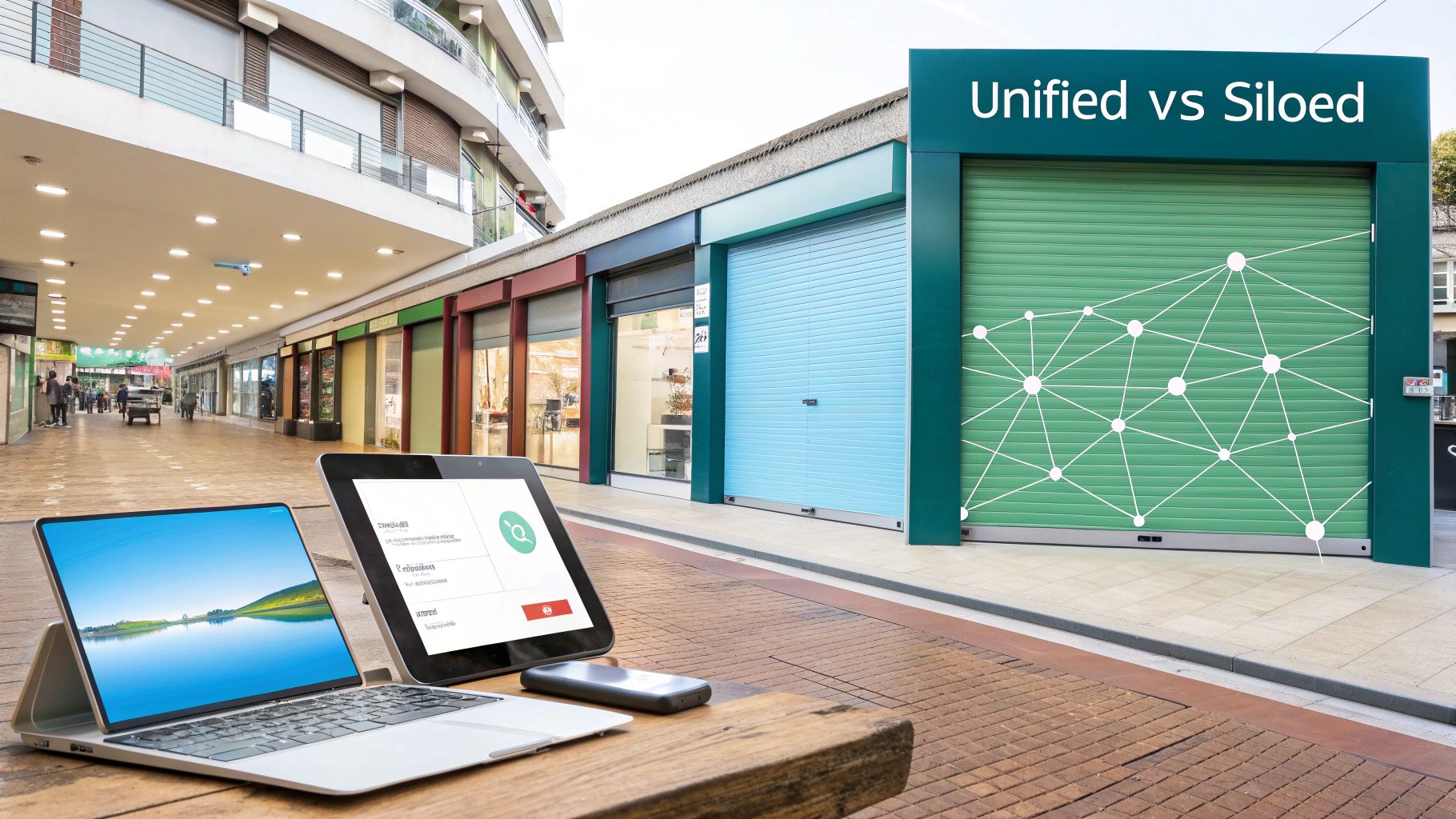
Many businesses, especially those with legacy systems, end up with a disconnected multichannel setup. Each channel operates in its own silo, collecting its own data and running its own campaigns. The result? Fragmented customer information and wildly inconsistent experiences.
A unified omnichannel strategy is the polar opposite. It’s powered by a solid Digital Experience Platform (DXP) like Sitecore that puts the customer at the center of every single interaction. This integration isn't just a nice-to-have; it's what builds loyalty and drives serious revenue.
The numbers don’t lie. Companies with strong omnichannel strategies retain an incredible 89% of their customers. Compare that to the paltry 33% retention rate for businesses with weak multichannel approaches. That massive gap makes it clear: a connected experience is what keeps customers coming back.
The Strategic Divide Explained
To really get what this all means for your business, it’s worth exploring how you can truly unlock the power of omnichannel marketing. The table below breaks down the core philosophies behind each approach, offering a quick side-by-side look.
Quick Comparison Multichannel vs Omnichannel Core Philosophies
As you can see, the difference isn't just tactical—it's strategic. One focuses on broadcasting a message wherever possible, while the other is about building a relationship that flows naturally from one touchpoint to the next.
The Reality of a Disconnected Multichannel Strategy
So, you’ve expanded your brand’s presence. You’re on the web, active on social media, and you have physical stores. That’s a great first step, but a purely multichannel approach often creates a frustrating reality for the customer. When each channel operates in its own little world, the experience feels broken and undermines the whole point of being more accessible in the first place.

This disconnection isn't just some abstract concept; it shows up in common, everyday ways that slowly chip away at customer trust. Picture this: a loyal customer buys something in your store, and the very next day, they get a promotional email for that exact same item. It’s a classic multichannel fumble, happening because the in-store POS system and the email marketing platform aren’t talking to each other.
Friction like this is common in enterprise settings, too. A B2B client might see one price when they log into their SharePoint-powered partner portal, only to find a different, conflicting price on the public e-commerce site. These little inconsistencies add up, creating confusion and making your brand look unreliable.
The Problem of Data Silos
These issues are really just symptoms of a much deeper problem: data silos. In a typical multichannel setup, every platform—from your e-commerce engine to your customer service software—hoards its own customer data. This makes it impossible to build a true 360-degree customer view, which is the absolute foundation of any meaningful personalization.
Without a unified data foundation, personalization is just guesswork. The system has no idea about a customer’s recent purchase, the status of their support ticket, or their last interaction on another channel. This is the core technical limitation that causes most multichannel strategies to fall short.
This fragmentation hits the bottom line hard. When your marketing efforts aren’t informed by a complete customer profile, they become irrelevant and inefficient. You end up with wasted ad spend, dismal engagement rates, and a customer base that feels like you don’t know them at all. The only way forward is to invest in robust customer data integration solutions that can tear down these internal walls.
How a Disconnected Tech Stack Creates Friction
The technical cracks in a multichannel strategy really start to show when you look at the tech stack. An organization might use a powerful tool like SharePoint for its intranet or client portals, but if that system isn't connected to the main DXP, it just becomes another isolated island of data.
This technological divide has real consequences:
- Inconsistent Customer Service: A support agent on live chat has no clue about a customer's recent in-app activity or their in-store purchase. This leads to them asking the same questions over and over, dragging out resolution times.
- Failed Personalization: An e-commerce site, even one running on a sophisticated platform like Sitecore, can’t use interaction data from a separate mobile app. This is a massive missed opportunity for relevant product recommendations, leaving Sitecore's powerful AI features starved of the complete data set they need to work effectively.
- Operational Inefficiency: Teams are stuck manually piecing together data from different systems, which is a recipe for errors and a huge administrative headache. Marketing and sales might even be working from conflicting reports, creating misalignment across the organization.
Ultimately, a disconnected multichannel strategy forces the customer to do all the heavy lifting. They’re the ones who have to connect the dots between inconsistent information, repeat their story to different departments, and put up with an experience that feels impersonal. This constant friction is a huge driver of customer churn, pushing even your most loyal fans toward competitors who offer a smoother journey.
Achieving a Unified Journey with an Omnichannel Approach
While a multichannel strategy often creates disconnected experiences, a true omnichannel approach puts the customer right at the center of everything. This isn't just about showing up on multiple channels; it's about weaving them together into a single, intelligent conversation that adapts to what the customer needs in that exact moment. The goal is to make the transition from one touchpoint to another completely invisible to the user.
Pulling this off requires a fundamental shift in both technology and mindset. It all hinges on unifying your data, content, and analytics—and that's where a powerful Digital Experience Platform (DXP) becomes the essential backbone of the entire operation.

The Power of Sitecore AI in a Unified Ecosystem
Platforms like Sitecore Experience Platform (XP) and the composable Sitecore XM Cloud are built to turn this unified vision into reality. At their core, they capture every single customer interaction—every click, search, and purchase—and feed it into a single, comprehensive customer profile. This is where Sitecore AI really starts to shine.
Instead of just looking at siloed, channel-specific metrics, Sitecore AI processes behavioral data across every touchpoint to understand intent and predict what a customer will do next. It goes beyond basic segmentation to deliver true 1-to-1 hyper-personalization, getting the right content on the right channel at the perfect moment. This is what transforms a standard digital presence into an intelligent, responsive experience engine.
An omnichannel strategy powered by a unified DXP isn't just about a better user experience—it's a direct driver of business growth. By connecting every interaction, you create a flywheel of loyalty and value that siloed channels can never replicate.
Think about a practical example. A customer starts their journey by browsing for a new laptop on their company's SharePoint-powered procurement portal during work hours. Later that evening, they use their personal tablet to read reviews on the company's public website, which is built on Sitecore XM Cloud.
Because both platforms feed data into a central hub, Sitecore AI recognizes this is the same user. The next time they log in, the website's homepage features a comparison chart of the laptops they viewed, plus a personalized offer available through their corporate account. This level of sophistication is only possible when data flows freely between systems.
From Disconnected Touchpoints to a Single Conversation
The true test of an omni channel vs multi channel strategy is its ability to maintain context. In a multichannel world, the customer's journey resets with every new interaction. In an omnichannel world, the journey is continuous.
Here’s how Sitecore’s portfolio makes this happen:
- Unified Customer Profile: Sitecore's Customer Data Platform (CDP) pulls in data from every source—web, mobile, CRM, in-store POS, and even enterprise systems like SharePoint—to create a single source of truth for each customer.
- Real-Time Decisioning: As data flows in, Sitecore's AI-driven decisioning engine instantly analyzes it to determine the next best action, whether that's showing a specific piece of content, sending a push notification, or alerting a sales rep.
- Composable Content Delivery: With a headless architecture, Sitecore XM Cloud can deliver consistent, personalized content to any endpoint, from a traditional website to a mobile app, a kiosk, or an IoT device, ensuring brand consistency everywhere.
This integrated approach delivers tangible business results. Strong omnichannel engagement drives a robust 9.5% year-over-year revenue growth, far outpacing the anemic 3.4% seen with weaker multichannel strategies. It also slashes cost per contact by 7.5% annually, compared to a negligible 0.2% for multichannel.
The impact goes well beyond marketing, touching every facet of the customer relationship. For a deeper look into crafting truly connected support, it's worth exploring the principles of an effective Omnichannel Customer Experience.
Ultimately, a successful omnichannel strategy transforms the brand-customer dynamic from a series of transactional interactions into a single, ongoing dialogue. This continuous conversation, informed by data and powered by intelligent automation, is what builds deep loyalty and maximizes customer lifetime value (LTV). It's the definitive advantage in a world where experience is everything.
The Technology Powering True Omnichannel Success
Knowing the difference between omni channel vs multi channel is one thing, but actually building a true omnichannel strategy is a completely different beast. It demands a very specific kind of technological foundation. A powerful Digital Experience Platform (DXP) isn't just a nice-to-have; it's the non-negotiable core that makes a seamless customer journey possible.
Think of it as the central nervous system for every customer interaction. This is a world away from the fragmented, siloed tools that hold most multichannel setups together. Without this central hub, data gets trapped, content is a mess of inconsistencies, and personalization is little more than a lucky guess.
A genuine omnichannel experience is born from an architecture designed for connectivity, not a patchwork of standalone solutions. This is where a composable DXP, particularly the Sitecore portfolio, really starts to shine.
Sitecore XM Cloud: The Composable Content Engine
At the heart of any modern omnichannel strategy is the ability to get the right content to the right place, instantly. Sitecore XM Cloud was built for exactly this. Its headless, composable architecture separates the content management backend from the front-end presentation layer where customers see it.
This separation is absolutely critical. It means you can create a single piece of content once and then push it out everywhere—a website, a mobile app, an in-store kiosk, or even a smart speaker. This is a fundamental break from typical multichannel workflows, where teams are constantly recreating content for each new channel, leading to brand inconsistencies and a mountain of extra work.
The agility of a headless CMS like Sitecore XM Cloud is what makes brand consistency technically possible. It ensures that no matter where a customer bumps into your brand, the messaging, offers, and look and feel are perfectly aligned, building trust with every single touchpoint.
Sitecore CDP: Unifying Data for a Single Source of Truth
Content is only half the battle; data is the other. An omnichannel strategy lives or dies on its ability to build a unified, 360-degree view of the customer. Sitecore's Customer Data Platform (CDP) is the engine that pulls this all together into a single source of truth.
It pulls in data from every touchpoint you can imagine:
- Website behavior: Clicks, page views, and time spent on site.
- Mobile app usage: In-app actions and engagement patterns.
- E-commerce activity: Purchase history, abandoned carts, and wish lists.
- Offline interactions: In-store purchases or calls to customer service.
By consolidating all this information, Sitecore CDP builds rich, dynamic customer profiles. This unified data then feeds Sitecore AI, allowing it to go beyond basic segmentation and deliver true 1-to-1 personalization. It can predict what a customer might do next, recommend the perfect product, and find the ideal moment to send a message on their favorite channel. Without a CDP, you're just flying blind.
Integrating Enterprise Systems Like SharePoint
A complete omnichannel ecosystem doesn't stop at customer-facing channels. It has to connect with core internal systems, too. For many businesses, SharePoint is a critical hub for internal knowledge, product documentation, or secure partner portals.
In a disconnected, multichannel world, SharePoint is its own island. A partner logging into a SharePoint portal gets an experience that’s completely detached from their interactions on the main website or mobile app. No data is shared, and the journey feels broken.
But when you integrate SharePoint into a Sitecore-powered DXP, it just becomes another connected part of the ecosystem. Customer data from Sitecore's CDP can personalize the content someone sees inside a SharePoint portal. In turn, a partner's activity in SharePoint can inform the marketing messages they see on other channels. This integration ensures a consistent, intelligent experience for every user—whether they're a customer, an employee, or a partner. You can learn more about how our omnichannel solutions create these powerful integrations.
This integrated model is the complete opposite of the fragmented tech stacks you see in most multichannel setups. Those systems are built to create data silos, block the flow of information, and make a consistent customer experience technically impossible. When it comes to the omni channel vs multi channel debate, the decision you’re really making is about your architecture: integrated and intelligent versus fragmented and inefficient.
How to Measure What Truly Matters
The real difference between omnichannel vs multichannel snaps into focus the moment you look at the metrics. A multichannel setup almost forces you to measure success in silos. Marketing teams get laser-focused on channel-specific KPIs, celebrating a jump in website traffic, killer email open rates, or a surge in social media engagement.
And look, those numbers are fine for taking a channel’s temperature. The problem is, they don’t tell you the whole story. They capture individual moments but completely miss the connections between them, making it impossible to see the real return on investment (ROI) from all your hard work.
Moving Beyond Channel-Specific KPIs
An omnichannel strategy isn’t just a small tweak—it’s a complete shift in how you measure success, moving from a channel-first to a customer-first mindset. The question is no longer, "How did our email campaign do?" Instead, you start asking, "How did everything we did, across every touchpoint, convince this specific customer to buy?"
This is where a powerful Digital Experience Platform like Sitecore really proves its worth. By bringing all your customer data together, a DXP lets you see the full picture. You can finally connect the dots from that first social ad they saw, to the research they did on your website, to the final purchase in your app—and even the support ticket they logged in a SharePoint portal afterward.
The big idea behind omnichannel measurement is simple: the entire customer relationship is more valuable than any single transaction. When you start tracking metrics that reflect the full journey, you can finally show the massive business impact of a truly connected experience.
Key Omnichannel Metrics You Must Track
To prove an omnichannel transformation is working, you need a new playbook of KPIs. These metrics paint a much clearer picture of long-term business health and customer loyalty.
- Customer Lifetime Value (LTV): This is the ultimate omnichannel metric. It projects the total revenue you can expect from a single customer over time, proving that seamless experiences create more valuable, long-term relationships.
- Cross-Channel Conversion Attribution: Instead of just giving credit to the last click, sophisticated attribution models—like those found in Sitecore—show how every single touchpoint contributed to a sale. This finally reveals the true value of channels that assist in the journey, even if they aren't the final converter.
- Customer Retention Rate: This metric is a direct measure of loyalty. If your retention rate is climbing, it’s a clear sign your unified experience is hitting the mark, because happy customers stick around.
Comparing Performance Metrics Multichannel vs Omnichannel
When you compare how performance is measured, the strategic gap between multichannel and omnichannel becomes obvious. The table below breaks down the typical siloed KPIs of a multichannel approach versus the holistic, customer-focused metrics that are essential for gauging true omnichannel success.
Comparing Performance Metrics Multichannel vs Omnichannel
By embracing these more sophisticated metrics, marketing leaders can shift the conversation from tactical channel performance to tangible business outcomes. It’s how you demonstrate the clear, bottom-line ROI of investing in a Sitecore-powered omnichannel strategy.
Your Roadmap from Multichannel to Omnichannel
Making the leap from a disconnected multichannel setup to a truly integrated omnichannel strategy is a major business evolution. It's not just a tech project; it’s a fundamental shift in how you think about your customers. The goal is to move your focus from channel-specific stats to genuine, measurable customer value. This journey demands a clear roadmap that aligns your technology, people, and processes around a single, unified customer experience.
The first step is always a thorough audit of your entire digital ecosystem. This deep dive is meant to uncover where your data is fragmented, where process gaps exist, and where customers are getting an inconsistent experience. Are your partner portals built on SharePoint completely isolated from your main e-commerce site? Does your in-store sales data actually inform your digital marketing campaigns? Answering these questions will show you just how siloed your multichannel efforts really are.
Building a Unified Foundation
Once you have a clear picture of the gaps, it's time to build the right technological foundation. This isn't about piling on more tools—it's about connecting what you already have with a powerful central hub.
- Develop a Unified Data Strategy: Real success starts with data. A Customer Data Platform (CDP), like the one in Sitecore's portfolio, is essential. It becomes your single source of truth, pulling customer information from every single touchpoint into one complete, actionable profile.
- Adopt a Scalable DXP: A composable Digital Experience Platform (DXP) like Sitecore XM Cloud gives you the agility needed for true omnichannel delivery. Its headless architecture means you can push consistent, personalized content to any channel—web, mobile, in-store kiosks, you name it—all from a single content repository.
An omnichannel transformation is fundamentally a cultural shift. It demands breaking down departmental walls and fostering deep collaboration between marketing, IT, sales, and customer service to rally around a shared vision of the customer journey.
This visualization perfectly illustrates the evolution in measurement. You start by tracking siloed channel metrics, then move to a holistic view of the journey, and finally, you focus on what really matters: true customer value.
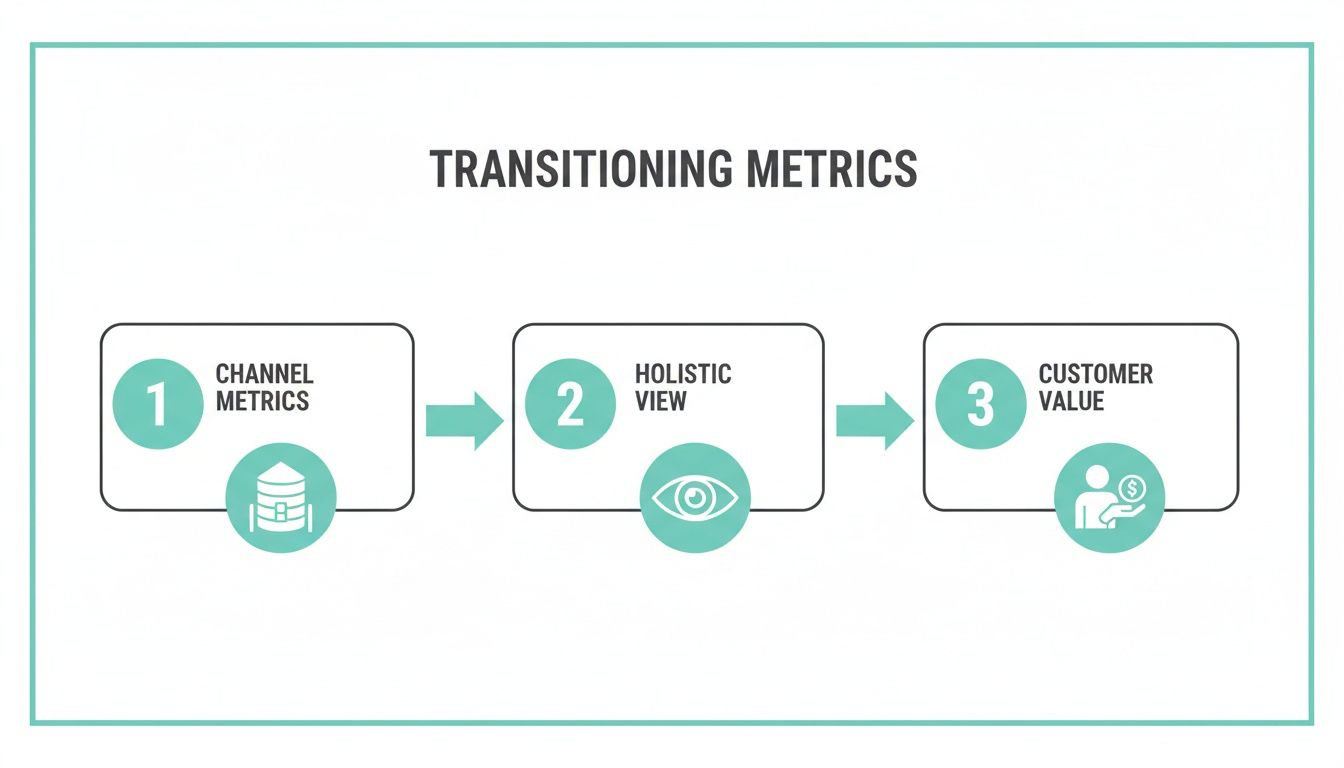
The key insight here is that real business impact isn't measured by channel performance. It's measured by increases in customer lifetime value and retention.
A Phased Rollout for Lasting Success
Trying to overhaul everything at once is a recipe for disaster. A phased rollout, focused on high-impact customer journeys, is a much smarter approach. Start by identifying a critical path, like the journey from online research to an in-store purchase, and focus on perfecting that single experience first. To get this right, take a look at our guide for creating an effective customer journey mapping template.
This iterative method allows you to lock in early wins, show tangible ROI to stakeholders, and build momentum for the bigger picture. As you connect more systems and get better at using tools like Sitecore AI for personalization, you can systematically take on more complex journeys. This strategic path ensures your transition is not only successful but sustainable, positioning your company to win on experience.
Frequently Asked Questions
Making the leap from a multichannel setup to a true omnichannel strategy always brings up some tough questions for leadership. Getting these answers right is the key to a smooth transition.
What Is the Biggest Challenge When Transitioning?
Honestly, the biggest hurdle isn't the technology—it's organizational. Most businesses are stuck with internal silos that keep marketing, sales, customer service, and IT from talking to each other.
Without breaking down those walls and creating a unified culture that’s completely focused on the customer's journey, even a powerful DXP like Sitecore can't deliver on its promise. This kind of cultural shift needs strong leadership and a vision everyone can get behind.
How Can I Justify the Investment in a DXP?
To justify spending on a platform like Sitecore, you have to stop looking at channel-specific metrics. Instead, the conversation needs to shift to customer-centric KPIs that actually matter to the bottom line, like Customer Lifetime Value (LTV) and retention rates.
An omnichannel strategy, powered by tools like Sitecore AI, directly boosts these numbers. It creates the seamless, personalized experiences that build real loyalty and keep customers coming back, delivering a clear and significant ROI.
How Does This Affect Internal Team Structures?
An omnichannel strategy completely changes how your teams work together by forcing cross-functional collaboration. It's no longer about separate departments doing their own thing.
For example, a content team using SharePoint for internal documents now has to be perfectly aligned with the marketing team managing the public-facing Sitecore XM Cloud site. This alignment ensures the brand voice is consistent and that data flows seamlessly, turning siloed departments into one unified team focused on delivering a great experience.
Ready to unify your customer experience and drive real growth? Kogifi has over a decade of expertise in implementing Sitecore and SharePoint solutions that power world-class omnichannel strategies. Let's connect.