

E-commerce marketing automation has moved far beyond just scheduling a few emails. Today, it’s an AI-driven engine for scalable growth. This strategic shift takes marketing from a series of manual, disconnected campaigns and turns it into an orchestrated symphony of real-time, personalized customer experiences across every single channel, powered by platforms like Sitecore's AI-native DXP.
Why Smart Automation Is Your New Growth Engine
Imagine a band where each musician is playing from a different song sheet—the result is just noise, not music. That’s exactly what happens when your marketing efforts are manual and disjointed. Your web, email, SMS, and social media channels all operate in silos, creating a confusing and inconsistent experience for the customer.
An automated Digital Experience Platform (DXP) like Sitecore's AI-powered tools acts as the conductor, making sure every channel works in perfect harmony to deliver a seamless customer journey. This modern approach replaces reactive marketing with proactive, behavior-driven engagement. Instead of just waiting for a customer to abandon a cart, the system can predict the likelihood of abandonment and intervene with a timely, personalized offer. It’s the difference between sending a generic weekly newsletter and delivering a unique product recommendation the moment a customer shows interest.
The Shift from Manual Tasks to Strategic Orchestration
The real value of e-commerce marketing automation is its ability to free up your team. By automating the repetitive, day-to-day tasks, marketers can finally pivot from just executing campaigns to focusing on strategic planning, analysis, and optimization. This shift is absolutely critical for enterprise growth.
Let's break down the difference in approach.
Manual vs Automated E-commerce Marketing
This table shows the strategic shift from traditional, hands-on marketing to a more integrated, automated approach powered by a modern DXP.
With the manual approach, teams spend most of their time building email lists, scheduling social posts, and manually segmenting audiences. It’s slow, prone to error, and nearly impossible to scale effectively. But with an automated DXP, platforms like Sitecore AI manage these tasks intelligently. They use machine learning to build dynamic segments, personalize content in real-time, and orchestrate complex journeys across every touchpoint—all without constant human intervention.
For enterprise leaders and CTOs, this transition is fundamental. It moves marketing from a cost center focused on manual output to a revenue-generating engine focused on measurable outcomes and customer lifetime value.
Building an Intelligent Digital Presence
An intelligent digital presence is one that anticipates customer needs rather than just reacting to them. This is where the power of integrated systems, like Sitecore's composable DXP, really shines. By unifying customer data from all your different sources, it builds a 360-degree view that fuels every automated action.
Plus, when you integrate with platforms like SharePoint, you can securely pull internal enterprise content and regulated documents into your marketing workflows. This keeps everything compliant while still allowing for personalized experiences. You can learn more about marketing automation best practices in our comprehensive article. This creates a cohesive and intelligent foundation for building a future-proof digital business.
The Four Pillars Of An Enterprise Automation Strategy
Building a powerful e-commerce marketing automation engine starts with a solid framework. It’s not about isolated tactics but four interconnected pillars. Together, they turn fragmented customer data into predictable revenue.
Below, you’ll find a clear visual of this shift from manual tasks to a unified, automated workflow.
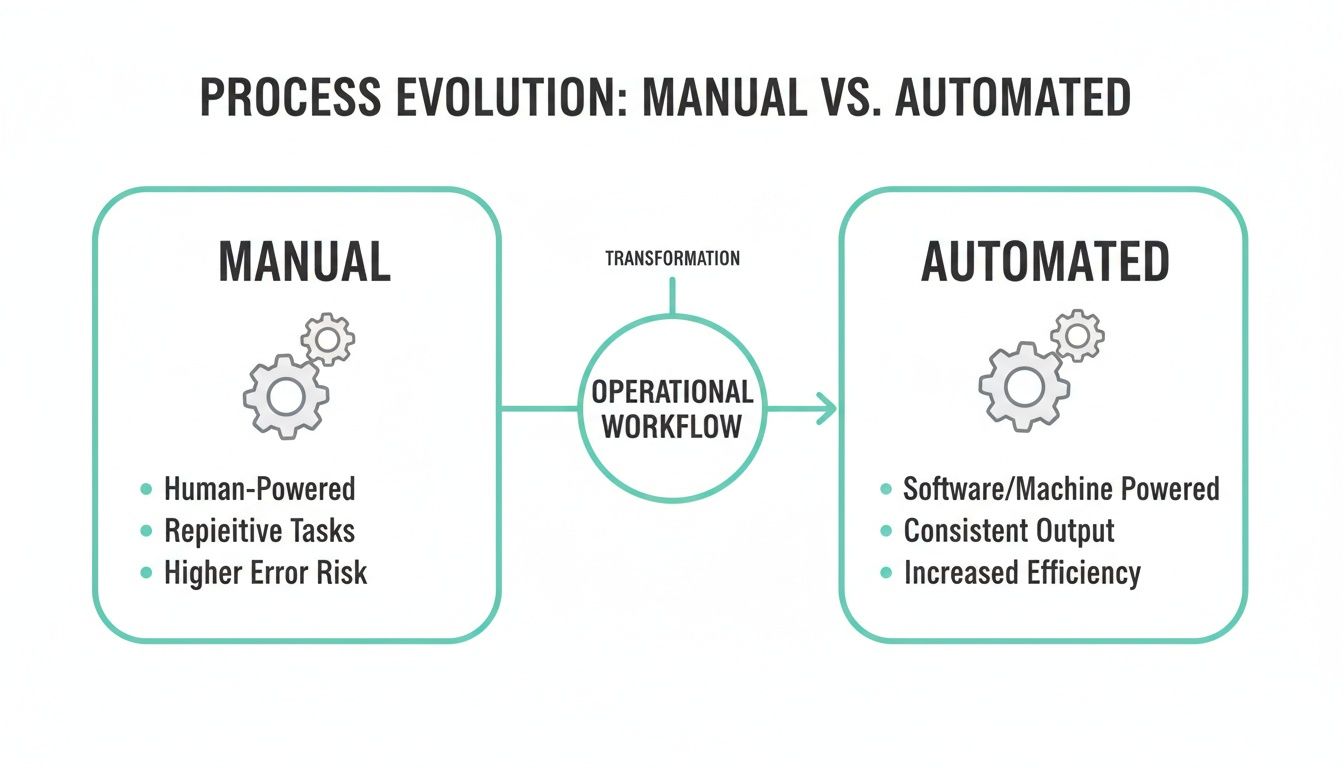
This diagram shows how automation knits disparate steps into a seamless system, removing friction and cutting errors out of your marketing efforts.
AI-Driven Segmentation
You can’t automate what you don’t truly understand. AI-driven segmentation dives deeper than basic demographics. It groups customers by real-time behaviors, engagement signals and predicted intent.
Key grouping factors include:
- Browsing paths, click streams, page views
- Purchase history and average order value
- Email opens, form fills and social interactions
- Predicted churn risk or high lifetime value
Sitecore’s AI engine, part of its CDP, processes every interaction—clicks, searches and past buys—to build these dynamic clusters. That way, you can target high-risk VIPs or first-time buyers eyeing a new category with pinpoint accuracy.
1-to-1 Personalization
With your audience segments in place, the next pillar is genuine 1-to-1 personalization. Forget sprinkling a first name into an email template. Now you tailor product suggestions, site layouts and promotional messages around each individual’s journey.
Consider:
- Homepage banners that adapt based on past purchases
- Cart upsell prompts suggesting complementary items
- Email content blocks reflecting current browsing behavior
Sitecore’s machine learning, especially within Sitecore Personalize, updates profiles in real time. To get the most from it, you need clean, organized data. For more on laying that groundwork, see our customer data integration solutions guide.
The goal is to make every customer feel like the experience was designed just for them. This level of personalization is a key differentiator in a crowded market and directly impacts conversion rates and customer loyalty.
Cross-Channel Journey Orchestration
Your audience jumps between website, app, email and social feeds. Cross-channel journey orchestration ensures each touchpoint feels part of the same story. It connects channels so your messaging never feels out of sync.
Common workflows include:
- An abandoned-cart email followed by a social ad reminder
- A personalized in-app banner on the next visit
- SMS or push alerts for back-in-stock products
Tightly integrated in a DXP, Sitecore lets you build these complex paths without heavy coding. In large enterprises, SharePoint often feeds approved content directly into those journeys, ensuring brand and regulatory consistency.
Predictive Analytics
Finally, you need to move from looking in the rearview mirror to seeing around corners. Predictive analytics uses AI to forecast customer actions. It answers questions like “Who’s likely to convert next?” and “Which campaign will move the needle?”
Key capabilities include:
- Next-best offer and next-best action suggestions
- Early warnings for at-risk segments
- Smart budget allocation toward high-ROI audiences
The market for this technology reflects its value; it's a multi-billion dollar industry with strong projected growth. For more on these trends, explore these marketing automation statistics.
Integrating Automation Into Your DXP Ecosystem
Standalone e-commerce marketing automation tools often create more problems than they solve for large enterprises. They tend to operate as isolated islands, completely cut off from the full context of the customer journey. The real power is unlocked when automation is deeply integrated within your Digital Experience Platform (DXP), where it’s not just another add-on but a core part of the entire digital engine.
Connecting automation to a composable DXP like Sitecore is absolutely critical. Think of it as the central nervous system for your digital operations. It isn’t just another tool in your stack; it’s the platform that pulls together customer data, content management, and commerce into one cohesive ecosystem.
This deep integration means your automation workflows are fueled by rich, real-time context. The system knows what a customer just browsed, what they bought last month, and which articles they read on your resource hub. This holistic view enables a level of personalization that siloed, bolt-on automation tools simply can't touch.
This kind of unified interface—where content, experience, and commerce meet—is the foundation for building effective, context-aware automation.
The Sitecore Advantage: A Unified Composable Architecture
Sitecore's composable architecture is purpose-built to tear down data silos. Instead of forcing your data into a rigid, monolithic system, it lets you connect best-in-breed tools through a flexible, API-first approach. For a deeper dive, check out our guide covering best practices for API integration in DXPs.
This architecture natively integrates the key components you need for enterprise e-commerce marketing automation:
- Sitecore Experience Platform (XP): This powerhouse combines a CMS with marketing automation, personalization, and analytics, giving you a 360-degree view of the customer.
- Sitecore OrderCloud: As a headless, API-first commerce platform, it handles complex B2B and B2C ordering, feeding crucial transactional data directly into your automation workflows.
- Sitecore CDP (Customer Data Platform): This is the central brain. It pulls in data from every touchpoint—online and off—to build unified, real-time customer profiles that power true personalization.
- Sitecore Personalize: This tool uses AI to deliver individualized experiences, from product recommendations to A/B testing, all driven by the rich data collected in the CDP.
When these components work together, the automation engine has everything it needs. An abandoned cart isn't just a random event; it's a data point tied to a user's entire history. The system can then trigger a hyper-personalized workflow that might include a tailored email, an on-site banner with a relevant offer on their next visit, and even an alert to a sales rep for a high-value customer.
SharePoint and Enterprise Content Integration
For many global enterprises, especially in regulated industries like finance, healthcare, or the public sector, marketing content is only one piece of the puzzle. Critical assets like internal documents, compliance disclosures, and technical specs are often managed within SharePoint. A disconnected automation strategy simply can’t access these crucial assets safely or efficiently.
The ability to seamlessly pull approved content from a secure repository like SharePoint directly into marketing workflows is a non-negotiable for enterprise-level compliance and brand consistency.
This integration ensures that regulated documents are always the most current version, dramatically reducing legal risk. It also allows marketers to enrich customer journeys with valuable, non-promotional content like user guides or policy updates, which builds tremendous trust and authority.
For example, a financial services company can automate a workflow for new account holders. The journey might kick off with a welcome email personalized by Sitecore AI, but it can also automatically attach the latest, compliant terms and conditions document pulled directly from a secure SharePoint library. This synergy—between Sitecore’s customer-facing experience and SharePoint’s role as a trusted content hub—creates a robust and highly effective automation ecosystem for the modern enterprise.
Real-World Automation Plays That Drive ROI
Theory is great, but tangible results are what really drive business decisions. The true power of e-commerce marketing automation shines when you move from planning to execution. A well-implemented DXP like Sitecore doesn't just automate tasks; it creates specific, measurable outcomes that directly boost your bottom line.
Let's dive into some practical scenarios that show how a connected platform turns sophisticated data into significant financial returns. These aren't just abstract ideas—they are proven plays that successful enterprises run every single day.
The Advanced Cart Recovery Sequence
A simple "you left something behind" email just doesn't cut it anymore. An advanced cart recovery play using Sitecore AI takes a multi-pronged approach that adapts in real time.
- Immediate On-Site Personalization: The moment the AI flags a high probability of cart abandonment, it can trigger an on-site banner or an exit-intent pop-up with a personalized message. This could be a gentle nudge, a limited-time free shipping offer, or a direct link to customer support.
- Multi-Channel Nudges: If the user still leaves, the orchestration engine kicks in. An initial email is sent within an hour. No response? The system might follow up with an SMS 24 hours later. For a high-value cart, it could even push a retargeting ad to their social media feed.
- Dynamic Content: Each message is uniquely personalized. Instead of a generic template, Sitecore's AI can dynamically insert images of the abandoned products, pull in customer reviews, and even provide a link to a secure SharePoint-hosted user guide for a more complex product.
This sophisticated sequence goes far beyond simple reminders. It actively removes friction and rebuilds purchase intent across multiple touchpoints, directly recovering revenue that would otherwise be lost.
Post-Purchase Nurturing and Upselling
The customer journey doesn't end at checkout—it’s just the beginning of the next one. A smart post-purchase nurturing sequence is essential for increasing Customer Lifetime Value (CLV).
Using Sitecore AI, you can automate a journey that:
- Recommends Complementary Products: Based on the initial purchase and browsing history, the system intelligently suggests related items. A customer who bought a camera might get an email a week later showcasing compatible lenses and tripods.
- Solicits Reviews and Feedback: Automated emails can ask for product reviews a set number of days after delivery. This helps build social proof and gathers valuable product insights for your team.
- Provides Value-Added Content: For B2B or complex products, the journey can include links to helpful tutorials or technical documents stored in a SharePoint repository, reinforcing the customer's purchase decision and building trust in your brand.
This kind of proactive engagement transforms a one-time transaction into a long-term relationship. It builds loyalty and drives repeat business by making the customer feel understood and supported long after the sale.
Proactive VIP Re-Engagement
Your most valuable customers deserve special attention. Sitecore’s predictive analytics can identify at-risk VIPs—customers with a history of high spending whose engagement has recently dropped off.
Instead of waiting for them to churn, the system can trigger a proactive re-engagement campaign. This might involve a personalized email from a senior manager, an exclusive incentive tailored to their past purchases, or an invitation to a special event.
By identifying churn signals early, you can intervene with a high-touch, personalized experience that reminds your best customers why they chose you in the first place. This directly impacts retention rates and safeguards future revenue. The data confirms this works: 60% of marketers report higher engagement and 58% see stronger loyalty after adopting AI-driven automation. You can find more details in this report on how AI adoption boosts marketing effectiveness.
To bring these concepts together, here is a summary of how specific automation workflows connect directly to business goals and platform features.
Key Automation Workflows and Their Business Impact
This table illustrates that automation isn't just about efficiency; it's a strategic tool for driving measurable growth in key areas of your e-commerce business.
Your Phased Implementation Roadmap
Rolling out an enterprise-grade e-commerce marketing automation solution is a major strategic move, not just another tech deployment. You need a structured roadmap to get it right and sidestep the common traps. The journey is best handled in deliberate phases, transforming your organization from manual, repetitive tasks to an intelligent, automated powerhouse.
The goal here is to build momentum, show value quickly, and make sure your teams actually adopt the technology. A rushed implementation almost always leads to underused features and a whole lot of disappointment.
Phase 1: Discovery and Audit
Before you can build anything, you have to know what you’re working with. This first phase is all about a deep audit of where you stand today. It means mapping out your current tech stack, hunting down all your customer data sources, and documenting every business process—the good, the bad, and the ugly.
This discovery work is absolutely critical for platforms like Sitecore, as it shines a light on where all your data silos are hiding. You have to know where customer information lives—is it in your CRM, ERP, e-commerce platform, or even offline systems? That’s the only way to plan for unifying it all within Sitecore CDP.
This phase also involves talking to the people on the ground. Stakeholder interviews help capture real business requirements. What are the marketing team's biggest headaches? What are the sales team's issues with lead quality? These insights are the bedrock of your entire strategy.
Phase 2: Strategic Planning
Once you have a crystal-clear picture of your current state, you can start planning. This is where you define what success actually looks like. The key is to set clear, measurable goals and KPIs that tie directly to business outcomes, like boosting customer lifetime value by 15% or slashing cart abandonment by 20%.
In this phase, you’ll also finalize your technology blueprint. For a composable DXP like Sitecore, this means picking the right tools for the job—like Sitecore Personalize, OrderCloud, and the CDP—that align with your specific goals. If your organization relies on SharePoint, this is the stage to map out the integration points for securely using enterprise content in your marketing workflows.
A well-defined strategy acts as your north star throughout the implementation. It prevents scope creep and ensures every technical decision serves a specific business objective, maximizing your long-term ROI.
Phase 3: Phased Implementation
Whatever you do, avoid a "big bang" launch. The most successful rollouts follow a crawl-walk-run approach. This phased method is all about delivering quick wins to build support and demonstrate value from day one.
- Crawl: Start with the fundamentals. Implement basic data collection in Sitecore CDP and launch a single, high-impact automation—like a really smart cart recovery sequence. This proves the system works and can generate revenue right away.
- Walk: Now, build on that early success. Introduce more sophisticated personalization on key pages, build out post-purchase nurture journeys, and start integrating more of your data sources.
- Run: It's time to unleash the full power of the platform. Leverage Sitecore AI for predictive segmentation, orchestrate complex, multi-channel journeys, and use predictive analytics to proactively engage your highest-value customers.
This methodical approach minimizes risk and keeps things stable. For a deeper dive into structuring projects like this, check out our guide on creating a successful software implementation project plan.
Phase 4: Team Enablement and Optimization
Technology is only half the equation; your people are the other half. This final phase is all about training and continuous improvement. Team enablement means running targeted training sessions designed for different groups—from the marketers building campaigns in Sitecore to the content authors managing assets in SharePoint.
But the work isn’t over once you go live. Optimization is an ongoing process. It involves constantly analyzing performance data, A/B testing different strategies, and fine-tuning your automation workflows based on what the data is telling you. This is where partnering with a trusted implementation expert who gets the entire lifecycle becomes crucial for unlocking the full potential of your investment and achieving sustained growth.
Why Your Future Depends on AI-Powered Automation
Making the jump to AI-powered e‑commerce marketing automation isn't about getting a competitive edge anymore—it’s about survival. The old way of managing campaigns by hand is just too slow and clumsy to keep up with customers who expect instant, relevant conversations with your brand.
Platforms like Sitecore AI are built specifically to handle this new reality. They automate the heavy lifting, like predictive segmentation and real-time content personalization, which frees up your marketing team. Instead of getting stuck in the weeds with tedious manual tasks, they can finally focus on high-level strategy, creative thinking, and analyzing what actually works. It's a fundamental shift from just running the machine to steering the ship.
From Manual Labor to Strategic Impact
The future of e-commerce is all about delivering smart, hyper-personalized experiences that can scale. This isn't just about blasting out more emails. It’s about sending the perfect message to the right person at exactly the right moment, on any channel they happen to be using.
The results speak for themselves. Automated emails that are part of a well-orchestrated journey consistently outperform generic campaigns by a wide margin in both engagement and revenue.
This proves that timely, personalized triggers—like a welcome series or a cart abandonment reminder—are far more powerful than any generic blast. Sitecore’s DXP brings it all together, unifying your data and intelligence into one engine to make it happen.
The message for enterprise leaders is simple: your team's real value is their strategic brainpower, not their ability to manually wrangle spreadsheets or segment email lists. AI automation is what unlocks that potential.
Building Your Future-Proof Foundation
Putting this kind of technology in place is the first step toward creating a truly resilient digital foundation. The next is to use that intelligence to drive real revenue. A great example of this in action is leveraging AI for platform-specific optimization, where AI can be fine-tuned to master a specific sales environment like Amazon Rufus.
When you pair Sitecore’s customer-facing smarts with an enterprise-grade content management system like SharePoint, your entire digital operation becomes more connected and compliant. This combination creates a robust, scalable, and intelligent ecosystem. To get the most out of this powerful duo and see a real return on your DXP investment, bringing in an expert partner isn't just a good idea—it's essential for getting it right.
Frequently Asked Questions
When you start digging into enterprise e-commerce marketing automation, a lot of questions come up. Here are some straightforward answers to the things we hear most from enterprise leaders, covering strategy, tech, and the results you should expect. Think of this as a quick guide to help you make smarter decisions as you move toward a more intelligent automation setup.
What Is the First Step to Implementing Automation?
The first and most important step is always a Discovery and Audit. Before you even think about new technology, you need to get a clear picture of what you already have. This means mapping your current tech stack, tracking down all your customer data sources—whether that's in a CRM, ERP, or your commerce platform—and documenting how your business actually runs today.
This groundwork is what uncovers the hidden data silos and operational friction points that can kill a project. Without it, you're just buying powerful tools without the clean data or clear strategy needed to make them work. It's about knowing exactly where you are before you try to figure out where you're going. A solid audit gives you the blueprint for a successful implementation with a platform like Sitecore.
How Does Sitecore AI Differ From Other Tools?
The biggest difference with Sitecore AI is how deeply and natively it's integrated into the composable Digital Experience Platform (DXP). Many tools are just bolted onto your existing stack, but Sitecore's components, like its CDP, Personalize, and OrderCloud commerce engine, are built to work together from the ground up.
This creates a single, connected ecosystem where your automation is fueled by a complete, real-time view of every customer. You get more than just simple email workflows; you get genuine cross-channel journey orchestration driven by predictive analytics. Plus, its ability to integrate with enterprise systems like SharePoint for secure content management brings a level of compliance and consistency that most standalone solutions just can't match.
What Kind of ROI Can We Expect?
A DXP-integrated automation strategy delivers a return on investment you can actually measure across a few key areas. You should expect to see real improvements in:
- Increased Conversion Rates: This comes from using advanced personalization and well-timed triggers, like sophisticated cart recovery sequences that go beyond a simple email.
- Higher Customer Lifetime Value (CLV): You can drive this up with automated post-purchase follow-ups, smart upselling, and relevant cross-selling campaigns that feel helpful, not pushy.
- Reduced Customer Churn: By using predictive analytics, you can spot at-risk VIPs before they leave and proactively re-engage them with offers that show you value their business.
- Improved Operational Efficiency: Automating all those manual marketing tasks frees up your team. Instead of being buried in repetitive work, they can focus on strategy and high-impact initiatives.
While the exact numbers will vary, enterprises almost always see a significant revenue lift and a much stronger, more loyal customer base.
How Long Does a Typical Implementation Take?
The timeline really depends on your organization's complexity, but we always recommend a phased "crawl-walk-run" approach. It's the best way to manage the process and get wins on the board quickly.
- Crawl (2-3 months): Start with the foundations. Get the basic setup right and launch one high-impact workflow, like cart abandonment. This delivers a quick, measurable win and builds momentum.
- Walk (3-6 months): Now you can expand. Roll out more complex customer journeys, pull in additional data sources, and start implementing broader personalization across your site.
- Run (Ongoing): This is where you get into the advanced stuff. Implement AI-driven segmentation and use predictive analytics to continuously test and optimize everything you're doing.
This staged rollout keeps disruption to a minimum and makes the whole project feel much more manageable.
Ready to build a future-proof digital foundation with AI-powered automation? Kogifi has over a decade of experience implementing enterprise DXP solutions like Sitecore and SharePoint. Our expert teams can guide you through every stage, from strategic planning to continuous optimization, ensuring you unlock the full potential of your investment. Contact us to start your digital transformation journey.