


When people talk about using Salesforce as a CMS, it's easy to get the wrong idea. This isn't about a single, off-the-shelf product. It’s about using the entire Salesforce ecosystem to manage and deliver content, forging a powerful, direct link between your customer data and your digital experiences.
The whole approach is fundamentally data-first, tying content directly to your CRM from the very beginning.
Understanding Salesforce as a CMS

Using Salesforce as a CMS flips the traditional model on its head. Instead of treating content and customer data as two separate worlds that need a bridge built between them, Salesforce brings them together from the start. This capability is woven throughout the platform, not bolted on as an afterthought.
Think of it like a supermarket with its own built-in kitchen. The shelves are stocked with fresh ingredients—your rich customer data, purchase histories, and service interactions. Salesforce lets you grab those ingredients and prepare a personalized meal (your content) right there, serving it directly to the customer in the aisle.
This is a world away from a dedicated Digital Experience Platform (DXP) like Sitecore. A DXP is more like a professional, standalone restaurant kitchen. It’s packed with specialized tools designed for high-end culinary creation, particularly those from Sitecore's portfolio. It can source ingredients from anywhere, but its primary function is to prepare sophisticated meals (digital experiences), often for a large, discerning public. While it can connect to the supermarket, its strength lies in the kitchen itself.
The Salesforce Content Ecosystem
To help you understand how Salesforce pulls this off, we've broken down the key products that make up its content capabilities. Each piece has a specific job in creating and delivering experiences fueled by your CRM data.
| Salesforce Product | Primary Function | Ideal Enterprise Use Case |
|---|---|---|
| Salesforce CMS | The central, headless content hub for creating, managing, and organizing all content assets. | Storing and managing marketing copy, knowledge articles, and product info in one place for delivery to any channel. |
| Experience Cloud | The presentation layer for building branded digital experiences like portals, forums, and microsites. | Creating a self-service customer portal or a partner community that pulls in personalized content and CRM data. |
| Headless APIs | The delivery mechanism that allows content to be sent from Salesforce to any frontend or channel. | Powering a native mobile app, an IoT device display, or a separate corporate website with content from Salesforce. |
This table shows how Salesforce’s integrated model gives a massive head start to businesses whose digital strategy lives and dies by their customer relationships.
Because the content sits right next to customer profiles, personalization becomes a native function, not an add-on. For instance, a premier customer can automatically see exclusive offers in their portal, a rule driven directly by their status in the CRM. You can explore our detailed guide to better understand what a CMS platform is and how it works in different business contexts.
But this tight integration also defines its boundaries. While it's fantastic for CRM-driven experiences, it’s not built for the sprawling, multi-brand content operations where CRM data is just one of many inputs. In those scenarios, a dedicated DXP from a leader like Sitecore offers a more robust and specialized solution.
How the Salesforce Content Ecosystem Works
Thinking about Salesforce as a CMS means looking beyond a single product. It’s really an interconnected system built to create, manage, and deliver content that’s already wired into your customer data. The different parts work in concert, pushing information from a central content library out to every customer touchpoint.
At the center of it all is Salesforce CMS, which serves as your organization’s content hub. Think of it as the single source of truth for everything from marketing copy and product details to support articles and banners. It's a headless repository, meaning content is created and stored without being tied to any specific design or channel.
This separation is what makes the whole ecosystem so flexible. Content isn’t locked into one format. Instead, it’s designed to be distributed anywhere, which is the core idea behind a Content as a Service (CaaS) strategy. Content becomes a modular, API-first asset.
Connecting Content to Experience
While Salesforce CMS holds the content, Experience Cloud is what brings it to life. This is the part of the platform you use to build the actual digital front doors—customer portals, partner sites, and branded community forums. It pulls content straight from Salesforce CMS and mashes it up with live CRM data.
So, when a customer logs into a portal built with Experience Cloud, they might see a personalized welcome banner (content from the CMS) right next to their recent order history (data from the CRM). This creates a deeply contextual experience without needing a web of custom integrations.
The real magic happens when this ecosystem plugs into other Salesforce clouds:
- Marketing Cloud: Content from Salesforce CMS can be used directly in email campaigns, landing pages, and mobile messages, keeping branding consistent and giving marketers access to approved assets on the fly.
- Service Cloud: Knowledge articles managed in the CMS can instantly appear in the Service Cloud knowledge base, empowering support agents and giving customers accurate self-help answers.
This integrated approach is a cornerstone of Salesforce's market position, demonstrating the power of a unified data and content model.
Supporting a Composable Architecture
For IT leaders and architects, the Salesforce ecosystem can be part of a modern, composable architecture. Because Salesforce CMS is headless, it can serve content through APIs to almost any front-end application you can think of—a custom website, a native mobile app, or even digital signage.
This hybrid headless model provides a pragmatic path for enterprises. You can use Experience Cloud for data-heavy, authenticated experiences like portals while using the same content repository to feed a high-performance public website built on a different technology stack.
Getting content from creation to publication smoothly relies on a series of automated processes. A critical part of any strong content system is the workflow automation happening behind the scenes. If you're new to the concept, you can learn more about what workflow automation is and how it works.
Ultimately, this whole system is designed to connect data-rich content to every single point of the customer journey, turning a traditional CRM into a powerful experience engine.
Deciding between using Salesforce as a CMS and a dedicated Digital Experience Platform (DXP) like Sitecore isn't just a technical choice—it's a strategic one. This isn't about which platform is universally "better." It's about understanding two fundamentally different philosophies and seeing which one aligns with your long-term business goals.
At its core, the decision comes down to this: do you want a CRM-centric ecosystem or a composable, content-first powerhouse?
Salesforce’s major advantage is its deep, native connection to customer data. If your digital world revolves around authenticated portals, partner communities, or internal sites where the user is already known, Salesforce offers a very direct path to personalization. It shines when it comes to dropping content into experiences tied directly to a CRM record.
Sitecore, on the other hand, was built from the ground up to lead in enterprise content and experience management. It's engineered for massive, complex digital properties that serve huge anonymous audiences just as well as they serve logged-in users. For Sitecore, content is the star of the show, enhanced by a sophisticated AI and data-driven product suite.
This concept map really drives home how the Salesforce content ecosystem is built around its core clouds, with Salesforce CMS acting as a service to them.
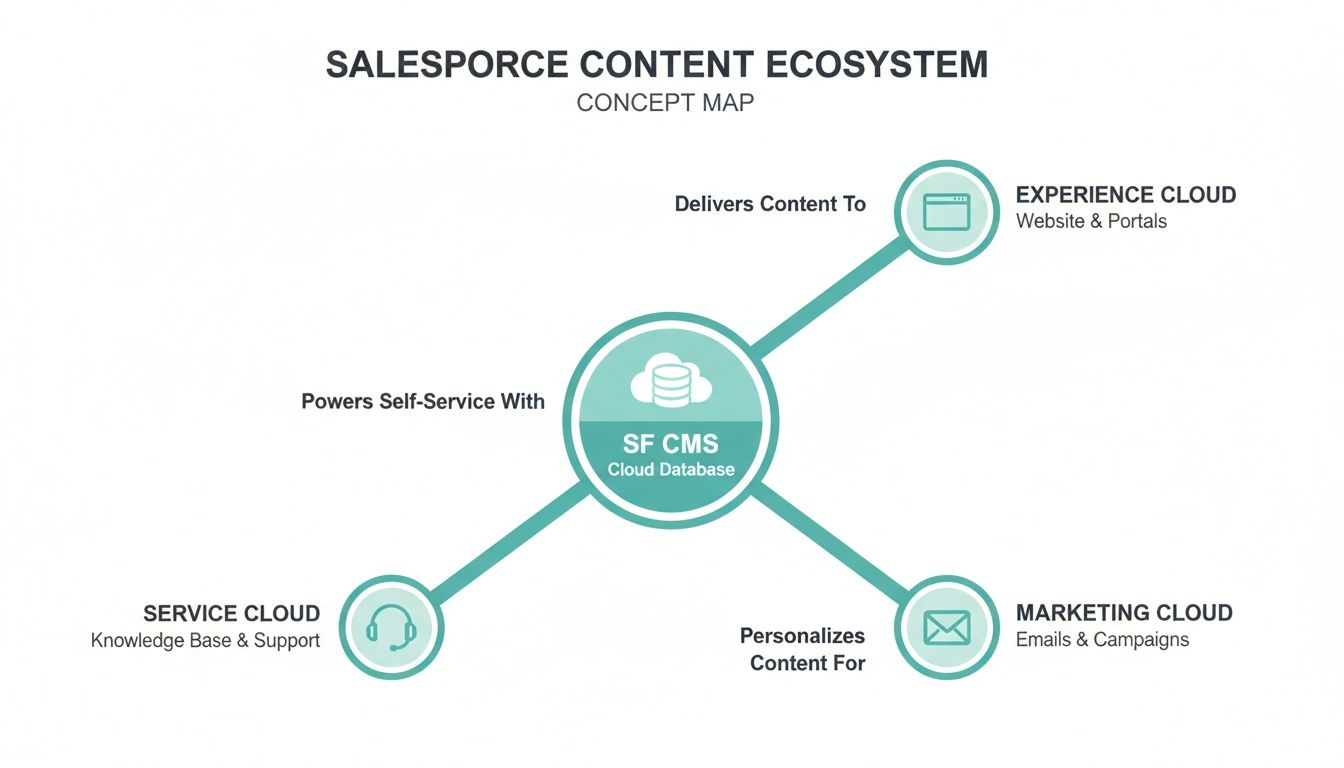
You can see how this ecosystem-first approach contrasts sharply with the content-first model of a true DXP. To help you weigh the options, here’s a head-to-head comparison of their core capabilities.
Core Capability Comparison: Salesforce CMS vs. Sitecore DXP
This table breaks down the key differences, helping you see where each platform's strengths lie in relation to common enterprise needs.
| Capability | Salesforce as CMS | Sitecore DXP |
|---|---|---|
| Primary Focus | CRM-driven experiences (portals, communities) for known users. | Content-first digital experiences for both anonymous and known audiences. |
| Personalization | Rule-based, driven by CRM data segments. Strong for authenticated users. | AI-driven and predictive, based on real-time behavior across all touchpoints. |
| Architecture | Hybrid CMS within a monolithic ecosystem. | Composable and headless-first, offering greater architectural flexibility. |
| Authoring Experience | Functional, but secondary to CRM functions. Can be limiting for large teams. | Best-in-class authoring designed for large, distributed marketing and content teams. |
| Use Case Sweet Spot | Customer service portals, partner extranets, B2B commerce tied to Sales Cloud. | High-traffic public websites, global brand management, complex B2C/B2B commerce. |
| Integration | Excellent within the Salesforce ecosystem; requires connectors for external systems. | API-first design integrates seamlessly with best-of-breed tools (ERPs, PIMs, etc.). |
While Salesforce provides a tightly integrated solution, Sitecore's composable nature offers a level of adaptability and future-proofing that is hard to match for content-heavy enterprises.
The Power of Sitecore AI and a Composable DXP
Sitecore has gone all-in on a composable DXP model, which gives enterprises incredible flexibility. This is where Sitecore's portfolio, especially Sitecore AI, creates a massive competitive advantage. While Salesforce personalization is effective within its own world, it's largely rule-based and relies on pre-defined segments from your CRM data.
Sitecore AI takes a different approach, bringing machine learning right to the front line of the user experience. It analyzes user behavior in real time across every touchpoint—not just within a CRM—to automatically serve up individualized content, product recommendations, and optimized user journeys. This AI-powered personalization goes far beyond simple segmentation to enable true one-to-one experiences at scale.
For a global brand managing multiple websites, Sitecore AI can dynamically adjust content for a visitor based on their real-time browsing patterns, even if they are completely anonymous. This is a capability that a CRM-tethered system like Salesforce CMS struggles to match for public-facing sites.
This is a critical distinction. If your goal is sophisticated, predictive personalization on high-traffic public sites, you’ll find Sitecore’s capabilities are far more advanced. Its product suite is purpose-built for this:
- Sitecore Experience Platform (XP) & Experience Manager (XM) Cloud: These tools deliver a world-class authoring experience and governance for large, distributed marketing teams.
- Sitecore OrderCloud: A headless commerce platform that integrates smoothly for complex B2B and B2C scenarios.
- Sitecore CDP & Personalize: The engine behind it all, powering AI-driven experiences with rich data from every channel.
You can dive deeper into how this kind of architecture gives you an edge by exploring the core benefits of headless CMS in our dedicated guide.
SharePoint Integration and Enterprise Content Collaboration
Beyond public websites, many enterprises lean heavily on SharePoint for intranets and document management. Here, the comparison takes another interesting turn. Salesforce can integrate with SharePoint, but it often feels like a patch, requiring custom connectors or third-party tools to bridge the gap.
A Sitecore-centric architecture, or even a pure SharePoint solution, can offer a much more cohesive experience for internal collaboration. SharePoint is a master of the document lifecycle, version control, and secure team collaboration. When you pair that with a powerful DXP for your external experiences, you create a robust framework for managing content both inside and outside the company walls.
For organizations already deep in the Microsoft stack, a strategy that uses SharePoint for internal content and a DXP like Sitecore for external digital experiences is incredibly effective. It lets each platform do what it does best without trying to force a CRM tool to perform tasks it wasn't built for.
Ultimately, Salesforce as a CMS is a powerful choice when your digital strategy lives and breathes inside the customer record. But for enterprises that demand advanced AI personalization, best-in-class content tools for large teams, and a truly composable architecture, a dedicated DXP from a leader like Sitecore is the more powerful and flexible long-term solution.
Integrating Salesforce into Your Enterprise Architecture
Getting Salesforce as a CMS to play nicely within a complex enterprise ecosystem isn’t as simple as flipping a switch. It calls for a smart architectural plan that fits your business goals, current tech stack, and where you want to go long-term. The conversation quickly moves from what Salesforce can do to how it will actually work alongside your other business-critical systems.
For most companies, this isn't an all-or-nothing game. The best path forward usually involves specific integration patterns that let each platform do what it does best. This is where getting expert advice is crucial if you want to avoid ending up with a messy, disconnected digital presence that’s a nightmare to manage.
Common Integration Patterns for Salesforce and Sitecore
One of the most effective strategies is a hybrid model. In this setup, you give each platform the job it’s best suited for. For instance, you might use Salesforce Experience Cloud to run a secure customer portal where authentication and direct CRM data access are the top priorities.
At the same time, you could have a dedicated DXP like Sitecore managing your high-traffic, public-facing corporate website. This setup lets Sitecore’s powerful content creation tools and AI-driven personalization work their magic on anonymous visitors, while Salesforce takes care of the deeply integrated experience for your known customers.
Another popular approach is using Salesforce as a headless CMS. Here, Salesforce serves as the central content hub, pushing content out through APIs to different channels. This content could power:
- A native mobile app
- An internal intranet built on SharePoint
- In-store digital signage or IoT devices
- A front-end experience built with a modern JavaScript framework
This model unifies where your content is created, but it demands a solid API strategy to make sure delivery is smooth and reliable everywhere. While it works, it often can't match the advanced content governance and delivery tools you'd find in a purpose-built headless solution from a provider like Sitecore.
The Strategic Role of Sitecore AI and SharePoint
When you’re piecing these systems together, you have to think about the unique strengths of platforms like Sitecore and SharePoint. Sitecore’s product family is built for true composability, which gives it a clear edge. Its AI tools, for example, aren’t stuck analyzing data from just one system.
Sitecore AI is designed to analyze real-time user behavior across every digital touchpoint to deliver predictive personalization. This means it can create tailored experiences for completely anonymous users on a public website—something that’s very difficult for a CRM-first system that relies on known customer data.
This capability is a game-changer for top-of-funnel marketing and bringing in new customers. By using Sitecore for your public-facing sites, you can tap into this advanced AI to turn visitors into leads, who can then be passed smoothly into the Salesforce ecosystem once they become customers.
For everything internal, SharePoint is still the undisputed king. Pulling Salesforce content into a SharePoint intranet is a frequent request. While it’s definitely possible, it usually means relying on third-party connectors or custom development to get data synchronization and user permissions right.
A smart architecture will treat SharePoint as the go-to system for document management and internal collaboration, which stops people from misusing Salesforce as a glorified file-sharing tool.
An experienced partner can map out an architecture where Sitecore owns the public experience, Salesforce manages the customer journey after conversion, and SharePoint drives internal workflows. Pulling off these complex integrations requires deep expertise to define API contracts, map out data flows, and build a governance model that keeps everything consistent and secure across all your platforms.
Managing Governance, Security, and Performance

For any enterprise, committing to a platform like Salesforce as a CMS boils down to three make-or-break factors: governance, security, and performance. Without a firm grip on all three, even the most impressive system can quickly become a mess. You need to know that the right people are touching the right content, that your data is locked down, and that the user experience is fast and frustration-free.
Salesforce builds its case on the back of its core platform strengths. The company’s projected $37.9 billion in total revenue for FY2025 and steady 9% year-over-year growth are more than just numbers—they fund a world-class, trusted infrastructure. That trust is reflected in its massive 20.7% global CRM market share as of 2024, proving that enterprises are comfortable entrusting their most critical data to the platform. You can find more details on these figures and their impact on Salesforce's market position.
Establishing Robust Content Governance
In simple terms, governance is about keeping things consistent and controlled. Salesforce provides familiar tools to manage user roles and permissions, letting you decide who can create, edit, approve, and publish content. These controls are built on the same profiles and permission sets used across the CRM, which is great for internal teams who already live and breathe the Salesforce model.
But when you stack it up against a dedicated DXP like Sitecore, the gaps start to show. Sitecore was built from the ground up for complex, multi-brand, and multilingual content operations, offering a much more granular and flexible governance framework.
A key part of content governance and performance involves managing data quality. While Salesforce has tools for this, the architecture of a DXP like Sitecore, especially when paired with a PIM, often delivers a more complete solution for ensuring data integrity across global sites.
For a large marketing department juggling multiple brands, Sitecore’s customizable workflows and versioning are far more powerful. You can design sophisticated, multi-step approval chains that are unique to a specific region, brand, or content type. That’s a level of control that’s tough to replicate with standard Salesforce configurations. Our guide to building a content governance framework offers a deeper dive into creating these essential structures.
Security and Performance Expectations
Security is, without a doubt, Salesforce's ace in the hole. The platform’s entire reputation is staked on its robust, multi-layered security model. When you use Salesforce as a CMS, your content is protected by the very same security measures that guard sensitive customer and financial data.
This includes:
- Object-Level Security (OLS): Controls which user profiles can see or touch certain types of content.
- Field-Level Security (FLS): Restricts access to specific data fields within a piece of content.
- Record-Level Security (RLS): Ensures users only see the specific content records they are permitted to access.
For any enterprise, especially those in highly regulated industries, this built-in security is a huge selling point.
Performance, on the other hand, is a more nuanced conversation. For public-facing sites built with Experience Cloud, Salesforce relies on a global Content Delivery Network (CDN) to cache content and speed up delivery. This works well for moderately trafficked sites and authenticated customer portals.
However, Salesforce's architecture wasn't primarily designed to serve massive, anonymous public audiences at web scale. Its real strength lies in delivering rich, data-driven experiences to logged-in users. For extremely high-traffic scenarios, a platform like Sitecore—engineered from day one for performance at scale—will almost always have the upper hand.
Your Decision-Making Checklist for 2026
Choosing between a CRM-centric ecosystem and a composable DXP is a major strategic move. To help you find some clarity and make the right call for your company's future, we’ve put together a practical framework. Your answers here will point you toward the most logical next step for your organization.
Define Your Primary Goal
First, let's get to the heart of your digital strategy. Your answer here is the single most important factor in this decision.
- Is our main objective CRM-driven personalization? If your world revolves around authenticated experiences like customer portals and partner communities—where surfacing CRM data is key—then exploring Salesforce as a CMS is a sensible starting point. Its native connection to customer data is its biggest advantage.
- Is our primary goal broad public content delivery and acquisition? If you need to attract, engage, and convert large, anonymous audiences on high-traffic public websites, a dedicated DXP like Sitecore is built for that exact job. Its content authoring and AI-driven personalization tools are designed to solve this specific challenge.
Assess Your Long-Term Architectural Vision
Next, think about where your technology stack is headed. Do you prefer a unified, all-in-one suite or a flexible, best-of-breed approach?
Your long-term vision—a single-vendor suite or a composable DXP—will dictate the flexibility you have in the future. A composable architecture, powered by a platform like Sitecore, allows you to swap in best-of-breed tools as your needs evolve without being locked into one ecosystem.
This choice directly impacts your ability to adapt to fast-moving market changes.
Evaluate Your Content and Personalization Ambitions
Think about the level of sophistication your marketing and content teams really need to succeed.
- Do we need AI-powered personalization for anonymous users? If your strategy involves predictive personalization based on real-time behavior, Sitecore AI is the clear leader. Its machine learning models analyze actions across all touchpoints to deliver one-to-one experiences at scale—a capability CRM-based personalization struggles to match for unknown visitors.
- What about internal collaboration and document management? Many large companies depend on SharePoint for their intranet and document workflows. If this is a non-negotiable part of your operation, you have to plan for integration. A strategy combining SharePoint for internal needs with Sitecore for external experiences often proves far more effective than trying to force a CRM to manage document-heavy processes.
Your Recommended Next Steps
Based on your answers, the path forward should be getting clearer. As a strategic partner, we can help you navigate these complexities and land on a decision you can be confident in.
- Deep-Dive Platform Audit: If you're still not sure which path is right, a comprehensive audit of your current digital ecosystem can reveal critical gaps and hidden opportunities.
- Proof-of-Concept with Sitecore: For teams aiming for advanced personalization and a composable future, a proof-of-concept with Sitecore's DXP can demonstrate the power of its AI and content tools firsthand.
- SharePoint Integration Strategy: If SharePoint is central to how you operate, we can help design an integration plan that lets each platform—be it Salesforce or Sitecore—play to its strengths.
Regardless of the platform you choose, Kogifi offers expert implementation, platform audits, and ongoing support to make sure your digital strategy succeeds.
Frequently Asked Questions
When you're weighing Salesforce against other enterprise platforms like Sitecore or SharePoint, a few key questions always come up. Let's tackle them head-on.
How Does Sitecore AI Differ from Salesforce Personalization?
The main difference comes down to how each platform uses data and intelligence. Salesforce personalization is mostly rule-based and reactive. It’s brilliant at personalizing experiences for your known customers—the people already logged in and in your CRM—based on predefined segments and their sales history.
Sitecore AI, in contrast, is predictive and proactive. It uses machine learning to analyze what users are doing right now, even if they’re anonymous visitors. This allows Sitecore to change content and adjust user journeys on the fly, reacting to immediate behavior and inferred intent. It’s what enables true, one-to-one personalization at scale. You can dig deeper into Sitecore's AI-driven experiences on their official site.
Can Salesforce CMS Replace SharePoint for an Intranet?
While you could technically build an intranet with Salesforce Experience Cloud, it’s not really the right tool for the job. We generally don't recommend it as a replacement for a platform like SharePoint.
SharePoint was built from the ground up for document management, internal collaboration, and secure team workflows. Its biggest advantage is its seamless integration with the Microsoft 365 ecosystem. Trying to force Salesforce into this role is like fitting a square peg in a round hole—it just doesn't have the robust document lifecycle management and version control that are native to SharePoint.
A much smarter approach is to integrate the two. Let each platform do what it does best: Salesforce for customer data and SharePoint for internal collaboration.
Is Salesforce a True Headless CMS?
Salesforce definitely has headless capabilities, but it's more accurately described as a hybrid CMS. It gives you APIs to push content to any front-end application, which is a key part of what "headless" means. This is great for powering a mobile app or sending content to a specific digital touchpoint.
However, the Salesforce architecture is fundamentally tied to its larger, integrated suite. A "pure" headless CMS, and the broader Sitecore composable DXP, are built from the ground up for maximum architectural freedom. They're designed to integrate with any best-of-breed tool, not just those from a single vendor's ecosystem.
If your organization is committed to building a truly composable architecture, dedicated headless solutions from providers like Sitecore will almost always offer more power and flexibility.
As a leader in Digital Experience Platforms, Kogifi specializes in implementing and optimizing enterprise-grade solutions from Sitecore. Our expert teams can help you audit your architecture, design a composable strategy, and unlock the full potential of your digital presence. Discover how we can help at https://www.kogifi.com.