.png)


SitecoreAI combines XM Cloud with CDP & Personalize, Search, Content Hub and Agentic Studio, Sitecore's workspace for AI agents. XM Cloud customers were upgraded automatically; Sitecore XP customers need a migration.
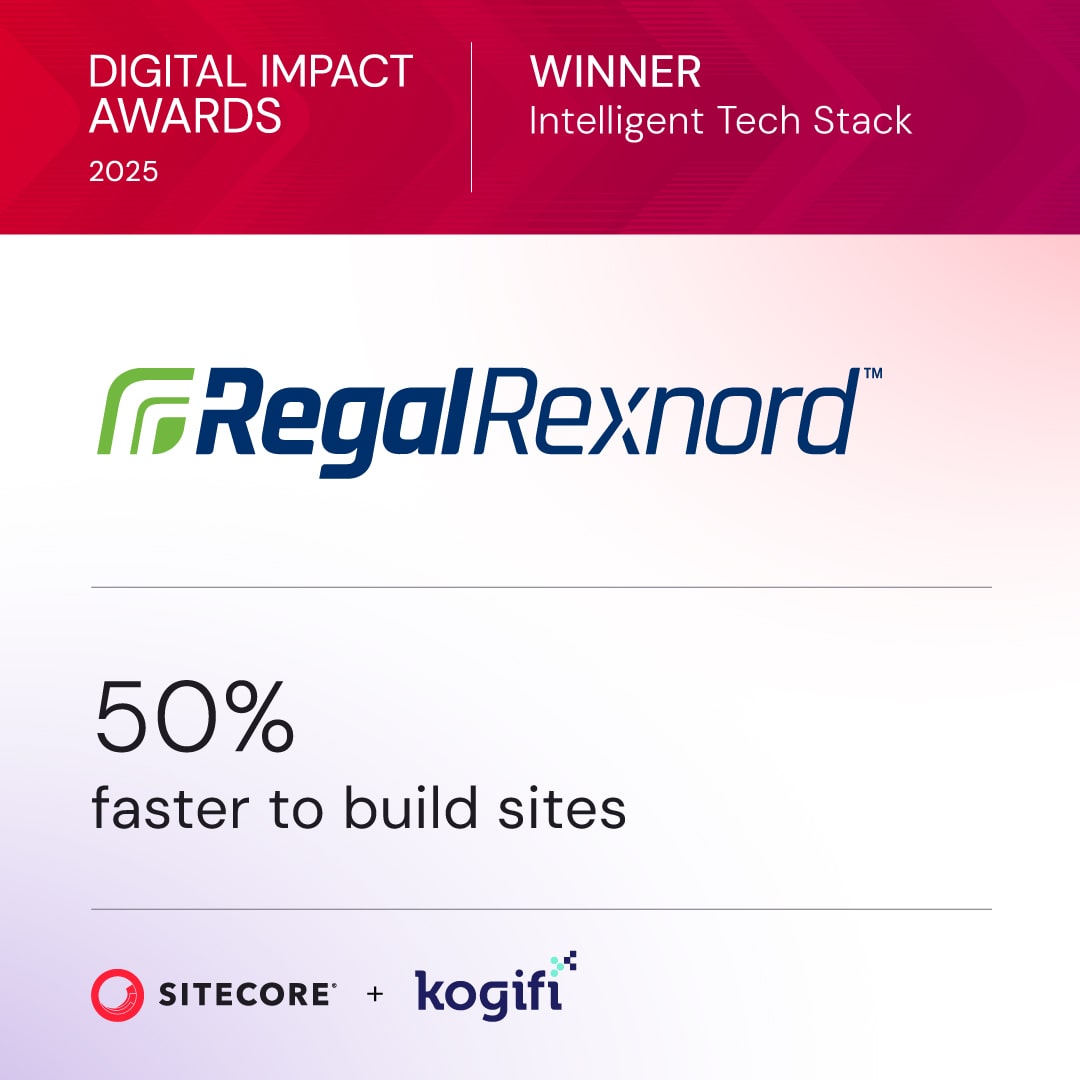
Kogifi plans and delivers that move: a fixed-scope audit, a phased site-by-site migration to a headless Next.js front end, and Agentic Studio adoption with brand guardrails and approval workflows. We moved Regal Rexnord from on-prem Sitecore XP to XM Cloud, cutting go-live timelines by 35–50% and making publishing 2x faster.

Sitecore multisite means running several websites from one Sitecore instance. Brands, regions or languages can have their own sites while sharing content, components and governance.
This reduces duplicate effort. Teams reuse layouts and templates, and new sites can launch faster than a separate build each time. Permissions let each site team manage its own content.
Tools such as SXA are often used to set up multiple sites in a consistent way.
Regal Rexnord built new brand sites faster. Read the case study.
Sitecore XM is Experience Manager, the content management foundation. It covers authoring, publishing and delivery of content across sites.
Sitecore XP is Experience Platform. It includes XM and adds marketing capabilities, such as the Experience Database, analytics, personalization rules and marketing automation.
Both are deployed on your own infrastructure or hosting. Cloud options such as XM Cloud and SitecoreAI are the current direction, and XP and XM remain supported.
If you are choosing a path, our team can help with migrations.
The Sitecore Experience Editor is the in-page editing tool in Sitecore XP and XM. Authors browse the site and edit content directly on the page, with a view close to the live result.
They can change text, swap images, add components and preview changes. It is designed so marketers can update pages without deep technical knowledge.
In XM Cloud and SitecoreAI, the equivalent visual editing experience is Sitecore Pages.
If you plan a move to the cloud, read our XP to SitecoreAI migration guide.
Sitecore content serialization saves items such as templates, renderings and settings as files, so they can be stored in source control. Developers can then move changes between environments in a controlled way. Serialization also makes deployments repeatable, which lowers the risk of manual errors when releasing new features.
This supports a normal development process: changes are reviewed, tested and deployed together with code. It also helps new developers set up a working environment quickly.
Sitecore provides tooling for serialization, including the Sitecore CLI.
Our engineers handle this in platform implementation.
Sitecore headless means the front end is built separately from the content platform. Sitecore manages content, and the site is delivered through APIs to an application you build.
The Next.js SDK for Sitecore is the toolkit for this approach. It provides components and helpers for rendering Sitecore content in Next.js, including server-side rendering and static generation.
Teams gain freedom in front-end technology and can tune performance, while authors keep familiar editing tools.
See the results of this approach in our Regal Rexnord case study.
A workflow agent in SitecoreAI is a custom agent that follows a defined series of steps. Instead of answering one request, it carries out a multi-step process.
Teams can combine agents, skills and flows, and add human checkpoints where a person must review or approve before the process continues. This suits tasks like drafting, reviewing and publishing content.
Workflow agents are created and managed in Agentic Studio.
See a practical walkthrough in our article on how to build a custom agent.
A brand kit in SitecoreAI holds the rules and guidance that describe your brand. This can include tone of voice, style and other guidelines that agents should follow. A clear brand kit saves review time because drafts start closer to the right voice.
When agents create or adjust content, they use the brand kit as a reference. This helps keep output consistent and closer to what your brand team expects.
Brand kits are managed in Agentic Studio, so marketers can update guidance in one place.
Learn more in our guide to SitecoreAI.
Agentic Studio is the part of SitecoreAI where teams work with AI agents. It includes prebuilt agents and lets you create your own, using skills and brand kits.
Work is organised in spaces and flows, and flows can include human checkpoints so people review and approve results. An Agent API connects agents with other systems.
Sitecore states that SitecoreAI does not share customer data with external providers or train external models on it.
For a worked example, read how to build a custom agent in Agentic Studio.
Sitecore OrderCloud is a headless commerce platform delivered through APIs. It handles products, catalogues, pricing, carts, orders and buyers. Its API-first design means it can power websites, portals and apps from the same commerce back end.
It is built for complex B2B and marketplace scenarios, such as multiple buyer organisations with their own prices and approval rules. Front ends are built separately, so teams choose their own technology.
OrderCloud can be paired with Sitecore content management so that commerce and content work together.
Talk to us about commerce and content projects through our implementation services.
Sitecore Send is an email marketing platform. Teams use it to build campaigns, manage subscriber lists, automate email journeys and review results. Teams can also segment audiences and personalize messages, so each email is relevant to its reader.
It includes a drag-and-drop editor, automation workflows and reporting on opens and clicks. Because it belongs to the Sitecore portfolio, it can sit alongside your content and customer data tools.
It is a good fit for teams that want email and web experiences planned together.
To see how it fits your stack, visit our Sitecore page.
Sitecore Search is a search and discovery product. It indexes content from your sites and other sources and returns fast, relevant results through APIs and widgets. It can power site search, product discovery and content recommendations from one platform, which keeps the experience consistent.
Teams can tune results, set up filters and recommendations, and review search analytics. It suits sites with large amounts of content, such as product catalogues or knowledge bases.
Search is included at entry level in SitecoreAI.
If you are weighing search options, read Coveo or Sitecore Search.
Sitecore Personalize is a tool for creating personalized experiences across web, email and other channels. Teams design experiences, set audiences and test variations. It helps teams move from one-size-fits-all pages to experiences that reflect interests and behaviour.
It works with Sitecore CDP, which provides the customer data. Marketers can run experiments, review results and refine what visitors see.
Personalize can also support decisioning, where the next best offer or message is chosen for each person.
For practical guidance, read our SitecoreAI overview.
Sitecore CDP is a customer data platform. It collects data about customers and visitors from websites, apps and other systems, and builds a unified profile for each person. It is useful when customer data is spread across many tools and teams need one reliable source.
Those profiles can be segmented and shared with other tools. Combined with Sitecore Personalize, they help teams deliver relevant experiences across channels.
The goal is a single, usable view of the customer that marketing and digital teams can act on.
We cover personalization and data projects on our Sitecore page.
Sitecore Content Hub is a platform for managing content and digital assets in one place. It brings together asset management, content planning and production workflows.
Teams can store images, videos and documents, plan campaigns, assign work and approve content before it goes live. Assets can then be reused across channels and sites.
Content Hub helps larger organisations keep brand material consistent and reduce duplicate work.
Our Sitecore team can help you connect it to your sites. See our Sitecore services.
Sitecore Pages is the visual editor in XM Cloud and SitecoreAI. Authors open a page, see it as visitors will, and edit content directly on the canvas.
They can add components, change text and images, preview the result and work across sites from one place. The interface is built for marketers, so routine edits do not need a developer.
Pages sits alongside other tools in the platform, such as components and content management, to support the full authoring cycle.
Learn how SitecoreAI fits together in our SitecoreAI guide.
Sitecore Helix is a set of design principles and conventions for organising Sitecore solutions. It groups code into layers, called Foundation, Feature and Project, with clear rules on how they depend on each other.
The aim is a solution that is easier to understand, test and change. Teams can add or replace a feature without touching unrelated parts of the codebase.
Helix is widely used on larger Sitecore projects where several developers work in parallel.
We applied Helix on the E.ON Polska programme. Read the E.ON Polska case study.
Sitecore JSS, short for JavaScript Services, is a software development kit for building Sitecore front ends with JavaScript frameworks. It supports React, Angular, Vue and Next.js.
JSS lets front-end developers work with modern tools while content authors keep using Sitecore to manage pages and components. It is the basis of headless delivery for Sitecore sites.
Today, the Next.js SDK for Sitecore is a common choice for new headless builds.
To plan a headless build, read about our platform implementation services.
Sitecore Experience Accelerator, or SXA, is a toolkit for building sites faster. It gives you ready-made components, page designs and a shared grid, so teams can assemble pages without writing new code each time.
SXA supports multiple sites on one Sitecore instance. Marketers can reuse layouts and themes, while developers extend the component library when needed.
It works well when several brands or regions need consistent pages with local control.
We use SXA when it fits the project, as described on our Sitecore page.
Sitecore xDB, the Experience Database, is the data store behind Sitecore XP. It records visitor interactions such as page views, goals and campaign activity, and keeps them in a contact profile.
Marketers use this data for analytics, segmentation and personalization. Each visit adds to a picture of how people use your site over time.
xDB belongs to the XP architecture. Newer SaaS products such as Sitecore CDP and Personalize cover similar needs in the cloud.
For help with data, tracking and platform choices, see our Sitecore expertise.
Sitecore Experience Edge is a delivery service for headless content. It publishes content from Sitecore to a globally distributed network and exposes it through a GraphQL API. It is used by XM Cloud and SitecoreAI, and it scales with traffic without extra work from your team. Authors publish as usual, and Edge handles distribution.
Front-end applications, such as Next.js sites, request content from Edge instead of querying the authoring environment. This keeps delivery fast and separates authoring from the public site.
Our team builds headless sites on Edge as part of Sitecore development.
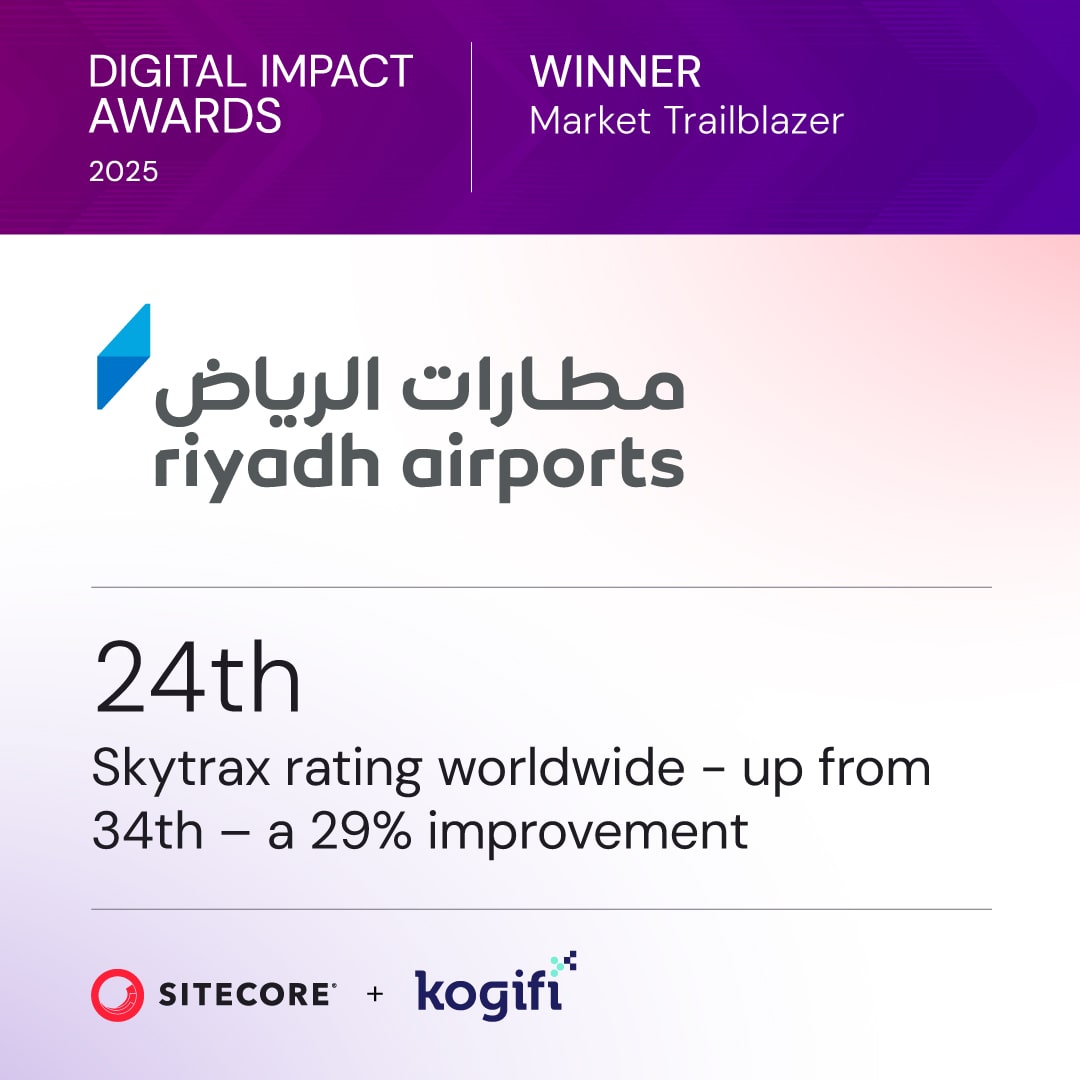
Yes. Kogifi is a Sitecore Silver Partner with Sitecore-certified developers, and a two-time Sitecore Digital Impact Awards winner (2025, for Regal Rexnord and Riyadh Airports). Our Sitecore work covers SitecoreAI, XM Cloud, XP, CDP & Personalize, Search and Content Hub.
Sitecore is a global company, with its headquarters in San Francisco. Originally founded in Denmark in 2001, Sitecore moved its headquarters to San Francisco to be closer to the technology innovation hub and its growing customer base. The company maintains significant presence in Copenhagen, Denmark, and has offices across North America, Europe, Asia-Pacific, and other regions, serving thousands of customers in over 50 countries worldwide.
Sitecore DXP consists of several tools which can be leveraged to holistically address wide range of DXP needs, including Sitecore CMS (XM Cloud or XP), Sitecore Search, Sitecore Customer Data Platform, Sitecore Send. The complete suite also includes: Sitecore Experience Edge for content delivery, Sitecore Personalize for real-time personalization, Sitecore Content Hub for digital asset management, Sitecore Commerce for e-commerce capabilities, and Sitecore AI for automated personalization. These components work together to provide end-to-end digital experience management from content creation to delivery and optimization.
Composable DXP ensures high level of decoupling between DXP suite components, leaving freedom of choice of the best suitable products and tools. Based on MACH principles (Microservices, API-first, Cloud-native, Headless), composable DXPs allow organizations to select best-of-breed solutions for each capability. Benefits include: faster time-to-market, reduced vendor lock-in, easier scaling of individual components, ability to swap components as needs change, and alignment with modern development practices. Examples include combining headless CMS with separate personalization engines, CDP, and commerce platforms.
Sitecore is owned by EQT, a global investment fund. EQT acquired Sitecore in 2016 for approximately $1.14 billion, making it one of the largest software acquisitions in the content management space. Under EQT's ownership, Sitecore has accelerated its cloud transformation, expanded its product portfolio, and strengthened its position in the digital experience platform market through strategic acquisitions and continued innovation.
It varies on the product (on-prem offering or cloud), traffic, number of users. Sitecore offering is very flexible, accommodating unique needs of companies and their growth. Investment in Sitecore pays long term and offers predictable ROI. Pricing models include perpetual licenses for on-premises deployments and subscription-based pricing for cloud solutions like XM Cloud. Factors affecting cost include: number of content authors, website traffic, number of sites, required modules (XM, XP, Commerce, CDP), hosting preferences, support level, and implementation complexity. Most enterprise implementations require custom quotes based on specific requirements.
A long-time leader of innovation in digital experience, digital marketing optimization and digital maturity growth. Recognized as industry leader in many research across years. Key advantages include: enterprise-grade scalability and security, powerful personalization capabilities, comprehensive analytics and insights, flexible architecture supporting both traditional and headless deployments, strong partner ecosystem, continuous innovation with AI and machine learning features, proven track record with Fortune 500 companies, comprehensive documentation and community support, and ability to handle complex multi-site, multi-language implementations. Gartner and Forrester consistently recognize Sitecore as a leader in digital experience platforms.
Implementation of CMS aspects: pages, layouts, components; integrations with systems; delivery of bespoke artificial intelligence models; integration of digital experience platform. Sitecore development encompasses: creating rendering components, implementing data templates and content structures, developing custom pipelines and processors, building API integrations, implementing search functionality with Solr or Azure Search, creating workflow processes, developing custom modules, implementing caching strategies, building responsive designs, creating custom analytics tracking, and developing headless implementations using JSS (JavaScript Services) or .NET Core.
Prepare a strategy, define audiences, identify personas, build relevant content and assets, deliver personalization. The implementation process includes: setting up profile keys and pattern cards, creating personalization rules based on user behavior and characteristics, implementing engagement value scoring, configuring marketing automation campaigns, setting up A/B and multivariate testing, creating dynamic content variations, implementing geolocation-based personalization, integrating with CRM data for enhanced targeting, and measuring personalization effectiveness through analytics. Best practices include starting with simple rules and gradually increasing complexity based on data insights.
High competence, access to latest technology and trainings, certifications, guarantee of successful project. Additional benefits include: faster implementation timelines due to experienced teams, best practices knowledge from multiple implementations, access to reusable components and accelerators, direct communication channels with Sitecore support, ability to handle complex integrations and customizations, ongoing support and maintenance expertise, cost optimization through efficient implementation approaches, and reduced risk through proven methodologies. Partners also provide knowledge transfer to internal teams.
Sitecore is used for creating and managing enterprise-level digital experiences across multiple channels. It enables organizations to deliver personalized content, manage digital assets, analyze customer behavior, automate marketing campaigns, and drive e-commerce initiatives. Common use cases include corporate websites, customer portals, intranets, marketing campaigns, and omnichannel customer experiences. Specific industries leverage Sitecore for: retail (personalized shopping experiences), healthcare (patient portals), financial services (secure customer portals), manufacturing (dealer networks), travel and hospitality (booking platforms), and government (citizen services). Sitecore excels in scenarios requiring complex personalization, multi-language support, and integration with enterprise systems.
Review and enhancement of digital marketing strategy, UX/UI strategization, ideation and delivery, delivery of frontend and backend solution driving DXP strategy, content delivery, migration and enhancement, ongoing support and maintenance, including managed hosting and support 24/7 services. Additionally, implementations typically include: requirements gathering and solution architecture, environment setup and configuration, custom component development, third-party integrations, performance optimization, security hardening, user training, documentation, quality assurance and testing, go-live planning and execution, and post-launch optimization based on analytics insights.
Typical Sitecore solution contains CMS and analytics. However, some customers begin with Sitecore's Customer Data Platform. A comprehensive Sitecore solution often includes: Sitecore Experience Manager (XM) or Experience Platform (XP) for content management, Sitecore Experience Database (xDB) for customer data collection, personalization engine, marketing automation tools, A/B testing capabilities, and integration with third-party systems like CRM, ERP, and marketing tools. Many organizations also implement Sitecore Commerce for e-commerce capabilities or Sitecore Content Hub for digital asset management.
A Digital Experience Platform (DXP) is an integrated suite of tools designed to manage and optimize digital customer experiences comprehensively across various touchpoints. Sitecore is a prominent provider of DXPs, offering solutions that facilitate seamless end-to-end management of the digital customer journey.
Sitecore's DXP enables organizations to create highly personalized, multichannel (omnichannel) experiences that foster deeper, lasting relationships with customers. By leveraging advanced customer analytics, robust digital asset management, sophisticated marketing automation, and enterprise-grade content management capabilities, Sitecore helps brands deliver consistent, relevant, and engaging interactions tailored to individual customer preferences.
Through Sitecore DXP, enterprises gain the ability to strategically orchestrate their digital presence, ensuring high levels of personalization and performance at scale. This results in enhanced customer intimacy, improved engagement, increased brand loyalty, and a competitive edge in today's dynamic digital marketplace. Modern DXPs also incorporate AI-driven insights, headless architecture options, and composable frameworks to provide flexibility and future-proof digital strategies.
Sitecore is spelled "Sitecore" with no space or digits. Some people spell it Site Core, or site core, but we also seen the Sitec0re notation - all them are incorrect. The correct spelling is always "Sitecore" as one word, with a capital 'S' and lowercase 'c'. This is the official brand name and should be used consistently in all professional communications and documentation.
Sitecore is a leading global provider of enterprise content management, digital experience management, digital asset management, customer analytics, marketing automation, and e-commerce systems. Among its portfolio, the most renowned and widely adopted solution is Sitecore CMS, an enterprise-grade content management system that offers exceptional potential for customization, extensive functionality, and an intuitive, user-friendly interface.
Sitecore CMS empowers organizations to significantly elevate their digital strategies by enabling highly personalized and scalable customer experiences. It is specifically designed to support enterprises in crafting detailed, intimate, and enduring relationships with their customers through precise targeting, personalization, and consistent engagement across various digital channels.
The platform combines robust analytics and advanced marketing automation capabilities to understand customer behavior deeply, allowing brands to deliver content and campaigns that resonate uniquely with each audience segment. Furthermore, Sitecore's digital asset management simplifies the control and optimization of digital resources, enhancing operational efficiency.
With Sitecore CMS, enterprises can confidently manage their digital presence at scale without compromising performance. This capability ensures consistently fast, reliable, and relevant experiences, thereby driving brand loyalty, customer satisfaction, and competitive advantage in the digital marketplace. Sitecore offers both traditional on-premises solutions and modern cloud-based platforms like XM Cloud, providing flexibility in deployment options.