


Your reactivation campaign is ready in principle, but the work is scattered. The audience sits in a customer platform, approved offers live in documents, content needs review, and someone still has to build the journey and explain whether it worked.
That's the practical opportunity for agentic AI in marketing in 2026: connecting those steps without handing an AI system unrestricted control. For enterprise teams, the useful question isn't whether an agent can write an email. It's whether your Sitecore architecture, SharePoint knowledge sources, permissions, and measurement can support reliable campaign actions.
Table of Contents
- What Agentic AI in Marketing Actually Means
- Rule-Based, Generative and Agentic Tools Compared
- How an Agent Works Through a Marketing Task
- Practical Applications Across the Campaign Lifecycle
- How Sitecore Supports Agentic Marketing Workflows
- Where SharePoint Solutions Fit Beside Sitecore
- Governance and Measurement Agents Need
- Confirm One Bounded Pilot Before You Scale
What Agentic AI in Marketing Actually Means
A campaign manager gives an assistant a goal: recover lapsed customers in one market using approved offers. In a well-designed implementation, the assistant checks audience eligibility, selects a message strategy, prepares variants, requests any required approval, launches a controlled test, and reports the outcome.
Think of it as the difference between a campaign coordinator and a copywriter waiting for the next brief. The coordinator can organize work toward an objective. The copywriter produces an output when asked.
The distinction starts with the marketer's goal, not the chat interface.

Agentic AI is software that pursues an objective across multiple steps, chooses among permitted actions, uses approved tools, and responds to feedback. Those tools might expose segmentation, content, analytics, or campaign activation APIs.
The ingredients behind the interface
An operational agent needs:
- A goal: A business outcome with an explicit definition of success.
- Context: Relevant customer signals, approved content, and operating rules.
- Permitted actions: Tools it can call, with restrictions enforced outside the model.
- A feedback loop: Outcomes that inform its next decision or trigger human intervention.
Adoption is real, but it isn't universal. A SAS survey of 300 organizations found that 21% of marketers were testing agentic AI in live environments in 2025. Separately, the SAS and Coleman Parkes announcement reported that 51% of marketing decision-makers planned to invest within the following year.
Those findings describe a transition toward operations, not proof of mainstream maturity. A convincing demonstration still needs production-grade integrations and accountability.
When evaluating a tool, ask: Does it pursue a goal? Does it choose its own steps? Does it act, or only suggest? A product that only drafts recommendations may be valuable, but it isn't completing an agentic workflow.
Rule-Based, Generative and Agentic Tools Compared
| Approach | How work starts | Scope of action | Human role | Typical marketing example |
|---|---|---|---|---|
| Rule-based automation | A scheduled trigger, journey entry rule or list upload | Runs only the steps written in advance | Designs and maintains every rule | Sends a cart-abandon email 24 hours after abandonment |
| Generative AI assistant | A prompt from a marketer | Produces drafts, summaries or analysis, then stops | Reviews, edits and carries output into other tools | Drafts three subject lines for a spring offer |
| Agentic AI system | A goal with constraints, such as recovering lapsed buyers in one market | Plans steps, calls approved tools, acts within permissions and learns from results | Sets boundaries, approves high-risk actions and reviews outcomes | Builds, tests and adjusts a reactivation journey for lapsed buyers |
The examples illustrate workflow choices, not recommended timing or content volumes. The important difference is who determines the next step.
With rule-based automation, the designer encodes the goal into a fixed sequence. A generative assistant handles the requested task but usually leaves execution to the marketer. An agent receives an objective and can select a route through the available tools.
That doesn't make agents the right replacement for every workflow. If a consent check has a clear answer, use deterministic logic. You don't need a language model deciding whether an unsubscribe flag matters.
What autonomy doesn't mean
- Agentic doesn't mean unsupervised: An agent can pause for approval and still coordinate the work around that checkpoint.
- More autonomy isn't automatically better: Publishing rights and spending authority should follow the risk of the action.
- Plugins don't automatically create an agent: Tool access alone doesn't establish goal-directed planning or outcome feedback.
A rule-based journey can mishandle an unanticipated scenario unless someone adds a branch. A generative assistant may describe an excellent response but stop at the draft. An agent can connect the response to execution, provided its tools expose the necessary capabilities safely.
According to MarTech's coverage of the marketing AI survey, 85% of marketing teams were deploying generative AI in 2025. That makes assistants a practical starting point for many teams, rather than something they must discard.
Practical test: List your last three AI-assisted tasks. Mark where a person copied output into another system. Those handoffs are candidates for integration, not automatic permission to remove human review.
How an Agent Works Through a Marketing Task
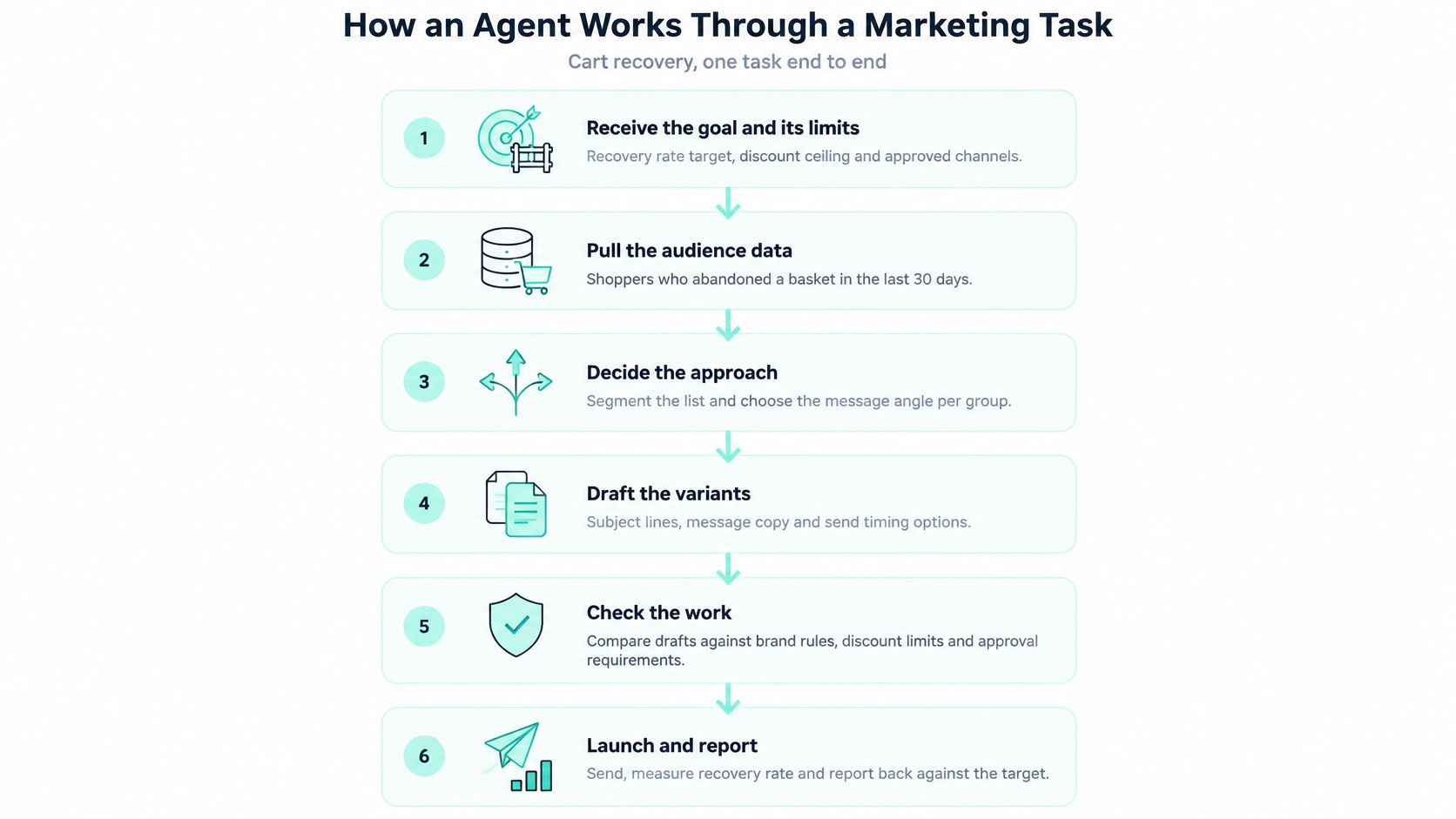
Consider cart recovery. The agent's job isn't just to produce a persuasive message. It must determine whether a shopper should receive anything, which approved approach fits, and whether the action helped.
The workflow below shows the operational handoffs involved.
Follow the execution loop
Receive the goal and its limits. Specify the recovery objective, discount ceiling, approved channels, and contact-frequency cap. Vague instructions such as improve performance leave the agent without a reliable basis for choosing between revenue, margin, and customer experience.
Gather data through typed tools. Retrieve segment membership, consent status, product availability, and recent session behavior through APIs with defined inputs and outputs. Missing identifiers, stale inventory, or inconsistent timestamps can invalidate the entire run. Treat this as the primary failure surface to investigate, rather than assuming the model needs a better prompt.
Plan from approved options. The agent might choose a reminder, a product-information message, or an eligible offer. Keep the options explicit. Otherwise, it may propose a discount or product claim that the organization never authorized.
Act within permissions. Allow activation in the designated channel, with campaign and offer limits enforced by the tool. If a proposed offer exceeds the ceiling, require approval. A prompt saying don't overspend isn't a spending control.
Observe outcomes against a control group. Compare eligible shoppers receiving agent-selected actions with shoppers assigned to the comparison experience. Counting purchases after a message doesn't establish that the message caused them.
Record the run and escalate exceptions. Log input references, tool calls, policy decisions, approvals, and results. Stop or route the task to a person when data is unavailable or a policy decision can't be resolved. Silent fallback makes diagnosis difficult.
The Marketing Agent Benchmark, covering 15 tasks, identified information gathering and orchestration as limiting factors rather than reasoning alone. For architects, the implication is practical: improve tool contracts and access paths before adding elaborate agent coordination.
Recognize a healthy run
A successful execution leaves a readable account of what happened, including why a customer was excluded. It also handles retries without sending duplicate messages or creating duplicate campaign objects.
The accompanying video offers another way to consider the workflow.
Completion alone isn't success. The agent should finish the permitted loop, produce a human-readable log, and report against a holdout rather than comparing results with last month.
Practical Applications Across the Campaign Lifecycle
| Workflow | What the agent does | Human checkpoint | Success measure |
|---|---|---|---|
| Lapsed-customer reactivation | Selects one approved offer and message per customer segment | Approves offer limits before launch | Incremental revenue against a holdout group |
| Cart recovery | Chooses timing and message strategy for abandoned baskets | Reviews discount ceiling and contact frequency | Recovered orders versus control cohort |
| Content variant production | Drafts variants from an approved brief and brand guidelines | Brand reviewer signs off before publishing | Conversion rate per variant |
| Budget reallocation | Shifts spend between channels within a set limit | Finance approves changes above the cap | Cost per acquisition against baseline |
| SEO tagging and metadata | Applies tags and metadata to new pages | Editor checks sample pages each week | Organic traffic and indexing errors |
These are candidate designs, not claims that every Sitecore deployment supplies every action natively. Each workflow needs an appropriate integration and a clearly assigned owner.
A reactivation pilot in practice
Say a retailer wants to reconnect with lapsed customers. The marketing team approves an offer library and excludes customers who aren't eligible for contact. The agent evaluates the remaining context, selects an approved message and offer, and adapts later choices to observed responses.
A business-as-usual cohort continues receiving the existing experience. That comparison matters because some customers would have returned without the new intervention.
Evidence supports testing this approach under controlled conditions. A randomized agentic-personalization field experiment involving 6.4 million users across four products over three weeks found statistically significant improvements across upper- and lower-funnel events. That supports measurable decision policies, not unrestricted generation or a guaranteed lift for another organization.
Connect the decision to the experience
Sitecore Personalize documents shared live visitor data across real-time personalization, search, A/B/n testing, and page analytics. Its Conversion Optimization capability supports controlled experiments on product pages or content blocks, identifies winning variants, and can distribute winners across connected sites and campaigns.
That creates a useful mechanism: the agent proposes or selects an experience, the experimentation layer evaluates it, and controlled activation distributes the result. Our guide to AI marketing automation provides related context for connecting these workflows.
For venue teams translating this into local campaigns, Purple Engage's AI marketing checklist for hospitality venues is a practical companion resource.
Start with work that's repetitive, measurable, low-risk, and reversible. Keep brand-defining statements and legally sensitive decisions with people.
How Sitecore Supports Agentic Marketing Workflows
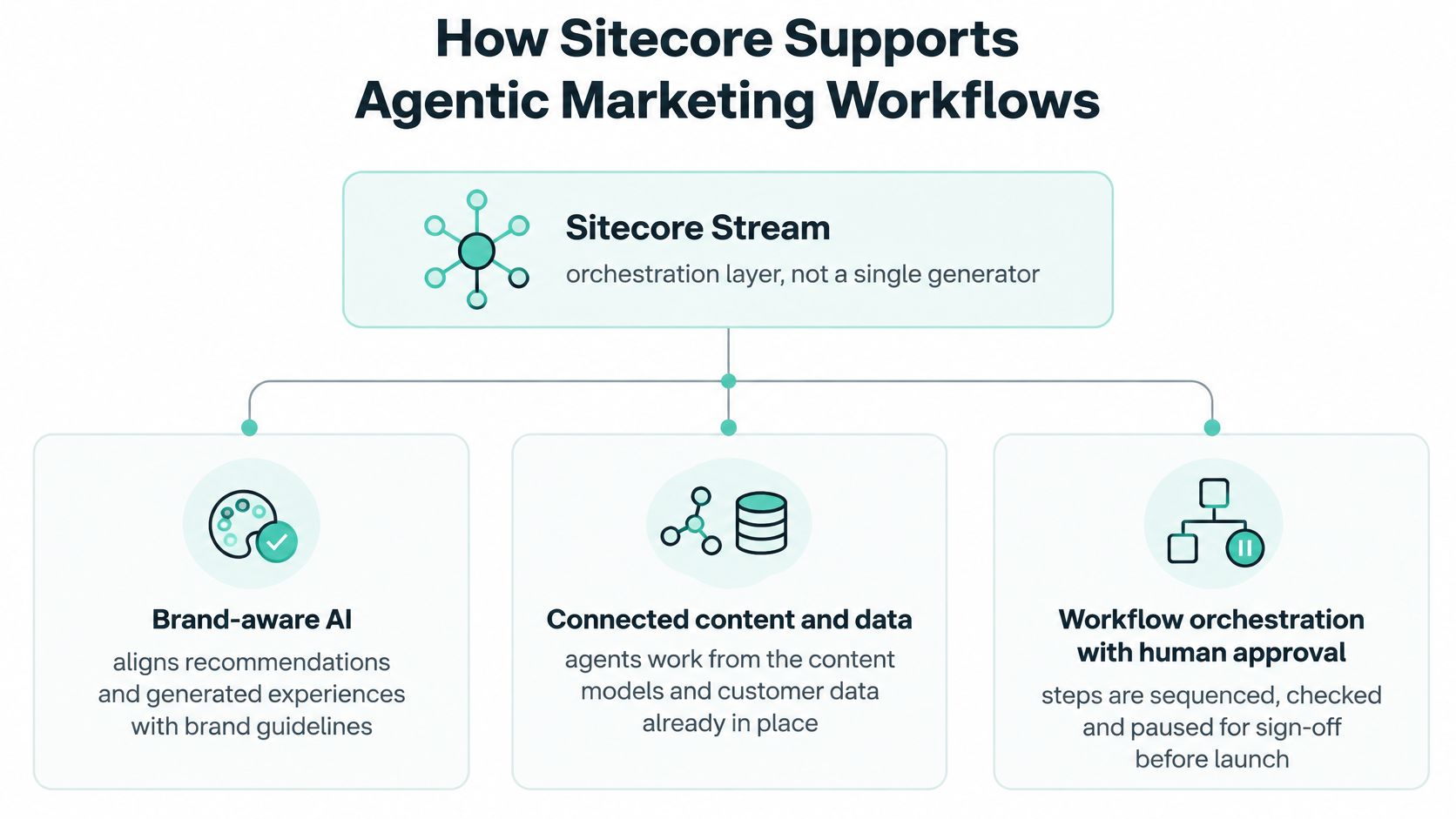
Sitecore Stream is an orchestration layer, not a text generator. Its usefulness depends on what the surrounding Sitecore estate makes available through content structures, customer signals, and executable workflows.
Build the architecture from the bottom up.
Separate data, decisions, and orchestration
- Data layer: Identity, events, and consent establish which customer context is available and usable. Sitecore CDP can participate where deployed, but architects must map the actual source of truth and integration boundaries.
- Decision layer: Personalization and experiments determine which experience to deliver and how to evaluate alternatives. Keep eligibility checks separate from creative recommendations.
- Orchestration layer: Stream coordinates marketing work across connected capabilities. Governance must apply across all layers, not only when someone publishes content.
Sitecore Stream's product documentation describes brand-aware AI, generative copilots, and agentic workflows. Brand-aware AI aligns recommendations and generated experiences with identity and guidelines; copilots assist with briefs, content, and experience work; agentic workflows can create deliverables, apply SEO tags, generate personalized content, and coordinate collaboration.
Sitecore also describes interoperability across its composable architecture and existing martech integrations, with guardrails intended to preserve brand compliance and data privacy. Those are platform capabilities, not a guarantee that a particular implementation has configured every required control.
The diagram summarizes how those responsibilities connect.
Ground outputs before enabling actions
Sitecore's intelligent DXP explanation describes the AI model through a model, grounding context, and a prompt. Grounding supplies the organization-specific information that a general model doesn't know.
For a headless Sitecore or XM Cloud estate, that means clean content models, explicit locale fields, reusable components, and stable APIs. Helix-based component libraries can provide predictable implementation boundaries, but they don't themselves authorize agent actions. An agent shouldn't invent a rendering or publish around an existing workflow.
Content Hub, Search, CDP, and Personalize should be connected according to the installed portfolio, licensing, and supported interfaces. Don't assume access to one product creates automatic access to every other capability.
At Kogifi, we can audit the platform foundation before agents are added. Our guide to building a custom agent with SitecoreAI Agentic Studio provides a more specific implementation path.
For campaigns involving creators, Clipatra's guide to automate creator payouts and approvals offers adjacent workflow context. Keep financial authorization separate from Sitecore content-publishing rights.
Where SharePoint Solutions Fit Beside Sitecore
SharePoint supplies governed reference material; Sitecore delivers and coordinates the customer experience. That division prevents a document library from becoming an accidental customer database.
Approved briefs, product sheets, policies, training material, and offer definitions can ground an agent's decisions. Retrieve them through controlled connectors rather than copying an entire library into an unrestricted index.
Make document authority explicit
Configure SharePoint solutions around clear content responsibilities:
- Authoritative libraries: Identify approved material and distinguish it from drafts and retired documents.
- Approval and version controls: Preserve the reviewed version that informed a campaign decision, using document workflows and version history.
- Permission-aware retrieval: Ensure the connector cannot return material the requesting marketer couldn't open. Broad application credentials require additional authorization checks.
- Retrieval metadata: Include owner, market, language, approval status, effective date, and expiry where relevant.
Keep audience profiles and consent in the DXP or CDP layer. SharePoint should provide reference content, not become the working store for behavioral segmentation.
Test the connector as a production dependency
Before live activation, test whether retrieval returns the correct language, current offer, and approved policy. Include negative tests: a draft document, a restricted library, and a retired product sheet should not become valid grounding material.
For organizations running Microsoft 365 alongside Sitecore, document the APIs, metadata filters, and service identities involved. Audit connector activity, and define what happens when no authoritative document matches the request.
The division of labor stays simple: Sitecore Stream orchestrates campaign actions; SharePoint grounds them in governed documents and approvals. That connection must be engineered, not assumed.
Governance and Measurement Agents Need
Faster production doesn't prove that an agent improves marketing. A system can generate more variants while increasing complaints, distributing unsupported claims, or spending more to reach customers who would have converted anyway.
The LeanIX agentic AI survey reports that more than 80% of surveyed companies deploying AI agents lack visibility into agent performance, compliance, business capability support, or ROI. Treat measurement as an architectural requirement, not a reporting task after launch.
| Metric type | Examples | Why it matters |
|---|---|---|
| Agent-level | Tool-call accuracy, escalation rate, latency, token and infrastructure cost | Shows whether the agent works as built |
| Business-level | Incremental conversion, qualified pipeline, retention, revenue per user against a holdout | Shows whether the agent creates measurable value |
| Risk-level | Accessibility defects, unauthorized brand deviations, consent violations, complaint rate | Shows what the agent could damage if left unchecked |
Enforce controls outside the prompt
- Permissioned access: Expose only the fields and operations required for the assigned task.
- Approval thresholds: Route sensitive claims, exceptional offers, and high-impact spending changes to a named approver.
- Sandbox testing: Test malformed data, unavailable services, conflicting documents, and denied permissions before activation.
- Reversible actions: Preserve prior configurations and provide a tested rollback route.
- Audit trails: Record input references, tool versions, decisions, approvals, and outcomes with appropriate access and retention controls.
Connect these controls to a content governance framework, so editorial ownership remains clear when an agent creates or modifies material. Avoid a separate AI approval process that bypasses the organization's existing accountability.
Give customers meaningful control
Transparency matters alongside technical reliability. Visa's consumer research on agentic commerce found that nearly nine in ten respondents wanted transparency into how agents make decisions.
Provide understandable explanations for personalized offers and practical ways to stop or correct personalization. Carry those preferences through identity, analytics, and activation systems rather than recording them in an isolated interface.
Accountability also needs an owner when an agent retrieves inaccurate content from another system. Assign responsibility for the source document, the retrieval integration, and campaign release. A chain of automated handoffs must not become a chain of people assuming someone else checked.
Release condition: Agree on pre-deployment metrics, a statistically defensible holdout size, an operating cost cap, and a named human reviewer before activation.
Interpret metrics together. A high escalation rate might indicate a broken tool, but it might also show that the agent correctly refused ambiguous requests. Investigate the underlying events before trying to optimize the number downward.
Confirm One Bounded Pilot Before You Scale
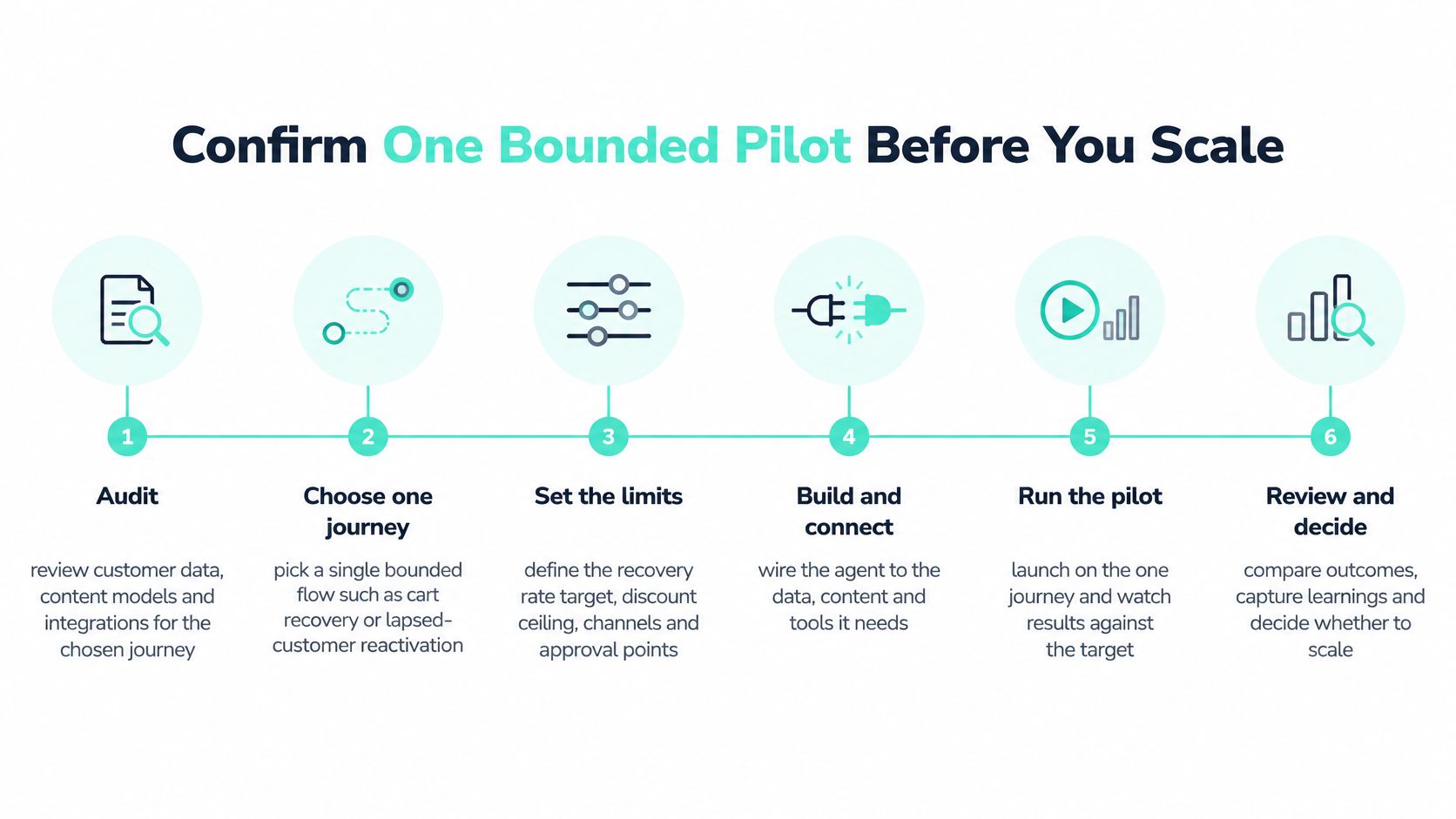
A broad launch makes diagnosis difficult. A bounded journey lets marketing and engineering isolate problems, preserve a valid comparison, and decide whether more autonomy is justified.
Use a phased sequence, with explicit approval to move forward:
- Audit the foundation. Review customer data, content models, event quality, and integrations for the intended journey. Resolve critical gaps before connecting activation tools.
- Choose one journey. Select cart recovery or lapsed-customer reactivation with a clear business measure and an accountable campaign owner.
- Establish the comparison. Record baseline metrics and calculate the holdout needed for a credible test. In an illustrative pilot, the team might reserve 10% to 20% of eligible customers, subject to sample-size analysis.
- Define execution boundaries. Approve content, offer limits, permissions, and human-review thresholds. Verify that the APIs enforce them.
- Run and inspect. An illustrative operating window is four to six weeks, with weekly agent and business reviews. Extend it if customer behavior or sample size makes the result inconclusive.
- Expand conditionally. Scale only when incremental outcomes remain credible and risk measures stay inside agreed limits.
The process diagram offers a compact planning view.
Make readiness a release decision
The easy step to skip is a structured review of the platform, data, and governance before agents act. Our Sitecore Support Readiness Check covers what's needed before AI agents work in your CMS. Kogifi is a Sitecore Silver Partner with experience across Sitecore, Adobe Experience Manager, and Microsoft 365.
Choose the journey, confirm the baseline, and set the permissions this month. That's a more useful commitment than approving an enterprise-wide autonomy target before the first controlled result.
Kogifi helps enterprise teams assess Sitecore readiness, connect governed content and customer signals, and implement AI-supported experience workflows with approval checkpoints. Visit Kogifi to discuss a bounded marketing pilot and identify the platform, integration, and measurement work needed before launch.