


Only 2% of sites reviewed in a 2025 European-market accessibility audit allowed users to complete checkout without a major accessibility barrier, according to the GetWCAG ecommerce accessibility guide. That's a useful corrective to the usual conversation about composable commerce solutions. A modern architecture isn't a successful customer experience unless someone owns the entire journey, including the components bought from other vendors.
For enterprise teams, the hard decisions concern operating responsibility: who approves AI-generated content, who fixes a broken payment interaction, and who pays to maintain the integrations. Sitecore's AI-oriented portfolio can support that operating model, while SharePoint serves a different but complementary role in internal collaboration. Neither removes the need for architecture discipline.
Table of Contents
- What Composable Commerce Means in Plain Terms
- The Building Blocks of a Composable Commerce Stack
- Sitecore AI and SharePoint in a Composable Estate
- Benefits and Hidden Costs to Model Before You Commit
- Performance Budgets That Keep Checkout Fast
- Choosing Your Implementation Path and First Step
What Composable Commerce Means in Plain Terms
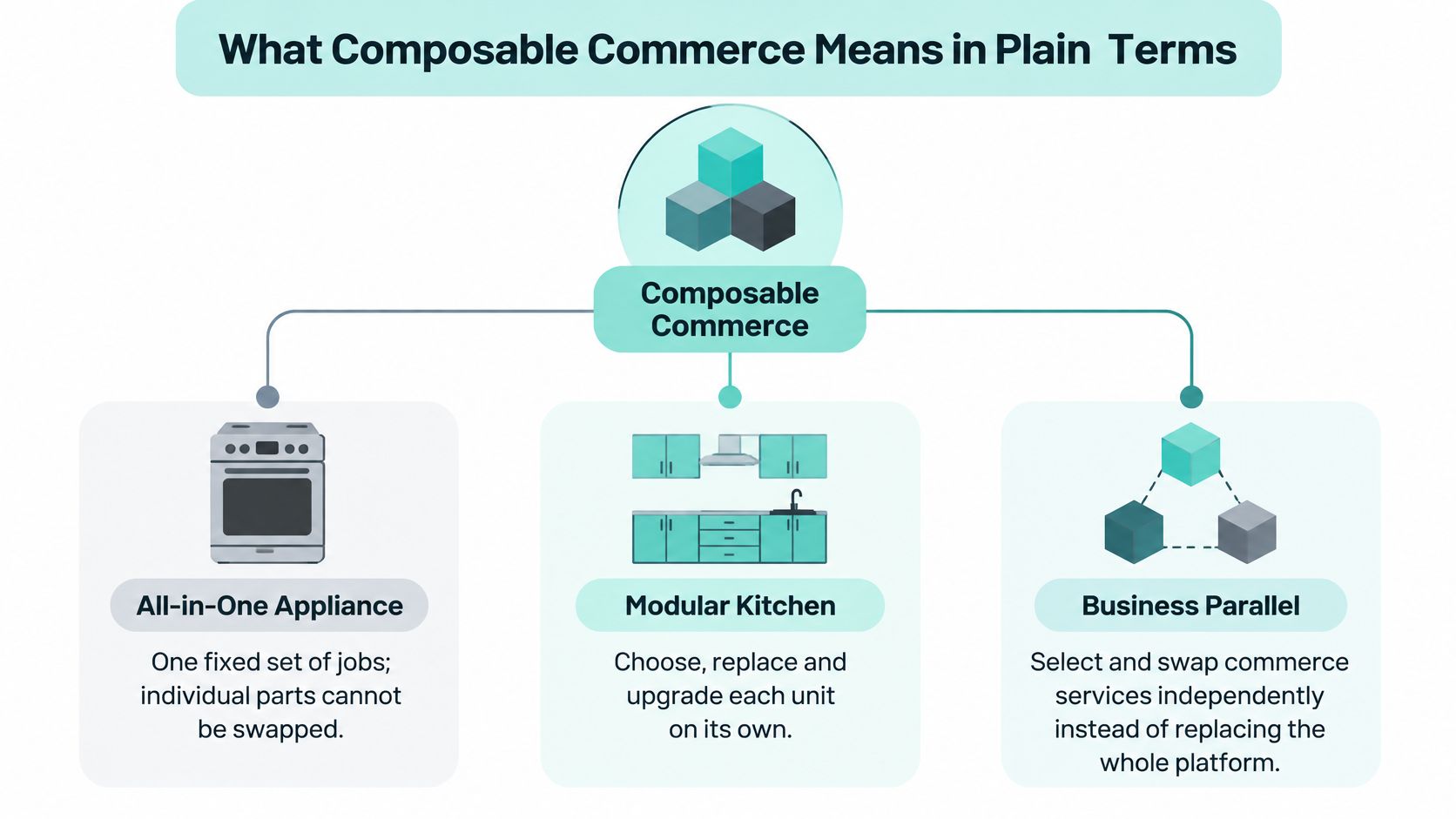
An all-in-one kitchen appliance performs a fixed set of jobs. A modular kitchen lets you choose the oven, replace the refrigerator, and upgrade the dishwasher independently. Composable commerce applies that principle to online selling, with an important qualification: the connections between the units must remain compatible.
Say a manufacturer operates regional storefronts on a shared platform. Its content management works well, but buyers struggle to find replacement parts. Instead of replacing the entire platform, the digital team introduces a dedicated search service and connects it to the existing catalogue and storefront.
The business has adopted composability where it solves a specific problem. It hasn't committed to replacing every application.
What MACH means in practice
The architectural shorthand is MACH:
- Microservices: Deploy business capabilities independently, with explicit ownership boundaries.
- API-first: Define supported interfaces before teams build integrations around implementation details.
- Cloud-native: Design deployment, scaling, and recovery around cloud capabilities.
- Headless: Separate presentation from the systems managing content and transactions.
Gartner's 2020 statement that “the future of business is composable” and the MACH Alliance's founding that year helped establish the approach; by 2024, 72% of retailers reported adopting composable ecommerce, 27% planned to adopt it, and only 2% described themselves as fully composable, according to Queue-it's composable commerce statistics.
That gap matters more than the adoption headline. A headless storefront can still depend on a tightly coupled backend. Conversely, a business can gain useful flexibility by replacing search while retaining its established transaction engine.
The kitchen comparison makes the boundaries easier to identify.
Practical rule: A component isn't meaningfully replaceable if changing it requires unrelated teams to rewrite their applications.
Commercial packaging doesn't establish independence. Check deployment pipelines, data ownership, authentication dependencies, and backward compatibility.
As a self-test, name the MACH principles without looking at a vendor diagram. Then mark your storefront, content, catalogue, search, pricing, cart, and checkout as monolithic, partly composable, or fully composable. Require evidence for each label, particularly whether the owning team can release or replace that capability without coordinating a platform-wide deployment.
The Building Blocks of a Composable Commerce Stack
A composable stack is a set of architectural layers, not a shopping list. Buying specialist software for every function can leave you with more contracts and no additional independence.
Sitecore's SitecoreAI announcement positions SitecoreAI as built on XM Cloud, bringing content, digital asset management, customer data, personalization, and search into a composable SaaS platform running on Microsoft Azure. Treat that portfolio as an experience foundation, not evidence that every commerce responsibility belongs inside the content platform.
Assign each layer a clear job
Composable commerce layers and Sitecore options
| Layer | Job in the stack | Sitecore option | Decision to make |
|---|---|---|---|
| Content management | Authors and publishes pages and components | XM Cloud | Headless or hybrid delivery |
| Digital asset management | Stores and governs images, video and documents | Content Hub | One asset library shared across brands |
| Customer data | Unifies profiles and behavioural events | CDP | Identity resolution and consent model |
| Search | Product and content discovery | Search | Who owns the index and relevance tuning |
| Personalization and experimentation | Serves variants and automates actions after tests | Personalize | Audience definitions and test governance |
| Commerce engine | Catalogue, pricing, cart and orders | Retained commerce core or separately selected engine | Build on or buy the commerce core |
| AI assistance | Generates content variants and workflow support | Stream and SitecoreAI | Which products and workflows get AI first |
| Frontend | Renders storefront and journeys | Next.js front end, not a Sitecore product | Shared component library across sites |
| API and orchestration | Connects services and enforces contracts | Integration layer around Sitecore APIs | Gateway, API contracts and service ownership |
For XM Cloud, model reusable content rather than copying page layouts into structured fields. Separate editorial content from live product facts so an author can't accidentally override availability or contractual pricing.
For Content Hub, establish asset identifiers, usage rights, localization relationships, and approval states. A shared library only works when brands agree on metadata and on who can approve an asset for publication.
CDP, Search, and Personalize need different owners. Customer-data teams should define identity and consent boundaries; search specialists should own ingestion and relevance; marketers should own experiment hypotheses within agreed technical and privacy controls.
Integrations determine actual replaceability
Sitecore describes Stream as an AI layer spanning XM Cloud, Content Hub, and XP, with generative assistance, content intelligence, and workflow orchestration. Its role is distinct from transaction orchestration: helping a marketer prepare content doesn't make it responsible for reserving stock.
Keep the commerce engine authoritative for commercial decisions. The frontend can request a price, but it shouldn't reconstruct promotion rules from content fields.
The API and orchestration layer is where integration risk concentrates, and there may be no single Sitecore product responsible for it. Define schema versioning, event ownership, authentication, and error semantics explicitly. Kogifi's guide to APIs for ecommerce provides useful context for these interface decisions.
Specialist creative tools also need boundaries. When assessing an ai model outfit e-commerce workflow from WearView, treat generated imagery as an input to asset review, not an automatic publication event. Product accuracy, rights, and approval metadata should remain governed.
List the layers you already own before adding software. Start where a named business problem and a credible service owner meet.
Sitecore AI and SharePoint in a Composable Estate
Sitecore AI becomes useful when marketers can complete governed work without assembling a separate process around every service. The implementation question isn't whether a copilot can generate copy. It's whether the team can control its context, approve its output, publish safely, and evaluate the result.
Sitecore's intelligent DXP announcement describes brand-aware AI, copilots and agents, content-variant generation, XM Cloud A/B/n testing, and automated post-experiment actions through Personalize. These capabilities connect content production to testing and subsequent experience decisions.
Build a controlled marketing workflow
Consider a regional product launch. The marketer supplies approved product information, brand guidance, audience context, and channel requirements. AI proposes messaging variants; the regional owner checks terminology and commercial claims before publication.
XM Cloud experimentation can then vary components and allocate traffic. Personalize supports the actions that follow experimentation, but the team must still define the conversion event and establish exclusions. An experiment optimized for clicks can produce the wrong outcome if qualified enquiries or completed purchases are what matter.
- Ground the output: Use approved brand material and current product information rather than an unrestricted collection of working documents.
- Control the action: Distinguish suggesting copy from publishing it, changing an audience, or activating a campaign.
- Preserve evidence: Record the approved version, reviewer, experiment configuration, and rollback point.
AI approval should follow the business consequence of the action, not how easy the interface makes it.
On an existing XP estate, inspect platform compatibility, subscription entitlement, and module deployment before estimating the AI work. Don't assume a new interface feature can be enabled on an unchanged installation.
The relevant Sitecore commerce implementation considerations also extend beyond content generation. Keep product facts, order state, and payment decisions outside unreviewed generative workflows.
Give SharePoint a complementary role
SharePoint should support internal documentation, collaboration, approvals, and marketing working files. Content Hub should govern approved brand assets. Don't use both as competing authoritative libraries for the same publication-ready material.
For example, a launch team can collaborate on a campaign brief in SharePoint while approved photography and localized renditions live in Content Hub. Store references between those records instead of distributing uncontrolled copies through several folders.
SharePoint Online solutions can use SPFx components for task-focused interfaces and Power Automate for internal review routing. Keep those approval flows distinguishable from the controls that authorize publication to a public storefront.
Align access with Microsoft 365 identity groups, then deliberately map permissions at the integration boundary. An employee's permission to read an internal document must not imply permission to expose its contents through public search or AI context.
Choose the first AI workflow by its business outcome, such as preparing approved localized campaign variants. Confirm the installed platform's eligibility before scoping delivery, and name the person accountable for the final publishing decision.
Benefits and Hidden Costs to Model Before You Commit
Composable commerce can lower long-term change costs. It doesn't automatically lower total spending, and the first year can be more expensive while teams build integrations and operate old and new systems together.
The gains are concrete: independent deployments, selective replacement of search or checkout, and reusable components across brands and regions. Those gains require stable contracts and funded ownership, not merely separate subscriptions.
In MACH Alliance research, 91% of IT decision-makers expected MACH and composable technology to be essential to organizational success over the following five years; 70% of retail decision-makers preferred or sought composable tooling in 2024, compared with 44% two years earlier. Investment confidence isn't a substitute for your own business case.
Budget for operating the system
The Composable Commerce Trends 2025 Executive Report identifies budget concerns at 32.6% and concern about wasted existing technology investment at 28.5% in a survey of more than 50 global ecommerce leaders, and cites separate findings that 34% of executives identified hiring the necessary skills as the leading challenge.
Operational work continues after the storefront launches.

Use a three-year planning model, with explicit cost categories rather than an assumed savings percentage:
| Planning period | Include in the model |
|---|---|
| Year one | Integration build, legacy parallel running, licences, hiring, baseline monitoring and security |
| Year two | Recurring licences, monitoring, security, release management, vendor management and remaining migration |
| Year three | Continuing operations, contract renewals, component replacement and platform improvements |
| Every year | Failure recovery, exit costs, data extraction and transition support |
Assign integration engineers, frontend owners, platform operations, security, and marketing operations by responsibility. Don't count the same developer as fully available for migration, incidents, and new features.
Centralize identity standards, observability conventions, and security policy where consistency matters. Let capability teams own their releases within those guardrails.
Test the economics of leaving
Ask whether a modular migration preserves valuable existing investment better than a full replacement. Price recovery exercises and data export work, not just production hosting.
Use cloud cost optimization to examine consumption, environments, and idle resources, but don't confuse a smaller infrastructure bill with lower total ownership cost. An affordable platform must also be affordable to operate, recover, and leave.
Performance Budgets That Keep Checkout Fast
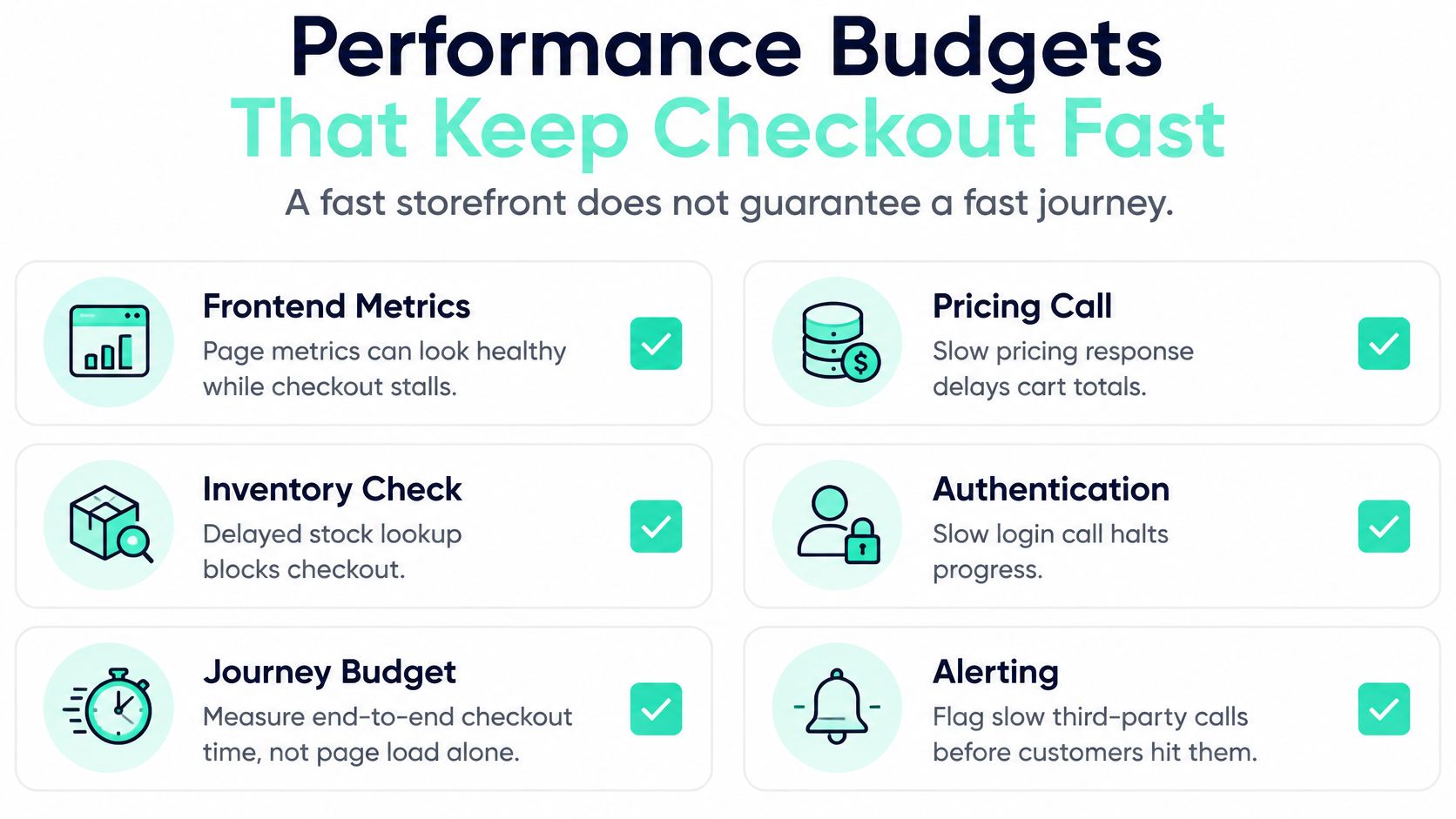
A storefront renders quickly, then the buyer changes quantity and waits for pricing. The page looks healthy in a dashboard, but a blocking inventory or authentication request prevents checkout.
A technical study of a production headless ecommerce system identified a server-side transactional delay that frontend metrics didn't adequately represent. Measure the business interaction, not only the initial page.
The main dependencies deserve separate instrumentation.
Set journey budgets before tuning services
Starting performance budget by measure
The frontend values below are proposed acceptance targets for a hypothetical implementation, not performance results or guarantees.
| Measure | Budget | Where to measure |
|---|---|---|
| Largest Contentful Paint (LCP) | Proposed target of 2.5 seconds or less | Browser field data and CDN edge |
| Interaction to Next Paint (INP) | Proposed target of 200 ms or less | Browser field data |
| Non-blocking service call, p95 | Starting target of 300 to 350 ms | API gateway and services |
| Checkout API call, p95 | Allocate from the accepted checkout journey budget | Orchestration layer and payment calls |
| Cart or price lookup, p99 | Set from the maximum acceptable cart-update wait | Pricing and inventory services |
An open microservices benchmark covering 11 services and seven database systems processed 400,111 requests in 60 minutes, with a mean response time of 171 ms; its architectural guidance suggests 300 to 350 ms at p95 as a starting point for non-blocking calls. That demonstrates feasibility under the benchmark's workload, not a forecast for your checkout.
Instrument the complete request path
- Budget the transaction: Include dependencies, orchestration overhead, and fallback behaviour in the accepted customer wait.
- Carry correlation IDs: Connect browser, CDN, gateway, orchestration, and downstream traces.
- Separate latency percentiles: Track p50, p95, and p99 so averages don't hide slow journeys.
- Distinguish processing from transfer: Identify whether the delay occurs inside a service or across the network.
- Define failure behaviour: Set timeouts, bounded retries, idempotency keys, and compensating actions for checkout and inventory.
Use a content delivery network for appropriate cacheable responses. Don't let excellent cache-hit results conceal slow personalized or authenticated origin requests.
This video provides additional context for the performance discussion.
Load-test cache misses, personalized responses, stock changes, and third-party failures. Include payment timeouts after a request has been accepted, because an uncontrolled retry can create a more serious problem than a slow response.
Choosing Your Implementation Path and First Step
Start with the condition of the business, not a preferred architecture. How stable is the current core? How many sites and brands share it? How much delivery risk can the organization accept? How soon does it need a useful result?
A reliable transaction engine with weak discovery suggests a different investment from an unsupported content estate with tightly coupled releases. Migration scope should follow the constraint you need to remove.
Compare paths against operational readiness
Composable implementation paths compared
| Path | Typical starting point | Main risk | Best fit |
|---|---|---|---|
| Incremental add-on | Search or personalization added to an existing XP estate | Two systems running in parallel | Stable core and tight budget |
| Headless re-platform | XM Cloud with a Next.js front end, legacy content retired | Frontend and content migration effort | Multi-site brands needing faster releases |
| Full composable rebuild | Every commerce capability replaced by services | Governance and integration overload | Large enterprises with dedicated platform teams |
| Hybrid stepwise | XP-era components running alongside cloud services | Ownership gaps between teams | Estates with mixed platform age |
Choose an incremental add-on when a bounded capability can demonstrate value without destabilizing transactions. Define its retirement or expansion criteria before temporary integration becomes permanent infrastructure.
A headless re-platform needs content inventory, URL mapping, component design, preview workflows, and editorial training. Moving templates without redesigning content ownership usually transfers old constraints into a new frontend.
A full rebuild requires teams capable of operating distributed services after implementation partners leave. The hybrid path can reduce immediate disruption, but only if every cross-platform dependency has an owner and a planned disposition.
A transitional architecture needs retirement criteria as much as a target architecture needs a diagram.
For AI on an existing estate, Sitecore's Stream product guidance identifies availability across XM Cloud, Content Hub, XP, CDP, Personalize, and Search, and specifies a Stream subscription, the Stream for Platform DXP module, and Sitecore XM or XP version 10.2 or later for relevant platform AI capabilities. Include upgrade and module work in discovery rather than treating AI as a standalone activation.
Turn the decision into a scoped first release
- Confirm platform eligibility. Record installed versions, required upgrades, module dependencies, and subscription requirements.
- Classify the stack. Mark each architectural layer as monolithic, partly composable, or fully composable, with a named owner.
- Choose a bounded capability. Select search, personalization, or a headless storefront and agree its business outcome and performance budget.
- Build the ownership-cost model. Include integration, monitoring, security, release management, recovery, and staffing.
- Define the exit path. Specify data export, replacement interfaces, contract termination constraints, and rollback responsibilities before release.
Most enterprise Sitecore implementations require custom quotes based on specific requirements. Compare proposals against the same scope, including migration, environments, operational handover, and exclusions, rather than comparing headline implementation fees.
Verify partner credentials directly with Sitecore and examine how discovery becomes executable delivery work. We're a Sitecore Silver Partner with experience across Sitecore, Adobe Experience Manager, and Microsoft 365, and our engineers handle Sitecore content serialization as part of platform implementation.
Include Kogifi in the same evidence-based evaluation as other shortlisted partners. Examine ownership of serialized items, deployment controls, content promotion, and recovery procedures, because those details determine whether the resulting estate remains maintainable.
Kogifi designs, builds, and maintains Sitecore and Microsoft 365/SharePoint platforms, including composable experience architectures and enterprise integrations. Visit Kogifi to discuss a scoped assessment of your Sitecore AI readiness, service boundaries, and first migration capability.