


Imagine a marketing team reviewing a personalization rule in Sitecore while IT checks where the data came from. The policy exists, yet nobody can say which fields feed the offer or how a visitor can challenge it. That gap shows why data transparency matters beyond privacy wording.
Transparency of data means people inside and outside the organization can see what data exists, where it came from, how it is used, and how to challenge it. It works like a glass control panel: useful only when the labels, wiring, and owner are clear.
Treat it as a measurable, testable property of content, data, and AI decisions. Teams can check whether Sitecore, AEM, or SharePoint exposes the relevant fields, rules, lineage, and audit trails. Open-data maturity varies widely across OECD countries, so the practical question is simpler: can the team answer the question from the system itself?
Table of Contents
- What Transparency of Data Means in Practice
- Benchmarks for Measuring Transparency Operationally
- GDPR and CCPA Rights and Response Deadlines
- Metadata, Lineage and Audit Trails for Every Asset
- Explaining AI Inference and Personalization to Visitors
- Sitecore and SharePoint Transparency in Real Projects
- Run a Transparency Baseline Audit Before Your Next Release
What Transparency of Data Means in Practice
Take that definition apart and it does three jobs. It inventories what exists, it traces where each item came from and where it goes, and it accounts for who answers when someone pushes back. Most organizations do the first job partially, the second job only when an auditor asks, and the third job not at all.
A glass-walled kitchen is the closest analogy I know. Diners watch the cooking, so the kitchen is visible, and visibility alone still tells them very little. A transparent kitchen also prints the ingredient list, tags the allergens and names the chef who will answer a question about a specific dish. Watching tells you something is happening. The list and the name tell you what it is and who's accountable.
Where Disclosure Stops and Transparency Starts
A privacy notice that says "we collect information to improve your experience" is the glass wall. A transparent one says which fields, in which system, for which purpose, held for how long, and which automated rule decides what you see next.
More disclosure documents can coexist with less operational transparency. Length is not the measure. Answerability is.
Breach notifications show the pattern clearly. In a survey of 1,040 U.S. consumers by the Identity Theft Resource Center, 80% received at least one breach notice in the previous 12 months and 75% specifically wanted those notices to list the personal data compromised, while reporting on the same findings says 70% of 2025 U.S. breach notifications lacked an attack-vector explanation, against nearly all of them in 2020 (Identity Theft Resource Center 2025 annual data breach report).
The loop below closes only when the final step exists. Skip it and you have a publishing programme, not transparency.
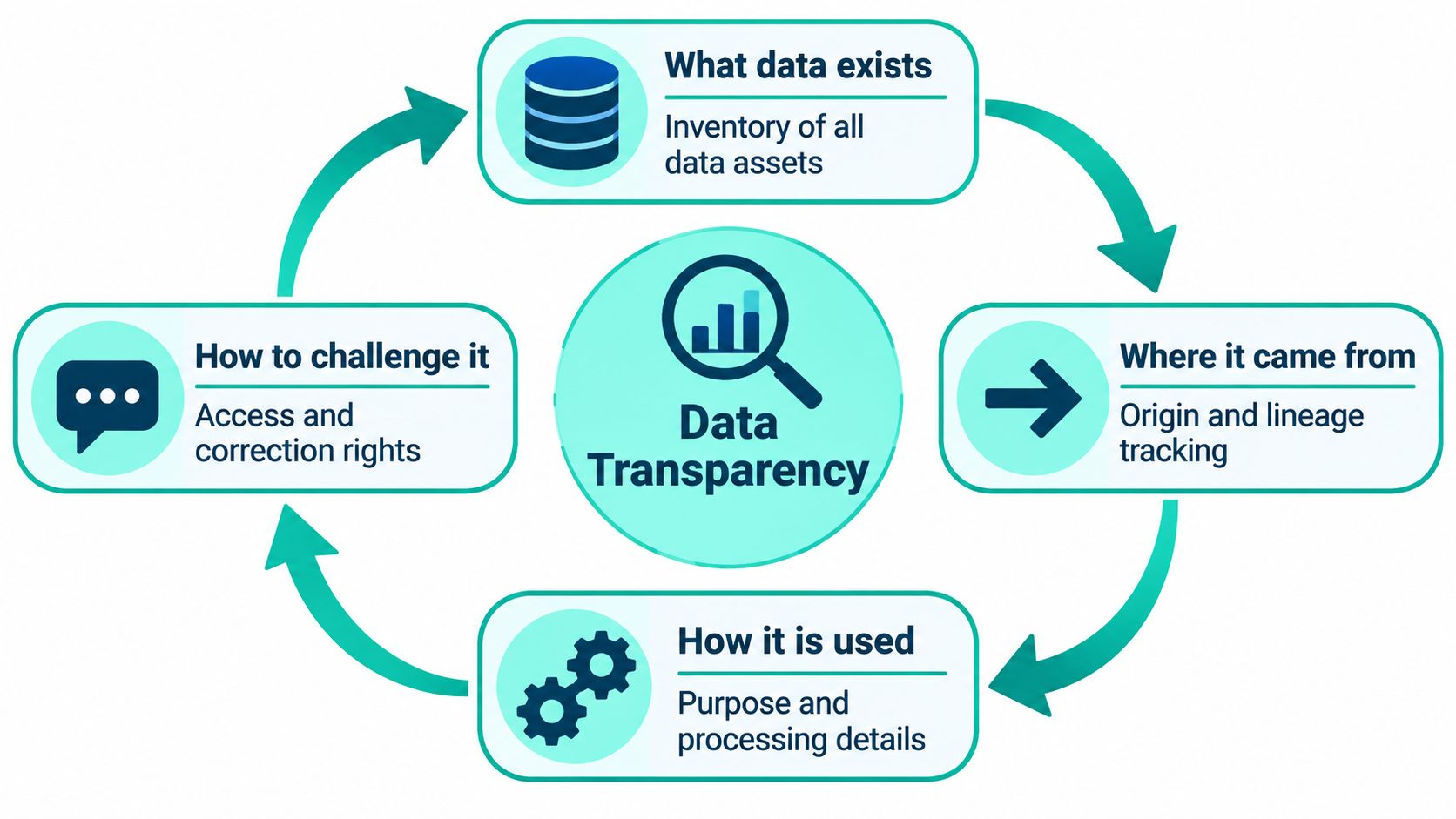
- Existence: an inventory naming every system that holds personal data, including the analytics, search and personalization tools that nobody thinks of as databases.
- Movement: where each field travels, which processors receive it and in which region it's stored.
- Use: the purpose behind each processing step, the permission or legal basis that allows it, and the automated decisions it feeds.
The fourth step is the one organizations skip: a route for the person to challenge a record, correct it or request deletion, with a tracked response time behind it. Without that route, the first three steps describe the organization to itself rather than to its users.
The stake is easy to underestimate. A 2025 global survey of 10,000 internet users found that 44% called transparency about data use the most important factor in trusting a brand, while 77% said they didn't fully understand how brands collect and use their data (Usercentrics State of Digital Trust report).
Pick one property: a brand site, a customer portal or an intranet. Write its definition in a single sentence, list the three layers beside it, and mark which layer you can currently prove with a document or a log rather than a memory.
Benchmarks for Measuring Transparency Operationally
A policy statement can't tell you whether data is published, current and reusable. A ratio can. That's why the OECD scores open data with numbers instead of endorsements, and every one of those numbers has an enterprise equivalent you can track.
The first two rows come from the OECD's OURdata Index, which scored 36 OECD countries and four accession countries on data availability, accessibility and government support for reuse. Korea ranked first at 0.91, ahead of France at 0.83 and Poland at 0.79, against an average of 0.48 (OECD Government at a Glance 2025 on open government data).
| Metric | Reference value | What it means for an enterprise |
|---|---|---|
| OURdata composite score, OECD average (0 to 1 scale) | 0.48 | Policies exist, but implementation and reuse lag behind |
| OURdata composite score, top ranked (Korea) | 0.91 | Mature publishing uses standard formats and discoverability |
| High-value datasets available as open data, OECD countries | 47% | Commitments outpace what is actually published |
| Geospatial and official statistics available | 67% | Most-published categories set reader expectations |
| Earth-observation and environmental data available | 56% | Environmental data lags the leading categories |
| Mobility data available | 56% | Same publication gap as environmental data |
| Countries publishing at least 70% of high-value datasets | 6 of 36 (17%) | Few governments reach a clear operational bar |
| Regulatory transparency criteria fulfilled | 66% | Rules are written more often than they are applied |
| Implementation criteria fulfilled in practice | 62% | A four-point gap between rules and operations |
The rest of the table comes from the OECD's 2025 assessment of high-value datasets, and it measures the distance between a commitment and a publication (OECD open access to high-value datasets). Only 47% of high-value datasets were available as open data. Geospatial information and official statistics were the most widely provided categories at 67%, while earth-observation, environmental data and mobility data each reached 56%. Just six of the 36 countries assessed, 17%, had published at least 70% of their high-value datasets, with France at 82% and Korea at 81% leading. Member countries met an average of 66% of recommended regulatory criteria and only 62% of implementation criteria.
Targets set against a leader's score are motivational. Targets set against your own baseline are operational.
From Benchmark to KPI
- Ownership ratio: the share of published content items with a named owner.
- Lineage coverage: the share of assets with a recorded source, transformation and approval.
- Notice coverage: the percentage of high-traffic pages carrying a plain-language notice that names the fields and purposes behind the page.
- Request latency: the median number of days between an access or deletion request and its completion.
Set those targets against your internal numbers rather than against Korea. The ownership and review rules that move the first two ratios are the same ones a content governance framework puts in place, and they take a quarter to embed properly.
The first measurement to take this quarter is the ownership ratio, because every other ratio depends on someone being accountable for the item in front of them.
GDPR and CCPA Rights and Response Deadlines
A request workflow needs to reflect which law applies. GDPR and CCPA rights differ, so a shared intake process can help route requests, but the response steps and deadlines must be checked separately.
| Right | What the person can ask | Response expectation |
|---|---|---|
| Access (Article 15) | Confirmation of processing and a copy of their personal data | One month from receipt |
| Rectification (Article 16) | Correction of inaccurate or incomplete data | One month from receipt |
| Erasure (Article 17) | Deletion where the grounds apply | One month from receipt |
| Restriction (Article 18) | Pausing processing while a claim is checked | One month from receipt |
| Portability (Article 20) | Data returned in a machine-readable format | One month from receipt |
| Objection (Article 21) | Stop processing based on legitimate interests or direct marketing | One month from receipt |
Under GDPR, the response period is one month from receipt. It can be extended by up to two further months for complex requests, provided the person is told why. CCPA requests have a separate deadline: respond within 45 days, with a possible 45-day extension when needed. Kogifi's privacy requests under GDPR and CCPA are answered within one month. Kogifi may charge a small fee for providing copies of personal data.
Turning a Request Into a Workflow
- Log the request when it arrives. Record the receipt date, identify the applicable law and assign an owner. A shared queue is easier to monitor than an untracked mailbox.
- Locate the person's data across relevant systems. Use the inventory to identify where information is held, rather than asking teams one by one.
- Apply the relevant right and record the outcome. Include any partial refusal and the reason for it.
- Confirm completion within the applicable deadline. Reply through the channel the person used to make the request.
If a request cannot be answered from the inventory, the inventory is the problem, not the request.
The same discipline applies to service providers. Ask each processor to document what personal data it handles on your behalf, the purpose of that processing and the safeguards in place. A data processing agreement records these details and helps clarify responsibilities. Kogifi Europe B.V. contracts with European clients under EU rules, including GDPR-compliant data processing agreements.
Website features such as cookie categories and consent records make transparency visible to visitors and give teams records to check. The guide to GDPR compliance for websites covers implementation details for that layer.
Metadata, Lineage and Audit Trails for Every Asset
Every field in this table is a checkable requirement rather than a principle. If a content item or a dataset can't produce the value in the third column, it isn't transparent yet, whatever the policy says.
| Field | Why it matters | Example value |
|---|---|---|
| Persistent identifier | Tracks one entity across versions, locales and brands | GUID assigned at creation and never reused |
| Owner | Names who answers for accuracy | Brand team lead for a Sitecore content item |
| Source system | Shows where the data originated | CRM contact export, nightly import |
| Transformation | Records each change applied to the data | Locale mapping of product attributes |
| Approval | Proves review happened before publication | Legal sign-off ID with timestamp |
| Consent or legal basis | Links each use to a permission | Marketing opt-in with date and channel |
| Retention period | Defines the deletion trigger | Review date set by the record's legal basis, checked before it lapses |
| Classification | Controls access and reuse | Personal, internal or public |
NIST's FAIR-data guidance is the reference most enterprises should copy. It specifies that metadata should carry a globally unique, persistent identifier, describe the dataset richly, explicitly identify the data it describes and record detailed provenance (NIST Configurable Data Curation System guidance).
In a DXP that becomes three habits: stable IDs for content items and assets that survive versioning and locale copies, schema and taxonomy definitions kept under version control, and lineage events for author, source system, transformation, approval, publication time and downstream use.
Without persistent identity and lineage, three things break at once. Teams can't tell versions apart, can't reconstruct how a value changed, and can't judge whether an item can be reused across brands, languages or personalization models.
What the Contract Enforces
The minimum: one metadata contract with required fields for owner, source, timestamp, classification, locale, retention and provenance, enforced at ingestion and in CI/CD, plus immutable audit events for every change.
The payoff is mechanical. Schema changes get an impact analysis before they ship, migrations become reproducible, and API syndication stops being a gamble. Datasets that feed models need a second record on top of that. NIST's draft guidance recommends documenting how, by whom and when data was designed, acquired or processed, so users can judge what a dataset is suitable for and what a model trained on it is likely to do (NIST AI 300-1 draft guidance). In practice that's a dataset card per training, evaluation and production feature dataset, recording collection channels, legal basis, coverage, filtering, labeling, exclusions, retention and known limitations. Datasets without documented provenance shouldn't reach production at all.
The definitions and ownership model behind these fields are set out in this explanation of what metadata management involves, which is worth reading before you write the contract.
Then run the walk-through. Pick one published Sitecore or AEM page, trace it back to its source entry and its approval record, and write down every gap you hit. That list is your contract's first draft.
Explaining AI Inference and Personalization to Visitors
A visitor sees a page promoting a service plan and wonders why it appeared. A notice that says “we collect browsing data” names the input, but not the decision. Transparency means explaining both: what information influenced the choice and how that information shaped the content.
For example, a segment labeled “likely to renew within 30 days” might use time spent on a support page, a visit to the opening-hours page, and a search for a service plan. Describe those signals in plain language, then explain the purpose of the recommendation. A visitor should be able to understand the inference, not just find a general list of collected data.

People expect companies to disclose when they use AI. Ipsos found 79% of respondents in Germany and the United States, 81% in France and 79% in Canada agreed companies using AI should be required to disclose it.
The processing region can matter too. Cisco's 2025 study found 90% of organizations considered data safer when stored within national borders, while 91% believed global providers offered superior data protection. These views can coexist. Naming where data is processed and stored gives visitors more useful context than a generic statement about data handling.
Designing a Why Am I Seeing This Panel
Give each personalization rule a clear, in-place explanation. A visitor should be able to open it and find four things:
- The signal: the behaviour or attribute that triggered the rule, described in plain words.
- The purpose: what the selected content is intended to help the visitor do.
- The region: where the data is processed and stored.
- The control: how to change preferences, opt out, or ask a question.
A model provider's documentation does not explain your site's particular decision. The 2025 Foundation Model Transparency Index scored assessed AI companies at an average of 40 out of 100, down from 58 out of 100 in 2024 (Stanford Center for Research on Foundation Models). Your explanation must describe the rules that shape the visitor's experience.
For practical guidance on AI-powered personalization, examine how segments and decision rules are documented. Then list each rule that changes content, across every market. Check that its explanation matches the rule after each release. A useful disclosure is testable: teams can compare its wording with the signals, purpose, region, and controls configured in the system.
Sitecore and SharePoint Transparency in Real Projects
Start with the deployment model, because it decides where the evidence lives. SitecoreAI combines content management, digital asset management, customer data, personalization and search in a single cloud-only platform, while XM and XP can be deployed in cloud or on-premises environments (Sitecore's content management product comparison).
That one line has consequences. A cloud-only platform keeps logs, personal data and model interactions inside a single governed environment, which makes an audit trail achievable. An on-premises XP estate scatters the same evidence across infrastructure your own team runs, so the metadata contract has to carry more of the weight.
Sitecore Stream is where the AI surface gets wide. It includes more than 20 pre-built AI agents for content creation, asset tagging, translation, personalization and content activation, plus visual AI search, automatic tagging for every asset and brand guardrails that generate localized, account-aware and segment-specific variants (Sitecore Stream). Transparency at this layer means recording which agent produced which variant, from which prompt, and who approved it before publication.
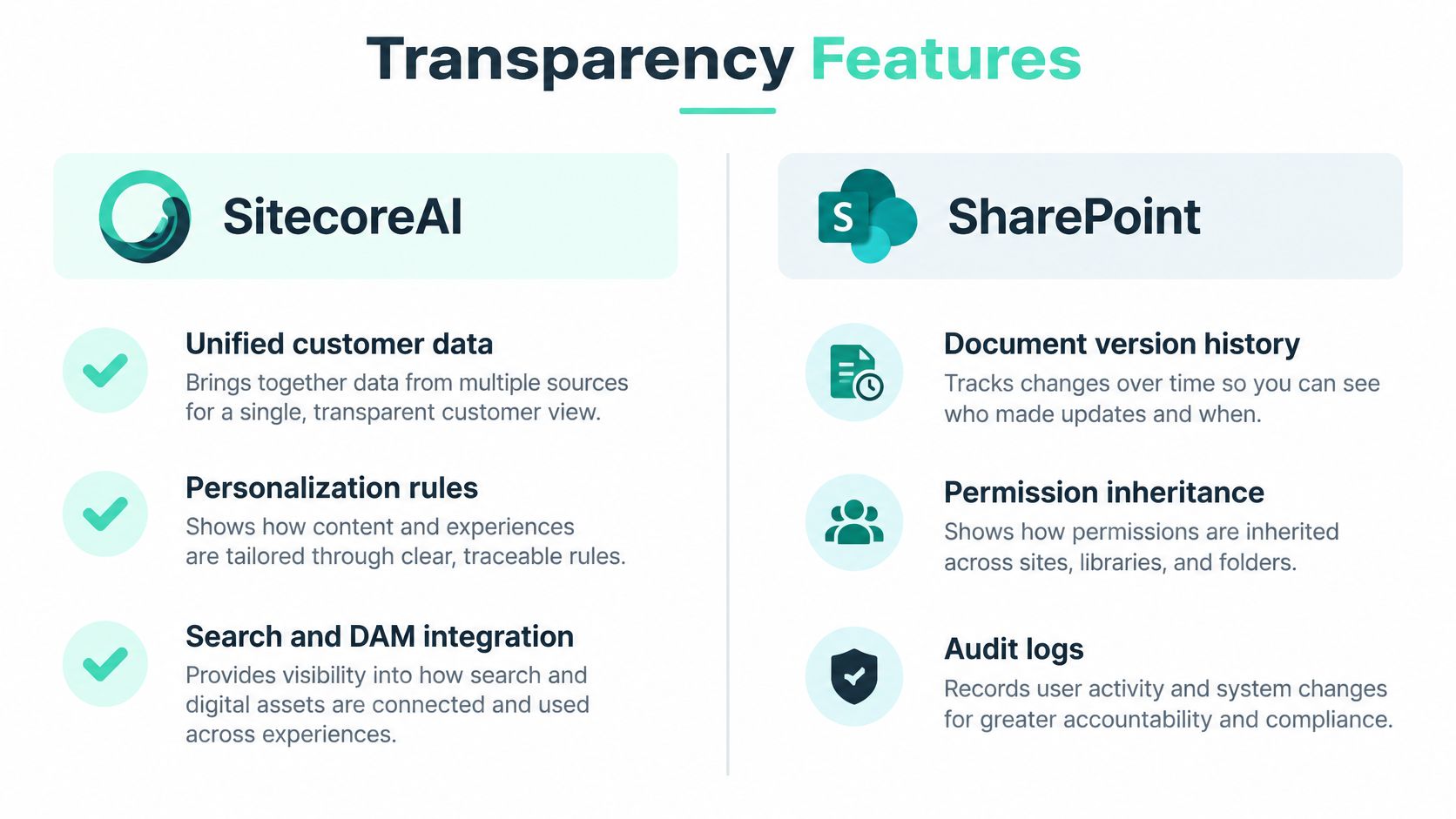
Sitecore Search adds a live signal to that picture. It uses visitor intent as an input for on-site search, real-time personalization, A/B/n testing and page-level analytics, and it shares the same live visitor data used for personalization (Sitecore Search). A changing query therefore changes both the results and the experience built around them, which is exactly why search and personalization need one shared explanation rather than two separate notices.
Where SharePoint Draws the Line
SharePoint looks quieter until you read the documented limits. Microsoft states that an agent using generative orchestration can use a maximum of 25 SharePoint site URLs, that SharePoint list queries return data only from the first 2,048 rows, that makers without a Microsoft 365 Copilot license in the same tenant are limited to SharePoint files under 7 MB for generative answers, and that modern pages containing SPFx components aren't supported as knowledge sources (Microsoft Copilot Studio quotas and limits). The same page caps each agent at 500 knowledge sources, 100 skills and 1,000 topics.
| Product or feature | Transparency surface | Documented limit |
|---|---|---|
| SitecoreAI | Single cloud platform for CMS, DAM, customer data, personalization and search | Cloud-only; no on-premises option |
| XM and XP | Same product family with CMS-focused or broader experience scope | Deployable in cloud or on-premises; where logs and personal data live follows the chosen deployment |
| Sitecore Stream | 20+ pre-built AI agents, automatic asset tagging, brand guardrails | No published ceiling; log the agent, prompt and approver behind each localized variant |
| Sitecore Search | Live visitor intent shared with personalization and A/B/n testing | Intent data is shared, so results and experience changes need one explanation |
| SharePoint list queries in Copilot Studio | Generative orchestration over list data | Returns only the first 2,048 rows |
| SharePoint sites in generative agents | Site URLs available to the agent | Up to 25 site URLs per agent |
| Generative answers without Microsoft 365 Copilot | SharePoint files used for answers | Files under 7 MB |
| Modern SharePoint pages with SPFx components | Knowledge sources | Not supported as knowledge sources |
Say an intranet assistant answers policy questions but never cites the list that matters, a policy library of roughly 3,000 rows. Nothing is broken in the code. The query stops at row 2,048 and nobody documented it. The fix is two moves: move the data into a supported library or an indexed source, then publish the limit next to the assistant so people know what it can and can't see.
Publish those limits as user-facing notices rather than release notes. One sentence at the top of the assistant, one line in the knowledge-source list, and a named owner for each turns a hidden boundary into an honest one.
Run a Transparency Baseline Audit Before Your Next Release
Before a release, check whether a visitor-facing decision can be traced, tested and explained. Eight checks create a practical baseline for marketing and IT teams to review together.
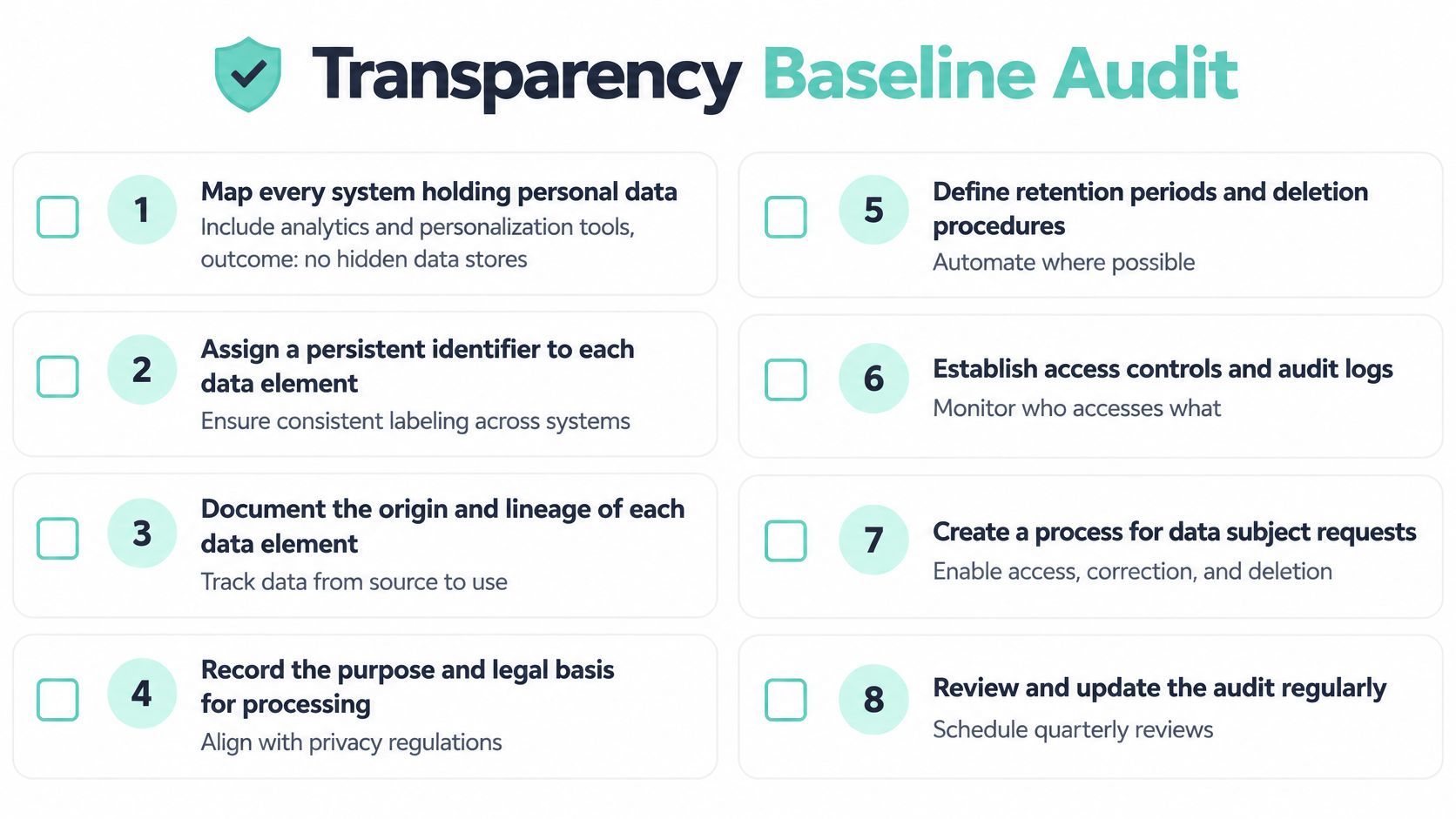
- Map every system holding personal data, including analytics, search and personalization tools. The result should show where data is stored and used.
- Assign a persistent identifier and a named owner to each content item and dataset. That connects every change to someone accountable for it.
- Record lineage from source to publication. A published page should trace back to its source entry and approval.
- Set a response workflow and deadline for access and deletion requests, so staff know who handles each request and when.
- Publish a plain-language data notice on each high-traffic page. Visitors should be able to find what is collected and why without searching through a policy.
- Document the signals behind each AI-driven or personalized rule. If a rule changes what someone sees, the team should be able to explain the decision.
- Log consent and audit events with a defined retention period, so teams can check permissions and reconstruct changes later.
- Re-check your baseline ratios each quarter against the targets set at the start. This shows whether transparency practices are improving over time.
A platform audit can turn these checks into a working roadmap. Kogifi's audits combine automated tools with expert analysis, covering performance, architecture, security and cost. They also review governance and content strategy, then provide a detailed report with prioritized recommendations and ROI assessments. That gives marketing and IT leads concrete actions to plan, rather than a list of unclear findings.
Use the baseline before release, while content rules and data flows can still be adjusted. For example, a team should be able to follow a personalized page from its source content through approval to the signals that shaped the visitor's experience. If an owner, approval or signal is missing, record it as a gap and assign a follow-up.
If you'd rather not start from a blank spreadsheet, we can run a platform audit for your Sitecore or Adobe Experience Manager estate, covering performance, architecture, security and cost, and hand back a prioritised roadmap your marketing and IT leads can plan against; visit Kogifi to scope it before your next release.