


Metadata management isn't just a technical term; it's the strategic practice of organizing, governing, and making sense of your 'data about your data.' Think of it as the powerful cataloging system that brings order to digital chaos, turning a messy pile of content into valuable, searchable assets. Without it, finding and trusting information becomes a shot in the dark.
Unlocking Your Digital Potential with Metadata

Picture your company’s digital assets—product images, articles, videos, and customer data—as books scattered throughout a massive, sprawling library. With no central catalog, finding a specific book would be a frustrating and time-consuming hunt. Metadata is that catalog. It’s the title, author, publication date, and summary that gives each book context and makes it discoverable in seconds.
In the business world, metadata management is the discipline of creating and maintaining this digital catalog for all your enterprise assets. It's so much more than just labeling files; it's a foundational strategy that makes sure your data is consistent, reliable, and intelligent. This framework is the bedrock of any modern Digital Experience Platform (DXP), turning on the sophisticated features that actually drive business growth. If you want to dive deeper, you can explore more about what is a digital experience platform in our detailed guide.
The Role of Metadata in Modern Platforms
Modern platforms like Sitecore and SharePoint are completely dependent on well-structured metadata to function at their peak. In Sitecore, rich metadata is the fuel for its AI-driven product portfolio, including tools like Sitecore Personalize and Sitecore Search. These systems require deep contextual understanding to serve up relevant content automatically. When you tag an article with "DXP Strategy" and "Enterprise," you're giving Sitecore AI the precise signals it needs to recommend that content to a CTO visiting your site.
It's the same story with SharePoint. The platform uses metadata to power its robust enterprise search, automate document workflows, and enforce strict governance policies. Proper metadata ensures a sales proposal is routed correctly for approval and that sensitive financial documents are only accessible to authorized personnel. This structured approach isn't a "nice-to-have" anymore; it's essential for achieving true digital agility and maximizing the ROI of your technology investments.
Metadata transforms raw data from a simple collection of facts into a connected web of intelligence. It provides the context needed for systems like Sitecore AI to make smart decisions, turning a standard website into a truly personal experience.
The growing importance of this field is undeniable. The global metadata management tools market was valued at USD 6.3 billion in 2021 and is projected to skyrocket to USD 15.1 billion by 2026, which is a massive Compound Annual Growth Rate (CAGR) of 19.0%. This explosive growth is being driven by the surging demand for centralized data management, which allows organizations to find what they need quickly and keep risks in check.
The Pillars of a Powerful Metadata Strategy
To really nail metadata management, you need a solid foundation. This foundation is built on three core pillars that work together to structure, organize, and control your digital assets. Getting a handle on these components is the first step in turning your data from a messy pile of files into an intelligent, connected ecosystem.
Think of it like building a house. You need blueprints to define the structure, a logical address system to find everything, and a secure vault to store it all. If one piece is missing, the whole thing becomes unstable and chaotic.
Metadata Schemas: The Architectural Blueprint
A metadata schema is essentially the architectural blueprint for your data. It’s a formal set of rules defining the structure and properties an asset must have. Just like a real blueprint specifies a room's dimensions and the materials to use, a schema dictates what information must be captured for each piece of content.
For example, a schema for a "Product" in an e-commerce site powered by Sitecore would define fields like ProductID, ProductName, Price, Category, and ImageURL. It sets the rules—Price has to be a number, and ProductID is a required field. This kind of rigid structure makes sure every product entry is complete and consistent, which is absolutely vital for everything from inventory management in Sitecore OrderCloud to personalized recommendations in Sitecore Personalize.
In a SharePoint environment, schemas are the backbone of good document management. A schema for a "Contract" document library might require metadata like ContractID, ClientName, EffectiveDate, and Status. This structured data makes powerful automations possible, like sending renewal reminders when a contract’s EffectiveDate is about to expire.
Taxonomies and Ontologies: The Intelligent Directory
If schemas are the blueprints, then taxonomies and ontologies are the building’s smart directory and navigation system. A taxonomy is a hierarchical system for organizing information into logical groups. It's like the folder structure on your computer, but built for your entire enterprise.
An ontology takes this a step further. It doesn’t just categorize things; it defines the relationships between those categories, building a true web of understanding.
- Taxonomy Example: A simple taxonomy might classify a blog post under
Services > DXP Implementation > Sitecore. - Ontology Example: An ontology would understand that "Sitecore" is a type of "DXP," that "DXP Implementation" is a service offered to the "Enterprise" sector, and that a user interested in one is probably interested in the others.
This is the secret sauce behind the effectiveness of tools like Sitecore AI. When your content is tagged with a rich, well-defined taxonomy, machine learning algorithms can grasp the context and relationships between different assets. This lets the platform make incredibly accurate predictions about user intent and serve up the perfect piece of content at just the right moment. The entire content life cycle just gets smarter.
Metadata Repositories: The Central Vault
The final pillar is the metadata repository. This is the central vault where all this structured information gets stored, managed, and governed. It’s the single source of truth for all metadata across the business, giving you a unified view of every single digital asset.
A metadata repository doesn’t just store data; it centralizes intelligence. It gives you a 360-degree view of your information assets, making them discoverable, governable, and ultimately, more valuable.
In practice, platforms like Sitecore and SharePoint come with their own built-in repositories. Sitecore’s content tree and media library act as a repository for web content, while SharePoint’s lists and libraries do the same for documents. The trick is to make sure these repositories are governed by the schemas and taxonomies you’ve already defined.
Getting a robust metadata strategy in place is also a critical step for moving to an Entity-First Content Strategy, which focuses on contextual understanding for better content organization and discovery. When these three pillars—schemas, taxonomies, and repositories—are working in harmony, you create a powerful system that drives efficiency, ensures compliance, and unlocks the full potential of your digital platforms.
Why Metadata Management Is a Business Imperative
Let's move past the technical blueprints for a moment. The real power of metadata management isn't found in a data center—it’s in its direct impact on your business's bottom line. This isn't just an IT initiative; it's a strategic imperative that fuels revenue, sharpens efficiency, and gives you a genuine competitive edge.
When your data is well-described and easy to find, every single department wins. Marketing teams can pull campaign assets in seconds, not hours. Sales teams get instant access to the latest product specs. And leadership can actually trust the numbers driving their biggest decisions. Without this foundation, you’re operating with one hand tied behind your back, losing precious time and opportunities in a sea of digital clutter.
Fueling Data Discovery and Agility
The first and most immediate win from a solid metadata strategy is a massive boost in data discovery.
Picture a marketer trying to launch a targeted campaign in Sitecore. Without clear metadata, they’re stuck digging through thousands of images and articles in Sitecore Content Hub, hoping to find assets tagged for a specific region, product, and customer profile. It’s a slow, painful process.
With great metadata management, that same search becomes almost instant. A quick query for "EMEA," "Product-X," and "Enterprise-Audience" brings back every relevant asset. This speed lets marketing teams pounce on market changes, launch campaigns faster, and personalize experiences at scale—directly impacting customer engagement and conversions.
Metadata is the central nervous system for your digital assets. It connects everything, letting your teams find exactly what they need, right when they need it. That’s the very definition of business agility.
Strengthening Governance and Compliance
In an age of strict rules like GDPR, strong data governance isn't optional. Metadata management is the engine that actually enforces these critical policies. For example, in a SharePoint environment, metadata tags can automatically flag documents containing Personally Identifiable Information (PII).
Once a document is flagged, specific governance rules kick in. Access might be restricted to authorized users, or an automatic retention and deletion schedule could be set. This proactive system simplifies compliance audits and dramatically cuts the risk of expensive data breaches. It turns governance from a manual chore into an automated, reliable safety net.
This kind of organization is essential for success. In fact, effective marketing operations, which lean heavily on well-organized data, are a clear sign of a company that gets metadata. You can learn more about this connection in this great piece on What Is Marketing Operations and Why It Matters.
Unlocking AI and Advanced Analytics
Perhaps the most compelling reason to get serious about metadata is its role in unlocking advanced AI and analytics. AI models, especially those powering Sitecore’s personalization and search products, are only as smart as the data you feed them. High-quality, context-rich metadata is the rocket fuel for these intelligent algorithms.
When your product catalogs, articles, and user profiles are meticulously tagged, Sitecore's AI can spot subtle patterns and predict user intent with incredible accuracy. This is what makes true one-to-one personalization possible, where the system automatically serves up the perfect piece of content or product recommendation via Sitecore Personalize.
The market for these tools tells the story. The sector was valued at roughly USD 5.29 billion in 2020 and is projected to hit USD 15.03 billion by 2026. This explosive growth is driven by the urgent need for data-driven decisions, especially when poor metadata can lead to a 20-30% loss in data value for businesses. You can find more details in this metadata management tools market growth report.
Driving Next-Gen Experiences with Sitecore AI and SharePoint

It’s one thing to talk about metadata in theory, but its real power clicks into place when you see it working inside major digital platforms. In ecosystems like Sitecore and SharePoint, structured data isn't just a "nice-to-have"—it's the essential ingredient for building smart, automated, and secure digital experiences.
Think of a platform like Sitecore without a solid metadata strategy. It's like a high-performance sports car running on cheap fuel; you're just not getting what you paid for. SharePoint without metadata is no better—it quickly turns into a messy digital filing cabinet, completely failing at its job of managing enterprise content. Let’s look at how metadata becomes the central nervous system for these powerful systems.
Activating Hyper-Personalization with Sitecore AI
The Sitecore ecosystem, especially with its AI-powered product portfolio, absolutely thrives on rich, contextual metadata. To make intelligent decisions, machine learning models need more than just raw data. They have to understand the meaning behind every piece of content. This is where metadata management becomes the key to unlocking true hyper-personalization.
Picture an e-commerce site for a global fashion brand running on Sitecore. Each product—a jacket, a pair of shoes, a handbag—is tagged with detailed metadata in Sitecore Content Hub:
- Descriptive Tags:
Category: Outerwear,Style: Bomber Jacket,Material: Leather - Contextual Tags:
Season: Autumn/Winter 2024,Target Audience: Millennial,Look: Urban Casual - Behavioral Tags:
Frequently Viewed With: Skinny Jeans,Often Purchased By: Repeat Customers
When someone visits the site, Sitecore AI’s algorithms chew through these metadata tags in real time. If a visitor spends time on a few items tagged "Urban Casual," the system immediately picks up on their style preference.
Sitecore AI doesn't just see a user clicking on products; it sees a pattern in the metadata. This pattern recognition is what allows it to predict intent and proactively deliver the perfect recommendation, transforming a generic browsing session into a curated shopping experience.
This is what allows tools like Sitecore Personalize to dynamically change the homepage, suggest complementary items, and even send out eerily accurate targeted emails. The metadata gives the AI the "why" behind what a user is doing, letting it move beyond basic personalization to truly predictive one-to-one engagement. To see how this works in practice, you can learn more about the personalization of content and the results it can deliver.
Ensuring Governance and Efficiency in SharePoint
While Sitecore uses metadata to shape the customer-facing experience, SharePoint uses it to bring order to the internal world of enterprise content. For any large organization, SharePoint is the single source of truth for documents, contracts, and internal knowledge. Metadata is the framework that makes this massive repository manageable, searchable, and secure.
Imagine a multinational pharmaceutical company that uses SharePoint to manage all its R&D documents. A metadata schema is enforced for every single file that gets uploaded, requiring key information like:
- Document Type:
Clinical Trial Report,Patent Application, orRegulatory Submission - Project Code: A unique ID that links the file to a specific research project.
- Security Classification:
Public,Internal Use Only, orHighly Confidential - Retention Policy: The exact date the document should be archived or securely deleted.
This structured approach brings immediate and powerful benefits. First off, it makes intelligent search a reality. An auditor can instantly pull up every document tied to a specific "Project Code" with a "Highly Confidential" tag—a search that would be a nightmare in a simple folder system.
Second, it automates document lifecycle management. When a document hits its retention date, SharePoint workflows can automatically kick off an approval process for archiving or deletion. This keeps the company compliant with industry rules and helps cut down on data storage costs.
Finally, it enforces granular governance. Policies driven by metadata can restrict who gets to see sensitive documents, preventing unauthorized access and creating a solid audit trail. Here, metadata isn't just descriptive—it's an active part of the company's security and compliance strategy.
By putting metadata management to work in platforms like Sitecore and SharePoint, organizations can stop just storing content and start activating it. This simple shift leads to more engaging customer journeys, streamlined internal processes, and a secure, intelligent foundation for the entire digital operation.
Implementing Your Metadata Management Roadmap
Turning digital asset chaos into a smart, organized system doesn't happen overnight. It requires a clear, actionable plan. A successful metadata initiative isn't a one-off project; it's a strategic journey broken down into manageable phases. This roadmap will guide you from an initial assessment all the way to continuous improvement, making sure your efforts deliver real business value.
The journey starts with a commitment to understanding where you stand today. You can't build a solid framework without first mapping the terrain, identifying both the pain points and the hidden opportunities within your digital assets. This methodical approach is key to aligning your strategy with actual business goals.
Phase 1: Assessment and Discovery
The first phase is all about discovery. Before you decide where you're going, you need to know your starting point. This means a full audit of your current data landscape, especially in platforms like Sitecore and SharePoint where your content and documents live.
The main goal here is to map out where your most critical assets are, how they're currently tagged (if at all), and who uses them. This process almost always uncovers major inconsistencies and data silos you didn't know you had.
- Content Inventory: Catalog all major content types in your Sitecore instance, from product pages and articles to marketing campaign assets within Sitecore Content Hub.
- Document Analysis: Dig into your SharePoint libraries. Understand how teams store, share, and search for documents, and pay close attention to version control and access permissions.
- Stakeholder Interviews: Talk to people from different teams—marketing, sales, legal, and IT. Uncover the daily challenges they face when trying to find and trust information.
This discovery work gives you the raw data you need to build a business case, highlighting specific problems a metadata strategy will solve.
Phase 2: Strategy and Governance
With a clear picture of your current state, you can now build your strategy. This is where you define the rules of the road: your metadata schemas, taxonomies, and the governance policies that will keep everything on track for the long haul. A well-defined strategy is the only way to maintain consistency and quality.
This step involves creating a robust content governance framework that spells out roles, responsibilities, and standards. To see how these pieces fit together, check out our detailed guide on building a content governance framework.
The goal of governance isn't to restrict, but to empower. By setting clear standards, you give your teams the confidence to create, manage, and use digital assets effectively, knowing they are compliant and easy to find.
Key activities in this phase include:
- Define Core Taxonomies: Develop a classification system that actually reflects your business. For a Sitecore e-commerce site, this might include product categories, target audiences, and campaign themes.
- Establish Schemas: Create standardized templates for key content types, specifying required metadata fields for assets in both Sitecore and SharePoint.
- Assign Roles: Appoint data stewards and content owners who will be responsible for keeping metadata quality high within their respective areas.
Phase 3: Technology Integration and Execution
Now it’s time to put your strategy into action. This phase is all about configuring your tech platforms to support your new metadata model. In Sitecore, this means updating content templates to reflect the new schemas and integrating your taxonomy to power personalization. For SharePoint, you’ll configure document libraries with custom metadata columns and set up automated workflows based on those tags.
But the technical work is only half the battle. You need user adoption. Without proper training and buy-in from your teams, even the best strategy will fall flat. Run workshops to show them how the new framework makes their jobs easier, whether it's finding an approved image faster in Sitecore or tracking a contract's lifecycle in SharePoint.
The market for these solutions is booming for a reason. The metadata management tools market is projected to grow from USD 11.69 billion in 2024 to USD 36.44 billion by 2030. This growth is driven by the need to break down data silos—a challenge for 85% of organizations—and effective management can reduce integration costs by 35%. You can read the full research about these market trends to get a better sense of the landscape.
Phase 4: Continuous Improvement and Optimization
Finally, remember that metadata management is not a "set it and forget it" task. The last phase is a continuous cycle of monitoring, measuring, and refining your approach. Your business will change, and your metadata strategy must adapt right alongside it.
Establish key performance indicators (KPIs) to track your success. These might include metrics like "time to find an asset," "content reuse rate," or "search success rate." Regularly review these numbers and gather feedback from users to identify where you can improve, ensuring your metadata framework remains a valuable and relevant business asset.
Frequently Asked Questions About Metadata Management
Even with a solid plan, a few questions always pop up when you start getting serious about metadata management. Let's tackle some of the most common ones to clear up any confusion and help guide your next steps.
What Is the Difference Between Metadata Management and Data Governance?
It’s easy to mix these two up, but they play very different roles. Think of data governance as the constitution for your company's data—it sets the high-level policies, standards, and roles that say who can do what with which information and why.
Metadata management, on the other hand, is the practical toolkit that actually brings that constitution to life. It's the "how" that makes the rules stick.
For instance, your data governance policy might state that all customer data must be classified by its sensitivity level. Metadata management is the process of creating and applying the confidential or internal tags to those assets in Sitecore or documents in SharePoint.
In short, governance sets the strategy ("what" and "why"), while metadata management provides the operational power to execute it ("how"). One isn't very effective without the other; they're two sides of the same coin.
How Does Metadata Directly Impact SEO Performance?
Metadata is absolutely fundamental to modern SEO. It’s the language you use to have a clear conversation with search engines. Crawlers from Google and Bing rely on things like title tags, meta descriptions, and especially schema markup to figure out what your content is about, why it's relevant, and how it connects to everything else on the web.
A well-oiled metadata strategy makes sure this information is consistent, accurate, and optimized everywhere you have a digital footprint. Internally, structured metadata inside a CMS like Sitecore lets you build powerful topic clusters, which signals authority to search engines. It also directly improves the user experience by powering accurate on-site search and navigation. Better UX means lower bounce rates and more time on site—both are huge positive signals to Google.
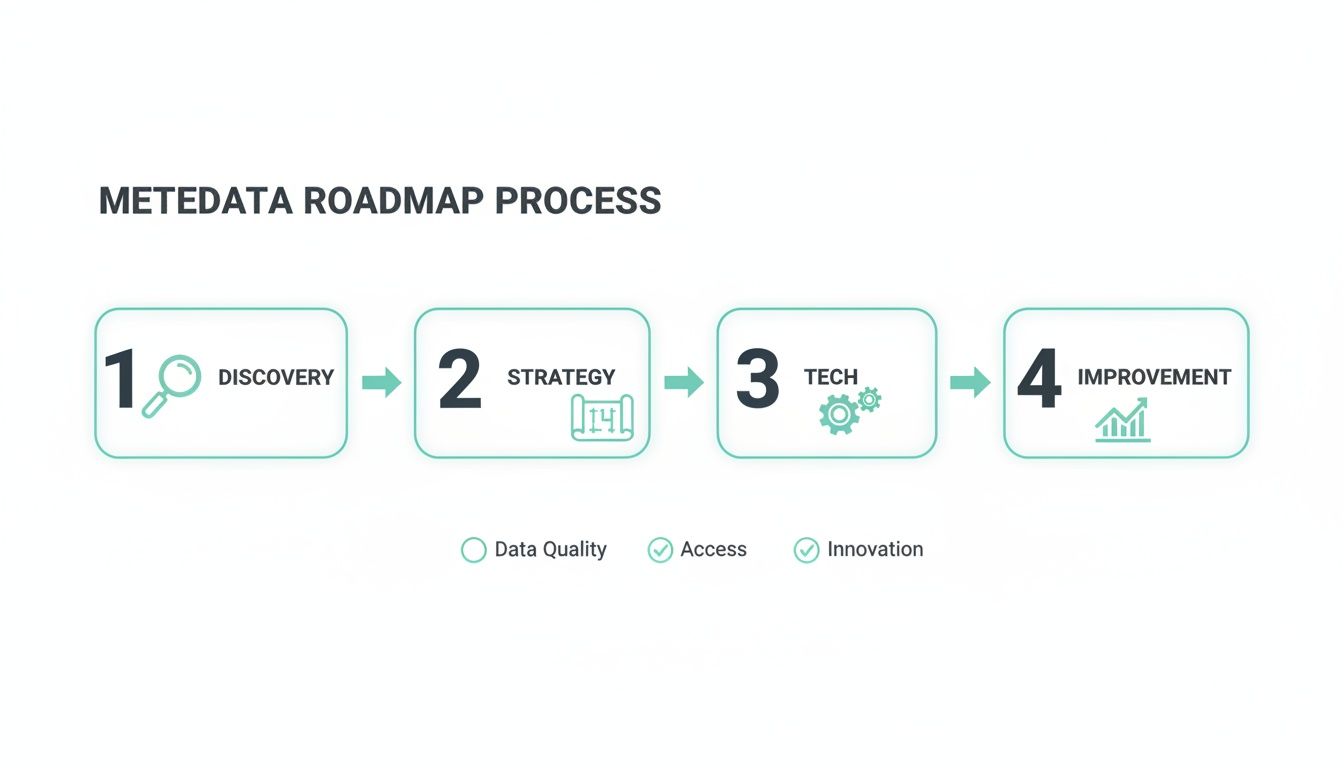
This roadmap shows that getting metadata right isn't a one-and-done project. It's a continuous cycle of refinement that keeps delivering value.
Our Data Is Siloed and Disorganized. Where Do We Start?
This is probably the most common starting point, and the answer is simple: start small and score an early win. Trying to boil the ocean with a massive, enterprise-wide overhaul is a recipe for failure.
Instead, pick a focused pilot project. Find a single business area where the data chaos is causing the most pain. Maybe it's your marketing asset library in Sitecore Content Hub or the legal contracts repository in SharePoint.
Get the stakeholders in a room and define a crystal-clear, measurable goal, like "cut the time it takes to find approved marketing images by 50%." Then, focus all your initial metadata efforts right there. Define a simple taxonomy, clean up the existing assets, and show a tangible improvement. A successful pilot creates a powerful business case that gets you the buy-in and momentum needed to go bigger.
How Do You Measure the ROI of a Metadata Initiative?
Measuring the ROI of metadata management comes down to tracking both efficiency gains and direct impacts on revenue. The trick is to connect your metadata efforts to real-world business outcomes that the C-suite cares about.
On the quantitative side, you can track metrics that show clear operational improvements and cost savings:
- Efficiency Gains: Measure the hours your teams get back now that they can find assets in seconds, not minutes or hours.
- Risk Mitigation: Calculate the reduced financial risk from better compliance with regulations like GDPR or CCPA, avoiding hefty fines.
- Revenue Growth: Track the lift in conversion rates from better personalization in Sitecore, which is fueled by accurate metadata.
- Cost Savings: Tally up the money saved from decommissioning redundant systems or slashing data storage costs.
On the qualitative side, you can measure improvements in data quality, faster decision-making, and how much more confident your teams are in the analytics coming from your platforms. To make this work, you have to benchmark these metrics before you start and track their improvement over time, tying them directly back to your initial business goals.
At Kogifi, we specialize in transforming digital chaos into a structured, intelligent asset. Our expertise in Sitecore AI and SharePoint allows us to build robust metadata management frameworks that drive efficiency, enhance personalization, and deliver measurable ROI. Start your journey toward a smarter digital presence with us.