

An ecommerce product recommendation engine is essentially your best salesperson, but in digital form. It’s a smart system that learns what your customers love by watching how they browse, what they've bought before, and what they’re looking at right now. The goal? To show them other products they’re almost certain to want, making their shopping trip easier and your business more profitable.
The Digital Salesperson Working Around The Clock

Imagine a store associate who remembers every customer's personal style, anticipates what they might need next, and always has the perfect suggestion ready. That’s what a product recommendation engine does for your online store, and it never clocks out. This is no longer just a cool feature to have—it’s a fundamental engine for growth for any serious e-commerce business.
This isn't about guesswork. The system intelligently tracks every click, search query, past purchase, and even abandoned cart to create a rich, evolving profile for each shopper. This turns a one-size-fits-all storefront into a genuinely personal shopping experience, all in real-time.
Driving Business Growth With Smart Suggestions
This level of intelligent guidance has a direct, powerful effect on your bottom line. At its heart, a recommendation engine is about delivering Hyper Personalization In Ecommerce, making every interaction unique. By cutting through the noise and showing customers exactly what they’re looking for (and a few things they didn't know they needed), you'll see tangible improvements across the board.
A recommendation engine delivers a clear return on investment by improving several key metrics. The table below highlights the core benefits you can expect.
Ultimately, a personalized journey powered by smart suggestions is what turns one-time buyers into loyal customers.
The Foundation For Advanced Personalization
For enterprises running on a Digital Experience Platform (DXP) like Sitecore, a recommendation engine is more than just an add-on; it's a cornerstone of the entire personalization strategy. Integrated tools like Sitecore AI depend on the data from these engines to power consistent, intelligent experiences everywhere—from the website to email campaigns. This is how you move from basic personalization to creating truly connected customer journeys.
This strategic value is why the market is booming. The global recommendation engine market is expected to surge from USD 5.54 billion in 2024 to USD 83.67 billion by 2032. A huge driver of this growth is the effectiveness of sophisticated algorithms that find patterns in user behavior to predict preferences—a technique central to the success of Sitecore's AI-driven tools. It’s a core piece of a much larger puzzle, which you can explore in our guide on what is content personalization.
How Different Recommendation Algorithms Work
To really get what makes an ecommerce product recommendation engine tick, you have to look under the hood. The "intelligence" isn't magic; it comes from specific algorithms that analyze data to figure out what a customer will want next. Think of them as different playbooks your digital salesperson uses to make a connection and close a sale.
At a high level, these playbooks fall into a few key categories. Each one has its own strengths and is a great fit for certain situations. But for enterprise platforms like Sitecore, the real power comes from mixing and matching them.
Collaborative Filtering: The Power of the Crowd
Collaborative filtering runs on a simple but incredibly effective idea: social proof. This algorithm doesn't need to know a thing about the products themselves—only how people interact with them. It works by finding shoppers with similar tastes and then recommending products that other, like-minded people have already bought and loved.
It’s the digital version of seeing a crowd gathered around a specific item in a physical store. The engine is essentially saying, "Hey, people who bought the running shoes you're looking at also bought these specific moisture-wicking socks."
This approach is fantastic for serendipitous discovery, helping users stumble upon items they would have never thought to search for. Its main weakness, however, is dealing with new users or new products. With no historical data to go on, the algorithm doesn't know where to start.
Content-Based Filtering: The Personal Stylist
In contrast, content-based filtering is like having a personal stylist who knows your tastes inside and out. This method zeroes in on the attributes of the products you've already engaged with—things like category, brand, color, price, and other descriptive tags.
So, if you buy a blue, cotton t-shirt from a certain brand, a content-based model will start showing you other cotton t-shirts, more blue apparel, or other items from that same brand. It's all about finding direct, logical connections between product features.
This strategy is great for a few reasons:
- New Products: It can start recommending new items the moment they’re added, as long as they have descriptive attributes.
- Niche Tastes: It's perfect for users with unique preferences that don't align with the broader crowd.
- Transparency: The recommendations are easy to explain ("Because you liked X...").
The biggest downside is the risk of creating a "filter bubble." By only recommending things that are very similar to what a user already knows, it can limit their discovery of new and different kinds of products.
Hybrid Models: The Gold Standard for Sitecore
This is where things get really interesting. Hybrid models represent the most advanced and effective approach for a modern ecommerce product recommendation engine, and they are the gold standard for leading platforms. These models blend collaborative and content-based methods to get the best of both worlds while canceling out their weaknesses.
For example, a hybrid engine might use collaborative filtering to generate a broad set of relevant products and then use content-based logic to fine-tune and rank those suggestions based on the user's specific preferences. This synergy means it can solve the "new product" problem by relying on content attributes until enough user data is gathered for collaborative filtering to kick in. You can see how this powerful capability fits into the bigger picture in our ultimate guide to predictive analytics in e-commerce.
This combined strategy is precisely what makes the AI powering tools like Sitecore Discover so effective. It doesn't put all its eggs in one basket. Instead, it orchestrates multiple data points and algorithmic strategies to make sure every recommendation is accurate, diverse, and perfectly timed for each individual shopper.
Weaving Recommendation Engines into Your Sitecore DXP
A product recommendation engine on its own is a fine tool. But when you plug it directly into a sophisticated platform like Sitecore, it’s like upgrading from a simple map to a full-fledged GPS that anticipates your every turn. This is how you shift from just showing related products to truly guiding a customer’s journey with predictive, context-aware personalization.
The real magic happens when you let the engine's AI tap into the rich stream of customer data already living in your Digital Experience Platform (DXP). Every click, every search, every abandoned cart becomes a signal that sharpens the recommendations. Suddenly, you're having one consistent, intelligent conversation with your customer, no matter where they interact with your brand.
Powering True Personalization with Sitecore Discover and Personalize
Sitecore’s ecosystem gives you a potent combination for achieving this: Sitecore Discover and Sitecore Personalize. These aren’t just separate tools that happen to share a brand name; they're built to work together, passing insights back and forth to create a seamless personalization layer. Architecting this handshake is where our team at Kogifi really shines.
Here’s a look at how they collaborate:
- Sitecore Discover is your AI-powered search and merchandising specialist. It digs deeper than simple keywords, using behavioral clues to figure out what a shopper really wants, then serves up incredibly relevant product grids and recommendations right in the moment.
- Sitecore Personalize acts as the brain for decision-making and optimization. It captures every customer interaction to build out a unified, 360-degree customer profile. This rich profile is then used to orchestrate personalized experiences—from targeted offers to, you guessed it, the perfect product recommendations.
When they work together, the results are powerful. A customer searching for "waterproof hiking boots" in Discover might instantly see a personalized hero banner on the homepage featuring new arrivals in hiking gear. A day later, an email could land in their inbox with a curated list of top-rated boots. This is a world away from a few isolated "you might also like" widgets.
The goal is to stop treating customer data like a collection of random facts and start weaving it into a coherent story. When you centralize that data into a single profile, your DXP can start anticipating customer needs instead of just reacting to them.
Connecting Internal Knowledge with SharePoint
One of the most underutilized assets for creating smarter recommendations is your own internal knowledge. For many companies, SharePoint is a goldmine of detailed product information, technical specs, how-to guides, and customer success stories.
Imagine a B2B customer looking at complex industrial machinery on your site. By connecting SharePoint to your Sitecore DXP, the recommendation engine can do so much more than suggest another expensive machine. It can pull in and display relevant installation guides, compatibility charts, or case studies right on the product page. This builds enormous confidence and provides tangible value beyond just a price tag.
The algorithms that drive these advanced systems are often a mix of different approaches, as shown below.
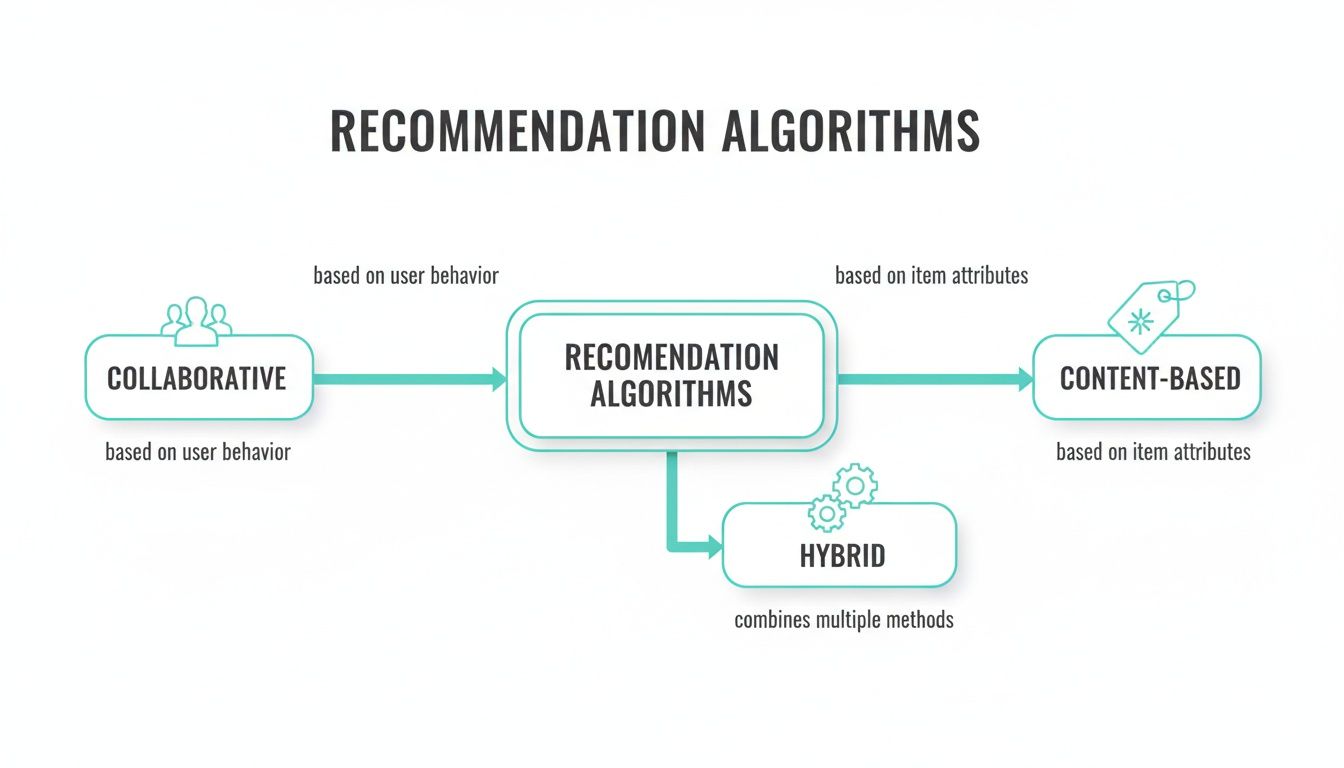
As you can see, the most sophisticated engines, especially those inside a DXP like Sitecore, almost always use hybrid models to get the best of all worlds, ensuring accuracy and relevance.
From Disconnected Tools to a Unified Experience
If your tools aren't talking to each other, you're bound to create a confusing and disjointed experience for your customers. A product recommendation on your website might completely contradict a special offer sent via email. Worse, your mobile app might have no idea what a user was just browsing on their laptop. This erodes trust and leaves money on the table.
Integrating your recommendation engine directly into Sitecore solves this problem by creating a single source of truth. The logic behind your recommendations is fueled by the same unified data that powers every other channel. For a closer look at making this happen, check out our guide on the 5 simple steps toward better personalization with Sitecore Personalize.
This connected ecosystem ensures every interaction builds on the last, making the customer feel seen and understood. It’s this strategic integration that elevates a recommendation tool from simply being useful to being indispensable.
4. Building the Data Architecture for Enterprise Success
For any IT leader, it's easy to get focused on the algorithms behind an ecommerce product recommendation engine. But the real secret to making it work isn't just the AI—it's the data architecture that feeds it. Think of it as the engine's central nervous system. Without a solid structure to collect, process, and act on data in real time, even the smartest algorithm is just making educated guesses.

Success comes down to capturing clean, usable data from every single place a customer interacts with your brand. This goes far beyond the obvious things they tell you, like items on a wishlist. We're talking about the huge volume of unspoken data—every click, scroll, search term, and even a moment's hesitation—that truly reveals what a shopper intends to do next.
Real-Time Processing for In-the-Moment Personalization
The single most important trait of a modern recommendation architecture is its ability to work in real time. The old way of doing things, batch processing, just doesn't cut it anymore. Collecting data and analyzing it hours or even days later is far too slow. To offer a suggestion that feels genuinely helpful and not just creepy, the system has to react while the customer is still on your site.
This means your architecture has to be built for pure speed. When a shopper adds a camera to their cart, a real-time system can instantly show them a compatible memory card and lens filter on the very next page. It’s that immediate relevance that drives upsells and makes the whole experience feel seamless.
A recommendation engine is only as good as the data it receives. A world-class architecture ensures a constant flow of clean, contextual, and real-time information, transforming raw data into revenue-driving actions.
This real-time connection needs to extend to your internal data, too. For B2B companies, this might mean integrating your SharePoint knowledge base so the engine can surface technical specs or user guides right when a buyer is comparing complex products. Getting this flow of information right is a major undertaking, and our guide to customer data integration solutions offers a deeper look at creating that unified view.
Cloud Scalability and Elasticity for Peak Performance
Enterprise ecommerce has massive swings in traffic. The number of visitors on Black Friday can be exponentially higher than on a random Tuesday in May. An on-premise setup simply can't handle that kind of volatility, which often leads to slow pages or, even worse, a full-blown crash during your biggest sales event.
This is exactly why today's data architectures are almost always built on the cloud. A cloud-based approach gives you two game-changing advantages:
- Scalability: The ability to handle more and more data and user traffic without performance taking a nosedive.
- Elasticity: The power to automatically add or remove resources based on real-time demand, so you’re only paying for the computing power you actually use.
Moving to the cloud isn't just a technical choice; it's a business imperative. The model holds a 64.19% share of the global market for a reason—it provides the resilience needed to compete and grow. And while North America currently leads in adoption, the Asia Pacific region is catching up fast, proving that cloud-powered recommendation systems are essential for keeping customers loyal worldwide. You can explore more of these market trends in Grandview Research's analysis.
For global brands running on a platform like Sitecore, a cloud-native architecture is absolutely essential. It’s what guarantees the high availability and snappy performance shoppers now expect, no matter where they are or how busy your site gets. With Kogifi's 24/7 maintenance supporting it, this powerful backend becomes the unsung hero that ensures your personalization efforts pay off, second by second.
How to Measure the ROI of Your Recommendation Engine
Putting a product recommendation engine in place is a significant commitment of time and resources. So, how do you prove it was worth it? Simply pointing to clicks and views won’t cut it. You need to show how it's actually making the business money, and that requires a clear plan for measuring its return on investment (ROI).
If you’re running on a platform like Sitecore, this process begins by getting crystal clear on your business goals. Are you trying to get shoppers to put more in their carts? Maybe you want to convert more first-time visitors or encourage loyal customers to buy again sooner. Nailing down that primary objective is the first step, as it focuses all your measurement efforts.
Key Metrics for Measuring Recommendation Engine ROI
When you're trying to prove the engine is pulling its weight, you have to track the metrics that speak the language of business: revenue and customer value. Within an ecosystem like Sitecore, powerful tools like Sitecore Personalize are designed to give you visibility into these exact performance indicators.
Focus your attention on how recommendations are influencing these three core areas.
- Conversion Rate Lift: This is the big one. It answers a simple question: are more people who interact with a recommendation actually buying something compared to those who don't? This is the most direct proof that your engine is turning browsers into buyers.
- Average Order Value (AOV) Increase: Are the recommendations encouraging shoppers to add just one more item? You need to track whether shopping carts that include a recommended product have a higher total value than those that don't.
- Customer Lifetime Value (CLV) Growth: A great recommendation engine doesn’t just make a single sale; it builds relationships. By looking at repeat purchase data over time, you can see if your personalized suggestions are fostering loyalty and turning one-time shoppers into your most valuable customers.
Measuring ROI isn't about creating a one-and-done report. Think of it as a continuous cycle of testing, learning, and fine-tuning your strategy to not only prove the initial value but also keep increasing that return over time.
A/B Testing for Continuous Improvement
The only way to be absolutely sure what's working is to test it. A/B testing is the gold standard for optimizing a product recommendation engine, and it’s a built-in feature of platforms like Sitecore Personalize. It's all about running controlled experiments where you pit one approach against another to see which one truly moves the needle.
A well-planned A/B test gives you concrete answers to some of your most pressing questions. For example, you could run tests to find out:
- Which algorithms perform best? Does a hybrid algorithm work better than a content-based one for your electronics category? Test it and find out.
- Where is the best placement? Do recommendations on the cart page drive more revenue than those on the homepage? An A/B test will give you the answer.
- How should they be presented? Does a "Frequently Bought Together" widget lead to a higher AOV than a "Customers Also Viewed" carousel? Let the data decide.
By isolating one variable at a time and measuring its direct impact on your core metrics, you can methodically improve your engine's performance. The data from these tests becomes hard evidence that justifies your strategy and guides future decisions. This turns ROI measurement from a simple calculation into a powerful engine for real, sustainable business growth.
Here’s how we’d approach your project, drawing on our deep experience with Sitecore and complex enterprise deployments. Turning an ecommerce product recommendation engine from a great idea into a revenue-driving reality isn’t magic—it’s a methodical process.
We’ve refined a clear, four-phase roadmap that ensures we get it right. This isn’t just about plugging in technology; it's about building a powerful asset that fits perfectly within your business and delivers a clear return on your investment.
Phase 1: Strategy and Audit
Everything starts here. Before we touch a line of code, we need to get on the same page about what success actually looks like for you. We’ll sit down with your team to define the core goals—are we aiming to lift the average order value, drive up conversion rates, or build the kind of loyalty that keeps customers coming back?
At the same time, we'll pop the hood on your current tech stack. This means a full audit of your data sources, a deep dive into your Sitecore setup, and even looking at how internal systems like SharePoint might feed into the larger picture. Think of it as mapping the terrain before we start building.
Phase 2: Data Architecture and Integration
With a solid plan in hand, we get to the technical heart of the project. Our architects will design a clean, reliable data pipeline that will fuel your new recommendation engine. This is a critical step where we prepare and scrub your customer data, ensuring the AI has high-quality, trustworthy information to learn from. Garbage in, garbage out simply isn’t an option.
Then comes the key connection: integrating everything with Sitecore Personalize. We hook up your data streams to the platform, which allows us to build a single, unified view of each customer. This is what makes it possible to deliver smart, consistent recommendations everywhere your customers interact with you, from the website to their inbox.
Phase 3: Go-Live and Testing
This is the moment we’ve been building toward. The launch isn't just a flip of a switch; it's a carefully managed deployment into your live environment. We'll be monitoring system performance like hawks to make sure everything is stable, fast, and running smoothly from the very first click.
As soon as we're live, the testing begins. We immediately start running A/B tests to compare different recommendation models and placements on the page. This real-world data is invaluable. It tells us what’s working, what isn’t, and how we can start fine-tuning the engine for maximum impact.
Phase 4: Continuous Optimization and Scaling
A recommendation engine is a living part of your ecosystem, not a "set it and forget it" tool. The real long-term value comes from continuous improvement. We keep a close eye on the key performance indicators (KPIs) we defined back in Phase 1, using those insights to constantly refine the algorithms and improve the customer experience.
Once the engine is proving its worth, we’ll help you think bigger. We can explore expanding recommendations to your mobile app, integrating more sophisticated personalization tactics, or finding new ways to use the data. This ongoing partnership ensures your recommendation engine doesn’t just keep up with your business—it helps drive it forward.
Common Questions Answered
When you're looking to integrate a product recommendation engine with a powerful DXP like Sitecore, a lot of questions come up. We get them all the time. Here are some of the most frequent ones we hear from clients, along with our straightforward answers.
How Does Sitecore AI Actually Improve Recommendations?
Think of standard recommenders as basic pattern matchers. Sitecore AI, especially within tools like Sitecore Discover and Sitecore Personalize, is a whole different ballgame. It doesn't just look at one thing; it combines a user's real-time actions (what they're clicking on right now) with their past purchase history and deep product data.
This means the engine moves from just suggesting "similar items" to actually predicting what a customer wants next. The result is smarter product grids, more relevant search results, and tailored offers that feel genuinely helpful, not just automated. Because the AI is always learning from every single interaction, the recommendations only get better with time.
For instance, a customer might be looking at hiking boots. A basic engine shows more boots. Sitecore AI, however, can instantly adjust the homepage to highlight waterproof jackets and, remembering a past purchase, even suggest the specific brand of wool socks that customer prefers. That's the power of deep integration.
Can We Use Our SharePoint Data for B2B Recommendations?
Yes, and you absolutely should. This is a game-changer for B2B ecommerce sites. Your company's SharePoint is likely a goldmine of unstructured data—think detailed product specs, technical manuals, compatibility charts, and client case studies.
When you feed this information into your ecommerce product recommendation engine, it can do so much more than just push another product. Imagine a buyer on a product page for a complex piece of machinery. The recommender could instantly pull up the relevant technical data sheet or a compatibility guide for their existing equipment.
This gives your B2B buyers immense confidence. It answers their complex questions on the spot, shortening the sales cycle and turning your recommender from a simple sales tool into an indispensable resource.
What's a Realistic ROI for a Recommendation Engine?
While every business is different, a properly implemented engine tied into Sitecore almost always delivers a significant return. The two big metrics you'll want to watch are Average Order Value (AOV) and overall conversion rate. Experts often cite that customers who interact with AI-driven recommendations can drive an AOV that is significantly higher.
But the immediate sale is only part of the story. The real long-term win is in Customer Lifetime Value (CLV). When you create personalized, helpful experiences, you build loyalty and encourage customers to come back again and again. The goal isn't just a one-time sales bump, but a sustained, measurable increase in the value of every customer you earn.
Ready to see how a world-class ecommerce product recommendation engine can transform your business? The experts at Kogifi specialize in implementing and optimizing advanced DXP solutions with Sitecore. Contact us to start your journey.