


Epsilon's benchmark study of 1,000 U.S. consumers aged 18 to 64 found that 80% said they were more likely to purchase from a company offering personalized experiences, and that shoppers who found personalization very appealing were 10 times more likely to belong to a brand's most valuable customer group, defined as those expected to make more than 15 transactions a year (Epsilon personalization research).
Those two numbers appear in more slide decks than almost any other personalization statistic. They also hide the harder question underneath: which of those personalized experiences changed a decision, and which reached people who were going to buy anyway? A shopper who already intends to purchase doesn't need a discount, and handing one over costs margin.
This guide takes the position that consent and measurement are performance variables, not compliance chores. Personalization deserves to be judged by incremental lift per unit of data risk, meaning the extra revenue a personalized experience creates set against the trust and privacy exposure it consumes. The examples run on the Sitecore AI portfolio, Sitecore Personalize and the Sitecore CDP, with SharePoint intranets handled through the same decision and governance layer.
Table of Contents
- Defining Data-Driven Personalization Without the Jargon
- The Data Types That Feed Personalized Experiences
- How Data Moves From Signal to Screen
- Choosing a Personalization Pattern From Rules to Uplift
- Governing Consent, Privacy and Data Quality
- Measuring Lift Instead of Clicks
- Enterprise Examples From Sitecore and SharePoint Projects
- Start With a Personalization Readiness Check
Defining Data-Driven Personalization Without the Jargon
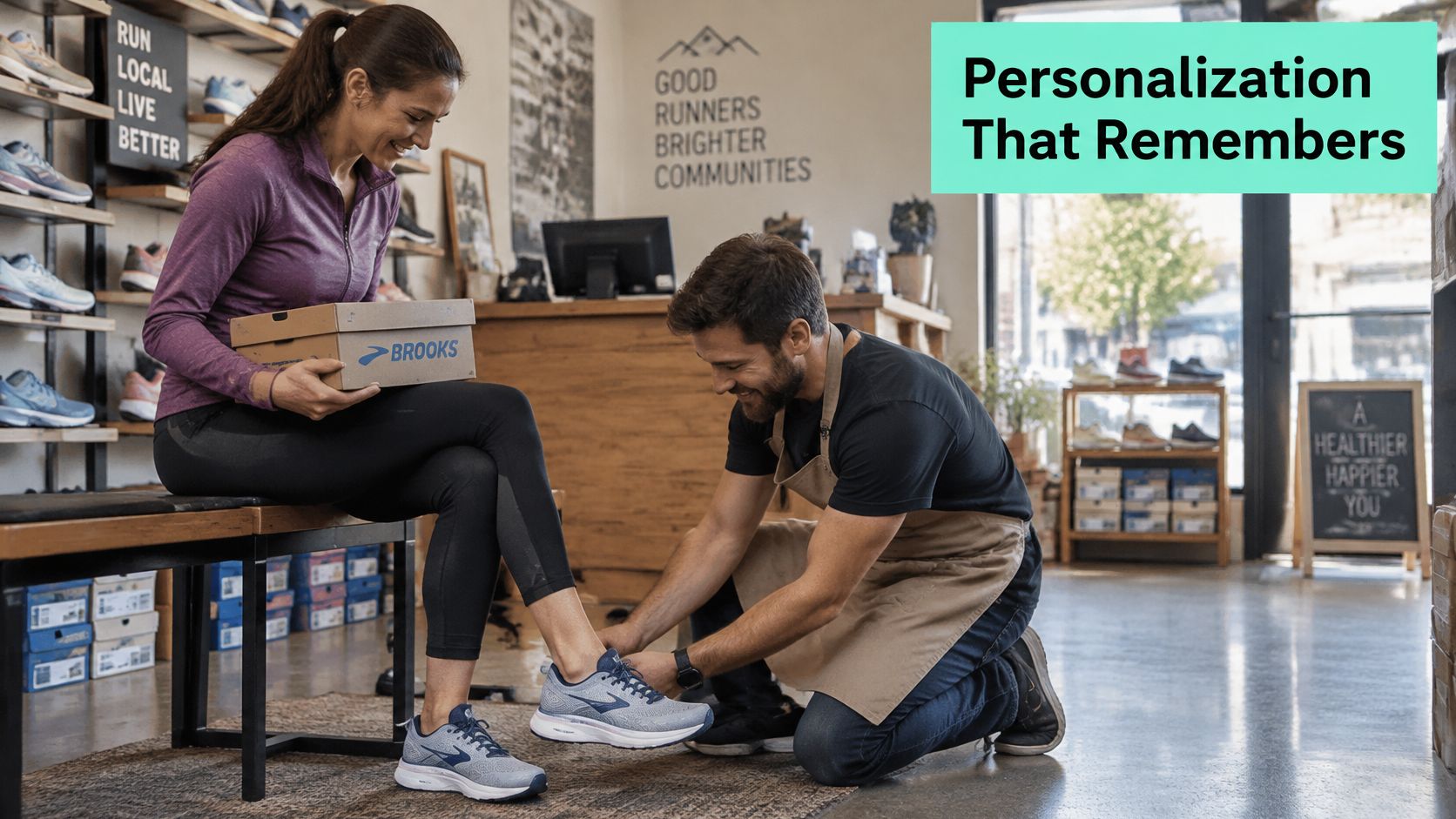
A good shop assistant doesn't read from a script. She remembers you bought trail shoes last spring, notices you standing in front of the road shoes, and asks whether you're training for something longer. That exchange runs on memory, attention and a judgement about what to say next. Data-driven personalization is those same three moves at enterprise scale, performed by a website, app or intranet instead of one person on a shop floor.
Three components do the work, always in this order. The data is what the platform has recorded: a preference someone ticked, a page they opened, an order they placed, the country they're browsing from. The decision layer is the rules or models that interpret those signals and pick something. The experience is what changes on screen, whether that's a homepage module, a product offer, a search ranking or a block in an email.
Most confusion starts in the middle layer, because two adjacent ideas get mixed together. A segment is a list refreshed in batches. It suits an email journey planned last week and it's the wrong tool for the visitor standing in front of you now. Personalization decides inside the session, while the person is still there. One-size-fits-all content isn't a lesser form of personalization either. It's a different strategy, and a legitimate one, for legal pages and stable reference material.
The commercial case has been measured. McKinsey's 2021 Next in Personalization research found that companies growing faster derived 40% more revenue from personalization than slower-growing counterparts, that programs most commonly produced a 10 to 15% revenue lift, and that company-specific results ranged from 5% to 25% depending on sector and execution. That work drew on a September 2021 survey of 1,013 U.S. adults, additional pulse surveys totaling more than 4,000 responses, and a February 2021 benchmarking survey of 100 consumer businesses. Read the 40% carefully. It compares faster growers with slower ones. It isn't a promise that switching personalization on grows total revenue by 40%.
Working definition: data-driven personalization is the practice of changing what a visitor sees, based on recorded signals about that person, under a consent state you can prove and a measurement design that can show what changed.
The Data Types That Feed Personalized Experiences
Every personalization program draws from a finite set of inputs. Scope one by listing those inputs and marking which you already hold, in what system, and under which consent state.
| Data type | Typical examples | Where it comes from | Consent or legal basis | What it personalizes |
|---|---|---|---|---|
| Declared preferences | Language, interests, product categories chosen by the visitor | Preference center, forms | Explicit opt-in in most regions | Navigation, content topics, offer categories |
| Behavioral | Page views, clicks, search terms, video completion | Web SDK, Stream API events | Analytics or marketing consent, depending on region | Next content, recommended products |
| Transactional | Orders, basket contents, renewal dates | Commerce platform, CRM | Contract or legitimate interest, varies by jurisdiction | Cross-sell, replenishment, loyalty messages |
| Contextual | Device, country or city, time of day, referrer | Browser and request data | Often lower risk, but precise location may need consent | Page layout, store finder, local offers |
| Profile attributes | Job function, account tier, industry, role | CRM, identity provider, Microsoft 365 directory | Contract terms or employee policy, plus any required consent | Intranet content, partner portals, B2B messages |
| Third-party audiences | Audience segments bought from external vendors | External data providers | Strict consent rules, increasingly restricted | Prospecting audiences; limited value on owned sites |
Read down the table from the safest row
Declared preferences deserve the first rollout slot because the visitor told you directly. Nothing has to be inferred, the consent basis is clean, and a preference center doubles as a place to correct bad assumptions.
Behavioral data carries the most intent but the most fragility. A single misnamed event, a tag that fires twice, or a consent banner that blocks the tracker for half your German traffic will poison a model. Audit the event stream before you trust a recommendation engine built on top of it.
Transactional data produces the most obviously useful experiences, cross-sell and replenishment, and it usually sits in a commerce or CRM system that has to be integrated first. Contextual signals cost almost nothing and cover layout and local offers. Profile attributes earn their keep in B2B portals and intranets, where a role or account tier tells you more than a browsing pattern ever will. Third-party audiences are listed for completeness, because they're restricted in more markets every year and add little on a site you already own.
A worked case makes the mechanics concrete. Say a manufacturing buyer in Germany ticks industrial automation in a preference form, opens three motor product pages, then orders spare parts through the portal. The homepage module shows a spare-parts reorder block and the local distributor's contact details. Every input in that decision is first-party, consented and inspectable.
Which of these six types does your platform actually use today, and which consent state covers each one in every market you sell into? Answer that in writing before anyone signs off a roadmap.
How Data Moves From Signal to Screen
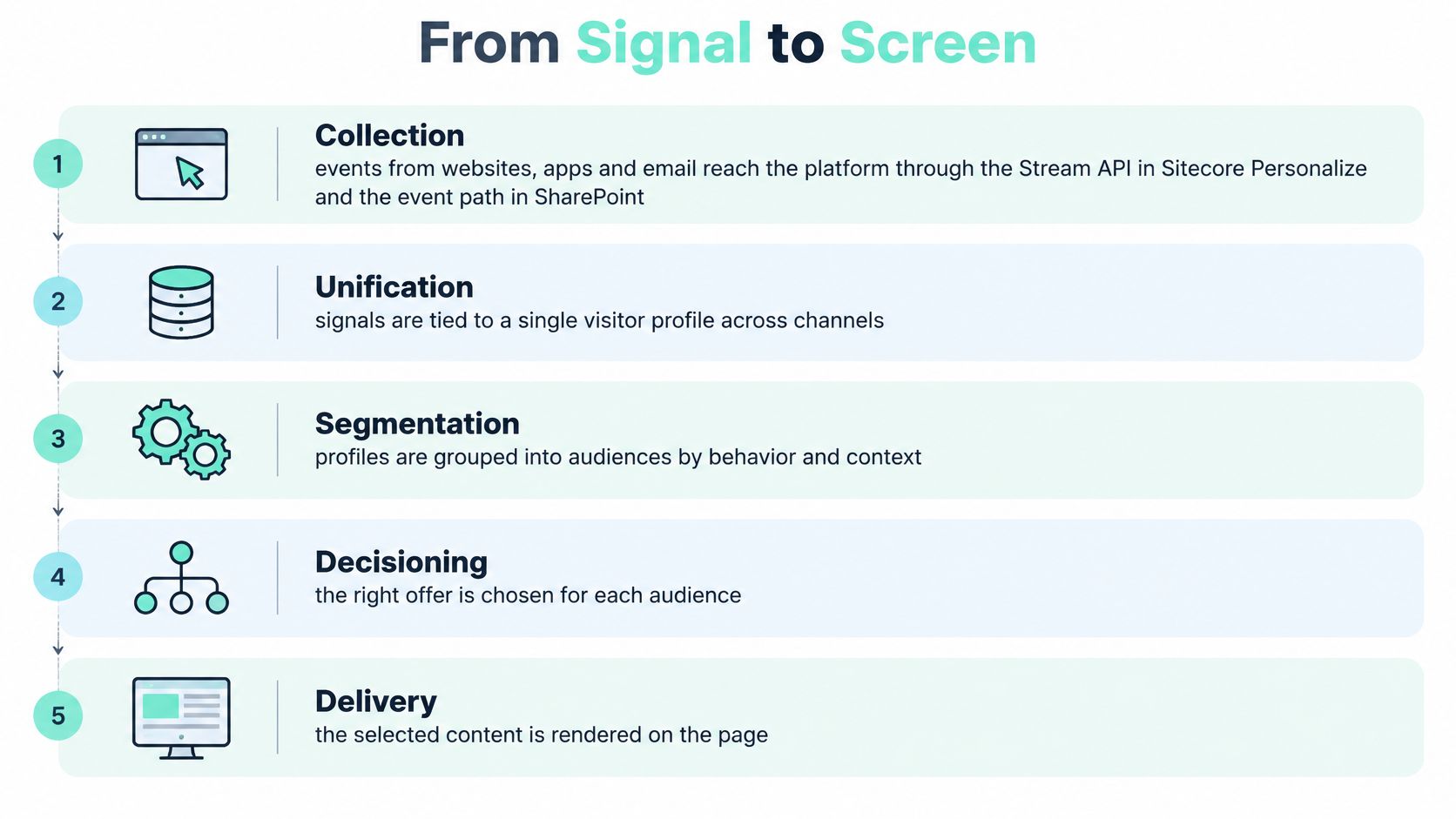
Personalization either works as a pipeline or fails as a pile of features. Five layers, each with exactly one job, is the mental model worth carrying into architecture reviews.
- Collection. Events from web pages, apps and email arrive through the Stream API in Sitecore Personalize, and through the parallel event path in SitecoreAI.
- Identity and profile. The platform matches the interaction to a guest or known profile and holds session state for the short term.
- Decisioning. A decision model, built from rules, data lookups and analytical models, chooses the offer, content or next best action.
- Delivery. XM Cloud or a SharePoint front end renders the chosen variant, with headless components requesting the decision at render time rather than from a cache.
- Measurement. Holdouts and experiments record what the decision changed, which is the layer most programs skip.
Here's that path as a single picture, since the handoffs are where ownership usually blurs.
The tier decision that changes your architecture
Sitecore splits personalization depth across two data-management tiers, and the choice has consequences that surface twelve months later. The lightweight CDP engine inside Sitecore Personalize identifies users, builds profiles and stores state across a limited number of sessions. It doesn't provide direct customer-profile access, segmentation or data export. Those capabilities require the full CDP, which aggregates customer data from across the enterprise, as Sitecore's guidance on Personalize and the CDP sets out.
Apply a three-question test. Do you need a profile that survives across months rather than sessions? Do you need segments shared between web, email and paid media? Do you need to export profile data into another system? Any yes points to the full CDP. Session-level personalization on one site, with decisions driven by live events and external API calls, can run on the lighter engine.
Whichever tier you license, the integration work is the actual project. If profile data is scattered across commerce, CRM and identity systems, our guide to customer data integration solutions covers the plumbing patterns that keep one profile coherent.
SharePoint intranets slot into the same five layers rather than running a separate stack. Map role, department and language from the Microsoft 365 directory into the profile layer, send portal interactions such as document opens and page views through the collection layer, and let one decision model serve employees and customers under a single governed consent configuration. That single governance path is the part most estates miss.
Choosing a Personalization Pattern From Rules to Uplift
Teams usually ask which model to build. The more useful question is which decision pattern the next use case needs, because the five patterns below demand different data, different engineering and different expectations.
| Pattern | Data it needs | Decision timing | Typical use | Main risk |
|---|---|---|---|---|
| Rules-based targeting | Declared attributes and campaign tags | At page load | Campaign landing pages and banners | Rules multiply and go stale |
| Segment-based personalization | Batch-built audiences from the CDP | Batch, hours to days old | Email and recurring journeys | Yesterday's segment shows today's wrong offer |
| Real-time decisioning | Session events, context, external APIs | Within the live interaction | Next-best content, live offers, search results | Latency and dependency on event quality |
| Predictive scoring | Historical behavior and transactions | Model refresh, then scoring at request | Propensity-based offers | Predicts who converts, not who was changed by the offer |
| Uplift modeling | Treatment logs with randomized control groups | Model refresh plus experiments | Deciding who should receive an incentive | Needs holdouts and careful logging |
Each pattern has a plain analogue. Rules-based targeting is a signpost: if the visitor is Canadian and holds a trade account, show the Canadian B2B banner. Fast to build, and after two years you have four hundred signposts and nobody remembers why one of them points left. Segment-based personalization is a mailing list, built in batches and used later. Real-time decisioning is a concierge who checks the weather before recommending a jacket.
That concierge is a literal description of how Sitecore Personalize decision models work. A model can combine business rules, customer or guest data, order data, real-time session events, external data systems and analytical models, and a decision can call a weather service with the visitor's location before selecting an offer. The same model can be reused across experiments and channels, and the underlying processing combines batch and stream handling through a Lambda architecture, which is why a live session event can influence the very next screen.
Uplift modeling is the pattern often skipped and the one that changes the economics. It estimates whether an offer shifts behavior for a specific person rather than whether that person is likely to convert. A peer-reviewed survey and benchmark of uplift methods, evaluated across eight datasets, found that no technique consistently outperformed the others and that performance depended on the business context. Algorithm selection is therefore an experimentation problem, not a vendor selection problem.
Build order that survives contact with reality: ship rules for one campaign, move to real-time decisioning once event data is clean, and only then add uplift modeling, when randomized holdout groups already exist to support it.
SitecoreAI bundles the surrounding capability, connecting content management, digital asset management, content operations, audience and insights, personalization, experimentation, search and conversion optimization, with conversion optimization using real-time visitor signals and intent to personalize, run A/B/n tests and improve search results per the SitecoreAI product documentation. Sitecore Personalize extends the same decision logic to mobile apps, email, SMS, and web and server-side interactive experiences. Once the first web use case is stable, that channel-spanning setup is the sane default for everything next.
Governing Consent, Privacy and Data Quality
The assumption that more data always improves personalization is backwards in a growing share of your markets. Research covering 11,000 consumers across the United States, United Kingdom, Germany, Spain, Italy, the Netherlands and Sweden found that 71% consider AI-driven personalization intrusive and 52% trust AI less than humans with their personal data, up from 48% the year before, according to Usercentrics' State of Digital Trust research.
Then comes the finding that should change your onboarding copy. 53% of privacy-aware consumers are comfortable with personalized experiences, against only 19% of privacy-unaware consumers. Explaining data use and offering granular controls moves more people into the comfortable group than collecting another signal ever will.
Your platform has to read three consent states reliably. Granted allows profile, behavioral and declared data across channels. Limited allows analytics and session signals only. Declined or withdrawn means no profile writes and no cross-session history at all. Build the fallbacks in advance: contextual personalization from page content and visible context, session-level signals that expire with the visit, a preference center where people tune topics and frequency, and a genuine do-not-personalize experience that shows the standard version with no tracking.
| Consent state | Data allowed | Experience shown | Test to run |
|---|---|---|---|
| Granted | Profile, behavioral and declared data across channels | Full personalized journey with a linked preference center | Compare incremental revenue per visitor against the holdout |
| Limited | Analytics and session signals only | Session-level personalization that expires after the visit | Confirm session offers render with no profile writes |
| Declined or withdrawn | No profile writes and no cross-session history | Contextual content, standard version or a do-not-personalize option | Confirm no profile is created and the withdrawal reaches every connected system |
Governance is where good intentions collapse. One consent state must propagate across CMS, analytics, commerce, identity and experimentation systems, so a withdrawal in one place is respected everywhere. We plan data handling with each client according to that client's requirements, and the first output of that planning is usually a consent-to-experience map: for each state, write the experience the visitor receives, then test it in every market. Our guide to consent management platforms covers how to wire that state through the stack.
Data quality deserves the same discipline. Duplicate profiles, stale attributes and missing identifiers corrupt decisions long before any model gets involved. On the employee side, restrict Microsoft 365 and SharePoint attributes to those a decision uses. A department field that nobody targets is a liability with a retention period.
Measuring Lift Instead of Clicks
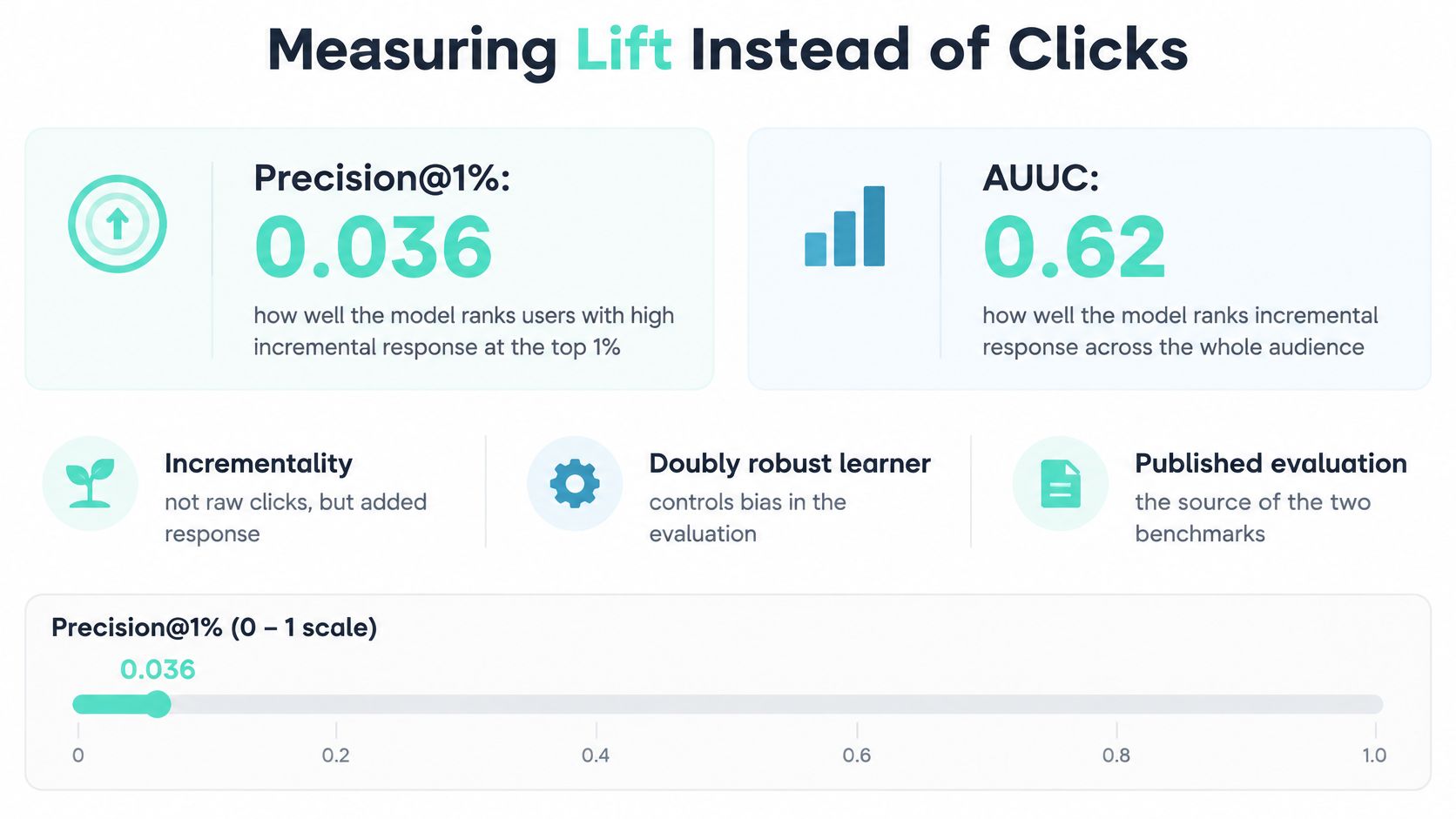
Here is a benchmark worth knowing precisely. A published evaluation combining propensity modeling with separate outcome models for treatment and control, then a doubly protected learner, reached Precision@1% of 0.036 and AUUC of 0.62, identifying users with high incremental response far better than a propensity baseline, while LightGBM produced the strongest straight predictive performance in the same tests, as reported in the published evaluation of doubly robust targeting.
The lesson matters more than the numbers. A high-probability converter is not automatically a good personalization target, because that person may buy without any intervention. Send them a discount and you've purchased a conversion you already had, minus the margin.
Most organizations aren't built to see this. More than 60% of marketing organizations claim personalization capabilities, yet those efforts remain heavily anchored in social media (61%) and email (59%), according to MMA Global's state of personalization report. Channel coverage is not proof of causation.
The minimum measurement design
Four elements, and any one missing weakens the result. A randomized holdout group that receives the standard experience. Treatment and control outcomes logged, not inferred from dashboards. Propensity scores or assignment logic recorded, so you can explain why someone saw what they saw. Incremental contribution calculated by segment, channel, locale and content variant, because a good global number can hide a broken market. When clicks and downstream conversions move differently, use a two-stage funnel so engagement doesn't mask the outcome that pays.
That discipline is how we build. Analytics and A/B testing go in from day one, and content, UX flows and conversion funnels get refined from real user behavior rather than from opinion.
| Metric | What it tells you | Common pitfall | How to read it |
|---|---|---|---|
| Incremental conversion | Whether the experience caused the outcome | Holdout too small or contaminated | Treatment minus randomized holdout, commonly a 5-10% holdout |
| Incremental revenue per visitor | Commercial value of the experience | A few large orders skew the average | Compare revenue per visitor between groups |
| Opt-out and preference change rate | Whether visitors accept or reject personalization | Opt-outs rise quietly after rollout | Track by market and by consent state |
| Complaint rate | Negative experience signal | Under-reported in web channels | Count support tickets tagged to personalization |
| Repeat usage and retention | Long-term value beyond one-off clicks | Needs a full purchase or usage cycle | Cohorts grouped by first exposure date |
| Performance by market and language | Whether outcomes are equitable across regions | Thin samples in smaller locales | Set a minimum sample size per segment |
| Click-through rate | Engagement only | Confuses interest with incremental value | Use as a diagnostic, never as the decision metric |
Rule of thumb: write your stop thresholds before launch. An opt-out ceiling, a complaint ceiling and a margin floor turn personalization from an opinion into a policy you can halt.
For a deeper treatment of the testing stack, our guide to experimentation platforms covers assignment, sample sizing and analysis.
Enterprise Examples From Sitecore and SharePoint Projects
Two delivered programs and two worked scenarios show how the layers connect. The delivered ones matter because personalization gains rest on a delivery base that can publish and scale.

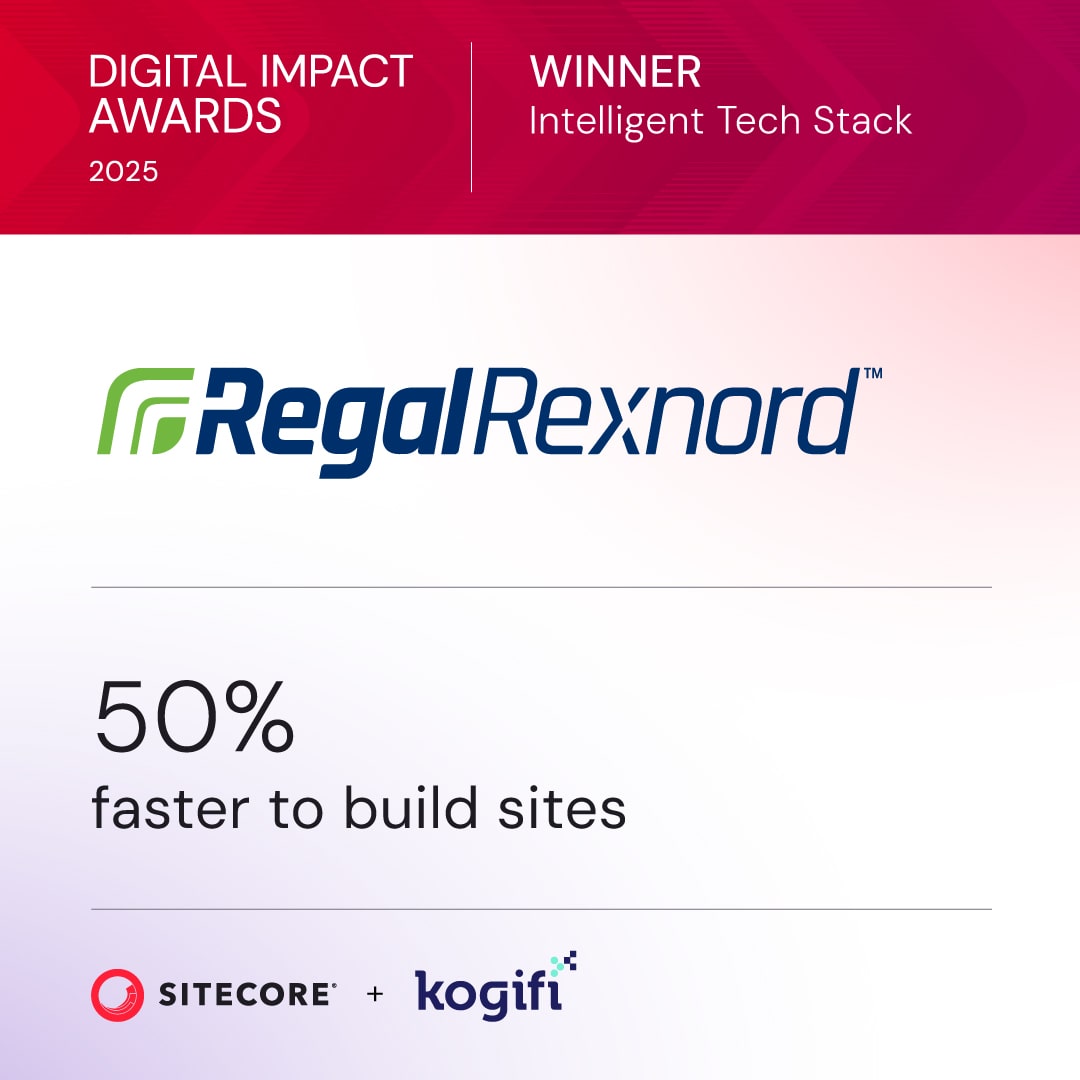
Regal Rexnord, before and after. The estate ran on on-premises Sitecore XP, with publishing speed limiting how often marketing could react. Moving to a headless Sitecore XM Cloud architecture with a Next.js hub-and-spoke model reduced go-live timelines by 35 to 50 percent and made publishing twice as fast. What to copy: fix the delivery foundation before promising real-time relevance, because a decision engine is only as current as the content it can publish.
Siemens Healthineers, holding steady under load. Seasonal peaks had forced overprovisioning, which carried cost without guaranteeing headroom. Azure-based autoscaling delivered reliable performance through those peaks and improved cost control compared with overprovisioned setups, while the platform serves personalized experiences based on historical behavior and partner attributes. What to copy: decisions have to stay responsive when traffic spikes, so capacity planning belongs in the personalization brief, not in a separate operations plan.
Two scenarios you can map onto your own estate
A multinational manufacturer's SharePoint partner portal. The portal personalizes by role, country and language from the Microsoft 365 directory, keeps a 10% holdout on the partner-offer module, and measures document downloads and support tickets rather than clicks. Before, every partner saw the same launch banner. After, distributors in one region get a certification notice while systems integrators get a technical bulletin, and the holdout proves whether the change moved downloads.
An airport retailer using flight context. Offers change with flight status and live location. Travelers who decline tracking see a gate-and-terminal contextual version with no stored profile, which keeps the experience useful without a consent breach. The comparison between the two groups is the measurement, not the number of impressions.
Four transferable lessons emerge: a sound delivery foundation, a randomized holdout on every module you'd defend in a budget meeting, a consent fallback that works without tracking, and metrics tied to what the audience does next. Our Sitecore CDP and Personalize practice covers the implementation detail behind both delivered programs.
Start With a Personalization Readiness Check
Work through this list this week, before any platform decision gets made.
- Map data types to consent states. Take each row of the data-types table and record, per market, which consent state covers it.
- Pick one decision pattern for the first use case. Start with rules unless clean event data already flows through the Stream API.
- Apply the tier test. Decide between the full CDP and the lightweight Sitecore Personalize engine on the three questions about profile longevity, shared segments and export.
- Attach a holdout design and three decision metrics to the first test, drawn from the measurement table rather than from click-through.
- Write stop thresholds for opt-outs, complaints and market-level performance into the launch brief.
- Name one owner for consent across CMS, analytics and identity, so a withdrawal is honoured everywhere rather than in one system.
Kogifi works across Sitecore, Adobe Experience Manager and Microsoft SharePoint, with Sitecore services spanning Experience Commerce, audit and optimization, Content Hub and Search, CDP and Personalize training, and an Airport Digital Experience Accelerator. Most enterprise Sitecore implementations require custom quotes based on specific requirements, so this checklist is a better first agenda than a price list.
Choose the first use case before you choose the platform. The use case tells you which data you need, which pattern fits and which metric proves it worked.
Kogifi builds personalization on Sitecore XM Cloud, Sitecore Personalize and the Sitecore CDP, and on SharePoint Online intranets where one governed decision model serves employees and customers. Bring the readiness check above to a conversation about your estate, and we'll turn it into a scoped plan with the holdouts, consent fallbacks and metrics already named. Visit Kogifi to see the delivery record behind the work described here.