


Your marketing team needs a multilingual website ready for a product launch, but your in-house developers are booked for the next two quarters. An external team could provide the capacity. The harder question is whether it can deliver without leaving you with fragile integrations, unclear security responsibilities, or a platform only its own engineers understand.
Web development outsourcing is an operating-model decision, not just a purchasing decision. For enterprises using SitecoreAI, SharePoint, or other complex digital platforms, the contract needs to define how work gets delivered, how production stays secure, and how another team could take over.
Table of Contents
- What Web Development Outsourcing Means for Enterprises
- Engagement Models and When Each One Fits
- Vendor Selection Checklist for Sitecore, AEM and SharePoint
- Contract Terms for SLAs, Delivery and Exit
- Cost Models and What Drives Total Spend
- Replatforming Sitecore and SharePoint with an External Team
- Shortlist Vendors and Confirm Your Next Step
What Web Development Outsourcing Means for Enterprises
Web development outsourcing means contracting an external specialist team to design, build, migrate, host, or support a website or web platform. Your organization keeps ownership of business goals, content priorities, and product decisions, even when the supplier handles implementation.
A fabrication shop works the same way. You buy specialist skills and production capacity, and you still own the blueprint and decide what the finished product must accomplish. If the blueprint is incomplete, a capable shop can help refine it. That is a different engagement from manufacturing against an approved design.
The same split shows up on a multilingual site. Developers can build language-aware components, configure publishing workflows, and connect translation services. Your organization must decide which markets launch first, who approves translations, and which content belongs in each region. When those decisions stay unnamed, the build finishes and then waits.
The work involves more than developers writing code.

What an external team can own
A useful scope separates the work into concrete responsibilities:
- UX and front-end build: Research, accessible interaction design, component implementation, and browser testing.
- CMS and integrations: Content models, publishing workflows, identity, CRM, commerce, and business-system connections.
- Platform upgrades: Compatibility checks, regression testing, dependency updates, and deployment preparation.
- Cloud migration: Environment design, configuration, observability, and cutover planning.
- 24/7 operations: Monitoring, incident response, maintenance, and escalation.
Outsourcing has become a common way for organizations to get specialist capacity for developing and maintaining web services. The gains are scarce expertise, faster capacity expansion, and spending that can flex with the work. The trade-offs are coordination overhead, knowledge concentrated outside your organization, and extra security exposure from a third party on production systems.
Comparing day rates does not settle those trade-offs. Someone still has to name who approves content, who can change a live environment, and how another team could understand the platform later. Leave that unnamed, and the cheaper team can become the only team that knows how the site works.
Practical rule: Outsourcing fits when the requirements are clear or the missing skill is specific. It struggles when nobody can make the product decisions.
Engagement Models and When Each One Fits
Engagement models compared
| Model | Best For | Who Owns the Roadmap | Typical Commitment | Main Risk |
|---|---|---|---|---|
| Fixed-scope project | Defined redesign or single launch | Vendor, against an agreed specification | Weeks to months | Scope changes become costly change requests |
| Dedicated team | Long roadmap needing continuity | Client product owner, vendor delivers | Ongoing, often multi-month terms | Knowledge concentrated in a few people |
| Staff augmentation | Filling a named skill gap | Client team | Flexible, per engineer | Client must manage quality and priorities |
| Hybrid pod | Migration where architecture stays in-house | Shared between client architects and vendor | Phased, tied to migration waves | Coordination overhead between two teams |
| Managed service | Hosting, monitoring and upgrades of a live platform | Shared, governed by SLA | Recurring retainer | Lock-in without a tested exit plan |
Read the table by asking who makes decisions, not who employs the developers. A fixed-scope supplier manages delivery against an agreed specification, but your business still approves changes to the intended outcome.
This visual also includes time and materials, which is a billing arrangement that can sit underneath several team structures.
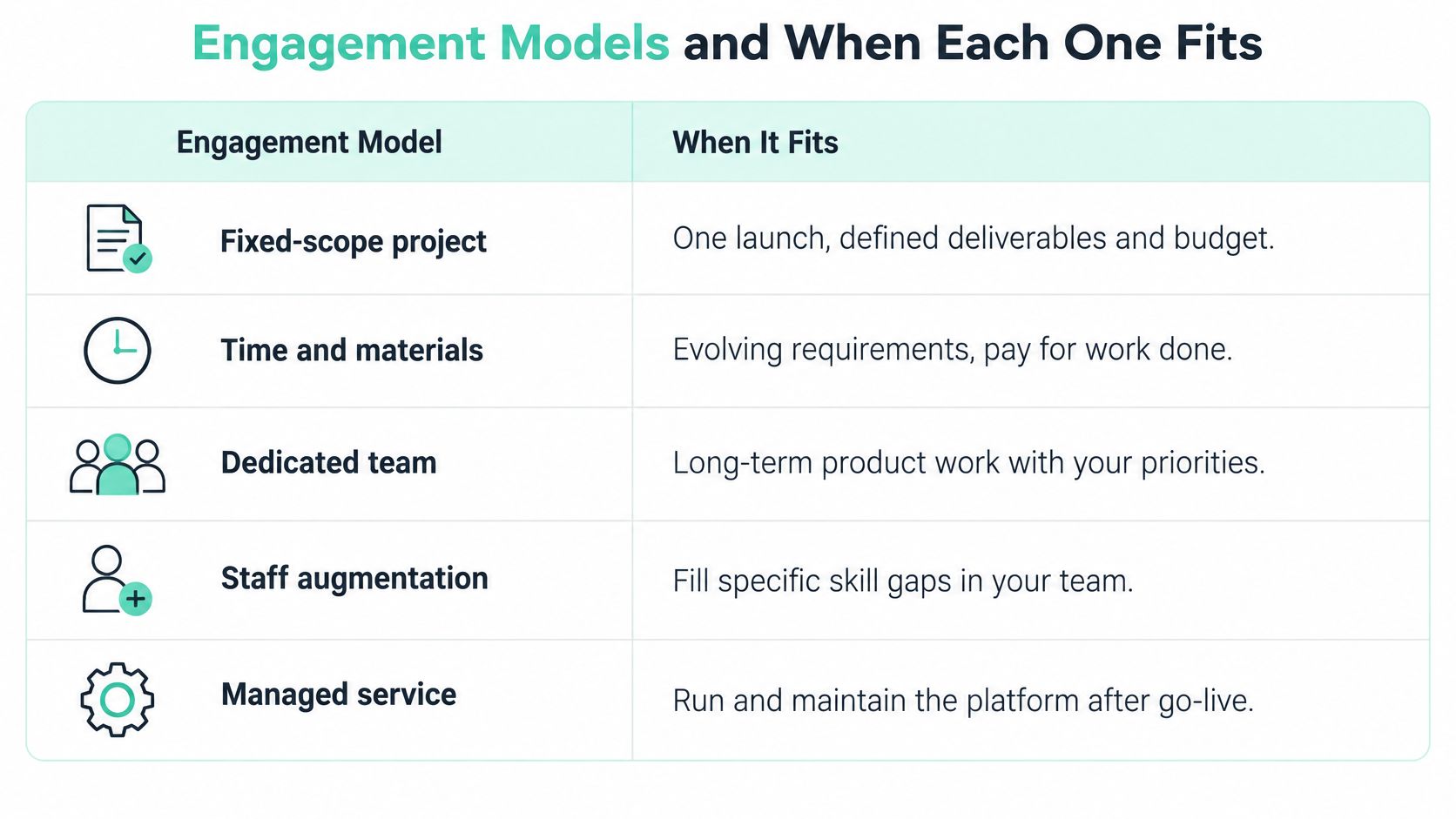
Match the model to the decision load
A fixed-scope project suits a bounded launch with approved designs, content requirements, and acceptance criteria. It becomes awkward when stakeholders are still debating what the platform should do.
A dedicated team suits an evolving Sitecore roadmap where engineers need to understand content governance, integration constraints, and release history. Your product owner prioritizes work while the team builds institutional knowledge. At Kogifi, our dedicated teams cover short-term projects or resource gaps through consultancy and staff augmentation.
Staff augmentation works when your engineering leads can already direct delivery. Adding a Next.js specialist or SharePoint Framework developer fills a gap, but it doesn't replace architecture leadership or quality management. The distinction between embedded individuals and a dedicated development team matters before you write the statement of work.
A hybrid pod keeps design authority with your architects while vendor developers implement migration waves. Define who can approve API contracts, component-library changes, and identity decisions so shared ownership doesn't become delayed ownership.
A managed service takes responsibility for operating the live platform within agreed boundaries. Separate incident handling from enhancement work, otherwise every improvement becomes a dispute about what the retainer includes.
The accompanying video provides another format for considering the engagement.
Choose your initial shortlist by answering:
- How long is the work? A bounded launch and an ongoing product roadmap need different arrangements.
- Who makes product calls? Keep that authority explicit and available.
- Which skills are missing? Name the capability before deciding how many people to buy.
Vendor Selection Checklist for Sitecore, AEM and SharePoint
A platform logo on a proposal isn't evidence that the proposed team can deliver your estate. Use the following checklist as a scoring sheet, then test the answers with technical conversations and delivery artifacts.
Vendor selection checklist
| Criterion | What to Verify | Red Flag |
|---|---|---|
| Sitecore, AEM and SharePoint skills | Named developers with delivery history on your exact version and product mix | Portfolio of generic web projects only |
| Platform certifications | Current partner or certification status for the named staff, checked in vendor directories | Badges with no named engineers attached |
| Architecture and integration | Experience with composable front ends, multi-brand component reuse and your identity, CRM and commerce systems | Proposes one monolithic build for a multi-brand estate |
| Service levels | Written response and resolution times, 24/7 production incident coverage and monthly reporting | Uptime claims with no remedy or service credit |
| Security and compliance | Secure development evidence, dependency scanning, access revocation and data-residency commitments | Security answered with a certificate alone |
| Regional delivery | Working-hours overlap with your teams, language coverage and accessibility skills | Delivery centre far outside your hours with no escalation owner |
Test people and architecture together
Ask the named engineers to explain an implementation on your exact platform version. For Sitecore, distinguish experience with XP customizations from XM Cloud delivery, CDP integration, Personalize decisioning, and Search configuration. Those aren't interchangeable skills.
Verify certifications where vendor directories permit, then confirm that the credentialed people will work on your account. If you're comparing augmentation with direct recruitment, Underdog.io's tech hiring agency guide is useful context for understanding the hiring alternative, rather than assuming every capability gap requires outsourcing.
Give the proposed architect a realistic scenario: several brands share components but need different publishing permissions, CRM connections, and identity policies. A credible answer should explain component boundaries, integration failure handling, and where brand-specific changes belong.
For SharePoint, test permissions, Microsoft 365 integration, SPFx extension design, and Power Platform ownership. A polished intranet demonstration doesn't establish that the supplier can preserve access boundaries during migration.
Require operational evidence
Use the NIST Secure Software Development Framework as the secure-development baseline. Request threat models for exposed features, authenticated code reviews, dependency and software-composition analysis, secrets scanning, artifact traceability, and a defined vulnerability-remediation SLA.
Include AI-generated code in that review. The supplier should identify introduced dependencies, retain review evidence, and show an audit trail for personalization logic developed with AI assistance.
The DORA delivery research supports evaluating delivery throughput and instability together, rather than treating added headcount as proof of improvement. Request release and incident examples that reveal handoffs, approval delays, and recovery practices.
Finally, interview the escalation owner and test working-hours overlap, language coverage, and WCAG implementation skills. Build these evidence checks into your vendor selection process.
A supplier that can't produce evidence for a checklist row shouldn't reach the final shortlist on the strength of its presentation.
Contract Terms for SLAs, Delivery and Exit
Put measured delivery targets in the contract, not promises to follow best practices. Define median and 95th-percentile change lead time, deployment frequency by environment, change-failure rate, recovery time, and the share of work spent on unplanned remediation.
Specify how each measure is calculated. For example, define whether lead time begins at code commit or an approved work request, and distinguish incident acknowledgment from service restoration. Require reporting from your version control, CI/CD, observability, and incident-management systems so procurement can audit the results.
Make service obligations executable
An SLA should identify severity levels, coverage hours, escalation routes, exclusions, and remedies. A publishing outage before a campaign launch may need a different response from a cosmetic defect in an internal page.
Agree on business responsibilities too. If an emergency release needs client approval, name the authorized approver and their backup. Our outsourcing process includes regular performance reviews, SLAs, and transparent reporting, which gives both parties a routine for reviewing performance and corrective actions.
Use this explanation of service levels to distinguish measurable commitments from broad support descriptions.
Procurement questions to put in writing
- Who owns source code, cloud accounts, and CMS packages? Specify repository custody, administrative access, infrastructure definitions, and rights to custom components.
- How are subcontractors disclosed and approved? Include their locations, responsibilities, access, and obligations under the main agreement.
- How are emergency fixes approved and logged? Require traceable authorization, deployment records, and retrospective review.
- How quickly is access revoked at offboarding? Cover identity accounts, privileged roles, service credentials, and downloaded client material.
- Can client data or code train external AI models? Define permitted tools, prohibited inputs, retention rules, and review responsibilities.
- How is disaster recovery tested, and how often? Set the cadence contractually and require evidence that recovery meets agreed recovery-time and recovery-point objectives.
- What does the documented exit plan contain, and who holds it? Require current runbooks, dependencies, configuration inventories, and transfer instructions in client-controlled storage.
- What are the change-request rates and approval thresholds? State who can authorize additional spend and what evidence must accompany an estimate.
An exit plan should describe an achievable transfer, not merely promise documentation at termination. Require a receiving team to demonstrate that it can deploy, restore, and operate the platform using the materials supplied.
Before signature: Insist on IP and account ownership, audit rights, SLA service credits, data-residency commitments, and a defined exit-assistance period.
Service credits don't restore a failed site. Pair commercial remedies with operational duties, including incident investigation, corrective actions, and verified completion of those actions.
Cost Models and What Drives Total Spend
There's no single outsourcing rate that describes the cost of an enterprise platform. Your spend depends on the billing model, the work included, and the obligations left with your internal team.
Future Market Insights estimated the global web development outsourcing services market at USD 1.6 billion in 2025, with a projection of USD 3.0 billion by 2035. That market context doesn't establish what your Sitecore or SharePoint implementation should cost; scope and operating responsibilities still determine the budget.
Cost models and hidden costs
| Cost Model | How It Is Billed | Best Fit | Hidden Cost to Watch |
|---|---|---|---|
| Fixed price | One agreed price for a defined scope | Bounded launch with stable requirements | Change requests priced above the original rate |
| Time and materials | Hourly or daily rates for actual effort | Discovery and evolving scope | Overrun without tight backlog control |
| Dedicated team | Recurring fee per team or role | Ongoing roadmap | Onboarding time and idle capacity |
| Managed service | Monthly retainer tied to SLAs | Hosting, monitoring and upgrades | Price increases at renewal and exit fees |
| Outcome-based | Fees linked to agreed KPIs | Conversion or performance goals | Hard-to-agree metrics and attribution |
Fixed price makes the initial commitment clearer, but only for the agreed scope. Time and materials accommodates discovery, provided a product owner controls priorities and reviews completed work.
Dedicated teams offer continuity, but you pay for onboarding and reserved capacity. Managed services simplify recurring operations only when upgrade labor, hosting, licenses, and emergency work are clearly separated. Outcome-based fees need careful attribution: a conversion change may reflect pricing or campaign quality rather than implementation.
Build a total ownership budget
Construct a three-year total cost of ownership using these budget lines:
- Launch cost: Discovery, design, implementation, migration, testing, and onboarding.
- Run cost: Hosting, licenses, monitoring, support, governance, and routine maintenance.
- Change budget: New integrations, accessibility remediation, upgrades, and roadmap delivery.
- Transition risk: Knowledge transfer, parallel operation, exit assistance, and contingency.
Don't hide internal review time or knowledge transfer inside an assumed overhead allowance. Assign owners and estimate the work explicitly.
At Kogifi, we scale outsourced resources up or down based on project needs and business cycles. For seasonal demand, document the notice periods and skills that must remain available.
Before accepting pricing, confirm one comparison currency, change-request pricing, minimum commitments, and renewal-rate rules. Otherwise, apparently comparable proposals can fund quite different obligations.
Replatforming Sitecore and SharePoint with an External Team
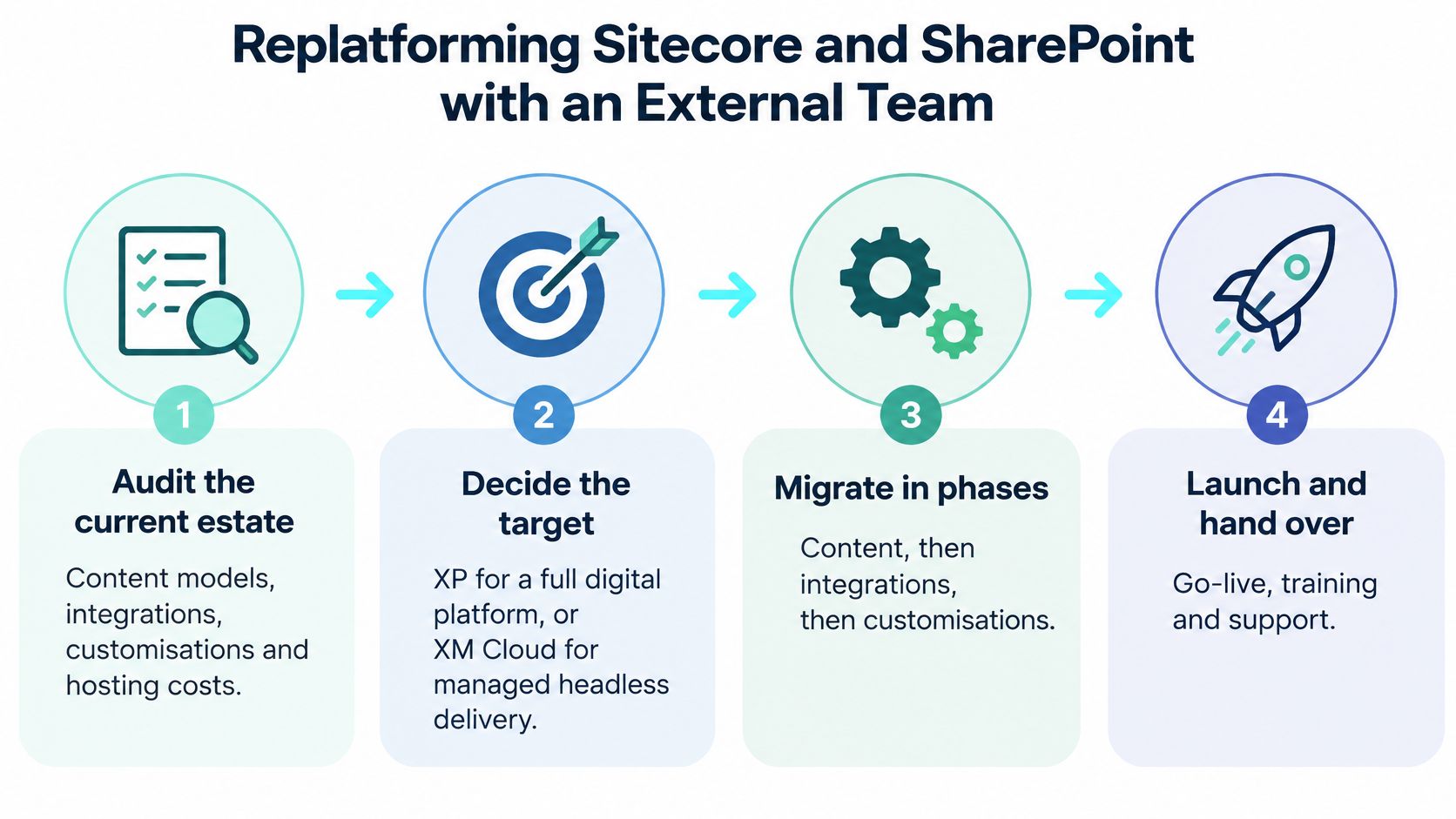
Treat replatforming as a sequence of evidence-based decisions, not a single launch event. The supplier should prove the target architecture and migration method before repeating them across the estate.
The visual summarizes the main transition stages.
Sequence the migration
- Audit the current estate. Inventory content models, integrations, customizations, permissions, hosting costs, and unused functionality. For SharePoint, include workflow owners and content access boundaries.
- Decide the target. Assess retaining XP for an on-premises or hybrid estate against XM Cloud for headless delivery. The SitecoreAI transition FAQ describes XM Cloud as its core platform, alongside CDP, Personalize, Search, and Content Hub, while existing XP and XM customers remain supported on active roadmaps.
- Run architecture workshops. Agree component-library boundaries, multi-brand structures, integration contracts, and decision ownership before implementation.
- Build a pilot. Test a representative site with realistic content and integrations. Validate performance and the author's publishing workflow, not just the rendered page.
- Migrate in waves. Move content and integrations through repeatable rehearsals. For SharePoint intranets, use Microsoft 365 integrations, SPFx components, and Power Platform automations where appropriate.
- Hand over operationally. Supply runbooks, alerts, training, and a tested rollback. Make acceptance depend on the receiving team's ability to operate the result.
Our delivery process has five steps: analytics, audit and optimization; workshops; web design and development; hosting and 24/7 support; and dedicated teams. Migration waves fit within that process rather than replacing it.
Check the whole SitecoreAI portfolio
SitecoreAI components and outsourcing checks
| Component | Role in a replatform | Outsourcing check |
|---|---|---|
| XM Cloud | Core content platform for headless delivery | Confirm component library and publishing workflow ownership |
| CDP | Customer data for profiles and segments | Confirm data residency and consent handling |
| Personalize | Experimentation and decisioning across web and email | Confirm who owns rules, models and Code Assistant output, reviewed like hand-written code |
| Search | AI-assisted on-site discovery | Confirm index ownership and editorial boost, bury and pin controls |
| Content Hub | Content and asset operations | Confirm migration of asset metadata and usage rights |
| XP and XM | Remain supported on active roadmaps | Confirm migration timing against vendor support dates |
Sitecore Personalize documentation explains that Code Assistant generates JavaScript for audience conditions, programmable decision-model components, and session traits. Require the external team to test that output against consent conditions, missing profile data, and unexpected event sequences.
Sitecore's personalization and search overview describes behavioral relevance and editorial boost, bury, and pin controls. Assign ownership of those settings and test business-critical searches before release.
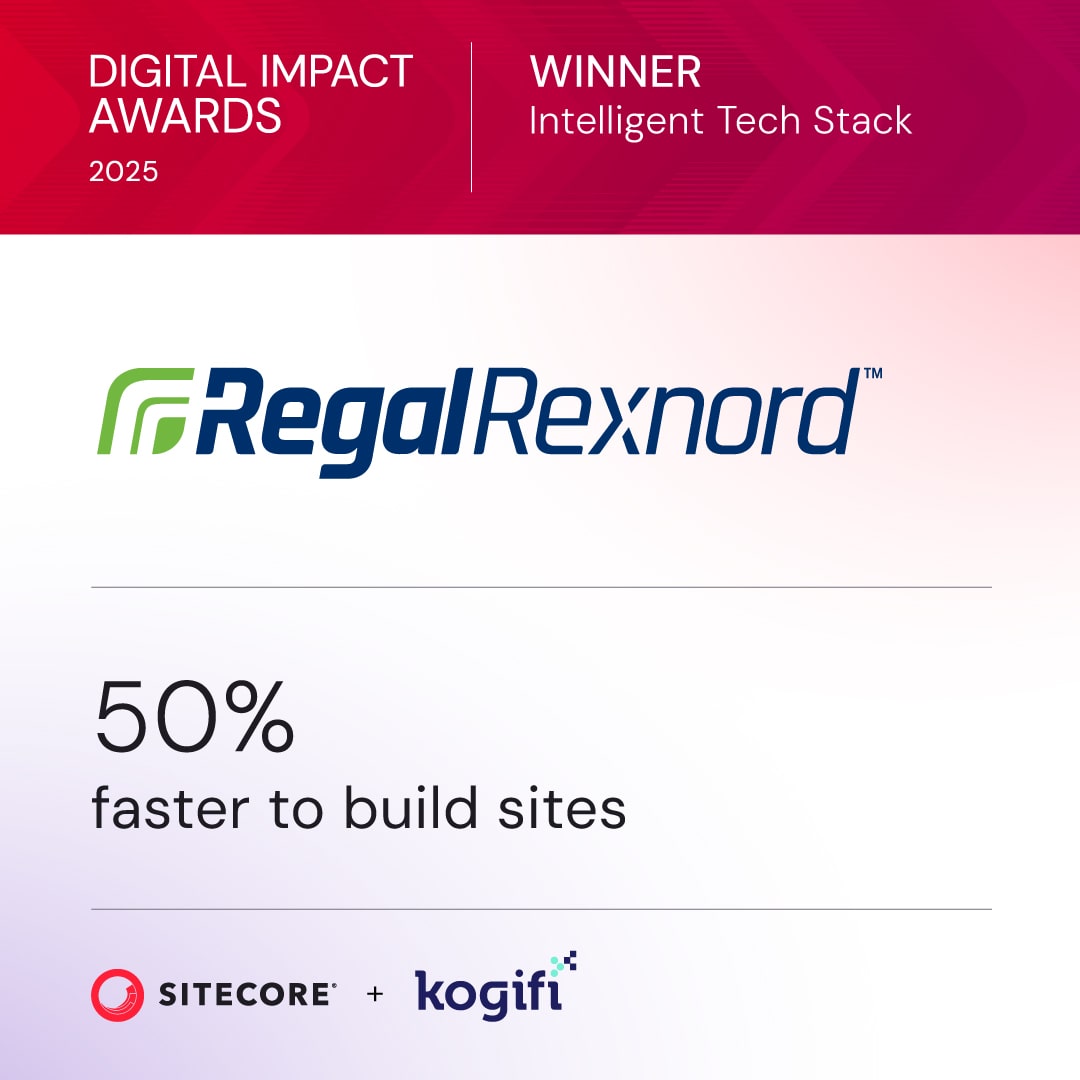
For Regal Rexnord, a move from Sitecore XP to headless XM Cloud reduced go-live timelines by 35 to 50 percent and made publishing twice as fast. Treat that outcome as a case-specific result, not a forecast for every migration.
Use a website migration checklist to track acceptance evidence. The external team should be able to leave without taking deployment knowledge, search configuration, or publishing expertise with it.
Shortlist Vendors and Confirm Your Next Step
Fix the engagement model before opening sales conversations. A defined scope with insufficient internal capacity points toward a project engagement; retained architecture authority points toward a hybrid pod; a stable platform needing ongoing operation points toward a managed service.
Don't let a vendor's preferred staffing arrangement decide how your organization will work. Start with your decision-making capacity, missing skills, and operational responsibilities.
Run a comparable evaluation
Use a compact shortlist routine:
- Send the same RFP to three vendors. Include the platform estate, intended outcomes, security requirements, and procurement questions.
- Score evidence consistently. Separate demonstrated capability from promises that depend on future recruitment or undisclosed subcontractors.
- Request a reference on your exact platform version. Discuss delivery difficulties and handover quality, not just launch-day satisfaction.
- Run a paid two-week discovery. Use this proposed evaluation period to produce an architecture outline, prioritized risks, delivery assumptions, and a defensible estimate before committing to a long contract.
Discovery should resolve uncertainty, not produce a generic presentation. Ask the proposed delivery team to investigate a real integration, walk through a publishing problem, or demonstrate how a SharePoint permission boundary will survive migration.
A strong shortlist contains named people, security evidence, measurable service commitments, and transparent pricing. It also identifies what your own team must contribute, including content approvals, product ownership, identity administration, and business acceptance.
Kogifi is one option to evaluate against that standard. Our Outsourcing service provides dedicated teams for Sitecore, Adobe Experience Manager, and SharePoint development, support, and maintenance, covering custom features, integrations, 24/7 platform monitoring, and helpdesk support.
The right decision isn't necessarily to outsource the largest possible scope. It's to allocate work so that specialists can deliver while your organization retains the authority and knowledge it needs.
This week, write a one-page scope, attach your SLA and security requirements, and send the same RFP questions to your shortlist. Require responses that name owners and provide evidence, rather than accepting assurances that details will be settled after signature.
Kogifi offers dedicated enterprise platform teams for Sitecore, Adobe Experience Manager, and SharePoint development and operations. Visit Kogifi to discuss your platform scope, missing capabilities, and the delivery, support, and handover responsibilities your outsourcing agreement needs to cover.