


A platform can be “available” while your teams still can't publish a campaign, customers can't complete checkout, and employees can't find a policy in the intranet. That's the uncomfortable reality many enterprise digital experience leaders face: the hosting dashboard is green, but the business experience is failing in visible, expensive ways.
So, what are service levels in practical terms? They're measurable commitments about how a service should perform for its users. A Service Level Agreement, or SLA, turns those commitments into a formal contract covering targets, measurement methods, reporting, exclusions, escalation, and possible remedies. For Sitecore, SharePoint, and composable cloud estates, that distinction matters because technical availability is only one part of service quality.
Table of Contents
- Define the service in business terms
- Choose targets that match the architecture
- Make dependencies visible
- Add AI and experience checks
When 99.9 Percent Uptime Still Feels Broken
The monthly report arrives: the Sitecore platform achieved 99.9 percent availability, so the hosting provider marks the service compliant. The marketing team reports something else. Personalization rules are missing for the intended audience, enterprise search returns stale content, and a publishing workflow fails intermittently during a major campaign.
The SharePoint intranet can fail in the same way. Employees open the homepage, so the monitoring dashboard reports success. Yet search is slow, a key document library loads unreliably, and an SPFx component fails for users in one region. Infrastructure sees an online service. Users experience a broken one.

Availability is only one measurement
A service level defines the expected performance of a service. It can cover availability, incident response, resolution time, performance, backup, security, and support coverage. An SLA records these expectations formally, including measurement rules and the action required when the provider misses a target. ITIL service-level management guidance treats service levels as commitments that can be measured and reviewed, rather than general promises about reliability.
That distinction matters during contract negotiations. “The platform will be reliable” has no operational meaning until the agreement defines reliable performance. Does availability mean that the homepage responds, or that login, search, checkout, publishing, personalization, and integrations all work? Does quick ticket acknowledgment count as success if the underlying fault remains unresolved?
A practical website uptime monitoring approach should test more than a URL response. It should monitor business-critical journeys and show whether a customer, editor, or employee can complete the task that brought them to the platform.
AI services, cloud identity, search APIs, and analytics platforms make that boundary harder to define. A Sitecore or SharePoint experience may depend on several vendors, each reporting its own availability. The customer still sees one journey, so the SLA needs a way to address failures across those dependencies, not only the health of the hosting environment.
The contract needs an experience boundary
A useful SLA names the service, its users, and its critical journeys. For Sitecore, those journeys may include content publishing, deployment, search, personalization, form submission, commerce integration, and AI-assisted features. For SharePoint, they may include authentication, document access, search, news publishing, workflow execution, and regional content delivery.
Incident management also needs shared definitions. Teams reviewing DataLunix ITSM solutions can apply IT service-management principles to ownership, escalation, and reporting. The agreement still needs platform-specific rules, including which vendor investigates a failed dependency and how responsibility is assigned when several services contribute to one user journey.
Practical rule: If a user cannot complete a business-critical task, the service is not healthy enough, even when the infrastructure dashboard is green.
Strong service levels connect technical signals to business impact. They distinguish a minor editorial inconvenience from failed checkout, a delayed search index from an authentication outage, and a regional defect from an incident affecting every brand and market.
Core Service Level Concepts and Metrics
Service levels earn their place in a contract when each term guides a real operational decision. Availability measures whether users can access the service. Response time measures how quickly the provider acknowledges an incident. Recovery Time Objective, or RTO, sets the expected time to restore a service or capability after a major failure. Recovery Point Objective, or RPO, defines how much recent data the business can afford to lose during recovery.
These measures should shape monitoring, staffing, backup design, escalation paths, and contractual remedies. A definition that never changes how the team operates is glossary material, not a useful service level.
Read availability targets as operating constraints
Availability is normally stated as a percentage of the measurement period. A 99.9 percent target permits approximately 0.1 percent unavailability, equal to about 8.76 hours over a 365-day year and roughly 43.8 minutes in a 30-day month. A 99.99 percent target reduces the annual allowance to approximately 52.6 minutes. A 99.999 percent target permits about 5.26 minutes.
The gap between these targets affects architecture, operations, and cost. A lower target may suit an internal editorial environment with planned maintenance windows. A public commerce or customer-service platform may need a tighter target because even a short interruption can affect transactions, support demand, and customer trust.
The percentage has meaning only when the agreement defines its boundaries. Confirm whether scheduled maintenance is excluded, whether partial outages count, how third-party dependency failures are handled, and whether monitoring runs continuously or only during business hours. In a cloud and multi-vendor stack, these details often determine whether a missed target can be proved.
Separate response, recovery, and data protection
Response time does not equal resolution time. A provider may acknowledge a critical incident quickly while requiring much longer to restore the affected capability. The SLA should define both measures, supported by severity criteria and escalation rules.
RTO and RPO govern different recovery decisions:
- RTO: The maximum acceptable period before the affected service or function is restored.
- RPO: The acceptable age of the latest recoverable data after a failure.
- Response window: The period in which the support team must acknowledge and begin handling an incident.
- Resolution target: The expected time to restore normal service or provide an agreed workaround.
A Sitecore content database, search index, analytics pipeline, and commerce integration may have different recovery needs. A SharePoint document repository may need stronger data-protection controls than a temporary presentation layer. Applying one target to every component can increase cost in low-impact areas while leaving the business-critical journey under-protected.
Operations must support the wording. Incident management best practices should cover severity classification, communication, evidence collection, root-cause analysis, and post-incident improvement.
Contract test: Every target should identify the measurement source, the clock that applies, the exclusions, the owner, and the consequence of missing it.
The Two Hidden Gaps in Traditional Service Levels
Traditional SLAs break down in two predictable ways. They measure infrastructure instead of the user's task, or they give one supplier responsibility for a service controlled by several suppliers. Both weaknesses are common in enterprise digital experience estates.
Gap one is journey blindness
A fast ticket acknowledgment does not tell you whether the business capability was restored. A page can return a successful response while search, login, checkout, personalization, or publishing is failing. Availability, response time, mean time to recovery, and error rate remain useful operational measures, but none captures the complete customer experience.
ITIL service-level management guidance treats service levels as a cycle of measurement, evaluation, reporting, and improvement. That approach is more useful than making uptime the contract's main outcome. The practical question is whether a defined user group completed its intended task with acceptable quality.
For a multinational Sitecore estate, the agreement may need measures for publishing success, deployment reliability, search relevance, accessibility defects, content freshness, and integration behavior. A multilingual site also needs visibility into whether a regional content change reached the correct market without affecting another language or brand. These outcomes expose failures that a healthy delivery server can hide.
A useful framework connects each target to:
- Journey: Publishing, search, login, checkout, or another business task.
- User group: Customers, editors, employees, partners, or administrators.
- Severity: The operational and commercial effect of failure.
- Geography: Whether the issue affects one region or the whole estate.
- Outcome: Task completion, content delivery, perceived performance, accessibility, or satisfaction.
This forms an experience-level agreement, often called an XLA. It adds measures of what users receive to the operational measures already used by infrastructure teams.
Gap two is distributed responsibility
A modern Sitecore or SharePoint service can depend on cloud infrastructure, identity, search, analytics, commerce, a CDN, third-party APIs, implementation teams, and support providers. An identity outage may leave the CMS vendor reporting full availability while users cannot log in. A stale external search service can produce failed journeys even when the hosting provider's application servers remain healthy.
AI adds another dependency and governance problem. A platform may be available while an AI-generated answer is inaccurate, a recommendation lacks the required context, or a model-driven workflow has no safe fallback. Technical availability alone cannot show whether the resulting service is trustworthy or usable.
Recent SLA research describes the move toward shared responsibility and experience-level agreements, and reports that organizations using automation missed SLAs at an 11 percent lower rate than organizations without automation, as discussed in research on service-level agreements in distributed environments. The practical lesson is to make service behavior observable enough for teams to detect, classify, and route failures before suppliers dispute ownership.
A workable agreement should document the dependency map, shared objectives, maintenance rules, security obligations, accessibility expectations, data-residency constraints, disaster-recovery objectives, and communication duties across suppliers. It should also assign ownership for experience failures that cross vendor boundaries. Otherwise, every provider can meet its narrow target while the customer receives one failed service.
From Infrastructure SLAs to Experience and AI Governance
An editor can publish a page successfully while visitors receive outdated content, an irrelevant personalized variant, or an answer generated from incomplete information. The hosting provider may still report a healthy platform. That gap is why infrastructure SLAs need a second layer for experience quality and AI governance.
An infrastructure SLA asks whether a platform is available and operating within defined technical limits. An experience-level agreement asks whether intended users can complete important tasks with the expected quality. The measures support each other, but they cover different responsibilities.
| Infrastructure SLA | Experience and AI governance |
|---|---|
| Measures platform availability and incident handling | Measures successful journeys and business outcomes |
| Assigns targets to a service boundary | Maps dependencies across the service chain |
| Reports response and recovery performance | Adds task completion, content delivery, accessibility, and satisfaction |
| Treats security as an operational obligation | Defines safety, escalation, fallback, and audit requirements for AI |
| Often assumes predictable application behavior | Plans for model variation, inaccurate outputs, and changing content context |
Sitecore AI needs governed operating boundaries
Sitecore Stream is an AI capability layer available across supported Sitecore products and through the Sitecore Cloud Portal. Its documented capabilities include brand-aware content generation and refinement, visual search using image color and descriptions, AI-assisted content optimization in XM Cloud Page Builder, audience-specific page-text personalization, and natural-language questions over a Sitecore content collection and Search domain. Some capabilities require Stream Premium, so licensing belongs in the operating model. These details appear in Sitecore Stream product documentation.
That capability changes the service commitment. A platform can remain available while generated content breaks brand guidance, personalization selects an unsuitable variation, or an AI answer lacks a safe fallback. A governed approach to AI-powered personalization pairs model output with editorial review and experimentation controls. Service levels should also define review requirements, human escalation, logging, model-quality checks, and the experience shown when the AI service or its data source is unavailable.
Sitecore's February 2025 DXP update names brand, campaign, content, experience, and optimization copilots. It describes automation ranging from chain-of-thought prompting to human-in-the-loop and fully agentic workflows. The update also describes AI-generated content variants and XM Cloud A/B/n testing that can control traffic and serve a better-performing component variant. The Sitecore DXP update supports a practical operating rule: AI can accelerate delivery, while approval and experimentation controls remain part of service quality.
SharePoint AI has architectural limits
Microsoft Copilot Studio documentation gives architects concrete constraints to include in design and service commitments. An agent can use up to 500 knowledge sources, 8,000 characters of instructions, 5 MB connector payloads, 512 MB uploaded files, 100 skills, 1,000 topics, and 200 trigger phrases per topic. For SharePoint, generative-orchestration agents can use a maximum of 25 SharePoint site URLs, while SharePoint list queries return data only from the first 2,048 rows. Modern SharePoint pages containing SPFx components are not supported as knowledge sources, and users without a Microsoft 365 Copilot license may be limited to SharePoint files under 7 MB, according to Microsoft's Copilot Studio requirements and quotas.
These limits affect information architecture, indexing, SPFx design, licensing, content ownership, and fallback behavior. An AI-enabled intranet service level should state what happens when a source falls outside the supported model, a query crosses a data boundary, or the agent must transfer the user to a person.
Teams refining delivery models can also use practical guidance on how to improve IT delivery when delivery, support, and governance responsibilities span several groups. AI governance now belongs in service quality, not in a separate policy document.
Applying Service Level Excellence to Sitecore and SharePoint
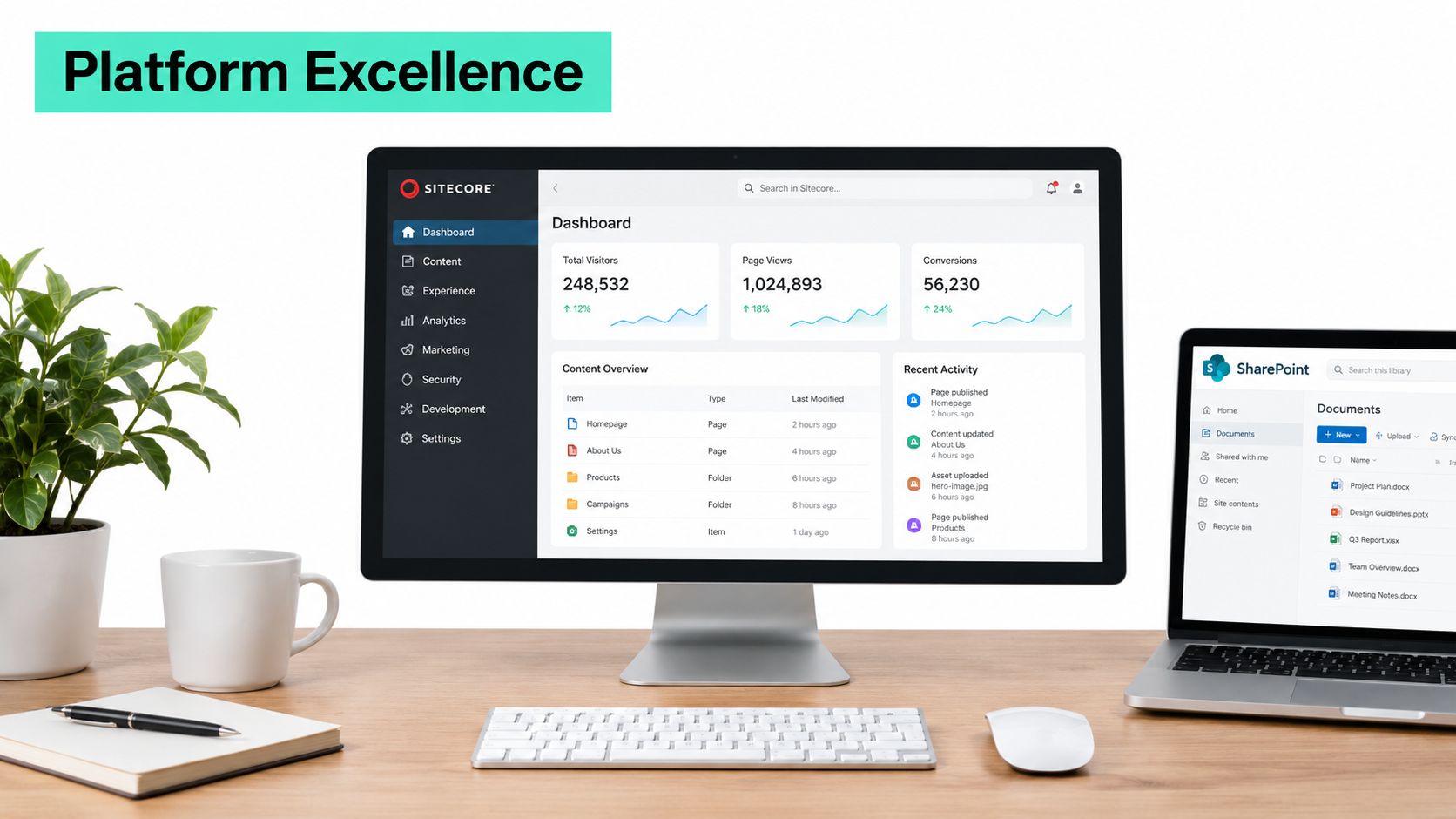
An editor publishes a campaign in Sitecore, sees a success message, and then finds the old page still live. A SharePoint employee opens the intranet, authenticates successfully, and receives no useful search result. Infrastructure monitoring may report healthy systems in both cases. The service has still failed from the user's perspective.
Platform behavior must shape the service level. A headless Sitecore XM Cloud architecture has different failure modes from a traditional monolithic deployment. A SharePoint Online intranet with SPFx, Power Platform workflows, identity integrations, multilingual content, and cloud services has a different dependency chain from a document repository. AI features and external APIs add more points where a technically available platform can produce an incomplete result.
Model the journeys before choosing targets
For Sitecore, define service objectives around the experiences that create commercial or operational value:
- Publishing and deployment: Can authorized editors validate and release content, and can visitors receive the updated version?
- Search: Does the index receive changes, process them, and return useful results?
- Personalization: Do audience rules execute, and does the page render the intended variant?
- Integration: Do identity, forms, booking, commerce, analytics, and partner services exchange data correctly?
- Accessibility: Can users complete the journey on supported devices and with assistive technologies?
For SharePoint, set comparable objectives for authentication, document retrieval, intranet search, news publishing, workflow completion, and localized content. Keep these outcomes separate. One unavailable connector or broken component can make a key journey unusable while the main platform remains online.
Map ownership across the dependency chain. Sitecore may rely on Azure services, a frontend application, search infrastructure, identity, and external APIs. SharePoint solutions may combine Microsoft 365 services, SPFx components, Power Platform automation, custom connectors, and AI services. Every dependency needs an owner, a monitoring signal, an escalation route, and a recovery expectation.
Turn operational knowledge into contract language
A support agreement should state what the provider monitors, what the customer supplies, and which conditions create a formal incident. Include maintenance notices, release controls, rollback responsibility, security escalation, data handoffs, and post-incident reporting.
A specialist Sitecore support services model can cover both platform operations and application behavior. The same approach suits SharePoint. A team familiar with SPFx rendering, search indexing, permissions, content models, Power Platform dependencies, and AI responses can investigate the complete user journey instead of passing each symptom to a different vendor.
Operational responsibility also needs clear boundaries:
A single uptime percentage is easy to compare and difficult to enforce against a broken journey. Journey-based service levels take more effort to define, but they give marketing, IT, and suppliers a shared basis for prioritizing incidents, assigning responsibility, and improving the platform.
Setting Actionable Service Level Targets for Your Platform
A platform can meet its uptime target while customers still abandon checkout, editors fail to publish, or employees receive stale search results. Set service levels around the work people need to complete, then connect those outcomes to the technical controls that support them. This approach matters even more when AI services, cloud platforms, and several suppliers share one user journey.
Define the service in business terms
Start by listing the journeys that affect revenue, service delivery, compliance, and internal productivity. A public product page, account login, checkout flow, content publishing workflow, and employee policy search may require different targets. For each journey, record the audience, regions, dependencies, business hours, business consequence, and acceptable workaround.
Then identify the signals that prove the journey works. A publishing flow may require a successful deployment, cache refresh, index update, and frontend render. SharePoint search may depend on permissions, crawl freshness, query behavior, and the structure of the source content. A successful server response proves very little if the user receives an empty result or outdated page.
Choose targets that match the architecture
Set availability, response, and recovery objectives according to business impact and technical design. A tighter target requires suitable architecture, monitoring, support coverage, testing, and recovery arrangements. If those capabilities are not funded, the SLA describes an aspiration rather than an operating commitment.
Define RTO and RPO separately. A content delivery layer may be restored through redeployment, while editorial data, customer submissions, analytics, or commerce transactions need different protection. State which data is covered, how backups are validated, how restoration is tested, and who approves recovery.
An experience target may also need a degraded-service definition. For example, a site might remain reachable while search, personalization, publishing, or login is unavailable. Count that condition explicitly instead of allowing technical uptime to hide a failed user journey.
Make dependencies visible
Create a service map covering the CMS or DXP, cloud infrastructure, CDN, identity, search, analytics, commerce, APIs, frontend applications, and support teams. For each dependency, name the owning supplier and the evidence used to decide whether it contributed to an incident.
Separate promises from shared operating responsibilities. Define who opens the incident, communicates with stakeholders, coordinates vendors, and owns the customer-facing status. Exclusions must be precise. “Third-party failure” should not excuse a provider when it controls integration monitoring, fallback behavior, or escalation.
Operational boundaries should also cover maintenance notices, release controls, rollback responsibility, security escalation, data handoffs, and post-incident reporting. If several vendors support Sitecore or SharePoint, the agreement should identify one party responsible for coordinating the complete journey.
Operational responsibility also needs clear boundaries:
Add AI and experience checks
AI-enabled Sitecore and SharePoint solutions need controls that infrastructure metrics cannot provide:
- Output quality: Define how teams review generated content, search answers, personalization, and recommendations.
- Brand and policy compliance: Specify approved context, content rules, and prohibited uses.
- Fallback behavior: State what users see when an AI service, index, connector, or model is unavailable.
- Human escalation: Identify when an editor, service desk analyst, or subject-matter expert takes over.
- Auditability: Record prompts, sources, approvals, changes, and incident evidence where appropriate.
- Accessibility and inclusion: Test AI-assisted experiences against the same accessibility and multilingual expectations as other content.
Ask providers before signing:
- What counts as downtime, degraded service, and a failed business journey?
- Which maintenance periods and third-party dependencies are excluded?
- How are partial failures in publishing, search, login, or personalization measured?
- Which tools provide evidence, and can the customer access the reports?
- What response, restoration, RTO, and RPO commitments apply to each severity?
- Who coordinates incidents involving several suppliers?
- How are security, accessibility, data residency, and disaster recovery represented?
- What testing proves that backup, failover, rollback, and recovery procedures work?
- How are AI quality, unsafe output, fallback, human review, and model changes governed?
- How often will the parties review targets, exclusions, dependencies, and recurring incidents?
A service level should guide decisions under pressure. It should tell the service desk what to do, the architect what to design, and the business owner what users can expect. Kogifi designs, builds, and maintains enterprise Sitecore and Microsoft 365 platforms, including SLA-backed hosting, monitoring, incident response, AI-enabled personalization, and SharePoint intranets. Visit Kogifi to discuss a service-level model based on critical journeys, dependencies, recovery needs, and governance requirements.