


An omnichannel ecommerce platform is a unified headless commerce and content orchestration system, like Sitecore XM Cloud integrated with SharePoint, that delivers consistent, real-time experiences across every customer touchpoint. The platform layer behind this model is projected to reach $14.6 billion by 2026, while the global multichannel ecommerce market is projected to reach $25.22 billion in 2026.
The popular advice is to “sell everywhere.” That advice is incomplete. Adding a marketplace, mobile storefront, social channel, or physical-store workflow doesn't create omnichannel commerce if each touchpoint still owns separate product data, customer context, inventory rules, and content governance.
The difficult work happens behind the interface. Enterprise teams must decide which system owns a product attribute, how quickly stock changes propagate, how an AI engine interprets customer intent, and how marketing teams publish localized content without weakening brand control. In practice, omnichannel is less a channel expansion project than a semantic, operational, and governance problem.
Table of Contents
Defining the Modern Omnichannel Ecommerce Platform
A business can sell through a website, mobile app, marketplace, store, and contact center and still operate a multichannel estate. The distinction is whether those channels share the same operational truth.
Consider a customer who discovers a product on a campaign landing page, receives a personalized recommendation in a mobile experience, checks local availability, and completes the purchase through a store-assisted interaction. In a disconnected estate, each step can create a new customer record, show a different price, or expose inventory that another system has already reserved. In a mature estate, Sitecore XM Cloud manages the experience and content context, commerce services manage the transaction, and SharePoint can support the internal knowledge and workflow layer that helps employees serve the customer consistently.
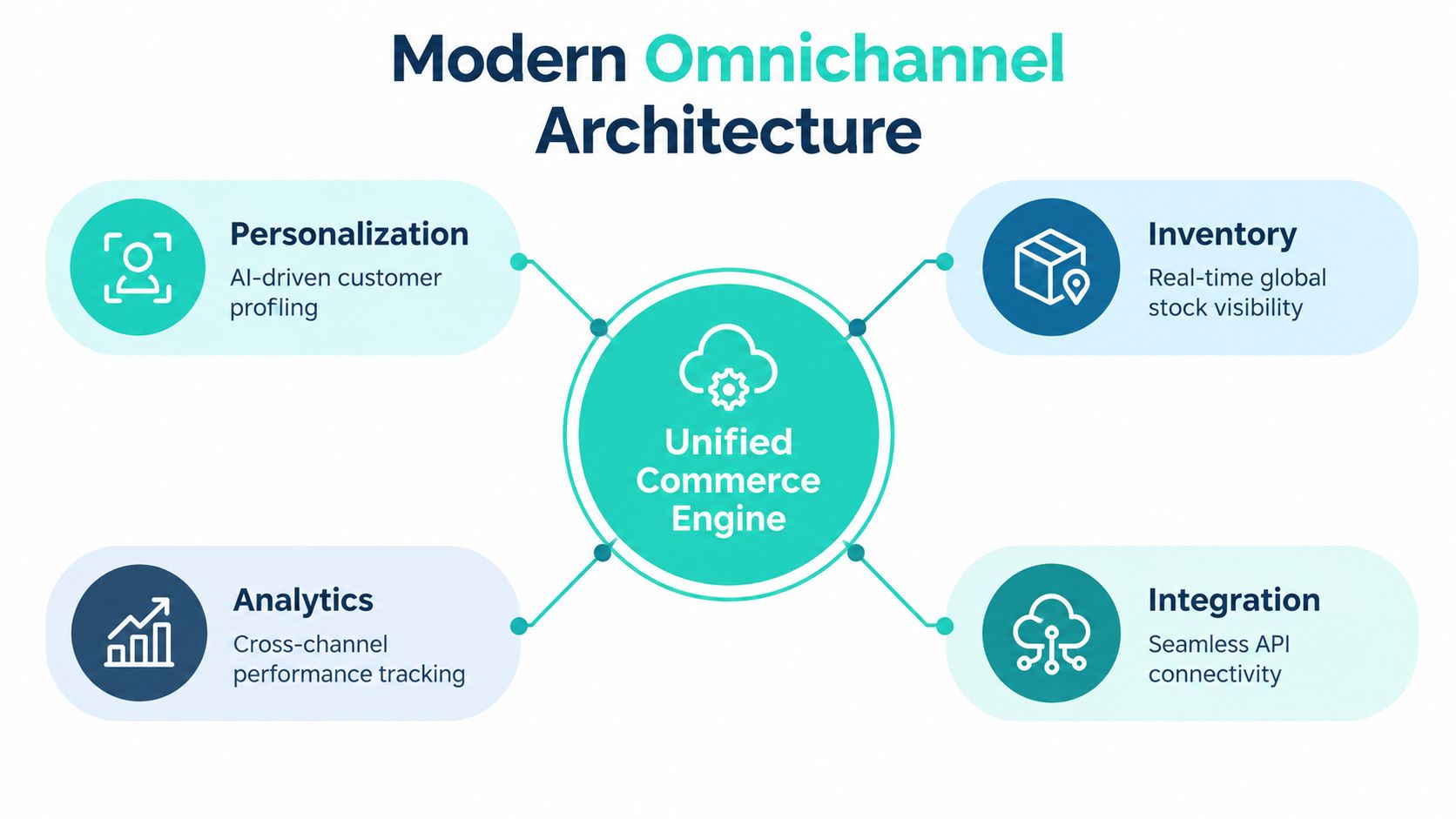
The platform therefore needs to synchronize:
- Product information, including descriptions, attributes, translations, and regulatory content.
- Pricing and promotion rules, including market, account, and audience conditions.
- Inventory and fulfillment status, including availability exposed to digital and physical touchpoints.
- Customer and account context, including permissions, preferences, and prior interactions.
- Content and personalization decisions, so the next interaction reflects what the customer has already done.
The term omnichannel retailing became recognized as a strategy in 2003, while historical accounts trace its modern growth to the early 2010s, when companies began moving beyond basic multichannel selling toward integrated journeys. By 2014, about 94% of companies still faced major implementation barriers, including inventory and channel integration problems, according to this historical overview of omnichannel retail development. That history matters because it shows why the current conversation must focus on operational maturity rather than channel count.
The invisible system behind the journey
A reliable platform behaves as an orchestration layer. It doesn't force every channel to look identical. Instead, it gives each channel an appropriate experience while ensuring that the underlying facts, permissions, and decisions remain consistent.
That distinction is especially important for enterprise brands. A customer-facing site may need rich editorial storytelling, while a sales portal needs account-specific pricing and a store associate needs fast product and order lookup. Consistency means shared rules and context, not identical screens.
Sitecore's role is strongest where content, experience, and personalization meet commerce. SharePoint's role is complementary. It can provide internal communications, product knowledge, approval processes, and employee-facing resources that support the same customer promise. The practical distinction between multichannel and omnichannel experience is therefore an architectural one, not merely a marketing definition.
Practical rule: If a channel cannot retrieve the same product, customer, order, and availability context as the other channels, it isn't part of a unified commerce operation. It's another integration to maintain.
Architectural Foundations and Key Features
An omnichannel ecommerce platform is not defined by the number of channels it connects. Its architecture succeeds only when those channels interpret the same product, customer, consent, and transaction meaning. A storefront can share APIs with a mobile app and still produce conflicting offers, unavailable inventory, or inconsistent customer treatment if the underlying semantics and ownership are unclear.
Headless architecture separates presentation from backend services. Catalog, pricing, inventory, and order services can support a web application, mobile interface, marketplace connector, store tool, or conversational buying flow. That separation gives frontend teams room to change their delivery layer without rewriting commerce services. It also shifts more work into integration design, observability, testing, release coordination, and governance.
SHOPLINE's comparison of headless and traditional commerce architecture reports that optimized headless implementations can improve frontend load performance by roughly 20% to 50%, with Largest Contentful Paint gains often in the 0.6 to 1+ second range. Those figures depend on the implementation. Caching, API design, rendering strategy, content delivery, and frontend code must work together before a team can expect a performance gain.
The core service model
A practical service model should define both the capability and the failure it is intended to prevent.
| Capability | What it must provide | Common failure mode |
|---|---|---|
| Product information management | One governed model for attributes, variants, translations, and channel-ready content | Product data is copied into each channel and drifts |
| Inventory synchronization | Location-aware availability and reservation events | Customers can buy stock that another channel has already committed |
| Order management | A shared order lifecycle across online, store, marketplace, and assisted sales | Support teams cannot see the complete order context |
| Experience orchestration | Audience, behavior, consent, and content signals for personalization | Personalization uses one channel's partial history |
| Integration layer | APIs, events, middleware, and gateways for ERP, CRM, POS, WMS, payments, and identity | Point-to-point connections become brittle and opaque |
| Analytics | Journey and operational measurement across touchpoints | Teams optimize channel reports instead of customer outcomes |
Sitecore XM Cloud imposes a concrete architectural constraint. Its documentation states that XM Cloud supports headless implementations only and does not support MVC-based solutions. A supported XM Cloud and Personalize path uses a headless CMS with JSS, Experience Edge, and a Jamstack or .NET Core client application, as described in the XM Cloud and XM Personalize feature documentation.
That requirement should shape discovery before migration begins. Teams need an inventory of rendering logic, component dependencies, personalization rules, content relationships, and integration contracts. The semantic model deserves equal attention. If “available,” “in stock,” “eligible,” or “premium customer” means something different across systems, a technically correct API can still create an incorrect customer experience.
Data orchestration matters more than the storefront
Middleware, microservices, and API gateways should assign clear ownership. A PIM may own product attributes, an ERP or warehouse system may own transactional stock, a customer platform may own identity, and Sitecore may own experience content. The goal is not to put every record in one database. It is to define authoritative sources, permitted transformations, event timing, and the response when a source is unavailable.
A research article on microservices and event-driven omnichannel retail reports 300% higher concurrent user loads, a 30% reduction in operational costs, a 31% improvement in inventory accuracy, and a 74% decrease in customer service response times in its reported implementation context. These figures come from the research on microservices and event-driven omnichannel commerce, not from a universal platform benchmark. The practical lesson is narrower and more useful: event-driven stock and order updates can reduce data lag, while independently scalable services can support resilience during demand peaks.
Before selecting frontend frameworks, document service ownership, event schemas, retry behavior, monitoring, consent handling, and failure recovery. The MACH architecture principles provide a useful reference for evaluating modularity and API contracts. In enterprise delivery, that discipline matters more than a polished storefront demo. The platform must preserve meaning as data moves through every channel.
Implementing Sitecore AI and SharePoint Integration
Sitecore AI produces useful omnichannel decisions only when the organization supplies governed context. Disconnected product data, inconsistent terminology, and incomplete identity records create unreliable recommendations regardless of model quality. Start with information architecture, semantic definitions, and system ownership. Add AI to workflows whose inputs, approvals, and fallback behavior are already understood.
Establish the experience foundation
Use XM Cloud as the headless content and experience hub. Define structured entities for products, categories, markets, audiences, campaigns, and reusable components. A shared taxonomy should clarify whether terms such as product availability, audience, promotion, and customer status mean the same thing across Sitecore, commerce, ERP, CRM, and SharePoint. Distribute approved content through Experience Edge and connect frontend applications with JSS and the selected delivery framework.
Build the implementation in a controlled sequence:
- Model shared content. Separate global brand rules from market-specific content, and create reusable component variants with clear inheritance.
- Define source ownership. Record whether product attributes, availability, price, customer data, and orders belong to Sitecore, commerce services, ERP, CRM, or another system.
- Connect event flows. Publish meaningful product, inventory, order, consent, and customer events rather than depending only on scheduled exports.
- Configure personalization inputs. Establish audience definitions, behavioral signals, consent rules, and fallback experiences before activating automated decisions.
- Integrate SharePoint Online. Use it for internal knowledge, employee communications, process documentation, approval workflows, and operational guidance. Keep transactional commerce data in its owning system.
- Test localized governance. Confirm that regional teams can adapt content without bypassing brand, legal, accessibility, or translation controls.
Sitecore's AI Automated Personalization is described as a SaaS capability hosted in Microsoft Azure. Its decisioning can use analytical models, including external machine learning models for propensity, forecast, and outlier use cases, according to the Sitecore XM Personalize feature documentation. Treat that capability as an integration boundary, not an autonomous strategy. Governance should specify which signals are allowed, how teams interpret them, how consent is enforced, and what the experience displays when confidence is insufficient.
Operationalize AI in the authoring workflow
Sitecore Stream is documented as a Content Copilot for creating on-brand text-based components in XM Cloud. It can personalize pages for a defined audience, while its brand-aware AI uses brand identity context across Sitecore products. Assigning a brand kit to a site gives the AI relevant brand insights when it generates or adapts content, as described in the Sitecore Stream documentation.
This model keeps AI inside the delivery process instead of treating it as a separate copywriting application. Authors work within established components, brand kits, approvals, localization rules, and publishing permissions. Human review remains required for regulated claims, product safety information, pricing statements, accessibility, and market-specific legal language. The content publishing workflow guidance offers a practical reference for assigning authoring, review, approval, and release responsibilities.
SharePoint integration should apply the same controls. Staff handling a return or advising a customer need current product guidance, fulfillment procedures, and escalation routes. A SharePoint intranet can expose that knowledge through role-aware experiences and Power Platform workflows, while XM Cloud focuses on external content and experience delivery. The integration succeeds when both systems preserve the meaning, ownership, and approval status of information as it moves between internal operations and customer-facing channels.
Choosing Between Composable and Monolithic Architectures
The monolith-versus-composable decision isn't a contest between old and new technology. It's a decision about where the enterprise wants complexity to live.
A monolithic CMS can be efficient when the organization has a contained scope, limited integration demands, and a stable release model. One deployment unit may simplify local development and reduce the number of services an operations team monitors. The trade-off appears when the same system must support multiple brands, markets, frontend applications, commerce services, and independent release cycles.
A composable architecture distributes capabilities across specialized services. XM Cloud can provide headless content and experience management, commerce services can own catalog and transaction logic, and SharePoint can support internal knowledge and collaboration. This arrangement improves architectural flexibility, but it also demands disciplined contracts, shared observability, identity design, environment management, and incident ownership.
A practical decision comparison
| Decision area | Monolithic approach | Composable headless approach |
|---|---|---|
| Frontend freedom | Presentation is closely tied to the platform | Frontends can evolve independently through APIs |
| Release management | A change may require a broad deployment | Services and applications can follow separate cadences |
| Integration | Connectors may be simpler initially | API and event design requires more upfront architecture |
| Scaling | Scaling can affect the whole application | Services can scale according to their workload |
| Personalization | Often coupled to platform rendering and data | Decisioning can consume signals from multiple services |
| Operations | Fewer moving parts, but larger deployment units | More moving parts, with clearer service boundaries |
| Migration | Familiar patterns may be easier to preserve | Legacy rendering and custom code need deliberate redesign |
Sitecore's XM Cloud constraint is decisive for teams moving from XP or another MVC-centered implementation. The target state must be headless, so a migration plan needs to address component rendering, content serialization, personalization dependencies, search, analytics, identity, and integration behavior rather than just moving databases.
Microservices and event-driven designs can support substantially higher concurrency and better inventory consistency in reported implementations, as noted in the earlier research citation. They don't automatically reduce cost. Poorly governed services can multiply platform fees, monitoring work, and debugging time.
Architect's test: Choose composable architecture when the business needs independent change across channels, markets, and capabilities. Keep a monolith where its simplicity is a real advantage, not where it merely hides unresolved integration debt.
Vendor Selection Criteria and Migration Roadmap
Vendor selection should begin with delivery evidence, not feature-page language. A platform may advertise headless commerce, AI personalization, and omnichannel support, but the evaluation team needs to see how those capabilities behave with the organization's catalog model, identity rules, ERP, warehouse operations, and publishing governance.
Ask vendors and implementation partners to demonstrate a complete journey. A useful demonstration starts with a product update, applies a market-specific content rule, changes availability, creates an order, exposes that order to support, and gives an employee the correct guidance in SharePoint. If the demonstration only shows a polished storefront, it hasn't tested the hard part.
Selection criteria that survive implementation
Evaluate the following areas:
- Architecture fit: Confirm support for headless delivery, APIs, events, cloud environments, and the frontend stack the team intends to operate.
- Sitecore depth: Check experience with XM Cloud, JSS, Experience Edge, Personalize, Stream, content modeling, and migration from XP or legacy rendering.
- Commerce integration: Test catalog, pricing, inventory, order, payment, fulfillment, returns, and marketplace scenarios using real business rules.
- Governance: Review workflows for brands, regions, languages, approvals, AI usage, accessibility, consent, and component reuse.
- Operational support: Establish expectations for monitoring, incident response, release management, security updates, disaster recovery, and performance tuning.
- Migration capability: Request a plan for content transformation, custom code replacement, redirect management, analytics continuity, and organizational adoption.
Kogifi operates as a Sitecore Silver Partner and delivers Sitecore, Adobe Experience Manager, and Microsoft 365 or SharePoint solutions. Its relevant delivery scope includes XM Cloud implementations, headless architectures, SharePoint Online intranets, composable migrations, and AI-driven personalization. That makes it one candidate for an enterprise team that needs those capabilities coordinated rather than procured as isolated workstreams.
A phased migration model
Begin with discovery and dependency mapping. Identify content types, integrations, rendering patterns, personalization rules, search behavior, analytics, workflows, and ownership gaps. Next, define a target architecture and select a bounded pilot journey that exposes real complexity without placing the entire business at risk.
Build the shared foundations before broad channel rollout:
- Establish environments, deployment pipelines, identity, observability, and integration contracts.
- Rebuild representative components and content models in XM Cloud.
- Connect commerce, inventory, customer, and order services.
- Integrate SharePoint workflows and employee knowledge where operational teams need them.
- Validate personalization, localization, accessibility, search, and analytics.
- Migrate in controlled waves, with rollback plans and parallel operational support.
The enterprise vendor selection process should include commercial assumptions as well as technical criteria. Require clarity on ownership after launch. A platform isn't successfully modernized if the internal team can't change content, diagnose an event failure, or govern AI decisions without returning to the implementation partner for every adjustment.
Enterprise Use Cases and Performance Measurement
A financial services portal may prioritize secure self-service, consent, auditability, and clear explanations. A manufacturer may need dealer portals, account-specific pricing, technical documentation, and sales-assisted ordering. Energy providers and airports may need multilingual content, accessibility, partner workflows, and high-availability service information. Retailers may focus on availability, returns, store fulfillment, and consistent product discovery.
The common requirement is not more channels. It is reliable execution at the handoff.

Measure whether the operating model works:
- Experience: conversion by journey, search success, content engagement, and continuation between touchpoints.
- Commerce: order completion, repeat purchase, customer lifetime value, and assisted-sales contribution.
- Operations: inventory accuracy, reservation failures, cancellation reasons, return completion, and fulfillment consistency.
- Service: first-contact resolution, repeated customer explanations, order visibility, and escalation volume.
- Governance: publishing lead time, localization quality, approval exceptions, accessibility defects, and AI content review outcomes.
These measures should be connected. A higher conversion rate isn't a success if cancellations rise because availability data is stale. More generated content isn't a success if regional teams spend longer correcting terminology and compliance errors. For teams scaling editorial production across markets, this guide to ecommerce content scaling is a useful complement to the platform discussion, especially when content volume begins to pressure governance.
AI-led discovery adds another requirement. Industry coverage describes a shift from keyword search toward AI-assisted product discovery and purchase completion inside messaging applications. The same coverage projects that 80% of marketing interactions may be AI-driven by 2026, and emphasizes the need for one consistent source of truth across channels in its discussion of omnichannel ecommerce trends. Product data must therefore be structured, unambiguous, localized, and governed well enough for an AI system or commerce agent to interpret it safely.
Before approving an omnichannel ecommerce platform, ask whether the organization can answer these questions:
- Which system owns every critical product, customer, inventory, and order field?
- Can an AI decision be explained, reviewed, overridden, and audited?
- Can employees find current operational guidance in SharePoint?
- Can the business publish across brands and markets without duplicating governance?
- Can the team measure fulfillment and returns alongside conversion?
- Can the architecture support new discovery surfaces without rebuilding the commerce core?
Sitecore's own description of hyper-personalization connects advanced data collection with AI-powered analysis of user behavior to support real-time omnichannel engagement, including use cases in financial services. Its hyper-personalization overview supports a practical conclusion: personalization is an orchestration capability only when the data, content, decisioning, and delivery layers are connected.
Kogifi helps enterprise teams design, migrate, and operate Sitecore XM Cloud, Sitecore AI, SharePoint Online, and composable digital experience platforms for connected commerce and content operations. Visit Kogifi to discuss your current architecture, integration risks, and a practical roadmap for building an omnichannel experience that is measurable, governed, and ready for AI-led discovery.