


A retailer can have a capable commerce engine and still struggle to launch a homepage campaign. Marketing waits for engineering, engineering waits for QA, and every change enters the same release train. Meanwhile, product teams want better search, merchandisers need faster catalog updates, and customers experience a storefront that feels slower and less relevant than the rest of the brand.
That situation is why headless e-commerce development services have moved beyond frontend experimentation. The architecture can separate presentation from commerce, but the value comes from changing how marketing, merchandising, engineering, and operations work together. For enterprise teams, Sitecore XM Cloud, Next.js, Sitecore Stream, SitecoreAI, and carefully governed integrations provide a practical foundation for that operating-model redesign.
Table of Contents
When a Monolithic Storefront Stops Serving the Business
Consider a retailer running a mature .NET commerce platform. The system handles pricing, inventory, checkout, and orders reliably, but the storefront has become the bottleneck. A homepage redesign touches server-rendered templates, shared business logic, analytics scripts, personalization rules, and regression tests. Marketing can't publish until engineering finishes, and engineering can't release until QA has tested a wide set of journeys.
The problem isn't necessarily that the commerce engine is inadequate. The problem is that one codebase owns too many decisions. A content editor's change can become a deployment concern. A merchandising experiment can compete with a payment integration for release capacity. A small design adjustment can require coordination between internal developers, an external delivery team, and an offshore testing group.
The operational symptoms
Monolithic storefronts usually reveal their limitations through workflow rather than architecture diagrams:
- Campaign delays: A seasonal landing page waits for a template release instead of moving through a controlled content workflow.
- Coupled testing: Teams retest checkout when they change a navigation component because both depend on the same deployment unit.
- Restricted experimentation: Personalization and search experiments require code changes, so marketers queue ideas behind product sprints.
- Fragile upgrades: A commerce-platform update creates pressure to modify the storefront at the same time, increasing regression risk.
- Duplicated channel work: Web, mobile, dealer portals, and kiosks each develop their own presentation logic around the same commerce data.
The industry is no longer treating this architecture as an edge case. One recent summary reports that 73% of businesses use headless website architecture, compared with 59% in 2021, while the global headless commerce market is projected to grow from $1.74 billion in 2025 to $7.16 billion by 2032. These figures are reported in the headless commerce statistics summary, but adoption alone doesn't prove that a headless implementation will work.
The operating-model response
Headless e-commerce development services create separate ownership boundaries. The commerce engine owns transactions and commercial rules. XM Cloud owns structured content and page composition. Next.js owns presentation and rendering. APIs define how those capabilities exchange data.
That separation lets a merchandiser update content without asking a developer to rebuild the checkout application. It lets engineering improve rendering without changing order logic. It also gives governance teams a clearer way to assign responsibility for authentication, caching, observability, accessibility, and release approval.
Practical rule: Don't decouple a storefront merely to replace server-rendered templates. Decouple the decisions that different teams need to make independently.
What Headless E-Commerce Development Services Actually Mean
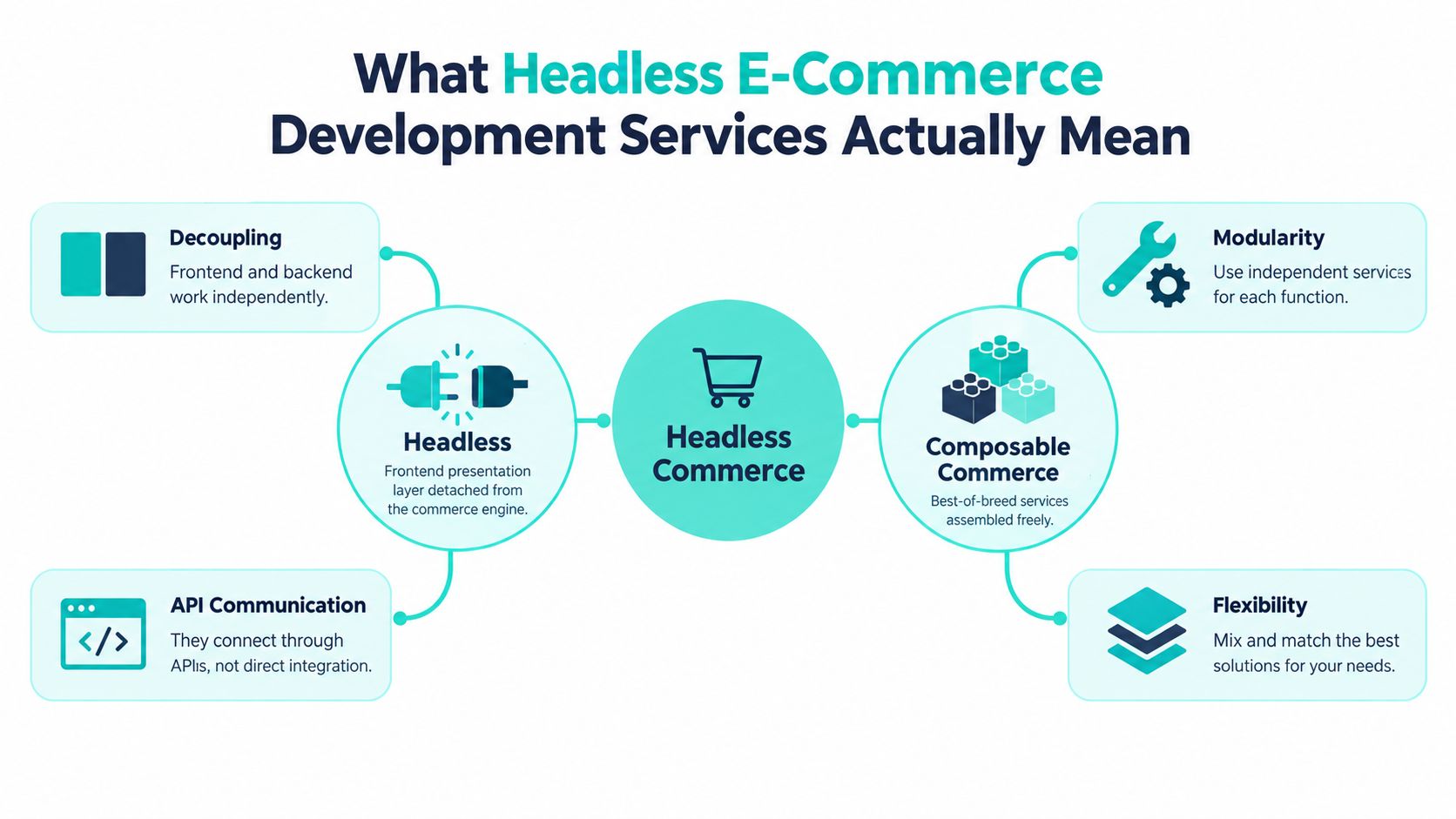
Headless commerce separates the customer-facing frontend from the commerce engine. Instead of rendering pages through templates owned by the backend platform, the frontend requests products, prices, availability, carts, and orders through documented APIs.
Composable commerce goes further. It treats commerce, CMS, search, payments, product information, customer data, and orchestration as capabilities that can be selected and connected according to business needs. A headless build can still use one primary commerce platform. A composable build usually coordinates several specialized services.
A restaurant analogy helps. The commerce engine is the kitchen, where orders, ingredients, and preparation rules live. The API contract is the menu, defining what can be requested and how the request is represented. The frontend is the dining room, where the customer experiences the result. Headless architecture separates the dining room from the kitchen. Composable architecture may also replace or specialize parts of the kitchen.
For a fuller plain-language definition, see this explanation of what headless commerce means.
The four building blocks
API layer: An API gateway or integration layer manages authentication, routing, throttling, transformations, and consistent contracts. It prevents every frontend component from developing a private connection to every backend service.
Frontend framework: Next.js is a strong fit for enterprise Sitecore delivery because it supports server rendering, static generation, client interactions, and edge-oriented deployment patterns. The framework should remain responsible for presentation, not pricing or order policy.
Commerce engine: This system manages catalog, price calculation, inventory, cart behavior, checkout, payment coordination, and orders. It might remain a legacy platform in a hybrid build or be replaced by a composable service.
Content hub: XM Cloud gives editors structured content, layouts, reusable components, and workflow. It can provide the narrative and merchandising context around commerce data without becoming the system of record for transactional rules.
The boundary matters more than the technology label. A poorly designed headless solution can create a distributed monolith, where every service is technically separate but every release still depends on every other team. Good services establish domain ownership, versioned contracts, fallback behavior, and a component library that teams can reuse across brands and channels.
Business Benefits That Move the Enterprise Needle
The strongest business case for headless e-commerce development services combines performance, release independence, and experimentation capacity. A faster frontend helps customers reach products. Independent releases help teams act on market opportunities. Reusable content and components help the organization scale without recreating every experience.
A benchmarked comparison reported homepage p95 LCP of 3.2 seconds for monolithic Magento, 1.4 seconds for a headless React storefront, and 1.5 seconds for a headless Vue storefront. The same comparison reported category-page LCP improving from 2.8 seconds to 1.1 to 1.2 seconds, and product-page LCP improving from 2.1 seconds to 0.9 to 1.0 seconds. The figures appear in this headless performance benchmark. The benchmark also links a 0.5-second LCP gain with a 4% to 7% conversion lift, and a 1.0-second gain with a 7% to 12% lift, so performance engineering can affect revenue rather than only technical scores.
Who benefits and why
- The CMO gets campaign autonomy: Content teams can publish approved layouts and offers without waiting for a full storefront release.
- The CTO gets clearer boundaries: Teams can upgrade presentation, search, or content services without automatically changing transaction logic.
- The CFO gets a measurable model: Faster journeys, reduced release friction, and lower duplication can be connected to revenue and operating effort.
- The SEO team gets control: Next.js gives engineers direct control over rendering, metadata, canonicalization, internal links, and structured content delivery.
- Customers get consistency: The same commerce capabilities can support web, mobile, kiosks, and partner experiences while each channel uses an appropriate interface.
The operational evidence also matters. An academic review of composable commerce reported up to 53% faster feature deployment and about 20% cost savings, while an integration study reported an average deployment time of 8.5 days, a 65% reduction after adopting a composable integration architecture. Those findings are summarized in this composable commerce integration review. They don't guarantee the same outcome for every organization. They show where value can emerge when teams standardize integration layers and reuse shared components.
| Metric | Legacy Baseline | Headless Outcome |
|---|---|---|
| Page delivery | Rendering and third-party scripts compete in one storefront | Rendering strategy, caching, and asset delivery can be optimized independently |
| Release process | Content and code changes often share a release train | Content workflows and frontend deployments can follow separate controls |
| Experimentation | Personalization changes may require engineering work | Teams can expose structured content and decision points through APIs |
| Channel reuse | Each channel may implement similar commerce logic | Multiple frontends can consume governed commerce capabilities |
| Measurement | Technical improvements sit apart from commercial reporting | Performance, release cadence, and conversion can be evaluated together |
A headless build isn't automatically faster or cheaper. Large client bundles, excessive API calls, poor cache rules, and ungoverned integrations can recreate the same friction in a new form. The business benefit appears when the architecture supports a better way of working, not just when the frontend uses React.
For enterprise context, the distinction between architecture and operating model is also central to enterprise e-commerce planning.
The Sitecore AI Tech Stack Behind Modern Headless Builds
A Sitecore-centered headless stack works best when each product has a defined job. XM Cloud should manage content and page composition. Next.js should render the experience. Experience Edge should deliver content through a globally distributed API. Commerce services should own transactions. Sitecore Stream and SitecoreAI should support content and experience operations without becoming an ungoverned automation layer.
Sitecore describes XM Cloud as a headless CMS and composable DXP foundation that includes Experience Manager, Pages, SXA, Headless Services, the Sitecore Next.js SDK, and Experience Edge. That product boundary is useful because it gives enterprise teams a managed content backbone while leaving presentation and commerce orchestration open.
A practical request path
A typical product page follows this sequence:
- A visitor requests a route handled by Next.js.
- Next.js resolves layout and editorial content from XM Cloud and Experience Edge.
- A commerce API provides product, pricing, inventory, and availability data.
- The server renders the initial page, while client-side code handles interactive choices such as variants or cart updates.
- Analytics, search, personalization, and consent services receive governed events.
- CI/CD promotes the application through Azure environments after automated tests and content checks pass.
Sitecore identifies Next.js as the preferred rendering SDK for XM Cloud, and its documentation describes precompiling content into static HTML for hosting on edge infrastructure such as Vercel or a CDN. In an Azure-centered enterprise setup, the same principle can be applied through an approved hosting and delivery topology, with careful decisions about preview, cache invalidation, and runtime data.
Where AI belongs
Sitecore describes Sitecore Stream as AI capability embedded in its products, using brand-aware AI, copilots, agents, and agentic workflows to accelerate content creation and delivery. The useful implementation question isn't whether AI exists. It's where the organization permits AI to act, what source content it may use, and which actions require human approval.
Independent reporting on the Sitecore roadmap describes SitecoreAI and Agentic Studio, including 20 AI-powered agents and connected migration pathways. Treat those capabilities as part of a governed product strategy. Establish content permissions, brand rules, audit trails, evaluation criteria, and cost controls before enabling broad automation.
| Component | Primary Role | Integration Pattern |
|---|---|---|
| XM Cloud | Structured content, layouts, workflows, and reusable components | Sitecore SDK, content APIs, deployment webhooks, and environment governance |
| Experience Edge | Distributed content delivery | GraphQL consumption from Next.js with cache and invalidation rules |
| Next.js | Rendering, routing, SEO, and interaction design | Server rendering, static generation, API clients, and shared component libraries |
| Commerce engine | Catalog, price, inventory, cart, checkout, and orders | REST or GraphQL APIs behind an integration layer |
| Sitecore Stream | Brand-aware content and delivery assistance | Governed workflows, approved prompts, and editorial review |
| SitecoreAI | AI-assisted creation, enrichment, personalization, and search capabilities | Product-native controls, observability, permissions, and usage monitoring |
| DAM and CDP | Asset governance and audience context | Asset references, profile signals, consent controls, and event pipelines |
The trade-offs are real. Preview data may not behave like edge-cached production data. Token usage needs forecasting and monitoring. DAM renditions, CDP consent, search indexing, and commerce availability can fail independently. A senior delivery team designs fallback states for each dependency rather than assuming every API responds perfectly.
Hybrid Headless, Full Composable, and the SharePoint Layer
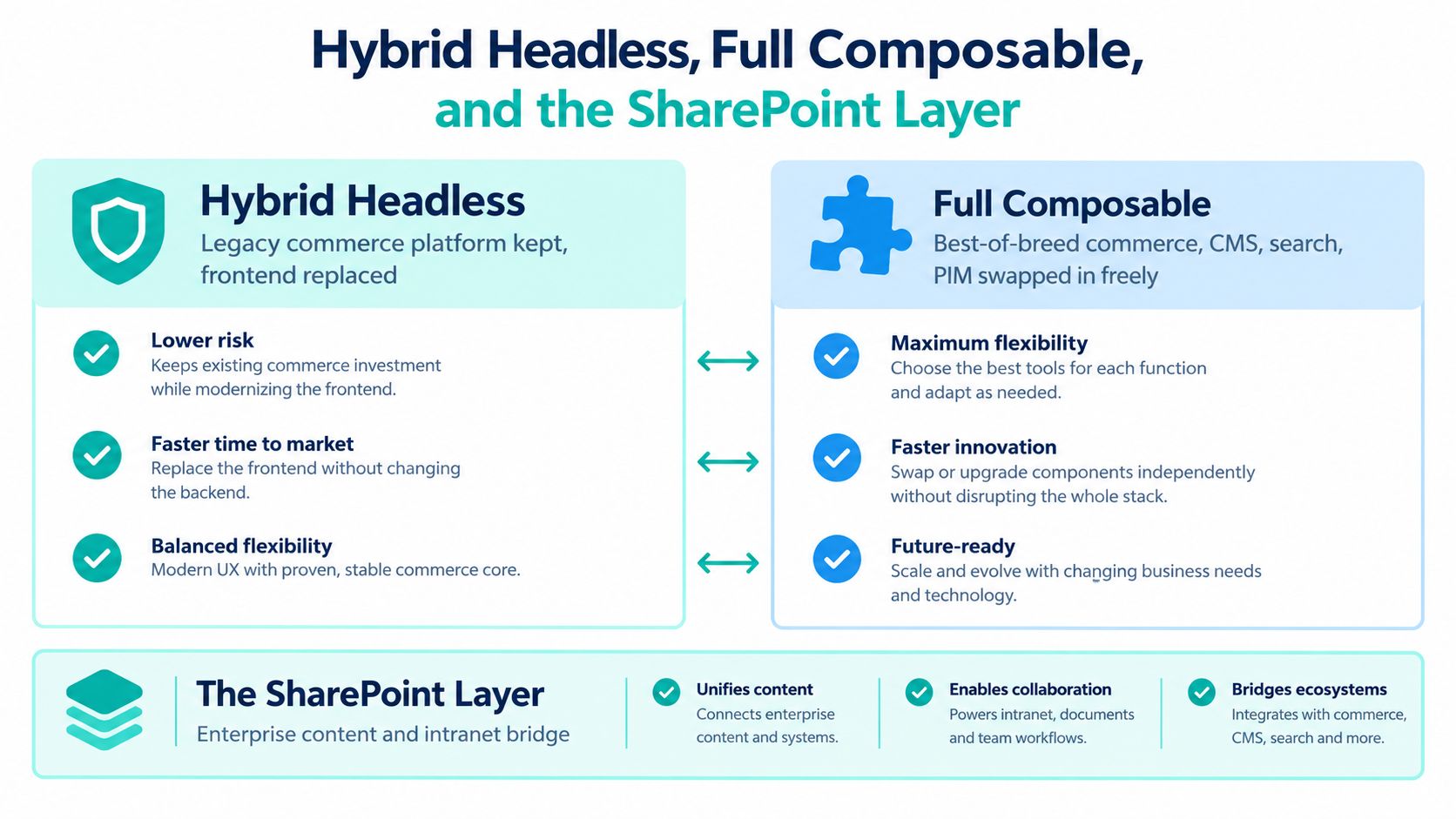
A hybrid headless build keeps the existing commerce platform and replaces or separates the storefront. A full composable build also changes the underlying capabilities, selecting specialized services for commerce, CMS, search, payments, product information, and customer data.
Hybrid is usually the safer choice when the existing platform contains complex pricing, ERP coupling, order management, tax rules, or operational processes that the business can't afford to destabilize. The team can improve the customer experience while preserving the transaction core. This approach also makes it easier to prove value before committing to a broader replatform.
Full composable is more appropriate when the organization needs multi-brand orchestration, channel-specific experiences, rapid experimentation, or a commerce foundation that the current platform can't provide. It offers more freedom, but every new service creates another contract, release dependency, security review, monitoring obligation, and ownership question.
The market data reinforces why a binary decision can be misleading. One industry analysis estimates the headless commerce platform market will grow from $2.04 billion in 2025 to $6.17 billion by 2031, with services projected to expand at a 23.84% CAGR through 2031. The same analysis reports cloud deployment at 68.19% of the market in 2025, retail and e-commerce at 34.82%, and B2B commerce, marketplaces, and other applications together at 65.18%. These figures are presented in the headless commerce platform market analysis. They show broad use cases, not a reason to replace a stable backend without a business case.
SharePoint as the employee-facing counterpart
The same architectural thinking applies inside the organization. A SharePoint Online intranet can remain the authoritative system for employee documents, collaboration, permissions, and Microsoft 365 content, while a customized experience layer presents information for employees, dealers, partners, or field teams.
A Next.js and XM Cloud pattern can support an extranet or dealer portal that combines structured experience content with authenticated SharePoint resources. Entra ID and OIDC provide identity continuity. SPFx components and Power Platform workflows can handle Microsoft 365-native interactions. The result isn't a second public storefront. It's a governed bridge between customer-facing experience design and employee-facing operational content.
The decision in practice
Choose hybrid when transaction continuity dominates the risk calculation. Choose full composable when service independence creates a clear advantage in channel delivery, product discovery, or organizational speed. Use the SharePoint layer when employees need a focused experience over existing Microsoft 365 systems, not when the organization needs to duplicate those systems in XM Cloud.
Migration and Integration Playbook for Legacy Platforms
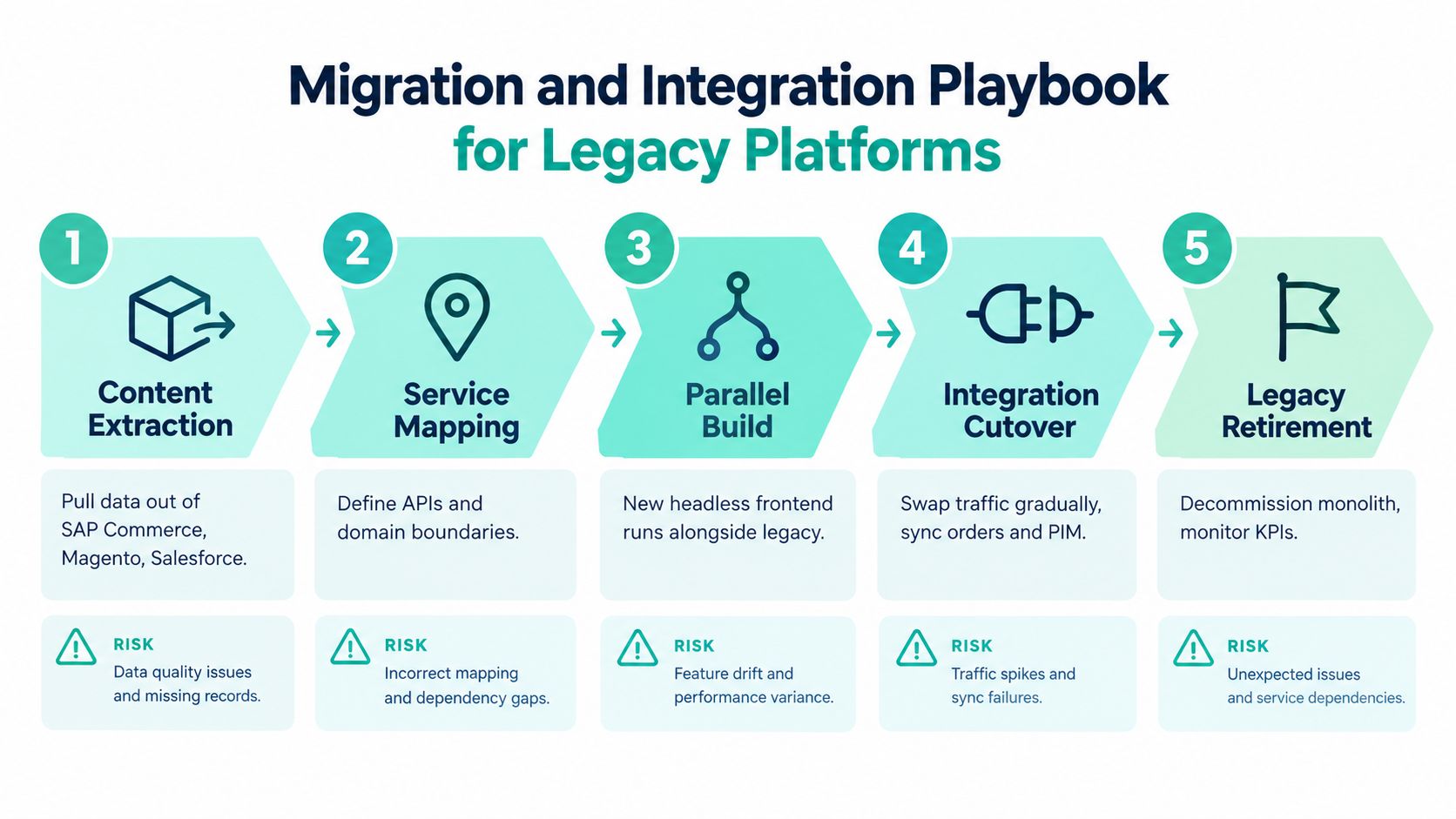
A migration succeeds when the team moves capabilities in controlled slices rather than treating launch day as a single switch. SAP Commerce, Magento, and Salesforce Commerce Cloud can remain active while the new experience proves its routes, integrations, content workflows, and operational controls.
Start with inventory and boundaries
Extract content from the legacy CMS into XM Cloud only after classifying it. Separate reusable structured content from presentation-specific markup, expired campaign material, product data, legal content, and assets with unclear ownership. A migration that copies every field preserves historical complexity instead of creating a maintainable content model.
Then map domains and APIs. Product, price, inventory, search, cart, order, customer, payment, tax, shipping, and promotions shouldn't all pass through one generic endpoint. Define ownership, response contracts, error behavior, caching rules, and versioning before the frontend team builds against them.
The headless e-commerce architecture guide is useful as a reference point, but delivery teams still need an implementation-specific contract catalogue.
Run the strangler pattern
Place the Next.js frontend in front of the monolith and migrate routes incrementally. A route or journey can move when its content, API dependencies, SEO behavior, analytics, accessibility, and support runbook are ready. Feature flags should control traffic allocation so the team can expose selected pages or customer segments without committing the whole estate.
Identity needs its own workstream. Use OIDC and Entra ID where appropriate, define token exchange rules, and test session behavior across account, cart, checkout, and partner journeys. Payment and tax services can coexist during cutover, but the team must know which system owns the final transaction and how reconciliation works.
Release and rollback discipline
Azure DevOps pipelines should build, test, scan, and promote the frontend and integration services through controlled environments. Useful gates include:
- Contract tests: Verify that commerce and content responses match what the frontend expects.
- Data checkpoints: Reconcile catalog, price, inventory, customer, order, and redirect data before each migration slice.
- Synthetic journeys: Exercise search, product selection, cart, checkout, account, and content publishing continuously.
- Rollback criteria: Define acceptable error behavior, latency, indexing, analytics, and order-reconciliation thresholds before launch.
- Operational ownership: Assign who responds to a failed deployment, stale cache, unavailable commerce API, or broken personalization rule.
Before each traffic change, test cache invalidation, payment-provider coexistence, order synchronization, and SEO redirects. A migration is ready when the organization can reverse a change safely, not merely when the new homepage looks correct.
Proving ROI and Controlling Hidden Lifecycle Costs
A defensible business case separates initial implementation cost from lifecycle economics. The first category includes discovery, design, migration, frontend delivery, integration, testing, and launch. The second includes hosting, observability, API maintenance, content operations, security, support, and the people needed to govern a distributed platform.
A retail-focused report identifies high development cost and integration complexity as barriers cited by 44% of respondents, and another market view notes that smaller organizations face limited resources and high initial implementation costs. Those findings appear in this headless commerce report. They explain why a technically attractive architecture can still fail financially when the operating model isn't funded.
Build the financial model around decisions
Don't promise a universal payback period. Model the current cost of delayed releases, duplicated channel work, platform upgrades, incident response, content production, and technical debt. Then model the target state using actual staffing, vendor contracts, infrastructure assumptions, traffic patterns, support coverage, and content volume.
Performance gains can be connected to commercial outcomes where measurement is reliable. The benchmark cited earlier links a 0.5-second LCP gain to a 4% to 7% conversion lift and a 1.0-second gain to a 7% to 12% lift, but a finance review should use the organization's own baseline, attribution model, and controlled testing rather than applying those ranges automatically.
| Cost / Value Driver | Legacy Monolith (3yr) | Headless Composable (3yr) |
|---|---|---|
| Platform licensing | Existing contract and upgrade obligations | XM Cloud and connected platform subscriptions |
| Hosting | Monolithic runtime and shared infrastructure | Frontend, APIs, edge delivery, and service environments |
| Integration maintenance | Fewer visible services, but tightly coupled changes | More explicit APIs, contracts, monitoring, and version management |
| Content operations | Development dependency for some experience changes | Greater editorial autonomy with governance and component ownership |
| Release effort | Shared release train and broad regression scope | Independent delivery where boundaries are well designed |
| Support model | Platform specialists and monolith incident response | Frontend, integration, content, AI, and observability coverage |
| Value creation | Stable transaction core but slower experience change | Faster experimentation, channel reuse, and selective modernization |
The costs buyers underestimate
API versioning becomes a permanent responsibility when commerce, search, PIM, DAM, CDP, and identity services evolve at different rates. Observability also expands. Teams need logs, traces, synthetic tests, alert routing, incident runbooks, and support coverage for failures that previously appeared as one application error.
AI-enabled delivery introduces governance and usage considerations. Sitecore Stream and SitecoreAI need approved data boundaries, human review, prompt and workflow ownership, evaluation practices, and usage monitoring. Security teams must also patch and test the headless surface, including frontend dependencies, API gateways, authentication flows, webhooks, and third-party integrations.
Finance discipline: Count the people required to own the platform after launch. A composable architecture is only economical when the organization budgets for its contracts, controls, and operational care.
The best ROI model pairs hard savings with deferred risk. Track release effort, campaign lead time, frontend performance, conversion by journey, incident volume, content production effort, API failure rates, and platform utilization. Review those measures after launch against the baseline, then decide whether the next investment should target commerce replacement, search, personalization, content reuse, or operational simplification.
Choosing a Headless E-Commerce Development Partner
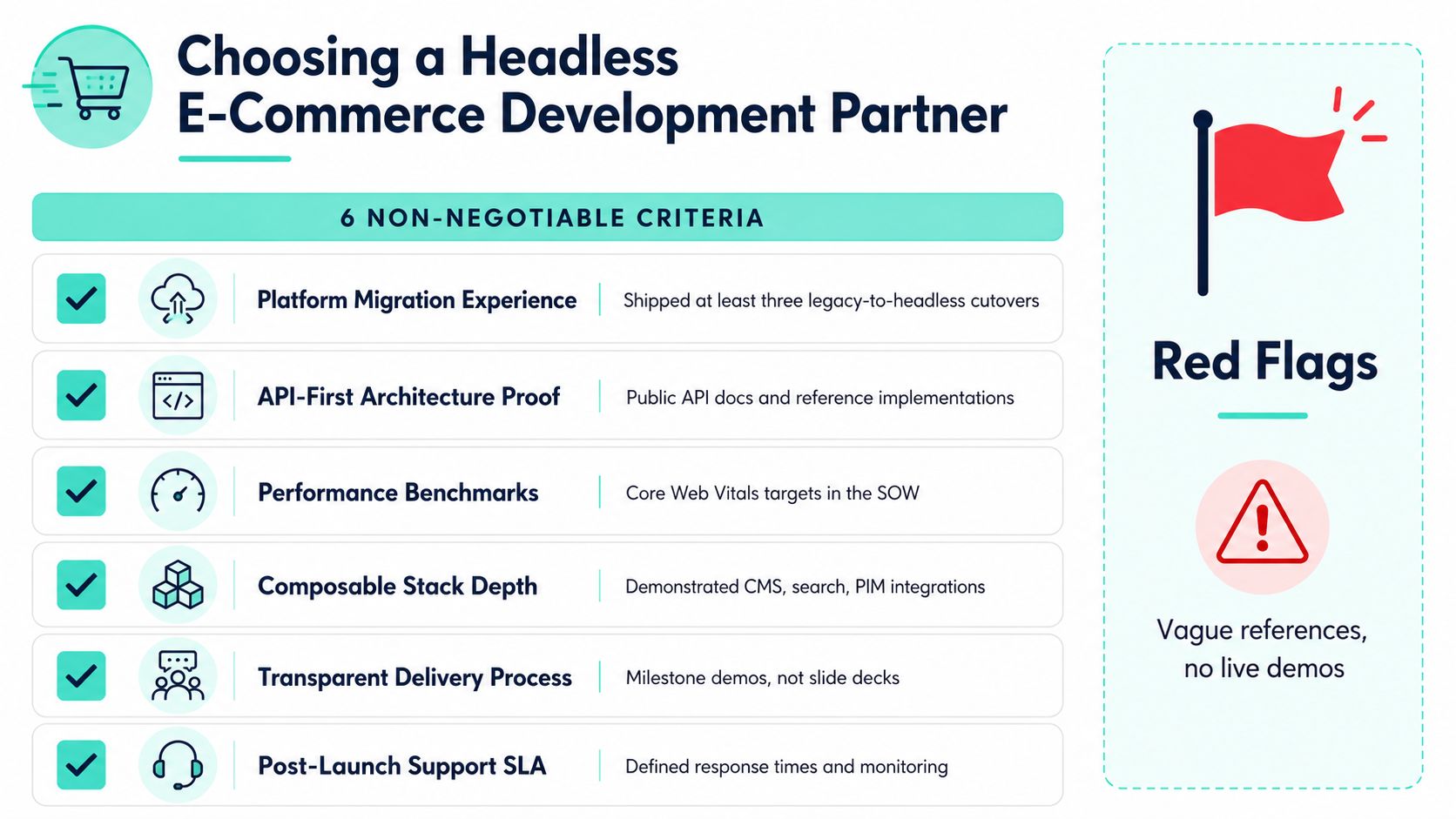
The right partner must understand both Sitecore implementation detail and enterprise operating risk. A portfolio full of attractive frontend designs isn't enough. The delivery team needs to show how it models content, integrates commerce, handles preview and edge delivery, protects SEO, supports releases, and responds when an external dependency fails.
Start with evidence rather than claims. Ask for certified Sitecore XM Cloud capability, delivered enterprise go-lives, deep Next.js and Experience Edge experience, and hands-on integration with a commerce engine such as OrderCloud, SAP Commerce, or commercetools. The partner should be able to explain why it chose a particular rendering strategy, where data is cached, how it handles unavailable APIs, and who owns each domain after launch.
What strong partners can demonstrate
- Migration experience: They can show a phased cutover from a legacy CMS or commerce platform, including redirects, data reconciliation, rollback, and post-launch stabilization.
- API-first architecture: They maintain domain contracts, integration tests, versioning rules, and clear ownership rather than connecting every component directly to every service.
- Performance accountability: Core Web Vitals, rendering behavior, accessibility, SEO, and observability appear in delivery acceptance criteria, not only in a sales presentation.
- Composable depth: They understand CMS, commerce, search, PIM, DAM, CDP, identity, payments, tax, and analytics as an operating system of dependencies.
- AI enablement: They can configure Sitecore Stream and SitecoreAI with permissions, review workflows, brand controls, usage monitoring, and measurable editorial outcomes.
- Support maturity: They provide monitoring, incident response, escalation paths, documented runbooks, and an SLA-backed support model suited to the commercial importance of the storefront.
A partner should also help decide not to go fully composable when hybrid headless will solve the actual constraint. That judgment is a sign of architecture maturity. Replacing a stable transaction core only to modernize presentation can create migration risk without improving the business process that caused the original problem.
Use a scorecard that assigns weight to migration quality, Sitecore depth, API design, Next.js delivery, Azure DevOps practices, security, accessibility, support, and knowledge transfer. During discovery, ask:
- Which parts of our current platform would you keep, and why?
- How will you separate content, commerce, search, identity, and personalization ownership?
- What happens when Experience Edge, commerce APIs, or personalization services are unavailable?
- How will you measure performance, release independence, conversion, and support cost?
- What runbooks and monitoring will exist on launch day?
- How will your team train our editors, developers, and platform owners?
A vendor that can't answer those questions may still build a polished frontend, but it isn't offering a complete headless e-commerce operating model. Use a structured vendor selection process to compare delivery evidence, governance, and lifecycle support rather than presentation quality alone.
Kogifi designs and maintains Sitecore XM Cloud and Next.js headless commerce platforms, integrates composable services and SharePoint-based employee experiences, and supports enterprise teams with Azure delivery, performance work, and ongoing operations. Visit Kogifi to discuss a migration or operating-model assessment for your commerce and digital experience estate.