


Most digital leaders aren’t asking whether enterprise e commerce matters anymore. They’re asking how to untangle a stack that grew by acquisition, regional workarounds, urgent integrations, and years of content decisions that made sense locally but broke globally.
That usually looks familiar. One team manages a CMS that was never designed for commerce. Another owns ERP integrations no one wants to touch. Product data lives in too many places. Regional sites behave differently. Search is inconsistent. Personalization is mostly manual. The board still expects faster launches, stronger conversion, cleaner reporting, and a platform that won’t become a rewrite project in two years.
That’s the essential frame for enterprise e commerce in 2026. It isn’t an online storefront project. It’s a business operating model expressed through architecture, content, data, AI, and integration discipline.
The Unavoidable Shift to Enterprise E Commerce
Enterprise e commerce has moved from strategic option to operating requirement. The pressure doesn’t come from one channel. It comes from every part of the business at once: customers expect consistent buying journeys, internal teams need cleaner workflows, and leadership wants digital revenue to scale without multiplying operational friction.

The market signal is clear. Global eCommerce sales are projected to reach $7.5 trillion in 2025, up from $5.7 trillion in 2023, with 85% of global consumers now shopping online, according to digital commerce statistics compiled by Cimulate. That matters because the shift is no longer about digital-first brands only. It affects manufacturers, distributors, public sector institutions, multi-brand groups, and global organizations running both B2B and B2C models.
Why leaders feel the pressure now
The issue isn’t just growth in online demand. It’s the mismatch between customer expectations and enterprise readiness.
Three problems show up repeatedly:
- Fragmented experience layers: Teams run separate websites, portals, commerce engines, and campaign tools that don’t share context well.
- Operational drag: Catalog, pricing, availability, and content updates move through manual processes that slow launches and create errors.
- Weak decision loops: Data exists, but it’s scattered, delayed, or too inconsistent to support meaningful personalization.
A lot of organizations still treat commerce as a channel bolted onto marketing infrastructure. That approach fails once buying journeys span product discovery, account-specific pricing, self-service support, reorder flows, and post-purchase service.
Practical rule: If your commerce stack can’t support content, transactions, service, and data in one connected model, it will create friction faster than your teams can patch it.
Leaders looking at the future of digital commerce usually reach the same conclusion. The winning move isn’t adding more point solutions. It’s building an enterprise-grade experience and commerce foundation that can adapt without forcing a replatform every time the business changes.
Defining the Enterprise E Commerce Landscape
Enterprise e commerce isn’t just a larger online store. It’s a coordinated digital business platform built to handle organizational complexity that standard commerce setups can’t absorb cleanly.
A simple test helps. If your buying experience depends on account hierarchies, region-specific content, negotiated pricing, approval workflows, ERP synchronization, and multiple internal teams owning parts of the journey, you’re already in enterprise territory.
The commercial context supports that view. In 2025, U.S. eCommerce sales hit a record $1.234 trillion and reached 23.1% of total retail sales, according to Digital Commerce 360’s U.S. eCommerce sales coverage. Online channels are no longer peripheral. They’re normalized. That changes the standard for platform design.
Enterprise scale is operational, not cosmetic
Most mid-market commerce discussions focus on storefront features. Enterprise e commerce starts elsewhere. It starts with what the business must coordinate.
That usually includes:
- Large catalog and content estates: Product data, media, documentation, support content, and region-specific messaging have to stay aligned.
- Multiple business models: B2B, B2C, B2B2C, dealer networks, distributors, and direct sales often run in parallel.
- Multi-region delivery: Language, compliance, market structure, and operational differences affect every layer of the journey.
Complexity changes the technical bar
At enterprise level, the transaction is only one moment in a longer process. Buyers may research across devices, return through account portals, involve procurement teams, request approvals, and expect service visibility after purchase.
That means the platform has to support more than checkout:
| Enterprise demand | What it means in practice |
|---|---|
| Account-aware journeys | Different users see different catalogs, pricing, permissions, and actions |
| Connected operations | Commerce must work with ERP, CRM, PIM, DAM, analytics, and service systems |
| Governed content | Legal, brand, and regional teams need workflow control without blocking speed |
Enterprise e commerce succeeds when the business can change pricing logic, buying flows, or regional content without opening an architecture crisis.
Integration is the real differentiator
The biggest misunderstanding is assuming enterprise e commerce is defined by revenue volume alone. It isn’t. It’s defined by the depth of integration required to run the business properly.
A standard platform can publish products and process orders. An enterprise platform has to support quoting, account structures, inventory visibility, localized content, omnichannel continuity, and governance across many teams.
That’s why architecture choices matter so much. The storefront is visible. The system coordination underneath it is where enterprise success is won or lost.
Architectural Crossroads Monolith vs Composable
Most enterprise teams reach the same decision point after living with an aging commerce stack for long enough. Do they keep extending a tightly coupled platform because it already exists, or do they move to a composable model that gives each capability room to evolve?
The easiest way to explain the difference is construction.
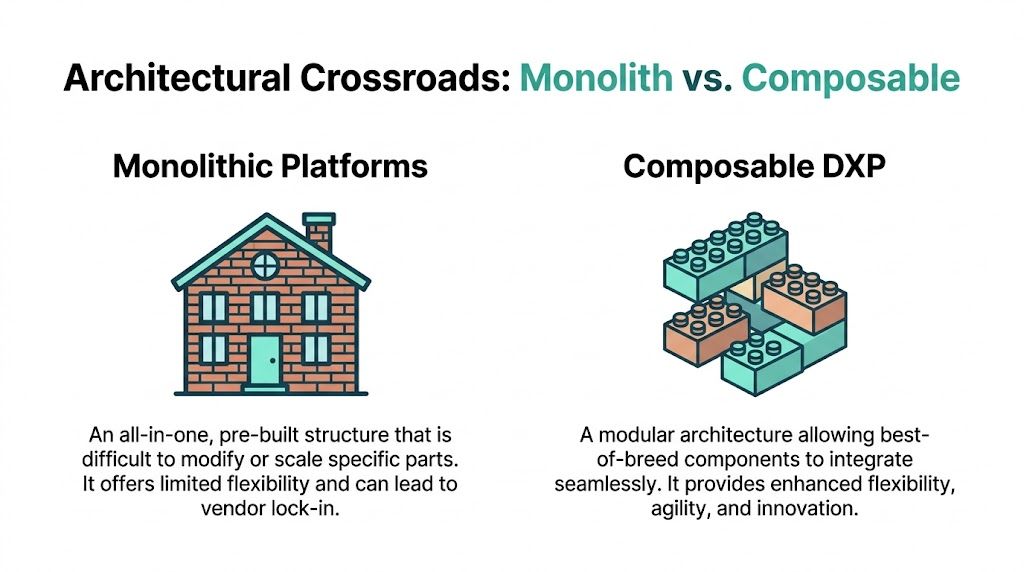
A monolith is like buying a pre-built house. It’s ready quickly, and a lot of essentials come bundled together. But once you need to move walls, replace plumbing in one section, or expand a single room without disturbing the rest, every change becomes expensive and invasive.
Composable architecture is like building with specialist trades on a shared plan. The structure still has to be coherent, but you can improve one part without rebuilding the whole property.
What monoliths still do well
Monolithic platforms aren’t automatically wrong. For some organizations, they still offer a useful package.
They can be attractive when:
- Speed matters more than flexibility: Teams need a defined feature set and can accept vendor conventions.
- The business model is stable: Product structure, pricing logic, and regional requirements don’t change often.
- Internal engineering capacity is limited: The organization prefers one platform boundary over an ecosystem of services.
The trade-off appears later. Every deep customization creates more dependency on platform-specific patterns. Over time, the business starts adapting to the system instead of the system adapting to the business.
Why composable wins in complex environments
Composable enterprise e commerce puts APIs at the center. Content, commerce, search, personalization, customer data, and integrations can be separated into focused services with clear responsibilities.
That matters because enterprise change is uneven. Marketing may need to launch new experiences quickly. Operations may need better fulfillment visibility. Regional teams may need different market logic. A composable stack lets those changes happen without forcing a full rebuild.
Enterprises using API-first, composable architectures can reduce implementation timelines by 30-40% compared to traditional tightly-coupled systems, according to SAM Solutions’ explanation of digital experience platforms.
That timeline advantage isn’t magic. It comes from decoupling concerns. Teams stop waiting for a single platform release cycle to change everything.
For a practical architectural primer, this guide to composable commerce is worth reviewing alongside your current platform constraints.
Architecture Showdown Monolith vs. Composable
| Attribute | Monolithic Architecture | Composable Architecture |
|---|---|---|
| Change management | Changes often affect the full platform | Teams can update capabilities independently |
| Integration pattern | Connectors are possible, but coupling tends to increase over time | API-first integration is foundational |
| Vendor dependency | Higher lock-in once customizations grow | Lower lock-in if capabilities remain modular |
| Time to evolve | Slows as platform complexity accumulates | Faster when services are well-governed |
| Best fit | Stable models with modest variation | Multi-brand, multi-region, and high-change environments |
The mistake to avoid
Some teams say they want composable when they really mean headless storefronts on top of the same brittle core. That isn’t enough.
A React frontend over tightly coupled business logic won’t solve pricing rigidity, poor data flow, or weak orchestration between systems. It only moves the visible layer.
A modern frontend can hide architectural debt for a while. It can’t remove it.
True enterprise e commerce modernization starts with deciding which capabilities deserve independence, which systems remain systems of record, and where AI and decisioning should live. Once those choices are explicit, composable becomes a strategy instead of a buzzword.
Building Your AI Powered Core with Sitecore
A common enterprise scenario looks like this. The commerce stack can process orders, the CMS can publish pages, and the CRM stores account data, but none of those systems can react fast enough during the buying session to change what the customer sees. The result is a store that functions, yet still underperforms.

That gap is where Sitecore is unusually strong. For enterprise e commerce, the value is not a bundled suite story. The value is a composable set of products that lets teams place content, commerce, customer intelligence, and internal operations in the right roles without forcing everything into one platform.
In practice, the AI-powered core needs four capabilities working together:
- A content system that supports structured publishing across brands, regions, and teams.
- A commerce engine that can represent account rules, catalog complexity, and nonstandard order flows.
- A customer data and decisioning layer that can act on behavior while the session is still active.
- An internal collaboration layer for approvals, documents, operational knowledge, and controlled workflows.
Sitecore covers the first three well. SharePoint often supports the fourth, especially in organizations with strict governance or regional operating models.
XM Cloud for content operations that keep pace with commerce
Enterprise commerce performance is often limited by content operations, not checkout logic. Teams need to update promotional pages, product education, campaign assets, service content, localization variants, and account messaging without waiting on backend release cycles.
XM Cloud gives teams a cleaner way to manage that workload. Content models stay structured, publishing gets faster, and front-end teams are not forced to rebuild business logic every time marketing needs a new page variation or regional message.
That matters because commerce journeys are content-heavy long before a customer reaches cart. In B2B, content supports specification review, stakeholder alignment, procurement confidence, onboarding, and retention. In B2C, it shapes discovery, comparison, and brand trust. If the content layer is slow, the commercial layer loses effectiveness.
Leaders aligning content architecture with real-time decisioning should also review how enterprise CMS powers AI personalization, because personalization quality depends heavily on the structure and usability of the content itself.
OrderCloud for transactional models that standard storefronts struggle to represent
OrderCloud fits enterprises that need commerce logic to reflect how the business sells. That distinction matters. Many platforms can launch a storefront. Fewer can cleanly support negotiated pricing, delegated purchasing, approval chains, seller-assisted ordering, distributor models, and internal procurement patterns in the same environment.
The practical advantage is flexibility at the model level. Product relationships, user roles, buyer organizations, and order rules can be shaped around the operating model instead of forced into retail-first assumptions.
Typical examples include:
- Account-specific pricing and assortments for contract customers or channel partners
- Multi-user buying structures where procurement, finance, and approvers all have different permissions
- Hybrid revenue models that combine direct sales, partner ordering, subscriptions, or service-related purchases
- Multi-region catalog control where business units need local variation without fragmenting the whole platform
From an architecture standpoint, OrderCloud works best when it is treated as commerce infrastructure. Teams that expect a prepackaged storefront experience often underestimate the design work required. Teams that need a flexible commerce domain usually see the benefit quickly.
CDP and Personalize for decisioning that happens in session
The AI conversation in enterprise e commerce gets vague fast. What matters is not whether a platform includes AI terminology. What matters is whether the system can use customer context in time to change the experience before the opportunity passes.
Sitecore CDP and Personalize address that problem directly. They help teams unify behavioral and transactional signals, then apply that context to content, offers, recommendations, and journey logic while the customer is still engaged.
A mature implementation can support decisions such as:
- identifying whether a visitor is researching, reordering, or close to abandonment
- changing messaging based on account status, product interest, or buying stage
- coordinating website, app, email, and service interactions around a shared customer view
- reducing irrelevant options so the buyer can complete a task faster
The best AI use cases are often operational rather than flashy. A reorder prompt shown at the right time, a support article surfaced before a service call, or a pricing message aligned to account status usually produces more business value than a generic recommendation carousel.
Teams evaluating adjacent patterns outside commerce sometimes review external AI solutions to compare orchestration approaches, automation maturity, and decision-support models in other enterprise contexts.
SharePoint as the operating layer behind the customer experience
SharePoint is not part of the storefront stack, but it often matters to commerce performance. Large commerce programs depend on legal review, product documentation, partner materials, internal policies, service guidance, and controlled approvals. If those processes remain fragmented, customer-facing teams slow down.
Used well, SharePoint supports the internal workflows that keep commerce reliable:
- knowledge hubs for product, compliance, and regional documentation
- approval workflows for content, policy, and operational changes
- document control for catalogs, campaign assets, and partner materials
- cross-functional collaboration between digital, sales, service, and operations teams
This matters most in regulated, multilingual, or multi-market environments where operational discipline affects the customer experience just as much as front-end design.
A short product walkthrough helps illustrate how these ideas fit together in practice:
What strong implementations get right
Strong implementations assign each platform a clear role. XM Cloud handles structured content and publishing velocity. OrderCloud manages commerce rules and transaction complexity. CDP and Personalize drive in-session decisioning. SharePoint supports the internal workflows around governance and operations.
The hard part is not product selection. It is operating discipline.
If product data lacks ownership, personalization rules are poorly governed, or integration contracts drift between teams, the stack becomes expensive without becoming smarter. I have seen enterprises buy the right components and still miss the outcome because no one owned content model quality, decision logic, or service boundaries.
Kogifi is one implementation partner used for Sitecore AI, SharePoint, and enterprise DXP programs where commerce, content, and operational systems need to work as one architecture.
Charting Your Implementation and Migration Roadmap
Enterprise e commerce programs fail when leadership treats them as platform swaps. The difficult part isn’t procurement. It’s sequencing. You’re changing processes, data flows, ownership boundaries, and customer-facing behavior at the same time.
A workable roadmap has to reduce risk while preserving momentum.

Many enterprise e-commerce initiatives fail to account for cross-border complexities, and a strategic roadmap must address pitfalls like inflexible architectures and slow adaptation to market trends to succeed globally, according to Leads Technologies’ cross-border eCommerce pitfalls analysis.
Start with the operating truth, not the desired future state
Discovery has to be blunt. Teams should identify where product data originates, how prices are governed, how content gets approved, where customer identity fragments, and which integrations are business-critical.
That audit should cover:
- Systems of record: ERP, CRM, PIM, DAM, service tools, and any regional applications that can’t just disappear.
- Experience dependencies: Search, content, merchandising, personalization, checkout, and account services.
- Organizational friction: Manual workarounds, duplicate ownership, release bottlenecks, and support gaps.
A migration plan built on assumptions always breaks at integration points.
Decide what to migrate, what to rebuild, and what to retire
This is usually the hardest conversation. Not everything should be carried forward.
A useful decision lens looks like this:
| Decision path | Best used when |
|---|---|
| Migrate largely as-is | The capability is stable, integrated properly, and not blocking growth |
| Rebuild on modern services | The current function exists, but architecture or usability limits future change |
| Retire entirely | A legacy function has low business value, high maintenance cost, or duplicate ownership |
The wrong move is migrating every old decision into a new platform. That creates expensive familiarity, not modernization.
Phase delivery around business capability
Big-bang commerce launches are rarely worth the risk in enterprise settings. A phased release model works better because it lets teams stabilize foundational services before expanding scope.
A practical sequence often looks like this:
- Foundation first: Identity, content model, integration layer, product and account data flows.
- Core journeys next: High-value transactional journeys, account dashboards, and key support interactions.
- Optimization layer after: Personalization, experimentation, automation, and regional extension.
Each phase should have a business owner, not just a technical owner.
If the roadmap doesn’t name who owns pricing logic, content governance, and customer data quality, the migration plan is incomplete.
Build the right team shape
Enterprise e commerce isn’t delivered by developers alone. The strongest programs bring together a cross-functional delivery group with clear authority.
Core roles usually include:
- DXP architect: Owns target architecture, service boundaries, and capability decisions.
- Integration specialist: Maps ERP, CRM, PIM, and order flow dependencies.
- Commerce product owner: Prioritizes journeys based on business impact.
- Content model lead: Structures reusable content, taxonomy, and workflow.
- Data and AI lead: Defines customer data use, audience logic, and measurement requirements.
- Regional or compliance stakeholders: Prevent global rollout blind spots before they become launch blockers.
Cloud strategy needs practical discipline
Cloud migration isn’t automatically modernization. If teams lift brittle designs into the cloud without changing service boundaries or support models, they just move complexity to a new hosting bill.
A sound cloud plan should answer:
- Which workloads need elasticity
- Which integrations require near real-time synchronization
- Which regions have localization or governance requirements
- Which support model will handle incidents after launch
The roadmap that works is the one that balances ambition with survivable delivery. Enterprise e commerce rewards disciplined sequencing far more than aggressive platform promises.
Governance KPIs and Continuous Optimization
Launch day proves the platform works. It doesn’t prove the operating model works.
The critical test begins after release, when content teams, regional marketers, product owners, merchandisers, service teams, and engineers all start using the system under normal business pressure. Without governance, even a well-designed composable stack turns into a slower version of the same old problem.
Governance has to cover more than content approval
In enterprise e commerce, governance should define how decisions are made across content, data, code, integrations, and AI logic.
That means setting clear rules for:
- Content operations: Who can create, localize, approve, and retire content across brands and regions.
- Experience consistency: How design systems, reusable components, and personalization rules are controlled.
- Integration change management: How downstream system changes are tested before they affect customer-facing journeys.
- Security and access: Which teams can modify pricing rules, account structures, or customer data workflows.
A composable environment gives teams more flexibility. It also gives them more ways to create inconsistency if no governance model exists.
Measure business performance, not just technical uptime
Most organizations still over-report operational metrics and under-report commercial quality. Uptime matters. Response times matter. But executives need to see whether the platform is improving the business.
Strong KPI frameworks usually include a mix of:
| KPI area | What leadership should ask |
|---|---|
| Commercial outcomes | Are digital channels increasing their contribution to revenue and account growth? |
| Customer quality | Are buyers completing tasks faster, returning more often, and needing less manual support? |
| Operational efficiency | Are teams publishing, merchandising, and updating the experience with less friction? |
| Platform health | Are integrations, releases, and service dependencies stable enough to support growth? |
For content-centric measurement, this guide to content KPIs for enterprise CMS platforms is a useful starting point for aligning editorial metrics with business outcomes.
Optimization has to include cost discipline
Continuous optimization isn’t only about conversion. It also includes infrastructure efficiency, support design, and platform spend visibility.
That’s one reason engineering and FinOps teams increasingly review practical frameworks for cloud cost optimization alongside experience analytics. If environments, integrations, and traffic patterns aren’t monitored carefully, cloud spend drifts upward while business value stays flat.
Good governance protects two things at once. Customer experience quality and organizational decision quality.
Support is part of the platform
Enterprise e commerce operations need a clear support model with defined escalation paths, release procedures, and incident ownership. This becomes more important in multilingual, multi-region, and always-on environments where a failure in one dependency can degrade several experiences at once.
The organizations that perform best over time usually institutionalize a few habits:
- Regular platform reviews: Assess backlog health, integration risks, and business requests before they turn into reactive fixes.
- Experimentation discipline: Test changes with defined hypotheses instead of launching broad experience changes by instinct.
- SLA-driven support: Match support coverage to commercial criticality, especially for global operations.
Optimization is not a final phase. It’s the management system that keeps enterprise e commerce commercially relevant after implementation teams step back.
Frequently Asked Questions for Digital Leaders
How do I know if we need enterprise e commerce or just a better storefront
If the main problem is visual refresh, a better storefront may help. If the problem includes fragmented data, inconsistent account experiences, regional complexity, approval-heavy operations, or deep ERP dependency, you’re dealing with enterprise e commerce.
The distinction matters because storefront-first projects often improve presentation while leaving the underlying business friction intact.
When should SharePoint be part of the solution
Use SharePoint when internal collaboration, document governance, knowledge distribution, or approval workflows are central to how commerce operates.
That’s common in organizations with distributor enablement, regulated content reviews, internal product documentation, or regional operating teams. It shouldn’t replace customer-facing experience tools. It should support the people and processes behind them.
Should we migrate everything at once
Usually no. Enterprise teams get better outcomes when they separate foundational services from customer-facing rollout waves.
Move the pieces that reduce long-term risk first. Identity, content structure, product and account data flow, and integration patterns typically matter more than reproducing every existing frontend page on day one.
What’s the biggest mistake in AI personalization programs
Treating AI as a feature instead of an operating capability.
Personalization fails when teams buy tooling before they define usable customer signals, content variants, audience logic, and ownership of experimentation. The model can’t compensate for weak data discipline or missing content operations.
How do we avoid vendor lock-in while still moving quickly
Choose services with clear responsibilities, define your integration layer carefully, and keep business rules visible rather than buried in custom code spread across many systems.
Moving quickly doesn’t require surrendering architectural control. It requires a practical target state, disciplined API usage, and governance that keeps exceptions from becoming permanent platform debt.
What should a CTO ask before approving a commerce replatform
A CTO should ask:
- Which capabilities are strategic enough to deserve modular independence?
- Which legacy constraints are we carrying forward without good reason?
- Where will customer identity and decisioning live?
- Who owns integration quality after launch?
- How will support, observability, and release governance work in production?
If those questions don’t have clear answers, the project is still at the wish-list stage.
How should we think about cost
The useful lens is total operating cost, not license cost alone.
Look at integration maintenance, cloud consumption, support coverage, release overhead, content operations, and the cost of manual workarounds. A cheaper platform that forces teams into constant exceptions usually becomes more expensive to run.
What does a strong first phase look like
A strong first phase creates architectural confidence and business trust at the same time.
That usually means one meaningful customer journey, connected to real systems, with clean content operations, measurable outcomes, and support readiness in place. It shouldn’t try to prove everything. It should prove the model.
If you’re reassessing your enterprise e commerce architecture, planning a Sitecore AI rollout, or trying to connect commerce, content, and SharePoint into one workable operating model, Kogifi can help you evaluate the target architecture, migration path, and governance approach with a practical delivery lens.