


The way we think about digital commerce is changing. It's no longer about putting up a digital storefront and waiting for customers. We're moving toward intelligent, real-time systems built on predictive AI and flexible, composable architectures designed to create truly personal experiences.
The Next Era of Digital Commerce Arrives
Forget about small, incremental updates. The world of commerce is shifting from rigid, one-size-fits-all platforms to dynamic, intelligent frameworks. This isn't just about selling things online; it's about understanding what your customers need before they even realize it and delivering the right interaction at the right moment.
A Sitecore-powered, AI-first vision is what makes this all possible.
The numbers behind this shift are staggering. As we head into 2026, global e-commerce sales are set to hit $6.42 trillion, with projections reaching $6.88 trillion by the end of the year. This growth is driven by over 2.77 billion online shoppers worldwide—that’s roughly 33% of the global population who are now completely comfortable buying online.
Forecasts show the market continuing its climb, expected to reach $7.89 trillion by 2028. This isn't just a trend; it's the new standard.
Key Trends Shaping Digital Commerce in 2026
To understand where we're headed, it helps to break down the major forces at play. These trends are not isolated; they work together to create the next generation of commerce experiences.
| Trend | Core Technology Driver | Primary Business Impact |
|---|---|---|
| Predictive Personalization | Artificial Intelligence (AI) & Machine Learning | Moves from reactive suggestions to proactively guiding the customer journey, increasing conversion and loyalty. |
| Composable Architectures | Headless CMS, Microservices, APIs | Provides agility to swap in best-of-breed tools, avoiding vendor lock-in and future-proofing the tech stack. |
| Omnichannel Experiences | Unified Customer Data Platforms (CDP) | Creates a single, seamless brand experience across all touchpoints—online, in-store, mobile, and social. |
| Frictionless Payments | Digital Wallets, BNPL, Crypto/Web3 | Simplifies the checkout process and accommodates modern consumer payment preferences, reducing cart abandonment. |
These core drivers are what allow businesses to stop just reacting to the market and start shaping their customer relationships in a more meaningful way.
Building Blocks of the Future
At the heart of this transformation are two concepts that go hand-in-hand: AI-driven intelligence and composable agility. Platforms like Sitecore are leading the charge here, creating systems where every component is both smart and interchangeable.
Think of it this way: traditional platforms are like a pre-built house. You can paint the walls, but you can't easily move them. A composable approach powered by Sitecore is more like having a set of advanced, automated construction bots that can build the perfect, unique home for every single visitor in real time.
This new model is powered by a portfolio of specialized tools that work together:
- AI-Powered Journeys: Goes beyond basic personalization to predict customer intent and actively shape their path to purchase.
- Composable DXP: Gives businesses the freedom to pick and choose best-in-class solutions, ensuring they stay agile and ready for whatever comes next.
- Unified Data: Brings all customer information into one place, creating a single source of truth that fuels smart decisions across every channel.
As we step further into this era, we'll also see innovative payment models like the future of crypto subscriptions and Web3 commerce become more integrated into the customer experience.
The goal is no longer just to build an e-commerce website. It's to construct an intelligent business ecosystem that learns, adapts, and delivers value continuously. This positions the future of digital commerce not as a distant concept but as an achievable reality built on an intelligent, adaptable, and deeply personal framework.
Mastering Hyper-Personalization with Sitecore AI
Let’s be honest: basic personalization is old news. The “customers who bought this also bought that” widget was a great start, but it’s no longer enough to cut through the noise. The real future of digital commerce is about moving from simply reacting to clicks to proactively anticipating what your customers need—sometimes before they even know it themselves.
Think of it like the difference between a new sales associate and a seasoned expert who’s been with the company for years. The rookie shows you what’s on the shelf. The expert intuits your style, anticipates your questions, and guides you to the perfect product you didn’t even know you were looking for.
This is precisely where Sitecore's AI ecosystem shines. It’s not just about reacting; it’s about orchestrating the entire customer journey. And with over 60% of online shoppers now saying they prefer brands that offer personalized experiences, this capability has moved from a "nice-to-have" to a must-have.
Sitecore's integrated suite of tools is built to meet this demand by combining powerful data aggregation, real-time decision-making, and intelligent search into a single, cohesive system.
The Core Components of Sitecore's AI Engine
To pull off this level of personalization, you need a set of specialized, interconnected tools. It helps to think of it as a highly skilled team where each member has a distinct role, but they all work from the same playbook. Sitecore’s approach relies on three core products operating in perfect sync.
- Sitecore CDP (Customer Data Platform): This is the brain of the entire operation. It pulls in data from every single customer touchpoint—website visits, mobile app usage, in-store purchases, support calls—to build one comprehensive, unified profile for each customer.
- Sitecore Personalize: This is the real-time decision-making engine. It takes the rich data from the CDP and uses it to execute hyper-relevant experiences across all your channels, from dynamic content and A/B testing to perfectly timed messages.
- Sitecore Discover: This is the AI-powered discovery tool. It turns your site search from a simple keyword matcher into an intelligent, intent-driven conversation that guides customers to exactly what they need.
Together, these three components work as a powerful trio, turning anonymous visitors into known, understood customers. For a deeper look into this process, our guide on AI personalization in DXP implementation offers a detailed roadmap.
Creating a Unified Customer View with Sitecore CDP
The entire journey to hyper-personalization starts with clean, unified data. If your data is fragmented across different systems, any attempt at personalization will feel just as disconnected to the customer. This is the exact problem Sitecore CDP was built to solve.
Imagine a customer who browses for hiking boots on your mobile app, adds a pair to their cart on your website but doesn't check out, and then calls customer service with a question about sizing. In a typical, siloed setup, these are three separate events tied to three different profiles.
With Sitecore CDP, these interactions are stitched together into a single, evolving profile. It combines behavioral data, transactional history, and demographic information to create a 360-degree view of the customer, capturing their identity and intent.
This unified profile becomes the fuel for Sitecore's entire AI engine, making true real-time interaction possible.
Activating Data with Sitecore Personalize and Discover
Once you have that unified customer view, you can finally start delivering experiences that feel truly relevant. Sitecore Personalize immediately acts on the data from the CDP to tailor the user journey in the moment.
If a customer has previously shown interest in sustainable products, it can automatically feature eco-friendly options on the homepage or in their next email. It’s about meeting them where they are, with what they want.
Sitecore Discover takes this a step further by completely reinventing search and recommendations. Instead of a static search box, it provides an AI-powered guide that understands context. A search for "red dress" can be intelligently refined based on the customer’s past purchases, browsing history, and even what’s currently trending.
This integrated system allows you to:
- Deliver one-to-one product recommendations that align with individual tastes.
- Personalize promotional offers based on customer loyalty and purchase frequency.
- Dynamically adjust website content and layouts to match a visitor's engagement level.
By combining a unified data foundation with real-time activation, the Sitecore AI suite moves far beyond basic segmentation. It empowers brands to build the intelligent, proactive, and deeply personal relationships that define the future of digital commerce.
Building an Agile Future With Composable DXPs
For years, enterprises felt stuck with monolithic digital platforms. Picture these old-school systems as a pre-fab house: everything comes in one package, but you can’t exactly move a wall, add a new bedroom, or upgrade the wiring without a massive overhaul. That kind of rigidity just doesn't cut it in the fast-moving world of digital commerce.
The future is being built on a totally different foundation: the composable Digital Experience Platform (DXP). Think of your digital ecosystem less like a house and more like a custom-built toolkit assembled from high-tech Lego blocks. Each block is a best-in-class tool—one for your CMS, another for e-commerce, a third for search. You pick the best block for every job and snap them together.
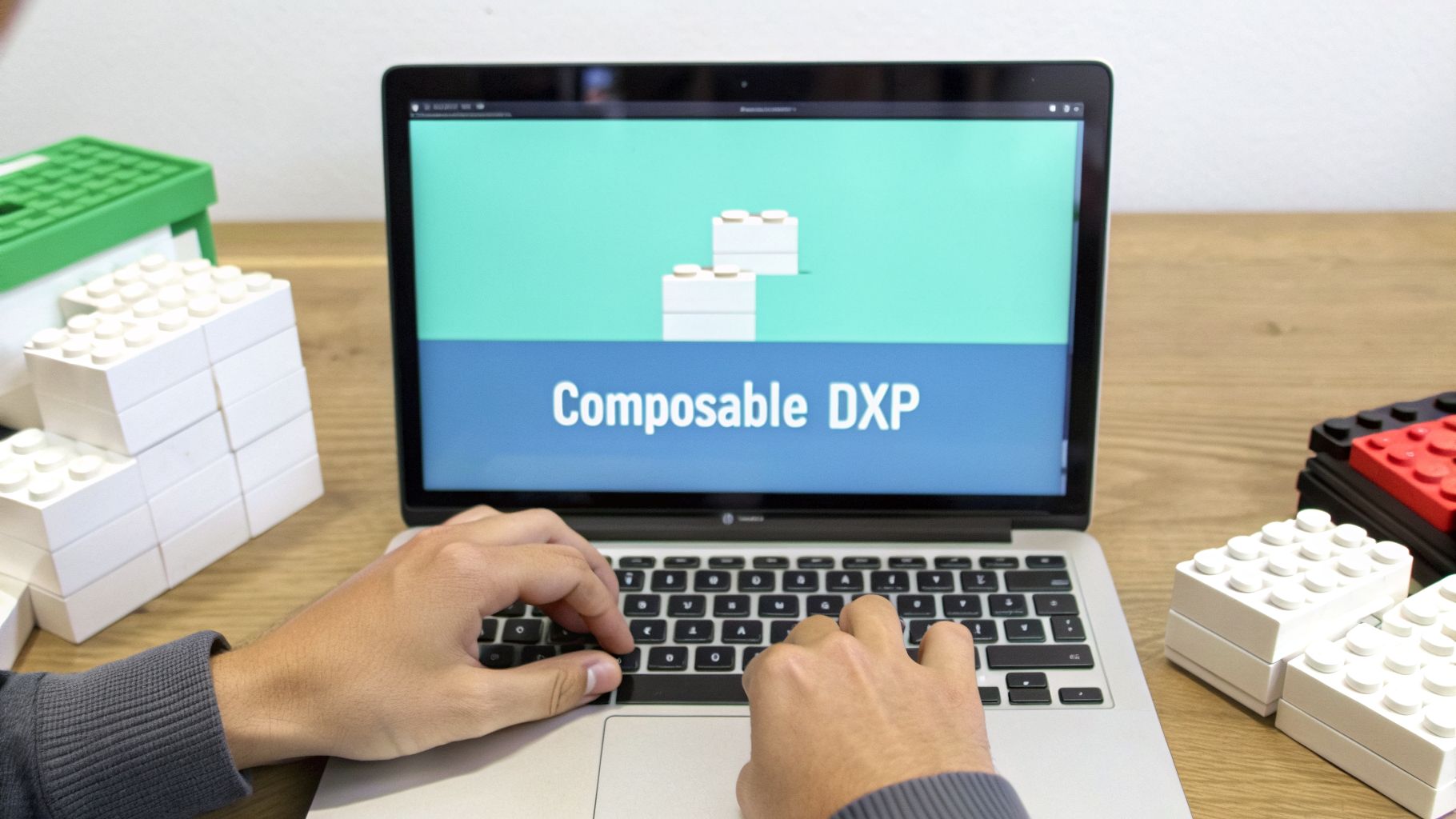
This modular approach, known as composable architecture, is what gives modern businesses the speed and flexibility to adapt and out-innovate the competition.
Sitecore XM Cloud as the Composable Centerpiece
Leading this shift is Sitecore's answer to the old monolithic problem: Sitecore XM Cloud. This isn't just another CMS. It's a cloud-native, SaaS platform engineered to be the hub of a composable DXP. Its headless architecture is the key, cleanly separating the back-end content hub from the front-end user experience.
This separation is what unlocks true agility. Your marketing team can create and manage content in XM Cloud, while developers are free to build amazing front-end experiences with whatever modern tech they want—whether it's for a website, a mobile app, or even a smart kiosk.
By breaking free from the all-in-one suite, businesses are no longer held hostage by a single vendor's roadmap. Instead, they can assemble a best-of-breed technology stack perfectly suited to their unique needs, creating a true competitive advantage.
This freedom allows businesses to pivot fast, launching new digital products and campaigns in weeks, not months. To successfully connect these diverse systems, a solid grasp of concepts like platform integration is non-negotiable. You can learn more by checking out our deep dive into future-proofing with composable DXP architecture.
The Power of an API-First Approach
So, how do all these separate "Lego blocks" talk to each other? The magic is in the APIs (Application Programming Interfaces). A composable DXP built around Sitecore XM Cloud is API-first by design. This means every function and piece of content is exposed through an API, making it simple to plug in other best-in-class services.
Want to add a powerful AI-driven search engine? Plug it in with an API. Need to connect a new payment gateway or a specialized analytics tool? Same process. This gives you incredible flexibility and makes scaling your operations far easier.
This architecture translates directly into tangible business results:
- Accelerated Innovation: Launch new features and campaigns without being held back by a rigid, all-in-one platform.
- Reduced Technical Debt: Swap out old components for modern ones without needing a full-platform rip-and-replace, keeping your tech stack lean and effective.
- Enhanced Business Agility: Respond instantly to market changes or customer demands by quickly integrating the right tool for the job.
When you adopt a composable strategy with Sitecore XM Cloud at its core, you aren't just buying new software. You're fundamentally changing how your business operates—empowering teams to build, test, and deploy at a pace that was once unthinkable. This is a critical step in shaping the future of digital commerce.
Integrating SharePoint for a Unified Enterprise Ecosystem
While a top-tier composable DXP and AI-driven personalization are busy perfecting the customer experience, the future of digital commerce is just as dependent on what’s happening behind the curtain. Real digital maturity isn’t just about what your customers see; it’s about making your internal operations just as connected and intelligent. This is where plugging a workhorse like SharePoint into your Sitecore-powered DXP becomes a genuinely smart move.
This isn't just about linking two systems together. It's about building a single, unified ecosystem for your entire business. By closing the gap between your internal knowledge base and your external commerce channels, you create one source of truth that gets everyone on the same page.
Creating a Single Source of Truth
In any large, global company, information silos are a massive drag on speed and consistency. Product specs are in one place, marketing assets are in another, and internal training guides are tucked away somewhere else entirely. This kind of fragmentation breeds inefficiency, creates errors, and leads to a disjointed brand experience.
Integrating SharePoint with your Sitecore DXP breaks down those walls. It elevates SharePoint from a simple file storage closet to a dynamic hub that feeds your entire digital operation.
This connection creates an operational backbone where internal data and assets directly power the customer journey. It ensures every team—from product development to marketing and customer service—is working from the same playbook, guaranteeing total consistency across all touchpoints.
Let's look at a real-world scenario. A product manager updates the technical specifications for a new product line in a SharePoint library. Because of the integration, that one action kicks off an entire workflow automatically.
The new data instantly syncs to your Sitecore e-commerce site, updating the product detail pages. At the same time, the latest marketing assets for that product are pulled from SharePoint into Sitecore Content Hub, making them ready for new campaigns. This clean handoff gets rid of manual data entry and makes sure customers always see the most current, accurate information. You can learn more about how Kogifi enables such powerful connections through our expert SharePoint solutions.
Empowering Teams and Enhancing Governance
A unified ecosystem does more than just keep your data straight; it gives your employees the tools they need to shine. When your customer service team has direct, easy access to the same product information and tech docs as your engineers, they can solve customer problems faster and with more confidence.
That direct line from internal knowledge to frontline support turns a transactional customer experience into an exceptional one. An empowered employee is one of your best tools for building long-term customer loyalty.
On top of that, this integration delivers huge wins for governance and compliance—two areas that are non-negotiable for global brands. Centralizing everything in SharePoint lets you enforce strict version control, manage access permissions, and keep a clear audit trail.
This streamlined governance delivers several key advantages:
- Streamlined Content Workflows: Content flows from creation and internal approval in SharePoint to publication on your Sitecore sites with fewer bottlenecks.
- Enhanced Brand Consistency: With one approved source for all digital assets, you know your brand is being represented consistently across every market and channel.
- Reduced Risk: Centralized control over sensitive information and digital assets dramatically lowers the risk of outdated or wrong content going live.
By linking SharePoint to your Sitecore DXP, you aren't just tweaking a workflow; you're building a smarter, more efficient, and more resilient organization. This holistic approach—connecting operational excellence on the inside with customer delight on the outside—is a cornerstone of winning in the future of digital commerce.
Navigating Payments Privacy and Customer Trust
You can build a brilliant customer experience, but if you fumble at the final hurdle—the transaction—it's all for nothing. In digital commerce, trust is the ultimate currency. Nowhere is this more obvious than in how you handle payments and personal data.
Customers today demand a seamless, one-click checkout. But they're also smarter and more cautious than ever about their digital privacy. This creates a real challenge. You need to integrate embedded finance and digital wallets, but you also have to be completely transparent about data management to comply with regulations like GDPR and CCPA. A modern, composable DXP is your key to navigating this, letting you add preferred payment options with the agility your business needs.
Building Trust Through Transparent Data Management
Customer caution is on the rise. A recent study found that 40% of online shoppers have bailed on a purchase because they were worried about how their personal data would be used. This isn't just a legal checkbox anymore; privacy is now a core part of the customer experience.
This is exactly where a powerful Customer Data Platform (CDP) comes into play. Tools like Sitecore CDP are built to solve this problem, giving enterprises a central hub to not only manage customer data but, more importantly, to handle consent with total transparency.
With Sitecore CDP, you can capture and honor customer consent preferences across every single touchpoint. If a user opts out of certain tracking on your mobile app, that choice is instantly respected on the website and in your email campaigns. This is how you build a real foundation of trust.
When you give customers clear control over their data, you turn a potential friction point into a chance to prove you’re committed to their privacy.
The Competitive Advantage of a Secure Framework
It’s a huge mistake to view data privacy as a burden. A secure, flexible framework for payments and privacy is actually a powerful competitive advantage. When customers feel secure, they come back, they spend more, and they become your best advocates.
A composable architecture is perfect for this. It lets you integrate best-in-class, secure payment gateways and digital wallets without getting locked into a single provider. This flexibility means you can offer the options your customers actually want.
- Digital Wallets: Give customers one-click payments through services like Apple Pay and Google Pay.
- Embedded Finance: Integrate "Buy Now, Pay Later" (BNPL) options right into your checkout flow.
- Secure Traditional Payments: Guarantee PCI compliance for all credit card transactions with trusted payment processors.
By pairing these flexible payment options with a rock-solid privacy framework powered by Sitecore CDP, you create an environment where customers feel both respected and secure. This approach is essential for building long-term loyalty. For any business ready to master this balance, learning how to personalize without compromising anonymity is the critical next step.
Ultimately, the future of digital commerce belongs to brands that prove they are worthy of their customers' trust. A secure, transparent, and flexible approach isn't just good practice—it's just good business.
Your Roadmap to Future-Ready Digital Commerce
Jumping into the future of digital commerce isn’t just about a tech shopping spree; it's about having a smart plan. We've talked about AI-driven personalization, composable architecture, and connected ecosystems. Now, let's tie it all together into a practical roadmap for enterprise leaders ready to make a move.
The first step is a hard, honest look at where you are today. Over the years, a patchwork approach to tech has left many companies with a tangled mess of systems that actually slows down growth. A real transformation starts with an audit to pinpoint the bottlenecks and find the hidden opportunities in your current tech stack.
This is exactly where a composable DXP, with solutions like Sitecore, gives you a clear upper hand. Instead of a high-stakes, all-or-nothing replatforming project, you can take it one step at a time. Start with a single business unit or a specific customer journey. This lets you prove the value quickly, build up your team's skills, and get the internal buy-in you need for a bigger rollout.
Selecting the Right Technology and Partner
Choosing the right platform is everything. When you're evaluating options, your top priorities should be flexibility, built-in intelligence, and how well it plays with the tools you have now—and the ones you'll need tomorrow.
- Composability and Headlessness: Does the platform, like Sitecore XM Cloud, let you pick best-of-breed tools and link them up with APIs? This is non-negotiable for staying agile and avoiding getting locked into one vendor.
- Integrated AI Capabilities: Look for a set of tools, such as Sitecore's CDP, Personalize, and Discover, that are built to work together on one unified data foundation. This is how you make sure your personalization is consistent and genuinely smart across every touchpoint.
- Enterprise Integration: Can the DXP talk to your core internal systems like SharePoint? Creating a single source of truth between your internal work and your external customer experiences is crucial for being efficient and accurate.
Just as important is finding an implementation partner who has been there and done that. A good partner doesn't just know the tech; they bring the strategic know-how to guide you through the headaches of change management and digital transformation.
Modern KPIs That Drive Real Value
The metrics that used to signal success are no longer enough. To measure the real return on your investment, you have to look past the surface-level numbers and focus on KPIs that show deep business value.
A future-ready strategy moves beyond simple conversion rates. Success is measured by long-term customer relationships and operational efficiency, proving that a superior customer experience and a smarter business go hand-in-hand.
This visual breaks down the path to building real, lasting customer trust. It's a journey that moves from secure transactions to protecting data and, finally, to earning genuine loyalty.
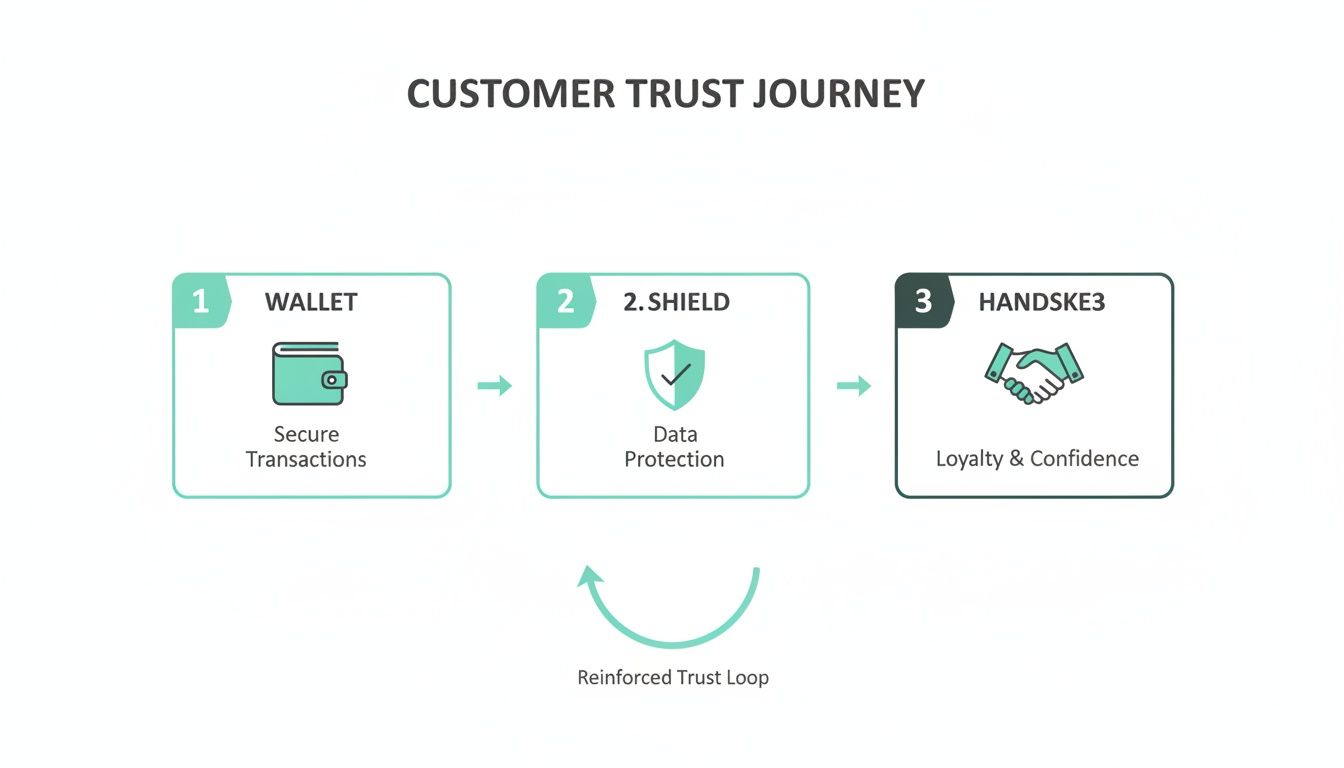
As you can see, trust isn't a one-and-done deal. It’s a step-by-step journey built on providing security and being transparent with your customers.
Here are the key performance indicators you should be tracking now:
- Customer Lifetime Value (CLV): Are your personalization efforts actually creating loyal customers who come back again and again?
- Time-to-Market: How fast can your team launch new campaigns, features, or digital experiences?
- Content Efficiency: Are you cutting down on redundant work and getting more out of your digital assets through smart integrations like SharePoint?
The path forward is clear. By embracing a proactive digital strategy built on intelligence, agility, and a real commitment to customer trust, your business can do more than just keep up—it can lead the way in the exciting future of digital commerce.
Your Questions Answered About the Future of Digital Commerce
As enterprise leaders map out their digital strategy, a few key questions always come up. Here are some direct answers focused on the practical side of implementing AI-driven intelligence and composable architecture.
What Is the First Step My Enterprise Should Take Toward a Composable Architecture?
The first move isn't about technology at all. It starts with a hard look at your current tech stack and business goals. You need to pinpoint exactly where your legacy system is causing the most friction and which parts of the business are ready to embrace a new way of working.
A strategic partner can guide you through this discovery phase, helping you map out a migration plan that makes sense. A smart, common approach is to start small—focus on a single business unit or one specific customer journey using a solution like Sitecore XM Cloud. This lets you show a quick ROI, keeps risk low, and builds the momentum you need to get the rest of the organization on board.
How Does Sitecore AI Differ From Other AI Personalization Tools?
The biggest difference is its integrated ecosystem. Plenty of standalone tools can personalize a single channel, but Sitecore's suite—including Personalize, CDP, and Discover—all work from a single, unified data foundation. This is a game-changer.
It means the AI isn't just tweaking a webpage; it's orchestrating a consistent, smart journey across every single touchpoint. It uses both historical and real-time behavioral data from the Sitecore CDP to get ahead of customer intent, not just react to it.
This integrated intelligence delivers a true one-to-one experience that is incredibly difficult to piece together with a collection of disconnected tools. It moves beyond simple reactions to proactively shape each customer's unique path.
Is SharePoint Still Relevant in a Modern Composable DXP?
Absolutely. In a modern DXP, SharePoint’s role just gets better. It evolves from a simple document library into a crucial content and collaboration backbone for the entire enterprise. Think of it as your operational hub.
When you integrate SharePoint correctly with Sitecore, it becomes the secure, central spot for managing internal product documentation, digital assets, and the workflows that feed your customer-facing channels. This connection ensures brand consistency, streamlines content operations, and gives your internal teams a single source of truth—directly linking your internal efficiency to your external digital performance.
Can I Adopt AI Personalization Without a Full Composable Migration?
Yes, and that’s one of the great things about a modern, composable setup. You can start seeing the benefits from Sitecore's AI tools, like Sitecore Personalize and Sitecore CDP, by plugging them into the digital platform you already have.
These tools are built to be composable, so they can connect to your current systems and start collecting data and delivering personalized experiences right away. This allows you to generate real, measurable value and build a strong business case for a larger architectural shift over time. You get to prove the impact of AI before you commit to a full replatforming project—a phased strategy that’s key to managing risk and getting the best ROI.
Ready to build an intelligent, agile, and future-ready digital ecosystem? Kogifi combines deep expertise in Sitecore and SharePoint with strategic implementation to drive real business results. Discover how we can transform your digital presence at https://www.kogifi.com.