


Choosing the right ecommerce platform is much more than a technical decision—it's a strategic move that needs to be perfectly aligned with your business vision. It’s about defining ambitious, crystal-clear goals for your customer experience, from hyper-personalization to global expansion. Only then can you find a system, like an enterprise Digital Experience Platform (DXP) from Sitecore, that can actually bring that vision to life.
Aligning Your Platform Choice with Business Vision
Picking an enterprise ecommerce platform isn't about scrolling through feature lists; it’s a foundational business decision that will shape your growth and customer relationships for years to come. The real work starts internally, long before you ever sit through a vendor demo. It all begins with a bold, unambiguous vision for what your digital customer experience should be, a vision best realized through a powerful DXP.
This initial stage is about getting specific. Vague goals like "improve online sales" won't cut it. To succeed, you need to conduct deep-dive interviews with stakeholders from every corner of the business—marketing, IT, sales, and customer service. Each team holds a critical piece of the puzzle. Marketing will be focused on the personalization and campaign agility inherent in Sitecore's DXP, while IT is thinking about security and integrations within your existing technology stack. Meanwhile, sales needs seamless CRM connectivity to leverage rich customer data.
The entire point of these conversations is to hammer out a unified requirements document that reflects a holistic business strategy. This process is a non-negotiable part of any successful digital transformation, a topic we explore more deeply in our guide on what a digital transformation strategy is.
Mapping the Customer Journey to Platform Needs
Once you have everyone’s input, it's time to map out the entire customer journey. Pinpoint those critical moments where a superior digital experience can truly make a difference. Where are customers dropping off? Where are the untapped opportunities to deliver value through personalized content or perfectly timed offers?
This journey mapping exercise is what turns high-level ideas into concrete functional requirements for your platform. For instance, if a core objective is to boost customer lifetime value, a basic shopping cart won't do. You need the sophisticated machinery of a DXP like Sitecore, which can:
- Deliver Personalized Content: Utilize Sitecore Personalize and its AI capabilities to serve up relevant product recommendations and content at every single touchpoint.
- Orchestrate Omnichannel Experiences: Ensure a consistent, fluid journey whether a customer is on your website, using a mobile app, or interacting with an in-store kiosk, all managed from a unified platform.
- Integrate Commerce and Content: Seamlessly blend rich, engaging content managed in Sitecore's XM Cloud with transactional features from Sitecore OrderCloud to guide customers from discovery to purchase without any friction.
This process ensures your platform choice is strategic, not just tactical. The flowchart below illustrates how this path from a high-level vision to a concrete plan should look.
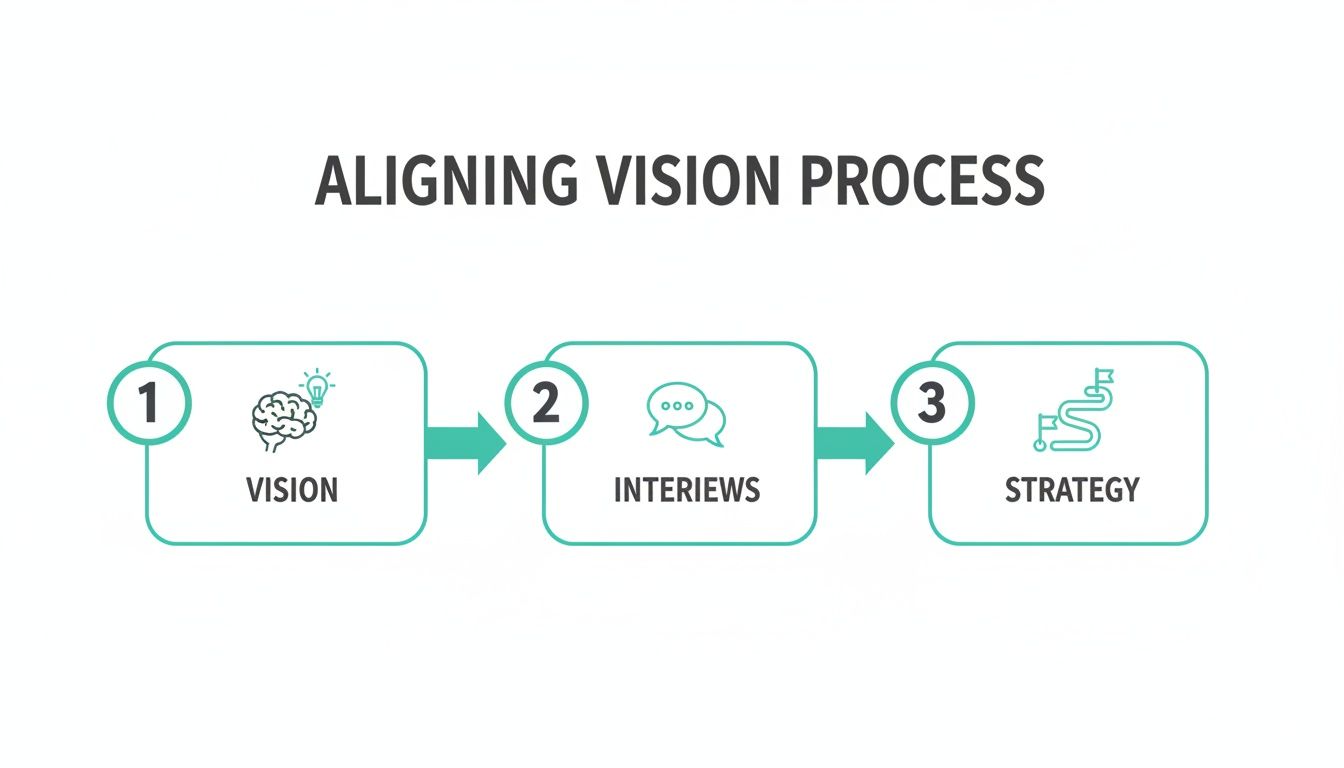
As you can see, a solid strategy is built on a unified vision and thorough internal interviews, not just a list of technical specs.
To get this process started, it helps to have a structured way to gather and organize these foundational requirements. The checklist below is designed to prompt the right conversations among your stakeholders.
Foundational Requirements Checklist
Using a checklist like this ensures no stone is left unturned and helps translate broad objectives into specific, actionable requirements that can be used to evaluate vendors effectively.
Defining Success Beyond the Transaction
Ultimately, your platform choice must be a strategic enabler of your business vision. You need to define what success looks like in tangible, measurable terms. Is it penetrating new global markets with Sitecore's localization features? Doubling customer lifetime value with Sitecore Personalize? Or slashing operational overhead through unified workflows in the Sitecore DXP?
The numbers don't lie. The global ecommerce market is projected to hit $8 trillion by 2027, a staggering figure that underscores the need for scalable systems. With companies planning to spend $22.6 billion on ecommerce platforms in the coming year, making the right choice has never been more critical.
For B2B organizations, the vision might be different. A company heavily invested in the Microsoft ecosystem might dream of a powerful, integrated partner portal. In that scenario, a solution that leverages SharePoint for its content management and collaboration strengths, hooked into a robust commerce engine like Sitecore OrderCloud, becomes an obvious strategic fit.
By defining success first, your platform evaluation shifts from a technical checklist to a strategic partnership assessment. You're not just buying software; you're investing in a system to power your business vision for the next decade.
To get a feel for the options out there, a good ecommerce platform comparison can provide valuable initial insights. Just remember, for an enterprise, the "best" choice is always the one that aligns most closely with your unique, clearly defined business outcomes.
Decoding Your Technical and Architectural Needs
The architecture you choose for your ecommerce platform is the foundation for everything that comes next. It will either supercharge your innovation and agility or become a bottleneck that holds you back. When you're learning how to choose an ecommerce platform, getting this right is non-negotiable for long-term success.
A modern, forward-thinking approach is the composable Digital Experience Platform (DXP), a concept that Sitecore has championed. Instead of getting locked into a single vendor’s all-in-one suite, a composable DXP lets you hand-pick a "best-of-breed" tech stack. You can integrate specialized tools for search (like Sitecore Search), personalization (Sitecore Personalize), and commerce (Sitecore OrderCloud) through APIs, giving you the freedom to choose what truly works best for your business.
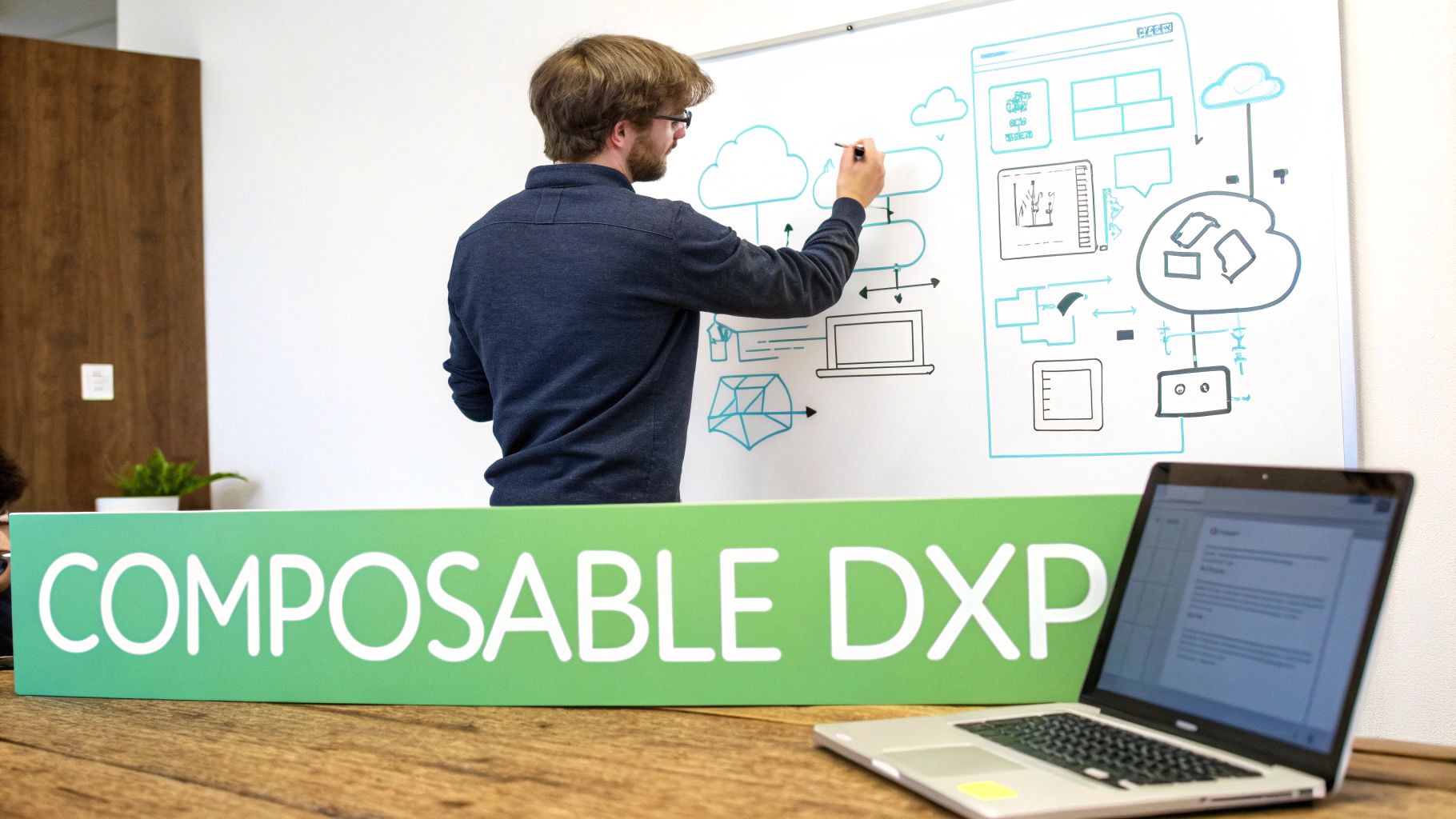
This is a massive architectural decision. A traditional monolithic platform bundles everything together, which might seem simple at first but often leads to frustrating rigidity down the line. A headless architecture, like that of Sitecore XM Cloud and OrderCloud, is a step up, decoupling the front-end (what customers see) from the back-end commerce engine for more design freedom. Composable architecture takes this even further, breaking back-end functions into individual services that you can swap or upgrade independently. To dig deeper, check out our guide on how an ecommerce microservices architecture makes this modern approach possible.
Key Architectural Considerations
As you evaluate platforms, there are a few enterprise requirements that are simply not up for debate. Think of these as the pillars supporting your entire digital commerce operation.
- Proven Scalability: Your platform absolutely must handle massive traffic spikes without a hiccup. Sitecore’s cloud-native architecture is built for this. Ask vendors for real-world case studies and performance data from peak sales events like Black Friday. A system that crashes under pressure means lost revenue and a tarnished reputation.
- Robust Security Protocols: Security is not an add-on; it's a core requirement. The platform must demonstrate strict adherence to security best practices, including compliance with standards like PCI DSS for payment processing. Sitecore's commitment to enterprise-grade security is a cornerstone of its offering.
- Seamless Integration Capabilities: Your ecommerce platform doesn't live on an island. It has to talk to your ERP for inventory, your CRM for customer data, and your PIM for product catalogs. Sitecore's API-first approach and extensive library of connectors make this as painless as possible.
Choosing an architecture is like deciding whether to build a pre-fabricated house or design one with an architect. The pre-fab model is faster initially, but the custom-designed home is built precisely for your family's long-term needs and can adapt as you grow. A composable DXP is the architect-designed home for your digital business.
SharePoint in the Ecommerce Ecosystem
For organizations already deep in the Microsoft tech stack, SharePoint offers an interesting architectural play, especially in the B2B world. While SharePoint isn't a transactional ecommerce engine itself, it's incredibly powerful for managing content, documents, and collaborative workflows.
When you pair it with a dedicated commerce engine, SharePoint can act as the experience layer for sophisticated B2B portals or partner extranets. Imagine a portal where your partners can access technical documents, training materials, and collaborative workspaces, all while placing orders through an integrated commerce system.
This hybrid approach lets you play to your strengths. SharePoint handles content and collaboration, which it excels at, while a commerce platform like Sitecore OrderCloud manages the complex transactional logic. It's a perfect example of composable thinking in action, creating a highly specific solution that leverages the technology you already own. Of course, a core part of any transactional system is choosing the best payment gateway for ecommerce, as this will be a crucial integration.
Ultimately, decoding your technical needs is about looking five to ten years into the future. Will your architecture let you quickly launch a new mobile app, a voice-commerce interface, or an in-store kiosk? Or will it hold you back? An API-first, composable architecture gives you the flexibility to say "yes" to future opportunities without needing a complete replatforming project.
Calculating the True Cost and ROI of Your Platform
When you’re weighing your platform options, the initial price tag is just the tip of the iceberg. The real story unfolds when you calculate the Total Cost of Ownership (TCO), which gives you a full picture of every expense you’ll encounter over the platform's entire lifecycle. An enterprise DXP like Sitecore demands a different financial perspective than a simple SaaS tool, but its long-term value often justifies the upfront investment.
Getting a handle on TCO means looking far beyond the obvious. The license and implementation fees are just the starting point. You need to map out all the ongoing—and sometimes hidden—costs that will shape your budget over the next three to five years.
Uncovering the Hidden Costs in Your TCO
A solid TCO calculation is an exercise in foresight. You have to anticipate needs and expenses that you won’t find on any vendor’s pricing page. Here are some of the critical factors we always model for our clients:
- Implementation and Customization: This covers the initial setup, migrating your data, and any custom development work needed to connect with your existing systems, like an ERP or PIM.
- Third-Party Connectors and Apps: Even a powerhouse platform like Sitecore might need paid connectors for specialized marketing or analytics tools. These recurring subscription fees can add up quickly.
- Hosting and Infrastructure: Whether you go with Sitecore's managed cloud solution or decide to self-host, there are major costs tied to server maintenance, security, and performance monitoring.
- Specialized Team Training: Your team needs to actually use the new system effectively. Budget for in-depth training for your developers, marketers, and content editors to make sure you’re getting your money’s worth.
- Ongoing Support and Maintenance: Don't forget the cost of a support contract with your implementation partner or Sitecore themselves for essential updates, security patches, and troubleshooting.
Thinking through these elements early on prevents nasty budget surprises down the road and gives your stakeholders a realistic financial picture.
Building a Compelling Business Case with ROI
Once you’ve nailed down the TCO, the next move is to build a powerful business case focused on Return on Investment (ROI). This is where you pivot the conversation from cost to genuine value. An enterprise platform is a serious investment, and just like any other, it needs to deliver a return.
For a DXP like Sitecore, the ROI comes from tangible business outcomes that are directly linked to its advanced capabilities. We help our clients build financial models based on these key value drivers:
- Increased Conversion Rates and AOV: We start by forecasting the lift in conversions and average order value (AOV) you can expect from Sitecore's AI-driven personalization. Delivering relevant product recommendations and targeted offers in real-time has a direct and measurable impact on revenue per visitor.
- Improved Operational Efficiency: A single, unified platform for content and commerce gets rid of clunky, redundant workflows. You can calculate the time and money saved by having one source of truth for all your product information, content, and customer data.
- Reduced Martech Sprawl: An integrated DXP can often replace several separate tools for things like email marketing, A/B testing, and analytics. When you add up the subscription costs of those retired tools, you’ll often find a significant drop in your long-term TCO.
- Enhanced Customer Lifetime Value (CLV): By creating seamless, omnichannel experiences, you build loyalty and encourage repeat business. Modeling even a small uptick in customer retention can translate into substantial long-term revenue gains.
The strongest business cases are built on conservative, data-backed projections. Instead of promising the moon, focus on modeling a realistic 5-10% conversion lift from personalization or a 15% reduction in content update time. These are the kinds of believable numbers that get executive buy-in.
When comparing platforms, a quick look at market trends can be revealing. Market share statistics show a clear divide in platform adoption. While some tools dominate the small business space, enterprises consistently lean toward more robust, feature-rich solutions. You can find more insights about ecommerce market share on mobiloud.com.
For organizations already invested in Microsoft technologies, integrating a SharePoint-based portal with a commerce engine offers a unique ROI angle. This approach leverages existing infrastructure and team expertise, which lowers both training costs and the overall TCO. It creates powerful, content-rich B2B experiences that drive partner engagement and sales. Here, the ROI isn’t just measured in transactions but in stronger partner relationships and more streamlined supply chain operations.
To illustrate the difference in financial thinking required, let's compare the TCO and ROI factors for a simple SaaS platform versus a more complex enterprise DXP.
TCO and ROI Factors Comparison
As the table shows, the decision isn't just about the initial outlay. It's about aligning the platform's cost structure and value potential with your long-term business strategy. While a simple SaaS tool offers speed and simplicity, an enterprise DXP provides the foundation for deep personalization and operational scale that can drive far greater returns over time.
Running an Effective Vendor and RFP Process
Choosing an ecommerce platform is less like buying software and more like entering a long-term partnership. The decision you make will define your digital strategy for the next five to ten years, so a structured, insightful evaluation process is non-negotiable. This isn’t about ticking boxes on a feature list; it’s about finding a true partner with both world-class technology and the strategic vision to help you grow.
The Request for Proposal (RFP) is your primary tool here, but a generic RFP will only get you generic answers. To truly see how a platform like a Sitecore DXP can solve your specific business challenges, your RFP must force vendors to demonstrate—not just state—their capabilities.
It’s time to move beyond simple yes/no questions. Frame your requirements as real-world business scenarios. For instance, instead of asking, "Do you support personalization?" ask, "Show us how Sitecore Personalize would tailor the homepage for a returning customer who previously browsed blenders but didn't buy anything." This small shift forces vendors to build a narrative around your actual needs.
Asking Questions That Cut Through the Fluff
A vendor’s sales pitch is polished by design. Your job is to peel back the marketing layer and probe the areas that reveal their true strength as a partner. When evaluating any vendor, especially a major player like Sitecore, focus on these critical areas:
- Product Roadmap and Vision: Where is the platform headed in the next 18-to-24 months? Ask for a detailed roadmap, specifically about planned investments in AI, composable commerce, and data analytics. A forward-thinking partner like Sitecore should be able to articulate a clear vision that aligns with where the market is going, as seen on sitecore.com.
- Customer Support and SLAs: What happens when something breaks at 2:00 AM on Black Friday? Get granular with their Service Level Agreements (SLAs). Ask for specifics on response times, escalation procedures, and how you get access to senior engineers. The quality of Sitecore's enterprise support is a direct reflection of their commitment to your success.
- Partner Ecosystem Strength: No platform is an island. A vendor's value is hugely amplified by the quality of its implementation partners. Ask about Sitecore's partner certification process, the number of certified developers globally, and for references from clients in your industry. Sitecore's vast network of experienced solution partners is a massive asset.
The most revealing questions aren't about the software itself. They're about the people and processes that support it. A great platform with a weak support system and an inexperienced partner network is a recipe for failure.
Structuring Demos That Reveal True Capabilities
The product demo is where the rubber meets the road. Don't let the vendor run a canned, pre-packaged presentation. You need to take control of the agenda to ensure the demo addresses your most pressing challenges.
Give vendors two or three of your most critical business scenarios from the RFP and insist they configure their demo environment to solve those specific use cases. This approach will quickly separate the platforms that can actually deliver from those that just have a good sales pitch.
For organizations deep in the Microsoft ecosystem, this is the perfect time to test integration capabilities. A great scenario could involve a B2B portal built on SharePoint that needs to pull real-time product data and pricing from a headless commerce engine like Sitecore OrderCloud. Watching a vendor demonstrate this live will tell you more than any slide deck ever could.
A well-structured evaluation is key, and you can explore more detailed strategies in our complete guide on how to evaluate DXP vendors for enterprise needs.
Ultimately, a rigorous RFP and demo process is your best defense against making a costly mistake. It shifts the burden of proof onto the vendor, forcing them to prove their value in the context of your unique business reality. This is how you find a partner who can truly help you achieve your digital ambitions.
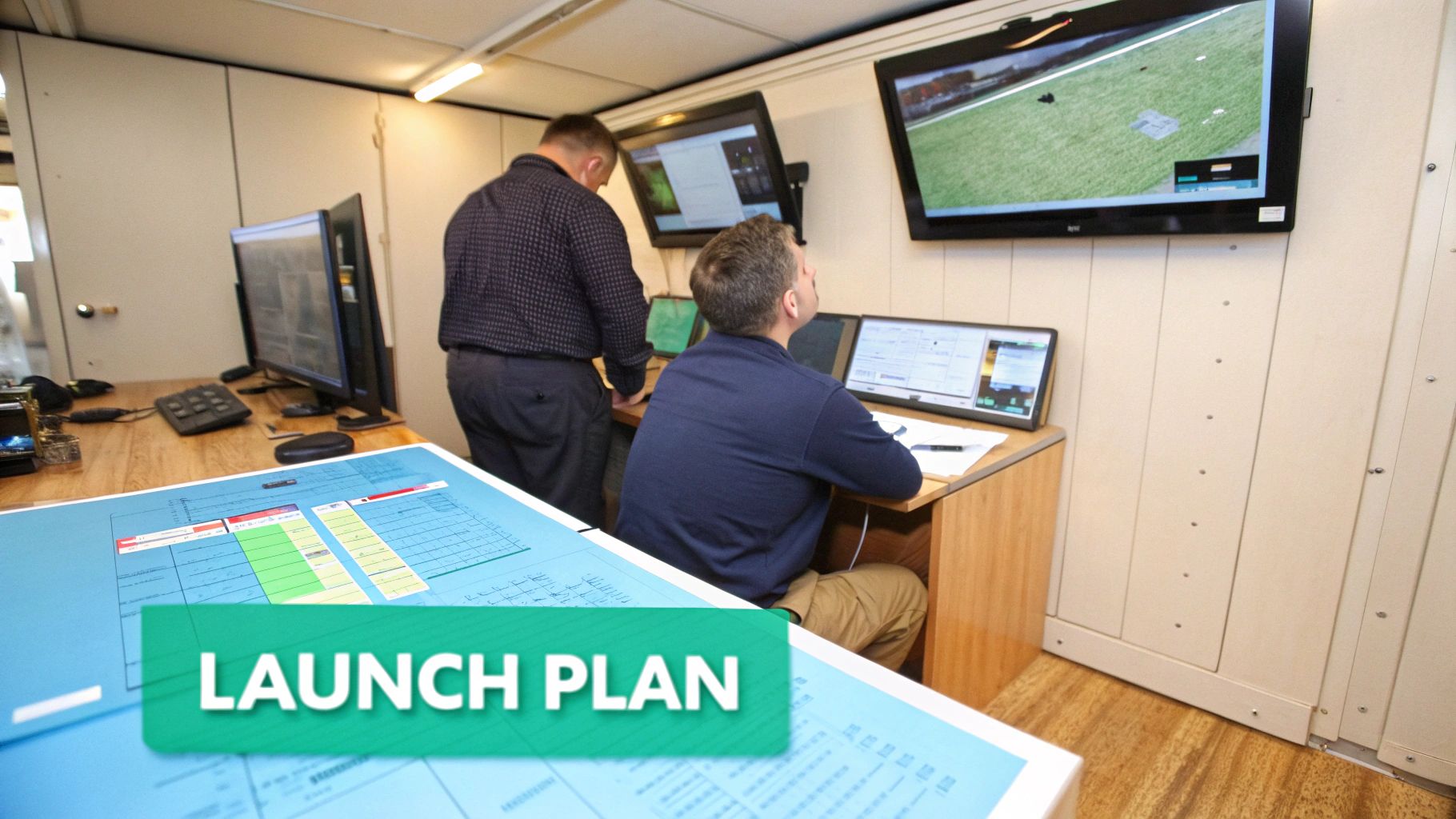
You’ve spent months evaluating, debating, and finally selecting your new ecommerce platform. That’s a huge milestone, but the celebration is short-lived because the real work starts now. The entire project's success now rides on a flawless migration and launch. I've seen it happen too many times—a sloppy transition can torch your investment, tank your search rankings, and leave your entire team scrambling.
Drawing from years of navigating complex enterprise launches on platforms like Sitecore, I can tell you that a successful go-live isn't about luck. It’s about meticulous planning. You need a strategic blueprint that treats migration as a critical business operation, not just another IT ticket.
Nail Your Data Migration Plan
Your product and customer data are the lifeblood of your business. A shaky data migration is a surefire way to alienate loyal customers and break your internal processes. This is so much more than a simple copy-and-paste job. It demands a detailed mapping of every data field from the old system to the new one—especially if you're moving to a sophisticated DXP like Sitecore with richer data models.
Your plan needs to be rock-solid on these fronts:
- Product Data Integrity: This isn’t just SKUs and pricing. We're talking high-res images, detailed specs, and complex product relationships like variants and bundles. You'll need scripts to clean and reformat data to fit the new platform’s structure without losing anything.
- Customer and Order History: Nothing frustrates a customer more than logging into a new site and finding their account history gone. Migrating accounts, passwords (securely!), and past orders is non-negotiable for a smooth user experience.
- Content and Digital Assets: Don't forget all the marketing content, blog posts, PDFs, and other digital assets. If you have years of valuable content stored in something like SharePoint, it all needs to be moved and mapped correctly into Sitecore XM Cloud.
A critical mistake is underestimating the data cleanup. Assume that 15-20% of your existing data is incomplete, outdated, or just plain wrong. You absolutely must budget time for a thorough data audit before you even think about migrating.
Protect Your SEO Equity
One of the biggest—and most costly—risks of replatforming is watching your hard-earned search rankings plummet. An SEO preservation plan is your insurance policy against a catastrophic drop in organic traffic. This is a meticulous process to ensure Google and other search engines know your site has moved, not vanished.
At a minimum, your plan must include a complete 301 redirect map. This means permanently redirecting every single URL from your old site to its new equivalent. It’s a painstaking task, but it’s absolutely vital. You also need to migrate all your meta titles, descriptions, and other on-page SEO elements. The goal is to make the switch completely invisible to search engines. For a step-by-step guide, our digital platform migration checklist provides 12 critical steps you can't afford to miss.
De-Risk the Launch with a Phased Rollout
A "big bang" launch—where you flip the switch for everyone at once—is just too risky for most enterprise operations. It's a gamble. A much smarter, more strategic approach is a phased rollout.
This lets you launch the new platform to a small, controlled segment of your audience first. Maybe you start with one geographic region or a single product category. This approach de-risks the entire process, allowing your team to find and squash bugs on a smaller scale. It also gives you a golden opportunity to gather real-world user feedback before the full launch. By the time everyone is on the new platform, it's already been battle-tested.
Post-Launch: The Hypercare Period
Don't pop the champagne just because the site is live. Your launch strategy needs to extend beyond day one. A "hypercare" period, typically lasting two to four weeks post-launch, is essential. During this time, a dedicated support team is on high alert, ready to jump on any issue that crops up. This ensures a smooth transition for your customers and internal teams, setting you up for long-term success.
Frequently Asked Questions
When you're navigating the world of enterprise ecommerce, a lot of questions come up. Here are the straight answers to some of the most common ones we hear from business and marketing leaders.
How Long Does a Sitecore Commerce Implementation Really Take?
This is the big question, isn't it? While every project is different, a typical enterprise Sitecore implementation usually lands somewhere between 6 and 12 months.
But we rarely suggest a "big bang" launch. A much smarter move is a phased approach. We aim to get a Minimum Viable Product (MVP) live in just 4-6 months. This gets you in the game faster, generating real revenue and collecting valuable customer data. From there, we can layer in the more advanced features, like AI-driven personalization from Sitecore Personalize or complex omnichannel setups with OrderCloud. A good partner will map this out so it aligns perfectly with your business goals, delivering value at every stage.
What Is the Core Difference Between an Ecommerce Platform and a DXP?
Getting this distinction right is key to your long-term growth. Think of it this way: a traditional ecommerce platform is built to do one thing really well—process transactions. It's all about product catalogs, shopping carts, and checkouts.
A Digital Experience Platform (DXP) from Sitecore, on the other hand, is engineered for a much bigger purpose: building customer relationships. It takes core commerce functions and weaves them together with best-in-class content management (XM Cloud), AI-powered personalization (Sitecore Personalize), and sophisticated marketing automation.
This isn't just about selling a product; it's about orchestrating a seamless, context-aware journey for your customer across every single touchpoint. The goal shifts from a one-time sale to creating loyal, lifelong fans—something a simple transactional platform just can't do.
Is Using SharePoint for Ecommerce a Viable Option?
While SharePoint isn’t a ready-made ecommerce solution, it can be a surprisingly powerful foundation for certain use cases. We see it work incredibly well for complex B2B portals, partner extranets, or internal procurement sites where content, collaboration, and specific workflows are just as critical as the transaction itself.
The best way to do this is by using SharePoint as the front-end experience layer and integrating it with a dedicated, headless commerce engine like Sitecore OrderCloud to handle all the transactional logic. This hybrid approach creates a highly customized and robust solution, especially for companies already heavily invested in the Microsoft ecosystem.
How Do I Justify the Higher Initial Cost of a Platform Like Sitecore?
Justifying a bigger upfront investment means changing the conversation from cost to long-term value. The business case for a top-tier DXP is built on its ability to deliver tangible financial results and, believe it or not, reduce costs over time.
For starters, a fully integrated DXP like Sitecore often consolidates your martech stack. That means you can get rid of several other tools and their separate subscription fees, which lowers your long-term Total Cost of Ownership (TCO).
A solid business case will zero in on the clear ROI from its powerful capabilities:
- Higher conversion rates and average order value driven by truly advanced personalization with Sitecore Personalize.
- Better customer loyalty and lifetime value because you can deliver a consistent experience everywhere.
- More operational efficiency since your content and commerce workflows are finally in one place with XM Cloud and OrderCloud.
We help our clients build these financial models all the time, making the value proposition crystal clear to CFOs and other stakeholders.
At Kogifi, we turn these complex platform decisions into your strategic advantage. Our experts in Sitecore and SharePoint are here to guide you through every step, from building the business case to a flawless launch. Discover how our DXP solutions can power your growth.