


The surprising part of the automotive industry trends 2025 story isn't that vehicles are becoming more digital. It's that automotive companies are growing while demand, adoption, and operational readiness remain uneven. Worldwide vehicle production rose from 92.7 million units in 2024 to 96.4 million in 2025, while sales increased from 95.3 million to 99.8 million, according to OICA's 2025 automotive market analysis. Yet more than 61% of global production was concentrated in Asia-Pacific, which means a global OEM can't plan customer experience, inventory, dealer communication, and content operations as if every market is moving at the same pace.
The practical search intent behind this topic is broader than a list of vehicle technologies. Enterprise teams want to know which trends affect conversion, service quality, dealer execution, content governance, and platform architecture, and which investments can move from pilot to repeatable capability. The strongest approach connects AI, digital commerce, dealer operations, and service content instead of funding them as disconnected technology projects.
The nine trends below treat the enterprise experience as one system. Sitecore AI, XM Cloud, Content Hub, Next.js, and SharePoint Online each have a role, with Sitecore expertise leading and SharePoint applied where it solves operational problems.
Better data and governed content are prerequisites for useful AI.
That principle also applies to using AI marketing with Veo3 AI. Automotive organizations should pursue automation, but only after deciding which data, content, approvals, and human owners make the output trustworthy.
Table of Contents
1. AI-Powered Predictive Personalization for Automotive Configuration and Pricing
A vehicle configurator has to answer more than “Which model did this visitor open?” It needs to help a buyer move from curiosity to a credible decision about trim, powertrain, accessories, trade-in, and financing. Sitecore AI can support that experience by using behavioral signals such as entry point, device type, traffic source, viewed content, and configuration choices to shape the next interaction.
The most effective implementation starts with relatively simple signals. A visitor arriving from an EV comparison page might see battery, charging, and range content first. Someone returning to a saved vehicle might receive a clearer path to availability, a dealer appointment, or a finance application. The point isn't to create a different website for every person. It's to remove irrelevant steps while keeping pricing, eligibility, and product information transparent.
A headless architecture can make the experience easier to evolve. XM Cloud with a Next.js front end separates presentation from content and personalization services, allowing teams to improve configurator components without rebuilding the entire DXP. Marketing users should be able to adjust audiences and content rules through visual tools, while IT retains control over data access, performance, and compliance.

What works in practice
- Start with behavioral intent: Use page entry, device, referral context, and configuration activity before adding more sensitive customer data.
- Tie testing to commercial outcomes: Track configurator completion, transaction value, accessory attachment, and dealer handoff quality.
- Protect customer clarity: Excessive personalization can make two visitors see different prices or options without understanding why.
- Keep a human service path: Chat, callback, trade-in assistance, warranty guidance, and financing questions should remain easy to access.
Teams evaluating implementation patterns can also review AI-powered personalization for automotive experiences. Personalization works best when it guides a decision, not when it merely changes headlines.
2. Intelligent Content Routing and Multichannel Campaign Orchestration for Launch Events
Launch campaigns fail when content, market timing, and dealer execution drift apart. Product pages, videos, finance calculators, showroom materials, regional compliance copy, and social assets need shared approvals while markets follow different inventory and launch schedules.
XM Cloud, Content Hub, analytics, and personalization give teams a connected operating model. Content teams can create approved launch modules in Content Hub, while XM Cloud delivers the right combination through web, email, paid media, and dealer channels. A Next.js front end can support fast campaign experiences without separating them from governed content and audience rules. SharePoint Online can provide dealers with controlled access to launch packs, offer terms, sales guidance, and market-specific updates.
Routing should reflect the customer's decision stage. Someone researching an EV platform needs education and proof. A high-intent visitor may need a configuration path, financing information, or a test-drive booking. Dealers need current creative, offer conditions, inventory context, and talking points. The same campaign should not force every audience through one sequence.
Regional planning adds another operational constraint. An ACEA report on the global and EU auto industry described worldwide registrations of 77.6 million units in 2025, up 3.5% year over year, with China up 5.5%, North America up 1%, and Europe up 1.4%. Those differences make a single global cadence risky. Set regional rules for demand, incentives, regulatory wording, local stock, translations, and dealer readiness before activation.
A practical launch sequence is:
- Define stage-based content: Map education, proof, configuration, financing, and appointment assets to customer intent.
- Reuse approved components: Let local teams assemble campaigns from Content Hub rather than copying files into unmanaged folders.
- Control contact frequency: Apply channel and audience caps, then monitor engagement and opt-outs.
- Verify dealer execution: Block or revise campaigns promoting unavailable trims or expired offers.
AI can select and sequence content. Publication rules, ownership, and approval history must still determine what reaches customers. That separation improves speed without sacrificing accuracy.
3. AI-Enhanced Enterprise Search for Automotive Service and Warranty Documentation
Service teams don't experience content problems as editorial problems. They experience them as delays at the service desk, repeated escalations, incorrect repairs, and frustrated customers. A technician or advisor needs to find the right service manual, technical bulletin, recall instruction, warranty term, or EV procedure using the language they naturally use.
Sitecore search, supported by a governed content model and an appropriate search engine, can make technical knowledge more useful across OEM and dealer environments. Natural-language queries should return relevant documents, related procedures, structured answers, and clear version information. Search analytics can then reveal unresolved queries, duplicate documentation, missing translations, and content that users routinely abandon.
The quality of the result depends on metadata and ownership. A search index filled with obsolete bulletins and duplicate PDFs won't become reliable just because an AI layer has been added. Each document needs an accountable owner, effective dates, market applicability, model and component tags, language status, and an approval history.
For organizations reviewing technical search architecture, Apache Solr search implementation guidance offers a relevant starting point. The technology matters, but the information architecture matters more.
Practical rule: Treat recall, battery safety, and warranty queries as controlled knowledge journeys, not ordinary site searches.
A service search scenario
A service advisor enters a plain-language query about an intermittent charging issue. The system should identify the applicable vehicle family and region, surface the current diagnostic procedure, distinguish a customer-facing explanation from an internal bulletin, and provide an escalation route if the evidence is incomplete. A customer-facing portal can present a simplified answer, while the dealer view exposes the technical detail and documentation required for the repair.
Search success should be measured through successful query journeys, document use, escalation patterns, and feedback from advisors. Ranking alone isn't the business outcome.
4. Generative AI Customer Service Chatbots and Knowledge Assistants
A customer service chatbot should reduce uncertainty across ownership, not merely answer generic product questions. Customers ask about vehicle availability, finance options, warranty coverage, service appointments, and dashboard warnings. Each answer affects a broader journey, from campaign response and commerce to dealer preparation and post-sale support.
Sitecore AI can generate the response, while XM Cloud and Content Hub provide governed experience content, product information, and approved assets. Next.js can deliver the assistant across customer-facing channels. SharePoint Online can support the operational handoff, giving dealer and service teams access to case context, approved guidance, and follow-up tasks. This connection turns the assistant into an enterprise capability rather than an isolated chat window.
The content repository, metadata, permissions, and escalation policy constrain the answer. The assistant should use approved OEM content, structured product data, inventory systems, service rules, and customer context only where permission exists. It can explain a finance process, identify a suitable vehicle page, prepare a customer for a service visit, or route a complex warranty case to a person. It must not invent an offer, promise a repair outcome, or interpret a safety warning beyond approved guidance. Tell visitors they are interacting with AI and provide a visible route to a human.
Start with bounded conversations:
- Choose high-volume questions: Cover opening hours, appointment preparation, finance process explanations, stock questions, and basic warranty guidance.
- Define escalation conditions: Route safety concerns, disputed claims, unclear eligibility, and low-confidence answers to trained staff.
- Use real integrations: Appointment and inventory systems must remain current. Stale data creates operational errors and damages trust.
- Review transcripts: Combine conversation outcomes, customer feedback, and unresolved questions to improve prompts, workflows, and the knowledge base.
Service quality determines whether the assistant creates value. ACSI's 2025 automobile study reported overall driver satisfaction at 79 out of 100, mobile app quality at 83, and reliability at 82. It also found that 12% of new-vehicle repairs weren't completed correctly on the first visit, and only 50% of those customers intended to return to the dealership. A chatbot cannot correct poor service delivery, but it can make information, preparation, and escalation more consistent.

5. SharePoint Dealer Portals and Sales Intelligence Hubs
SharePoint Online should support dealer operations while Sitecore leads customer-facing experience delivery. The two platforms serve connected parts of the same journey: Sitecore manages the public brand and commerce experience, while SharePoint gives regional teams and dealers the information needed to execute campaigns, sales, and service consistently.
A useful dealer portal brings approved promotional assets, inventory feeds, sales guidance, financing documents, training resources, calendars, and performance information into one working environment. SPFx components can tailor dashboards to different roles, and Power BI can present relevant sales indicators to regional managers and dealer users. Teams and Outlook integration can keep announcements, approvals, and follow-up close to the daily workflow.
Dealers need task-oriented access, not a corporate archive. Put inventory, campaign actions, current offers, and training updates ahead of general news. Give the home page a clear purpose, make search prominent, and use role-based navigation. Each offer should show its applicable markets, models, validity, and required disclaimers. Inventory records need timestamps and named ownership. Mark content clearly as approved for use or reference only.
Mobile access also affects adoption. Dealer staff may need information away from a desk, so summaries and drill-downs should remain usable on smaller screens. Pilot the portal with dealers from different markets and operating models before expanding it across the network. This exposes differences in processes, permissions, and content needs early.
Microsoft's SharePoint Copilot overview describes tools for flagging outdated pages, fixing broken links, suggesting improvements, triggering actions through natural-language prompts, and supporting workflow automation. These features can reduce maintenance effort, but publishing rules and accountable content owners still matter. AI may identify a page that appears outdated. A business owner must confirm whether its offer, legal wording, or inventory reference is actually obsolete.
Use Teams, Outlook, Power BI, and Power Platform only where they reduce duplicate entry or shorten a dealer task. A practical reference for this operating model is SharePoint intranet development for dealer and enterprise portals. SharePoint should not imitate a public commerce site. Its job is to give the people delivering the customer promise reliable operational information.
6. AI-Driven Demand Forecasting and Inventory Optimization
Customer experience data can improve decisions far beyond the website. Saved vehicles, configuration activity, finance interest, content engagement, regional incentives, and dealer feedback can help planning teams understand demand signals that traditional sales reports may capture too late.
A Sitecore implementation can contribute behavioral data to a broader analytics environment such as Azure or Databricks. Planning teams can combine that information with sales history, promotion calendars, seasonality, economic indicators, production constraints, and dealer-level knowledge. The resulting forecast can support allocation by model, trim, color, powertrain, and region, but it should inform decisions rather than replace them.
The market context makes this especially important. Kroll's 2025 automotive industry insights describes a more uneven EV picture in the United States, where EV sales growth slowed to 10% in 2024 from 40% in 2023, and BEVs and PHEVs represented about 10% of new-car sales. That pattern warns against treating global EV demand as a single, predictable curve.
Use forecasts as decision support
A regional team may see high interest in a particular EV configuration, but that doesn't automatically justify moving inventory there. The team also needs to check charging access, local incentives, dealer capability, delivery timing, price sensitivity, and competing stock. Behavioral data can reveal interest. It can't explain every reason a customer fails to purchase.
Start with one model and one region. Document assumptions, variables, data quality issues, and override decisions. Establish a feedback loop with dealers so local knowledge can challenge a model that looks mathematically confident but operationally wrong.
For teams monitoring broader planning context, early risk signals for trade stock can complement the customer and inventory view. Forecasting earns trust when planners can see why a recommendation changed and when the business can measure whether the recommendation improved availability without creating unwanted stock.
7. Sitecore Content Hub and Digital Asset Management
Asset readiness affects every automotive experience, from a vehicle launch in XM Cloud to dealer sales tools in SharePoint Online. Creative teams manage vehicle photography, video, 3D experiences, configurator media, technical illustrations, localized copy, legal variants, dealer toolkits, and files that must be withdrawn when a model or offer changes.
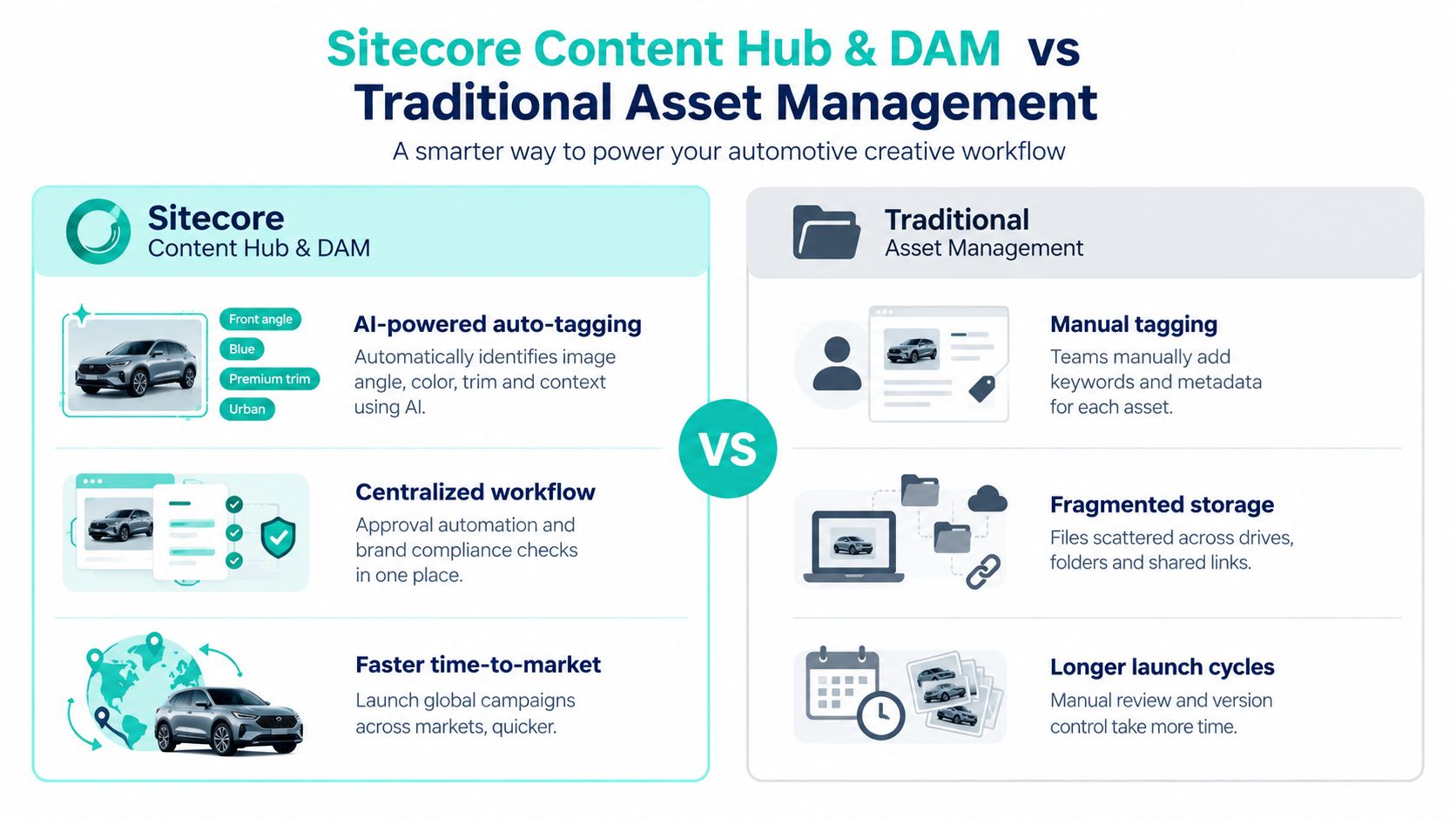
Sitecore Content Hub provides a governed operating environment for that work. It can connect metadata, renditions, permissions, approval workflows, usage rights, and publishing destinations. AI-assisted tagging reduces manual classification, while structured workflows route assets through brand, legal, market, accessibility, and dealer reviews.
The operating question is whether an asset is ready, not whether it exists. A file is publishable only when users can identify what it represents, where it applies, whether it is current, and whether its rights and approvals remain valid. That model supports consistent delivery across Sitecore, Next.js experiences, commerce channels, and dealer operations.
A practical asset model should define:
- Controlled taxonomy: Tag model, market, language, body style, powertrain, campaign, channel, accessibility status, and approval state.
- Modular variants: Separate reusable components from campaign-specific material so teams can adapt content without recreating every file.
- Automated checks: Flag missing metadata, expired rights, broken renditions, and unapproved usage before publication.
- Readiness measures: Track the time from brief to approved, discoverable, and publishable asset.
Sitecore announced SitecoreAI in 2025 as a platform built on XM Cloud that unifies content, data, and personalization. Its Agentic Studio launched with 20 AI-powered agents intended to automate work from campaign planning through content migration, production, and testing, as described in Sitecore's SitecoreAI announcement. Automotive teams still need permissions, review gates, brand rules, and defined failure handling before assigning agents production work.
Teams assessing creative bottlenecks can review workflow improvements with Sitecore Content Hub. Automation delivers value only when the content model matches how the business approves, distributes, and retires assets.
8. Cross-Use-Case Governance and Enterprise Readiness
The same risks appear across personalization, search, chat, portals, forecasting, and asset management. An automotive organization may have strong technology and still fail because teams can't agree on data ownership, content definitions, regional permissions, model explanations, or escalation responsibilities.
The first control is data quality. Customer identity, vehicle availability, trim names, market rules, and service documentation must use consistent definitions. The second is privacy. Behavioral data and customer profiles require explicit access controls, retention decisions, consent handling, and a clear explanation of how personalization affects the experience.
The third is integration discipline. Sitecore XM Cloud, Content Hub, commerce services, CRM, dealer management systems, inventory feeds, finance APIs, analytics platforms, and SharePoint may all participate in one journey. Teams need an integration map, failure states, monitoring, and a fallback experience for when a dependent service is unavailable.
The software-defined vehicle reality
Automotive coverage often treats the software-defined vehicle as an inevitable technology destination. The more useful enterprise question is whether the operating model can make software a reliable, profitable capability at scale. A 2025 SDV survey from Sonatus found that 67% of respondents already deploy OTA updates, but only 23% use OTA for feature upgrades today. The same survey reported that 55% expect broader deployment by 2026 to 2027, while respondents identified cost optimization and ROI at 29%, data privacy at 27%, and legacy systems or mindset at 26% as leading blockers.
Those figures point to a governance problem, not just a feature problem. Product, engineering, legal, service, marketing, dealer operations, and finance must agree on who owns a digital feature after launch, how it is priced, how it is supported, and what happens when the experience fails.
9. Implementation Tips and Common Pitfalls
A focused pilot gives automotive teams better evidence than a broad AI rollout. Choose a measurable business problem, limit the available content and data, and assign one business owner who remains accountable after launch. A service FAQ assistant, consent-based personalization for one audience, technical document search in one market, or a demand forecast for one model can provide useful learning without changing every connected system.
Build in stages, then test the operating model
Start by defining the pilot's audience, region, journey, data source, success measure, and owner. Reuse the resulting patterns rather than treating the pilot as disposable:
- Create reusable building blocks: Apply Sitecore component libraries, Content Hub asset structures, and Next.js patterns across future markets.
- Add human controls: Set confidence thresholds, approval stages, escalation rules, and audit logs for generative AI.
- Design for field use: Make SharePoint dashboards, dealer portals, and service search interfaces usable on mobile devices.
- Monitor model behavior: Review drift, missing data, unexpected recommendations, and regional performance on a defined schedule.
- Set a retraining rhythm: Give forecasting and personalization models a review cadence, with clear triggers for recalibration.
Run the pilot through realistic failure scenarios before expanding it. Check what happens when product data is incomplete, a recommendation lacks confidence, a dealer sees outdated content, or a dependent service becomes unavailable. A fallback experience and an escalation path should be designed before launch, not added after the first incident.
Platform selection does not replace operating discipline. XM Cloud will not correct fragmented product data. A SharePoint portal will not resolve unclear dealer ownership. A chatbot will continue to expose contradictory warranty content unless someone maintains the knowledge base. A forecast will not improve allocation if planners cannot inspect or challenge its assumptions.
Use A/B/n testing when teams need evidence about experience variants, but set guardrails first. Sitecore's February 2025 update describes AI capabilities across its DXP, including CMS, DAM, and CDP, plus variant generation in Sitecore Stream AI and A/B/n testing in XM Cloud that can automatically serve the best-performing variant, as summarized in Sitecore Symposium 2025 takeaways. Optimization should improve an approved, accurate journey rather than reward a misleading short-term interaction.
Automotive Trends 2025, 9-Point Comparison
| Item | Implementation Complexity 🔄 | Resource & Integration Needs ⚡ | Expected Outcomes 📊 | Ideal Use Cases 💡 | Key Advantages ⭐ |
|---|---|---|---|---|---|
| AI-Powered Predictive Personalization for Automotive Configuration & Pricing | High, ML training (3–6 mo), complex DMS + pricing integrations | Significant, Sitecore XM Cloud, Next.js front-end, data engineering, CDN/edge optimization | 📊 25–40% configurator completion lift; higher AOV and accessory/finance attach rates | DTC configurators, EV bundles, dynamic offers during peak traffic | ⭐ Hyper-relevant bundles, dynamic pricing, omnichannel consistency, first‑party data capture |
| Intelligent Content Routing & Multi-Channel Campaign Orchestration for Launch Events | Medium–High, content hub setup, compliance workflows, localization | Moderate–High, Content Hub, channel connectors (email/SMS/push), localization/legal teams | 📊 35–50% lift in event/test-drive bookings; faster content turnaround | Product launches, regional market entries, synchronized EV announcements | ⭐ Single source of truth, automated compliance, send‑time/channel optimization |
| AI-Enhanced Enterprise Search for Automotive Service & Warranty Documentation | Medium, indexing, NLU tuning, multilingual testing | Moderate, content governance, search index infra (50k+ docs), language support | 📊 20–35% fewer support tickets; faster diagnostics and warranty resolution | Technician knowledge bases, recall lookup, service desks | ⭐ Natural‑language search, semantic ranking, quick access to critical docs |
| Generative AI-Powered Customer Service Chatbots & Knowledge Assistants | Medium, LLM integration, grounding, escalation rules | High, LLMs, CRM/DMS/appointment integrations, content grounding & monitoring | 📊 30–50% inbound deflection; improved conversion and booking rates | 24/7 support, peak-season inquiry handling, appointment/finance queries | ⭐ Scalable 24/7 support, instant answers, conversational insights; human handoff |
| SharePoint-Based Dealer Portal & Sales Intelligence Hub for Inventory & Promotion Management | Medium, SPFx development, dashboard design, access control | Moderate, SharePoint Online, Power BI, DMS feeds, governance & training | 📊 Faster dealer decisions; example: fulfillment time cut from 5→1 day; improved execution metrics | Dealer operations, inventory/promotion management, training distribution | ⭐ Centralized data, embedded analytics, Teams/Outlook integration for adoption |
| AI-Driven Demand Forecasting & Inventory Optimization for Supply Chain Planning | High, complex ETL, model explainability, scenario planning | High, Azure/Databricks or similar, integrated DMS/CRM/external data feeds | 📊 Reduced excess inventory (e.g., ~18%), improved availability and fewer markdowns | Production planning, allocation of limited EVs, launch supply decisions | ⭐ Proactive allocation, scenario "what‑if" planning, reduced lost sales |
| Sitecore Content Hub & Digital Asset Management for Automotive Creative Workflow Automation | Low–Medium, DAM setup, migration, approval workflows | Moderate, Content Hub, asset migration, AI tagging pipelines, governance | 📊 Faster time‑to‑market; consistent branding and faster campaign launches | Creative workflows, global campaigns, localized creative distribution | ⭐ AI auto‑tagging, approval automation, brand compliance at scale |
| Cross-Use-Case Key Considerations & Governance | Medium (ongoing), governance, compliance, model explainability | Moderate, legal, data governance, monitoring, exec sponsorship | 📊 Reduced regulatory risk and smoother deployments; more reliable outcomes | All AI/automation pilots and scaling projects | ⭐ Clear data ownership, embedded compliance, explainable models, localization support |
| Implementation Tips, Best Practices & Common Pitfalls | Low, advisory but requires disciplined execution | Low–Moderate, PM, cross‑functional steering, pilot resources | 📊 Faster time‑to‑value; fewer rollout failures when followed | Pilot selection, roadmap planning, change management | ⭐ Start small, prioritize data cleaning, implement confidence thresholds and retraining cadence |
Turn the Trends Into a Governed Roadmap
The nine automotive industry trends 2025 become more useful when an enterprise treats them as a sequence of connected capabilities. The order matters because customer-facing AI depends on content, content depends on governance, and operational automation depends on reliable data exchanges between systems.
Start with the foundation. Define the core entities that appear across the customer and dealer journey, including models, trims, powertrains, markets, offers, dealers, service procedures, assets, and customer consent. Assign ownership for each entity. Decide which system is authoritative, how changes are approved, and what happens when a feed or integration fails.
Next, choose one customer-facing pilot. Sitecore personalization, enterprise search, or a bounded chatbot are practical options because each can be tied to a specific journey. A configurator pilot might focus on helping visitors reach a complete build. A service search pilot might focus on finding current warranty or technical information. A chatbot pilot might focus on appointment preparation and frequently asked questions. Keep the scope narrow enough that teams can review the results and the failure modes.
After that, connect the content supply chain. Content Hub should make approved assets discoverable and reusable. XM Cloud should deliver structured content and experience variations. A Next.js front end can support a fast, composable presentation layer where the architecture requires it. Campaign orchestration should then connect the right content to the right market, channel, journey stage, and dealer action.
SharePoint Online belongs in the operational extension of this roadmap. Use it for dealer communication, sales enablement, inventory workflows, promotion calendars, training, and internal knowledge. Microsoft says Copilot in SharePoint supports creating, organizing, and acting on content with AI, while related Microsoft 365 Copilot updates support natural-language site building for sites, libraries, pages, and lists, as described in Microsoft 365 and Sitecore AI coverage. Those capabilities can reduce administrative friction, but only when the portal has clear structure and ownership.
Measure the roadmap with business and operational KPIs:
- Configurator completion: Track whether personalization helps qualified visitors finish a build.
- Search success: Measure useful results, document engagement, unresolved queries, and escalations.
- Response quality: Review chatbot resolution, human handoffs, customer feedback, and incorrect-answer incidents.
- Dealer adoption: Monitor active use, search behavior, content consumption, and completion of required actions.
- Content turnaround: Measure time from brief to approved, localized, discoverable, and publishable asset.
- Forecast accuracy: Compare recommendations with actual demand and record planner overrides.
- Service execution: Connect digital guidance with repair quality, appointment outcomes, and retention signals.
Kogifi can be considered where an enterprise needs Sitecore XM Cloud or XP, Content Hub, headless Next.js delivery, AI-enabled search and personalization, or SharePoint Online with SPFx and Power Platform integrations. The right partner should fit the organization's governance model, integration architecture, regional requirements, and support expectations.
Prioritize one customer-facing pilot and one operational pilot. Govern both, measure both, and scale only after the teams responsible for the outcomes can run them confidently.
Kogifi designs, builds, and maintains enterprise digital experience platforms on Sitecore and Microsoft 365, including XM Cloud, Content Hub, headless Next.js solutions, AI-driven personalization, search, and SharePoint Online dealer portals. Visit Kogifi to discuss a focused automotive customer-experience and operations roadmap.